
A landing page copy generator is an AI workflow that turns a product URL into a mobile-first advertorial or listicle draft in minutes, aligned to the ad promise and brand context, then tested by editors rather than launched as final copy. The useful benchmark is not how quickly it produces words, but whether the resulting presell page can compete with a 6.6% median landing-page conversion rate across industries, reported from more than 41,000 landing pages, 464 million visits, and 57 million conversions in a HubSpot landing-page benchmark.
That sounds less exciting than “write a page instantly,” but it's the distinction that matters when cold paid traffic is involved. AI can remove the blank page, generate angles, and assemble a coherent narrative. It can't decide whether your ad promise is credible, whether the proof is strong enough, or whether a buyer will trust the page after arriving from TikTok or Meta.
A generator should therefore be treated as a presell system, not a headline vending machine. It turns product information, customer language, positioning, proof, and traffic context into a draft that a marketer can edit, publish, duplicate, and test.
Table of Contents
- What a Landing Page Copy Generator Actually Is
- How AI Builds Presell Pages from a Product URL
- When a Landing Page Copy Generator Actually Lifts Conversions
- Evaluation Checklist for Choosing the Right Generator
- Before and After Examples That Show Real Differences
- Best Practices and Common Pitfalls to Avoid
- How to Adopt a Landing Page Copy Generator Step by Step
What a Landing Page Copy Generator Actually Is
A basic copy tool gives you a headline, a few benefits, and a CTA. That output can be useful, but it solves only the smallest part of a cold-traffic problem. Visitors who don't know your brand need a reason to keep reading, a clear explanation of the problem, evidence that the product fits, and a low-friction path to the offer.
A proper landing page copy generator handles the page as a sequence. It can turn a product URL into an advertorial, listicle, or other presell format, then arrange the headline, subheadline, body sections, proof, objections, and calls to action around a specific audience angle. The page should feel like a continuation of the ad, not a disconnected product-detail page.
Practical rule: If the tool can generate copy but can't help you preserve context, edit the result, duplicate variants, and publish to your stack, it's a writing assistant, not a complete presell workflow.
The confusion exists because AI tools are often marketed around visible outputs. “Generate ten headlines” is easy to demonstrate. Message matching, editorial judgment, mobile hierarchy, and controlled testing are harder to show, even though they decide whether the page earns its media spend.
A useful workflow starts with the brand's website, product claims, reviews, ingredients, offer details, and customer language. It then produces an editor-ready first draft, not a supposedly finished page. Teams comparing tools for broader content workflows may find this AI tools guide by Veo3 AI useful, but a content generator still needs a direct-response layer for paid acquisition.
Landra's AI landing page guide is another relevant reference for understanding the presell model. The core question isn't whether AI wrote the words. It's whether the page helps a cold visitor understand the offer quickly enough to make the next decision.
How AI Builds Presell Pages from a Product URL
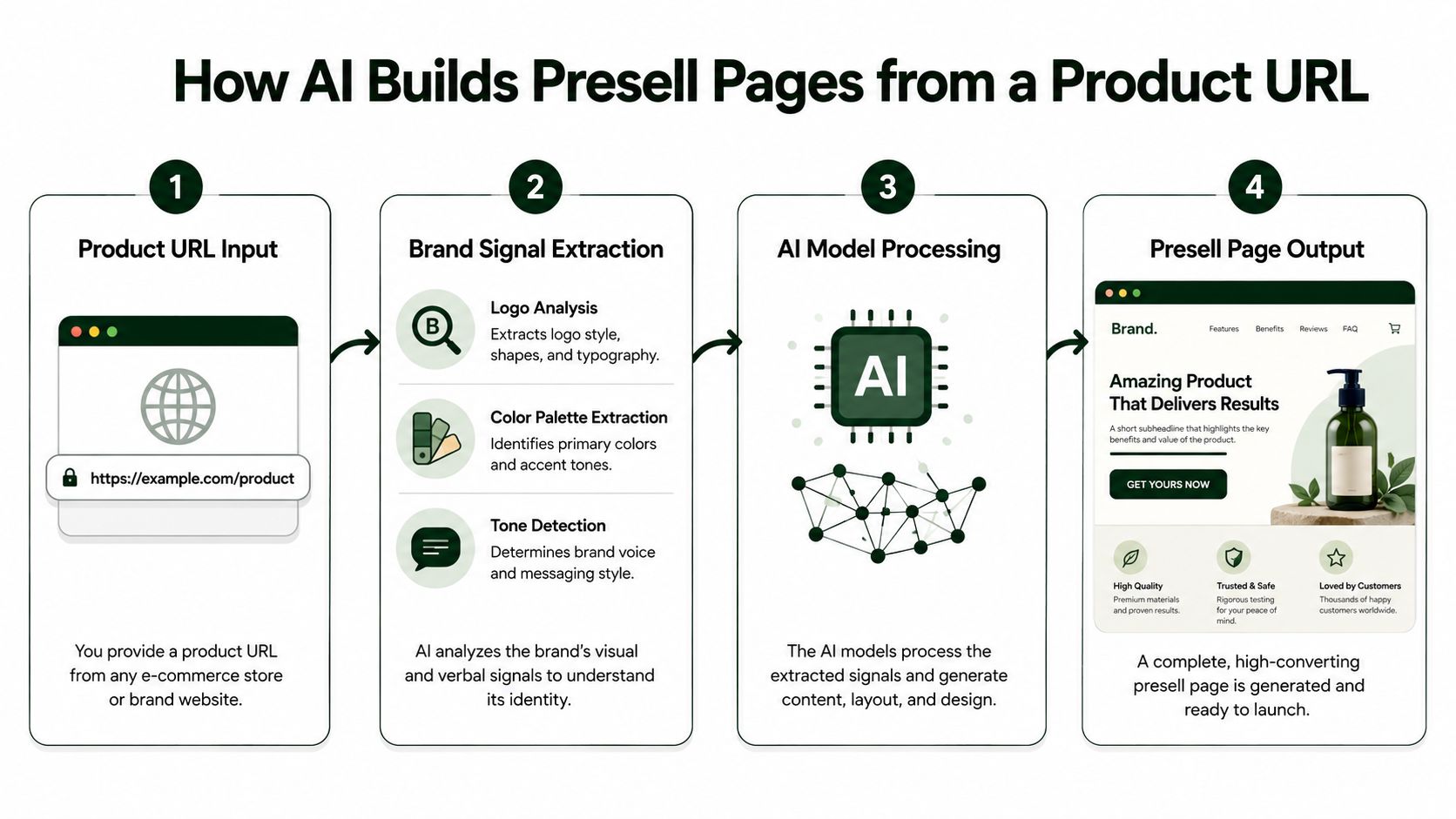
The URL is only the starting point. A strong generator extracts the signals around the product, then uses those signals to choose a structure and write a page that reflects the brand instead of filling a generic template.
The inputs that shape the draft
The first pass should identify what the brand sells, who it serves, which problems it addresses, what proof it can support, and what claims it must avoid. Product pages often contain useful ingredients, but they don't always explain the customer's real objections or the angle behind the ad.
Give the system more context when you have it:
- Brand language: Feed it approved phrases, tone examples, vocabulary, and claims your team uses.
- Audience context: Specify the customer segment, traffic source, awareness level, and problem the ad has already introduced.
- Offer details: Include price framing, bundles, guarantees, subscriptions, shipping information, and the action the CTA should lead to.
- Proof and limits: Add reviews, product facts, certifications, and compliance boundaries. A generator shouldn't fill missing evidence with invented certainty.
The output quality follows the input quality. A short URL prompt may produce clean prose, but it usually lacks the specificity needed for a convincing cold-traffic page.
Structure matters more than clever phrasing
The generator can then select an advertorial or listicle frame. An advertorial may lead with a problem and develop the product as a solution. A listicle may organize benefits or use cases into scannable sections. Neither structure automatically converts. The right choice depends on the promise made in the ad and the amount of education the reader needs before clicking through.
Readability is a major constraint. A historical benchmark reported an 11.1% conversion rate for pages written at a 5th- to 7th-grade reading level, compared with 5.3% for professional-level writing, while pages under 100 words converted 50% better than pages exceeding 500 words, according to Shopify's landing-page statistics summary. Those figures aren't a guarantee for your offer, but they support a practical preference for plain language, short sections, concrete benefits, and strong visual hierarchy.
The page should also be designed for a phone before desktop polish. You can find a broader guide to URL-based landing pages useful when mapping this workflow from ingestion to publication.
The video below adds a visual explanation of how AI-assisted page generation fits into a broader workflow.
A final editorial pass checks every claim, removes generic filler, confirms the page matches the ad, and makes sure the CTA says what happens next. That last step is where a fast draft becomes usable acquisition creative.
When a Landing Page Copy Generator Actually Lifts Conversions
AI copy earns its place when it helps a team test a better message faster. It doesn't earn its place merely because the draft sounds polished.
The strongest use case is message-matched presell content. If the ad introduces a specific problem, the landing page should recognize that problem immediately, develop the same angle, and make the product's role clear. A generic headline forces the visitor to translate the page. A matched headline confirms that they arrived in the right place.
Personalization data supports this direction. A benchmark cited by AI Best Practices on dynamic landing-page personalization reports that personalized calls to action can convert 202% better than generic versions, while dynamically personalized landing pages can convert about 25.2% more mobile users than static alternatives. Treat those figures as directional evidence, not a promise. The operational lesson is to generate variants around audience, benefit angle, and CTA framing instead of producing one universal page.
Speed only helps when the page remains usable
A generator can create a long advertorial quickly, but more copy and more assets can create a slower experience. Google reports that as mobile load time increases from 1 second to 10 seconds, the probability of a mobile visitor bouncing rises by 123%, and that a 0.1-second improvement can influence the user journey and conversion rates in its mobile page-speed benchmarks.
That makes page construction part of copy performance. Keep the first screen focused, limit unnecessary assets, use concise modules, and check the rendered page on an actual phone. A strong paragraph can't recover attention lost before the reader sees it.
Where AI falls short
The most useful recent evidence is uncomfortable for vendors. An independent 2026 study of 2,000 pages found AI copy roughly on par with human copy in B2B, but underperforming by about 2% in DTC ecommerce and 5% on webinar pages, as reported by Digital Applied's landing-page conversion study. Another analysis of 47 campaigns reported AI copy converting at 4.2%, human-written copy at 6.8%, and a hybrid approach using AI drafts with human editing at 9.1%, from the same source.
The conclusion is practical: use AI for volume and variation, then use human judgment for positioning, proof, compliance, and prioritization. The generator creates candidates. Testing decides winners.
Evaluation Checklist for Choosing the Right Generator
Feature lists are a poor way to compare these tools. Start with the work your team needs to complete after the first draft appears.
A generic template generator may be adequate for a simple page or internal concept. A presell-focused system needs to support the full path from product context to cold-traffic variant.
| Capability | Generic template generator | Presell-focused generator |
|---|---|---|
| Starting input | Prompt or blank template | Product URL, brand site, offer, proof, and audience context |
| Primary output | Sections or standalone copy | Editable advertorial or listicle page |
| Traffic awareness | Usually generic | Built around ad promise and cold-traffic intent |
| Brand retention | Often manual | Saved brand context and reusable signals |
| Testing workflow | Copy and paste variants | Duplicate pages, change one variable, publish again |
| Editing | Text-only or limited | Inline editing across copy, images, and structure |
| Publishing | Manual export | Store, hosted URL, website builder, or HTML outputs |
| Mobile control | Depends on template | Mobile-first hierarchy and performance checks |
The trial questions that expose weak tools
Use a real product URL during evaluation, not a fictional prompt. Ask the system to create more than one angle, then check whether the variants are meaningfully different or merely synonyms.
Look for these practical signals:
- Context retention: Does the tool remember approved claims, voice, product details, and customer language?
- Editorial control: Can you rewrite a section without rebuilding the whole page?
- Variant duplication: Can you preserve the control and change only the headline, opening angle, proof block, or CTA?
- Publishing fit: Does the output work with Shopify, Webflow, a hosted URL, or HTML export?
- Mobile behavior: Does the page stay readable and lightweight on a phone?
- Evidence discipline: Does the draft distinguish verified facts from assumptions and placeholders?
- Compliance visibility: Can you review health, performance, or advertorial claims before publication?
A tool that saves drafting time but creates a manual rebuild at export isn't saving the whole workflow. Nor is a page builder useful if every variant requires a developer.
The best generator is the one your team can edit, publish, and test without losing the original context.
Landra, for example, generates editable advertorial and listicle pages from product or brand URLs, with inline editing and outputs intended for common storefront and web workflows. Treat that as a capability comparison point, not a substitute for validating your own pages and traffic.
Before and After Examples That Show Real Differences
The most revealing improvements aren't usually dramatic rewrites. They remove the mismatch between what the ad promised and what the page says next.
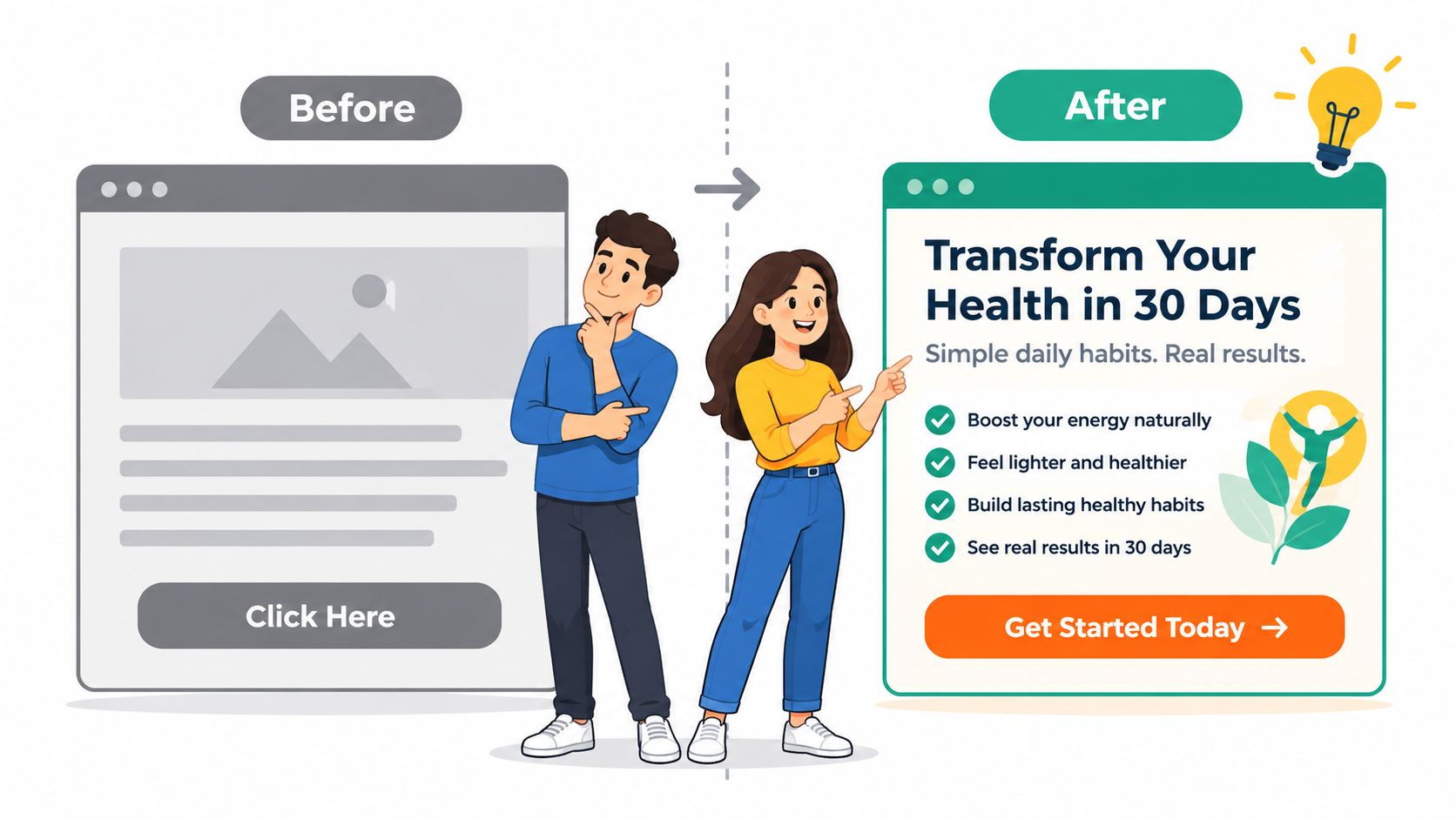
Example one, a supplement advertorial
Before
Discover a better wellness routine with our premium daily formula.
This opening is polished but empty. It doesn't identify the reader, connect to the ad, or explain why the page deserves attention.
After
Why your afternoon routine may be working against your energy goals
The revised version creates an editorial frame and leaves room for the page to explain the problem before presenting the product. If the ad already discusses afternoon fatigue or inconsistent routines, the opening carries that promise forward instead of resetting the conversation.
The next sections should stay concrete:
- The problem: Explain the routine or friction the reader recognizes.
- The mechanism: Describe how the product fits into that routine without overstating outcomes.
- The evidence: Use verified ingredients, reviews, or product details.
- The next step: Make the CTA specific to the offer rather than repeating “Learn more.”
The point isn't that the second headline is universally superior. The point is that it gives the reader a reason to continue and creates a testable angle.
Example two, a home product listicle
Before
The ultimate solution for a better home.
This could describe almost anything. It asks the visitor to supply the meaning.
After
Five small changes that make a crowded kitchen easier to use
The listicle frame gives cold readers a recognizable editorial promise. Each item can then introduce a specific use case, followed by the product's relevant benefit and a proof element. The product shouldn't appear as an unrelated sales interruption. It should earn its place in the list.
Keep the test controlled. Change the opening frame first, while holding the offer, page speed, and primary CTA steady. Teams looking for before and after metrics for DTC pages can use that type of comparison to document what changed, but your own traffic and audience still determine the result.
Novelty is not the goal. Clarity, continuity, and proof placement are.
Best Practices and Common Pitfalls to Avoid
Adopt the generator as a production system with checkpoints. That keeps speed from turning into careless publishing.
A workflow that holds up under pressure
Start with the source material, not the prompt box. Gather the product URL, ad copy, audience angle, customer language, offer terms, approved claims, and proof. Then ask for several structures or openings rather than accepting the first draft as the answer.
Edit in a deliberate order:
- Verify claims: Remove anything the product page, legal team, or evidence can't support.
- Match the ad: Confirm that the first screen continues the same problem and promise.
- Simplify language: Replace jargon, inflated adjectives, and abstract benefits with plain explanations.
- Reorder proof: Put the evidence near the claim it supports, not in a detached testimonial section.
- Check the CTA: Tell the reader what the click does and what they can expect next.
- Inspect mobile layout: Read the page on a phone and remove sections that delay the main decision.
Don't ask the tool to “make it more convincing” without naming the problem. Give it a specific revision request such as “make the opening reflect the customer's concern about setup time” or “rewrite this proof section using only the verified product facts.”
The shortcuts that create expensive pages
Fully automated publishing is the biggest trap. AI can misread a product page, repeat unsupported claims, or produce a confident explanation that doesn't fit the offer. Human review isn't a ceremonial approval. It protects the brand and improves the page's relevance.
Another mistake is generating many variants and changing everything at once. If the headline, structure, images, CTA, and offer all change together, the result may move but you won't know why. Test one meaningful variable at a time whenever traffic allows.
Testing discipline: Generate broadly, publish selectively, and change only what you can interpret.
Don't let the generator preserve bad brand habits either. If the existing site uses vague claims, dense paragraphs, or internal jargon, feeding it that material without guidance will reproduce the problem. Saved context should include what the brand avoids, not just what it likes.
How to Adopt a Landing Page Copy Generator Step by Step
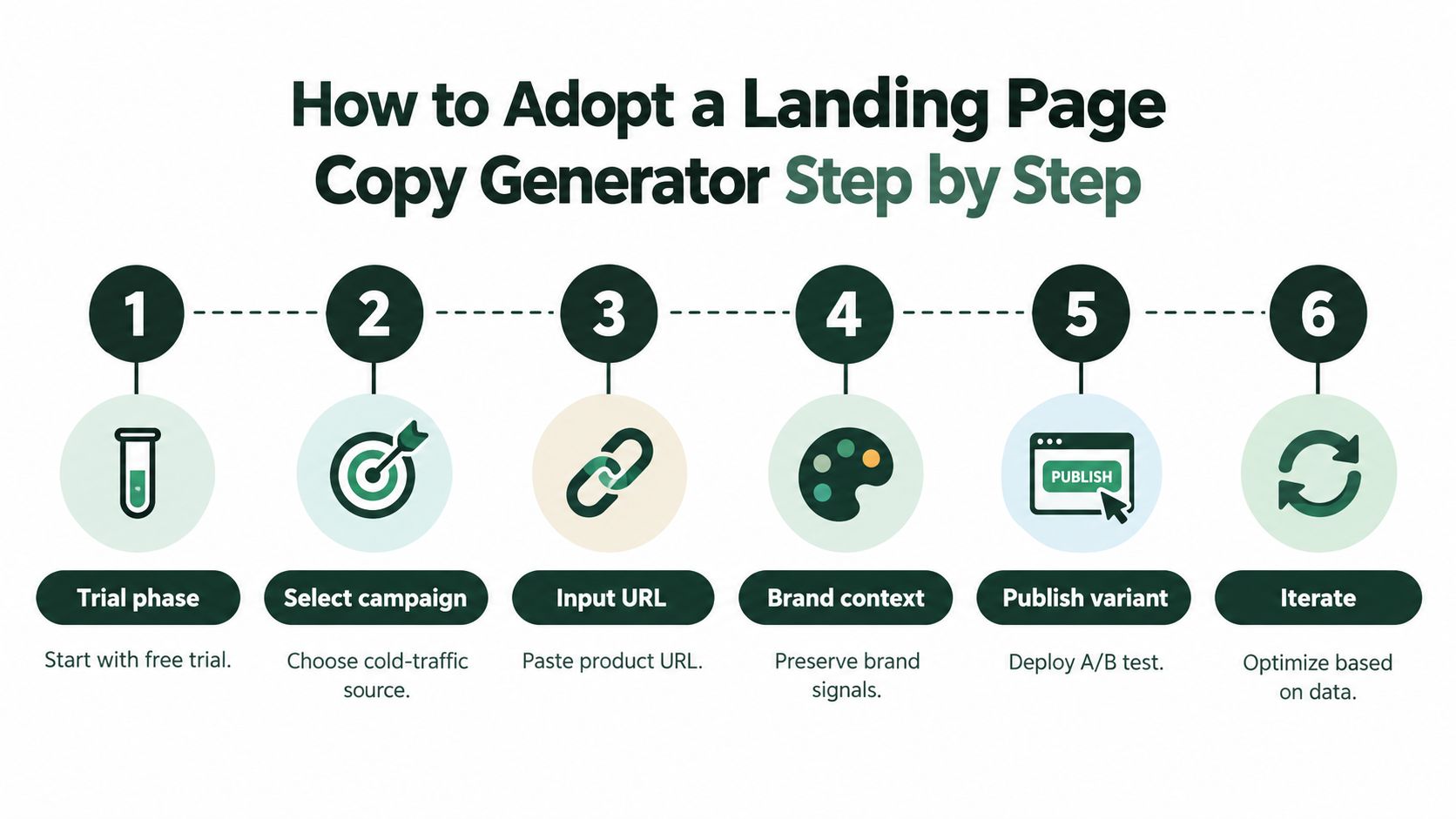
Start with one campaign, one product, and one cold-traffic source. A narrow test gives you a clear control and makes editorial decisions easier than launching a library of pages without a baseline.
Build the operating loop
- Choose the campaign: Select traffic with a clear ad promise and enough intent to evaluate the presell experience.
- Capture the context: Add the product URL, customer language, offer details, proof, exclusions, and desired action.
- Generate the draft: Create an advertorial or listicle structure that develops the ad's angle.
- Edit for truth and clarity: Check every claim, simplify the copy, and remove sections that don't help the decision.
- Publish a control and variant: Keep the original page intact, then change one testable element in the duplicate.
- Review the data: Compare the pages against your own baseline, inspect qualitative feedback, and feed the learning into the next draft.
The global benchmark of 6.6% median conversion can provide context for landing-page evaluation, but it shouldn't replace your account-level baseline or make you expect a particular outcome. Your audience, offer, traffic quality, page speed, and checkout experience all affect the result.
Teams building a broader production system may also benefit from reading about automating content creation in 2026, especially when deciding which parts of ideation, drafting, design, and review should be automated. Keep the final approval with someone who understands the customer and the commercial risk.
The right mental model is simple. A landing page copy generator isn't a shortcut around positioning or testing. It's a faster way to turn validated context into structured page variants, so your team can spend less time staring at a blank canvas and more time learning which message earns the next click.
Landra turns a product or brand URL into editable advertorial and listicle presell pages, with mobile-first layouts, brand-aware drafts, inline editing, and publishing options for DTC workflows. Visit Landra to generate a page for one cold-traffic campaign, edit the first draft, and create a controlled variant for testing.