
Search "AI landing page generator" and every result promises the same thing: type something in, get a landing page out. Run the test yourself, though, and what actually comes back is almost never a landing page you'd put media spend behind. It's a template with filler copy. Or your brand colors applied to someone else's layout. Or three headline options and a "good luck."
That gap matters because the people searching aren't hobbyists; they're marketers who need a page for a campaign that's already burning budget. This guide sorts out what "generate a landing page from a URL" actually means, what each kind of tool really returns, what the done-for-you alternative costs, and how true URL-to-page generation works when it's built for conversion rather than for demos.
What does "generating a landing page from a URL" actually mean?
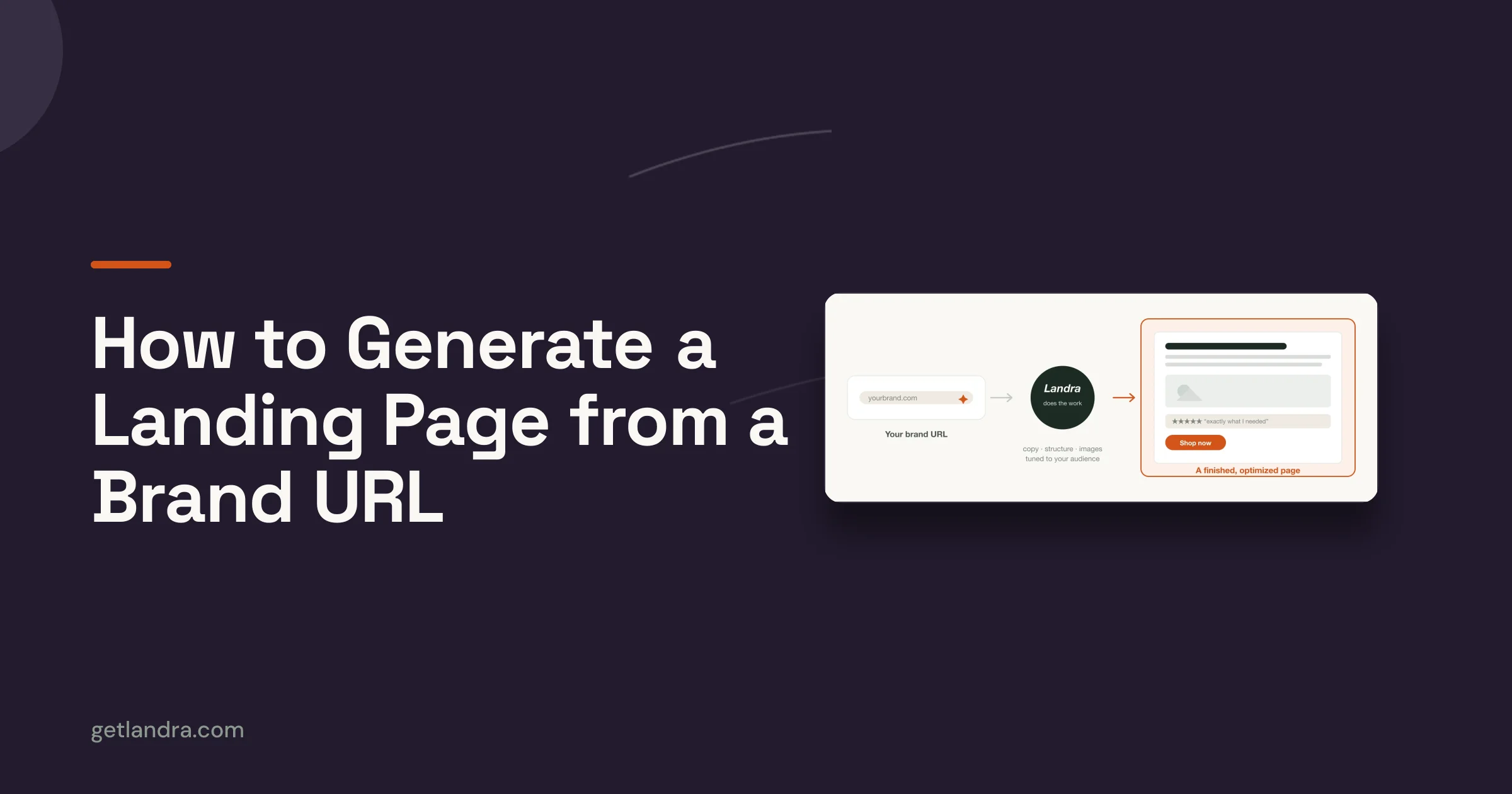
Generating a landing page from a URL means a system fetches the brand behind the link, extracts what it finds — product, claims, ingredients, reviews, voice, images — and uses that analysis to build a complete, conversion-structured page. The URL isn't a styling shortcut; it's the research input that would otherwise take a copywriter days of briefing.
That definition matters because the phrase gets used for three much weaker things. Some tools read a URL and extract a brand kit (colors, fonts, a logo) then apply it to a stock template. Some accept a URL as a design reference and clone the layout, with none of your substance. And most "AI landing page" tools don't take a URL at all; they take a text prompt and return a generic page. All three hand you an input to a landing page. None hands you the landing page itself.
The version worth wanting does the whole job: it reads the brand, picks up the product's actual claims and social proof, and returns a finished page in a format that's already proven for the traffic you're buying. For cold DTC traffic, that means an advertorial or a listicle, not a generic hero-and-features layout.
Why your ads need a dedicated page in the first place
Paid traffic converts on dedicated landing pages because a landing page continues the specific promise the ad made, while a homepage serves every possible visitor and therefore sells to none of them. The data and the practitioners agree on this one loudly; it's the least controversial claim in performance marketing. (We walk through when the homepage still wins in homepage vs landing page.)
Unbounce's Conversion Benchmark Report — built on 41,000 landing pages and 464 million visits, with Q4 2024 data — puts the median landing-page conversion rate at 6.6%, several multiples of typical ecommerce sitewide rates (see our DTC conversion benchmarks for those). And when Instapage A/B-tested identical branded-search traffic against its own homepage versus a dedicated landing page, the landing page converted at roughly three times the rate at about a third lower cost per conversion: a first-party test, but a clean one.
The practitioner version is blunter. In his April 2026 supplements field report, Nik Sharma put it this way: "Your homepage should build your brand. Your landing pages should sell your product." And on cold traffic specifically: "Winners don't dump cold traffic on a homepage."
There's an old directional stat worth one caveated line: HubSpot's 2012 benchmark analysis found businesses with 10–15 landing pages saw about 55% more conversions than those with fewer than 10 (HubSpot, 2012, fourteen-year-old B2B data, so treat the number as folklore and the direction as sound). More pages, each matched to an audience and an ad, means more surface for conversion. The reason brands don't run a page per angle has never been strategy. It's been cost.
What "AI landing page generators" actually return
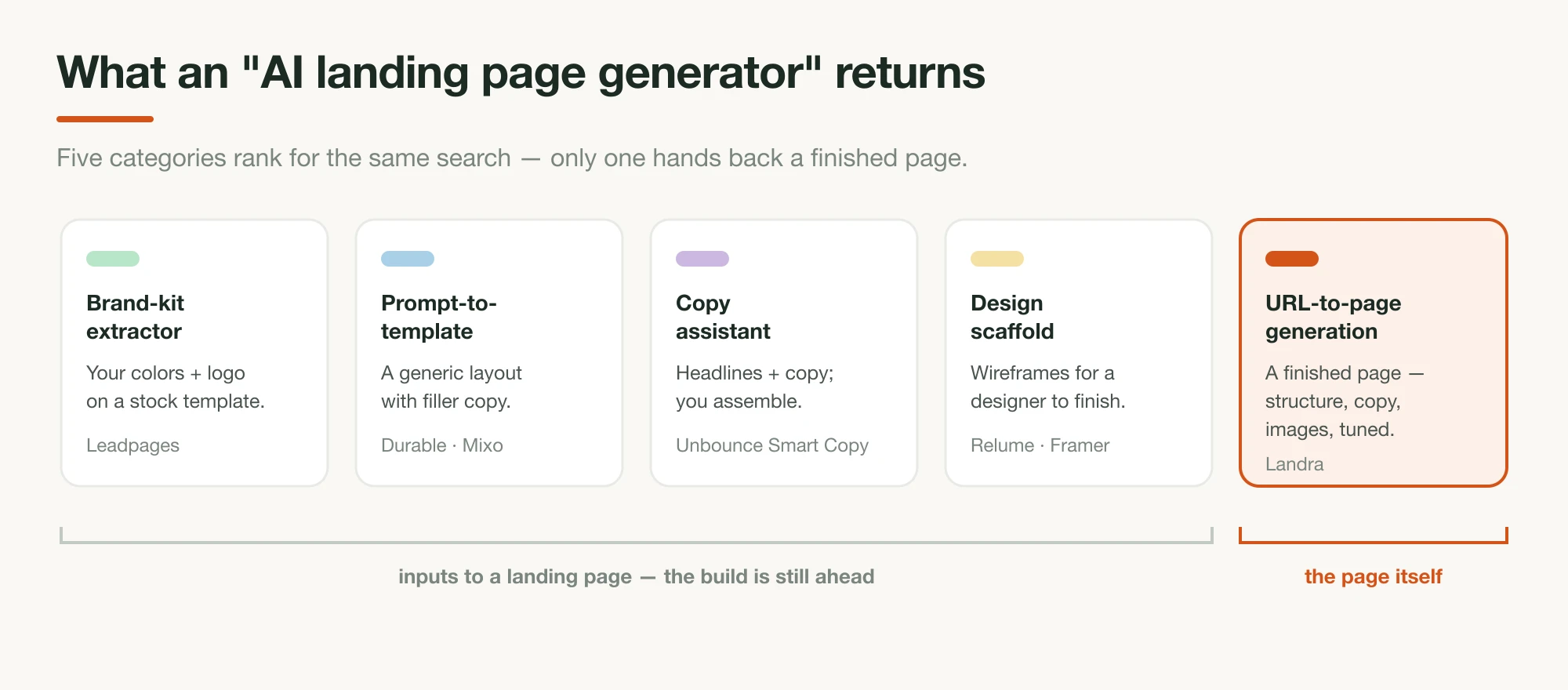
As of June 2026, the tools ranking for these searches fall into five categories, and only one of them returns a finished conversion page. Knowing which category a tool belongs to tells you exactly how much work is left after the demo: restyling, writing, assembling — or nothing.
| Tool (June 2026) | Takes a URL? | What actually comes back |
|---|---|---|
| Leadpages | For brand-kit extraction | A template page styled with your colors, fonts, and logo; copy from your text prompt |
| Replo | As a design reference | A Shopify page that recreates the layout of the URL you point it at |
| Unbounce | No | AI copy suggestions (Smart Copy) and assisted layout — you assemble the page |
| Durable, Hostinger, Mixo | No | A generic small-business website from a text description |
| Relume, Framer AI | Prompt-led | Wireframes, sitemaps, and starter layouts for a designer to finish |
| PagePilot | Yes (product link) | A Shopify product page, dropshipping-style — not a pre-sell page |
| Landra | Yes (brand analysis) | A finished advertorial or listicle — structure, copy, and images, tuned to an audience |
A quick way to self-diagnose the tool you're using now: if it asked you for a text prompt, you're in the template or scaffold rows; if it asked for your URL but only your colors changed, that's brand-kit extraction; if what came back needs a writer before it can take traffic, it was a copy assistant.
Two honest notes on that table. First, PagePilot genuinely does URL-to-page, but the output is a product page for dropshippers, which is the page your warmest traffic lands on, not the pre-sell page that converts cold Meta and TikTok clicks. Second, Replo is a serious DTC tool — we've compared it head-to-head with Landra — but its URL input is layout cloning: it rebuilds the page you showed it, it doesn't analyze your brand.
On pricing, at the same specificity for everyone (as of June 2026): PagePilot starts at $39/mo, Leadpages around $99/mo, Unbounce at $99/mo, Durable at $25/mo with a free tier, and Landra runs from $19/mo with a 14-day free trial. None of these numbers is the real cost story, though. The real story is what the page would cost without any of them.
The economics: what a done-for-you page costs
Without automation, a single conversion-grade landing page is a four-figure, multi-week artifact. Per Linear Design's 2025 cost breakdown, freelancers charge roughly $500–$2,000 per landing page and agencies from $2,000 up past $10,000 for bespoke builds; typical timelines run 7–10 days for a simple page and 2–3 weeks for a high-quality commercial one.
The advertorial-specific market is even clearer, because two services have productized exactly the page this guide is about (both verified live, June 2026):
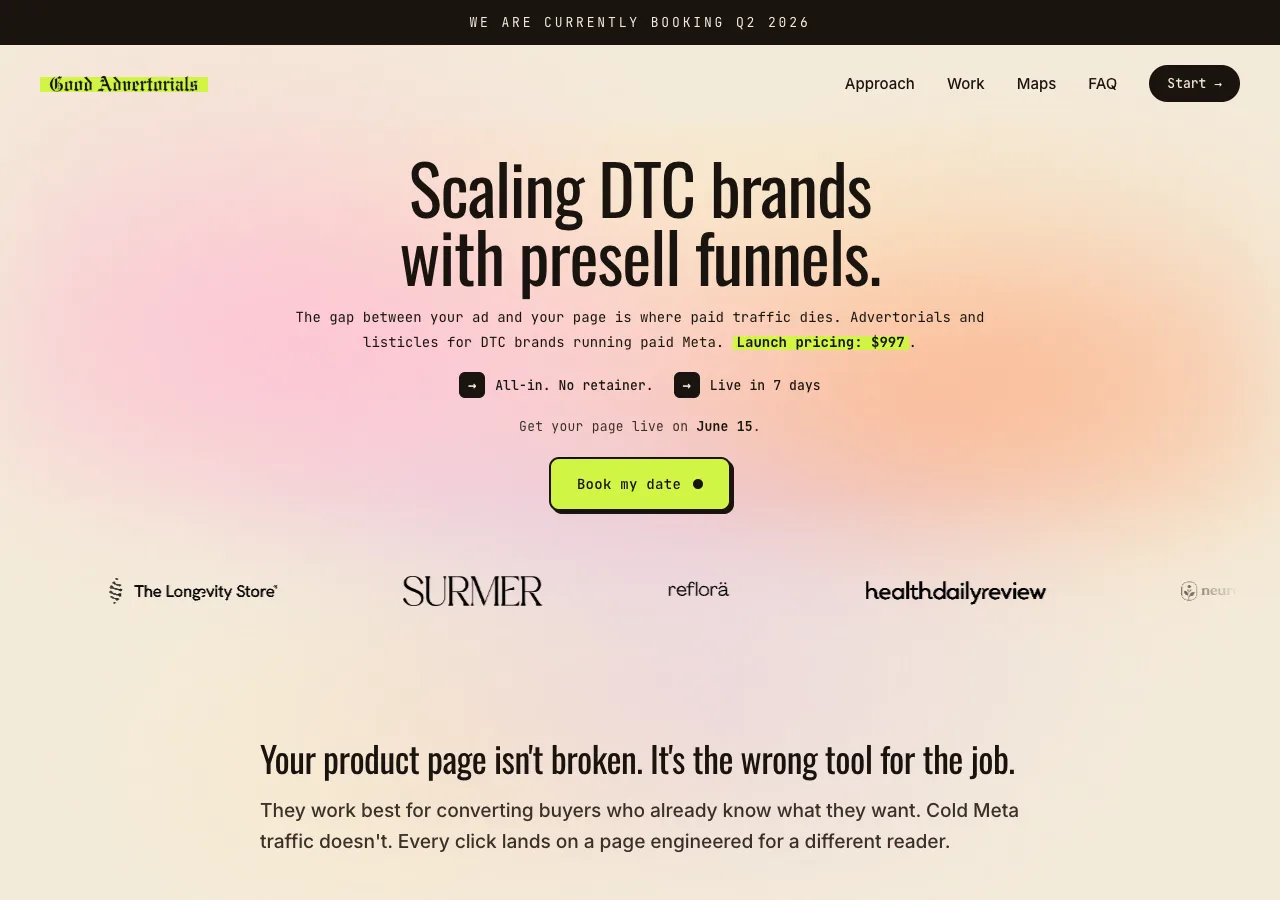
- Good Advertorials sells a done-for-you advertorial or listicle, matched to a specific ad angle, for a flat $997 per page, live in 7 days.
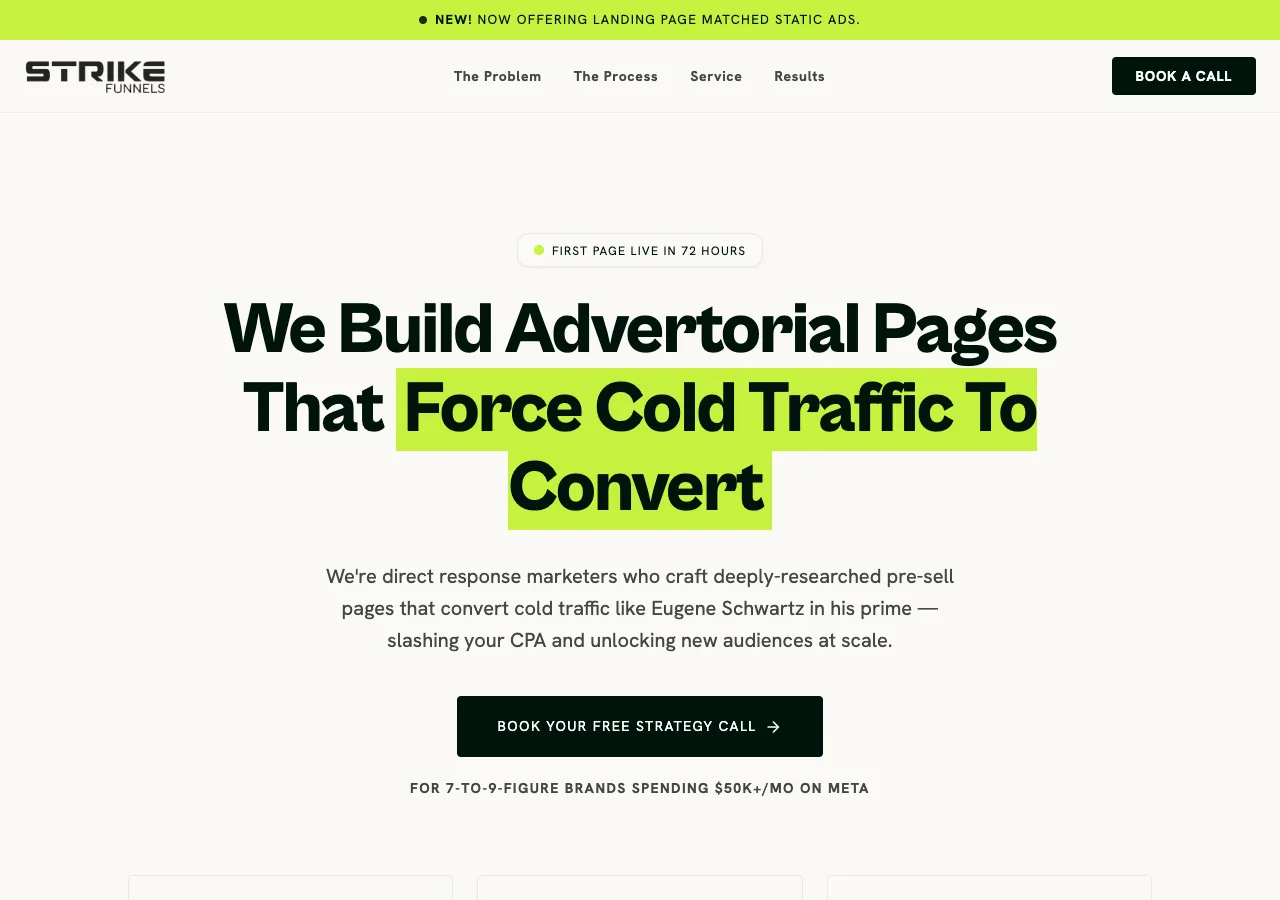
- StrikeFunnels promises a first advertorial page live in 72 hours (full research-copy-design package in 7 days), pricing undisclosed, targeting brands spending $50k+/month on Meta.
That's the market-clearing price of one angle: about a thousand dollars and most of a week. Now do the math media buyers actually face. Testing five audience angles — the normal way you find a winner on cold traffic — is roughly $5,000 and over a month of calendar time the manual way. So teams ration: one landing page, every audience funneled through it, and the ad account never learns which angle would have won. The constraint was never strategy. It was the per-page cost.
How URL-to-page generation works in Landra
This is the part where we show our own tool (fair warning) because Landra is the system we built to do the full version of this job: not colors, not a layout clone, but brand analysis to finished pre-sell page. Here's what actually happens between pasting a URL and publishing, and what each step replaces in the manual process.
1. Paste the brand URL: this is the brief
Landra fetches the site and runs a structured brand analysis: the product and what it actually claims, ingredients or features, real customer reviews and the voice they're written in, brand imagery, even the category's compliance posture. This is the research a freelancer bills the first day or two for, and it's why the URL matters as an input: the page gets built from your substance, not from a template's placeholder text.
2. Pick the format and the audience
You choose the page format — advertorial for colder, more skeptical traffic; listicle for readers comparing solutions (the format decision guide covers when each wins) — then tell Landra who the page is for and the angle to take. The audience input isn't a headline variable; it shapes the entire page, the way a brief shapes a copywriter.
3. Generation: structure, copy, and images together
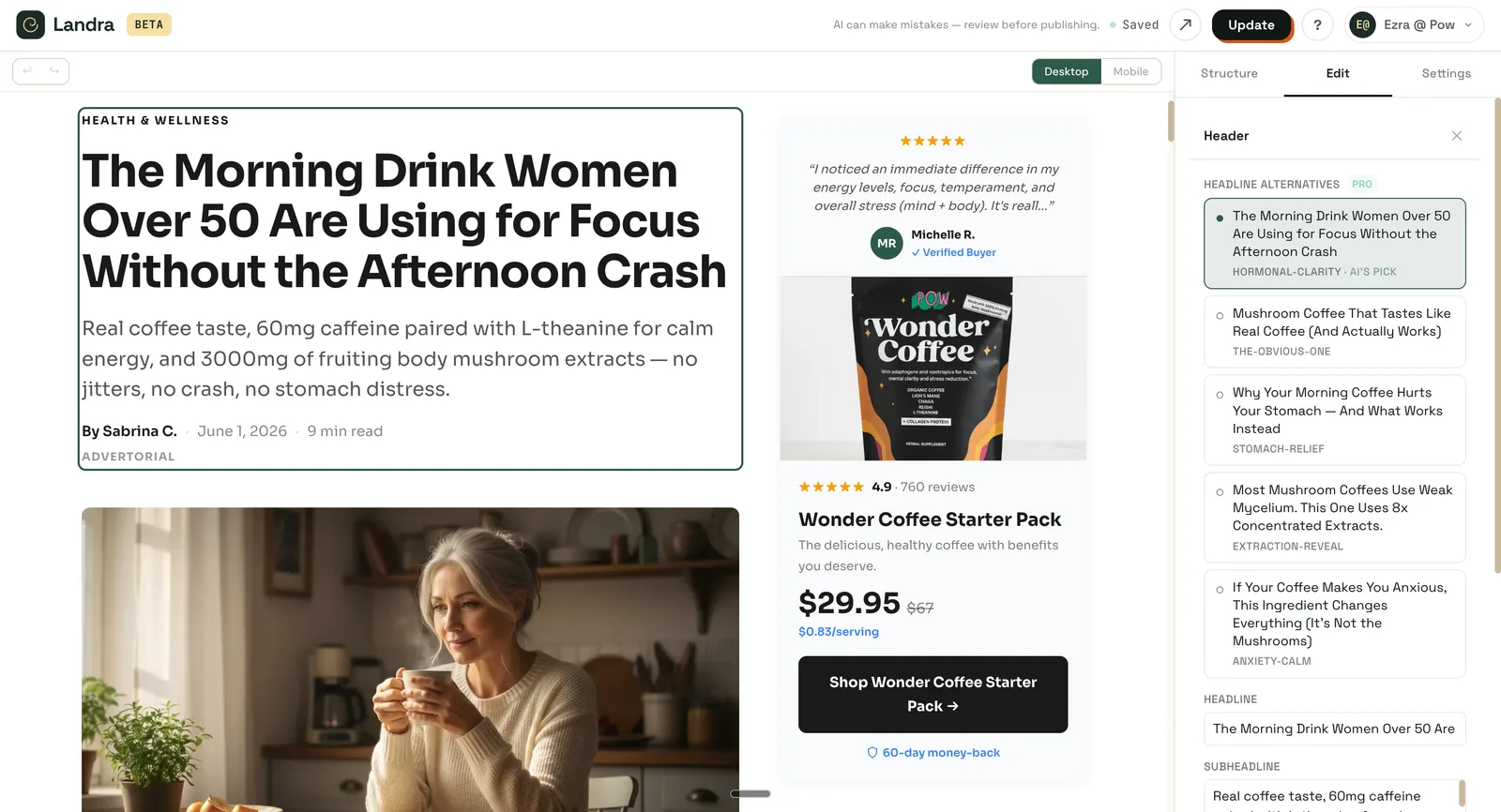
Landra generates the complete page: a conversion-proven structure for the format, copy written from the brand analysis (direct-response principles built in, one CTA discipline, compliance guardrails like the FDA structure/function disclaimer where the category calls for it), and the images. Minutes, not weeks. What comes back is the artifact the $997 services sell: the full writing structure, every pixel, and the visuals, tuned to the audience you named.
4. Edit like a document, publish like a page
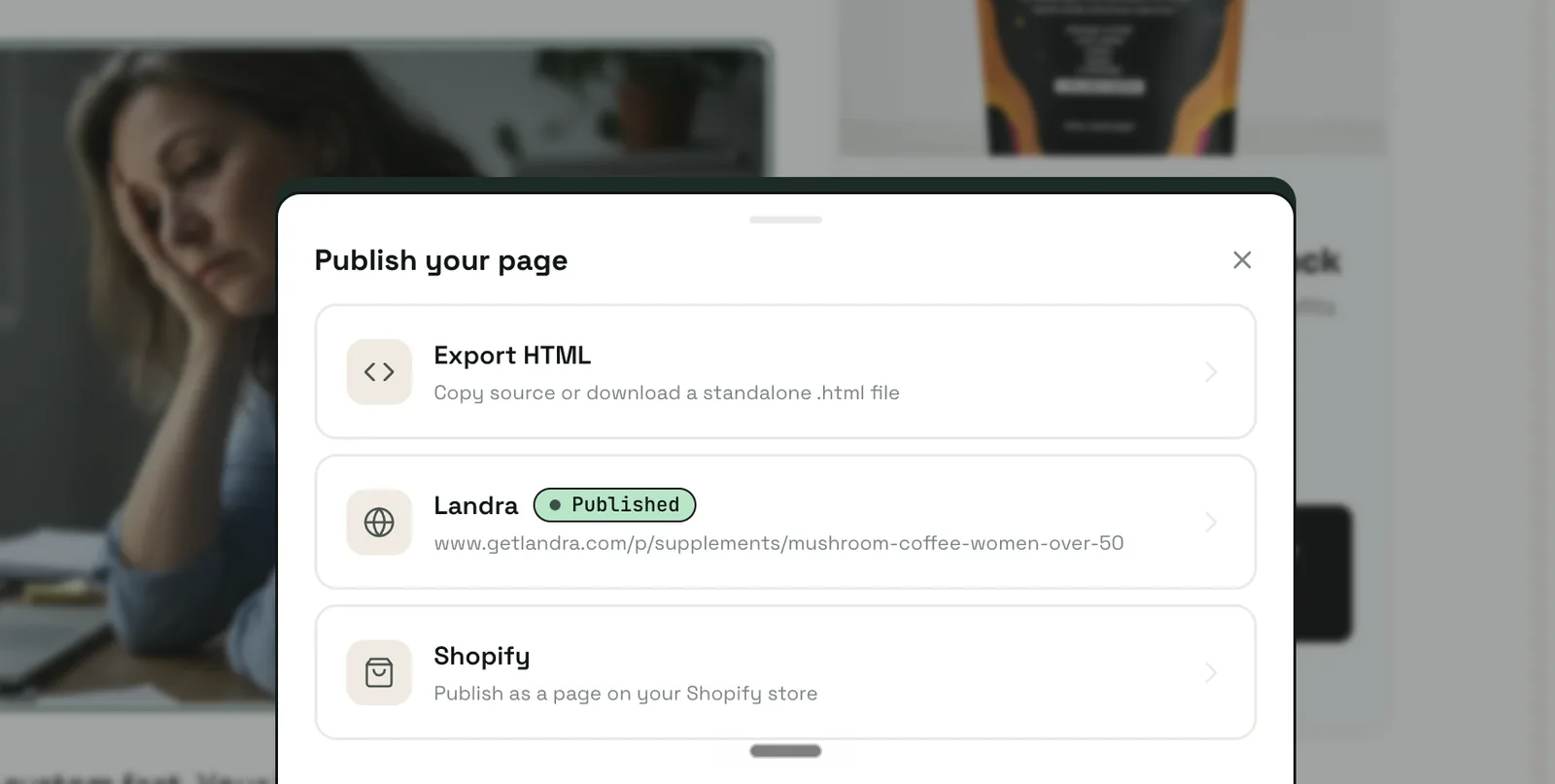
The generated page opens in a WYSIWYG editor (swap sections, regenerate images, adjust the offer) then publishes to a hosted URL or straight to Shopify, with HTML export if you'd rather own the hosting. From there, the marginal cost of the next angle is a few minutes: same URL, different audience, different page.
What to check before you trust any generated page
A generated page earns media spend the same way a human-built one does: by being checked. Whatever tool produced it, walk it against four things before the campaign goes live. This is the QA pass that separates "AI made me a page" from "this page is ready for $500/day."
- Claims match reality. Every product claim on the page should be one your brand can substantiate; generation should pull from your real reviews and claims, never invent stats. (Supplement and health brands: this is a legal line, not a style note — see the FTC disclosure guide.)
- Message match with the ad. The page's top should continue the exact promise of the ad that sends traffic to it; mismatched scent is the silent killer of otherwise-good landers.
- Disclosure is present. Advertorials and listicles are advertising and should say so plainly.
- The page reads like your brand. The tell of template output is copy that could sell anything; a page built from your URL should be unmistakably about your product, in something near your voice.
The honest answer on when to use which
If you need one brand-defining flagship page and have $10,000 and three weeks, an agency will hand-craft something excellent. If you have an in-house designer and writer with conversion experience, a builder like Replo or Unbounce gives them full control to make a perfectly fine page themselves. URL-to-page generation is for the job in between, the one most DTC teams actually have: cold-traffic pre-sell pages, per audience, per angle, where the formats are known, speed compounds, and the difference between testing one angle and five is the difference between guessing and knowing. That's the page Landra builds from your URL: finished, optimized, and cheap enough to stop rationing.
Frequently asked questions
Can AI generate a landing page from a URL?
Yes, but very few tools actually do it. Most AI landing page generators take a text prompt and return a generic template; some extract brand colors from a URL; a few clone a layout from a reference URL. True URL-to-page generation analyzes the brand behind the URL — product, claims, testimonials, voice — and generates a complete page from it.
What does an AI landing page generator actually produce?
It depends on the category. Prompt-to-template builders produce a generic layout with filler copy. Brand-kit tools restyle templates with your colors and fonts. Copy assistants write headlines and sections you place yourself. Design scaffolds produce wireframes. Only URL-to-page systems return a finished, conversion-structured page — copy, layout, and images together.
How much does a landing page cost to build without AI?
Reported freelancer rates run about $500–$2,000 per landing page, and agencies charge from $2,000 up to $10,000+ for high-end builds, per Linear Design (2025). Done-for-you advertorial services sit near $1,000 per page — Good Advertorials charges $997 with a 7-day turnaround as of June 2026.
How long does it take to build a landing page manually?
Industry estimates put a simple landing page at 7–10 days from brief to live, and 2–3 weeks for a high-quality commercial build — longer if copy and images are not ready on day one. Even specialist done-for-you advertorial services quote roughly a week per page: Good Advertorials lists a 7-day turnaround, and StrikeFunnels promises a first page in 72 hours with the full package in 7 days (June 2026).
Should paid traffic go to my homepage or a landing page?
A dedicated landing page. A homepage serves every visitor and therefore sells to none; a landing page continues the specific promise the ad made. In one A/B test by Instapage, identical branded-search traffic converted at roughly three times the rate on a dedicated landing page versus the homepage.
What should a page generated from my brand URL include?
A conversion format matched to your traffic (advertorial or listicle for cold visitors), copy built from your real product claims and reviews, your offer and CTA, images, and compliant disclosure. Treat anything that returns a bare template with placeholder text as a starting point, not a finished page.