
You are three paragraphs into an article about the housing market on a major news site. You finish it. Below the last line is a grid of thumbnails — "You may also like," "Around the web" — and one of them has a headline that snags you: a story about a coffee swap that supposedly fixed someone's afternoon crash. You click.
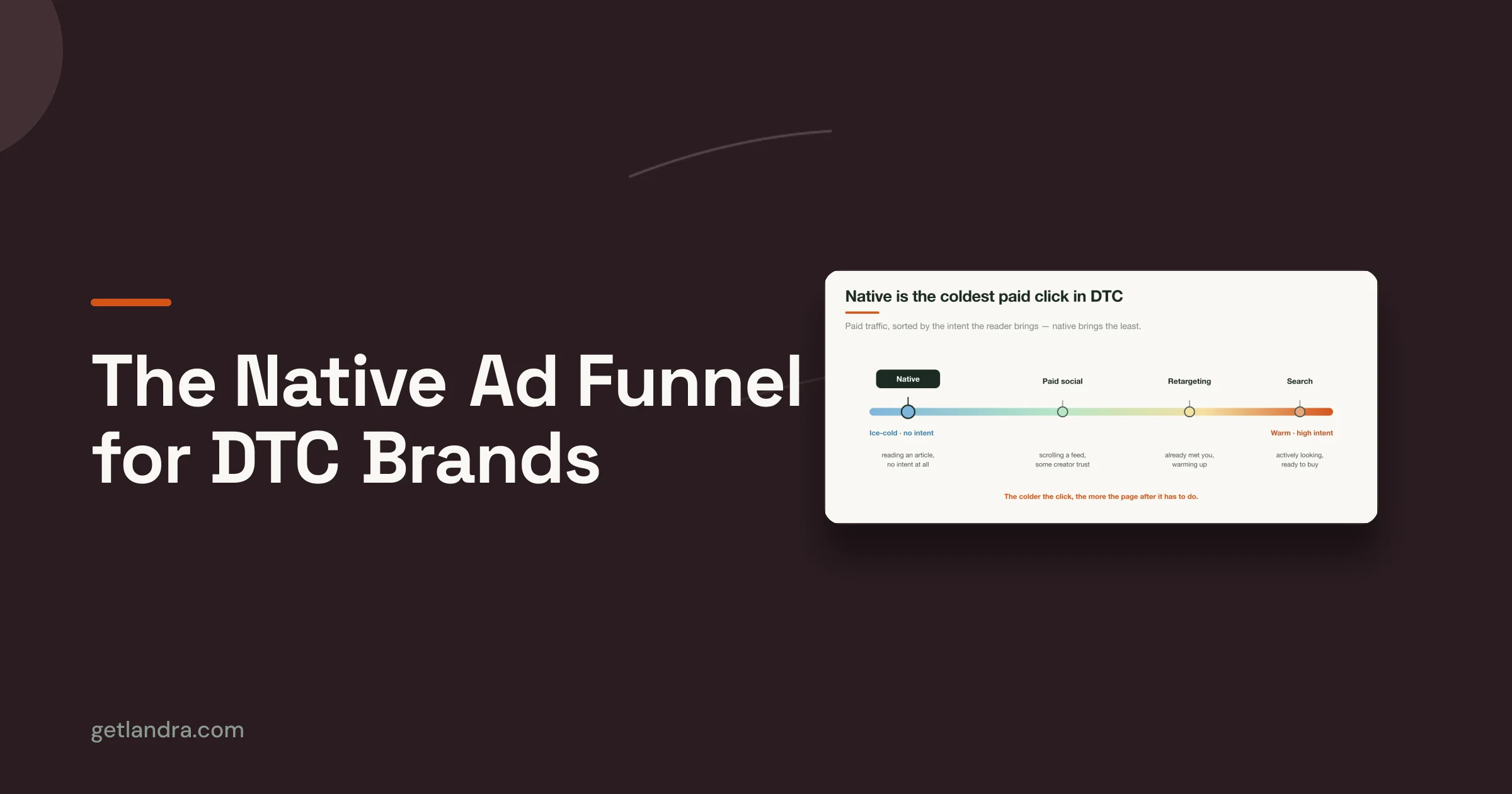
You were not shopping. You were not on a feed you opened to browse. You were reading, and a widget interrupted you. That click, the one that just left a news article for a brand's page, is the coldest paid click in DTC, colder than anything Meta or TikTok sends you. And it is exactly the click that native advertising runs on. This guide is about the funnel that turns it into a sale: what the stages are, why the middle one is not optional, and the on-page requirement the networks impose that catches operators off guard. (New to the page that does the warming? Start with what a presell page is.)
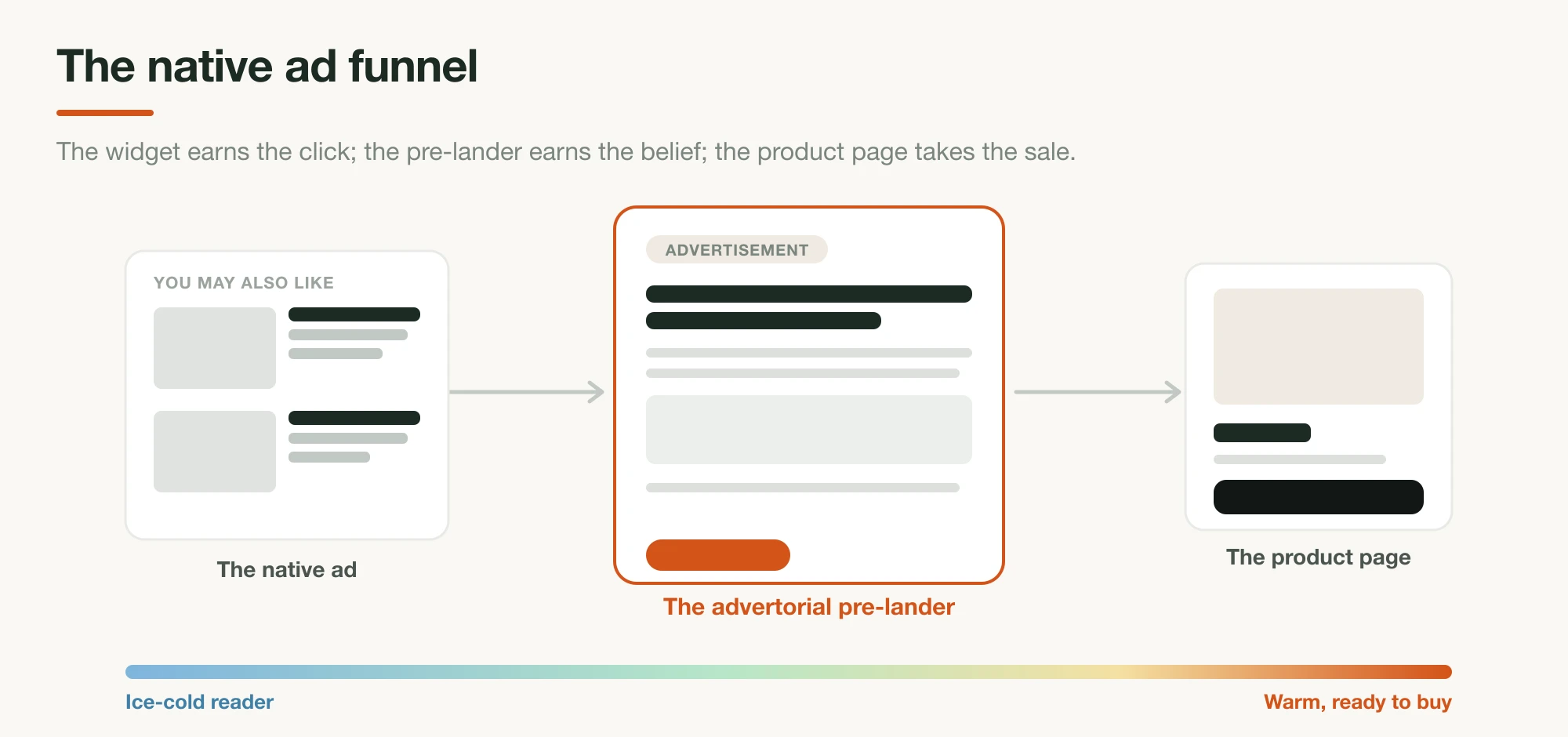
What the native ad funnel is
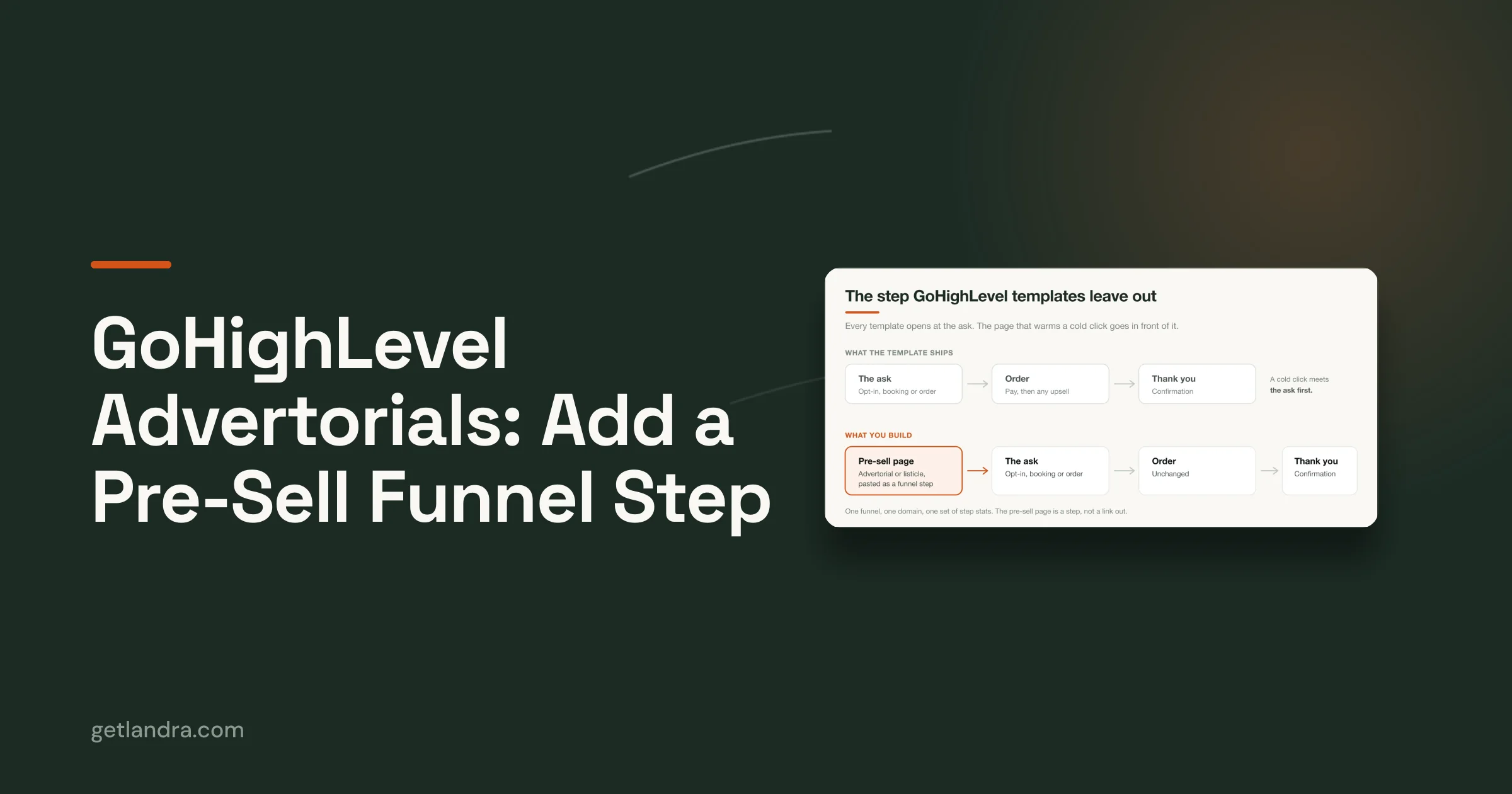
The native ad funnel is the three-stage path a native campaign runs on: a content-recommendation widget drives the click, an advertorial or listicle pre-lander warms the reader and earns belief, and the product page closes the sale. The widget lives at the bottom of articles on publisher sites; the pre-lander is the load-bearing stage. Skip it and the click dies.
Native ads are the recommendation widgets — "you may also like," "around the web" — that sit below and beside articles on publisher sites. They run on networks like Taboola and Outbrain (which merged with Teads in February 2025), alongside Revcontent, MGID, and Nativo, placing across publisher rosters that include USA Today, CNN, NBC, and The Guardian (AI Digital, 2026). It is a large, still-growing slice of digital ad spend, and, crucially, a cheap one to click. That cheap click is the trap: it is cheap precisely because the reader's intent is near zero.
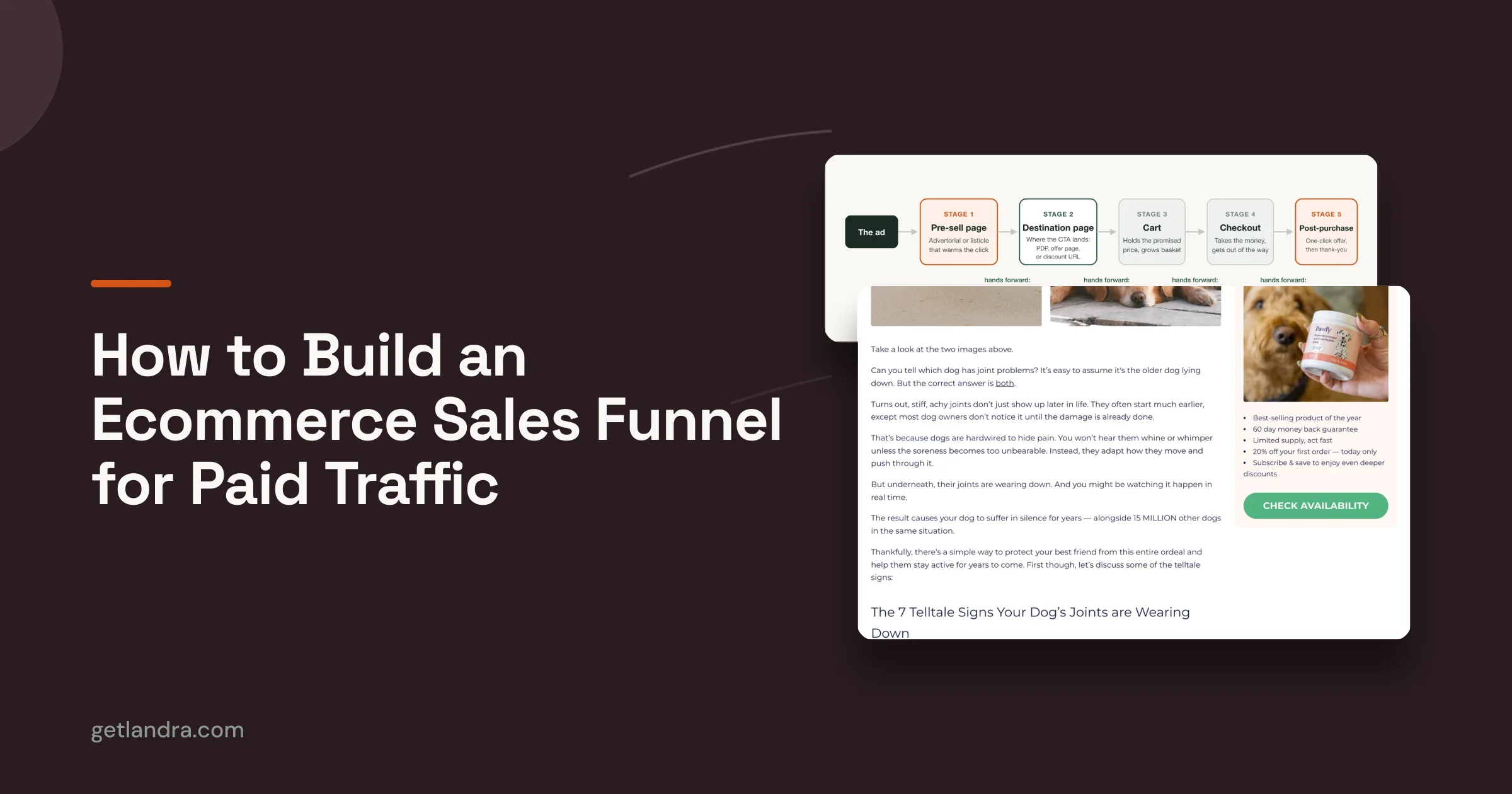
It is the native-specific version of the same five-stage path any paid click walks; if you want the general shape first, start with how to build an ecommerce sales funnel for paid traffic, then come back here for what native changes.
The funnel itself is canonical among native operators. The widget earns attention; the pre-lander does the work a cold reader needs before an offer can land; the product page only ever has to close someone the pre-lander already warmed. Rachel Mazza, who breaks down the native funnel for direct-response brands, frames the pre-lander as the asset that carries the campaign: the ad buys the click, but the advertorial is what converts it.
Why native traffic is colder than paid social
Native traffic is colder than paid social because the reader was in content-browsing mode, not feed-scrolling mode: consuming an article, not idly grazing a feed that already lives next to shopping. There is no creator vouching, no social-proof signal, and no brand the reader chose to follow. Intent is lower and the only trust in the room is borrowed from the publisher.
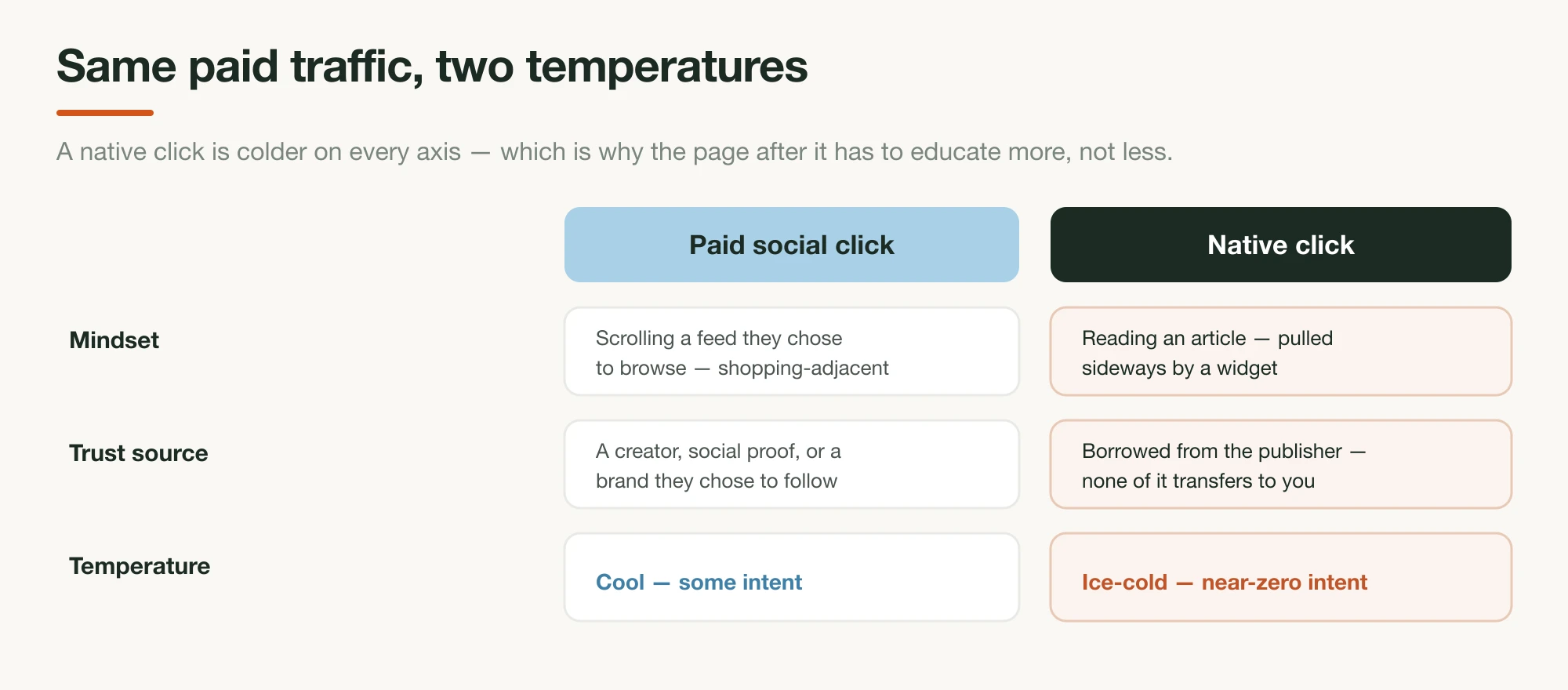
LanderLab draws the distinction worth keeping: a social scroller is in a "social-scrolling mode" that sits adjacent to discovery and shopping, while a native reader is in "content-browsing mode": they came to read, and a recommendation tile pulled them sideways. The mindsets are not the same temperature. On paid social, a creator or a familiar brand in the feed lends a trust signal before the click. On native, that signal does not exist — the reader trusts the publisher they were reading, not you, and that trust does not transfer to your brand the second they leave the article.
Map it to the stages of awareness and the picture sharpens. A paid-social click often arrives problem- or solution-aware, nudged by a creator or a retargeting pixel. A native click typically arrives problem-unaware or barely problem-aware: the reader did not even know they were in the market until the headline suggested it. That is the coldest a paid reader gets, and it sets the bar for the page: it has to do more educating than a Meta advertorial, not less.
Why a product page dies on native (twice)
A native click sent to a product page dies twice. First, on temperature: a product page is a closing argument, and a content-browsing reader with no intent is the wrong audience for a price and a buy button. Second, on policy: the networks will not approve a bare product page as the destination for an editorial-style native ad. One click, two ways to lose it.
The temperature failure is the same one a product page hits on any cold traffic: it opens at "most aware," hands the reader a dozen exits, and reads as a continuation of the ad. Native just makes it worse, because native is the coldest cold there is. The reader did not tap a creator's recommendation or a retargeting ad; they left an article. A page that opens with variants and an Add to Cart asks a stranger to buy something they did not know existed forty seconds ago.
The policy failure is the one operators do not see coming. You cannot simply choose to skip the pre-lander on native the way you sometimes can on paid social. The network itself requires an advertorial-grade page for any editorial-style campaign — a labeled, substantiated, disclosed page — and a bare product page does not clear that bar. So the middle stage of the funnel is not just a conversion best practice on native. It is a condition of being allowed to run the campaign at all.
The network reality: Taboola and Outbrain mandate the advertorial page
This is the non-obvious operator beat: Taboola and Outbrain require an advertorial-grade landing page for editorial-style native ads. Both mandate a prominent "Advertorial" or "Advertisement" label across the top of any page a reader could mistake for editorial, plus substantiated claims and health or finance disclaimers in the footer. The label is a condition of running, not a polish item.
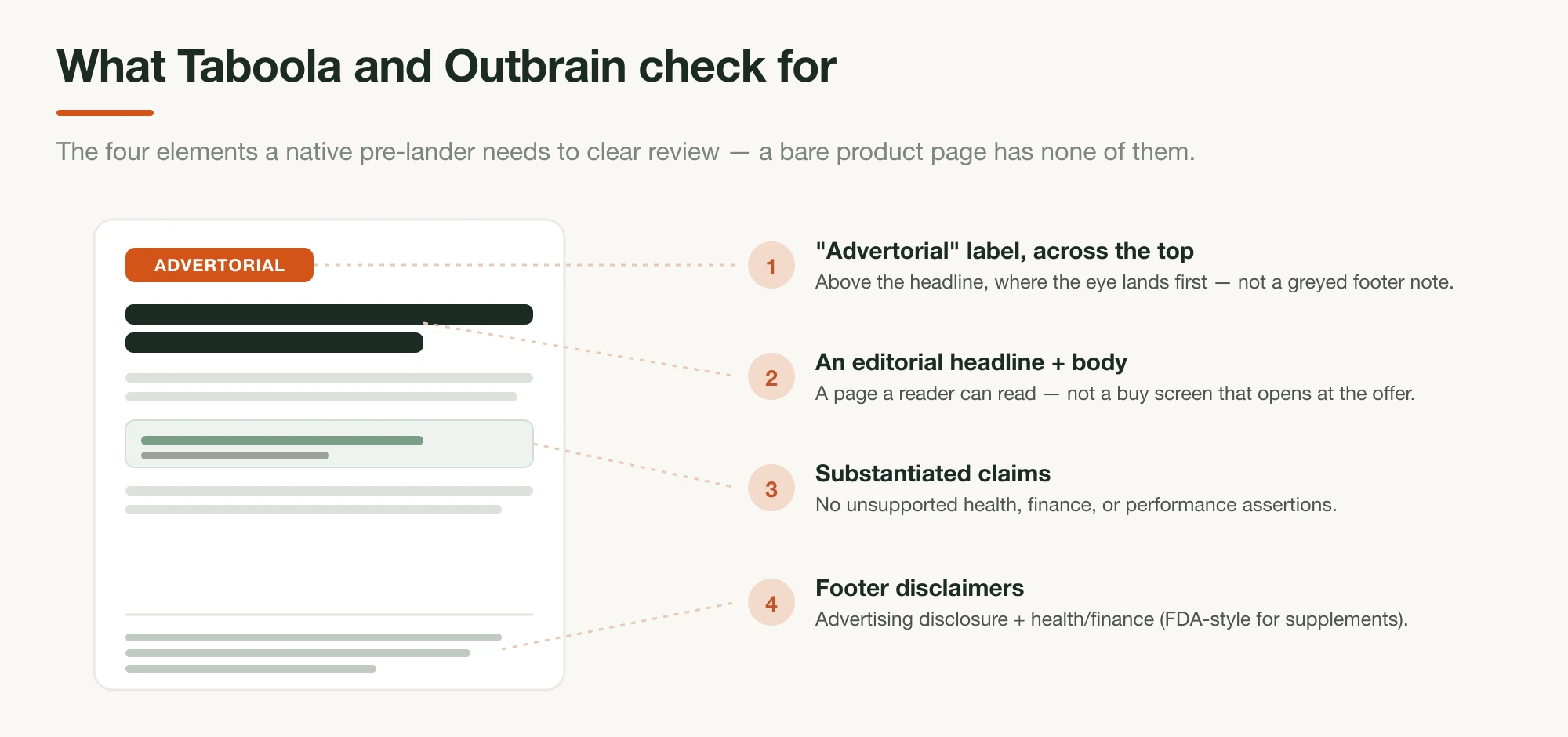
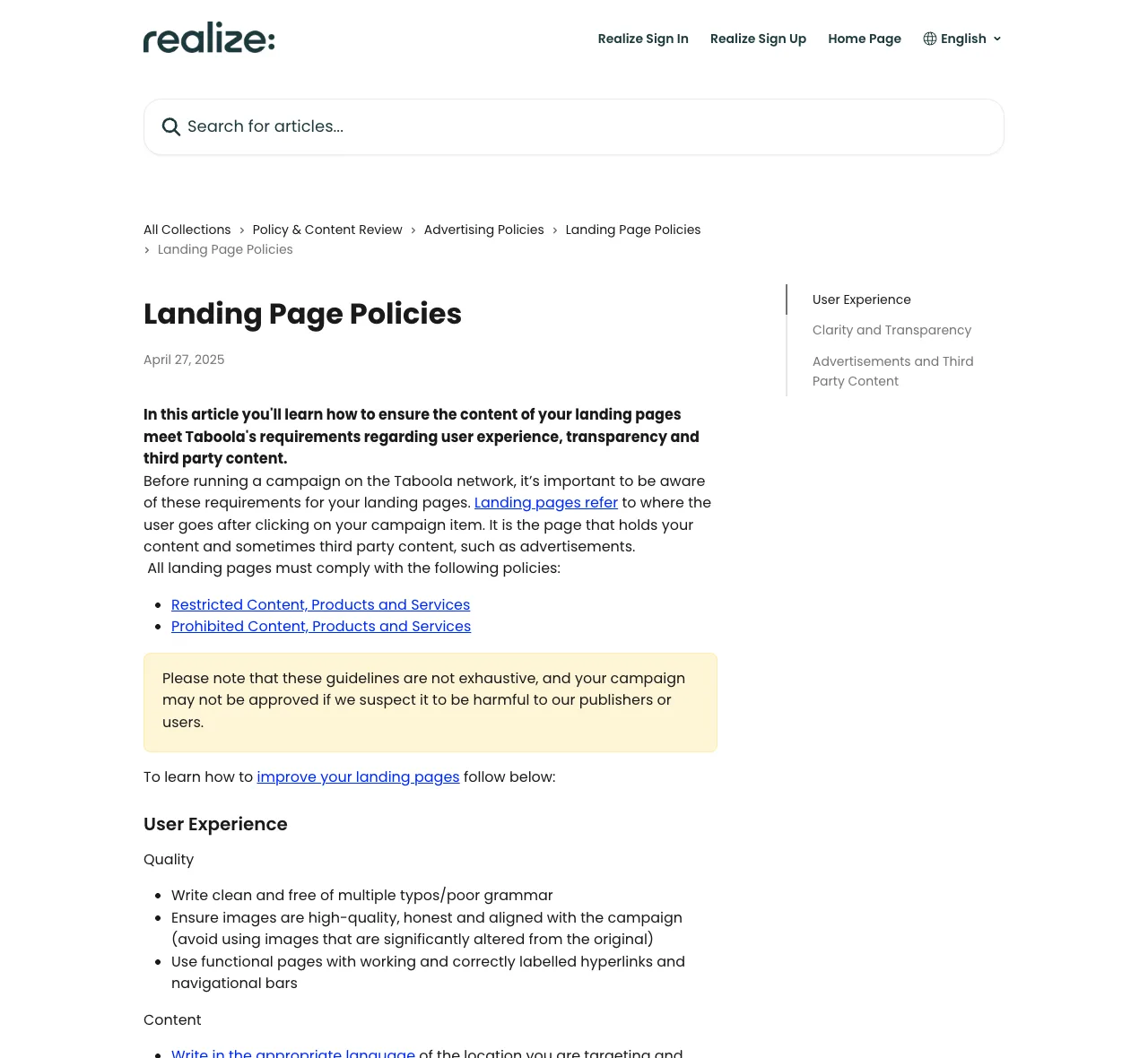
Taboola's landing-page policies require that a page which could be confused with editorial carry the word "Advertorial" written clearly across the top, and its prohibited-content rules bar unsubstantiated and misleading claims outright. Outbrain's advertising guidelines take the same line: an "Advertisement" or "Advertorial" disclosure prominently at the top, with health and finance pages carrying the appropriate footer disclaimers. These are not the FTC's rules (though they rhyme with them); they are the networks' own approval criteria, and a campaign that misses them does not run.
That is the part that surprises people. On Meta, a clean advertorial is a conversion choice you make. On native, the labeled advertorial page is the entry ticket. The discipline that the FTC's disclosure rules ask of you as a matter of law, Taboola and Outbrain ask of you as a matter of access. So on native, the compliant page and the converting page are the same page, and you do not get to run without it. (For the specific moves that get a page rejected — fake newsrooms, disease claims, a buried label — see what Taboola and Outbrain reject on landing pages.)
| What Taboola / Outbrain require on the page | Why a bare product page fails it |
|---|---|
| A visible "Advertorial" / "Advertisement" label across the top, above the headline | A product page carries no ad label — it reads as a store, not disclosed content |
| Substantiated claims — no unsupported health, finance, or performance assertions | Product copy routinely makes claims with no on-page evidence cited |
| Health / finance disclaimers in the footer (FDA-style for supplements) | A standard product page ships no such disclaimer block |
| An editorial-grade page a reader can read, not just a buy screen | A product page opens at the offer — there is nothing to read first |
Sources for the requirements above: Taboola — Landing Page Policies, Taboola — Prohibited Content, and Outbrain — Advertising Guidelines.
One thing the native page is not: the ad creative
Worth separating two assets people conflate, because they are built differently and they convert differently. The native ad creative is the thumbnail image and headline inside the recommendation widget — the tile a reader sees and clicks. The native landing page is where that click lands: the advertorial or listicle pre-lander. The creative buys the click; the page earns the sale.
The networks blur this on purpose, because some of them sell tools for the creative half. Taboola, for instance, ships its own generative tooling for native ad creative — it helps you spin up thumbnail-and-headline variations to test inside the widget. That is a different job from building the landing page. When you read "AI native ads," check which half it means: generating the tile a reader clicks is not the same as building the advertorial page that does the convincing after the click. Most of the conversion work (the warming, the education, the proof, the substantiated claims, the labeled and disclosed page the network demands) happens on the landing page, which the creative tools do not touch.
How to build the native funnel page
Build the native pre-lander in four moves: pick advertorial or listicle by how cold the reader is, message-match the page's opening to the exact widget headline that earned the click, place the "Advertorial" label and footer disclaimers the networks require, then warm with education before you ever reach the offer. The colder the click, the more the page has to teach.
1. Pick the format by how cold the reader is
The format follows the temperature, the way it does on any presell page, but native pushes you toward the more-educational end of the dial because the reader is colder. A flowing advertorial suits a problem-unaware reader who needs the full story — the mechanism, the discovery, the reason to care — told as an article. A listicle suits a slightly-warmer or skim-prone reader who responds to scannable, numbered reasons. On native, when in doubt, reach for the format that explains more; you are starting the reader further back than you would on paid social.
2. Message-match the page to the widget headline
The reader clicked a specific promise in the tile: a coffee swap, a sleep fix, a number that surprised them. The first screen of the page has to pay that promise off in the same words, or the reader bounces on the mismatch. This is the same continuity rule that governs how to write an advertorial: the headline they clicked and the headline they land on should feel like one thought, not two. For the copy itself — the hook, the proof, the voice tuned to native — see how to write an advertorial for native ads. Native makes the match harder and more important, since there is no brand recall cushioning the gap, so a generic page after a specific tile reads as a bait-and-switch and loses the click instantly.
3. Place the label and the disclaimers the networks require
This is the step a DIY build forgets, and on native it is the step that gets the campaign rejected. The "Advertorial" label goes across the very top, above the headline, where the reader looks first. Not in a footer, not greyed out. The footer carries the disclaimer block: an advertising disclosure, a testimonials/results line, and for supplements the FDA-style health disclaimer. Get the placement wrong and you fail network review even with great copy. (For the legal backbone underneath the network rule, see advertorial disclosure and FTC compliance.)
4. Warm with education before the offer
The body does the job the product page cannot: name the problem the reader did not know they had, teach the mechanism, substantiate the claims with something real, and only then reach for the offer. Because native is the coldest entry point, this section runs longer and works harder than its paid-social equivalent. The reader gives you their attention because the page reads like content — so let it read like content all the way down to the moment it earns the click through to the product page.
Where Landra fits the native build
Every move above is real work, and the disclosure step is the one most builders leave to you to remember. That is the gap Landra closes. Give it your brand URL and the audience you are targeting, and it reads your brand and products, then writes the whole optimized pre-lander — the advertorial or the listicle, copy and structure and images, laid out in proprietary DTC components built to convert and tuned to the reader you named, published straight to Shopify or exported as HTML on your own domain. Both are valid Taboola and Outbrain destinations; the networks ask only for a functional advertiser-owned URL.
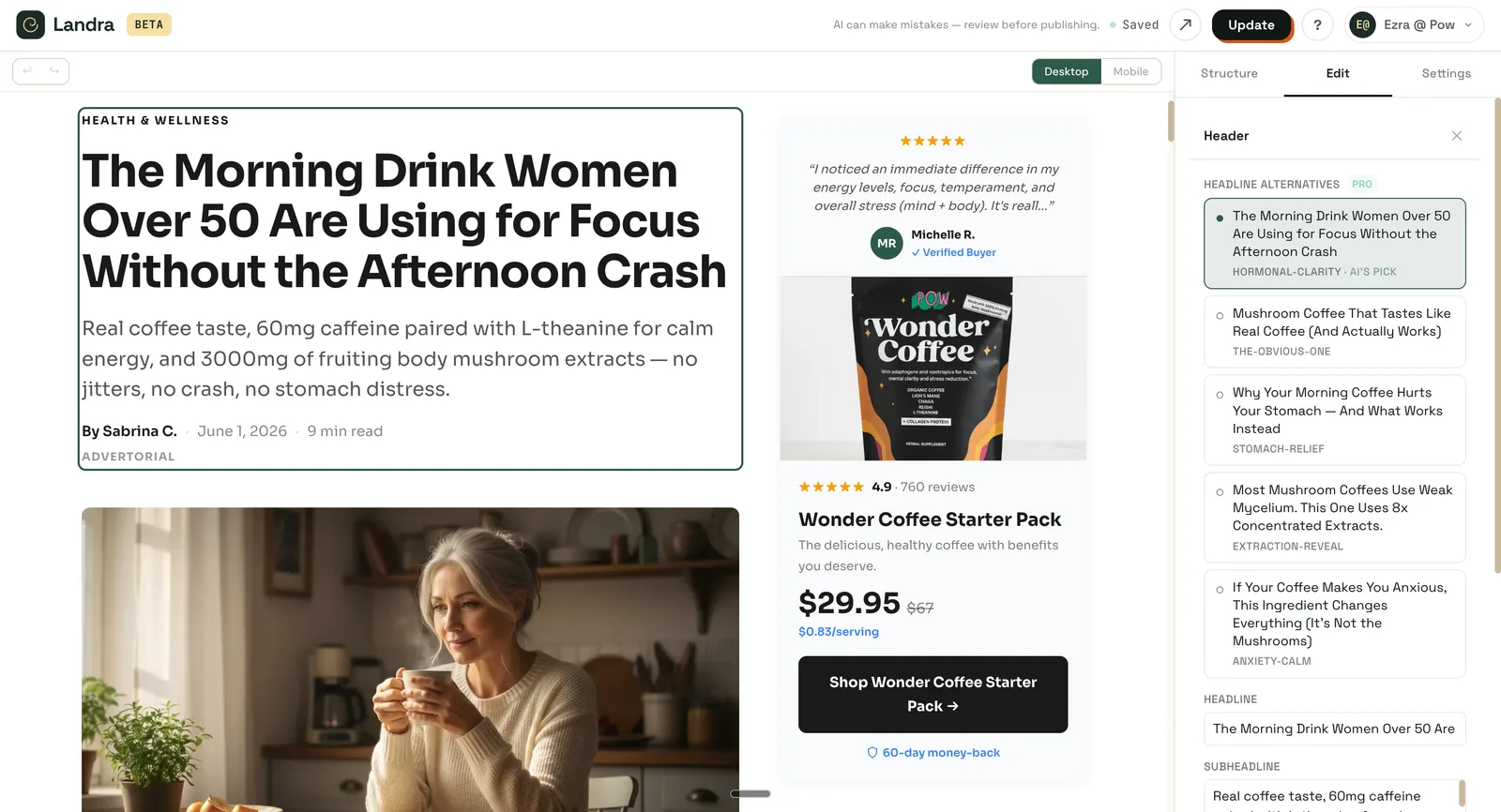
The native-specific part: every Landra advertorial ships with the "ADVERTORIAL" label auto-injected above the headline and a compliance footer (the FTC advertising disclosure and, for supplement and functional categories, the FDA-style health disclaimer) built in by default. That is exactly the on-page furniture Taboola and Outbrain require, so the page clears network review on the elements a DIY page typically forgets. (To be clear about the dividing line drawn above: Landra builds the landing page, not the ad creative — the thumbnail and headline inside the widget are yours to make.)
The honest framing still holds: the page is most of the work on native, but not all of it. You still write the widget creative, pick the campaign settings, and substantiate your own claims with something real. What Landra removes is the part where you build a labeled, disclosed, conversion-optimized advertorial from scratch and hope you remembered the furniture the network checks for. See the AI advertorial generator for how the page itself comes together.
Where to start with native
Before you spend a dollar on a Taboola or Outbrain campaign, get the destination right, because on native the page is not the place you cut corners; it is the place the campaign lives or dies. Start here: assume the reader is the coldest you will ever pay for, and build the pre-lander to match. Pick advertorial or listicle by how much the reader needs taught, message-match the open to the exact tile that earned the click, place the "Advertorial" label above the headline and the disclaimers in the footer so the campaign clears review, and warm with real education before the offer. Then point the warmed reader at the product page to buy. The widget gets you the click; everything that turns it into a sale happens on the page in the middle, which is why, on native more than anywhere, the pre-lander is the campaign. Once the page is built, the format choice — advertorial or listicle — is the last knob to turn before you launch.
Frequently asked questions
What is a native ad funnel?
The native ad funnel is the three-stage path a native campaign runs on: a content-recommendation widget (the "you may also like" tile on Taboola or Outbrain) drives the click, an advertorial or listicle pre-lander warms the reader and earns belief, and the product page takes the sale. The pre-lander is the load-bearing stage — native traffic is too cold to send straight to a product page.
Why is native traffic colder than paid social?
A native click comes from someone reading an article, not scrolling a feed they came to browse — content-browsing mode, not shopping-adjacent scrolling. There is no creator, no social proof, and no brand the reader chose to follow. Intent is lower and trust is borrowed from the publisher, not the brand, so the landing page has to build more belief than a paid-social one.
Do Taboola and Outbrain require an advertorial landing page?
Effectively, yes, for editorial-style campaigns. Both networks require a prominent "Advertorial" or "Advertisement" label across the top of any page that could be confused with editorial, plus substantiated claims and health or finance disclaimers in the footer. A bare product page styled as an article without those elements fails review.
Can I send native ad traffic straight to my product page?
You can try, but it usually fails twice. The reader is too cold — they were reading content, not shopping — so a closing page with a price and a buy button asks for a decision they have not reached. And the networks will not approve a bare product page as the destination for an editorial-style native ad in the first place. The fix is an advertorial-grade pre-lander between the widget and the product page.
What is the difference between native ad creative and the native landing page?
The native ad creative is the thumbnail image and headline that appear inside the recommendation widget — the tile a reader clicks. The native landing page is where that click lands: the advertorial or listicle pre-lander. They are two different assets. Some networks offer tools to generate the creative; the landing page is a separate build and where most of the conversion work happens.
Which DTC categories run native ads the most?
Supplements and nutra, finance, and education-heavy DTC dominate native — categories where the buyer needs teaching before the sale, which is exactly what an advertorial does well. The editorial frame lets a brand explain a mechanism and lower skepticism in a way a product page cannot, which is why these verticals built native into their playbook.