
For most of the past three decades, the most useful book ever written about advertising was out of print, and used copies sold for hundreds of dollars, with documented sales around $900 before the official reprint. Breakthrough Advertising, written by Eugene Schwartz in 1966, now sells as a $125 hardcover from Brian Kurtz's Titans Marketing, and working copywriters still treat it as required reading.
A book doesn't hold a three-figure price for sixty years because of clever phrasing. It holds it because of one idea at its center: your prospect's state of awareness decides where your ad must begin. Get that right and the rest of the copy follows; get it wrong and nothing downstream can save the page.
This guide explains the five stages as Schwartz framed them, then does the part most write-ups skip: it maps each stage to the landing-page format a DTC brand should actually run (advertorial, listicle, or product page) and shows how to diagnose the stage your paid traffic is in before you spend on it.
Who was Eugene Schwartz?

Eugene Schwartz was a direct-mail copywriter who, between the 1950s and his death in 1995, became one of the highest-paid writers in advertising, famous for headlines like "Give Me 15 Minutes and I'll Give You a Super-Power Memory," and for fees that became industry legend: Rodale Press is widely reported to have once paid him $54,000 for four hours of work. When he died in 1995, his New York Times obituary led with the other half of his life: "Eugene Schwartz, Modern-Art Collector."
The work habits were as famous as the fees. Brian Kurtz, who worked with Schwartz at Boardroom in the 1980s, describes the kitchen timer set to 33 minutes and 33 seconds: one task, no interruptions, break, repeat. And Schwartz famously took no cash from Boardroom at all: he traded winning copy for mailing lists to feed his own publishing company, a deal Kurtz reckons out-earned any fee.
But the reason the book outlived the man is the framework at its core. Schwartz's deepest principle — "this is the copy writer's task: not to create this mass desire — but to channel and direct it" (Breakthrough Advertising, ch. 1, as quoted by Mirasee) — raises the obvious question: channel it from where? His answer is the five stages.
What are the 5 stages of awareness?
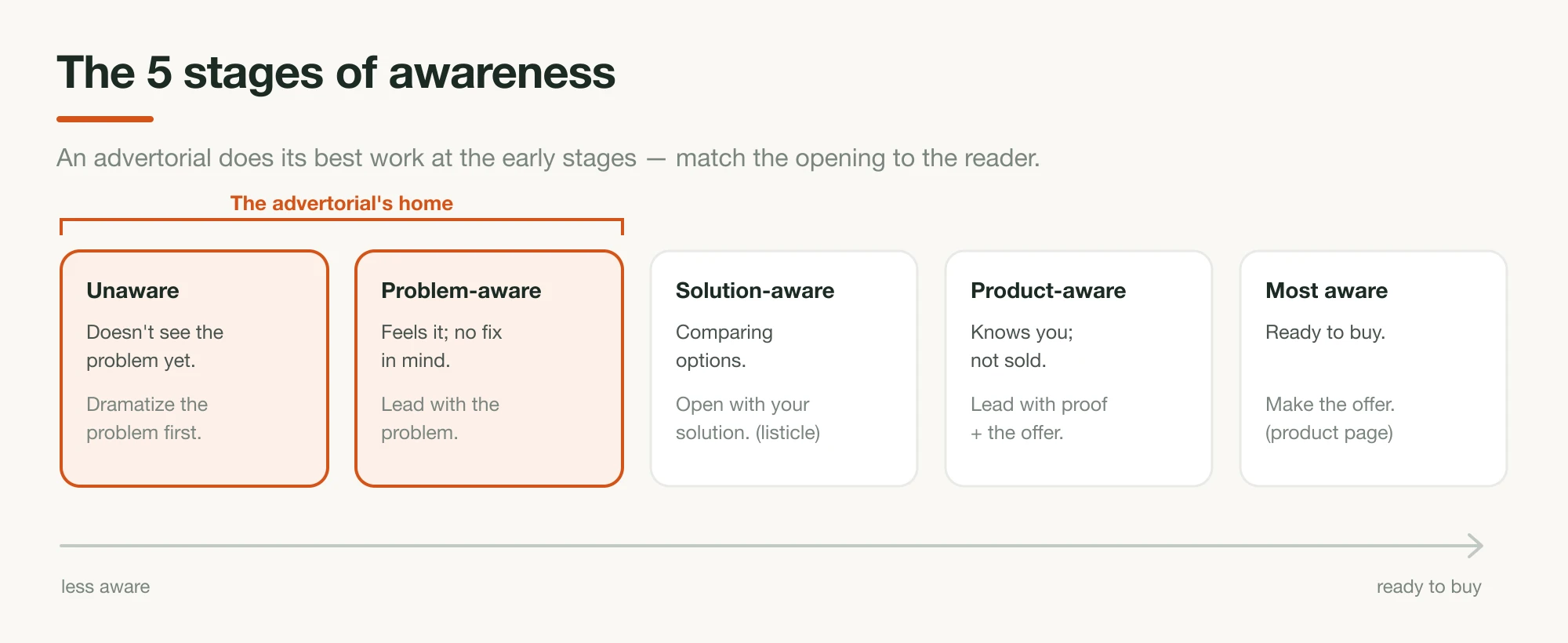
The five stages of awareness describe how much a prospect already knows — about their problem, about the solutions that exist, and about your product. Schwartz ordered them from Most Aware down to Completely Unaware; modern marketers usually flip them into journey order. The stage a reader is in determines where your copy must begin.
The canonical definitions, as preserved by Copyhackers — the team that has done the most to translate Schwartz for the conversion era — run as follows, journey-first:
1. Unaware
The reader doesn't feel the problem yet. Schwartz's "completely unaware" prospect knows nothing "except, perhaps, his own identity or opinion." You cannot open with the problem, let alone the product; there's nothing for either to attach to. The lead has to start with the reader — a story, an identity, a claim about their world — and walk them to the problem. This is the hardest, most expensive reader to convert, and most DTC brands shouldn't start here.
2. Problem-Aware
The reader feels the pain but doesn't know solutions exist. The lead opens on the problem (names it more precisely than the reader can, agitates what it costs them) and then introduces the idea that it's solvable. This is PAS territory, and it's where most cold paid-social traffic actually lands: the ad spoke to a pain the reader already felt.
3. Solution-Aware
The reader knows the result they want and knows solutions exist — they just don't know your product delivers it, or which option to pick. The lead opens on the desired result, then proves your product is the best route to it. This reader is comparing, so copy that ranks, contrasts, and scores options meets them exactly where they are.
4. Product-Aware
The reader knows your product but isn't convinced. Schwartz's prescription: sharpen the claims and stack the proof — reviews, demonstrations, guarantees, the difference between you and the alternative they're also considering. Desire doesn't need creating here; doubt needs removing.
5. Most Aware
The reader is ready to buy and just needs the deal: the product, the price, the terms. Schwartz's most-aware ad is barely an ad — name the product, state the offer. Anything more is friction between a decided buyer and the checkout.
Cold traffic isn't unaware traffic
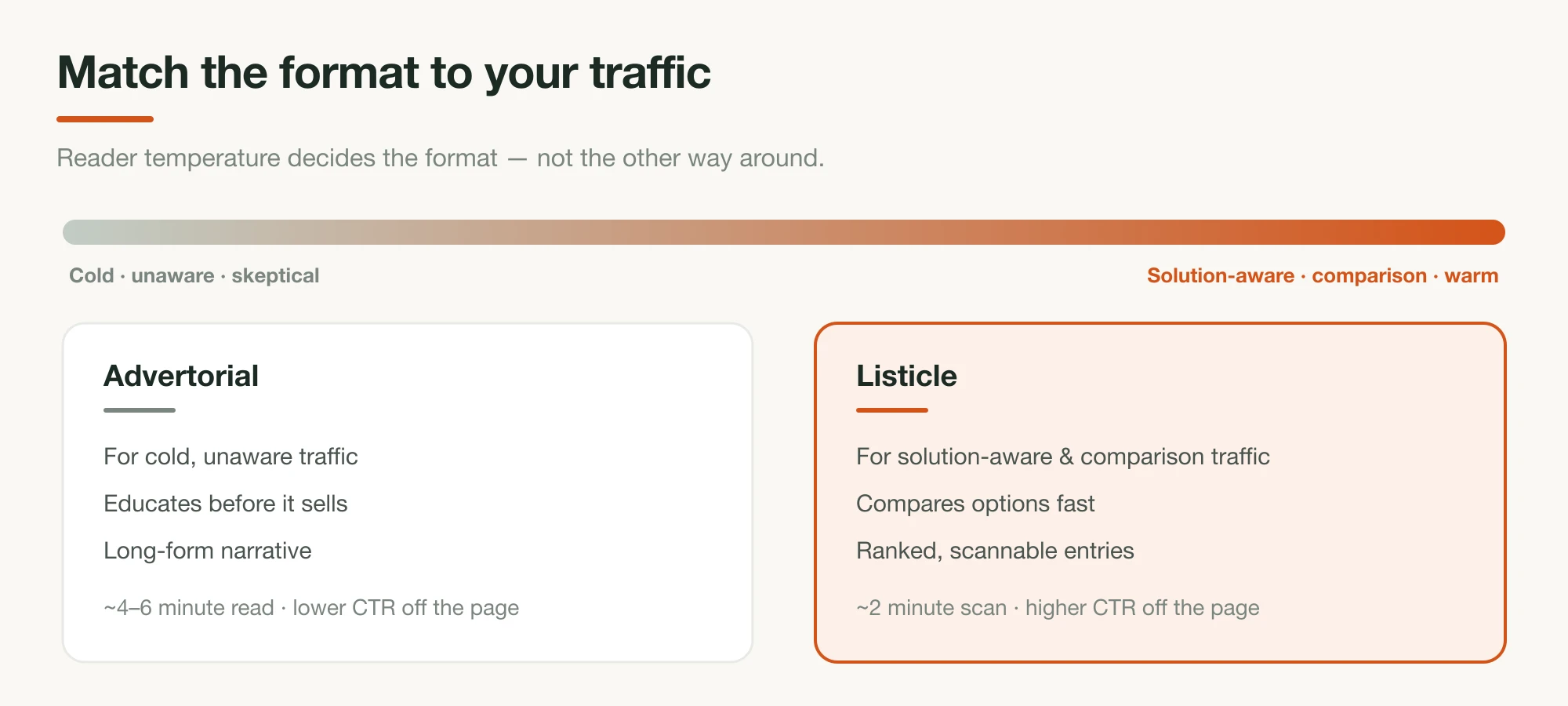
The most expensive mistake in applying the stages is equating "cold" with "unaware." Cold measures familiarity with your brand; awareness measures familiarity with the problem, and a reader who clicked your Meta ad almost always arrives already feeling the pain the ad named. Most cold paid-social traffic is problem-aware or solution-aware, not unaware.
That distinction does real work. It explains why a problem-led listicle can convert cold traffic the "advertorials for cold, listicles for warm" shorthand would hand to an advertorial, and why a genuinely unaware reader bounces off a list of reasons no matter how warm the targeting says they are. Temperature is a proxy for awareness, not a synonym. Diagnose the stage, not the source.
One number to be suspicious of while you're diagnosing: the "60% of every market is unaware" breakdown (and its 20/10/7/3 cousins) that circulates in awareness-stage articles has no primary source; it isn't in Breakthrough Advertising. Per-stage percentages are folklore. What's defensible is directional: prospecting channels skew early-stage, retargeting and search skew late-stage.
Which landing-page format fits each stage
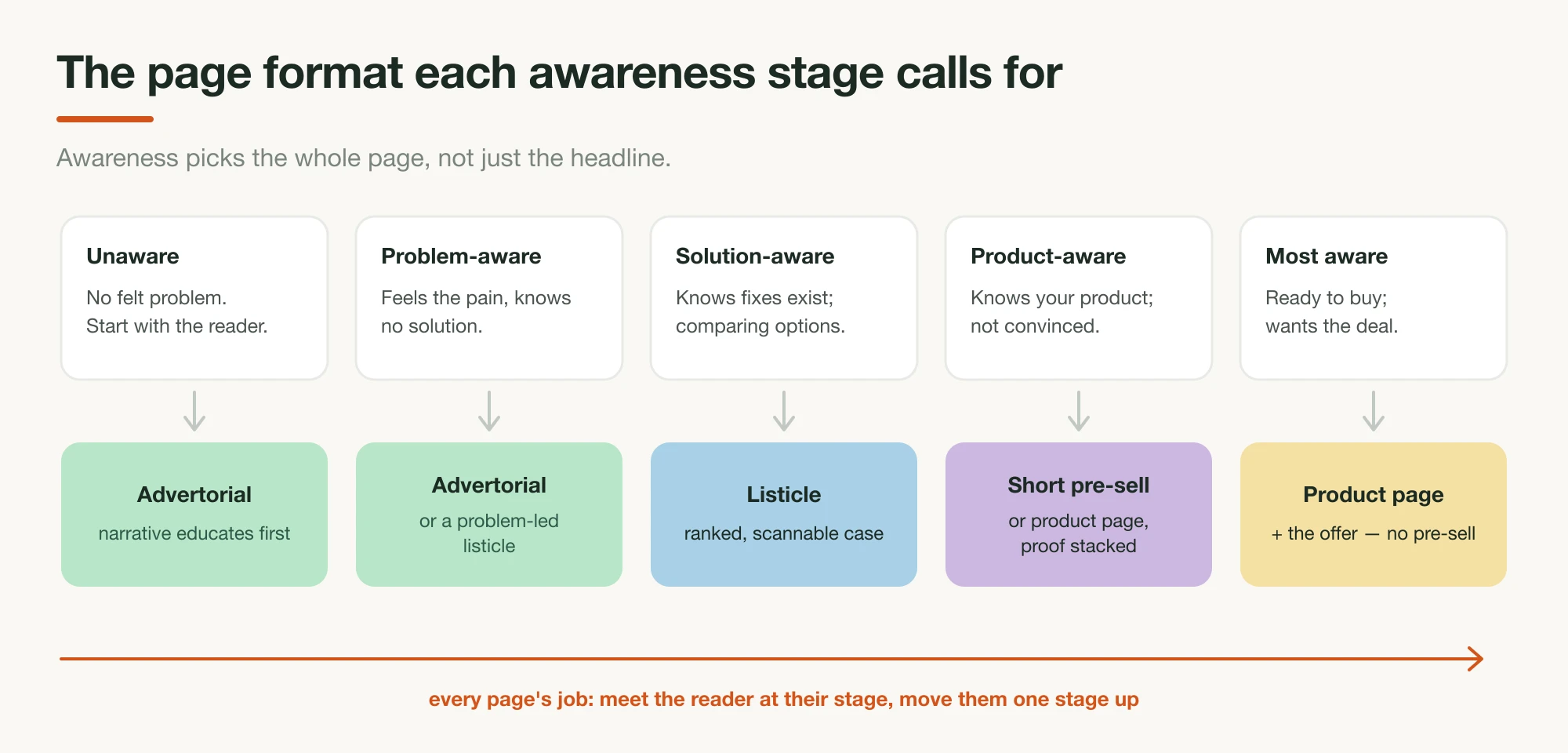
Awareness doesn't just pick your headline; on paid traffic it picks the whole page format. The early stages need a page that educates before it sells: an advertorial. The middle stage wants comparison: a listicle. The late stages want proof and the offer: a product page. Most awareness-stage guides stop at content types; this mapping is the part that moves ROAS.
- Unaware → advertorial. Only narrative can take a reader from "no felt problem" to "I need this" in one visit. An advertorial opens on a story or an identity, surfaces the problem, then earns the pitch. There's a second reason editorial shape wins here: readers reflexively skip anything that looks like an ad — the Nielsen Norman Group has documented banner blindness across three decades of eye-tracking. A page that reads like an article gets the attention an ad-shaped page never will.
- Problem-Aware → advertorial, or a problem-led listicle. The narrative advertorial is the durable default; it can agitate and educate at depth. But a listicle whose headline names the problem (not your product) meets this reader too, especially when the ad already did some educating.
- Solution-Aware → listicle. This reader is comparing, and a ranked, scannable list is comparison in page form. NN/g's eye-tracking found users read at most about 28% of the words on a page, so a numbered list puts the whole argument in the headings that actually get read.
- Product-Aware → short pre-sell or product page with stacked proof. Reviews, before/afters, guarantees, "us vs them." A pre-sell page earns its keep when doubt is specific; otherwise the product page does it.
- Most Aware → product page or offer page. Skip the pre-sell entirely. The deal is the message.
This is the same mapping working DTC agencies converge on from practice. SplitBase, a CRO agency for eight- and nine-figure DTC brands, prescribes advertorials and listicles for cold first-stage traffic and product-focused landers as the journey progresses: a four-stage buyer-journey version of the same Schwartz logic.
The operating instruction for any of these pages comes from Joanna Wiebe's conversion copywriting guide for Unbounce: the top of the page must match the ad and the visitor's current stage; the rest of the page exists to move them to the next stage. A landing page isn't a stage's destination — it's the machine that advances the reader one rung.
This stage-to-format decision is also exactly the one Landra automates. Tell it your product and the audience you're targeting — including how aware they are — and it generates the matching page in minutes: the full advertorial or listicle, structure, copy, and images, tuned to that reader rather than assembled from a generic template.
The second axis: market sophistication
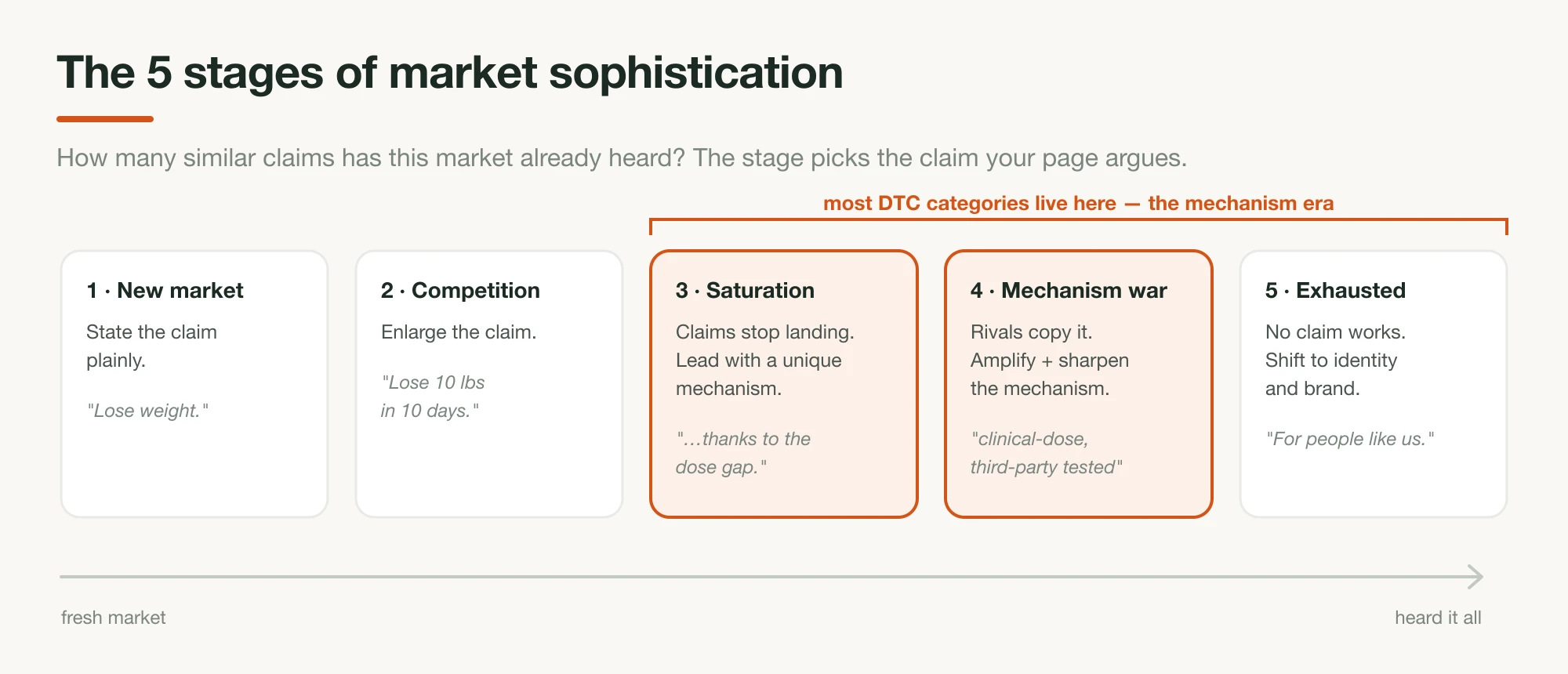
Awareness is half of Schwartz's diagnosis. The same book pairs it with market sophistication: how many similar claims your market has already heard. Awareness asks "how much does this prospect know?"; sophistication asks "how tired is this market?" Together they pick the lead and the claim, which is why reading only the awareness chapter gets you half a strategy.
Schwartz's five sophistication stages run from a virgin market (state the claim plainly, "lose weight") through claim inflation ("lose 10 pounds in 10 days") to the saturated stages where bare claims stop working and the winning move is a unique mechanism: the reason your product works where others failed. Most DTC categories — supplements, skincare, sleep, anything sold on Meta for a decade — sit at stage four or five. That's why the advertorials that scale in those categories are mechanism stories ("the dose gap," "the chlorine problem in your shower") rather than claim stacks: the market has heard every claim, but a new mechanism resets the conversation.
The practical split to remember: awareness picks where the page begins; sophistication picks what the page argues. A problem-aware reader in a stage-five market needs an advertorial that opens on their pain and pivots to a mechanism they haven't heard before.
How to diagnose the stage your traffic is in
You can't survey every visitor, but you can read the stage off three signals you already have: the channel, the ad, and the query. Run each campaign through them before you pick the page, and re-run them when a page underperforms — the most common fix is moving the lead one stage earlier.
- The channel sets the prior. Broad Meta/TikTok prospecting skews problem-aware (the ad found them; they weren't looking). Search skews solution-aware ("best magnesium for sleep") or product-aware (your brand name). Retargeting and email skew product- and most-aware. Same logic as traffic temperature, but read it as evidence about awareness, not a rule about formats.
- The ad moves the reader before the click. A long, problem-agitating video ad can take a problem-aware viewer most of the way to solution-aware before they land, which is why the page must pick up exactly where the ad left off, not restart the pitch from zero. Mismatched scent kills the click's momentum.
- The query says it out loud. On search, the words are the diagnosis: "why do I wake up at 3am" is problem-aware; "magnesium glycinate vs citrate" is solution-aware; "BrandX discount code" is most-aware. Map ad groups to stages and the landing-page assignments fall out.
When two signals disagree, write for the earlier stage. A solution-aware reader will skim past education they don't need, but a problem-aware reader hits a comparison page built for someone two rungs up and bounces. Over-educating costs seconds; under-educating costs the click.
Start with the reader, not the page
Sixty years on, the stages survive because they encode the only order that works: first diagnose what the reader already knows, then decide what the page must do, and only then write. Schwartz said it himself, in a 1994 talk at Rodale Press: "copy is not written. Copy is assembled." You assemble it from what's already in the prospect's head, and the five stages are the inventory of what's in there.
So inventory first. Place this campaign's reader on the ladder, check how sophisticated the market is, pick the format the stage calls for, and let the page move them one rung. The format guides take it from there: how to write an advertorial for the early stages, how to write a high-converting listicle for the middle, and the direct-response principles that run underneath all of it.
Frequently asked questions
What are the 5 stages of awareness?
The five stages of customer awareness, from Eugene Schwartz's Breakthrough Advertising (1966), are Unaware (doesn't feel the problem), Problem-Aware (feels the pain, knows no solution), Solution-Aware (knows solutions exist, not yours), Product-Aware (knows your product, isn't convinced), and Most Aware (ready to buy, needs the offer). The stage determines where your copy must begin.
Who created the 5 stages of awareness?
Eugene Schwartz, a direct-mail copywriter, laid them out in his 1966 book Breakthrough Advertising. The book was out of print for decades — used copies sold for hundreds of dollars — and is now back in an official edition from Brian Kurtz's Titans Marketing.
What landing page format works for each awareness stage?
Unaware and problem-aware readers convert best on an advertorial, which educates through narrative before it sells. Solution-aware readers want a listicle or comparison they can scan. Product-aware readers need proof and differentiation — a short pre-sell or product page with reviews. Most-aware buyers should go straight to the product page or offer.
What is the difference between stages of awareness and market sophistication?
Both come from Breakthrough Advertising. Awareness measures how much the prospect knows — about the problem, solutions, and your product. Sophistication measures how many similar claims the market has already heard. In practice, awareness picks your lead and page format; sophistication picks the claim and mechanism you build the page around.
Is most cold traffic unaware?
Usually not. Cold means new to your brand, not new to the problem. A reader who clicks a Meta ad almost always arrives problem-aware or solution-aware, because the ad spoke to a pain they already feel. Genuinely unaware traffic is rare on paid social — interest targeting and the ad itself pre-filter for people who recognize the problem.
Is it true that 60% of every market is unaware?
That figure circulates widely — usually as 60% unaware, 20% problem-aware, and so on — but it has no primary source and does not appear in Breakthrough Advertising. Treat any per-stage percentage as folklore. The honest version is directional: colder channels skew toward the early stages, warmer ones toward the later stages.