
The page was clean. Good editorial voice, a real mechanism, a labeled and disclosed layout that would have cleared review. And it opened: "Most people don't realize how much their afternoon energy depends on one overlooked habit." The widget tile that earned the click had said something far more specific — a coffee swap, a number, a person. The reader tapped a promise and landed on a throat-clear. By the second line they were gone, back to the article they'd left.
That page didn't fail on structure or compliance. It failed on the first sentence, because it was written like a Meta advertorial, where the reader arrives warmer and the open can take its time. Native is different in three ways that change how you write the copy itself, not just where you run it. This is a copy-craft guide for those three: it assumes you already know what an advertorial is and how the native ad funnel works, and it stays narrowly on the sentences.
What native changes about the writing
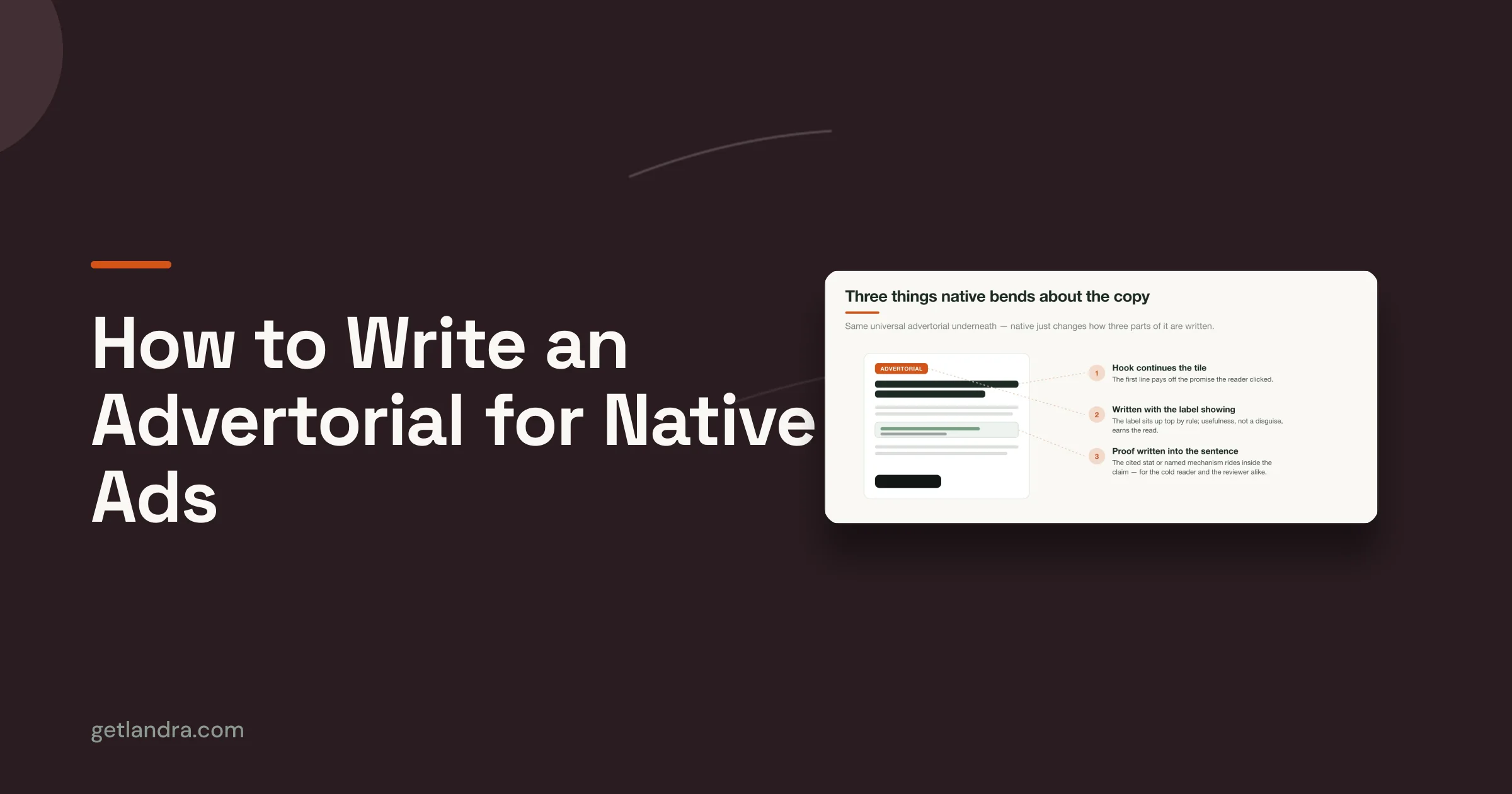
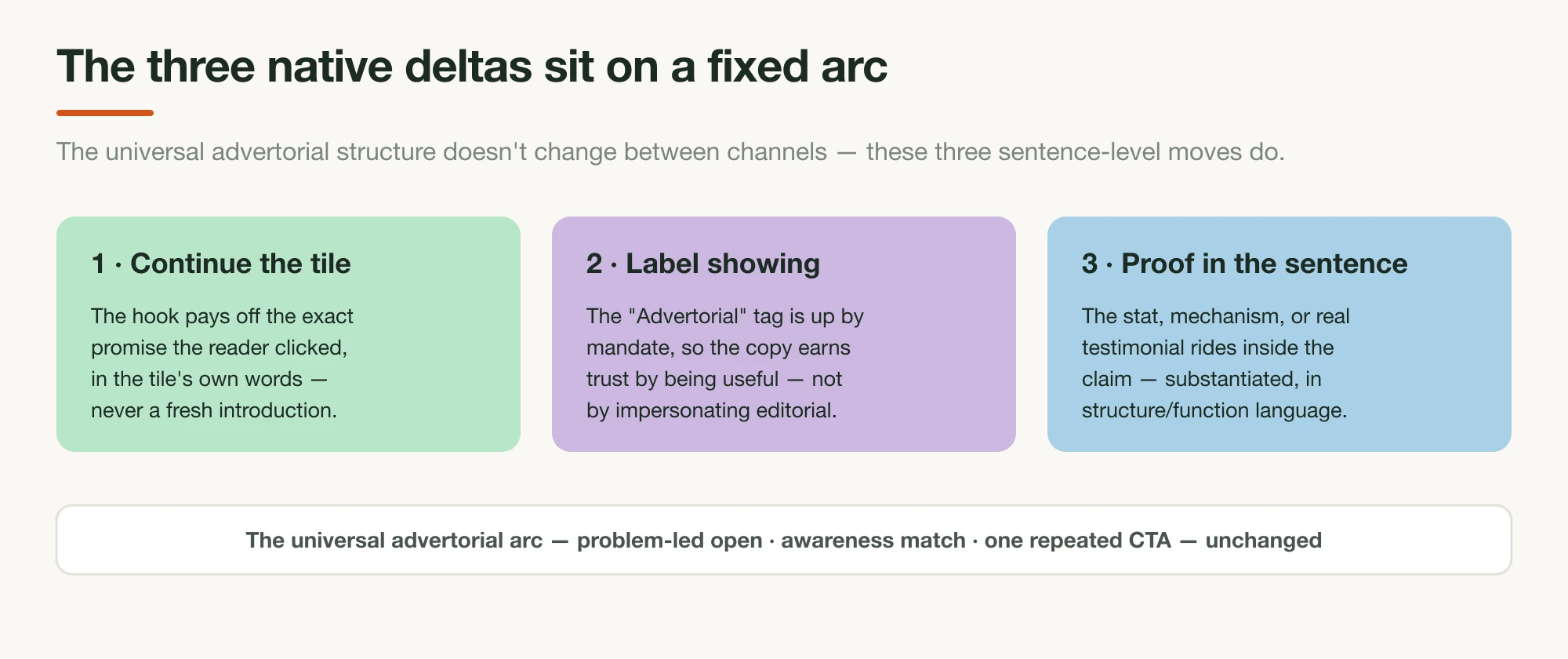
Native changes three things about how you write the copy, not just where it runs. One: the reader arrives in content-browsing mode off a specific widget headline, so the hook has to continue that exact curiosity, not restart it. Two: the "Advertorial" label is visible by mandate, so the copy earns attention honestly with the label showing. Three: every claim faces substantiation review, so proof goes into the sentence, not around it.
Those three deltas are the whole piece. They sit on top of the universal advertorial craft (the problem-led open, the awareness match, the one repeated call to action), which doesn't change between channels and which the 5-step advertorial framework already covers. Don't re-derive it here; what follows is only the three things native bends. Each one is a writing technique, not a strategy note.
Technique 1: write the hook as a continuation
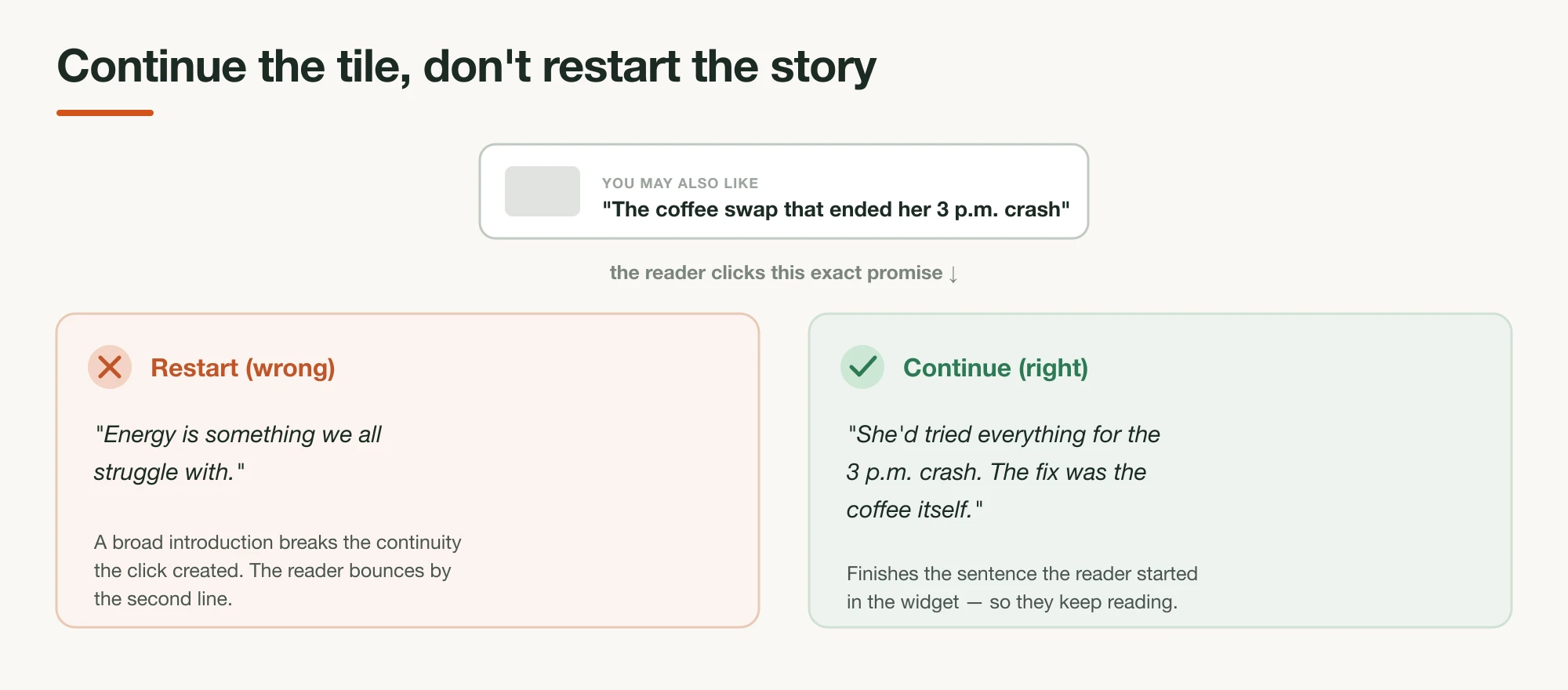
Write the native hook as a continuation of the widget headline, not an introduction. The reader didn't arrive curious in general. They clicked a specific promise in the tile, and the first two lines have to pay off that promise, in the same words, before doing anything else. A native open that restarts the story (a broad statement, a "most people don't realize") breaks the continuity the click created and bounces the reader.
This is message-match pushed down to the sentence. On paid social there's usually some brand recall or a creator's face cushioning a loose match; on native there is none. The reader trusts the publisher they were reading, not you, and that trust evaporates the instant the page reads like a different thought than the tile. So the craft move is mechanical: pull the exact noun and the exact promise out of the widget headline and make them the first thing the page says.
A worked version: the tile reads "The coffee swap that ended her 3 p.m. crash." The wrong open introduces: "Energy is something we all struggle with." The right open continues — "She'd tried everything for the 3 p.m. crash. The fix turned out to be the coffee itself." Same product, same body to follow. The second one finishes the sentence the reader started in the widget, so they keep reading instead of feeling handed off.
The move holds across categories, because it's mechanical, not creative. A skincare tile reading "The drugstore moisturizer dermatologists keep quietly recommending" does not want an open about how confusing skincare is; it wants "Three dermatologists named the same $12 moisturizer — and none of them sell it." Pull the concrete nouns the tile put in the reader's head (the dermatologist, the $12, the specific product) and lead with them. Write the body first if you have to, but write the hook to the tile last, and write it in the tile's own words.
Technique 2: write with the label showing
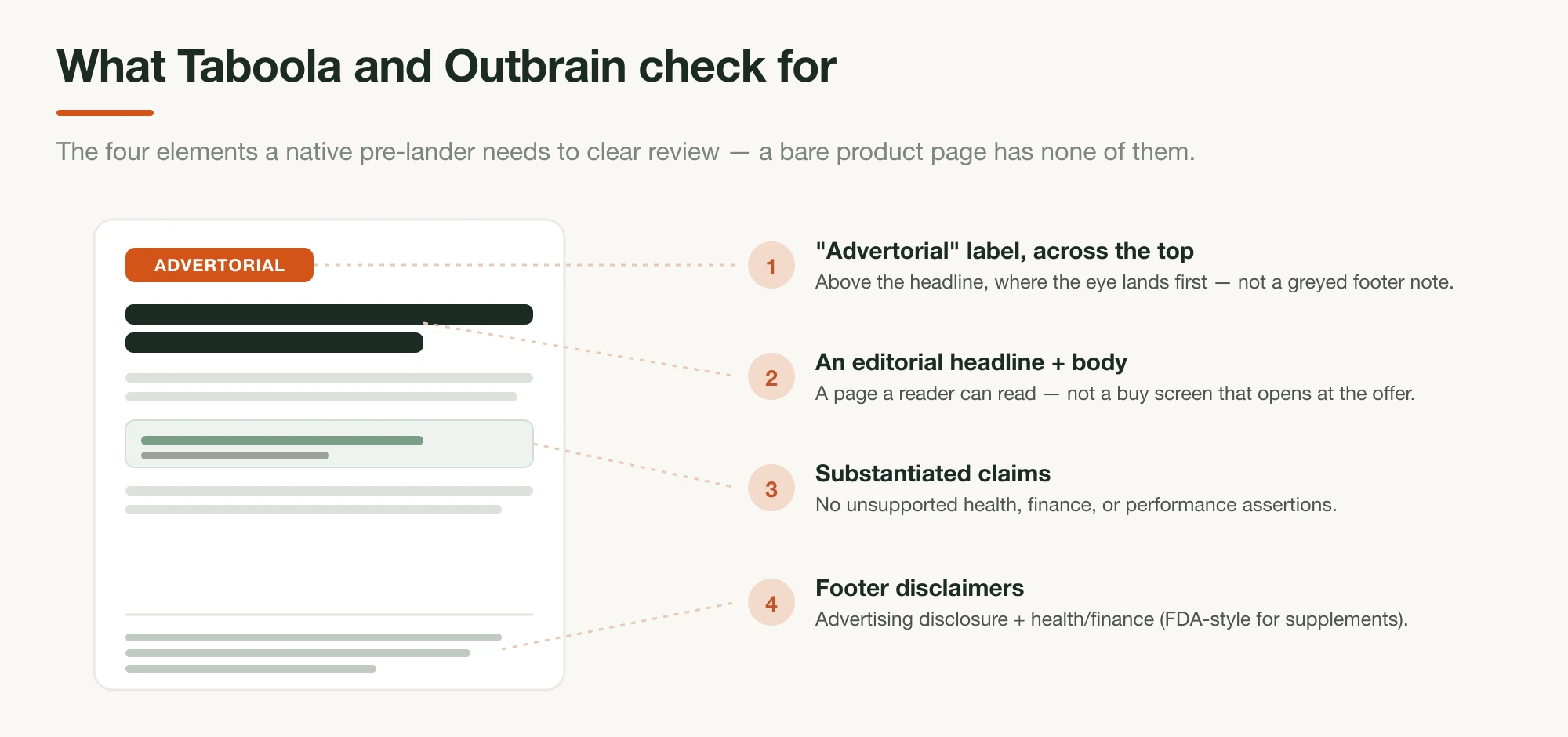
Write a native advertorial as if the "Advertorial" label is visible — because it is. Taboola and Outbrain mandate that disclosure across the top of any editorial-style page, so the copy cannot borrow the look of independent editorial to earn trust. It has to earn trust the honest way: by being genuinely, immediately useful with the label in plain sight. The label isn't a tax on the copy. It's a constraint you write toward.
This kills one move and rewards another. The dead move is impersonation — the fake masthead, the "as a recent study in [invented outlet] found," the borrowed authority of a publication that didn't endorse you. That's the fastest way to get rejected, and the native compliance rules cover exactly why it loses the account. The rewarded move is a reportorial voice that teaches something true. Building Landra's generator, this is the line we kept landing on: the honest editorial voice doesn't convert despite the label. It converts because a reader who can see it's an ad and keeps reading anyway is a reader you've actually earned.
What that looks like in the sentence: explain a mechanism the reader can repeat to a skeptical partner, name the specific thing that went wrong before the fix, quote a real person instead of an invented expert. Outbrain's own advertorial guidance lands in the same place from the network side — it frames the format as content that "flow[s] within the reading or viewing experience" instead of disrupting it. The label is up; the usefulness, not a costume, has to do the work the disguise used to.
Technique 3: write proof into the sentence
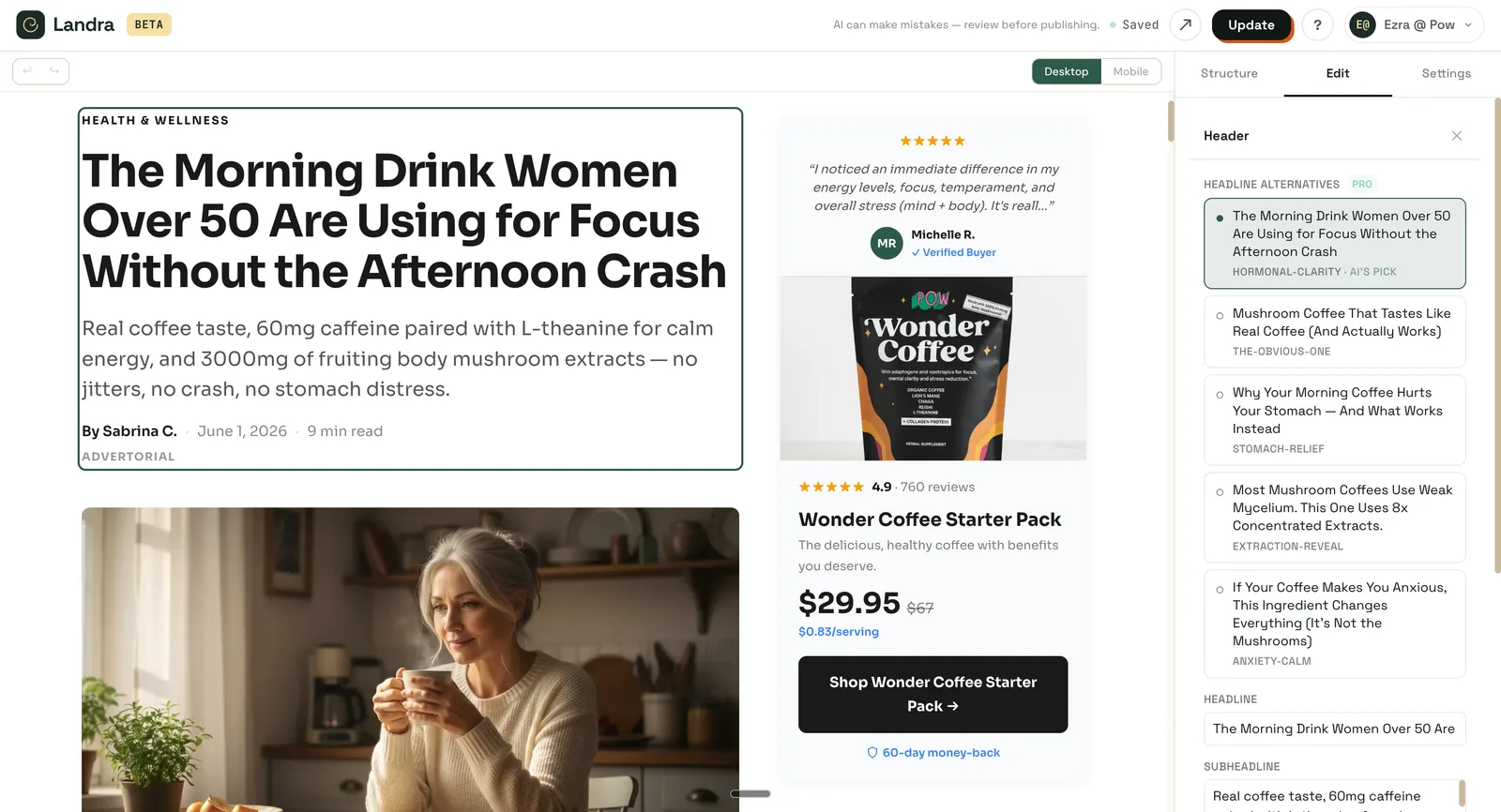
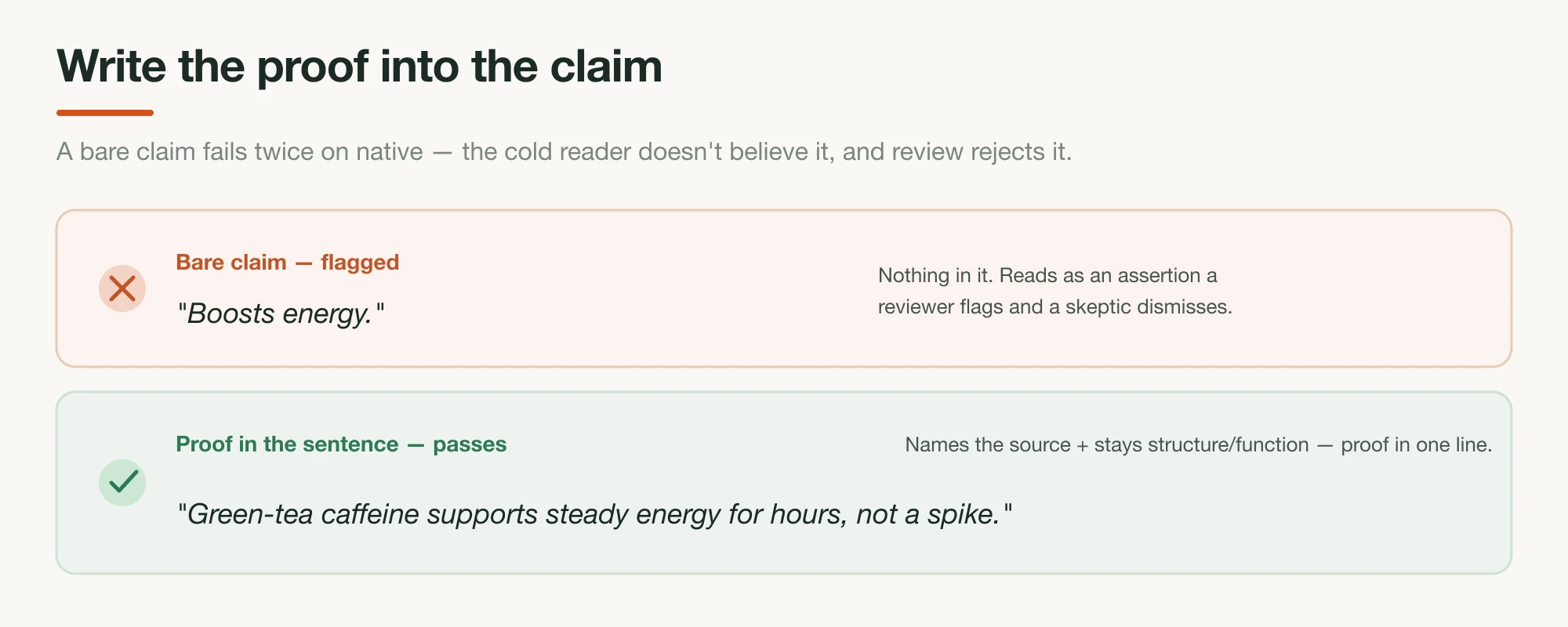
On native, write proof into the sentence the claim lives in — because a bare claim fails twice. The cold reader doesn't believe it without evidence, and network review rejects an unsubstantiated assertion outright. So the cited stat, the named mechanism, or the real testimonial isn't a separate "proof section" you bolt on later. It rides inside the claim itself, and the claim stays in structure/function language.
This is a sentence-level discipline, not a page-level one. "Boosts energy" is a claim with nothing in it; "green-tea caffeine supports steady energy for hours, not a spike" carries its own mechanism in the same breath. It names the source (green-tea caffeine) and stays in structure/function language ("supports steady energy"). The first reads as an assertion a reviewer flags; the second reads as an explanation a reader can repeat. Write the why into the claim and you satisfy the cold reader and the reviewer at once.
Two craft rules keep this honest on native:
- Every hard number arrives with its source attached. A naked statistic ("89% of women…") is an unsubstantiated claim by default, on native and to the reader. Either cite it in the sentence or soften it to something you can stand behind.
- Stay in structure/function language, always. "Supports restful sleep," never "cures insomnia." Disease and absolute language ("guaranteed," "melts fat") is a reject — the compliance piece details the exact lane, and the discipline belongs at the sentence level while you write, not in an edit pass after.
The reason this matters more on native than on Meta: the native reader started problem-unaware or barely problem-aware, so they're carrying maximum skepticism and zero brand trust. A claim with its proof built in is the only kind that survives that reader — and it happens to be the only kind that survives review, too.
The transition to the offer
The transition from editorial body to offer runs longer on native, because the reader is colder. There's no creator or brand-recall cushion, so the ramp from "here's the mechanism" to "here's the product and the price" needs more warming than its paid-social equivalent. In practice that means one more beat than you'd run on Meta: one extra objection answered between the mechanism and the ask (usually the "does this actually work for someone like me" objection a cold publisher reader carries by default), and one extra proof unit, a second real testimonial or a one-line mechanism recap, sitting between your last teaching beat and the first time you name the price. The native-specific note is just that longer ramp.
The structure of the close itself (one offer, one repeated call to action, the button copy that describes what happens on click) doesn't change between channels. That's universal advertorial craft, covered in the 5-step framework; don't reinvent it for native. The only adjustment is patience: assume the coldest reader you'll ever pay for, and earn the click through to the product page a beat later than your instincts want.
Write the page they thought they clicked
A native advertorial works when it reads like the article the reader believed they were clicking — and survives review while doing it. That comes down to three sentences-level moves, not a different strategy: open by continuing the widget's exact promise, write usefully with the "Advertorial" label in plain sight, and build proof into every claim in structure/function language. Get those right and the page that earns the coldest click on the internet is the same page that clears Taboola and Outbrain. Everything else (the arc, the awareness match, the single call to action) is the universal advertorial craft you already know, pointed at a colder reader who clicked a more specific promise.
Frequently asked questions
How is writing a native advertorial different from a Meta one?
Three things change the copy. The native reader arrives in content-browsing mode off a specific widget headline, so the hook continues that exact curiosity instead of restarting it. The "Advertorial" label is visible by mandate, so the copy earns trust by being useful, not by looking like real editorial. And every claim faces substantiation review, so you write proof into the copy rather than around it.
What should the first line of a native advertorial say?
It should continue the exact promise the reader clicked in the widget tile, in the same words. The reader tapped a specific hook — a coffee swap, a sleep fix, a surprising number — so the first two lines pay that promise off rather than introducing a new idea. A generic open after a specific tile reads as a bait-and-switch and loses the click.
Does the visible "Advertorial" label hurt the copy?
No. The label is up top by network rule on Taboola and Outbrain, so the copy cannot lean on looking like independent editorial. That is freeing, not limiting: you write in an honest, reportorial editorial voice that is genuinely useful, and the usefulness — not a disguise — is what earns the read with the label showing.
How do you write claims that pass native ad review?
Substantiate them on the page and keep them in structure/function language. Native review rejects a bare claim with no on-page evidence, so a cited stat, a named mechanism, or a real testimonial goes into the sentence with the claim. For supplements that means "supports restful sleep," never "cures insomnia" — structure/function, not disease language.
How long should the transition to the offer be on a native advertorial?
Longer than on paid social, because the reader is colder. There is no creator or brand-recall cushion, so the ramp from the editorial body to the offer needs more warming before the price and button appear. The native-specific point is the longer ramp; the universal close structure is the same arc every advertorial uses.