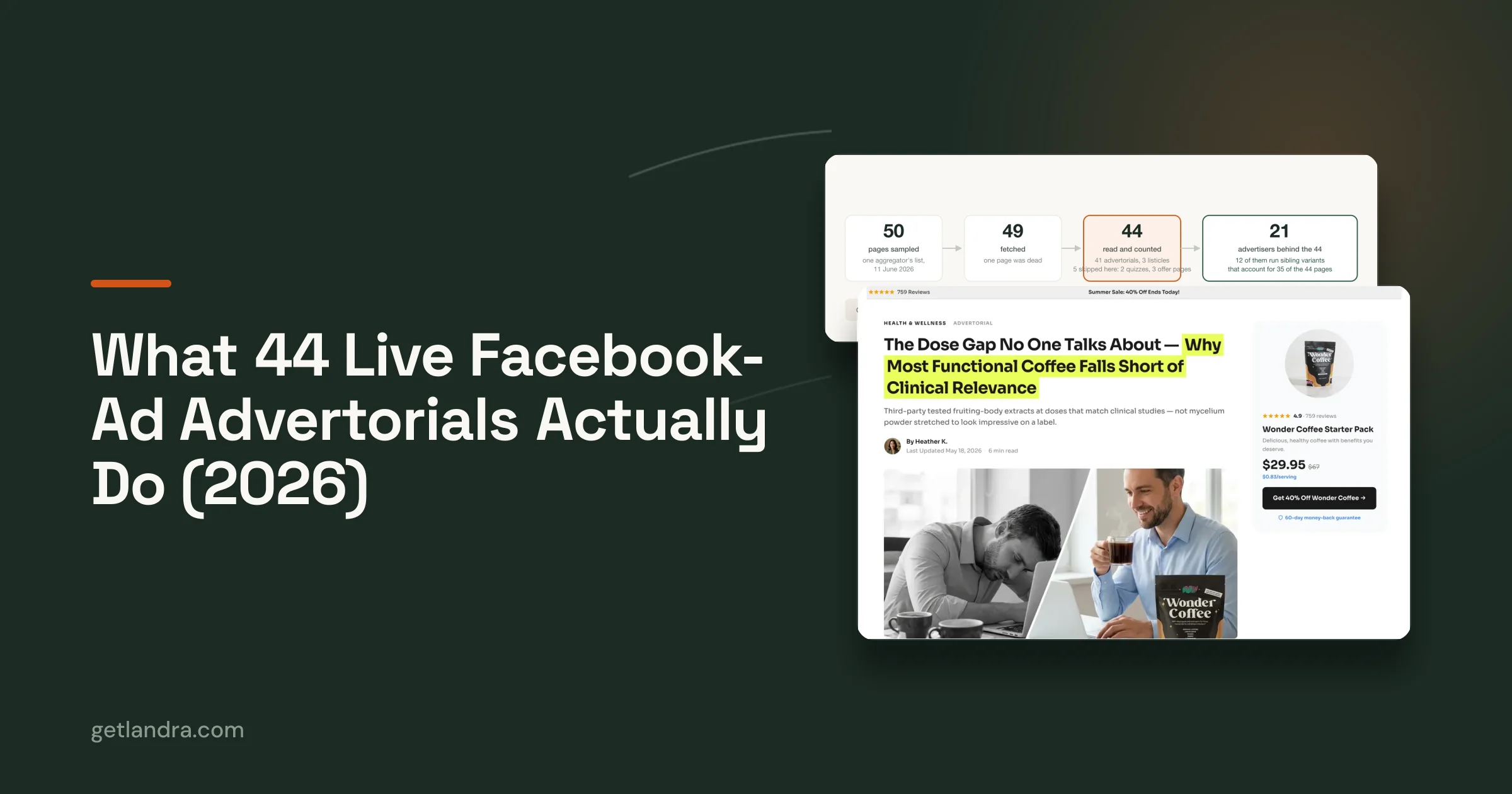

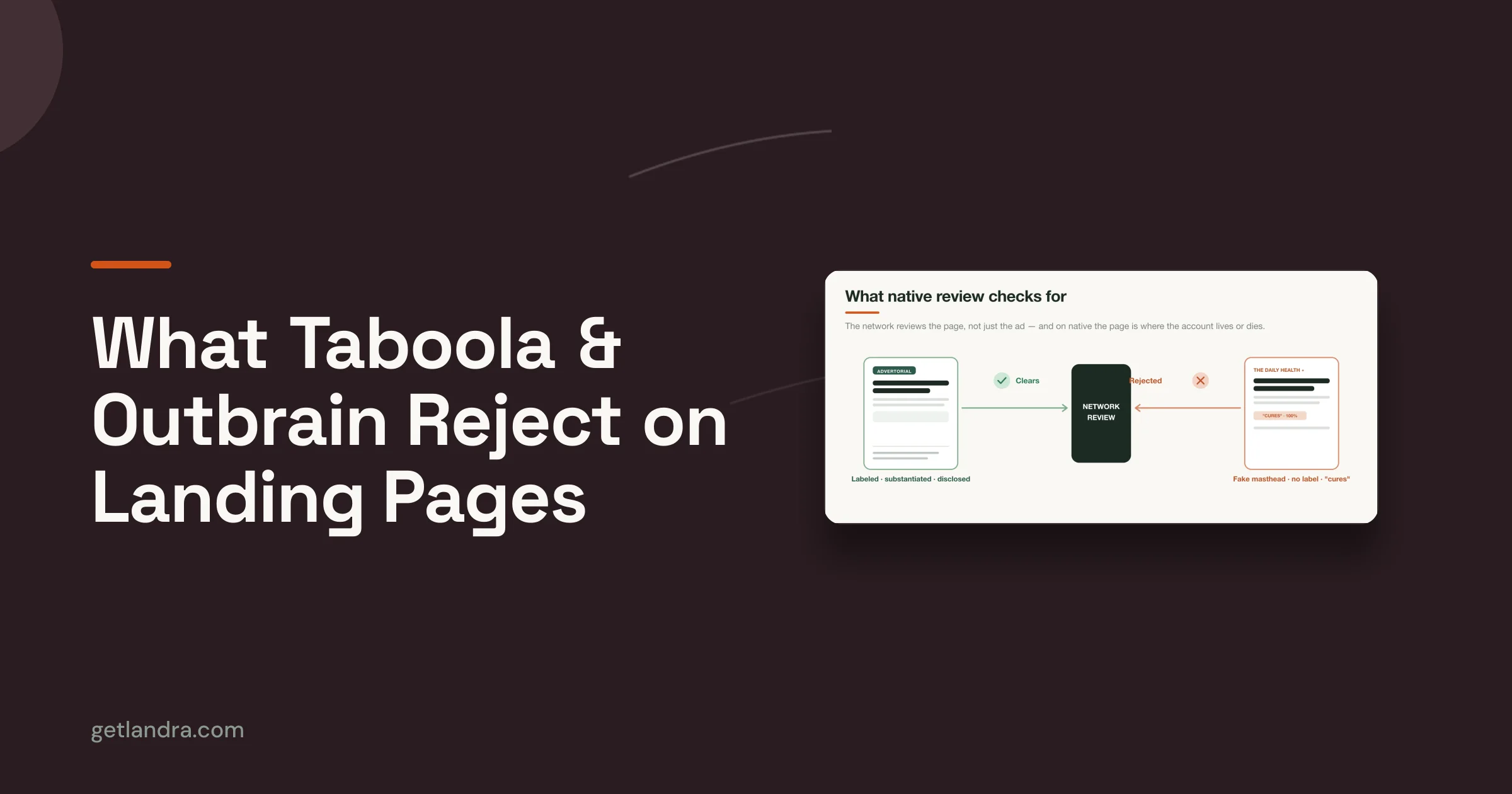
A supplement advertiser I was talking through a funnel with had a Taboola campaign disappear overnight. Not one ad paused — the whole advertiser account suspended, every campaign with it, mid-scale, no warning. The ads were fine. The creative was approved. What pulled the account was the landing page: an advertorial dressed up to look like a story on a real health-news site, with a number in the headline nobody could back up. The network does not just review your tile. It reviews where the tile sends people, and on native, the page is where accounts live or die.
This is the part of native advertising operators learn the expensive way. Native networks are stricter than Meta on advertorials, not looser, and they reject for the exact deceptive moves the FTC also penalizes. So on native, compliance is not a tax you pay grudgingly. It is the thing that keeps the account alive. This guide is the do-versus-don't reference: what Taboola and Outbrain actually reject on a landing page, why, and how to build the page that clears review. (New to the funnel this page sits inside? Start with the native ad funnel for DTC brands.)
Why native is stricter than Meta on landing pages
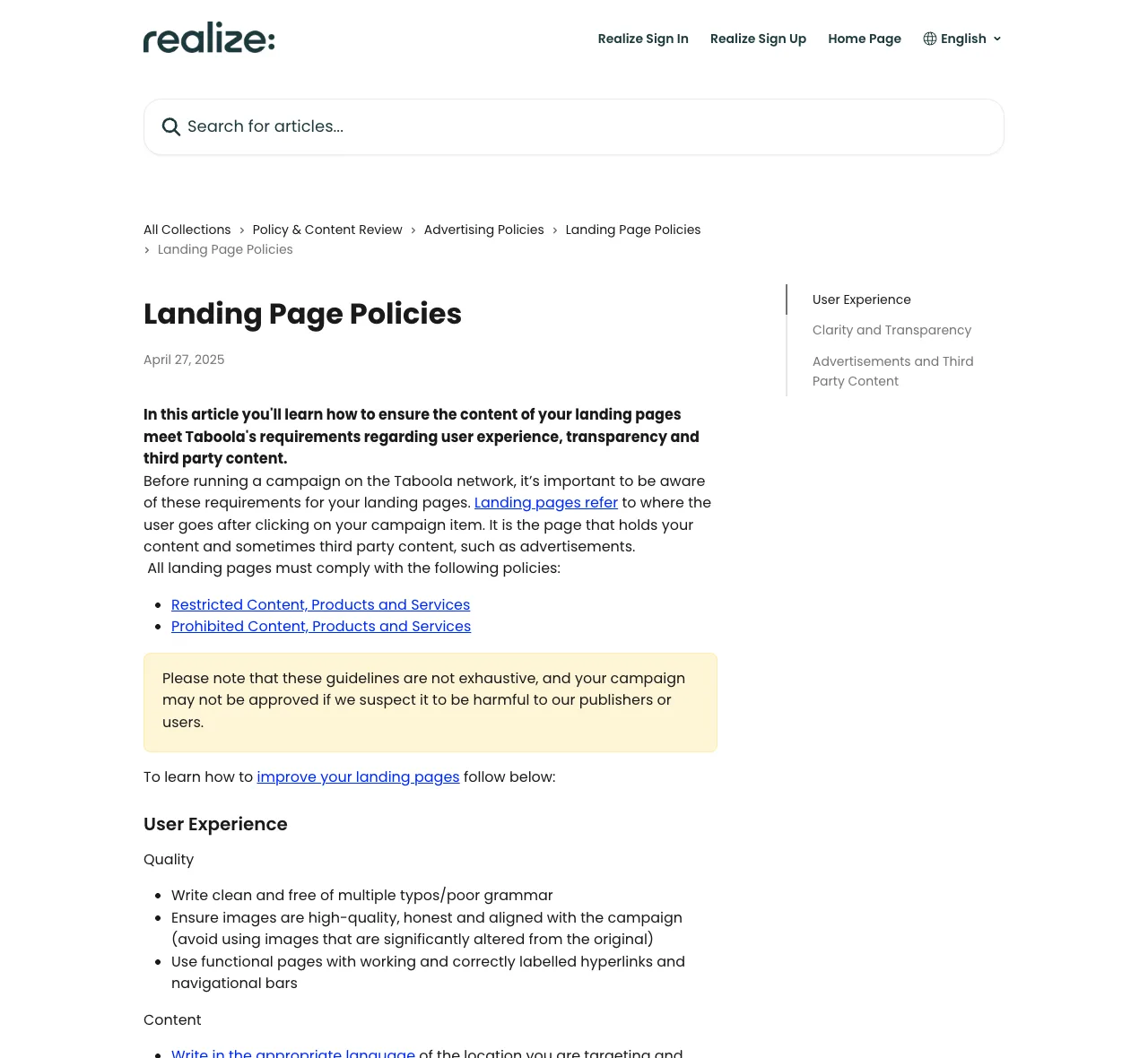
Native networks review landing pages harder than Meta because of where your ad runs. Taboola and Outbrain place editorial-style ads inside premium publisher sites (CNN, USA Today, NBC) and the network carries the reputational and contractual liability for what those readers land on. So landing-page review is manual, claims-checked, and policy-driven, not just an automated creative scan.
On Meta, the ad and the landing page share a feed-native context — the reader already knows they are in an ad environment, and the platform's review leans on automated systems against its ad policies. Native is different. The reader was inside a trusted publisher's article when the recommendation tile pulled them sideways. The publisher lent that trust; the network has to protect it. That is why both networks publish explicit landing-page policies that govern the destination page, not only the creative — and why a page that cleared Meta can still fail native review on the page itself.
The practical upshot: on native, the landing page is a first-class review surface. Taboola's landing-page policies and Outbrain's advertising guidelines both set conditions on what the destination page may say, how it must disclose, and what it may not impersonate. You are not getting approved on the strength of a good thumbnail. You are getting approved — or rejected — on the page.
What gets rejected: the five moves
Five things get a DTC advertorial rejected on native, and four of them are the same deceptive moves the FTC penalizes: impersonating a news site or real publication, absolute or disease health claims, unsubstantiated assertions, a missing or buried disclosure label, and missing footer disclaimers on health or finance pages. Each one maps to a published policy rule, not a reviewer's mood.
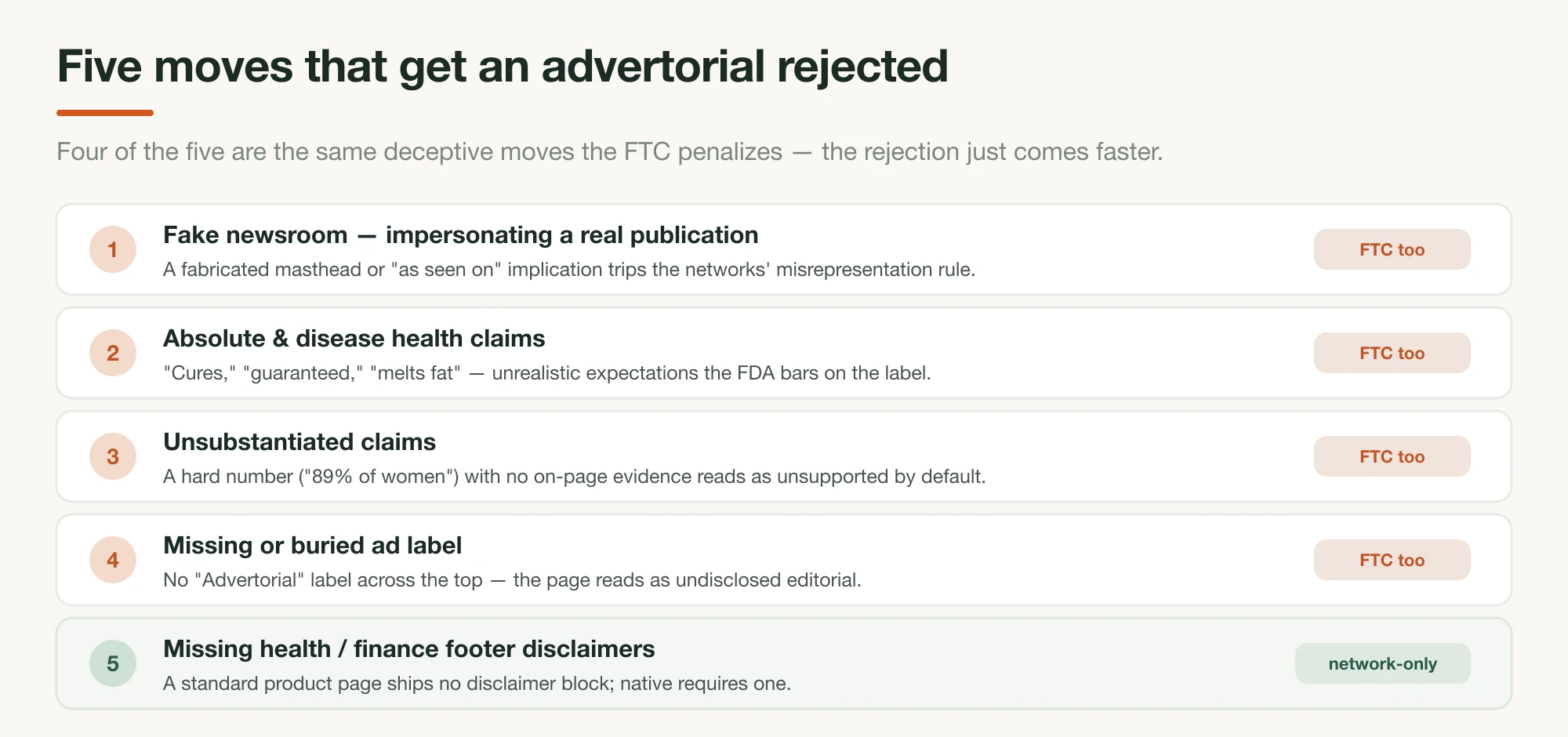
Here is the reference table (the rule, and why a page trips it), followed by each move in detail.
| What gets rejected | The rule behind it | Why pages trip it |
|---|---|---|
| Fake newsroom / publisher impersonation | Misrepresentation rules bar deceiving the reader about what they're viewing — and a fake masthead also skips the required ad label | The "shocking discovery" trope reaches for a fake masthead to borrow credibility |
| Absolute & disease health claims | Claims must be "easily supported"; absolute/disease claims set "unrealistic expectations" — and the FDA bars disease claims on supplements | Nutra copy overstates to juice CTR — the exact language review flags |
| Unsubstantiated claims | Prohibited-content rules bar misleading or unsupported assertions | A number with no on-page evidence reads as unsubstantiated by default |
| Missing or buried ad label | Editorial-style pages must carry a clear "Advertorial" / "Advertisement" label across the top | A DIY build forgets the label, or greys it out / drops it in the footer |
| Missing health / finance disclaimers | Health and finance pages must carry the appropriate footer disclaimers | A standard product page ships no disclaimer block at all |
1. Fake newsroom: impersonating a news site or publication
This is the load-bearing one, and it is the fastest way to lose the whole account. A page with a fake masthead trips two rules at once. Taboola's prohibited-content rules bar misrepresentation outright — content must not "use deception or intentionally hide or exaggerate information to lead users to misunderstand or believe something that is incorrect" — and a page dressed up as a real news outlet is exactly that deception. It also dodges the mandatory ad label that Taboola's landing-page policies and Outbrain's guidelines require across the top of an editorial-style page. You may borrow the structure of editorial: a narrative, a discovery, a clear story arc. You may not borrow the identity of a publisher.
The documented version of this move is specific. Supplement brand Obvi runs an advertorial — "Why 89% of Women Can't Lose Weight After 30" — under a "Mid Life Miracles" masthead with an expert byline a reader has no way to check, the news-discovery trope our supplement advertorial playbook breaks down (page observed June 2026; the byline's credentials we could not independently verify). That is the fake-newsroom pattern: dress the page in an invented publication, paste a credential nobody can check, imply a publisher endorsed you. It is the exact trope the FTC's fake-news-site cases were built on, and the one a native reviewer is trained to catch, because the network's entire value proposition is that its publishers are real.
2. Absolute and disease health claims
The second reject reason is the supplement category's signature failure: disease and cure claims, before/after misuse, and absolute language ("cures," "guaranteed," "melts fat," "100% effective"). Taboola's prohibited-content rules bar claims "that cannot be easily supported or that set unrealistic expectations for the user" — which is exactly what an absolute or disease claim does. And the line the network is protecting is the same one the FDA draws on the supplement label itself: a supplement may not claim to diagnose, treat, cure, or prevent a disease. The network is simply refusing to host, on a real publisher, the claim a regulator already bars.
The fix is the lane supplement marketers already know: structure/function language, not disease language. "Supports restful sleep" passes where "cures insomnia" does not. The discipline is identical to the FDA and FTC compliance floor under any supplement page; native review just enforces it as a condition of running, before the FDA or FTC ever sees the page.
3. Unsubstantiated claims with no on-page evidence
The third is the quiet one. A claim that isn't a disease claim can still get rejected for being unsupported. Taboola's prohibited-content rules bar misleading and unsubstantiated assertions outright — a hard number ("89% of women," "300% more absorption") with nothing on the page to back it reads as unsubstantiated by default. The reviewer is not asking you to prove it in the campaign manager. They are asking that the page itself not assert something a reasonable reader would take as fact with zero evidence shown.
The honest move is the same one the FTC requires: substantiate on the page, or soften the claim. A cited study, a real before/after with disclosure, a named source — that is what turns an assertion into a substantiated one. A bare number is a rejection waiting to happen, on native and in front of a regulator alike.
4. Missing or buried disclosure label
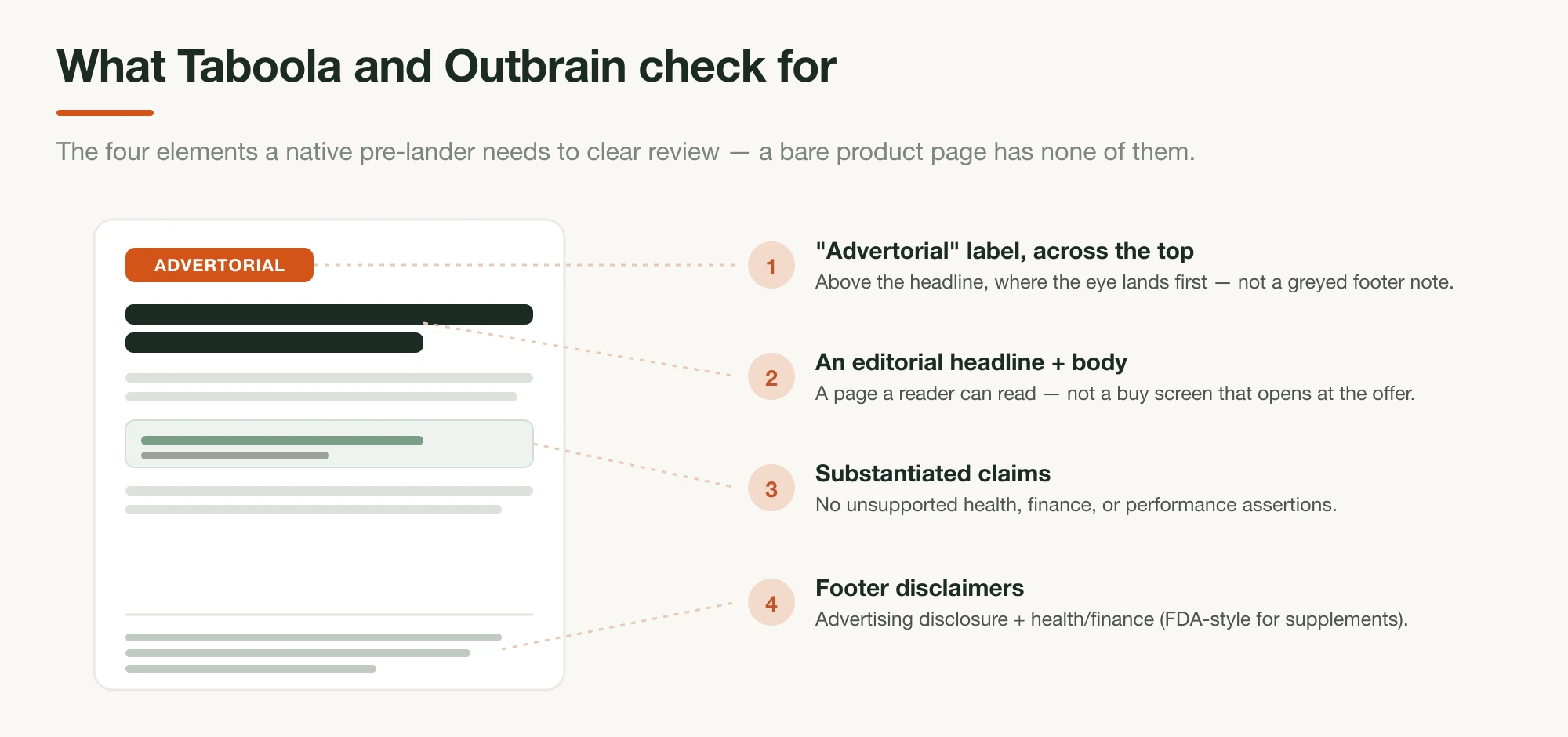
The fourth is the cheapest to fix and the most often forgotten. Both networks require editorial-style pages to carry a clear advertising label — the word "Advertorial" or "Advertisement" across the top, above the headline, where the reader looks first. Taboola's landing-page policies and Outbrain's guidelines both mandate this prominent disclosure. Grey it out, drop it in the footer, or skip it, and the page reads as undisclosed editorial — which is precisely what the networks (and the FTC) treat as deceptive.
A DIY build forgets this constantly, because it is the one element that feels like it works against the page. It does not. The label is the price of using the editorial frame at all, and the cleanest live advertorials place it plainly and convert fine with it on.
5. Missing health or finance footer disclaimers
The fifth applies to the two categories native runs hardest: health and finance. Outbrain's guidelines call for the appropriate footer disclaimers on these pages — for supplements, the FDA-style structure/function disclaimer; for finance, the standard risk language. A standard product page ships no such block. An advertorial-grade page has to, and a missing disclaimer footer on a supplement page is a routine reject.
The overlap with FTC law: same moves, different consequence
Network policy and FTC law are not the same thing, but they rhyme, because both target the same deceptive moves. The FTC's native-advertising guidance and endorsement rules penalize undisclosed ads, fake editorial formats, fabricated authority, and unsubstantiated claims. So does network review. The difference is the consequence: break network policy and your campaign does not run; break FTC rules and you face federal enforcement.
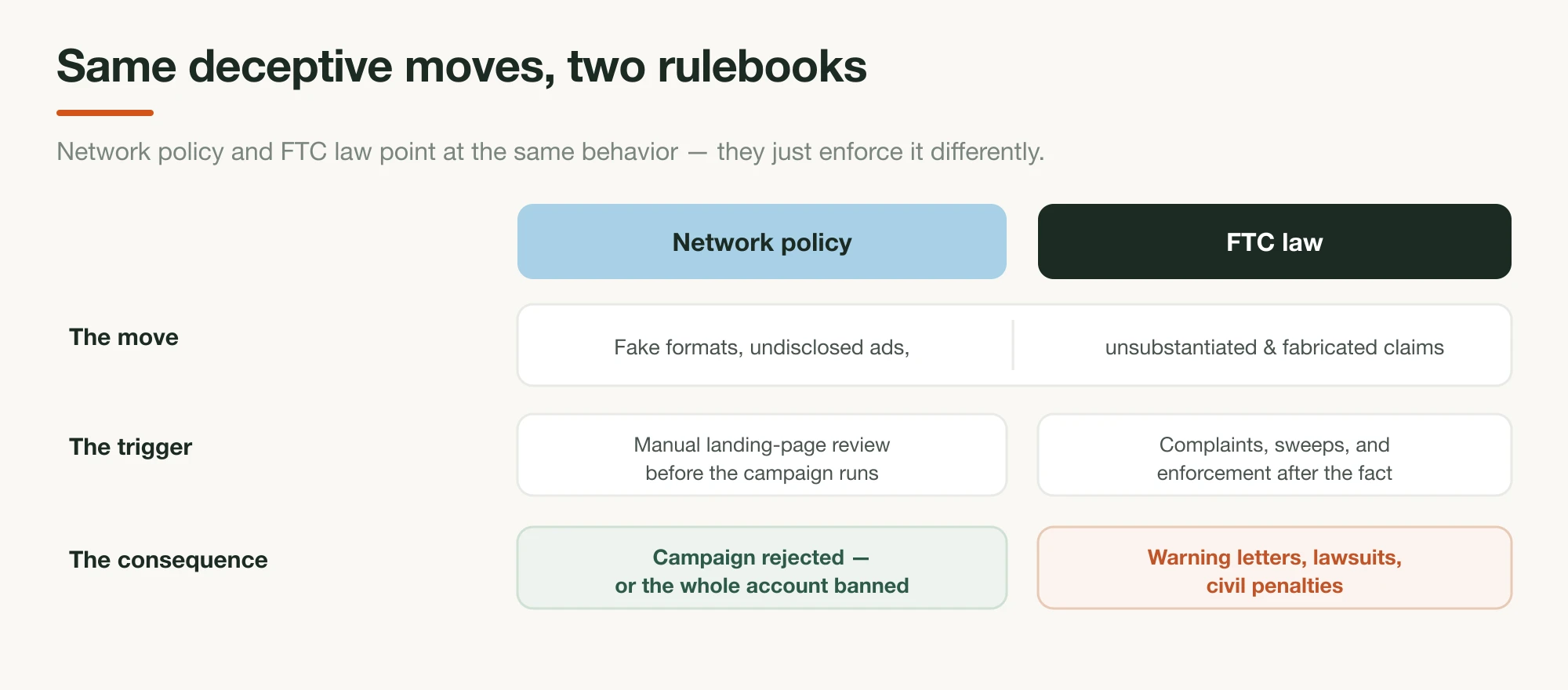
Worth being precise about the line. Network policy is a private approval condition set by a company you are paying to distribute your ad; it is enforced by rejection, not by law. FTC rules are federal law, enforced by warning letters, lawsuits, and civil penalties that reach into the tens of thousands of dollars per violation. They are different machines. But they are pointed at the same behavior, which is why the page that clears Taboola review and the page that keeps you out of an FTC file end up being the same page. For the legal backbone underneath the network rule — the exact labels, the placement, the substantiation standard — see advertorial disclosure and FTC compliance. This piece is the network-policy layer that sits on top of it.
Here is the signed take, because it is the part that costs operators real money: the fake-newsroom advertorial is not a clever growth hack with a small compliance risk. It is the single fastest way to get an entire ad account banned — and the documented cases that used it did not convert their way out of trouble. The fabricated publication exists to juice click-through, but a stolen masthead does not build belief that survives the click; it builds a click that the reader, the network, and the regulator can all see through. An honest advertorial with a real mechanism does the same persuasion job without betting the account on a lie.
Compliant and converting are not a trade-off
A compliant native advertorial does not convert worse than a deceptive one. The deceptive moves (the fake publication, the unverifiable doctor, the absolute claim) exist to lift click-through, but they do not deepen belief, and belief is what closes a cold reader. An honest page that names a real mechanism, shows real evidence, and labels itself plainly converts on trust the reader can keep after the click.
The reason this matters is that operators treat compliance and conversion as opposing dials: turn one up, the other goes down. On native, they are the same dial. The page that passes review is the labeled, substantiated, disclosed page; the page that converts a cold publisher click is the page that earns belief honestly. The fake-newsroom version optimizes the wrong moment, the click, and pays for it at the two moments that actually matter: the network's review and the reader's skepticism. You do not have to choose between a page that runs and a page that works. The same page does both.
This is the through-line across the whole supplement playbook, too: the advertorial and listicle a supplement brand runs both live or die on the same compliance floor, and the brands that scale build to it on purpose rather than gambling against it.
How to pass native review: the checklist
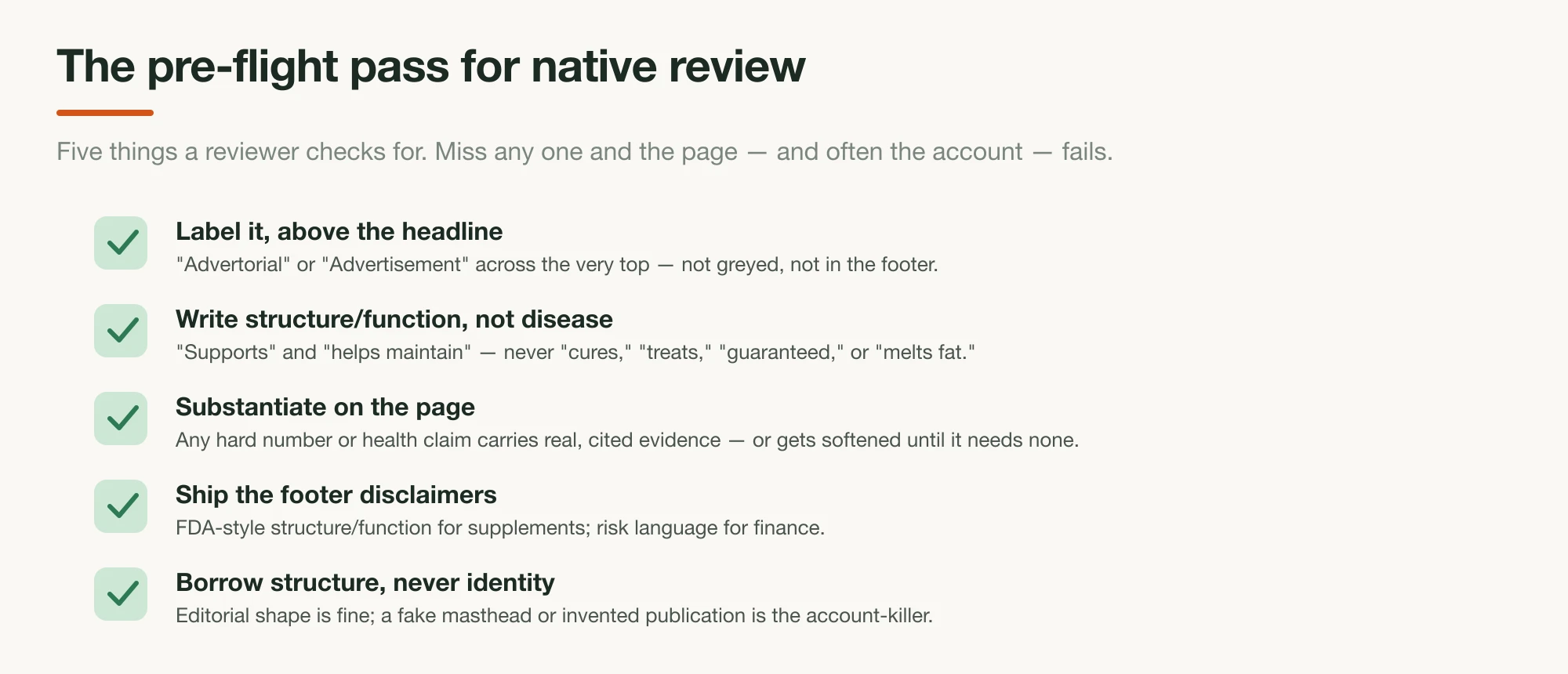
To pass Taboola or Outbrain review, the landing page needs five things: a prominent "Advertorial" label above the headline, claims written in structure/function language, on-page substantiation for any hard number, the required health or finance footer disclaimers, and no impersonation of a real news outlet. Run this before you point a dollar of spend at the page.
Pass review by getting these right:
- Label it, above the headline. The word "Advertorial" or "Advertisement" across the very top, where the reader looks first. Not greyed, not in the footer.
- Write structure/function, not disease. "Supports" and "helps maintain," never "cures," "treats," "guaranteed," or "melts fat." Absolute language is a reject.
- Substantiate on the page. Any hard number or health claim carries real, cited evidence on the page itself — or it gets softened until it doesn't need any.
- Ship the disclaimers. Health pages carry the FDA-style structure/function disclaimer in the footer; finance pages carry the risk language.
- Borrow structure, never identity. Editorial shape is fine; editorial impersonation (a fake masthead, an invented publication, an unverifiable byline) is the account-killer. Don't.
The moves that get you rejected:
- A fabricated publication name, masthead, or "as seen on" implication you can't back.
- An unverifiable expert or "doctor" byline a reader has no way to check.
- Disease, cure, or absolute claims anywhere on the page.
- A hard statistic with no on-page evidence.
- A missing, greyed, or footer-buried ad label.
Where Landra fits
Most of that checklist is furniture a DIY build forgets under deadline — the label placement, the disclaimer block, the discipline of keeping every claim in the structure/function lane. That is the gap Landra closes by default. Give it your brand URL and the audience you're targeting, and it reads your brand and products, then writes the whole optimized advertorial or listicle pre-lander — copy, structure, and images, laid out in proprietary DTC components built to convert and tuned to the reader you named, published straight to Shopify or exported as HTML on your own domain.
The native-specific part is the compliance furniture review checks for. Every Landra advertorial ships with the "ADVERTORIAL" label auto-injected above the headline and a compliance footer built in: the FTC advertising disclosure and, for supplement and functional categories, the FDA-style structure/function disclaimer. And the copy itself is gated: the writing avoids disease claims and stays in structure/function language at generation, so the page doesn't author the exact assertions that get a campaign rejected. It writes to the substantiated-claim line and ships the label and disclaimer that native review looks for — the elements a from-scratch page typically misremembers.
The honest framing still holds: Landra builds the page, not the campaign. You still write the widget creative, hold the evidence behind your own claims, and check the live policy pages before you launch — the networks update them, and the AI advertorial generator builds the destination, not your substantiation file. What it removes is the part where you assemble a labeled, disclosed, structure/function advertorial from scratch and hope you remembered the furniture the reviewer checks for.
Build the page that survives review
On native, the destination page is not where you cut corners; it is where the account lives or dies. So build for review before you build for the click. Assume the reviewer reads the whole page: put the "Advertorial" label above the headline, keep every claim in structure/function language, substantiate any hard number on the page, ship the footer disclaimers, and never let the page pretend to be a publisher it isn't. Get those right and the same page clears Taboola, clears Outbrain, and keeps you off the FTC's radar — three problems, one page. Then point your coldest paid click at it, knowing the destination won't be the thing that pulls the account. The next decision is the format itself, advertorial or listicle, the last knob to turn before you launch.
Frequently asked questions
Why did Taboola reject my advertorial landing page?
The most common reasons are an unlabeled editorial-style page (no clear "Advertorial" label across the top), claims that read as disease or absolute health claims ("cures," "melts fat," "guaranteed"), assertions with no on-page evidence, or a page styled to look like a real news outlet. Taboola reviews the landing page, not just the ad, and rejects on the page itself.
Are native ad networks stricter than Meta on landing pages?
Generally, yes, for editorial-style advertorials. Native networks place your ad inside premium publisher sites and review the destination page against their own landing-page and prohibited-content policies — including a mandatory disclosure label and a substantiated-claims bar. A page that slips past Meta can still fail Taboola or Outbrain review on the label or the claims.
Can I run an advertorial that looks like a news article on Taboola?
You can use editorial structure — a narrative, a discovery, a clear story — but you cannot make the page look like it belongs to a real news outlet or independent publication. Both networks bar misrepresentation — deceiving the reader about what they're viewing — and require a prominent advertising label across the top, so a page dressed as a real publication trips both rules. Borrow the structure of editorial, never the identity of a publisher.
What health claims get a native ad campaign rejected?
Disease claims (diagnose, treat, cure, prevent), absolute language ("guaranteed," "melts fat," "100% effective"), and before/after misuse are the usual triggers in supplement and health campaigns. Native networks reject these the same way the FDA bars disease claims and the FTC requires substantiation — so writing in structure/function language ("supports restful sleep") is what keeps a campaign live.
Is network landing-page policy the same as FTC law?
No, but they rhyme. Network policy is a private approval condition — break it and your campaign does not run. FTC rules are federal law — break them and you face enforcement and penalties. They are different consequences for overlapping behavior, because both target the same deceptive moves: undisclosed ads, fake formats, and unsubstantiated claims. A page built to pass one is most of the way to passing the other.
Does a compliant native landing page convert worse than a fake-newsroom one?
There is no evidence it does. The deceptive moves — a fabricated publication, a fake doctor byline — exist to juice click-through, but the documented cases that used them ended in enforcement and account loss, not durable performance. An honest, labeled advertorial with a real mechanism and substantiated claims converts on belief that survives the click, which is the only kind that compounds.