
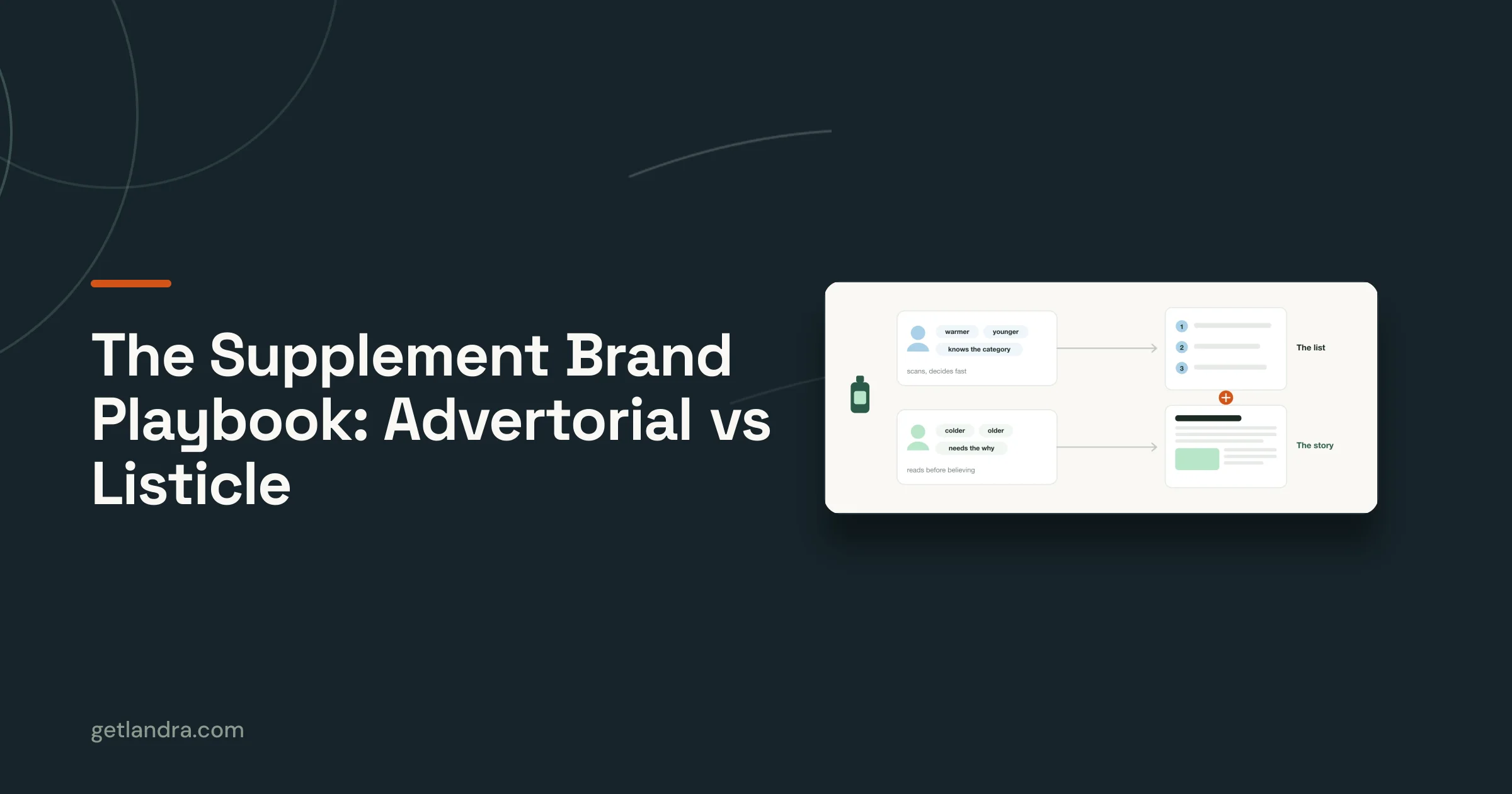
If you sell supplements and you're buying cold Meta or TikTok traffic, should the click land on an advertorial or a listicle? For most DTC categories that's a real either/or, and awareness stage picks the winner. For supplements, the honest answer is different. It's both: the brands that scale this category run the two formats side by side, against the same product and offer. The real questions are which audience lands on which page, and which one you build first.
This guide makes that case: why supplements in particular push you to both formats, the audience signals that say which to lean on per campaign, the do/don't for each (this is the category with the worst enforcement history on the internet, so the line matters), and the compliance floor that sits under both pages.
Why supplement brands end up running both
Supplement brands converge on both formats because no other DTC category sells one product to so many different readers at once. The audience spans generations, the product's mechanism is invisible and needs explaining at different depths, and most "cold" traffic already takes something else. One page format can't serve that spread, so the working question becomes allocation, not selection.
Three structural reasons drive it:
- The widest audience spread in DTC. The same magnesium sells to a 25-year-old who found you on TikTok and a 65-year-old who found you on Facebook. They consume pages differently (one scans and decides fast, the other reads long-form before believing anything), and the format follows the reader, not the product.
- An invisible mechanism product. A capsule shows nothing and proves nothing on sight, so how much educating a page must do varies enormously with what the reader already knows. A category-literate buyer needs five scannable reasons; a first-time skeptic needs the whole story.
- Cold traffic is mostly switchers. Per the Council for Responsible Nutrition's 2024 survey (industry-funded, worth noting), about three-quarters of U.S. adults already take supplements. So a "cold" supplement click usually isn't new to the category. Odds are it's someone currently using a competitor or a habit, and persuading a switcher takes a fuller case than persuading a browser. (That's an inference from the prevalence number, not something the survey measures, but it's the inference the category's funnels are built on.)
The proof is live: the supplement brands that scale on paid traffic run the portfolio, not a pick — same product, two pages, different readers. We'll look at the clearest live example of the pattern below: structure worth borrowing, disclosure choices that aren't.
The lever: how much does this reader still need to learn?
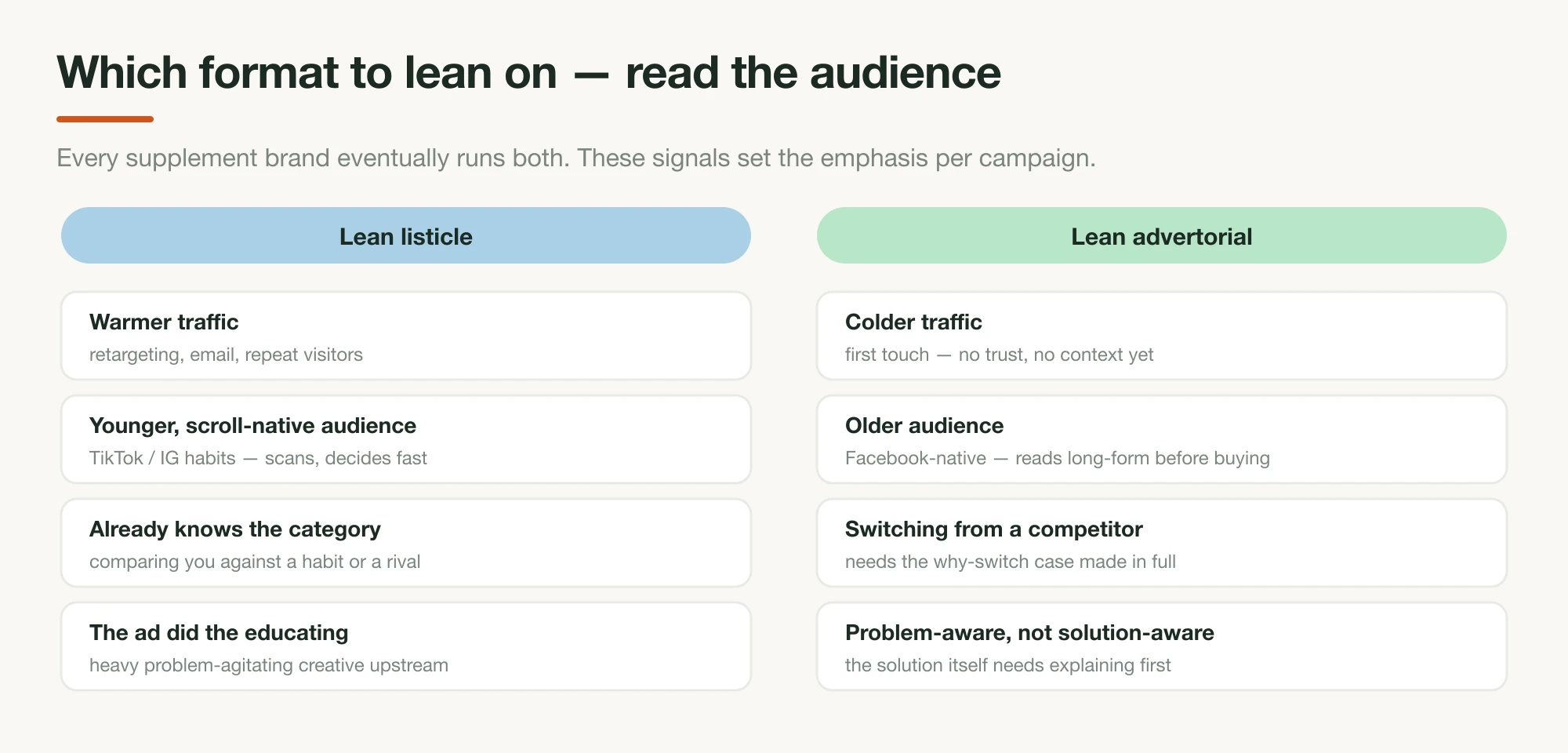
The variable that decides which format a campaign should lean on is information need: how much does this reader still have to learn (about the problem, the solution, and you) before they can buy? A listicle confirms what a reader mostly already believes. An advertorial builds belief that isn't there yet. Every useful audience signal is a proxy for that one question.
Read it off four signals you already have:
- Traffic temperature. Warm traffic — retargeting, email, repeat visitors — has been educated by every prior touch; it needs confirmation, not a curriculum. Cold first-touch traffic has no trust and no context, and narrative is how you build both.
- Age and platform habits. Younger, scroll-native audiences (TikTok, IG) are trained to scan, extract, and decide fast — a numbered list is their native format. Older, Facebook-native audiences are the readers long-form direct response was built for; they'll give a good story several minutes, and they often need them. (These are practitioner heuristics grounded in where each audience lives, not lab findings, but they're heuristics the category's media buyers bet real budgets on.)
- Switcher status. A reader currently using a competitor doesn't need to be sold on the category — they need the why-switch case: what their current product gets wrong, the mechanism yours fixes, and why that difference matters. That's a structured argument, and it's advertorial work. (A problem-led listicle, "5 signs your magnesium isn't working," can open that door too, but the full case wants narrative room.)
- Awareness stage. The general rule still applies inside the portfolio: problem-aware-but-not-solution-aware readers need the solution explained before your product can win, so reach for the advertorial. Solution-aware comparison shoppers want the ranked case — listicle.
When the signals conflict (a younger but ice-cold audience, an older retargeting pool), weight information need over demographics: over-educating costs a scroll, under-educating costs the click.
When to lean listicle
Lean on the listicle when the reader arrives mostly educated: warmer traffic, younger scroll-native audiences, category-literate buyers comparing you against a habit or a rival, or cold clicks whose ad already did the problem agitation. For that reader the page's job is confirmation at speed, and a ranked, scannable list is confirmation in page form.
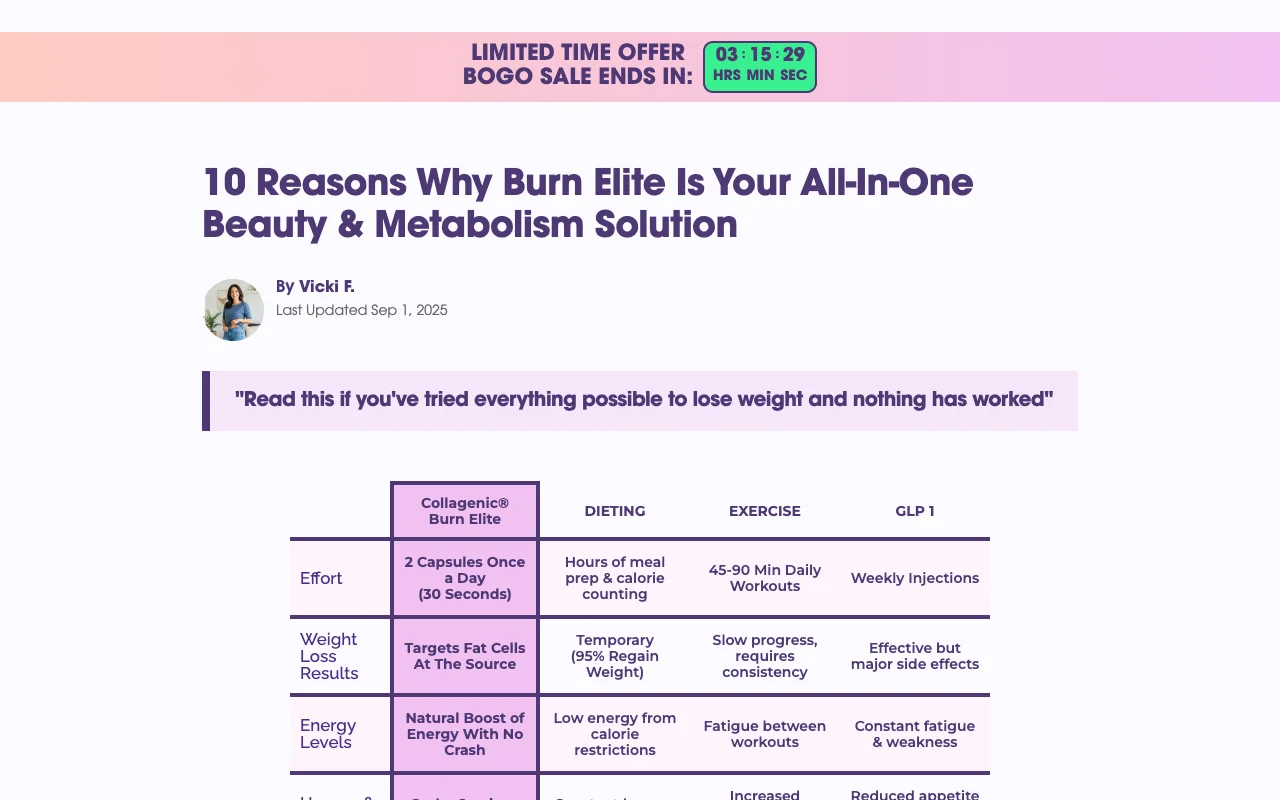
The live examples show exactly this targeting. Javvy's listicle funnel ("11 Reasons Why This High-Protein Iced Coffee is the #1 Trending Drink for Summer 2026") sells a protein coffee against the reader's existing coffee habit, forked across younger and older audience variants. Obvi's "10 Reasons Why Burn Elite Is Your All-In-One Beauty & Metabolism Solution" ranks its case against dieting, exercise, and GLP-1s — a comparison table for a reader who already believes in the outcome and is choosing the vehicle.
Two supplement-specific cautions, both visible on live pages as of June 2026:
- The listicle still needs its labels. A listicle pre-sell page is advertising like any advertorial, yet of the live examples above, neither carries an "Advertisement" label on-page, and Javvy's runs without a formal FDA disclaimer block. Popular ≠ compliant; run yours with the label and the disclaimer regardless of what the category's biggest spenders omit.
- Discrete claims are still claims. "280% more weight loss" in a list item needs the same competent-and-reliable evidence as it would in a paragraph. A side benefit of the format: each claim sits in its own numbered box, so a pre-launch compliance pass on a listicle is a checklist rather than literary criticism. But the format lowers the audit burden, not the proof burden.
When to lean advertorial
Lean on the advertorial when the reader still has real learning to do: cold first-touch traffic, older long-form-native audiences, competitor switchers who need the why-switch case argued in full, and problem-aware readers who don't yet know a solution exists. Narrative is the only landing-page format with room to teach before it asks, and in supplements, teaching usually means a mechanism: the ingredient, the absorption problem, the dose gap that explains why what they're doing now isn't working.
That framing matters doubly here because the advertorial is also the format with the worst enforcement history in this category. Built mechanism-led, it's the strongest education tool in the funnel. Built transformation-led (the miracle story, the invented narrator), it's the format the FTC's case list is made of. Which is why the next section is the line between the two.
The do / don't for the supplement advertorial
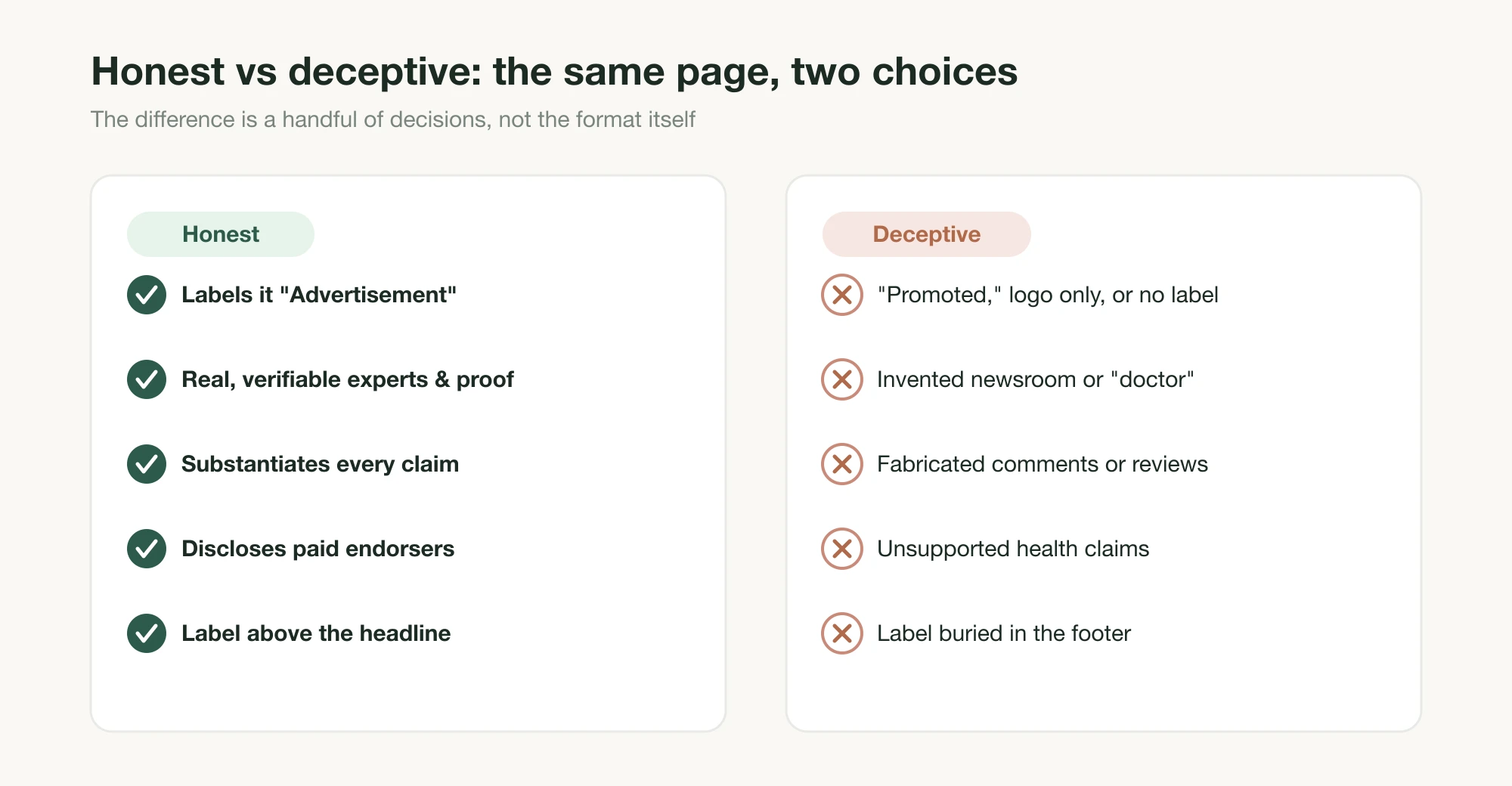
The difference between a compliant supplement advertorial and an FTC case file is a short list of choices: lead with the mechanism rather than a transformation story, label the page as advertising, use only real named experts, and frame results at what's typical. The do's are the playbook; the don'ts below are drawn straight from the enforcement record.
Do build it like this:
- Mechanism-led, not transformation-led. The spine is "here's the problem in the category, here's why, here's the mechanism that fixes it" — not "here's a person whose life changed." How to write an advertorial covers the structure; for supplements, the mechanism carries the persuasion so the claims don't have to.
- Label it. "Advertisement" or "Advertorial," above the headline, readable before the content — the cleanest live examples do exactly this.
- Real people, real credentials only. If an expert appears, they exist, they're named, and they actually said it.
- Frame results at typical. Any testimonial or outcome carries what users generally experience, not the best case.
Don't — and this list is the FTC's enforcement record, not our taste:
- No fake newsroom. The FTC's 2011 sweep against fake news sites selling acai weight-loss supplements, with network logos, invented reporters, and fake "comments," ended in settlements topping $9 million, and the pattern (invented mastheads like "Women's Health Journal") reappeared in later cases.
- Don't assume a disclaimer saves a deceptive format. In the Pure Green Coffee case, the court found the pages misleading despite advertorial disclaimers placed at the top, and entered a $30 million judgment — the FTC was still mailing those refunds in March 2025.
- Don't think "it was the affiliate's page" protects anyone. The Second Circuit upheld $11.9 million against LeadClick, the affiliate network behind fake-news supplement advertorials — liability runs through the whole chain.
- No invented narrators. A composite "doctor" persona telling a patient story is a fabricated endorsement wearing a lab coat — exactly the trope the cases above turned on.
The compliance floor under both pages
None of the regulation picks your format — it constrains what either page is allowed to say and how honestly it has to present itself. The FDA governs what the product may claim about the body; the FTC governs whether the advertising can prove what it says and whether the ad is identifiable as an ad. You don't need a law degree to run paid traffic — you need these five facts, and they apply to the listicle exactly as much as the advertorial.
- Structure/function claims are the lane. Under DSHEA (1994), a supplement page can describe a nutrient's role in normal structure or function, and cannot claim to diagnose, treat, cure, or prevent disease, per the FDA's structure/function claims guidance. The standard disclaimer ("This statement has not been evaluated by the Food and Drug Administration…") rides along with the claims.
- The FTC expects real science behind health claims. The Health Products Compliance Guidance (December 2022, the first revision of its supplement advertising guide in roughly 25 years) sets the substantiation bar at "competent and reliable scientific evidence" which, as law firm Cooley's summary lays out, generally means randomized, controlled human clinical testing, with blinding expected and post-hoc data mining rejected.
- Substantiation failures now carry sticker prices. In April 2023 the FTC sent its substantiation Notice of Penalty Offenses to about 670 companies, with supplement and functional-food marketers prominently included, opening the door to civil penalties that started above $50,000 per violation at issuance. Receiving the notice isn't a finding of wrongdoing; it's the FTC pre-loading the penalty math.
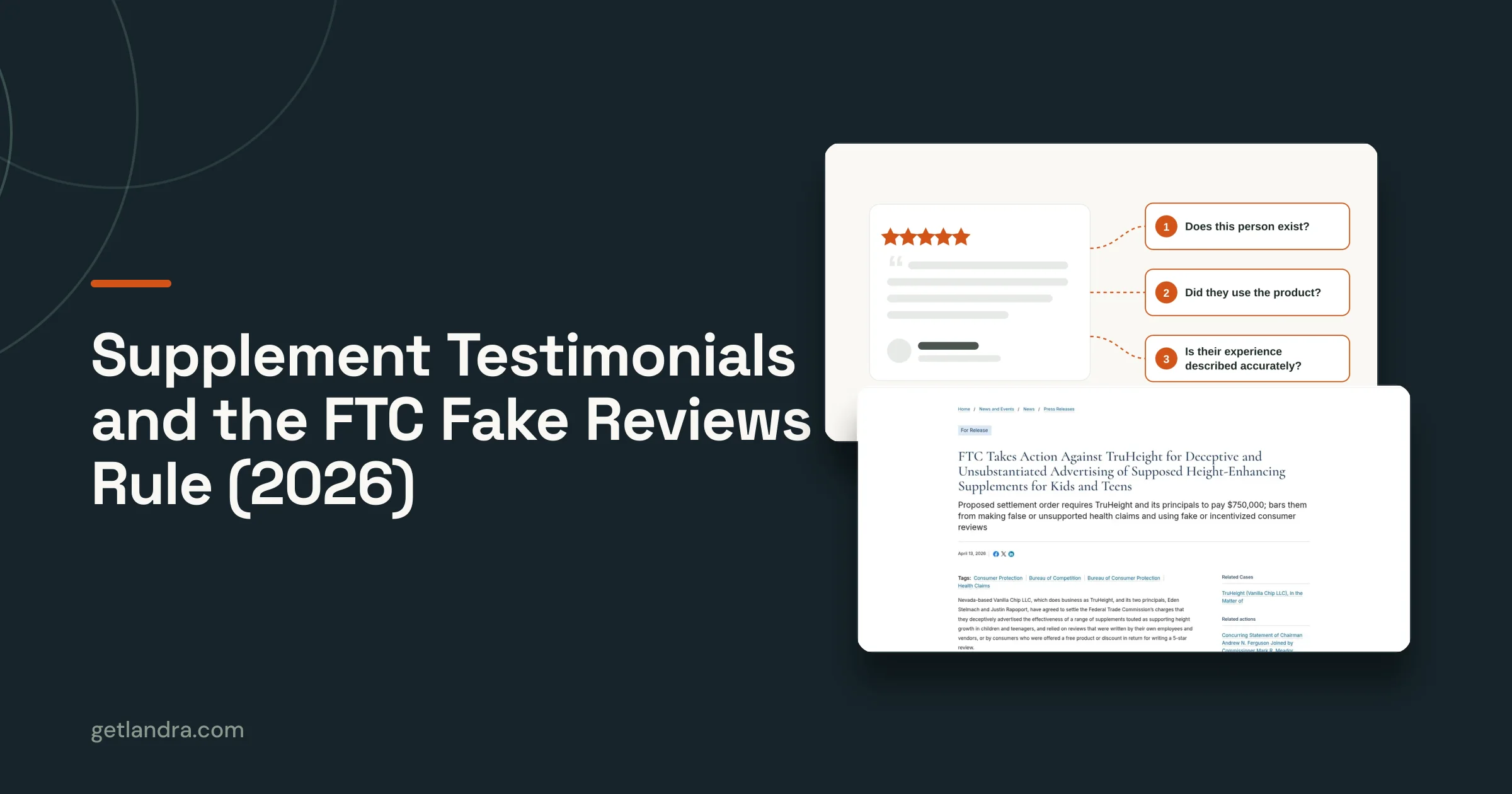
- Atypical-results testimonials need typical-results disclosure. Under the 2023 Endorsement Guides, a truthful "I lost 30 pounds" is still deceptive without a clear statement of what users generally achieve — "results not typical" doesn't cut it. And the Fake Reviews Rule (effective October 2024) bans fabricated or AI-generated testimonials outright, with civil penalties per violation. We checked 15 live supplement pages against it in supplement testimonials and the FTC Fake Reviews Rule.
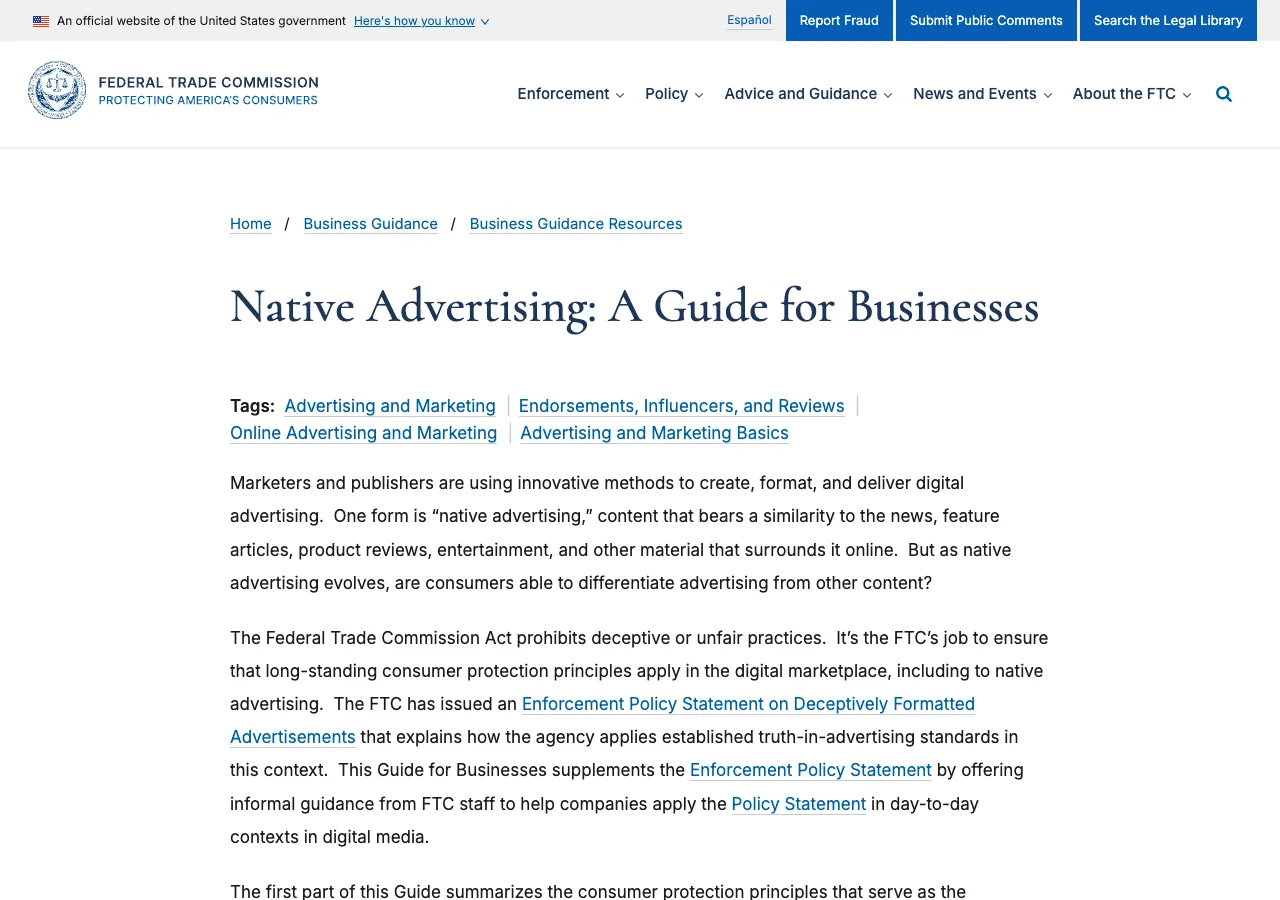
- The ad must look like an ad. The FTC's native advertising enforcement policy (2015) makes the format itself a deception vector: an advertorial a reader can't identify as advertising is deceptive regardless of the claims inside it. The disclosure guide covers placement in detail.
What live supplement brands actually run
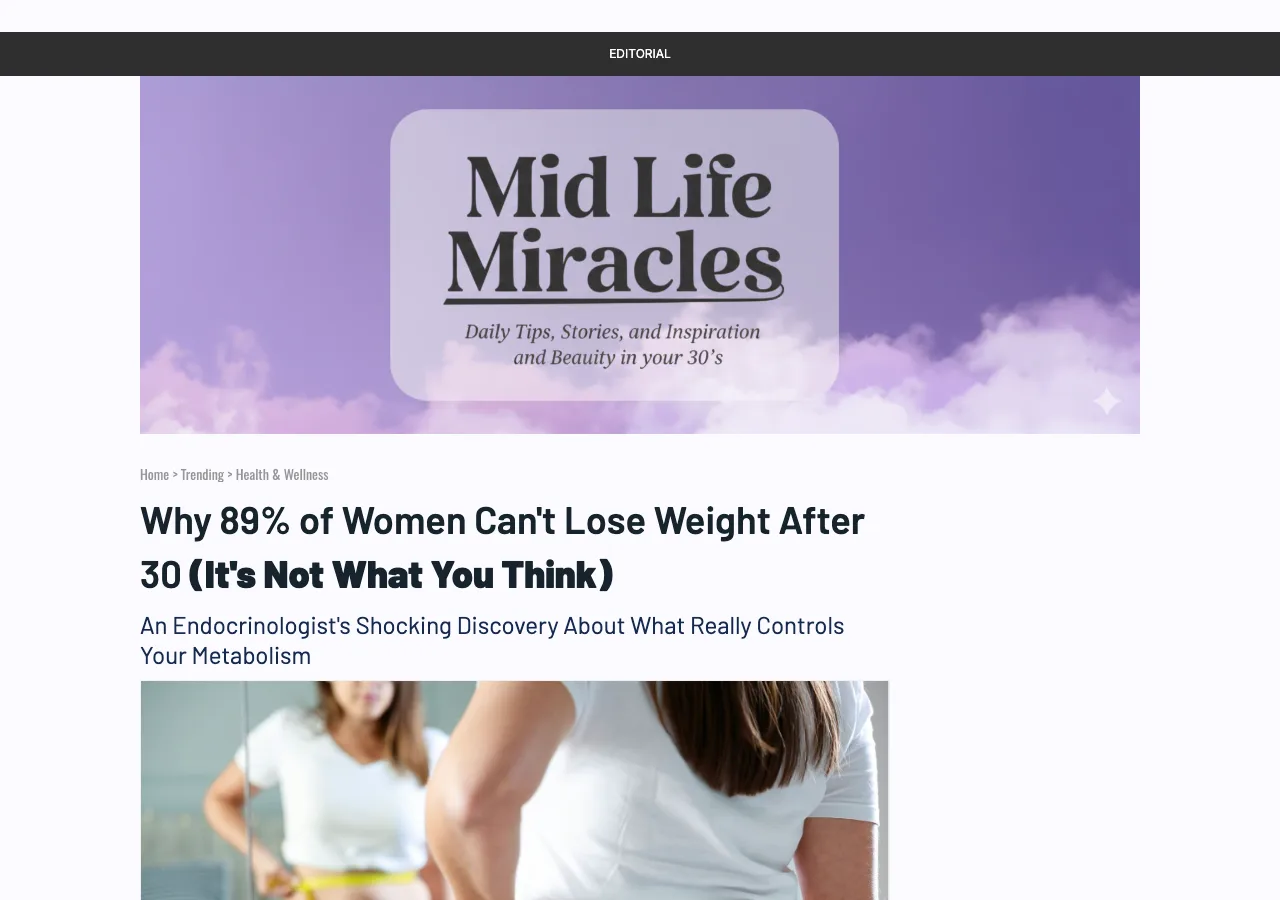
The thesis isn't theoretical; it's what the category's paid-traffic operators already do. Obvi's funnel pairs a first-person advertorial ("Why 89% of Women Can't Lose Weight After 30") with the ten-reasons listicle above: same product, same offer, two audiences. The advertorial does the heavy education for colder, more skeptical clicks; the listicle catches comparison-ready readers who just want the reasons.
Borrow the two-format structure, not the presentation. The same advertorial doubles as a cautionary example on disclosure: it runs under a "Mid Life Miracles" masthead with an expert byline a reader has no way to check (the news-discovery trope our advertorial examples guide breaks down), and its fine print includes a line that reviews and testimonials "may be fictionalized" — a position the Fake Reviews Rule has since made fraught for anyone tempted to copy it. The pairing is the lesson; the page dressing is the warning.
At the top of the market, the biggest wellness brands — AG1, Ritual, Seed — answer the same information-need question with a bigger budget: they lead their education with clinical-research pages. AG1 fronts its funnel with research, including peer-reviewed clinical work on its formula; Ritual has committed $5 million to clinical studies with an Auburn University RCT behind its flagship, and Seed leads with probiotic-science education. That's not a different strategy; it's the same lever read top-down. Every supplement funnel that works is answering "how much does my buyer still need to learn?" with education at whatever strength the brand can afford; the formats are just the delivery vehicles.
Which page to build first
If budget forces a sequence, let your current traffic mix pick the first build. Mostly cold prospecting, especially older, Facebook-native audiences or buyers you're trying to switch off a competitor? Build the advertorial first; it's where the education debt is. Scaling retargeting, email, or younger scroll-native audiences who already know the category? Build the listicle first; it converts the readers you've already warmed. Then add the other — same product, same offer — and you've got the Obvi pattern: each audience landing on the page built for how much it still needs to learn.
The reason most brands don't get there isn't conviction; it's that building one good pre-sell page is slow, and building two feels like a luxury. That's the constraint Landra removes: it analyzes your brand and product from the URL to understand them, then generates the advertorial and the listicle — each one the complete page, copy, structure, and images, tuned to the audience you name — with the supplement guardrails on by default. Copy stays in structure/function lanes, disease claims are gated out at generation, and the FDA disclaimer block is injected automatically. The two-page portfolio stops being a quarter's project and becomes an afternoon.
Before you publish
The pre-flight list for any supplement pre-sell page, advertorial or listicle:
- Claims matched to substantiation — every objective claim on the page traces to evidence you actually hold; anything without it is rewritten as structure/function.
- FDA disclaimer present and rendered where it's readable.
- "Advertisement" label above the fold — the format must be identifiable as advertising before the reader is persuaded by it.
- Testimonials framed at typical results — and none of them invented, composited, or AI-generated.
- The ad and the page match — Meta reviews the destination, and lander claims that outrun the ad's are a rejection (or an account flag) waiting to happen.
The general format decision still stands: awareness picks the format for a single page. Supplements just turn it into a portfolio question: not "which page converts better?" but "which page does each of my audiences need, and which do I build first?"
Frequently asked questions
Should a supplement brand use an advertorial or a listicle?
Both, in most cases — the supplement funnels that scale run an advertorial and a listicle against the same product. The real decision is emphasis: lean listicle for warmer, younger, category-literate audiences who scan and decide fast; lean advertorial for colder, older audiences and anyone who still needs the case made — competitor switchers, or readers who feel the problem but don't know the solution.
Which should a supplement brand build first?
Read your traffic mix. If your spend is mostly cold prospecting — especially to older, Facebook-native audiences or buyers currently using a competitor — build the advertorial first. If you're scaling retargeting, email, or younger scroll-native audiences who already know the category, build the listicle first. Then add the other as the second format, same product and offer.
What claims can a supplement landing page legally make?
Structure/function claims — how a nutrient affects normal body structure or function ("supports restful sleep") — are allowed under DSHEA, with the FDA disclaimer. Disease claims (diagnose, treat, cure, prevent) are not. On the advertising side, the FTC requires competent and reliable scientific evidence for health claims, which its 2022 guidance describes in terms of randomized, controlled human testing.
Do supplement advertorials need a disclosure?
Yes, twice over. The page needs the FDA structure/function disclaimer for its claims, and the FTC requires the advertorial itself be clearly identifiable as advertising — a plain label like "Advertisement" placed where readers see it before the content. Enforcement history shows a disclaimer does not cure a deceptive format: the Pure Green Coffee case ended in a $30 million judgment despite advertorial disclaimers at the top of the page.
What is competent and reliable scientific evidence?
It is the FTC's substantiation standard for health claims. The 2022 Health Products Compliance Guidance describes it as testing by qualified experts that the relevant scientific community would accept — generally randomized, controlled human clinical testing, with controls, randomization, and blinding expected, and post-hoc data mining rejected.
Can supplement pages use customer testimonials?
Carefully. Under the FTC's 2023 Endorsement Guides, a truthful but atypical result is still deceptive without a clear disclosure of generally expected results — a 'results not typical' line is not enough. And since October 2024, the Fake Reviews Rule makes fabricated or AI-generated testimonials a civil-penalty offense in their own right.
Why do supplement brands use advertorials at all?
Because supplements are mechanism products sold to skeptical readers. A new ingredient or formula needs explaining — what it is, why existing options fall short, how it works — before a claim lands. Narrative is the only landing-page format with room to do that education, which is why mid-market supplement brands have run advertorials for decades.