
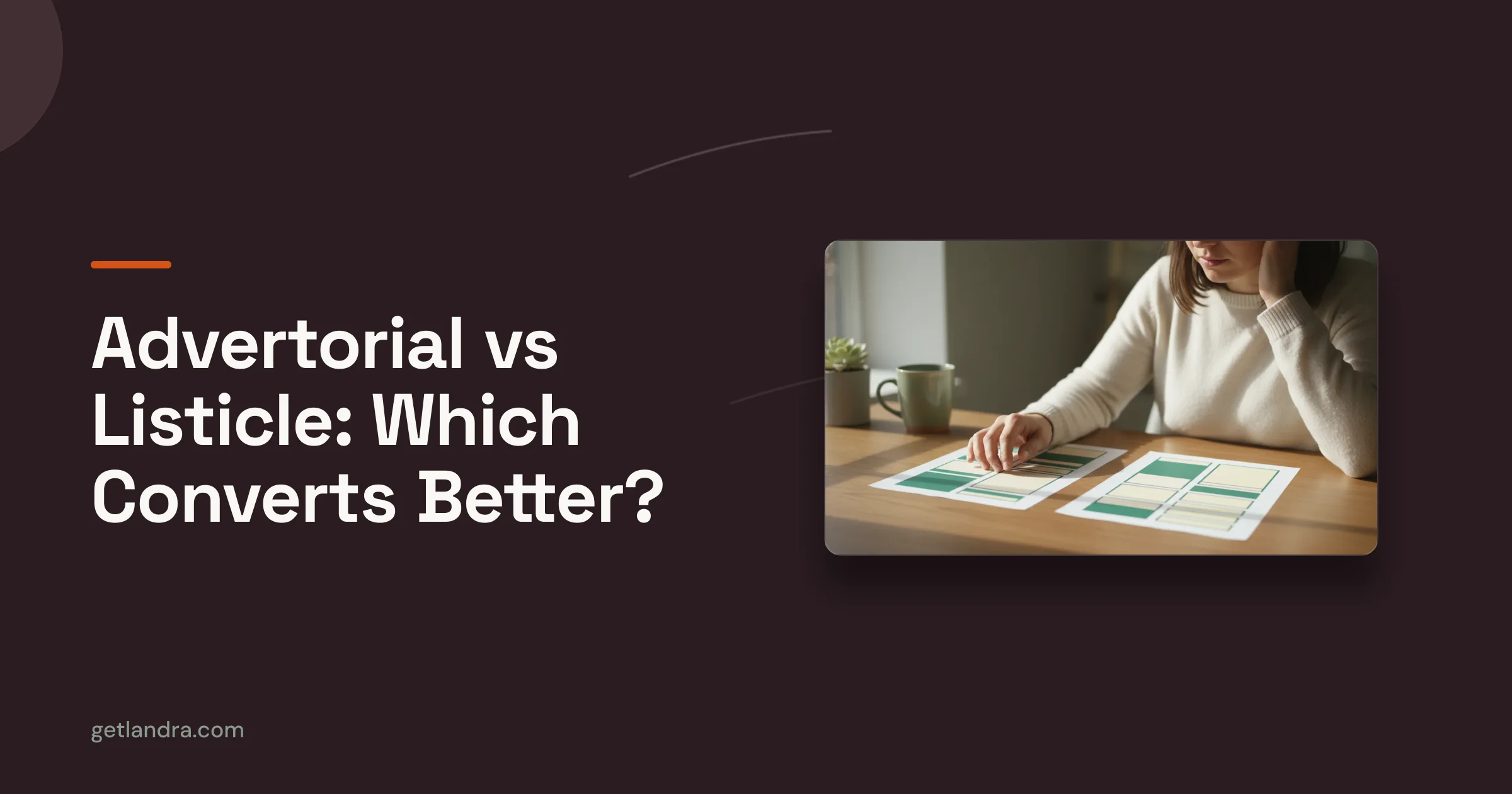
"Which converts better, an advertorial or a listicle?" is the wrong question asked the right way. There is no universal winner. The format that converts is the one matched to the reader who lands on it. You'll hear a clean rule — advertorials for cold traffic, listicles for warm — and it's a fine starting point, but it's too blunt to trust: what actually decides is the reader's awareness, not their familiarity with your brand, and a listicle can absolutely win cold traffic when it's built for it. This guide gives you the real framework. New to the formats? Start with what an advertorial is and what a listicle is.
What is the difference between an advertorial and a listicle?
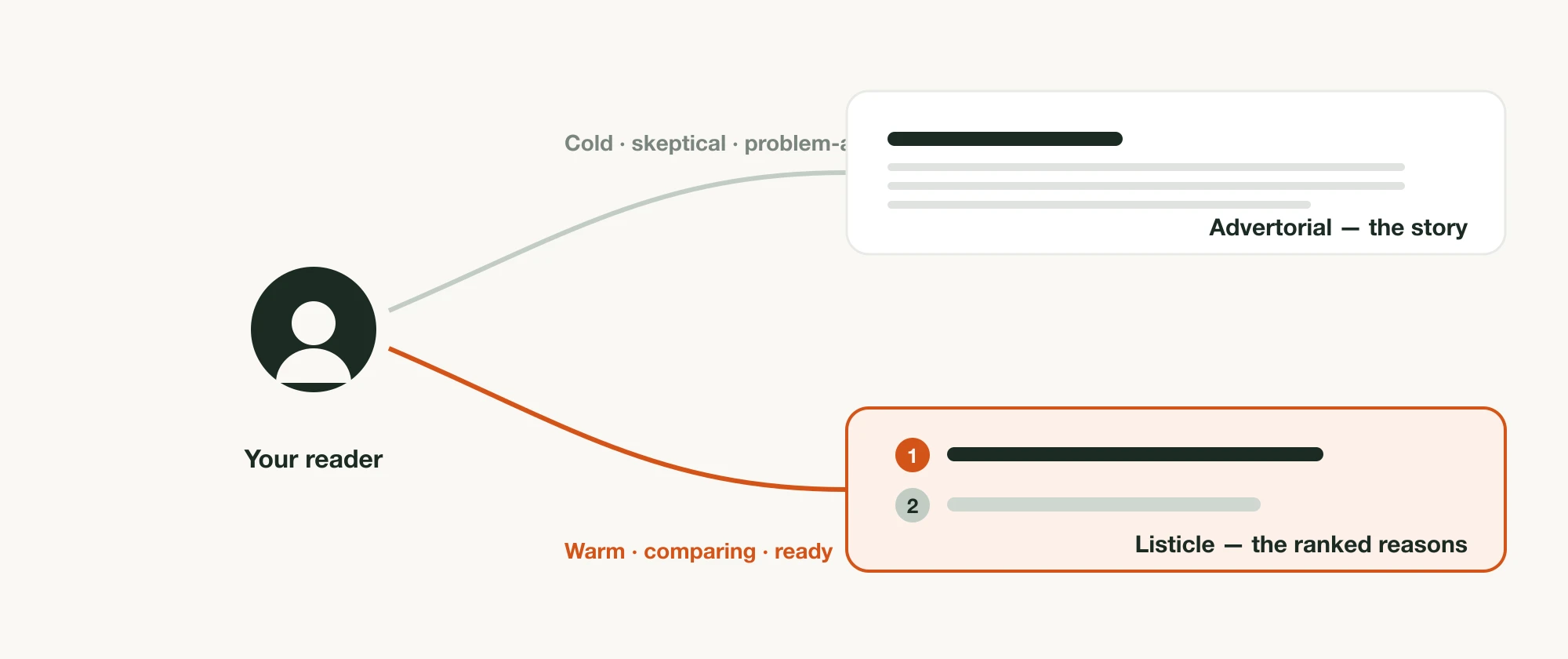
Both are pre-sell pages — landing pages that warm a reader before the product page. The difference is shape. An advertorial is an editorial-style article that builds a case through narrative: a story, a problem, a mechanism, then proof. A listicle landing page makes the same case as a ranked, numbered set of reasons ("5 Reasons Why…") built to be scanned. One persuades by reading; the other persuades by skimming.
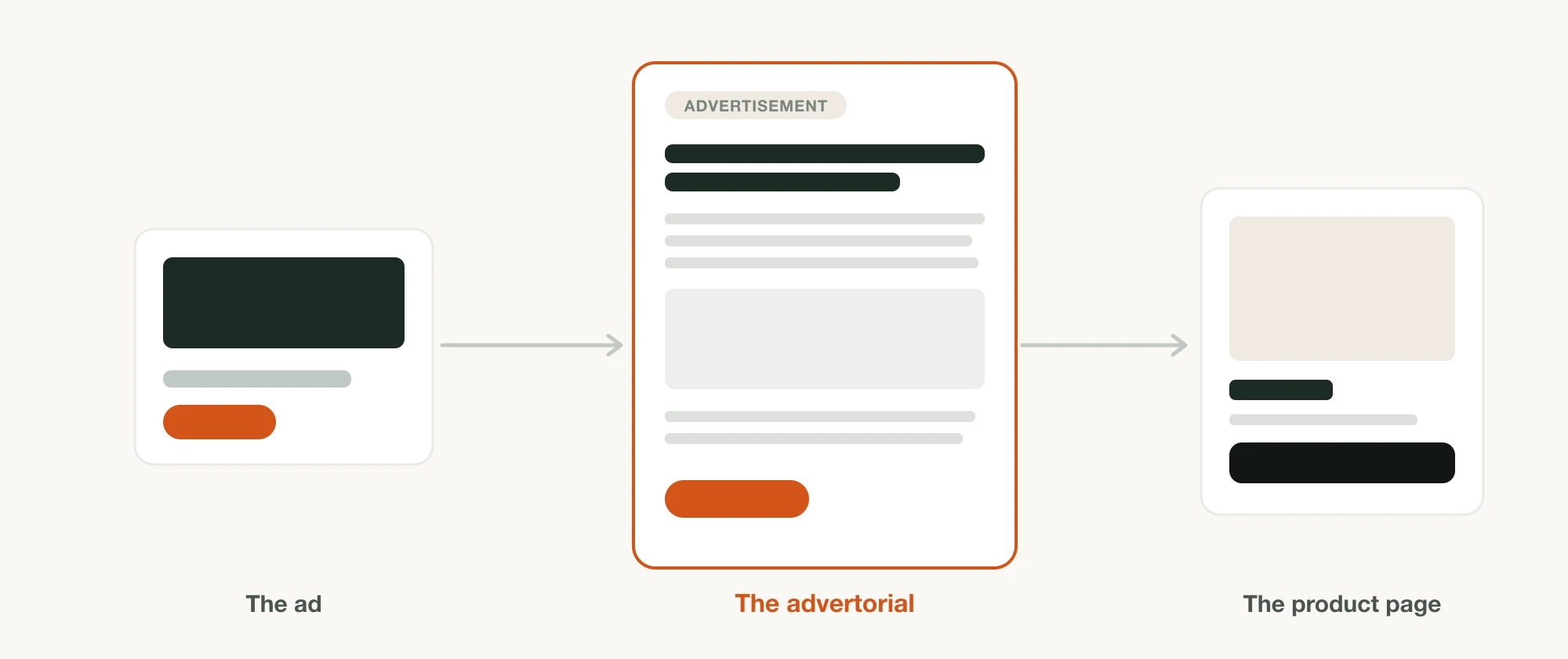
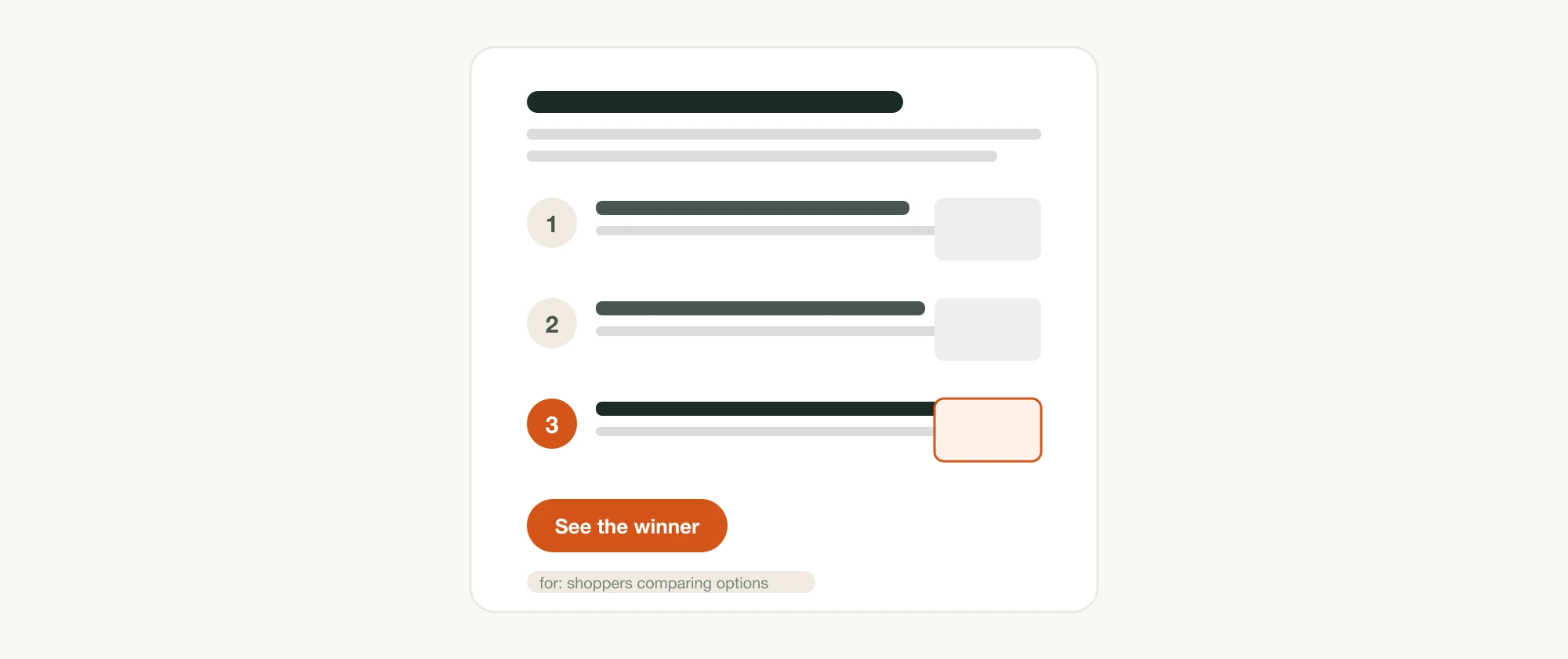
The terminology is messy in practice: practitioners call the same "7 Reasons Why" page both a listicle and an advertorial, because a listicle can be written in an editorial, disclosed-as-advertising style. The label matters less than the mechanism: narrative trust-building versus scannable benefit confirmation. That mechanism is what predicts which one converts a given reader.
Which converts better: advertorial or listicle?
Neither, universally, and any source that tells you one always wins is selling you that format. The honest answer is conditional, and it turns on awareness, not temperature. An advertorial is the more durable choice for the reader who's least aware and most skeptical, because narrative can do the deepest educating before it asks. A listicle wins once the reader already feels the problem — which includes a lot of cold, first-click traffic — because it lets them scan reasons and decide fast. The winner is set before the click, by where the reader's head is.
It's worth being upfront about the evidence: there is no public controlled A/B test that pits the two formats against matched traffic and declares a winner. The "advertorials win cold, listicles win warm" rule is near-universal consensus among DTC media buyers and CRO practitioners, and it's grounded in solid independent research on how people read and how persuasion tracks awareness; but it's directional evidence, not a randomized trial, and the rule is a proxy for awareness rather than a law. Treat it as a useful starting heuristic — with the problem-led listicle as the common exception — then test against your own traffic.
Why the answer depends on awareness
The cleanest way to predict the right format is Eugene Schwartz's five stages of customer awareness, laid out in Breakthrough Advertising (1966) and still the backbone of how performance marketers think about cold traffic. A reader who doesn't yet feel a problem needs a different page than one who's comparing three solutions:
- Unaware: doesn't yet feel the problem. Needs the most education. → Advertorial (a list of reasons answers a question they haven't asked).
- Problem-aware: feels the problem, hasn't gone looking for solutions. → Either. A narrative advertorial is more durable for skeptical or high-consideration buys; a problem-led listicle — one that opens on the problem, not your product — can convert here too, especially if the ad did some educating first.
- Solution-aware: knows solutions exist, hasn't chosen. Wants to compare. → Listicle.
- Product-aware: knows your product, needs reasons and proof. → Listicle, or a short pre-sell.
- Most aware: ready to buy. → Skip the pre-sell; send them to the product page.
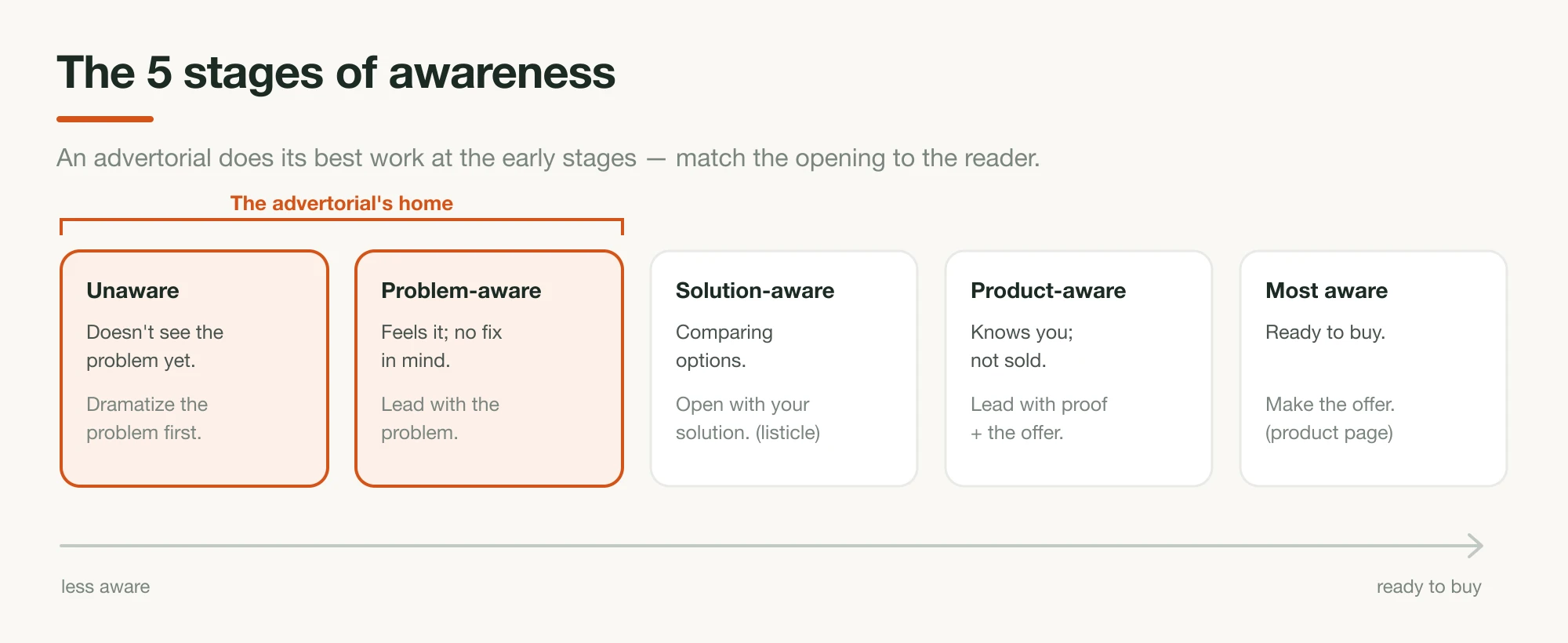
A message pitched at the wrong stage falls flat regardless of format. When a listicle "dies on cold traffic," the culprit is usually awareness, not temperature: a list of reasons (worse, one that names your product) sold to a reader who doesn't yet feel the problem answers a question they haven't asked. Give that same cold reader a list that opens on the problem they do feel, and it can land.
The science behind the format fit
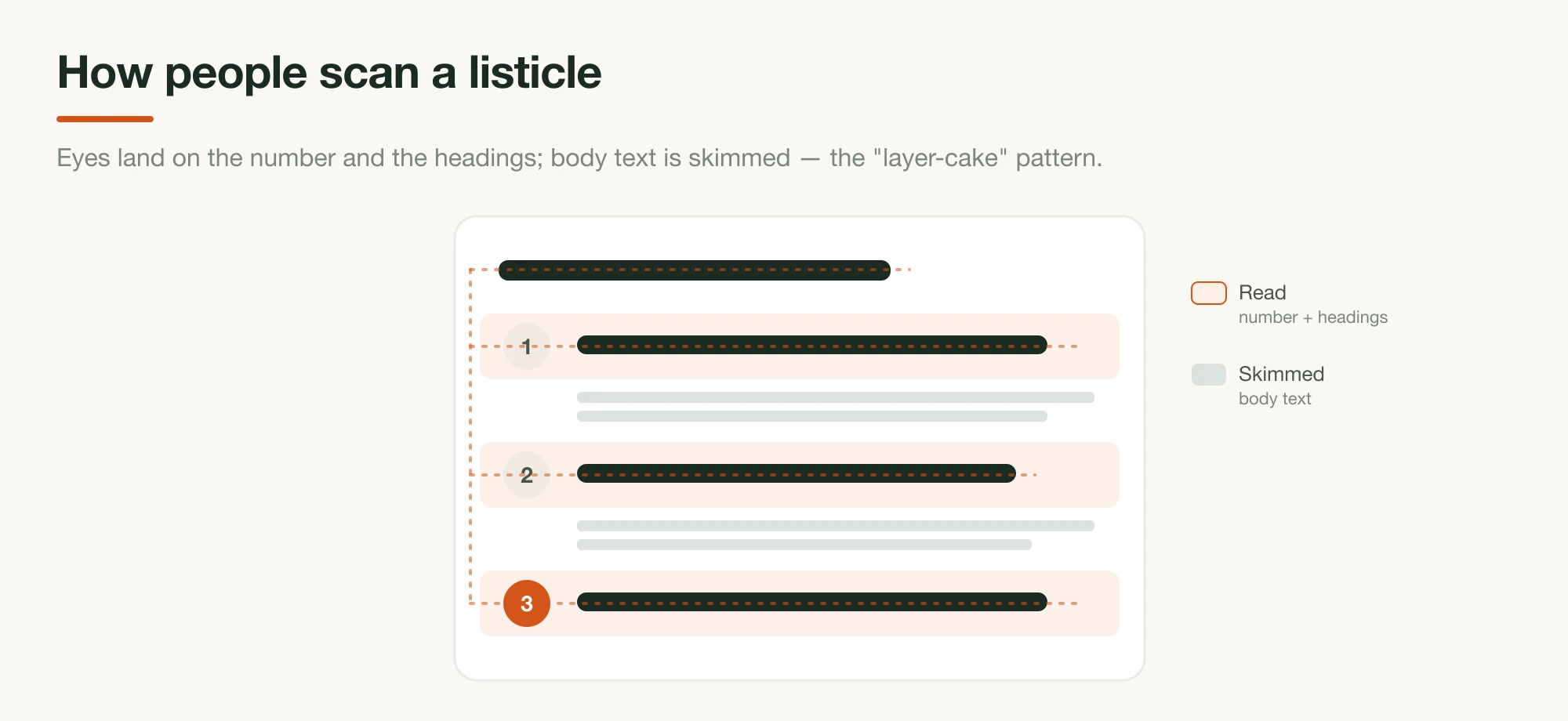
Both formats are backed by independent research, and the research explains the split. People don't read web pages — they scan them. Nielsen Norman Group's eye-tracking work documents a "layer-cake" pattern: readers lock onto headings and subheadings and skim the body in between, and an F-shaped pattern on text-heavy pages. A numbered listicle is purpose-built for that behavior: every entry heading is a landing spot for a scanning eye, so a warm reader can extract the whole argument in under two minutes.
That same strength has a limit. A deeply skeptical reader who feels no problem yet won't be moved by a list of reasons; they'll question every one. That's where the advertorial's narrative does a job a list can't: it earns attention with a story or a problem before it makes a claim, so by the time the reasons arrive the reader is listening. But "cold" rarely means "feels nothing": most cold paid-social readers already feel the problem (it's what the ad spoke to), so a problem-led list often has all the attention it needs. (A listicle itself comes in three frames — product-led, problem-led, and best-of — and which one you pick is what decides how cold it can go.)
The deciding variable: traffic temperature
In practice you rarely diagnose awareness one reader at a time — you infer it from where the traffic comes from. Traffic source is a reliable proxy for temperature, and temperature picks the format. Cold prospecting traffic skews unaware and skeptical; retargeting, search, and email skew warm and ready.
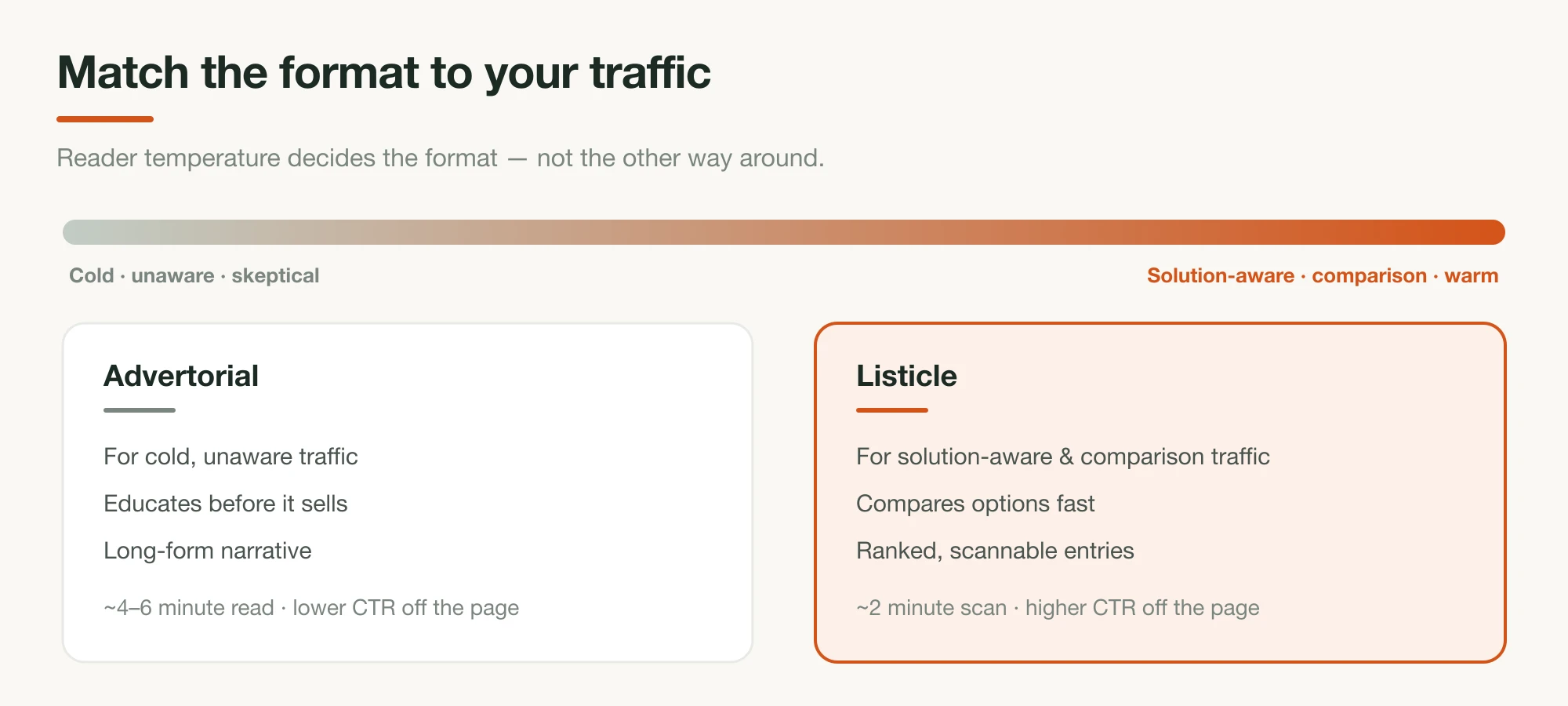
- Cold paid social (Meta, TikTok broad prospecting): first touch, no brand familiarity → advertorial by default, but if the ad already named and agitated the problem, a problem-led listicle can pick up where it left off.
- Warm retargeting / engaged audiences: they've seen you 3–4 times → listicle.
- High-intent search (Google): the reader is actively comparing → listicle.
- Email to your list: existing trust → listicle, or straight to the offer.
This maps onto the awareness ladder, but loosely, and that's the trap. Traffic temperature predicts awareness; it doesn't equal it. As one DTC media-buyer breakdown frames it, an advertorial holds attention for several minutes of deeper persuasion while a listicle gets scanned in two: different tools for different reader states. (For what "good" looks like by source, see the DTC conversion benchmarks.)
"Cold" isn't "unaware": when a listicle wins cold traffic
The shorthand — listicles for warm, advertorials for cold — quietly assumes cold traffic is unaware traffic. It usually isn't. A reader who taps a Meta ad is cold to your brand, but the ad almost always spoke to a problem they already feel, so they arrive problem-aware (sometimes solution-aware), just not aware of your solution yet. That reader doesn't need a five-minute story to admit they have the problem; they need a fast, credible case for your answer. A listicle can be exactly that. Listicles educate too; they're not a warm-only format.
Two things decide whether a listicle holds cold traffic:
- Problem-led, not product-led. A list headlined on the problem ("5 reasons your magnesium isn't actually helping you sleep") meets a cold-but-problem-aware reader where they are. A list headlined on the product ("5 reasons to switch to BrandX") assumes a warmth they don't have yet. Lead with the problem and a listicle reaches much colder than the shorthand suggests.
- The ad did part of the job. The page never works alone; the ad ahead of it does real educating. A heavy, problem-agitating ad can move a cold click up the awareness ladder before they land, leaving the listicle to do the selling, not the teaching.
None of this dethrones the advertorial. For the genuinely unaware reader, the high-skepticism category, or the higher-consideration purchase, narrative is still the more durable tool: it educates deeper than a list ever will, and it holds up over more of the funnel. The point is narrower and more useful: a listicle is not a warm-only format. Match it to awareness, lead it with the problem, and let the ad carry its share.
The decision framework
Awareness and traffic temperature get you most of the way, but three more variables sharpen the call: price and complexity, claim skepticism, and how much the reader already trusts you. Run a new page through these and the format usually picks itself.
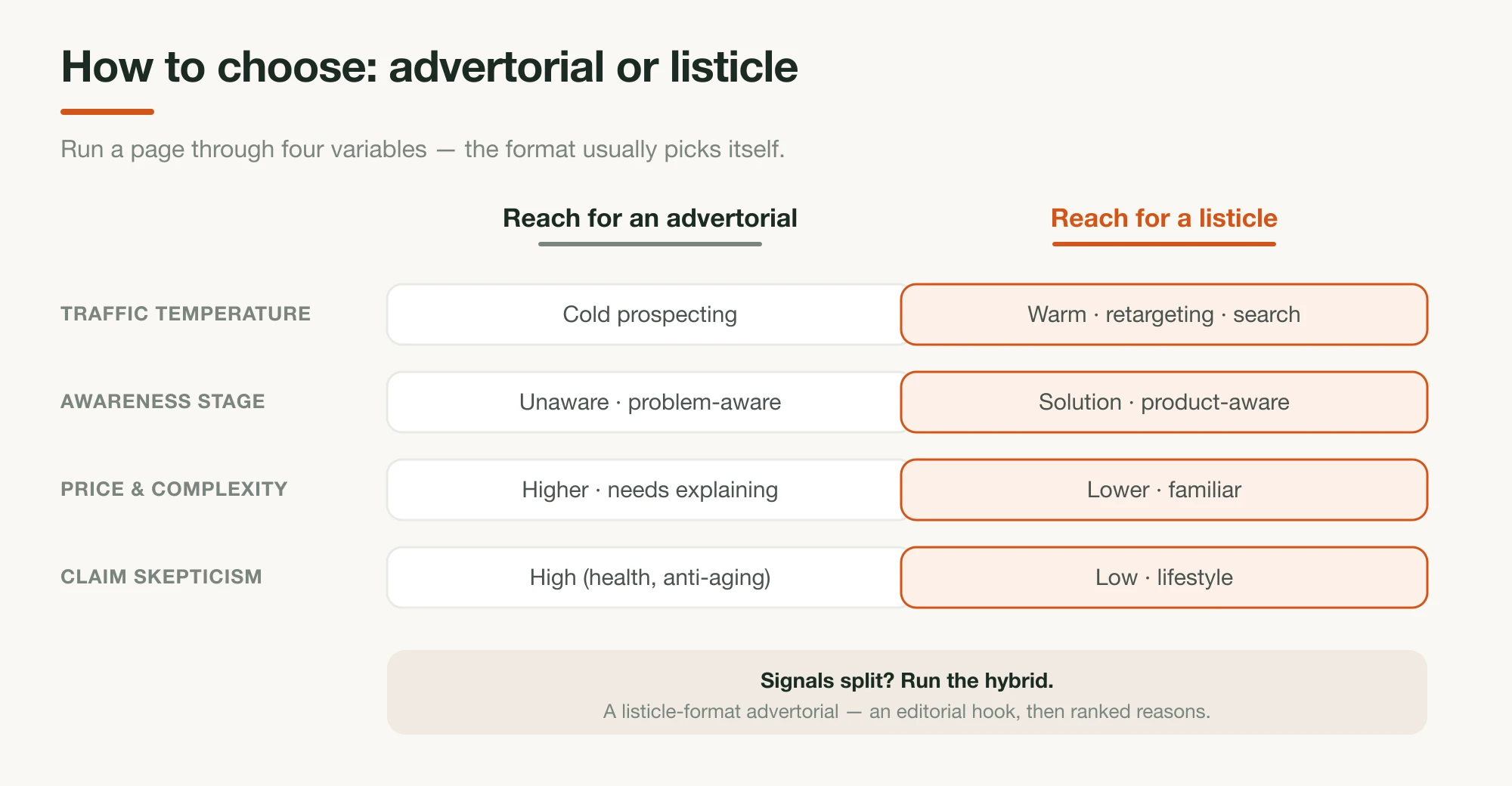
- Awareness stage: unaware → advertorial; problem-aware → either (a problem-led listicle or an advertorial); solution/product-aware → listicle.
- Traffic temperature: a proxy for awareness, not a rule. Cold leans advertorial, but a cold-but-problem-aware reader can convert on a problem-led listicle.
- Price and complexity: higher-priced or mechanism-heavy products that need explaining lean advertorial; simpler, familiar, lower-priced products lean listicle.
- Claim skepticism: high-skepticism categories (weight loss, anti-aging, health) lean advertorial, where a story lowers defenses before the claims land; lower-skepticism, lifestyle products carry their claims fine as scannable reasons. Supplements layer FTC and FDA claim rules on top of the skepticism, so that vertical gets its own decision guide.
When the signals split (say, a cold audience but a simple, low-priced product) reach for the hybrid: a listicle-format advertorial that opens with an editorial hook and then delivers ranked reasons. It's the most common real-world shape precisely because it hedges the temperature.
What top DTC brands actually do
The brands that scale on paid traffic don't pick a house format; they match the format to the source, and many run both at once. The pattern shows up again and again in reported case studies (read these as brand- and agency-reported results, not independent measurement):
- Snow Teeth Whitening scaled on paid social with "reasons why" listicle advertorials as a visible part of its playbook (reported across multiple agency case studies): the hybrid in its natural habitat, combining a scannable list with celebrity authority and stacked social proof.
- Jones Road Beauty runs listicle pre-sell pages for warm and comparison traffic (its live "5 Reasons Why" pages, as of June 2026) while using longer editorial and quiz funnels to warm colder audiences.
- AG1 has run editorial, story-driven, source-personalized pre-sell pages for cold, podcast-style traffic: narrative trust-building for an audience that often starts unaware.
The throughline isn't a format preference; it's discipline about the reader. The brands that win decide the temperature first and let it choose the page. For deeper teardowns, see advertorial examples that convert and listicle landing page examples that convert.
The mistake that kills both formats
The single biggest mistake is running the right page to the wrong reader. A cold-traffic advertorial sent to a warm retargeting list bores an impatient buyer who already knows the story and just wants the offer. A product-led listicle sent to problem-unaware traffic gives reasons to buy something the reader doesn't yet know they need, so they bounce. Note the diagnosis, though: it's the awareness mismatch that breaks it, not the cold click; a problem-led list to the same audience can still work. In both cases the format isn't the problem; the mismatch is. Diagnose the reader's awareness before you choose the page, and disclose either one honestly as advertising — both are paid pre-sell content.
Let Landra build the right one for you
The reason most teams default to one format is that building either well is slow, and building both, for different audiences, is slower. Landra removes that constraint. Tell it your product and the audience you're targeting, and it generates the whole optimized page — copy, structure, and images — tuned to that reader: an advertorial for your cold prospecting traffic, a listicle for your warm and search traffic, built to convert and ready to edit in minutes.
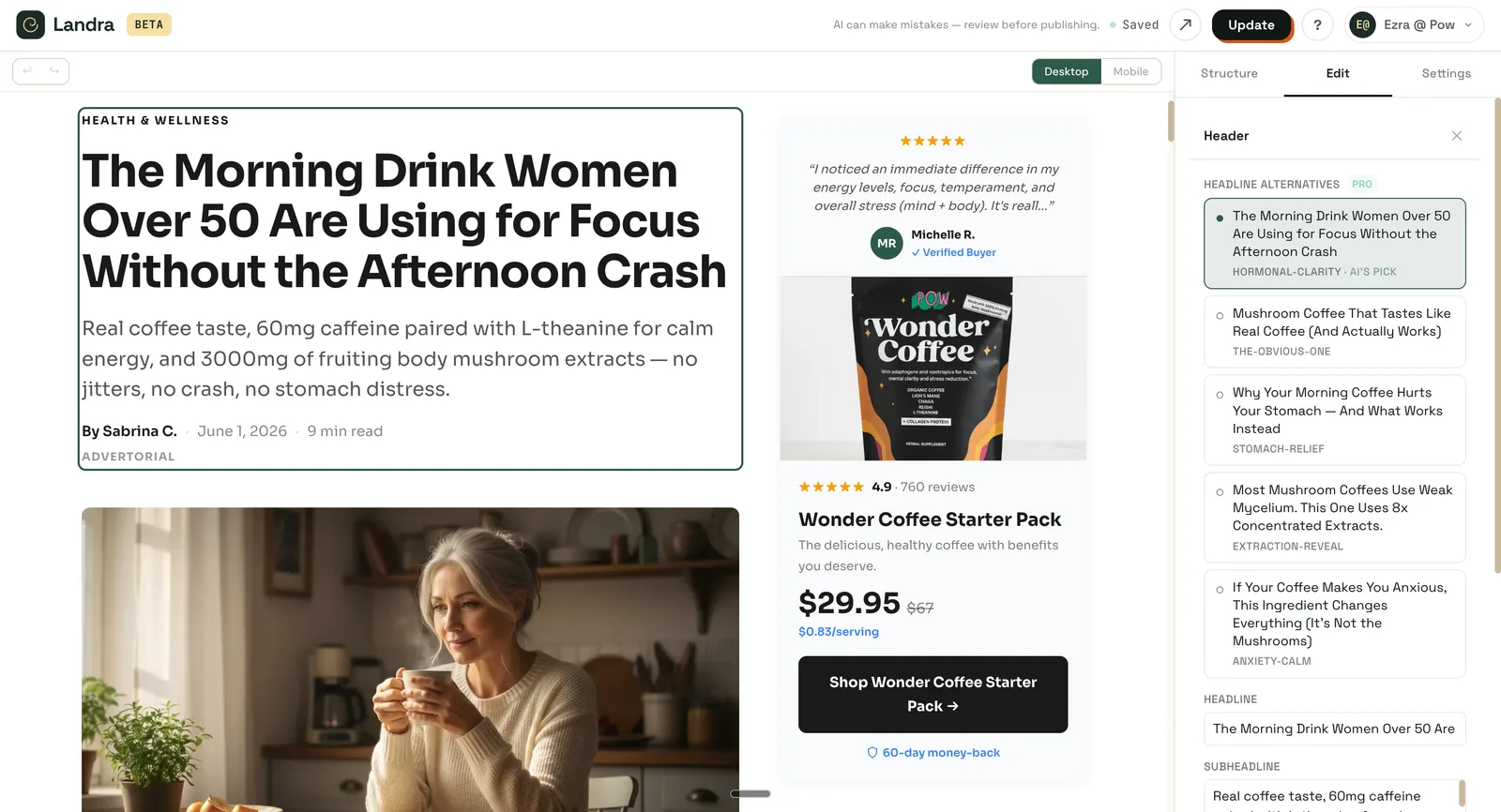
Because the best-practice structure for each format is built into how Landra generates, you're not choosing between "fast" and "optimized"; you get a page shaped for the reader you picked, every time. That makes matching the format to traffic temperature a setting, not a project.
The bottom line
Advertorial versus listicle is not a contest with a permanent winner. It's a matching problem. The least-aware, most-skeptical, highest-consideration traffic converts better on an advertorial that educates first; a reader who already feels the problem — cold click or warm — converts better on a listicle they can scan, especially one led by the problem rather than the product. Diagnose the reader's awareness first (temperature only proxies for it), weigh price and skepticism, and pick accordingly, or run the hybrid when the signals split. Then learn to write each one well: the advertorial framework and the high-converting listicle guide take it from here.
Frequently asked questions
Which converts better, an advertorial or a listicle?
Neither universally. The format that wins is the one matched to the reader's awareness stage. An advertorial is the more durable choice for the least-aware and most-skeptical traffic, because narrative educates deepest. A listicle wins once the reader already feels the problem — which includes plenty of cold, first-click traffic — especially when it leads with the problem rather than the product.
What is the difference between an advertorial and a listicle landing page?
An advertorial is an editorial-style pre-sell page that reads like an article and builds trust through narrative. A listicle landing page presents the case as a ranked, numbered set of reasons built for scanning. Both are pre-sell pages; the difference is narrative depth versus scannable structure.
When should I use an advertorial instead of a listicle?
Reach for an advertorial when the reader is genuinely unaware, the product is higher-priced or mechanism-heavy, or the category is high-skepticism (health, anti-aging) — narrative does the deepest educating and is the more durable choice. Reach for a listicle when the reader already feels the problem or is comparing solutions (even on a cold click), when the ad has already done the educating, or when the product is simpler — and lead the list with the problem, not the product.
Can a listicle work on cold traffic?
Yes. Listicles are educational, and most "cold" paid-social traffic is cold to your brand but already problem-aware or solution-aware — readers feel the problem, they just don't know you yet. A problem-led listicle (one whose headline names the problem, not your product) can convert that reader, especially when the ad has already done some of the educating. Advertorials remain the more durable choice for the truly unaware or highly skeptical.
Can a page be both an advertorial and a listicle?
Yes — the hybrid is common. A "listicle advertorial" uses a numbered structure inside an editorial pre-sell page, opening with a story or authority hook and then delivering ranked reasons. Snow Teeth Whitening's "reasons why" pages are a well-known example of the hybrid.
Is there data proving one format converts better?
No public controlled A/B test directly compares the two across matched traffic. The "advertorials win cold, listicles win warm" rule of thumb is near-universal practitioner consensus, grounded in independent scanning research (Nielsen Norman Group) and Eugene Schwartz's awareness framework — but treat it as a useful heuristic, not a law: it proxies for awareness, and a problem-led listicle can win cold traffic the shorthand would hand to an advertorial.