
Supplement pages lean hard on testimonials. 11 of the 15 pages we checked for this post had them in the page body. When a reader doesn't know your brand yet, a real person saying "this worked for me" carries more weight than anything you can write about yourself.
That's exactly why the FTC wrote a rule about them.
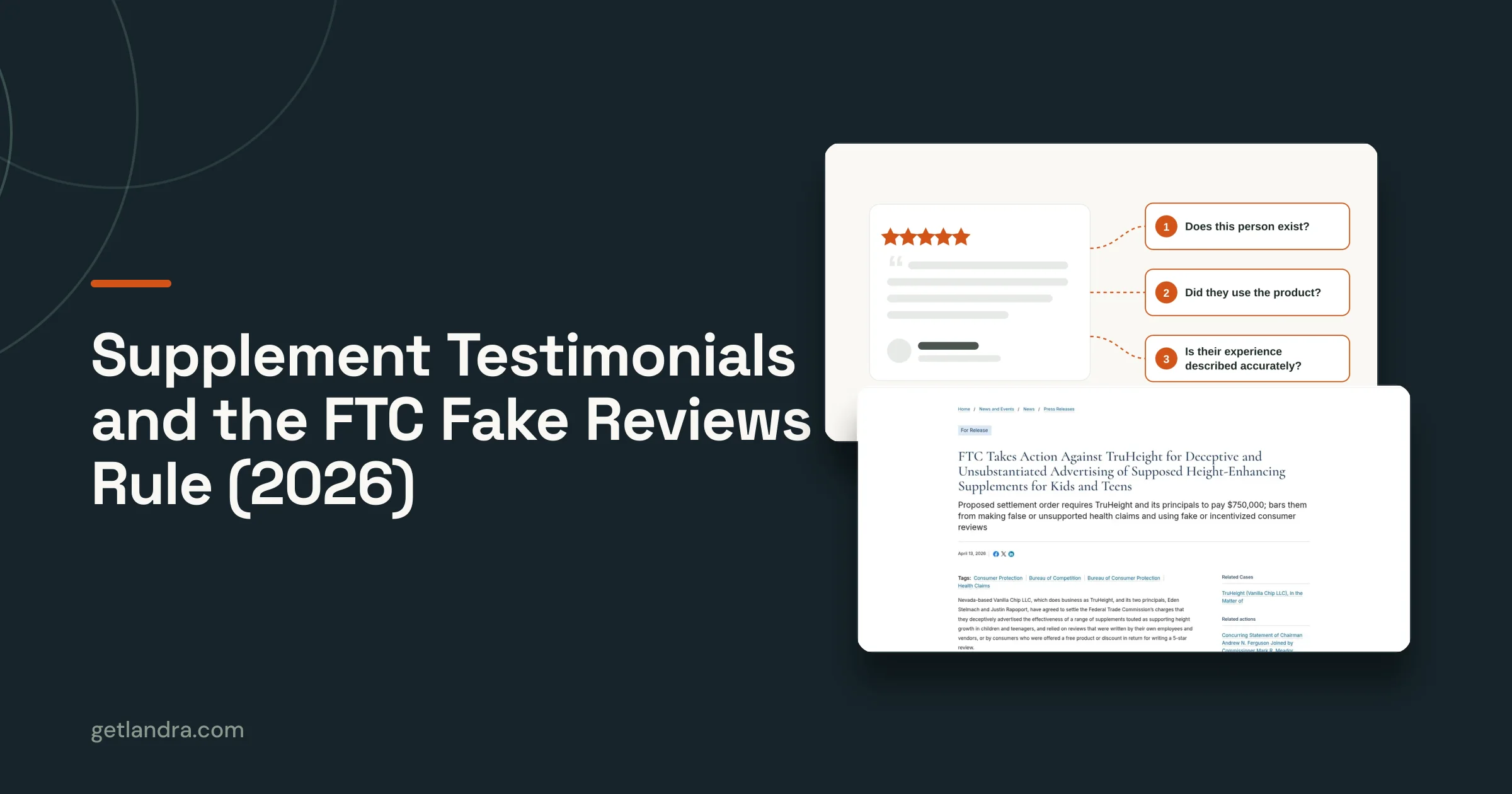
Since October 2024, fake and false testimonials aren't just a deceptive-advertising problem. They're a rule violation with a fine attached. So we pulled 16 supplement pages from our swipe file, loaded them on October 10, 2026, and read every testimonial on them. Here's what the rule says, what we found, and what I'd check on your page before you put more spend behind it.
What is the FTC Fake Reviews Rule?
The FTC's Trade Regulation Rule on the Use of Consumer Reviews and Testimonials (16 CFR Part 465) bans fake and false reviews and testimonials, review buying, undisclosed insider reviews, and review suppression. The FTC announced it on August 14, 2024, in a 5-0 vote, and it took effect on October 21, 2024.
Two things changed with it.
First, money. Breaking an FTC rule knowingly can cost up to $53,088 per violation. That's the 2025 figure, and the FTC kept it for 2026. The FTC itself notes that courts decide how violations get counted and can set lower amounts.
Second, scope. The rule covers testimonials on your own site, and the FTC was direct about it: "A business that puts testimonials on its own website is 'disseminating' them and is not merely 'hosting' them. When such testimonials are fake or false, the business should face potential liability."
So the quote block halfway down your advertorial counts.
Which parts of the rule apply to a supplement landing page?
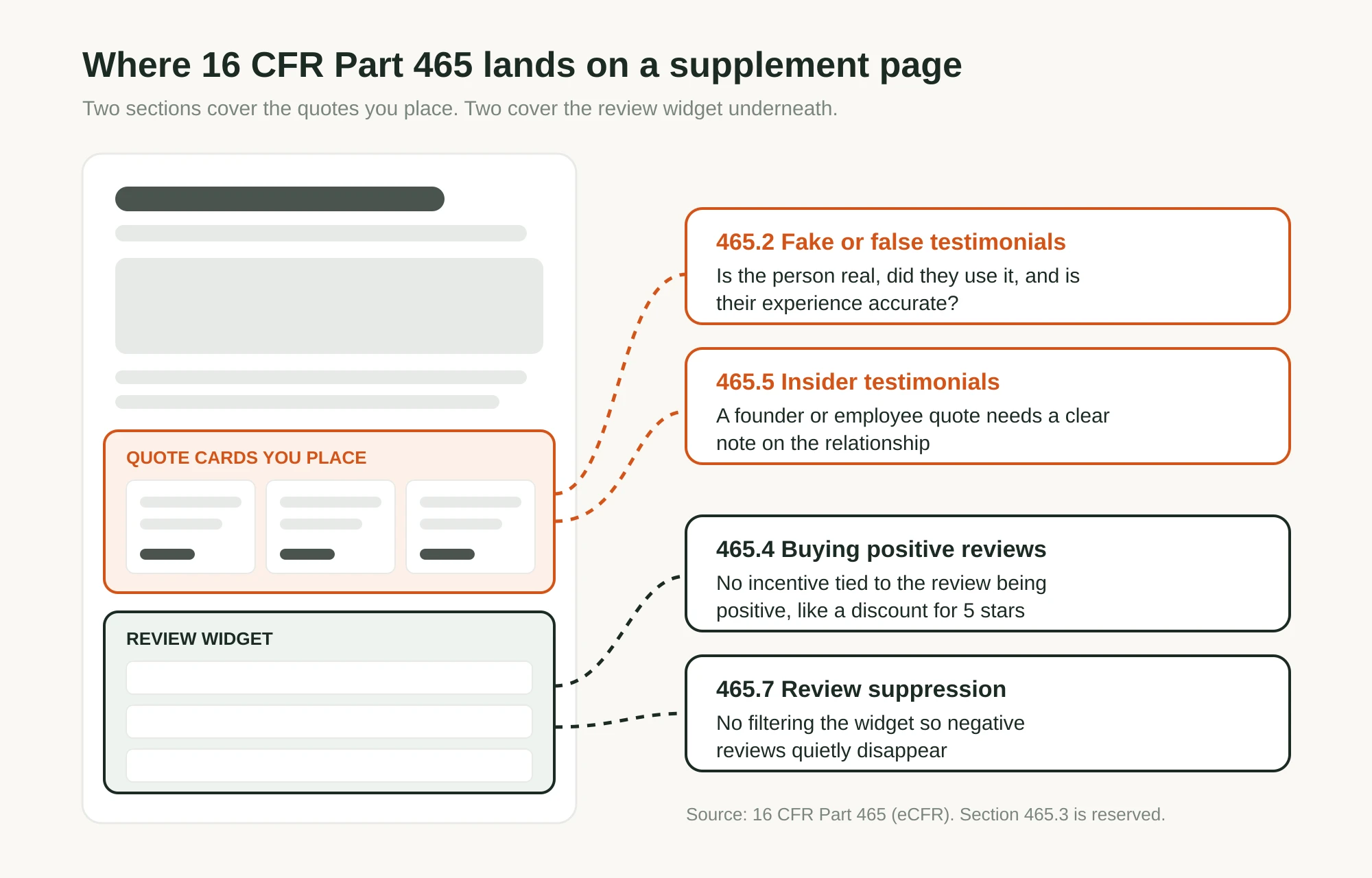
Four sections matter for a landing page. Section 465.2 covers fake or false testimonials, 465.5 covers testimonials from your own team, 465.4 covers paying for positive reviews, and 465.7 covers hiding negative reviews. The first two apply to the quotes you place on the page. The last two apply to the review widget underneath.
| Section | What it bans | Where it shows up on a supplement page |
|---|---|---|
| 465.2 Fake or false reviews and testimonials | Testimonials that misrepresent that the person exists, that they used the product, or what their experience was. For testimonials you display, the test is whether you "knew or should have known" | The quote cards, the story-led narrator, before/after photos, AI-written quotes |
| 465.5 Insider reviews and testimonials | Testimonials from officers, managers, employees or agents without a clear disclosure of that relationship | A founder's or team member's "I take this every day" quote |
| 465.4 Buying positive or negative reviews | Incentives conditioned on a review expressing a particular sentiment | "Leave a 5-star review and get 10% off" emails |
| 465.7 Review suppression | Displaying reviews as if they're most or all of them while hiding the negative ones | Filtering 1- and 2-star reviews out of the widget |
| 465.8 Fake social media indicators | Buying fake followers, views or likes | Inflated follower counts on a creator you feature |
Source: the rule text on eCFR. One detail if you read it yourself: section 465.3 is reserved, so the sections run 465.2, then 465.4.
The rule never uses the words "artificial intelligence." The FTC's commentary does: "AI-generated reviews are covered by the final rule." A quote written by a model for a customer who doesn't exist fails the first question in 465.2.
What does an FTC case under the rule look like?
The clearest supplement case under the rule so far is TruHeight, a height-growth supplement for kids and teens. The FTC filed in April 2026 and finalized the order in July 2026.
Two of the counts were rule violations. The complaint says "numerous seemingly legitimate 5-star reviews" on the brand's site were written by employees (465.2). It also says the brand offered buyers "a 10 percent discount on their next order" if they would "leave a 5-star review and upload at least one picture" (465.4).
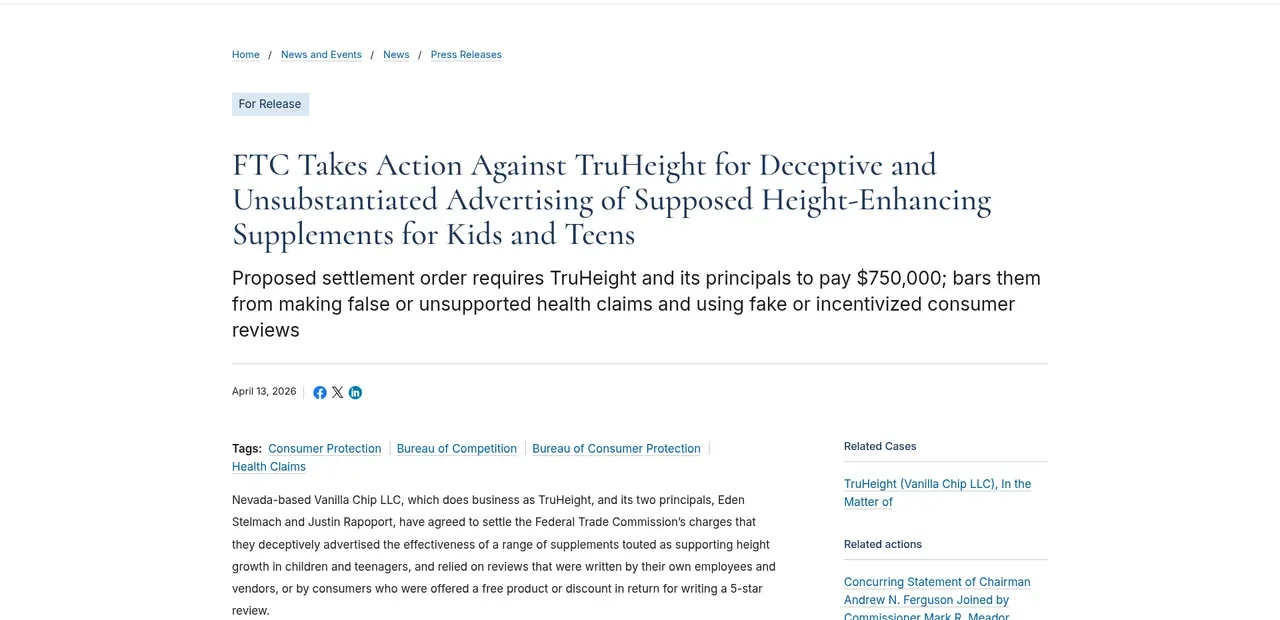
The order is a $4 million judgment, suspended once the company pays $750,000. It also covered the height claims themselves, so not all of that is about reviews.
Look at what the FTC charged, because both moves are ordinary. A discount for a review is a standard post-purchase email. Asking the team to seed a few reviews on a new product is a common shortcut. The rule turns both into counts in a complaint.
What we found on 15 live supplement pages
We loaded 16 supplement pages from our library on October 10, 2026. 15 loaded (one page no longer resolves). One of the 15 is a third-party affiliate review blog rather than a brand page. 11 had testimonials in the page body, 72 quotes in total.
We're not saying any of these pages break the rule. A first name doesn't make a quote fake. But the patterns show what a reader (or a regulator) can and can't check.
| What we checked | What we found |
|---|---|
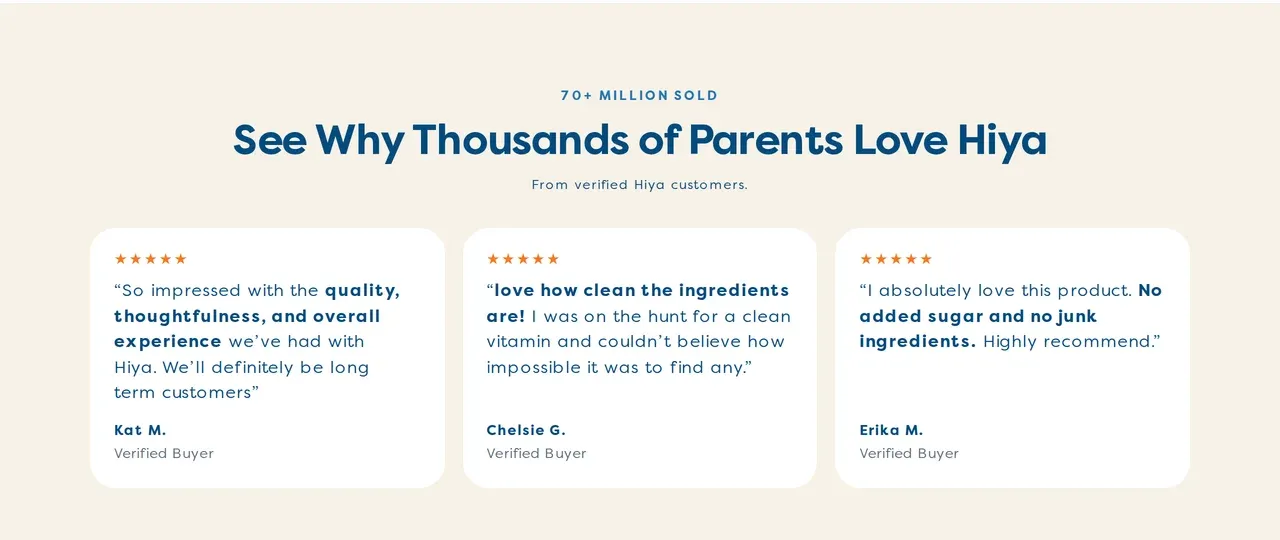
| How quotes are signed | 42 of 72 quotes use a first name and last initial ("Kat M."). Only 3 pages show any full names |
| Dates | 2 of 11 pages date their testimonials. On the other 9, no quote card has a date |
| "Verified" badges | 6 of 11 pages put a "Verified Buyer" or similar badge on each quote. None says who verified it or how |
| "Results may vary" lines | 7 of 15 pages have one. Only 2 put it directly under the testimonials. 4 have it in a footer or bottom block |
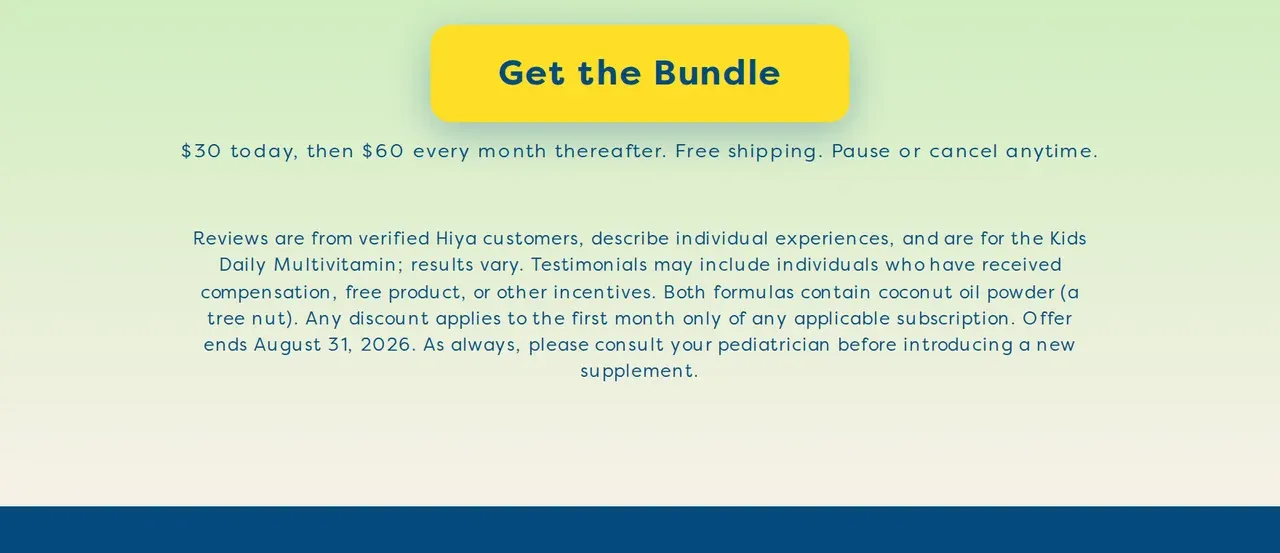
| Compensation disclosure | 1 of 15 pages (Hiya) says testimonials may come from people who got "compensation, free product, or other incentives" |
| Aggregate counts | 12 of 15 pages make a claim like "100K+ reviews". 4 show different numbers for the same thing on one page |
A few things stood out.
The badge does work the page doesn't back up. "Verified Buyer" tells the reader someone checked. On none of these pages can you see what that check was. Two pages go the other way in their fine print: NativePath says "Customer results have not been independently verified", and Primal Queen calls its testimonials "unverified results."
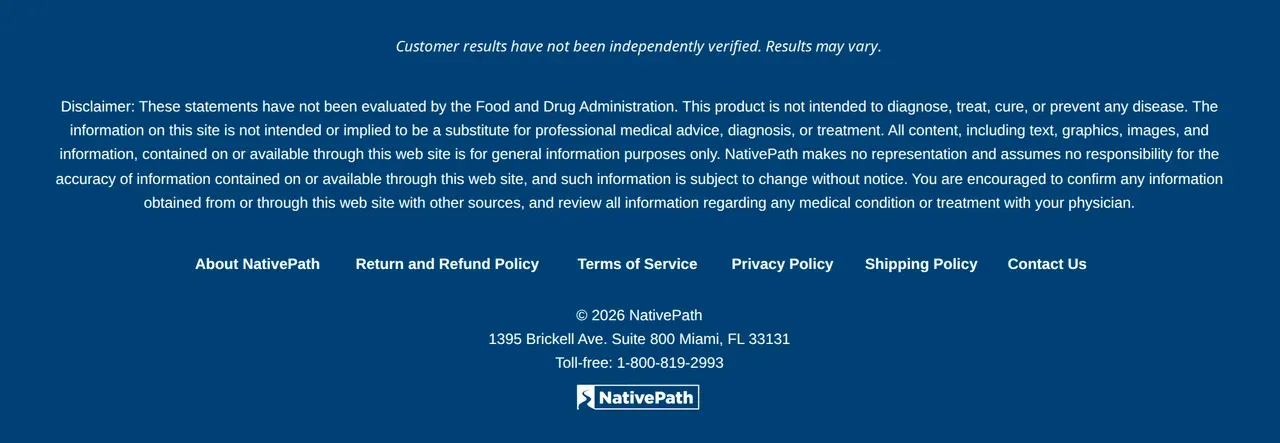
Hiya is the one page we'd copy. Its bottom block says the reviews "are from verified Hiya customers, describe individual experiences, and are for the Kids Daily Multivitamin; results vary. Testimonials may include individuals who have received compensation, free product, or other incentives." That names which product, says results vary, and discloses incentives, in two sentences.
The numbers disagree with themselves. One page shows "247 reviews, 4.8/5" in the body and "Based on 665 reviews, 4.9" in its review widget a few scrolls down. Another shows "100K+ reviews", "85,000+ Five-Star Reviews" and "(95,000)" on the same page. None of that is necessarily false. Each number may have been true when someone typed it. But a reader who notices starts doubting the quotes too.
Story-led pages never say whether the story is real. 7 pages use a narrator, persona or doctor byline. Two make it clear the narrator is a co-founder. None of the 7 says whether the person and the result are real or typical.
Does "results may vary" protect you?
No. The FTC has tested this. In the Endorsement Guides, it says disclaimers like "Results not typical" are "insufficient", because readers still assume the testimonial shows what they'll get. Its Health Products Compliance Guidance says attempts to disclaim dramatic results "don't cure the deception."
What the FTC asks for instead is the typical result, stated clearly, next to the dramatic one. Its own example is a supplement ad: the vague disclaimer fails, and this line works, "In an 8-week study, subjects taking the supplement lost an average of 5 pounds. Subjects taking a placebo lost an average of 1 pound," placed right by the quote.
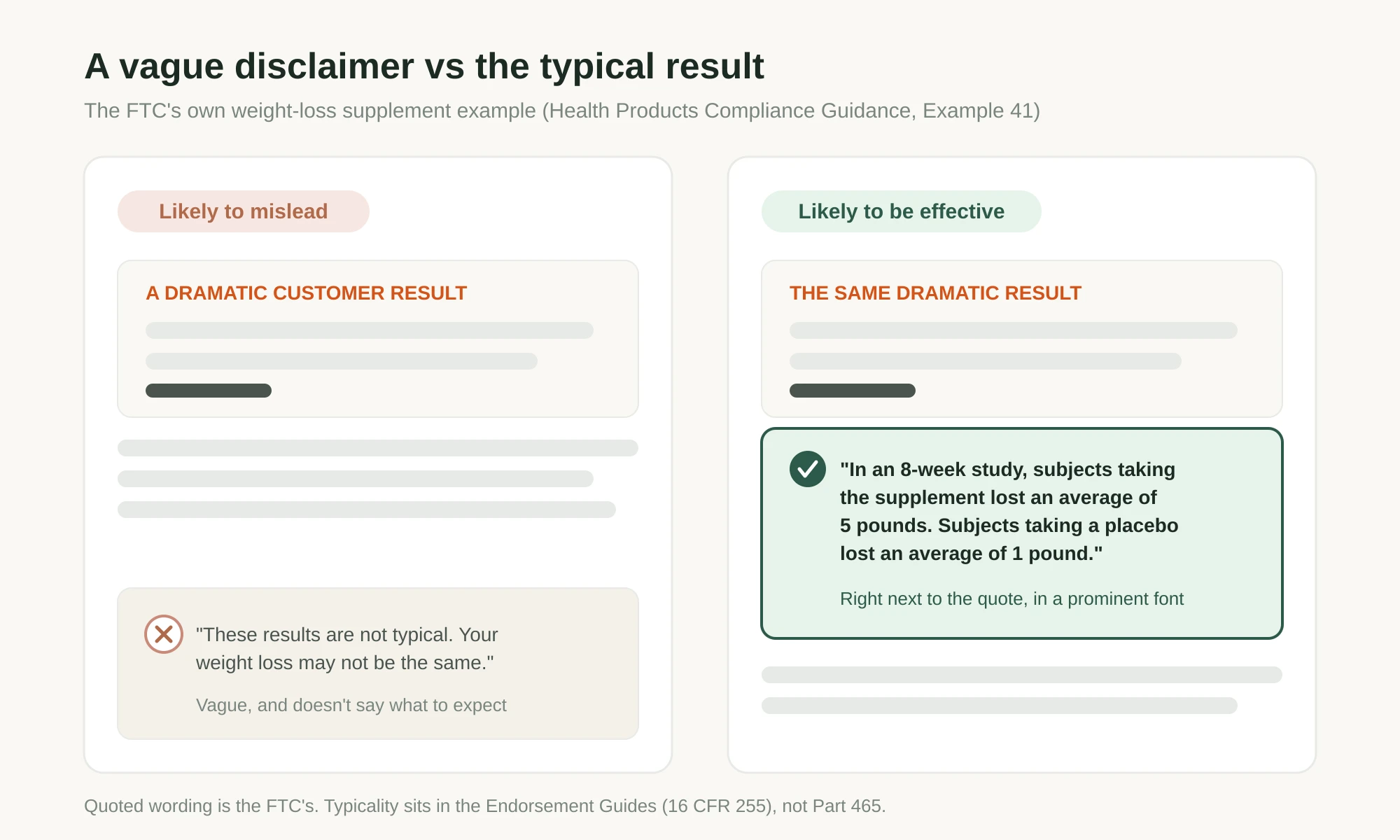
Two caveats. Typicality is an Endorsement Guides issue, not a Part 465 one (the FTC said so in the rule's commentary), so the rule's fines don't attach to it directly. And the FTC still says customer stories "are never sufficient to substantiate claims about the effects of a health product." A testimonial can't make a claim you couldn't make yourself on the product page. Our supplement playbook covers that substantiation floor.
The line I'd worry most about is the opposite of a disclaimer. One advertorial we wrote about in that playbook says in its fine print that reviews and testimonials "may be fictionalized." Under 465.2, a fictional testimonial misrepresents that the person exists or what happened to them. Writing that down doesn't make the person real. It's a record that you knew.
A checklist for every testimonial on your page
Run this on every quote before it goes on a page you're paying to send traffic to:
- Keep a file for each quote. Who said it, when, the order it came from, and their permission to use it. If you can't produce that file, take the quote down.
- Use real words, lightly edited. Fix typos, cut length. Don't change what happened or how much.
- Never write a testimonial yourself, with AI or without it. That includes "composite" customers and placeholder quotes that stay up after launch.
- Disclose insiders. A founder, employee or agent quoting their own results needs a clear note next to the quote, unless the page already makes the relationship obvious.
- Disclose incentives. If someone got free product, a discount or a contest entry, say so. Hiya's two sentences are a good model. (The Endorsement Guides, 16 CFR 255.5, cover this.)
- Ask for reviews, not 5-star reviews. Offering the same thank-you for any honest review is fine. Offering it only for 5 stars is what TruHeight was charged with.
- Don't filter the widget by star rating. Removing spam, abuse or fakes is allowed, as long as the same criteria apply to every review regardless of how positive it is.
- Put the typical result next to the dramatic one. If your best quote says "down 20 pounds", the number most buyers can expect belongs right beside it, not in the footer.
- Say what "verified" means, or drop the badge. "Verified purchase through our store" is a claim you can back up. "Verified" on its own isn't.
- Make your counts agree. Pick one review count and one rating, pull them from the same source, and update them together.
None of this makes your page weaker. Readers can tell a real quote from a polished one. A dated quote with a name, the product it's about, and a plain note about how typical the result is makes your page more believable, not less.
And if you're building a new supplement page, the disclosure guide covers the other half of compliance: labeling the page as an ad. If it's your first advertorial, start there.
Frequently asked questions
Does the FTC Fake Reviews Rule apply to testimonials on my own landing page?
Yes. The FTC said a business that puts testimonials on its own website is "disseminating" them, not merely hosting them. If a testimonial misrepresents that the person exists, that they used the product, or what their experience was, and you knew or should have known, it falls under section 465.2.
Are AI-generated testimonials illegal under the FTC rule?
A testimonial written by AI for a customer who doesn't exist misrepresents that the person exists, which section 465.2 bans. The rule text doesn't mention AI, but the FTC's commentary on the final rule says "AI-generated reviews are covered."
What is the fine for fake testimonials?
Up to $53,088 per violation for knowing violations of an FTC rule. That's the 2025 figure, which the FTC kept for 2026. Courts decide how violations are counted and can set lower amounts.
Can I give customers a discount for leaving a review?
You can offer an incentive for honest reviews in general. You can't make it conditional on the review being positive. Section 465.4 bans incentives tied to a particular sentiment, and a 10% discount for 5-star reviews was one of the counts in the FTC's TruHeight case.
Is "results may vary" enough of a disclaimer?
No. The FTC says vague disclaimers like "Results not typical" don't fix a testimonial that shows better results than most buyers get. It asks for a clear statement of the results people can generally expect, placed next to the testimonial.
Can my founder or employees give testimonials?
Yes, with a clear disclosure of their relationship to the business next to the testimonial, unless the page already makes it obvious (for example, the quote is signed "co-founder"). Section 465.5 covers this.
Has the FTC enforced the rule yet?
Yes. It sent warning letters to 10 companies in December 2025, brought the TruHeight supplement case in April 2026, and filed a civil penalty case with Illinois against a home services company in May 2026.