
An advertorial is one of the oldest and most durable formats in direct-response marketing, and one of the most misunderstood. This page defines what an advertorial is, where it came from, how it differs from neighboring formats, where DTC brands use it, and why it still converts. It's the format Landra is purpose-built to produce — a complete, optimized advertorial built from your brand URL, copy and structure and images included.
What is an advertorial?
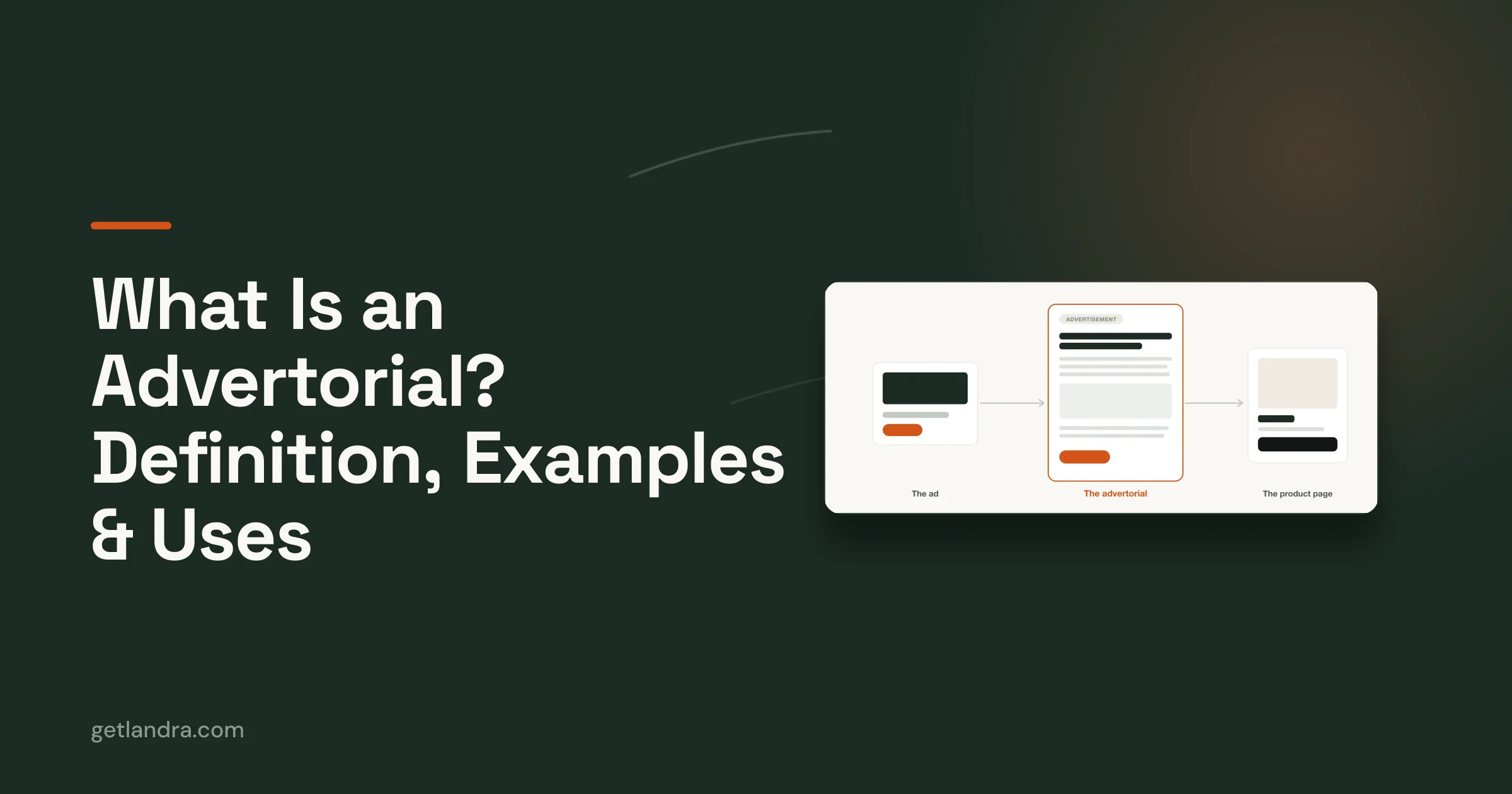
An advertorial is a paid advertisement written and designed to read like an editorial article. The word is a blend of "advertisement" and "editorial," and it dates to 1946, though the practice is older, going back to long-form brand stories in newspapers and magazines in the 1910s. Instead of a hard sell, an advertorial opens with a story, a problem, or a question, educates the reader, and only then introduces the product as the resolution, all while being clearly labeled as paid content.
The format trades the interruptive feel of a banner or a short video for the credibility of an article. Readers give an article more attention and more trust than an obvious ad, and a well-built advertorial uses that attention to walk them from curiosity to conviction.
How does an advertorial work?
An advertorial works by mirroring the sequence a person follows when making a considered decision: they notice a problem, look for an explanation, weigh the evidence, settle their doubts, and then act. A strong advertorial follows the same five steps in order, earning a little more trust at each one:
- Problem: name the relatable problem the reader already feels, then agitate it honestly.
- Solution: explain what fixes the problem and why it works, before naming the product.
- Proof: make it believable with testimonials, results, ingredients, or data.
- Objections: answer the obvious doubts with an FAQ, a guarantee, or a "who it's for" section.
- Call to action: make one clear next step obvious.
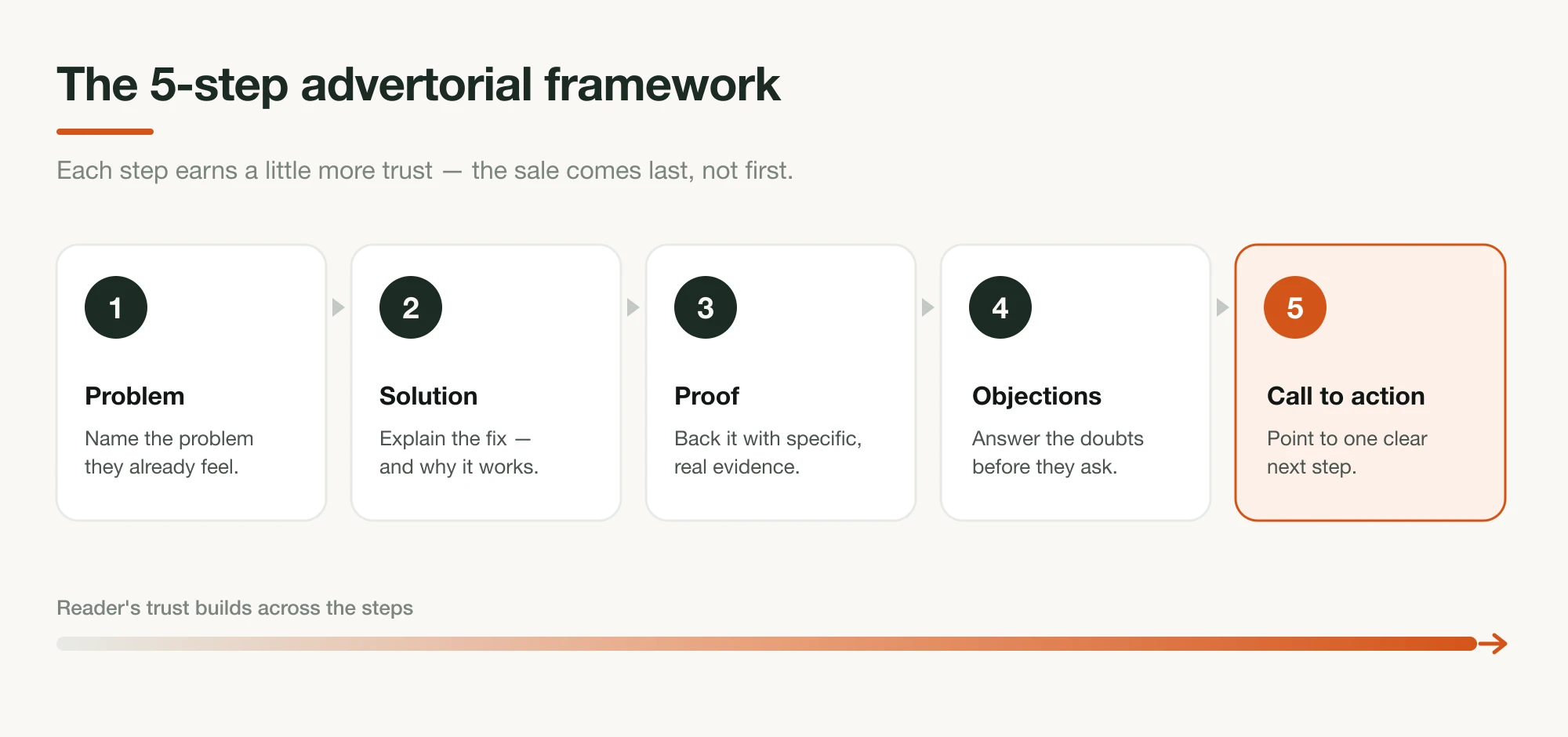
Because the reader feels informed rather than sold to, the call to action lands as a logical conclusion instead of an interruption. For the full method, see our guide on how to write an advertorial.
Advertorial vs native advertising vs editorial
These three terms overlap, which is why they get confused. Editorial is independent content created by a publication, not paid for by a brand. Native advertising is the broad category of paid content designed to match the look and feel of its platform. An advertorial is one specific native format: a paid article in editorial style.
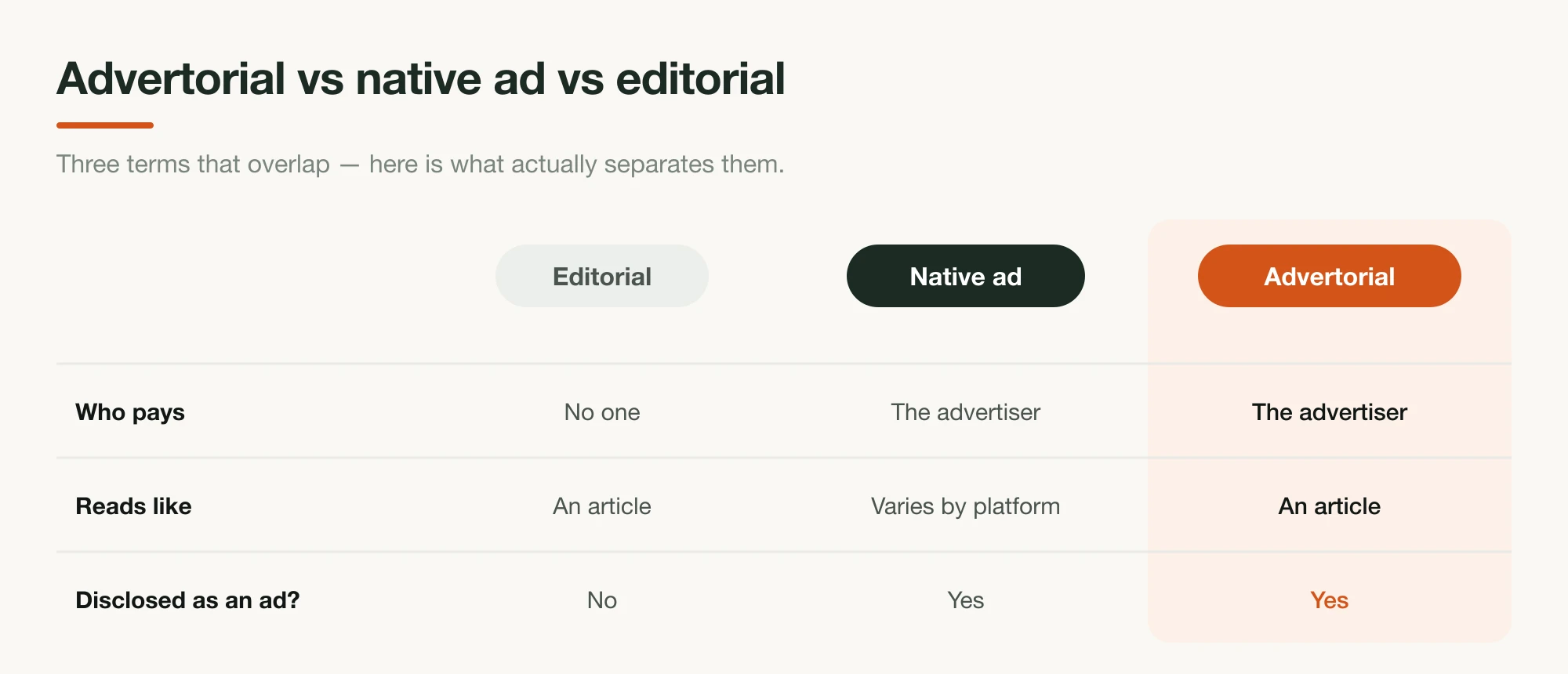
The practical takeaway: an advertorial is always native advertising, and it always requires disclosure, but it's distinct from a feed-native ad or a sponsored video.
The clearest place to see the distinction is a native ad network like Taboola or Outbrain. The "you may also like" recommendation widget at the bottom of a news article is native advertising — a paid tile matched to the publisher's content. Click it and you usually land on an advertorial: the full editorial-style page that does the selling. So in one funnel, "native advertising" names the ad unit (the widget) and "advertorial" names the destination (the page). The two are not synonyms; the advertorial is the format the native click most often leads to. (For how that funnel is built, see the native ad funnel for DTC.)
Disclosure is where the overlap gets practical. Because an advertorial reads like a real article, it carries the heaviest disclosure burden of the three, and on native networks that burden is enforced, not optional: Taboola and Outbrain require a visible "Advertorial" label across the top of the page as a condition of running the campaign, which maps directly onto the FTC's rule that paid content must not pass as independent editorial. Editorial needs no label because no one paid for it; a feed-native ad is obviously an ad in context; the advertorial is the one that has to say so out loud. (For exactly what the networks reject, see native ad landing page compliance.)
Where you'll see advertorials
You've almost certainly read advertorials without naming them. The classic example is the supplement or skincare "article" you reach from a social ad — it opens with a relatable struggle, explains why the problem happens, introduces a product as the solution, and carries a small "Advertisement" label at the top. The same pattern shows up as the listicle ("5 reasons people are switching…") and the founder story ("why I started making this after my own diagnosis").
It's a staple of modern DTC marketing. Hims & Hers fronts pages with the problem ("Trouble sleeping?") before the treatment; Jones Road Beauty runs listicle advertorials like "5 Reasons Why Jones Road Products Are Great for Mature Skin"; and teeth-whitening brand Snow is known for running advertorials as a primary acquisition play. You see them most where the traffic is cold and the purchase needs explaining — the top and middle of the funnel, not the checkout-ready bottom.
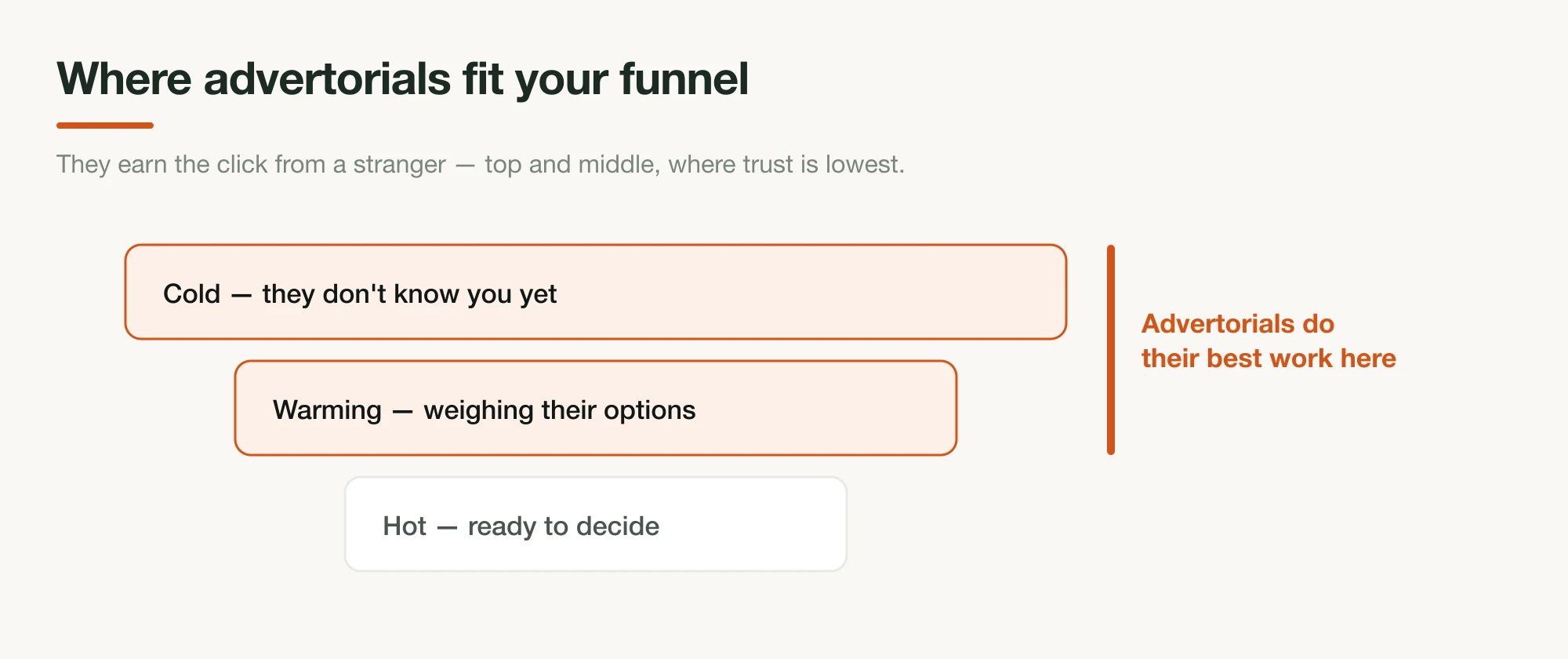
What unites the examples is structure, not subject. An advertorial can sell a $25 supplement or a $300 device; it can run as a first-person diary or a third-person report. The format is defined by the sequence — problem, solution, proof, objections, call to action — and by the disclosure, not by any one industry.
Why advertorials still work
Advertorials endure because they match how people make considered decisions and because the editorial format transfers trust the way a banner ad can't. For a product that needs explaining, an article that earns attention first will out-convert a hard sell that demands it.
One useful way to see why is Eugene Schwartz's five stages of customer awareness. A reader who doesn't yet know they have a problem (or doesn't know your product exists) won't respond to a product page that assumes they're ready to buy. The advertorial meets that reader earlier and walks them up the staircase.
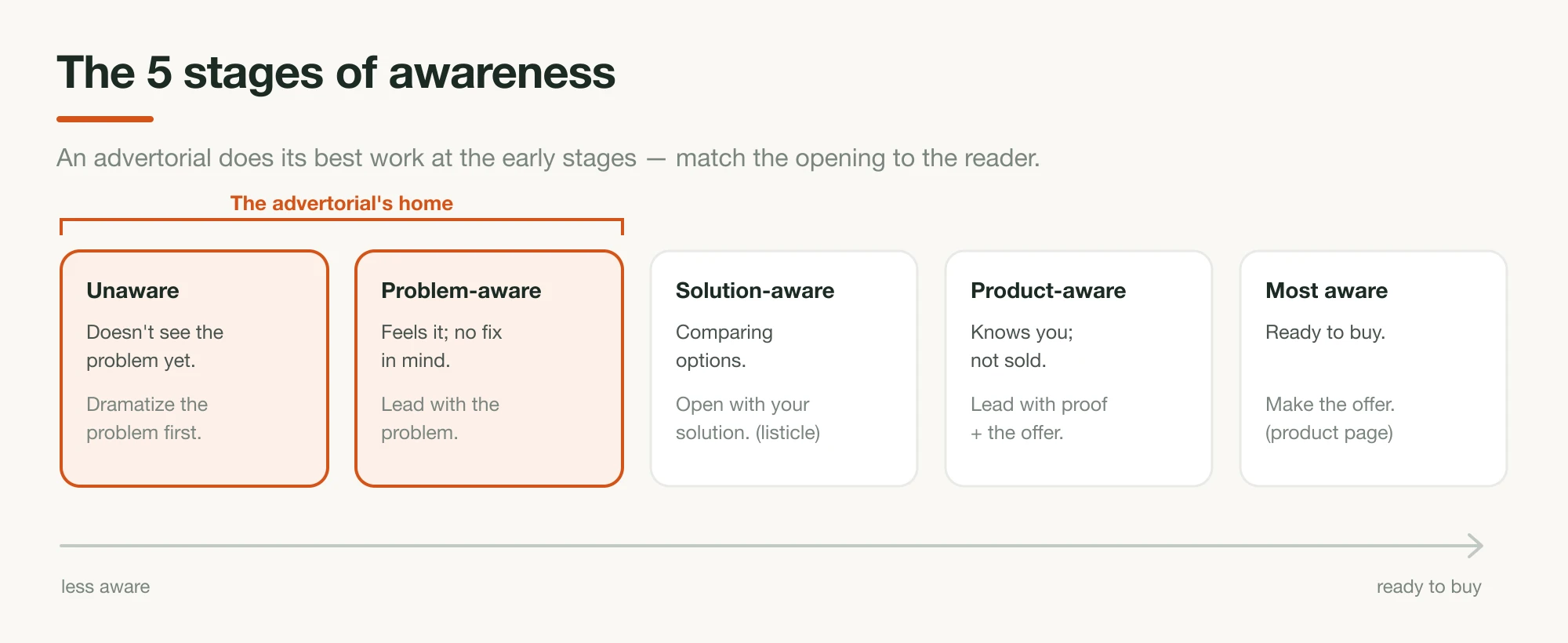
The economics show up clearly as a pre-sell. TrueProfit estimates that sending cold ad traffic straight to a product page might convert "around 0.5%," while routing it through an advertorial first "can jump to 3–5%" (a vendor figure, so read it as directional), but it reflects how the page does the warming a product page can't. That's the same reason the format outlived print and became a core DTC acquisition tool: it works on the cold, skeptical reader who isn't ready to buy yet.
Are advertorials legal? Disclosure and the FTC
Advertorials are legal — as long as they're clearly disclosed. The U.S. Federal Trade Commission's native advertising guidance requires that paid content not masquerade as independent editorial, and it's specific about how to label it:
- Use a clear term — "Ad," "Advertisement," "Paid Advertisement," or "Sponsored." Avoid ambiguous words like "promoted."
- Place the disclosure where readers will see it before they engage — at the top, in front of or above the headline.
- Make it stand out (size, contrast, placement) so a reader readily notices it.
Disclosure isn't only a legal requirement; done honestly, it's a trust signal that costs little and protects the brand. An undisclosed advertorial is a deceptive ad — and a clawback or penalty is far more expensive than a label.
How brands create advertorials
Brands write advertorials by hand, hire agencies to build them, or generate them. Landra builds a complete, optimized advertorial from your brand URL — the problem, solution, proof, objections, and call to action, plus images — tuned to the audience you name, then hands you an editor to refine it.

An advertorial is one of the formats a presell page can take — the wider category, and how the formats are routed by reader awareness, is in what is a presell page. To go deeper, read how to write an advertorial, compare it with its sibling format in what is a listicle and how to write a high-converting listicle, or see the tools in our best AI landing page builders for ecommerce roundup.
Frequently asked questions
Is an advertorial the same as native advertising?
No. Native advertising is the broad practice of matching an ad to the form of its surrounding platform. An advertorial is one specific format: a paid article written in editorial style. Every advertorial is native advertising, but not all native ads are advertorials.
Are advertorials legal?
Yes, when they are clearly disclosed. The U.S. FTC requires paid content to be labeled (for example, "Advertisement" or "Sponsored") so readers are not misled into thinking it is independent editorial. Undisclosed advertorials are deceptive and can carry penalties.
When did advertorials start?
The practice goes back to long-form brand articles in newspapers and magazines in the 1910s; the word "advertorial" itself dates to 1946, per Merriam-Webster. The digital, paid-traffic version DTC brands run today is the same idea adapted to the feed.
How long should an advertorial be?
Long enough to make the case and no longer. Most direct-response advertorials run 800–2,000 words — enough to frame a problem, explain a solution, and answer objections, while staying focused on a single product and a single call to action.
Do advertorials still work in 2026?
Yes. For products that need explanation before purchase, an advertorial tends to outperform a short ad or a generic product page, because it earns trust before asking for the sale. It mirrors how people actually make considered decisions, which is why the format has lasted decades.