
Most advertorials fail for the same reason: they start selling on line one. A good one does the opposite. It earns a stranger's attention with a story or a problem, and only asks for the sale once it's earned the right. This guide gives you a research-backed, five-step framework for writing one that converts, grounded in how the format actually performs for DTC brands. New to the format? Start with what an advertorial is.
Why advertorials convert
An advertorial converts because it sells inside the reading flow instead of interrupting it. Formatted like an article, it borrows the credibility of editorial, explains more than an ad can, and handles objections before the reader hits the product page, so trust is already built when the ask arrives. It's a pre-sell, not a sales page. For the page type itself, see how to write a pre-sell page; for the section-by-section anatomy and build, see how to build an advertorial landing page.
The economics are the reason DTC brands lean on them. Cold ad traffic sent straight to a product page can convert as low as ~0.5%; routing it through an advertorial first can lift conversion into the 3–5% range, according to a TrueProfit benchmark, because the page does the warming a product page can't. The format is old (newspapers ran paid articles a century ago) but the digital, paid-traffic version is now a core DTC acquisition tool precisely because of that lift.
When does an advertorial make sense?
An advertorial earns its keep in a specific situation: the product needs explaining, the price needs justifying, and the traffic is cold. TrueProfit suggests advertorials pay off when a product needs explanation and runs above roughly $70, enough complexity that a product photo and a price won't close the sale on their own.
It's the wrong tool in the opposite case. If your reader is already solution-aware and comparing options, a scannable listicle usually converts better; if they're ready to buy, send them to the product page. Match the format to the reader: an advertorial for the cold, problem-aware visitor who needs educating; a listicle for the comparison shopper; a product page for the decided buyer.
Match the advertorial to your reader's awareness
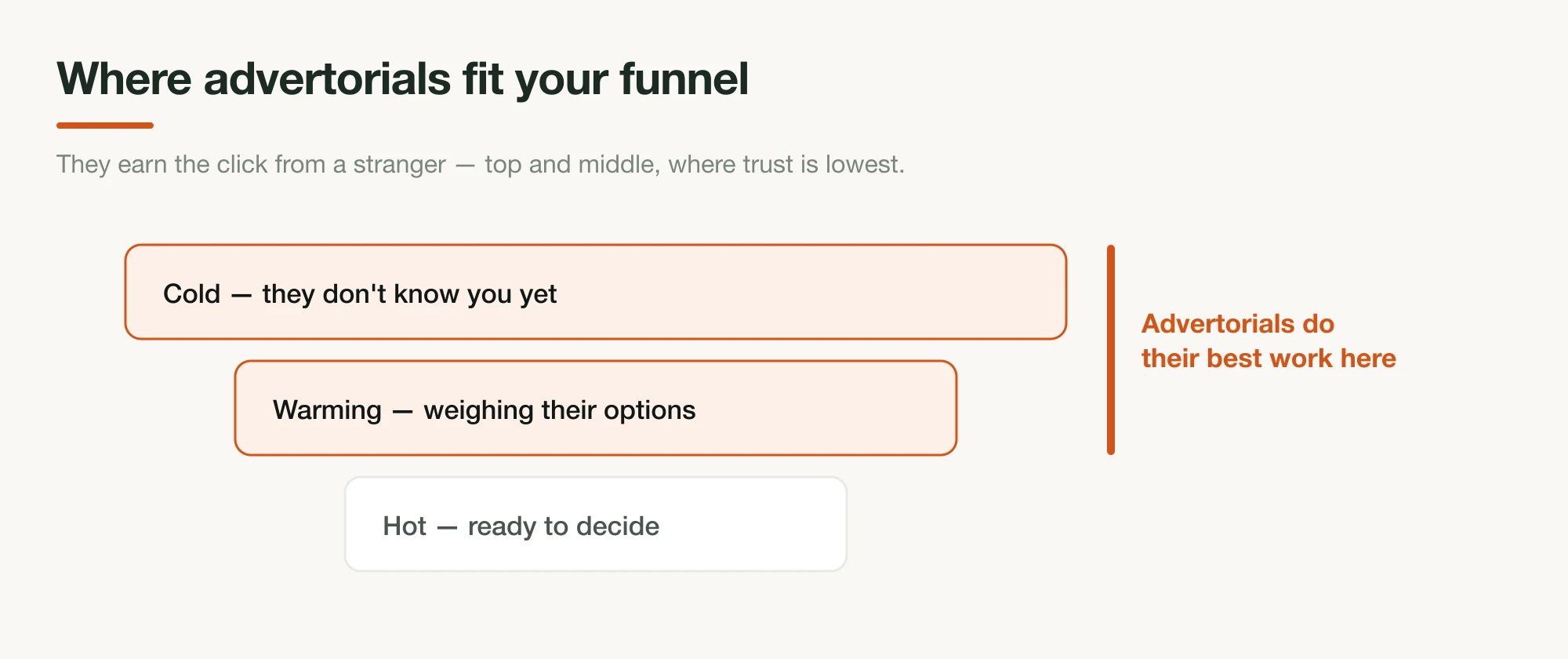
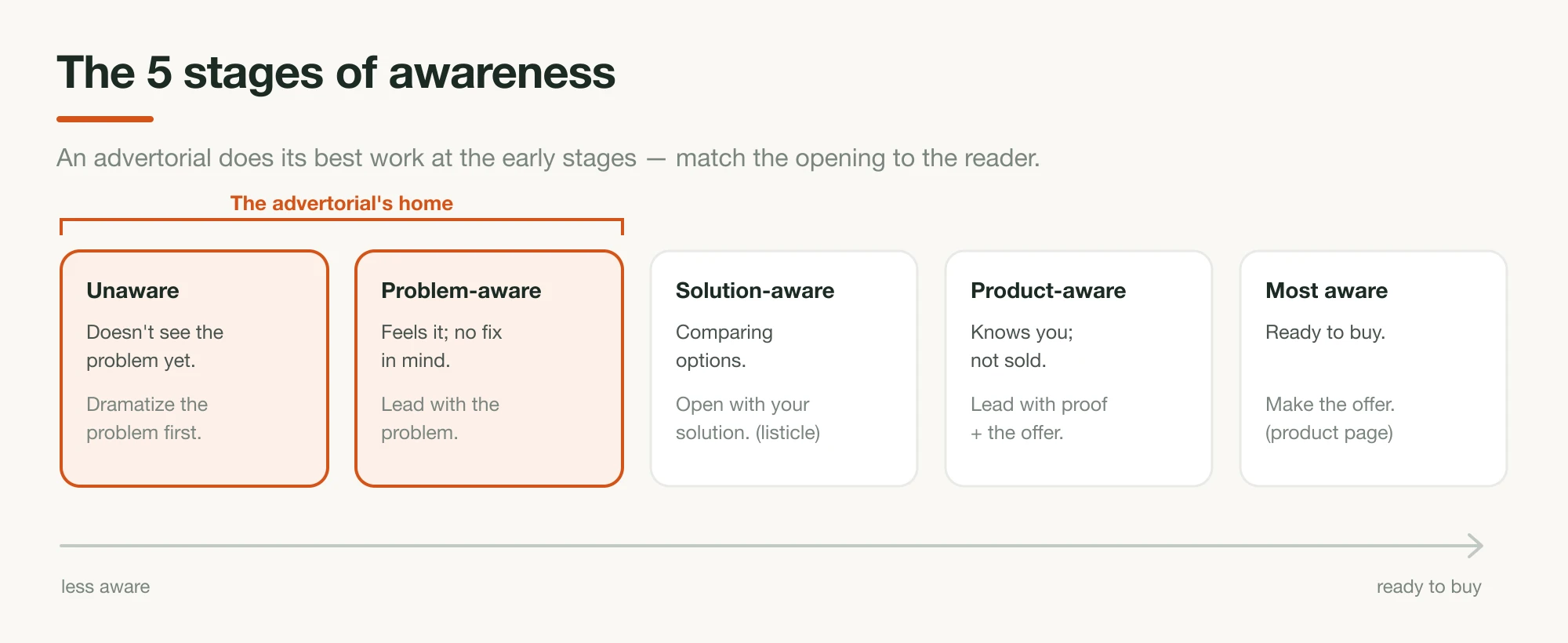
The biggest lever on an advertorial is starting where the reader actually is. Eugene Schwartz's Breakthrough Advertising (1966) laid out five stages of awareness, and the advertorial's home is the early ones — the reader who doesn't yet know you, and maybe doesn't yet name the problem. (An advertorial is direct-response copywriting applied to a landing page, and awareness is its master key.) Where you open the page depends on which stage you're writing to:
- Unaware: doesn't recognize the problem. Open by naming and dramatizing the problem; the product comes much later.
- Problem-aware: feels the problem, doesn't know the fix. Lead with the problem, build desire for a solution, introduce the product toward the end. This is the advertorial's sweet spot.
- Solution-aware: knows solutions exist, hasn't chosen. Open with your solution and why it beats the alternatives (often a listicle's job).
- Product-aware: knows your product, isn't convinced. Lead with proof, offers, and objection-handling.
- Most aware: ready to buy. Skip the advertorial; give them the offer.
A message pitched at the wrong stage falls flat. Selling a product to someone who doesn't yet feel the problem is the most common reason a page dies. Pick the stage before you write the first line.
What top DTC brands do
Advertorials aren't a fringe tactic; they're a staple of DTC acquisition for products that need explaining. Jones Road Beauty's quiz-to-advertorial funnel reportedly drove seven figures in a single quarter, per Marketing Examined. And advertorial-style pre-sell pages show up repeatedly in roundups of what's working for DTC brands — see this collection of advertorial examples spanning supplements, skincare, and home goods.
The common thread is the problem-led open. Hims & Hers fronts its pages with the problem ("Trouble sleeping?") before the treatment; Dr. Squatch lets brand voice carry an educational, story-led funnel rather than a product pitch. None of them open with "buy our product." They open with the reader's problem, which is exactly what the framework below systematizes.
Before you write: pin down the reader and the one promise
Before the first sentence, settle two things in writing. First, exactly who you're talking to — not "people who want energy" but "parents who hit a wall at 3 p.m. and have already tried more coffee." Second, the single promise the page makes. One reader, one problem, one product, one promise. If you can't state the promise in a sentence, the page will wander, and a wandering advertorial reads as an ad.
This step is unglamorous, and it's where most of the conversion is won or lost. A sharp reader-and-promise brief makes every later decision (the hook, the proof you choose, the objections you answer) almost automatic. A fuzzy one means you're guessing for 1,500 words.
The 5-step advertorial framework
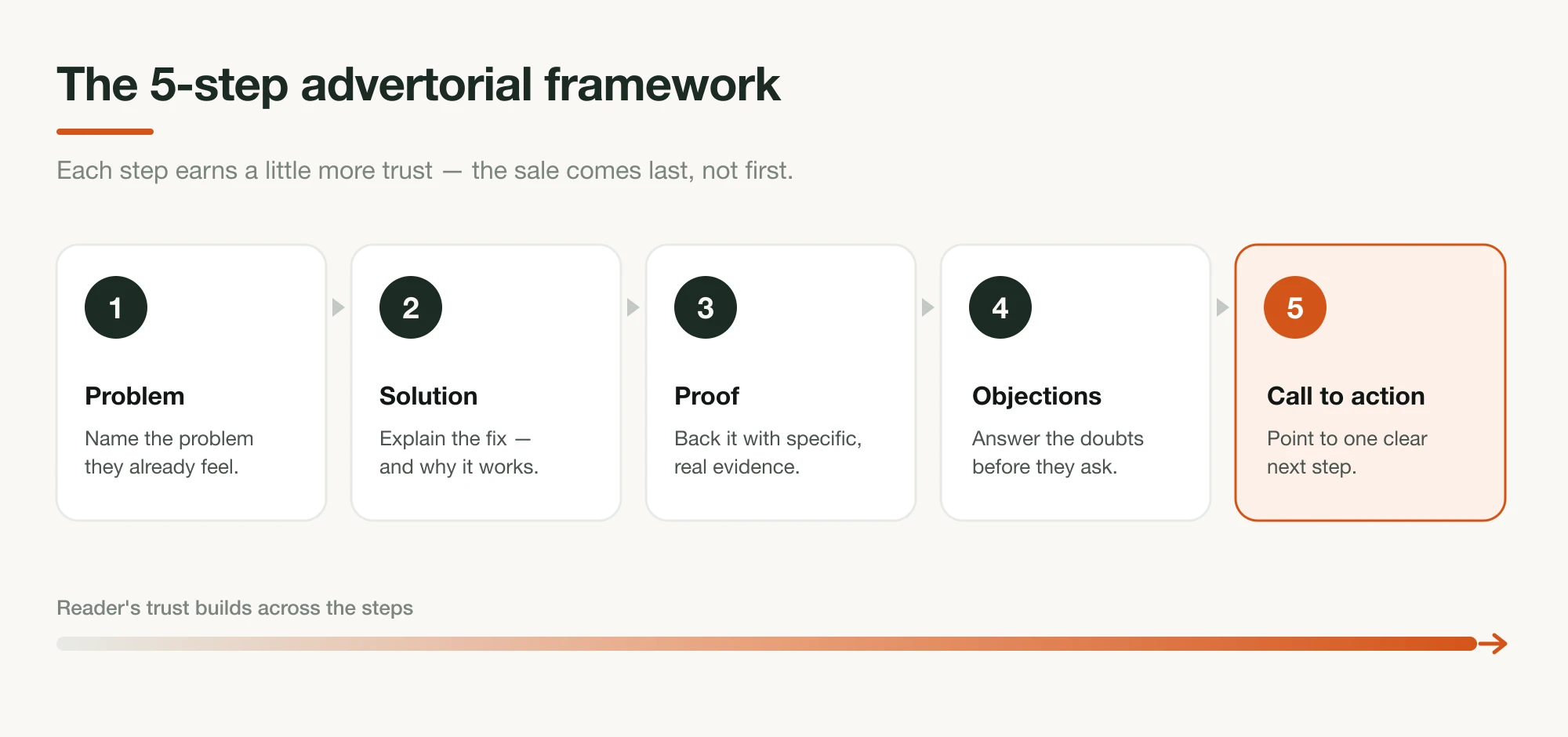
The body of every converting advertorial walks the same arc, the path a person follows in their own head before they buy: notice the problem, understand the fix, weigh the evidence, settle their doubts, decide. Skip a step and the reader feels the gap as a sales pitch.
1. Open with the problem and agitate it honestly
Your first job is recognition. The opening must make the right reader think "this is about me" within two sentences. Lead with the symptom they live with — the 3 p.m. energy crash, the breakouts that come back, the dog that won't stop scratching — not your brand name or your offer. Then deepen it honestly: what it costs them, what they've already tried, why the usual fixes fall short.
The product doesn't appear yet. If a reader can tell they're reading an ad before they're hooked, you've lost the format's only advantage. Honesty matters in the agitation, too: manufactured urgency or invented stakes read as manipulation and break trust you can't rebuild later. Agitation isn't inventing fear; it's showing the reader you understand the problem more precisely than they've been able to put into words.
2. Explain the solution and why it works
Once the reader feels understood, explain the solution and, crucially, why it works. This is the step amateurs skip and pros obsess over. Don't just name a product. Give the specific, credible reason the problem gets solved: an ingredient and how it acts, a design choice, a process. "Clinically studied ashwagandha lowers cortisol, the hormone behind the afternoon crash" beats "boosts energy" every time.
Often the most persuasive move is to explain the approach that works (the why) and only then connect your product to it. Explaining the why makes the eventual benefit believable, differentiates you from competitors making the same vague claims, and gives the reader a story they can repeat to a skeptical partner.
3. Prove it
A claim without proof is just an assertion. Layer in evidence the reader can verify: customer testimonials with specifics, before-and-after results, study references, ingredient transparency, third-party ratings. Specific proof ("down two jeans sizes in eight weeks") outperforms generic praise ("amazing product!") because it's concrete and falsifiable.
Place your strongest proof right after the solution, while belief is highest. Vary the type of proof, too. A testimonial, a number, and a credential persuade different readers, and stacking all three covers more of your audience than three testimonials would.
4. Handle the obvious objections
Before the reader can act, they raise objections in their head: "Is it worth the price? Will it work for me? What if it doesn't?" Answer them on the page. A short FAQ, a satisfaction guarantee, or a "who this is (and isn't) for" section removes the friction that silently kills conversions. You're not being defensive; you're doing the reader's due diligence for them.
The bravest and most effective move here is to name who the product is not for. Disqualifying the wrong buyer signals confidence and makes the right buyer trust every other claim on the page.
5. Close with one clear call to action
End with a single, obvious next step, and make the button copy describe what happens when they click. You can repeat the same call to action down a long page, but every instance must point to the same action. Competing offers ("subscribe, or buy once, or book a call") split attention and lower conversion. One reader, one decision.
The headline carries the whole page
If there's one element you can't afford to get wrong, it's the headline. It decides whether the rest of the page ever gets read. Effective advertorial headlines borrow from news: they frame a story, highlight a problem, or tease a transformation. Real-world patterns look like:
- Problem + authority: "Health Experts Warn: The Wrong Shoes Can Slowly Wear Down Your Joints…"
- Transformation story: "This 65-Year-Old's Knees Were Ruining His Retirement — Until He Turned Back the Clock"
- Curiosity + social proof: "The Bedtime Breakthrough Moms Are Calling 'Magic in a Bottle'"
What they avoid is naming the product. A headline that leads with your brand has given up the format's one advantage before the reader has decided to care. The craft tip that trips up most writers: write the headline last. Draft the body, find the single sharpest idea in it, then write the headline to promise exactly that. Write five, sleep on them, and cut to the one you'd click yourself. For a swipe file of real advertorial hooks grouped by mechanism, see advertorial headlines that convert.
The framework in action: a sleep-supplement advertorial
Here's how the arc looks end to end for a magnesium sleep aid. Problem (Step 1): "You fall asleep fine. It's 3 a.m. that's the issue," then name the groggy mornings, the doom-scrolling, the melatonin that left them foggy. Solution (Step 2): explain that the 3 a.m. wake-up is a nervous-system calm-down problem, and that glycinate-form magnesium supports exactly that phase — the why, before the product. Proof (Step 3): a 14-night customer sleep log, a third-party purity certificate, a sleep-doctor quote. Objections (Step 4): "Won't this make me groggy like melatonin?" answered directly. Call to action (Step 5): one button, "Start your first 14 nights," repeated.
Notice the product name barely appears until the solution is explained. By the time it does, the reader is leaning in, not bracing for a pitch. That's the whole game.
Format it like an article, not an ad
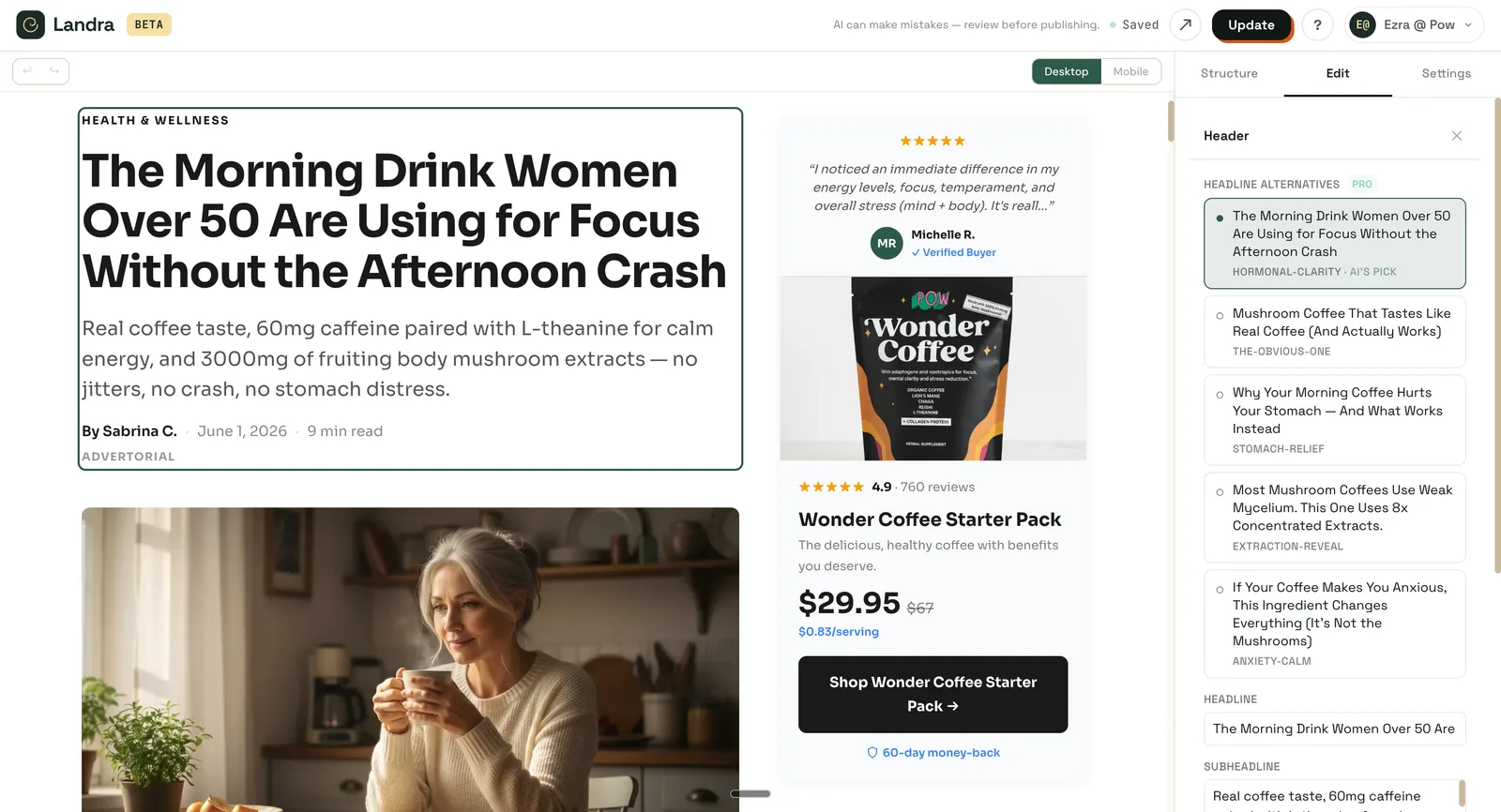
The framework only works if the page looks like content. The best advertorials read like a magazine feature: a large hero image, short paragraphs (one or two sentences each), descriptive image captions that double as subheads, pull quotes, and testimonials embedded where they back a claim. Formatting is what earns the reader's attention in the first place. Lose it and you're back to a banner ad with more words.
It's also where the line between an advertorial and a plain native ad or independent editorial actually sits:
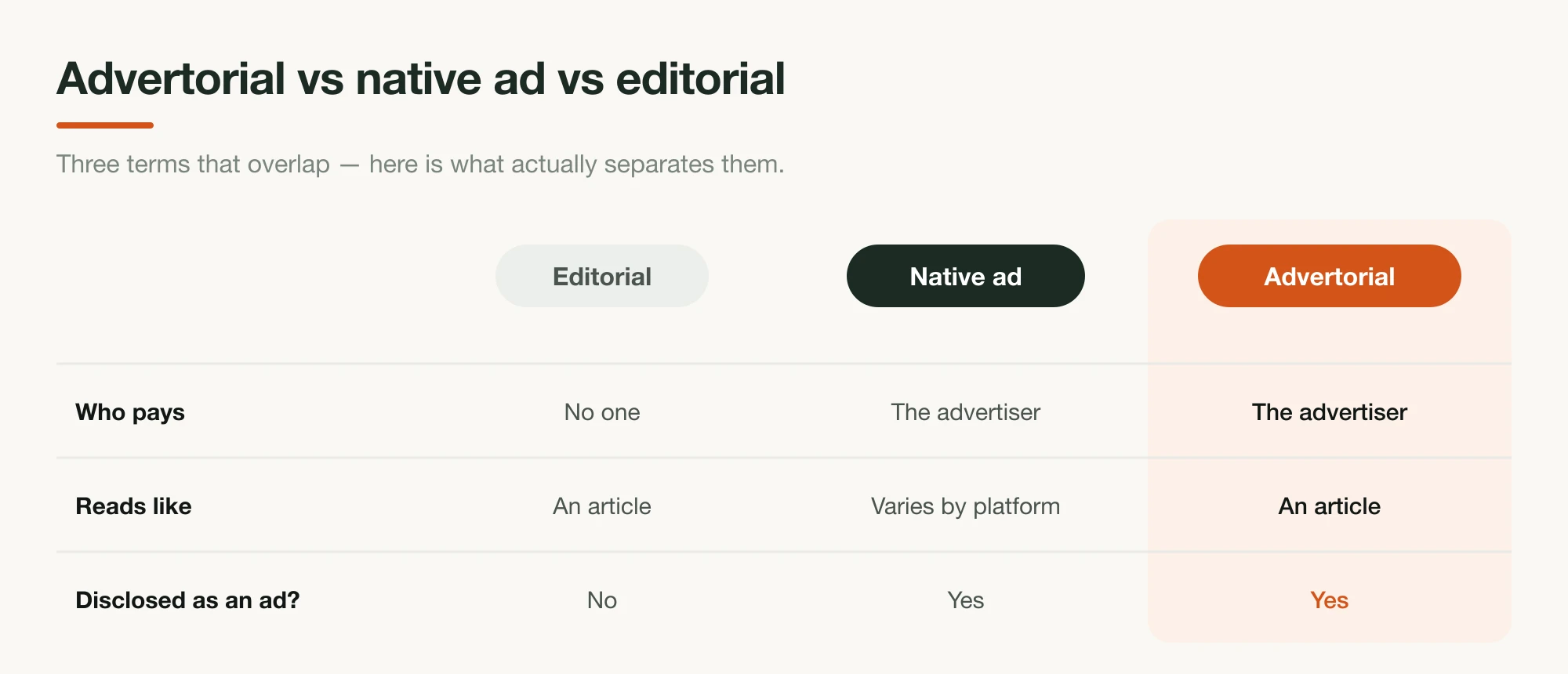
That disclosure is non-negotiable: label the page as advertising. The FTC requires paid content not to masquerade as independent editorial, and a visible "Advertisement" or "Sponsored" label near the top keeps you compliant. Done honestly, it costs you very little trust, and it's far cheaper than a clawback.
Test advertorials like a portfolio
Because an advertorial lives or dies on the problem it leads with, the format rewards testing several angles rather than perfecting one. Write a handful around different problems and audiences, point ads at each, and let conversion rate tell you which problem your market actually feels most. The same applies to its sibling format, the listicle. Drafting several angles is also where AI earns its keep; the full workflow is in how to create an AI-generated advertorial.
That portfolio approach is only practical when a new page takes minutes, not a day. Landra reads your brand and products from the URL to understand them first, then builds the whole optimized advertorial — problem, solution, proof, objections, and CTA, tuned to the audience you name — so you can generate a fresh angle and test it instead of laboring over a single draft.
Common advertorial mistakes
The fastest ways to sink an advertorial:
- Leading with the product. Recognition comes before the offer, always.
- Writing to the wrong awareness stage. Selling to someone who doesn't yet feel the problem is the most common failure.
- Naming a solution without the why. "Feel your best" persuades no one — explain how it works.
- Generic proof. Specifics convert; superlatives don't.
- Multiple competing offers. One action, repeated.
- Looking like an ad. No article formatting means no borrowed credibility.
- Hiding the disclosure. It's required, and honesty is cheaper than a clawback.
The bottom line
A high-converting advertorial is a pre-sell built for a cold, problem-aware reader: it opens at the right awareness stage, walks the five-step arc from problem to a single call to action, proves every claim, and reads like an article the whole way down. Get that right and you can turn cold traffic that a product page barely converts into the 3–5% range TrueProfit's benchmark associates with advertorials, which is why so many DTC brands run them.
When you're ready to build one, see Replo vs Landra or our roundup of the best AI landing page builders for ecommerce.
Frequently asked questions
When does an advertorial make sense?
When the product needs explaining and the traffic is cold or problem-aware. As a rule of thumb, practitioners reach for an advertorial when a purchase needs justification (often above ~$70) or the benefit isn't obvious from a product photo. For solution-aware shoppers comparing options, a listicle usually fits better.
How long should an advertorial be?
Most high-converting advertorials run 800–2,000 words — enough to frame the problem, explain a solution, and answer objections without padding. Let the complexity of the purchase decide: a $25 supplement needs less than a $300 device.
What is the most important part of an advertorial?
The headline and hook. If the opening does not make the right reader feel "this is about me," nothing downstream matters because they never get there. Spend a disproportionate share of your editing time on the first hundred words.
Should an advertorial be written in first person or third person?
Both work. First person ("I tried it for 30 days") suits warm audiences who already know the brand or founder. Third-person, reportorial voice tends to feel more credible to cold paid traffic. Match the voice to how much the reader already trusts you.
How many calls to action should an advertorial have?
One action, repeated. You can place the same call to action several times down a long page, but every button must point to the same next step. Competing offers split attention and lower conversion.
Do I need to disclose that an advertorial is an ad?
Yes. Regulators such as the FTC require paid content to be clearly labeled. A visible "Advertisement" or "Sponsored" label near the top keeps you compliant and, done honestly, costs you very little trust.