
A listicle is one of the most-clicked formats on the internet, and in DTC marketing, one of the hardest-working landing pages you can run. This page defines what a listicle is, where the word came from, why the format works on a scanning reader, the main types, how it differs from neighboring formats, and where ecommerce brands use it to convert. It's one of the two formats Landra is purpose-built to produce — a complete, optimized listicle built from your brand URL.
What is a listicle?
A listicle is an article structured as a list. Merriam-Webster defines it as "an article consisting of a series of items presented as a list," and the word itself is a blend of "list" and "article." It's a recent coinage — the Oxford English Dictionary dates its earliest evidence to around 2007, alongside the rise of social-sharing journalism — but the underlying idea, packaging information as a numbered set of points, is far older.
The format trades the flowing paragraphs of a traditional article for discrete, numbered entries: a headline that names a number ("7 ways to…", "5 reasons why…"), a short intro, the list itself as the bulk of the page, and a brief close. That structure is the whole point: it tells the reader exactly how much is coming and lets them jump to the parts they care about.
Why do listicles work?
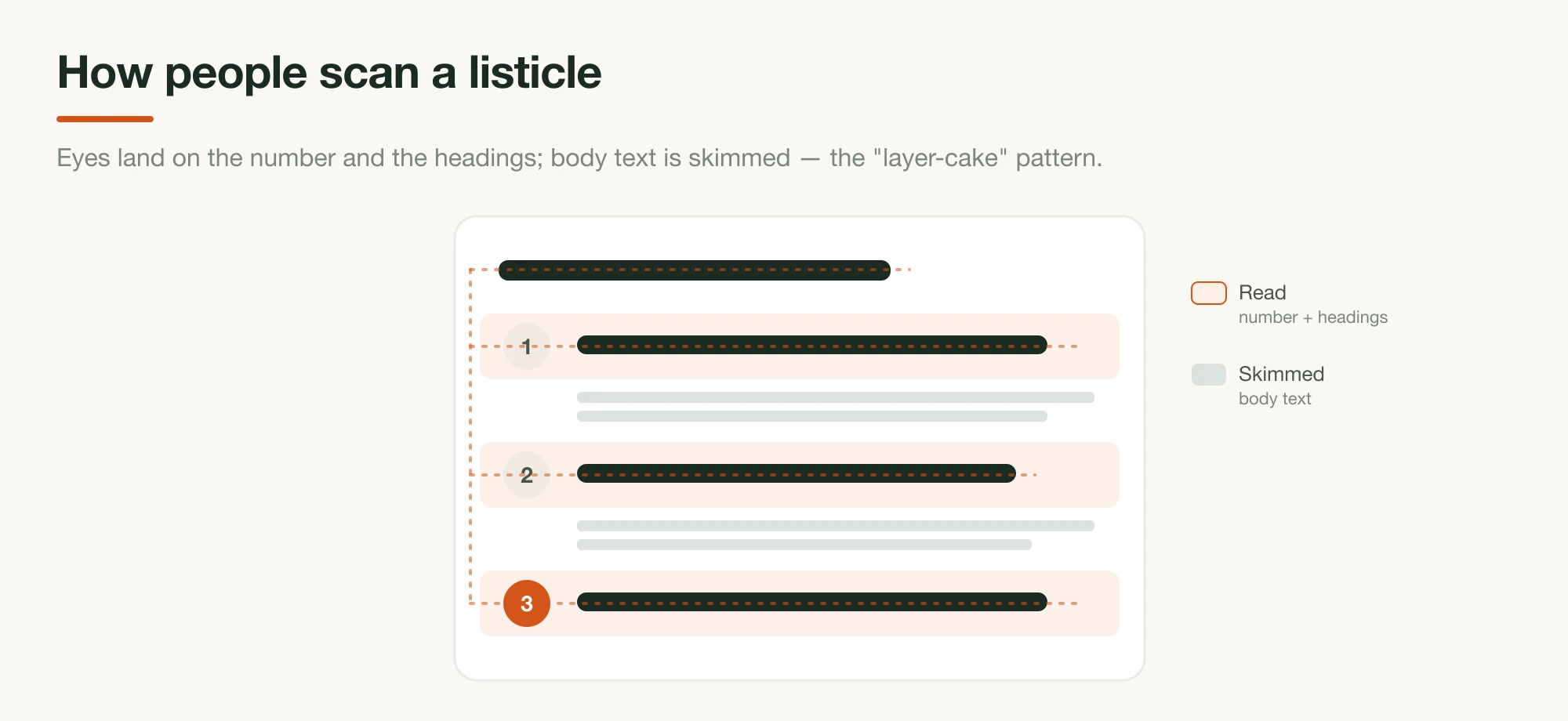
Listicles work because people don't read web pages — they scan them. Nielsen Norman Group's eye-tracking research found readers move through pages in an F-shaped pattern and skim content broken into headings in a "layer-cake" pattern, pulling keywords from the subheads and skipping the body in between. A numbered list is built for exactly that behavior: each entry heading is a landing spot for a scanning eye.
Underneath the scannability are a couple of well-documented mechanics. There's chunking: human short-term memory is limited (Nielsen Norman Group points to the classic "seven, plus or minus two" finding), so breaking information into discrete, labeled entries makes it easier to process and compare than a dense paragraph. And there's closure: a number in the headline promises a finite, knowable payoff, and that certainty is part of what earns the click in the first place.
The format's pull shows up in the data, too. In Backlinko's analysis of 912 million blog posts, list posts earned an average of 218% more shares than how-to posts and 203% more than infographics — strong evidence that the structure matches what readers actually engage with and pass along.
What are the main types of listicles?
There are three common shapes, and the difference matters because each sets a different reader expectation. A simple numbered list is a flat set of items of roughly equal weight ("10 gifts for coffee lovers"). A ranked list orders items toward a verdict ("best X," "reasons why one option wins") and is the workhorse of commercial content. A how-to or step list is a sequence the reader follows in order. Most can also run as either a short "card" list or an expanded list where each entry gets a few paragraphs.
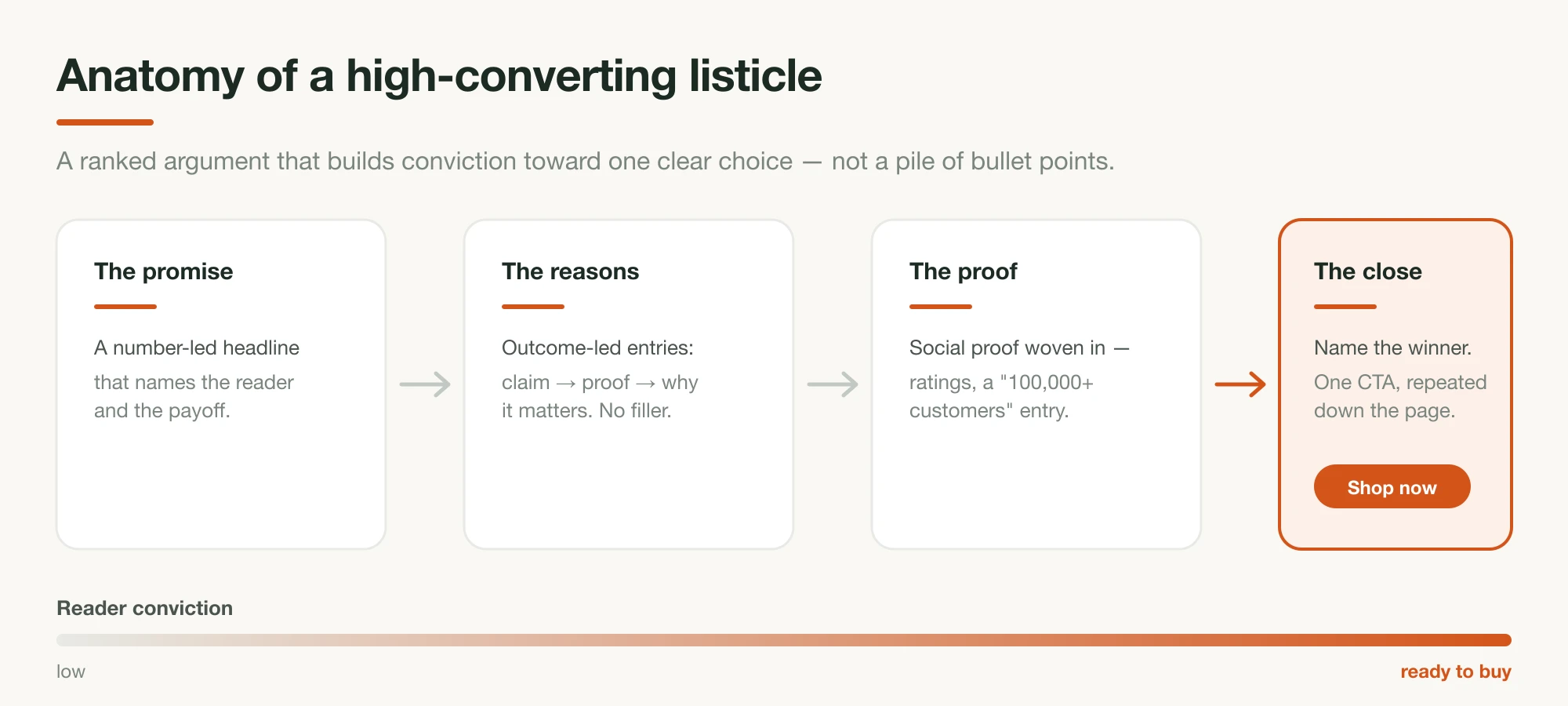
For a DTC landing page, the ranked or "reasons why" list is almost always the right type, because the reader's job is to reach one decision rather than browse a flat set. For the full build, see how to write a high-converting listicle.
Listicle vs advertorial vs editorial
These three overlap, which is why they get confused. An editorial listicle is independent content a publication creates and isn't paid for; Time's "100 Most Influential People" is a genuine ranked list. An advertorial is a paid advertisement written as a flowing editorial article. A marketing listicle sits between them: paid pre-sell content shaped as a scannable list, clearly disclosed as advertising.
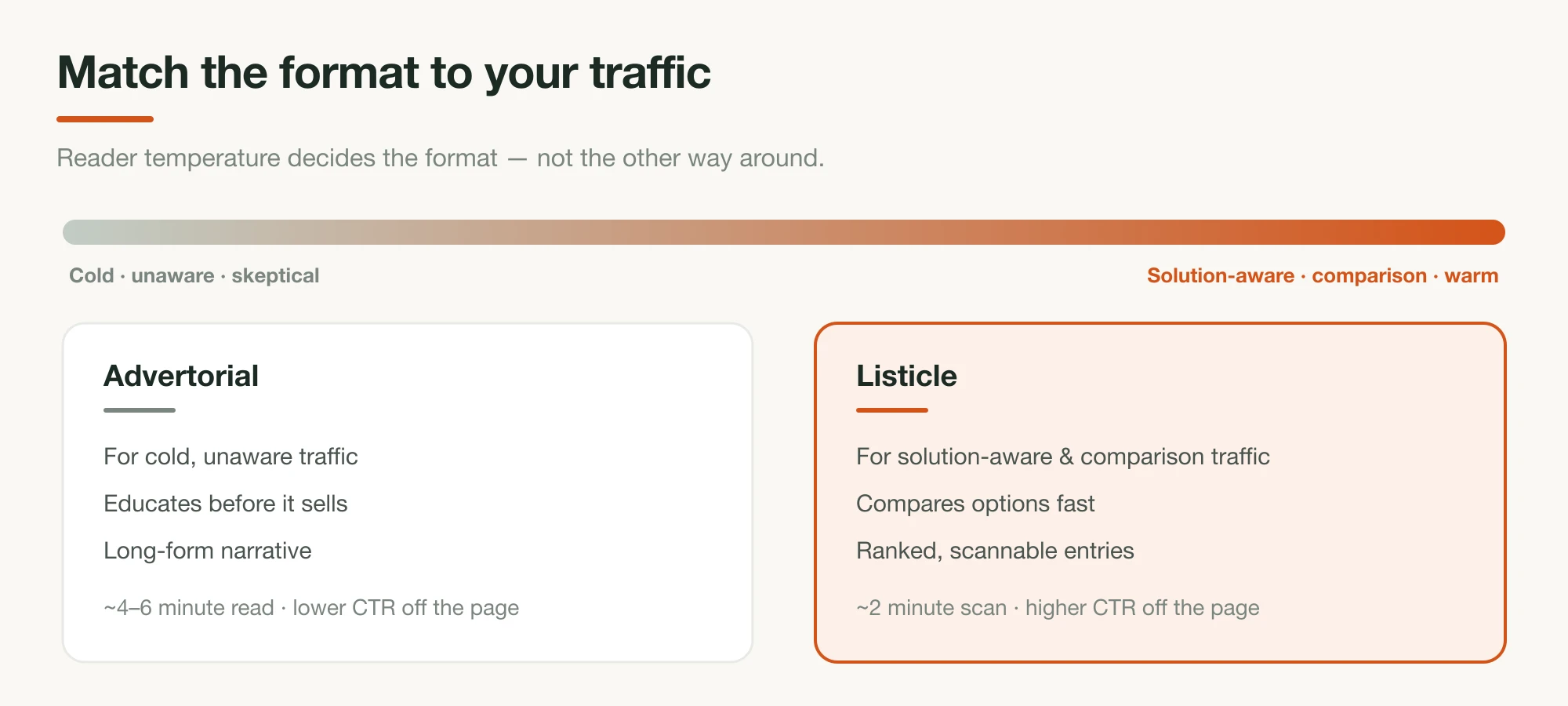
The practical distinction in DTC is between the listicle and the advertorial, and the deciding factor is the reader's awareness (traffic temperature only approximates it). A listicle suits comparison-ready and high-intent traffic (readers who already feel the problem and want help choosing fast), and reaches cold traffic too when it leads with the problem rather than the product. An advertorial suits the genuinely unaware or skeptical reader who needs educating before they will consider buying. As one DTC media-buyer breakdown frames it, a listicle gets scanned in two to three minutes while an advertorial holds attention longer for deeper persuasion: different tools for different reader states.
Where DTC brands use listicles
In ecommerce, the listicle's most common job is the pre-sell page: a paid landing page that warms a shopper before the product page. The dominant pattern is the "[Number] Reasons Why" headline — it names the criterion and the payoff in a single line, then the entries deliver the reasons. It's a staple, not an experiment.
Real, live examples make the pattern concrete. GemPages documents several DTC listicle landing pages — cookware brand HexClad's "5 Reasons Why You Need HexClad," Caraway's "5 Reasons You'll Love This Bakeware Set," and skincare-device brand Solawave's listicle organized by skin concern. Beauty brand Jones Road runs "5 Reasons Why You Need To Try Jones Road Beauty" as a live pre-sell page (as of June 2026). The shape repeats because it works: a skimming buyer can weigh the reasons and decide in about two minutes.
The numbers behind the headline help explain why marketers reach for it. In Anyword's analysis of listicle headlines, the marketing platform reported that 70% saw a higher click-through rate after switching to a numbered listicle format (a vendor-run test, so read it as directional), but consistent with how reliably the format earns the click.

How brands create listicles
Brands write listicles by hand, hire conversion agencies to build them, or generate them. Writing one that converts — the number-led headline, the ranked entries, the proof, the images, the close — is a meaningful chunk of a day. The recurring moves are well understood, as a glance at the live listicle landing page examples shows:
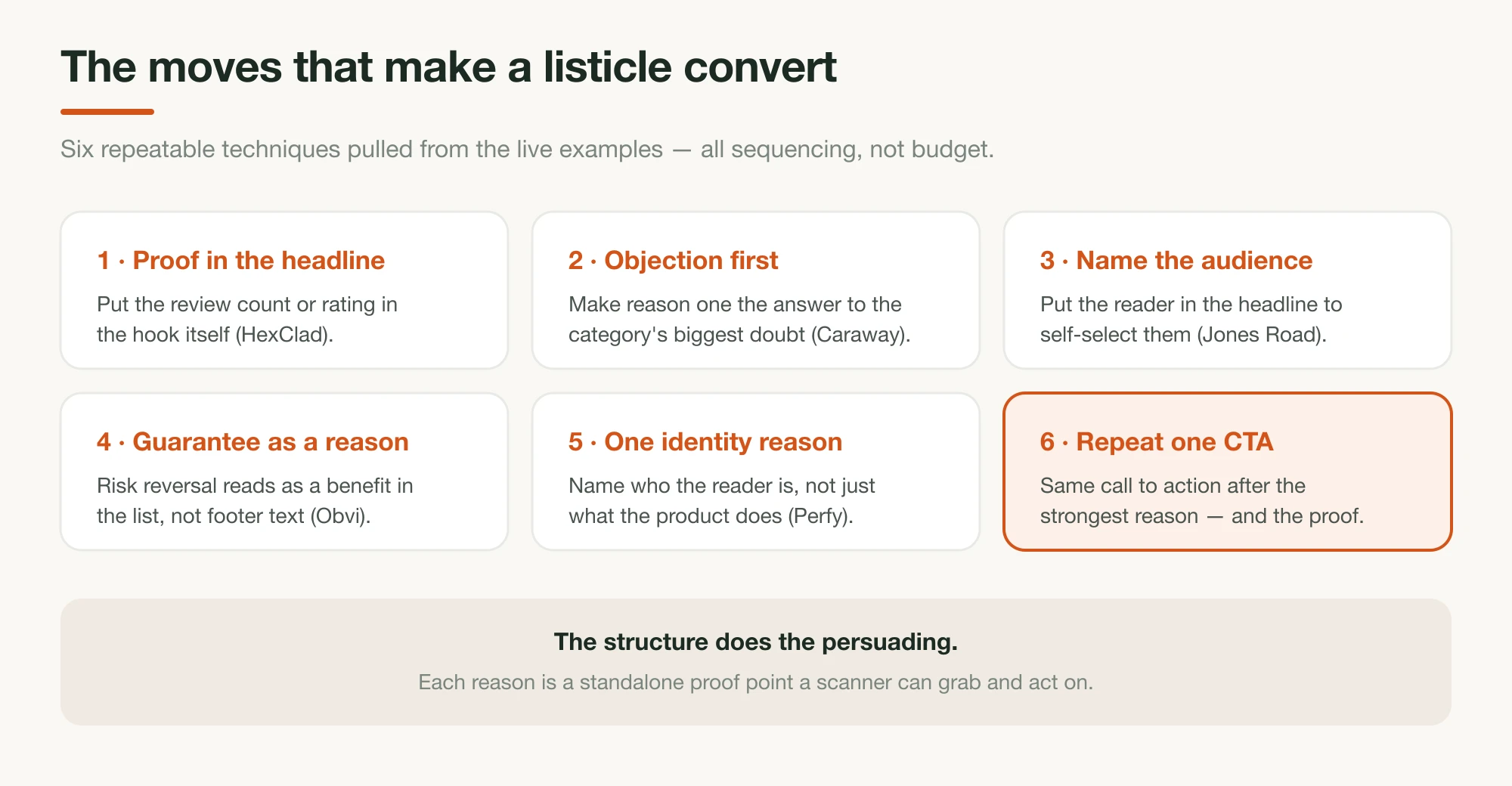
Landra builds the whole optimized listicle from your brand URL, tuned to the audience you name — with these moves built in — then hands you an editor to refine it.
A listicle is one of the formats a presell page can take — the wider category, and how reader awareness routes you to a listicle over an advertorial, is in what is a presell page. To go deeper, read how to write a high-converting listicle, compare it with its sibling format in what is an advertorial, or see the tools in our best AI landing page builders for ecommerce roundup.
Frequently asked questions
Is a listicle the same as an advertorial?
No. A listicle is a scannable list format; an advertorial is a longer, editorial-style narrative. In DTC marketing both run as pre-sell pages, but they suit different readers: a listicle helps a reader who already feels the problem decide fast (including cold traffic, when it's problem-led), while an advertorial educates the genuinely unaware or skeptical first.
Why are listicles so popular?
They match how people behave online — scanning rather than reading — and they are highly shareable. One analysis of 912 million posts by Backlinko found list posts earn far more shares than other formats, which is part of why publishers and marketers lean on them.
What are the main types of listicles?
The common types are the simple numbered list (a flat set of items), the ranked list (ordered toward a winner, like "best X"), and the how-to or step list (a sequence). DTC pre-sell pages usually use a ranked or "reasons why" list aimed at a single decision.
Are listicles good for SEO?
Yes, when they genuinely answer the query. Numbered list content maps cleanly to high-intent searches like "best X" and "[number] reasons why," and its scannable structure is easy for both readers and AI answer engines to extract — provided the items are substantive, not padding.
Do listicles work for ecommerce?
They do. DTC brands run listicle landing pages as pre-sell pages for paid and comparison traffic — the "[Number] Reasons Why [Brand]" format is a staple — because a skimming buyer can weigh the reasons and reach a decision in about two minutes.