
Roughly two-thirds of A/B test ideas fail to improve the metric they target, while only about one-third produce a positive result (Microsoft experimentation research). The practical answer is to validate the experiment before trusting its lift, especially when testing Landra-style pre-sell pages where message-market match can matter more than a polished button or hero layout.
That reality challenges the most popular conversion advice. Marketers are often told to test aggressively, wait for statistical significance, and ship the apparent winner. But significance only tells you what the observed data says under a model. It doesn't tell you whether users were assigned correctly, whether tracking worked, whether the audience changed halfway through, or whether a headline “win” was caused by the full advertorial angle around it.
Conversion rate A/B testing works when it separates a credible causal signal from random variation and operational error. For paid social traffic, that means controlling the ad, audience, offer, and checkout while testing a page hypothesis that reflects how buyers make decisions.
Table of Contents
- The Hard Truth About A/B Test Success Rates
- Planning Your Test, Goals, Metrics, and Hypotheses
- Choosing Between Element Isolation and Angle Packages
- Setting Up the Experiment for Accurate Results
- Diagnosing Validity and Avoiding False Positives
- Interpreting Results and Planning the Rollout
The Hard Truth About A/B Test Success Rates
A lot of losing tests start with the wrong expectation. Teams enter the experiment assuming the new page should win, then hunt for confirmation. On paid social, that usually shows up as peeking at early results, trusting a green dashboard too quickly, or sending equal traffic to ideas that were never equally credible.
The baseline is harsher than many teams expect. Microsoft's experimentation research found that only about one-third of ideas improved the target metric, and later summaries from Bing reported that approximately 80% to 90% of ideas failed to produce a positive result (Microsoft's experimentation research summary).
That is normal. A test is supposed to reject weak ideas before they become expensive defaults.
For Landra-style pre-sell pages, this matters even more because message-market match usually drives the result before any cosmetic change does. If the angle is off, a cleaner layout will not rescue it. If the promise attracts the wrong click, a better button treatment will not fix the economics. I have seen plenty of variants lift click-through to the next step while lowering purchase intent because the page sold curiosity instead of conviction.
Why pre-sell pages expose weak ideas
A cold visitor does not judge a page as a standalone asset. They click from an ad, carry a specific expectation into the page, scan the promise, assess the explanation, look for proof, and decide whether the offer matches the reason they clicked in the first place. When those pieces do not line up, local lifts can hide overall damage.
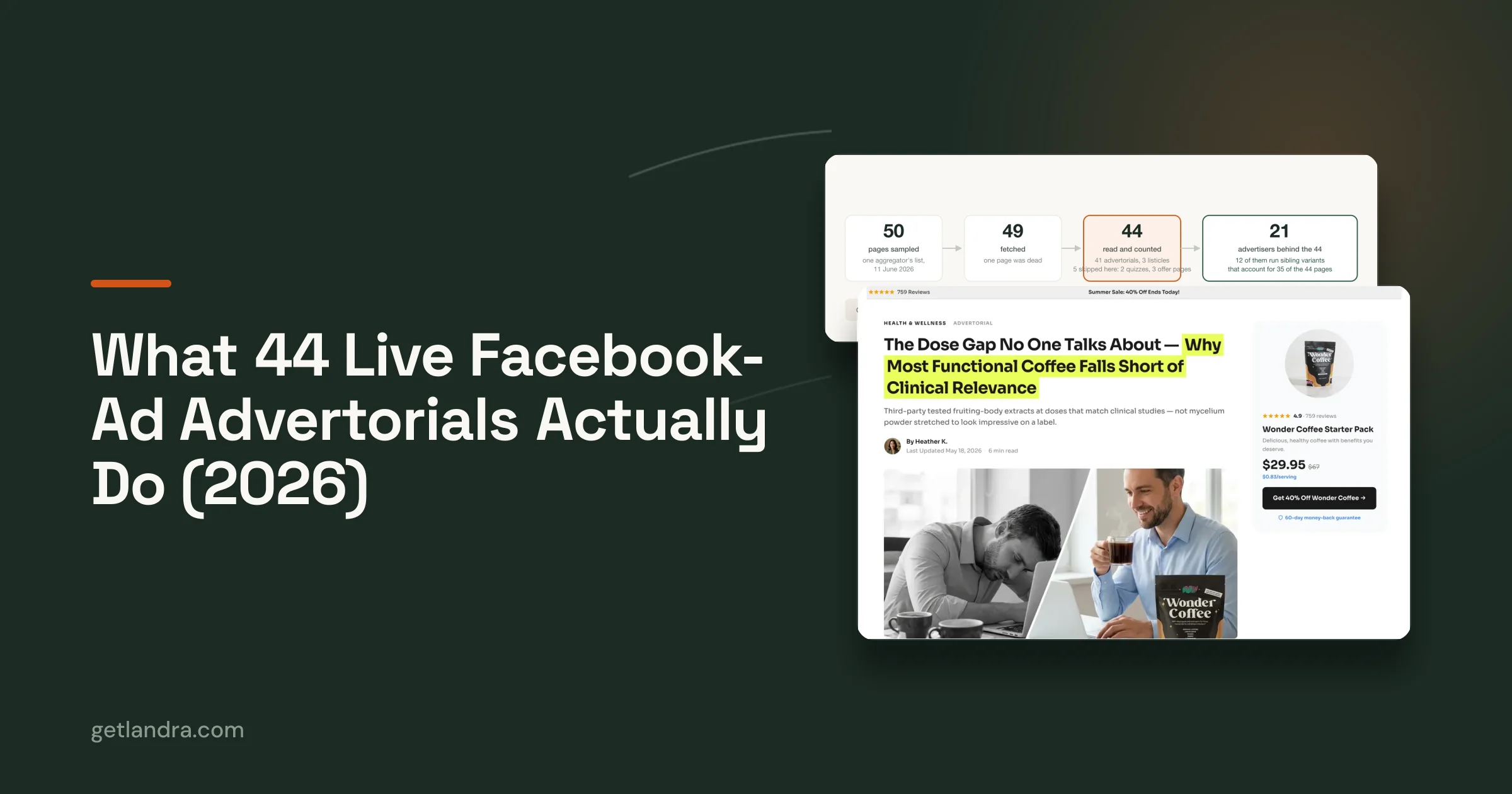
That is why advertorials and listicles produce so many false winners. A sharper headline can pull attention while setting up disappointment. A shorter page can reduce friction while stripping out the context a skeptical buyer needed. A CTA treatment can look like the cause of the win when the driver was the surrounding angle package, the hook, proof, pacing, and objection handling working together.
Practical rule: Treat every variant as a hypothesis, not an upgrade.
A useful guide to build a winning A/B testing strategy can help structure the backlog, but the discipline comes first. Write down the problem, the mechanism you expect to change behavior, the primary outcome, and why that outcome matters commercially.
A failed test still has value when the randomization held, tracking was clean, and the audience stayed comparable. Then you learned something real. The expensive mistake is not a loser on the scoreboard. It is rolling out a supposed win that came from broken assignment, tracking noise, or an interaction effect you never isolated.
Planning Your Test, Goals, Metrics, and Hypotheses
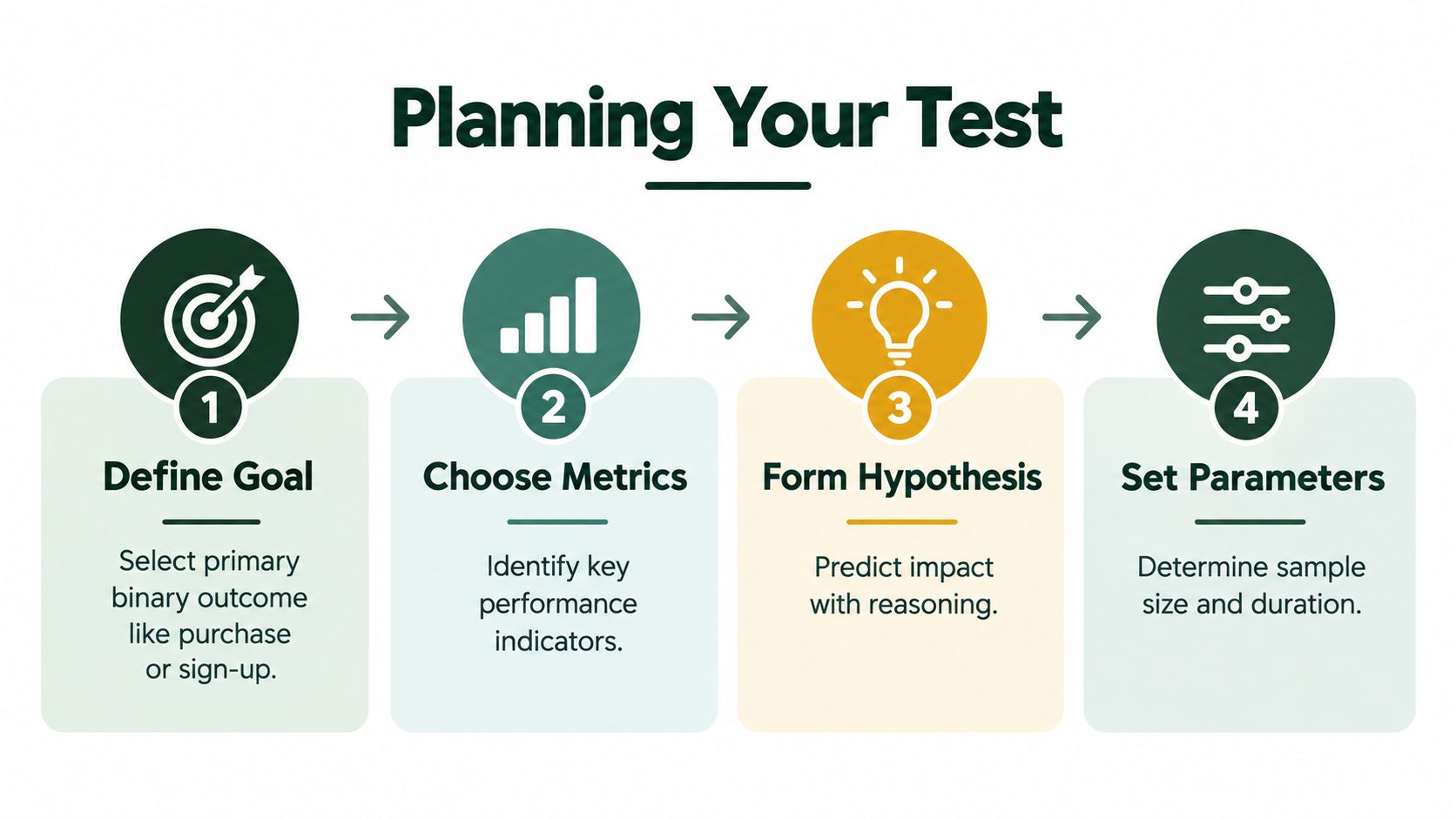
Good experiments become easier to interpret because the important decisions were made before traffic arrived. Start with the business outcome, then work backward to the page change. Don't begin by asking which color, headline, or section should be tested.
Choose one primary outcome
Define one primary binary outcome, such as completed purchase, checkout initiation, or email capture. You can monitor supporting metrics, but don't let several competing outcomes create a convenient winner. A page that increases email capture while reducing completed purchases isn't a clear success for a purchase-focused campaign.
Write down the baseline conversion rate, minimum detectable effect, significance threshold, and target power before allocating traffic. Then define guardrails, including bounce rate, add-to-cart rate, revenue per visitor, page-load performance, and downstream refund or cancellation behavior.
Revenue per visitor is particularly useful for pre-sell pages. It keeps the team from confusing a higher page conversion rate with higher-quality demand. If the variant attracts buyers who cancel more often or spend less, the page may be winning the wrong contest.
Size the test around a useful lift
A planning approximation for a two-arm test is:
visitors per variant ≈ 16 × p × (1 − p) ÷ δ²
Here, p is the baseline conversion rate and δ is the absolute lift you want to detect. At a 3% baseline rate, a 20% relative lift means detecting a 0.6 percentage-point absolute increase and requires roughly 13,000 visitors per variant. Detecting only a 5% relative lift requires approximately 207,000 visitors per variant (Optimizely's statistical planning guidance).
Use the calculate your CVR tool to ground the planning conversation, then apply judgment. A test designed to detect a tiny improvement may consume too much time to support a useful paid-social decision. Choose an effect size that would justify the implementation, media allocation, or offer change.
Write hypotheses for the whole message
A strong hypothesis names the audience, friction, change, mechanism, and outcome. For example: “For cold visitors arriving from a problem-led ad, a problem-led advertorial opening should increase completed purchases because it explains the visitor's situation before introducing the product.”
That is more useful than “Test a stronger headline.” It also gives you a reason to convert browsers with AI chat or any other research and drafting workflow into a defined test process rather than using tools to generate random copy.
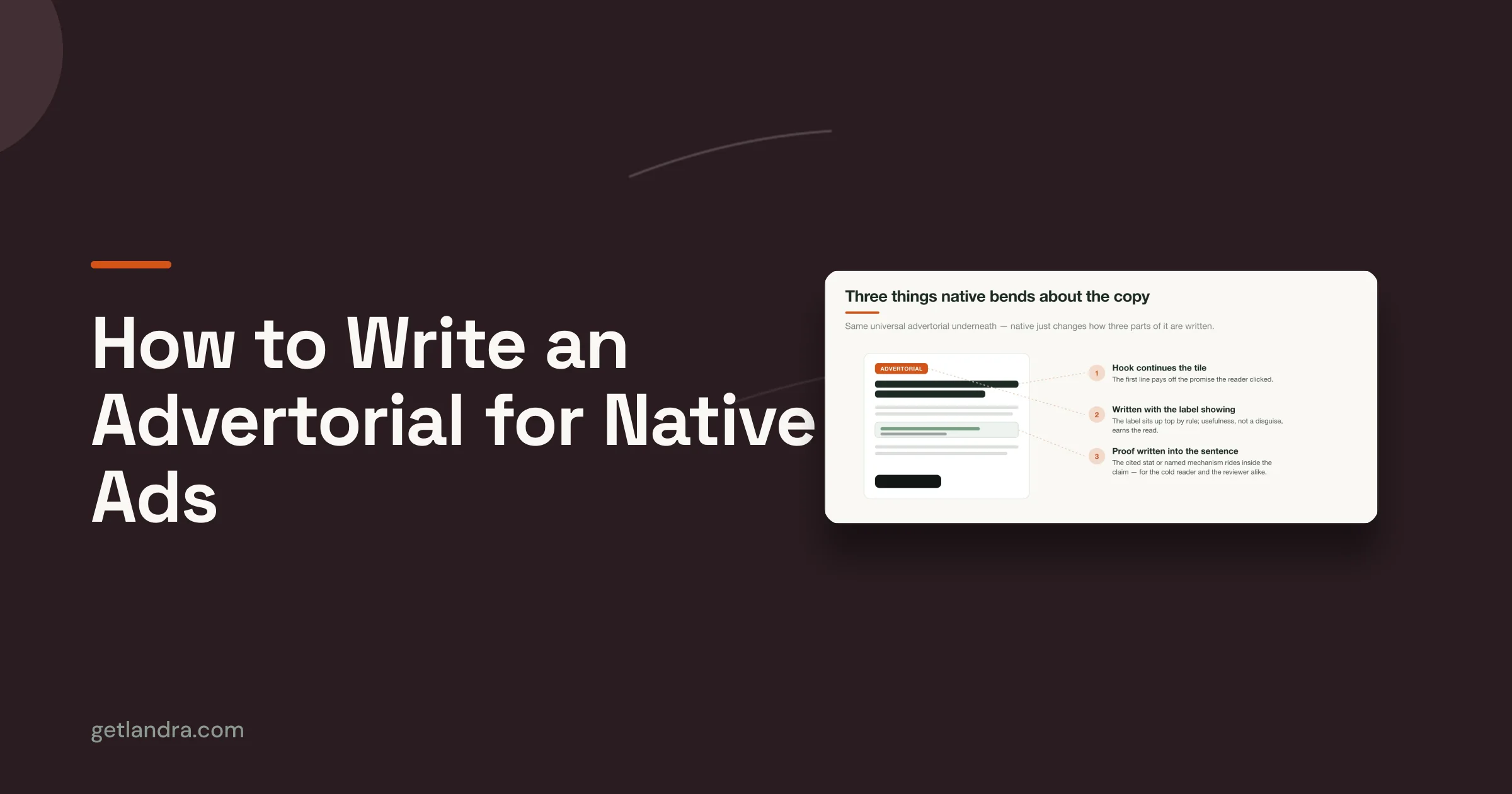
For listicles, test whether the ranking logic and comparison frame answer the buyer's question. For advertorials, test whether the narrative, proof sequence, and offer explanation match the awareness level created by the ad. The page should express a testable theory about why this audience will act.
Choosing Between Element Isolation and Angle Packages
Single-element testing is valuable when the question is narrow and the surrounding experience is stable. If the offer, audience, page angle, and proof are already aligned, changing one headline or call to action can isolate a specific mechanism.
That logic breaks down when the page's core promise is wrong. A cold paid-social visitor may respond to a connected message spanning the ad, opening, product explanation, proof, offer, and checkout expectation. Changing only the hero headline can create a mismatch between the first promise and everything that follows.
Microsoft Research warns that multiple simultaneous tests can reduce statistical power, while interaction effects and small data-quality problems can invalidate conclusions (Microsoft's discussion of A/B interactions). The practical answer isn't to test every element together. It's to choose the unit of change that matches the decision.
| Feature | Element Isolation | Angle Package |
|---|---|---|
| Primary use | Diagnose one specific mechanism | Test a complete message-market hypothesis |
| Typical change | Headline, CTA, image, proof placement | Ad promise, opening, narrative, proof, offer framing |
| Main advantage | Easier attribution | Better representation of the visitor journey |
| Main risk | Missed interactions and weak transfer to the funnel | Harder to identify the winning component |
| Best fit | Stable page with a focused question | New audience, new offer angle, or weak message match |
| Follow-up | Test another isolated mechanism | Decompose the winning package in later tests |
When isolation is the right trade-off
Use element isolation for questions such as whether a specific objection should appear earlier, whether a proof block is visible enough, or whether a checkout expectation is clear. Keep the rest of the experience fixed and make the change meaningful enough to matter.
Don't spend a high-volume paid campaign testing a cosmetic adjustment just because it is easy to build. Ease of implementation isn't evidence of business importance.
When a package is more honest
Test an angle package when the ad and pre-sell page need to tell the same story. A problem-led package might alter the opening, sequence of education, product introduction, and proof. A comparison-led package might use a different editorial frame, selection criteria, and offer explanation.
That doesn't mean you should run an uncontrolled redesign. Define the package, preserve the primary conversion event, and document what changed. After a credible package result, use designing significant multivariate experiments or focused follow-up tests to learn which mechanism drove the outcome.
Setting Up the Experiment for Accurate Results
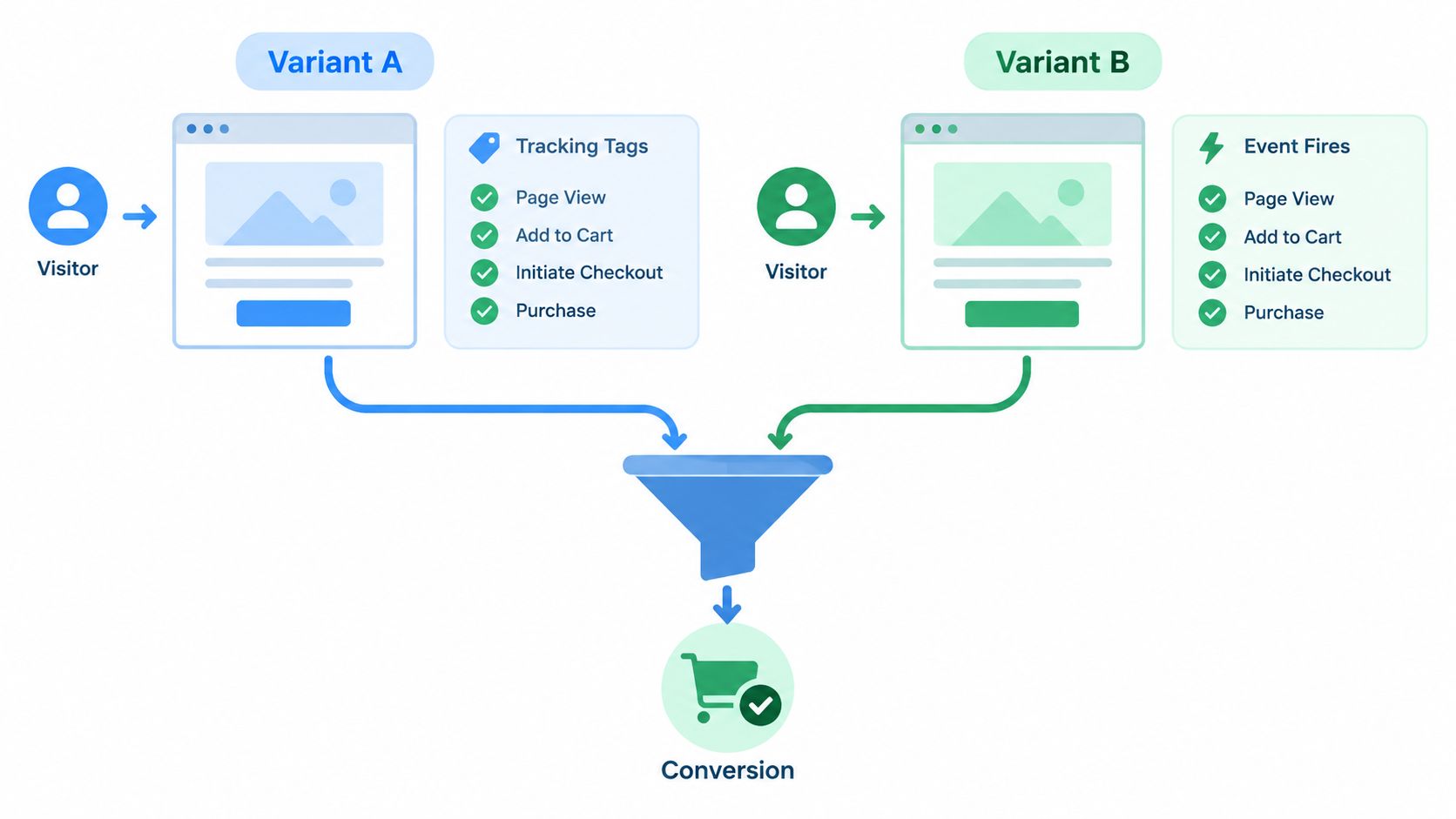
The setup determines whether your result can answer the question you asked. Before launch, create a control and a treatment, assign users consistently, and verify that both versions send identical events to the same analytics destinations.
Pre-launch checks
Use a short checklist rather than relying on a visual inspection:
- Event parity: Confirm that view, click, checkout, purchase, revenue, and cancellation events fire identically in both variants.
- User-level assignment: Randomize at the user level where repeat visits could otherwise move one person between versions.
- Traffic consistency: Keep the ad creative, audience, bid strategy, offer, and checkout flow constant.
- Device coverage: Test mobile webviews, standard mobile browsers, and desktop paths separately for broken layouts or missing events.
- Variant persistence: Make sure a returning user sees the assigned version rather than being reallocated on each session.
- Page speed: Check that the testing layer doesn't introduce a delay that affects one treatment disproportionately.
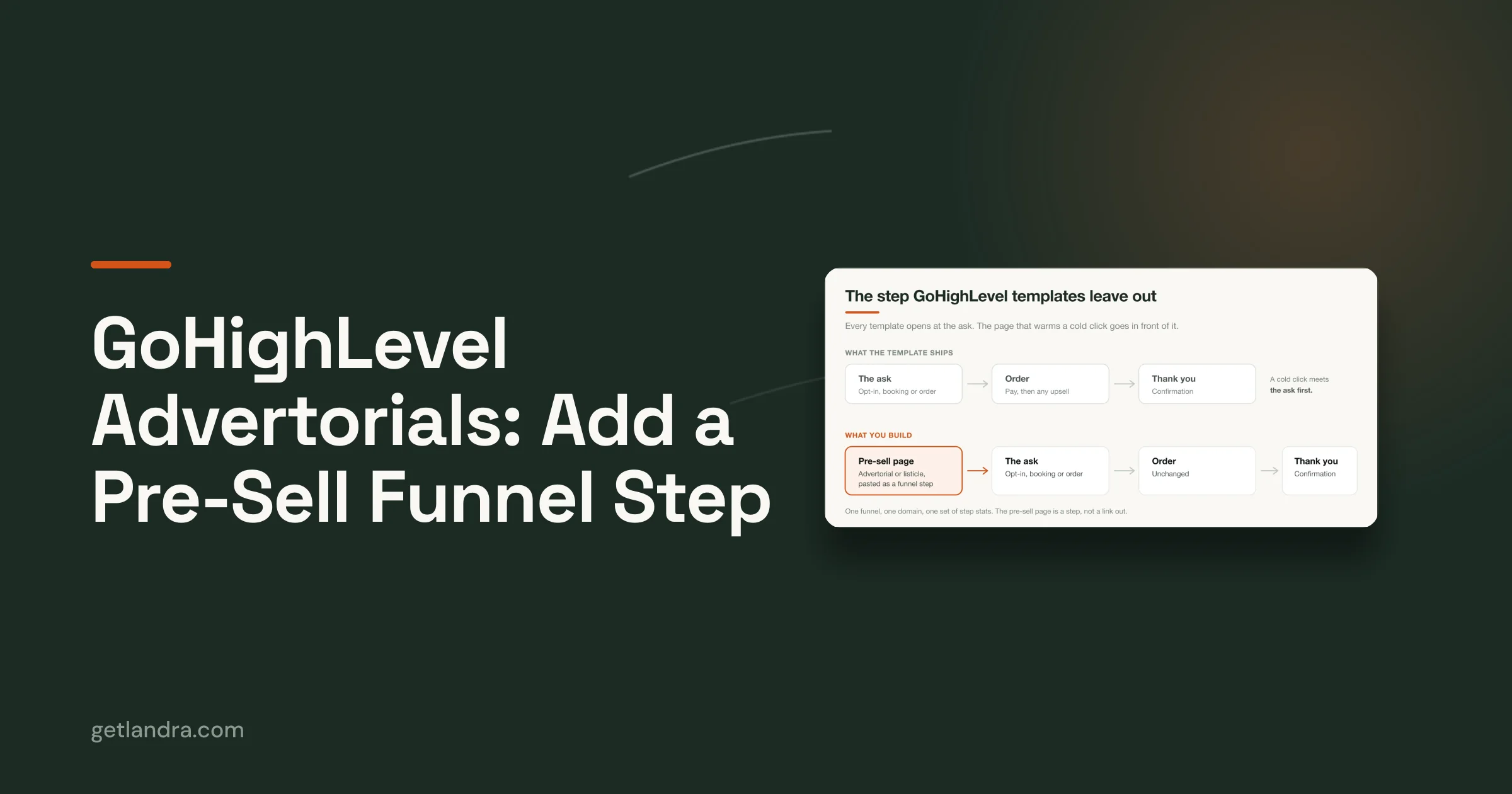
A tool that lets you duplicate and edit an existing page can reduce production friction, but speed shouldn't replace QA. Landra, for example, generates editable advertorial and listicle pre-sell pages and supports duplication for creating page variants, while publication can fit Shopify, Webflow, a hosted URL, or HTML workflows. That makes rapid variant production possible, but the experiment still needs clean assignment and measurement.
The page should be easy to optimize landing page conversions without changing the underlying funnel by accident. Keep the URL logic, checkout destination, product, price, and fulfillment experience stable unless one of those is the explicit hypothesis.
Keep the media environment controlled
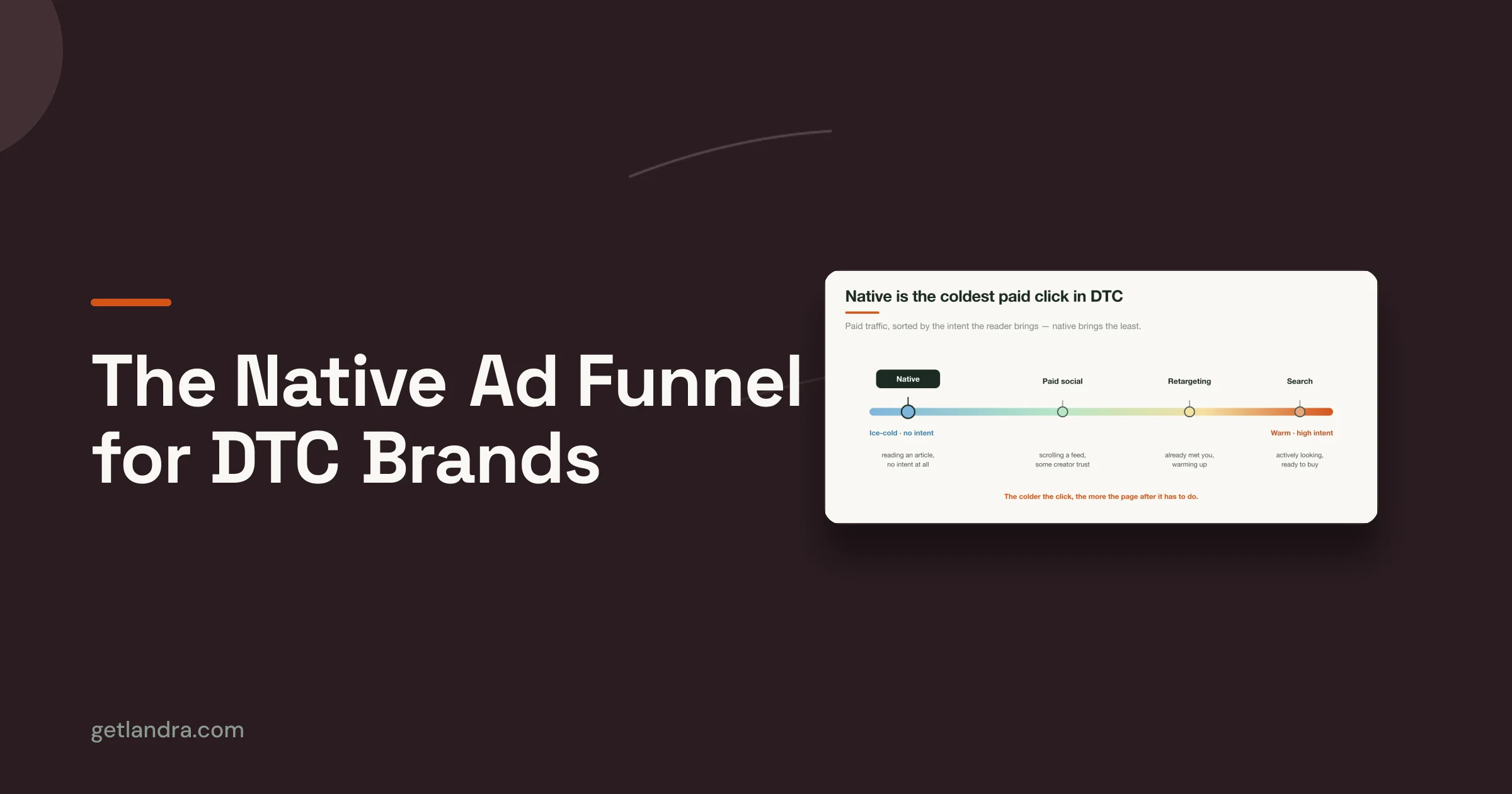
Paid social introduces movement that can overwhelm a page change. A new creative can attract a different intent profile, a platform can shift delivery, or a campaign can enter a promotion period. If the test requires a new ad angle, treat that as part of the angle package and document it rather than pretending the page alone caused the result.
Use a planned runtime that includes complete business cycles so weekday, weekend, and campaign variation are represented. Analyze users according to their original assignment, and keep a launch log containing deployment time, allocation, event changes, campaign changes, and known incidents.
A short visual explanation of the assignment flow can help teams align before launch.
The most useful setup question is simple: if the variant wins, can you explain exactly which users saw it, which conversion event counted, and whether the rest of the funnel remained comparable? If the answer is uncertain, don't interpret the result yet.
Diagnosing Validity and Avoiding False Positives
A significant lift from a broken experiment is still a broken result. Validity checks belong before the winner decision, not after a team has already redesigned the campaign around the apparent improvement.
Start with the traffic split
Sample-ratio mismatch, or SRM, occurs when observed allocation differs materially from the planned split. A planned 50/50 test that receives a materially different number of users in each arm may have a problem with randomization, exclusions, redirects, identity stitching, or the data pipeline.
Microsoft reports SRM in about 6% of its A/B tests, while LinkedIn previously found it in roughly 10% of certain condition-triggered tests (Microsoft's SRM diagnostic guidance). These figures aren't a reason to expect a mismatch in every DTC test. They show why allocation deserves an explicit diagnostic.
For pre-sell pages, inspect the places where assignment can break:
- Redirect behavior: Verify that ad-platform and mobile-webview redirects don't bypass the experiment.
- Identity rules: Separate users from sessions and check whether cookie restrictions create duplicate assignments.
- Eligibility filters: Confirm that exclusions apply equally to control and treatment.
- Event delivery: Compare page views, checkout events, and purchases across variants, not just the final conversion count.
- Source composition: Review device, placement, campaign, and traffic-source mix for unexpected imbalance.
Validity comes before significance. A cleanly measured smaller test is more useful than a larger test with contaminated assignment.
Audit the whole funnel
A headline conversion rate can hide deterioration elsewhere. Compare bounce rate, page-load performance, add-to-cart rate, checkout initiation, revenue per visitor, refund behavior, and cancellation behavior. A page that wins on purchase rate but causes a meaningful performance problem may not be the page you want to scale.
Don't overread segments. Device and source cuts can reveal a broken implementation, but slicing every audience, browser, headline, and outcome creates opportunities for noise to look like insight. Treat unplanned segment findings as exploratory unless the test was designed and powered for them.
Stop the dashboard habit
Repeatedly checking a conventional fixed-horizon test and stopping whenever the result crosses a nominal threshold inflates false-positive risk. One technical summary reports that checking five times can push the actual false-positive rate above 20%, despite a nominal 5% threshold (Optimizely's statistical analysis overview).
Precommit to a sample size and decision date, or use a sequential method whose error guarantees remain valid during continuous monitoring. Either way, don't let a favorable dashboard reading become the stopping rule.
Interpreting Results and Planning the Rollout
The final decision should combine statistical evidence, absolute business impact, and customer quality. A relative lift can sound impressive while representing a small absolute movement, and a small page lift can still matter when the traffic and margin support it.
Start with the primary outcome and report both absolute and relative change. Then review the confidence interval, allocation health, runtime, guardrails, and exposure by device and traffic source. If the result is flat or negative, record the learning instead of forcing a winner.
A useful decision table looks like this:
| Result pattern | Recommended action |
|---|---|
| Credible primary lift, clean allocation, healthy guardrails | Replicate, then roll out gradually |
| Directional lift with weak precision | Keep as a hypothesis, collect planned evidence |
| Primary lift with weaker revenue or customer quality | Reject or revise the package |
| No lift with valid instrumentation | Preserve the control and update the backlog |
| Large unexpected lift with data anomalies | Pause and investigate before adoption |
| Allocation or tracking failure | Invalidate the result and repair the test |
Replicate before scaling spend
A promising result should survive fresh traffic or a new comparable period. Replication doesn't mean repeating the exact same mistake until the dashboard turns green. It means confirming that the effect remains when novelty, campaign mix, or temporary audience conditions change.
For angle packages, examine whether the downstream business metric holds. A page that increases add-to-cart activity but lowers completed purchases, margin, or repeat purchase isn't a durable winner. The business decision should be based on incremental profit per visitor across the funnel, not the most flattering page metric.
Turn results into a learning system
Document what changed, who saw it, what happened, and what you believe caused the result. If the package won, decompose it carefully in later tests. If the control won, ask whether the challenger targeted a real objection, whether the change was too subtle, or whether the audience needed a different message entirely.
A disciplined rollout is deliberately boring. Keep the incumbent until the evidence is credible, deploy the validated page, monitor guardrails after launch, and preserve the test record so future campaigns don't repeat an unproductive idea.
Landra lets DTC teams generate editable advertorial and listicle pre-sell pages, duplicate variants, and publish them to Shopify, Webflow, a Landra URL, or HTML for controlled message testing. Visit Landra to create a page, define a clean primary conversion goal, and test the angle before investing more paid-social budget in it.