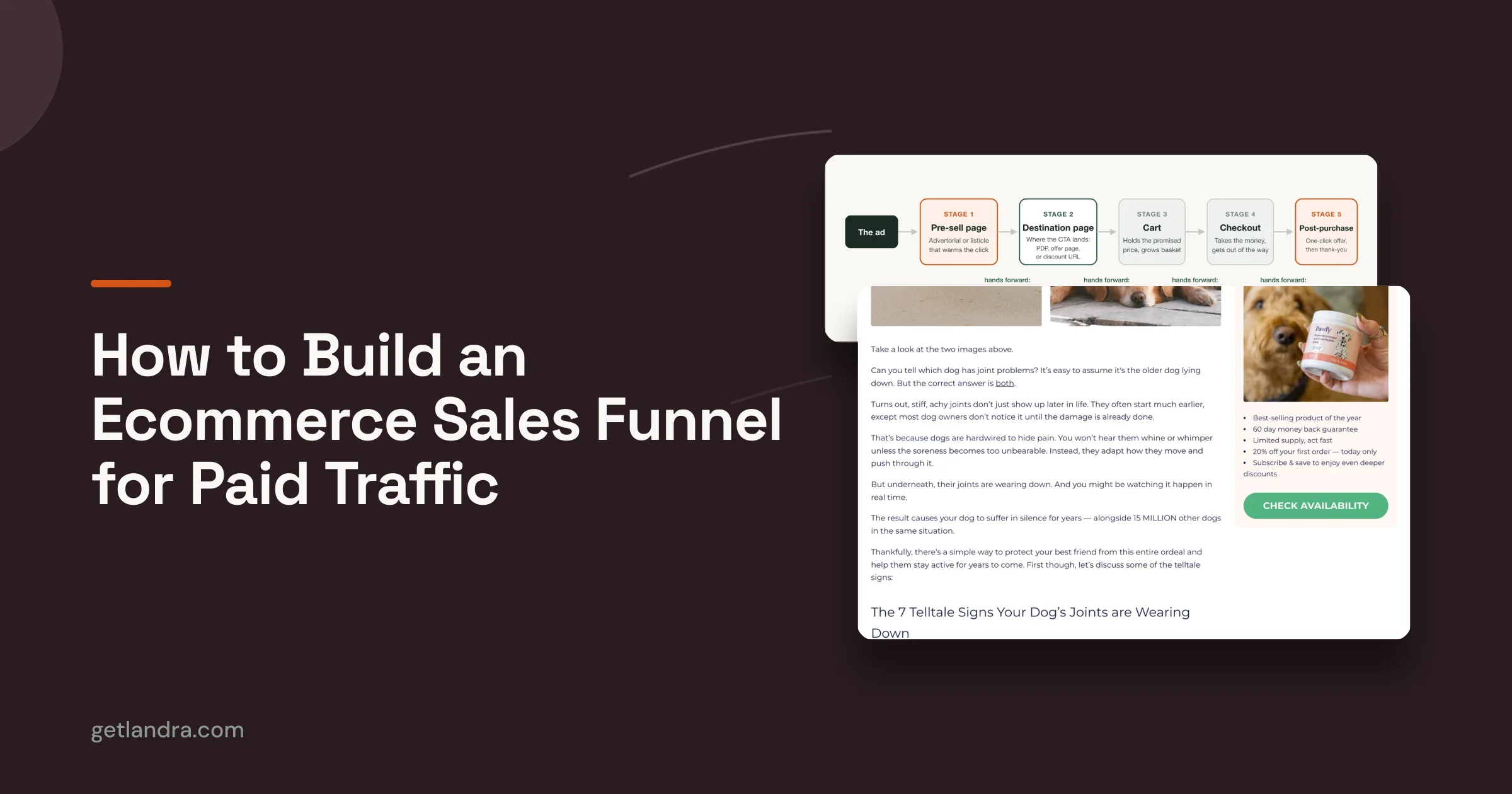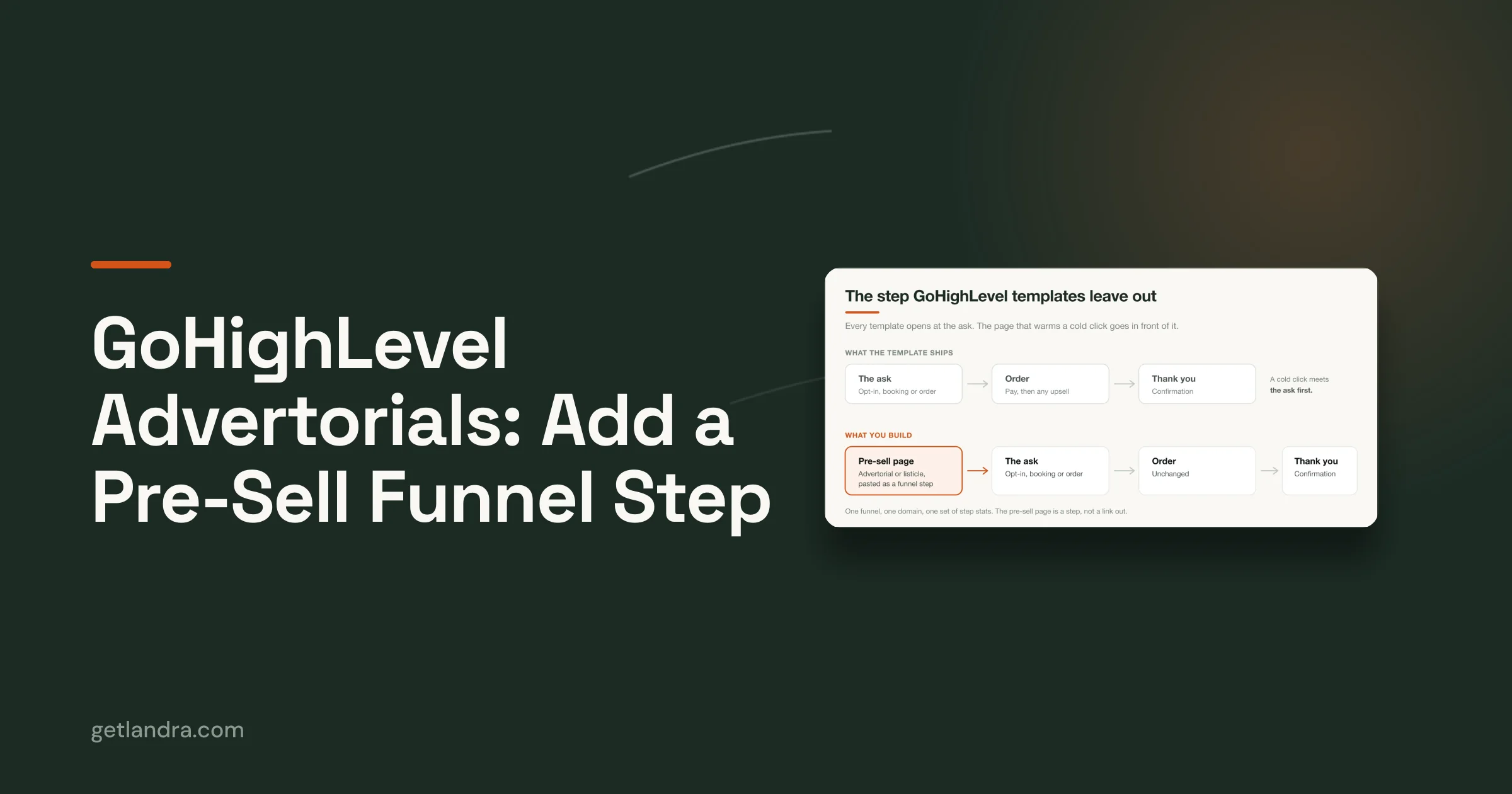

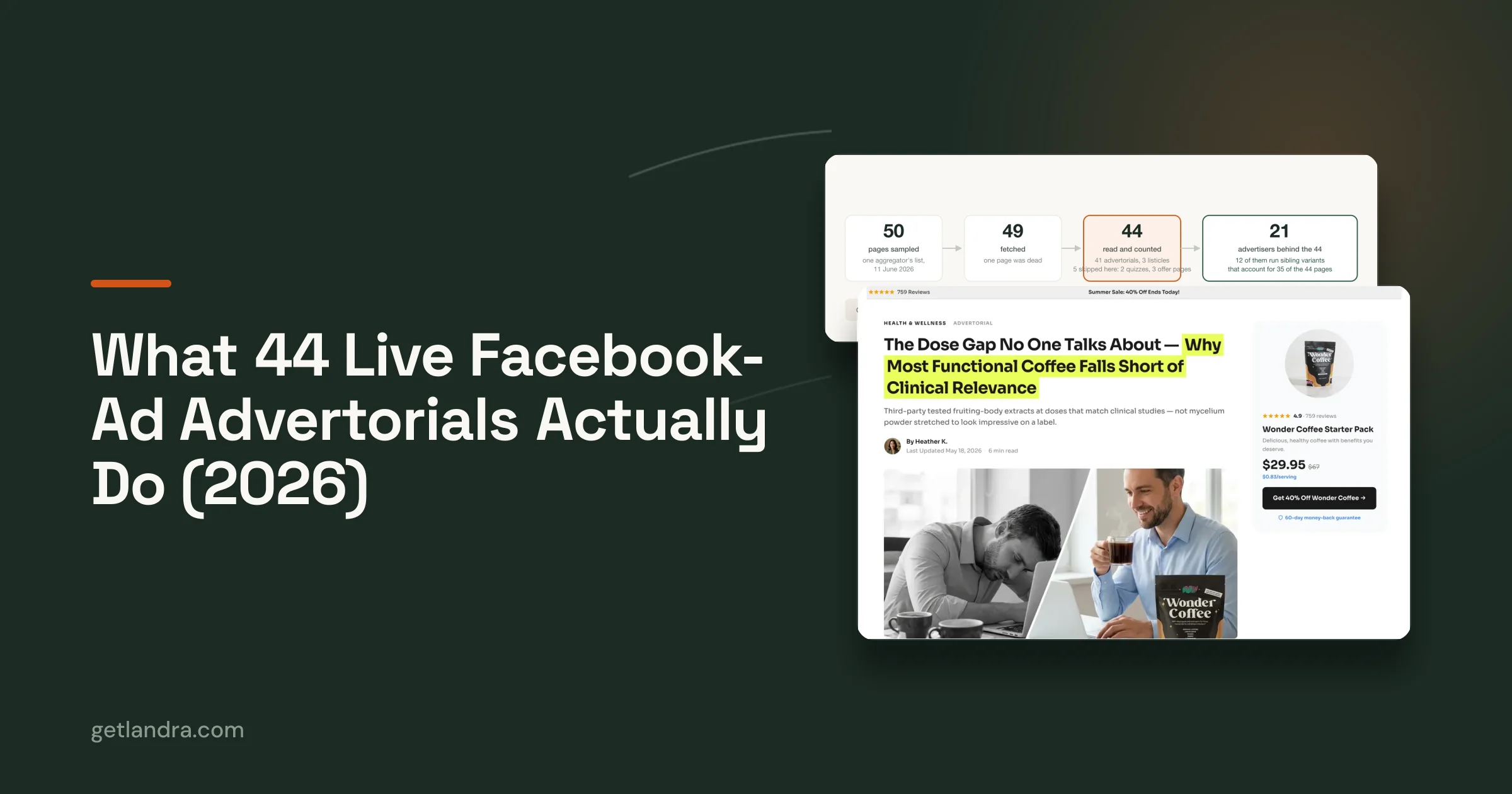
In June we pulled 50 advertorials that were running as Facebook ads, archived them, and read all of them page by page. Forty-four survived triage. This month we re-ran every count against that archive, and four of our own June numbers turned out to be wrong. One of those corrections was itself wrong, and a second pass caught it. What follows is every figure we can still defend, and they are counts, not rates: 44 pages from one aggregator's list is a sample. It measures nothing about the market.
Which is why this page sits beside our advertorial and listicle conversion statistics hub rather than inside it. That page is what the industry reports. This one is what 44 real pages did on a Tuesday in June. We hold no conversion data on any of them, so nothing below says these pages convert. If the format itself is new, start with what an advertorial is.
How we counted
The source was scrollstash's list of advertorial pages running as Facebook ads, extracted on 11 June 2026 and ranked by that aggregator's own authority score, a 15 to 64 range we treat as a rough proxy for spend or longevity and never for conversion. Everything below counts pages inside that sample. Every page in it is a cold-traffic page by construction: it was buying its readers from a Facebook ad on the day we archived it.
Fifty were listed, 49 fetched, 44 analyzed: 41 advertorials and 3 listicles. Six were skipped, being two client-rendered quiz funnels with no server-rendered text, one dead URL, and three offer or product pages wearing advertorial headlines. We archived the raw HTML and extracted text on 11 June 2026, then re-ran every count with ripgrep against those 49 files on 16 September 2026, subtracting the six skipped pages each time.
- The counts are a floor, twice over. The archive is server-rendered HTML only, so anything an A/B tool injects client-side never reached the file. And most greps run against the extracted text rather than the raw HTML, which silently drops some sidebar and widget markup. That is exactly how the first version of this page undercounted comment threads, and the fix is published in section 9.
- The pages are not independent. 35 of the 44 come from 12 advertisers, out of 21 in total.
- The categories are skewed. Sleep 12, pain and mobility 9, detox foot pads 5, hair 4, which is 30 of the 44 between them. Two pages are in Spanish. Nothing here describes apparel, electronics or home goods.
- We hold no performance data. "Was running as a Facebook ad on 11 June 2026" is the only performance fact available on any page.
What the 44 pages do, counted
Twelve countable units, in the order a page assembles itself: who is behind it, who narrates, when the product arrives, which beats carry it, what the offer says, where the buttons sit, what surrounds the article, and how it labels itself. Every number is a count of pages in this corpus, and the qualitative calls are flagged as ours.
1. The 44 pages come from 21 advertisers
Twenty-one advertisers produced the 44 pages, and 35 of them are sibling variants: one structure shipped several times with a single variable rotated. Twelve advertisers run families, nine of which we documented, from a pair up to a set of five. Page-level counts in this corpus are therefore not independent observations.
What a family freezes is what the advertiser believes is load-bearing; what it rotates is the lever it is testing. Frozen: the skeleton, the offer mechanics, the chrome. Rotated, one slot per variant: the narrator's credential, the condition or fear named, the audience persona, the format (one footwear brand runs the same shoe as an advertorial, a listicle and a hybrid), or the language. One family ships the identical story in first-person English, third-person English and first-person Spanish. These pages are not written one at a time. They are assembled from a frozen skeleton with labeled slots, which makes writing a second advertorial from scratch more work for less information.
2. Who narrates the page
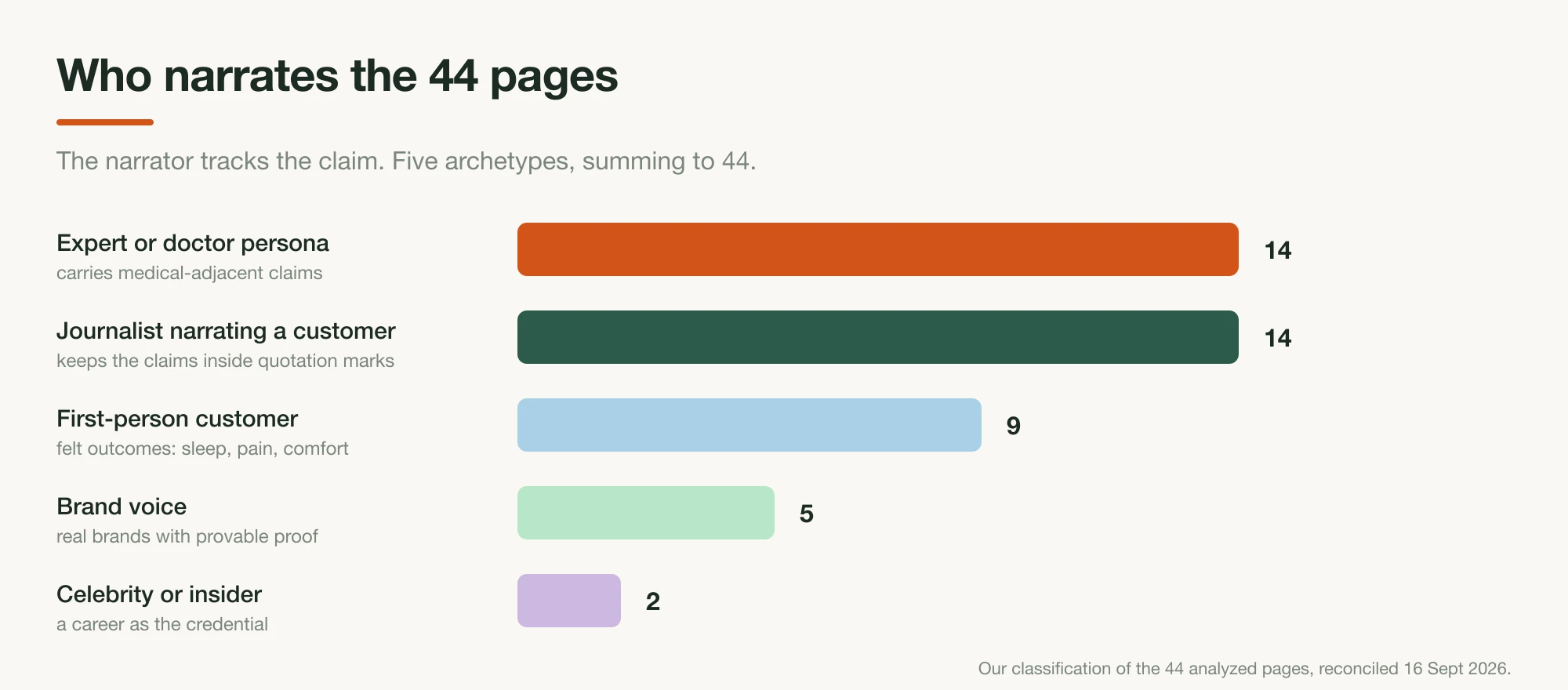
Every page has a narrator, and five archetypes cover all 44. Two tie at 14 pages each: an expert or doctor byline, and a journalist narrating a named customer. First-person customer confession takes 9, brand voice 5, celebrity or insider 2. These are our classifications, made page by page.
| Narrator | Pages (of 44) | What it is carrying |
|---|---|---|
| Expert or doctor byline | 14 | Medical-adjacent claims and re-diagnosis sections |
| Journalist narrating a customer | 14 | Claims that live inside a customer's quotation marks |
| First-person customer | 9 | Felt outcomes: sleep, pain, comfort |
| Brand voice | 5 | Real brands with proof they can show |
| Celebrity or insider | 2 | A career that is itself the credential |
Narrator choice tracks claim risk. Felt outcomes, the sleep and pain and comfort claims, get a customer. Medical claims rent an expert. Brands with provable proof use their own voice. Nobody here puts a brand voice behind a medical claim, and nobody wastes a doctor persona on a pillowcase. Decide what the riskiest sentence on your page will be, then pick the voice that can carry it honestly.
3. When the product first appears
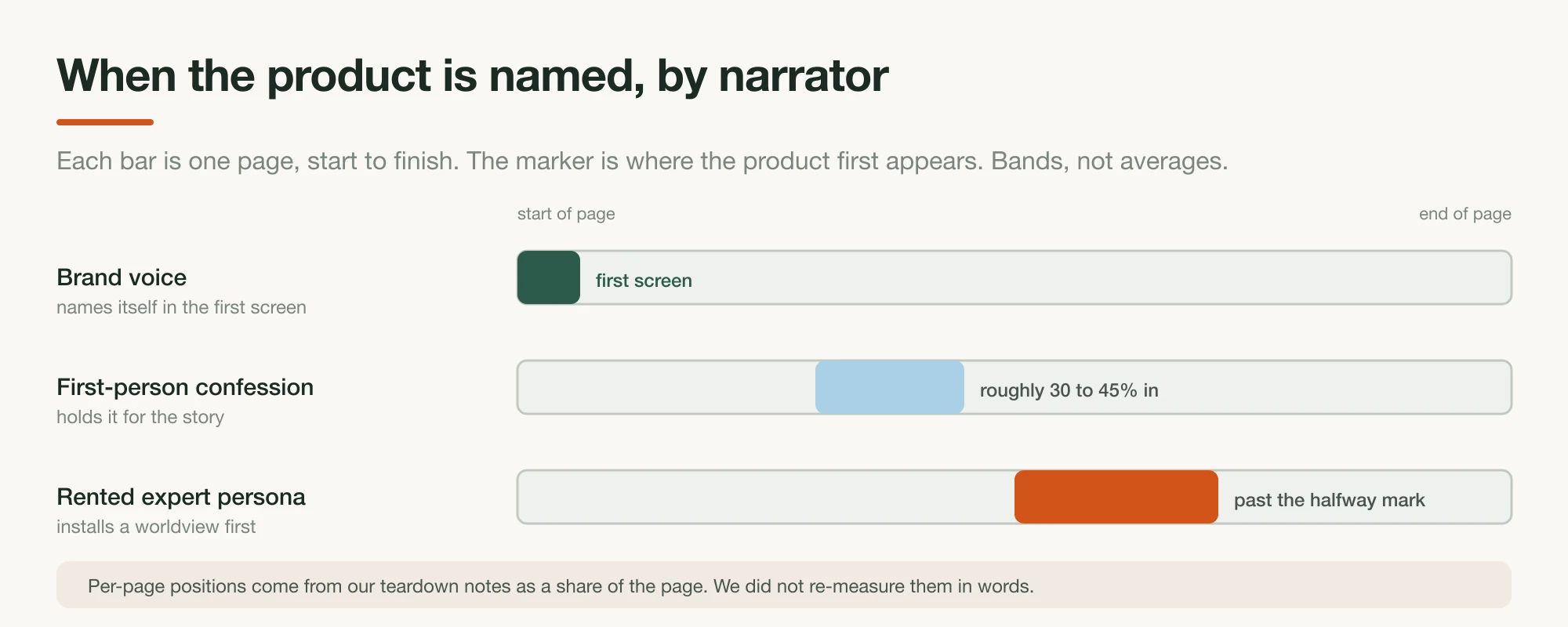
There is no single reveal point, and the delay tracks the narrator rather than the word count. Brand-voice pages name the product in the first screen. First-person confession pages hold it to roughly 30 to 45 percent of the page. Rented-expert pages hold it past the halfway mark, sometimes well past.
| Narrator | Where the product is first named | Why the page can afford it |
|---|---|---|
| Brand voice or celebrity | The first screen | It spends the page building desire instead of borrowing trust |
| First-person confession | Roughly 30 to 45% of the page | The suffering and the failed alternatives have to land first |
| Rented expert | Past the halfway mark | A worldview has to be installed before the product fits in it |
So the rule is not "hold the reveal for 600 words." A pre-sell page is buying the right to make the recommendation, and the delay is a debt you spend, not a timer you run. A page that withholds the product for 1,200 idling words has bought nothing with them, and a page that names itself in the first screen and spends the rest earning the claim is not doing it wrong.
4. The beat order most pages run
No page runs every beat. Reading all 44, we assembled a 15-beat superset, and a typical page runs eight to ten of them in this order. This is our framework, built from the teardowns. It is not a count of pages.
Qualification, before-state with receipts, a failed-alternatives ladder with prices attached, the emotional bottom, discovery through a person or a study, the skeptic beat, the mechanism carried by one household analogy, the first-use scene, a results timeline, the proof stack, an honesty beat, the price reframe against the expensive alternative, risk reversal with personality, urgency, then a future-pacing close.
Three of those do more work than their length suggests. The failed-alternatives ladder names each failure and its price, which validates the reader's history before the pitch arrives. Discovery is always social or evidentiary, a chiropractor or a neighbor or a study, and not one page here says the narrator found the product in an ad. And every page that explains a mechanism uses exactly one household analogy, because a second one competes with the first. For the beats as a writing process, how to write an advertorial walks them in order.
5. The offer words
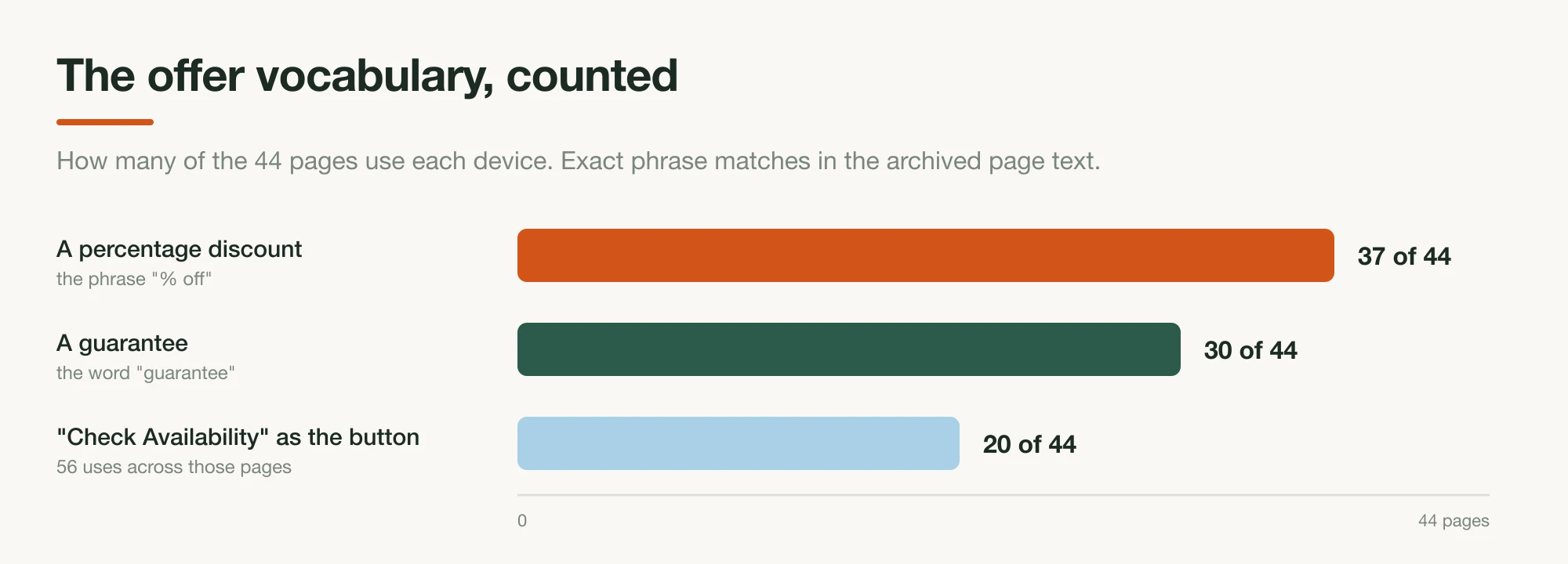
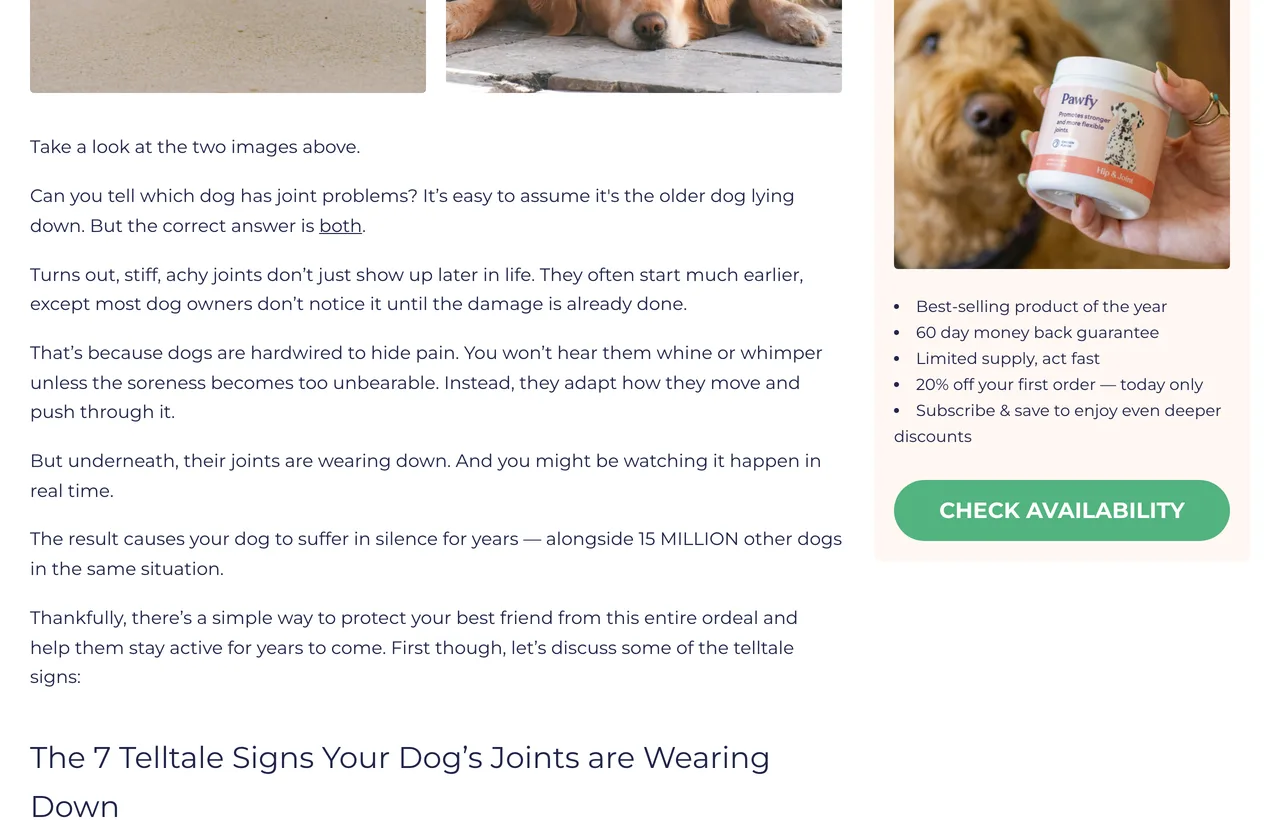
The offer vocabulary is the most uniform thing in the corpus. A percentage discount appears on 37 of the 44 pages, the word "guarantee" on 30, and "Check Availability" is the button verb on 20 pages across 56 separate uses. The literal word "Buy" is close to absent: we found "Buy now" on 2 pages and "Add to cart" on 2, against "Order now" on 12.
| Offer element | Pages (of 44) |
|---|---|
| A percentage discount ("% off") | 37 |
| The word "guarantee" | 30 |
| "Check Availability" as the button verb | 20 (56 uses) |
Counting the action phrases one at a time, one case-insensitive pass over the 44 archived text extracts on 16 September 2026, counting pages that contain each phrase anywhere, so a page that uses two verbs is counted under both:
| Button phrase | Pages (of 44) |
|---|---|
| "Check Availability" | 20 |
| "Order now" | 12 |
| "Get yours" | 8 |
| "Shop now" | 6 |
| "Claim your" | 9 |
| "Buy now" | 2 |
| "Add to cart" | 2 |
Pages carry more than one phrase, so the column does not sum to 44: 10 pages run a Check Availability button alongside one of the others, and 5 pages use neither Check Availability nor any of the transaction verbs at all. Read the shape, not the totals. The two phrases that describe a transaction, "Buy now" and "Add to cart", are on 2 pages each. The phrases that describe supply, timing or possession carry the rest.
"Check Availability" is the one worth stealing verbatim, and worth understanding before you do. It puts the scarcity inside the verb, so the button implies something the copy never has to claim. Which is exactly why it needs a real stock position behind it. Borrow the phrasing when it is true, drop it when it is decoration.
6. Where the CTA sits
Three placement schools coexist, and they are three different bets on what interrupts a reader, not three points on one spectrum. Our notes record a first-CTA position on 28 of the 44 pages, so this describes those 28 and not the full corpus.
- Story-protective. No in-body CTA until roughly 80 to 90 percent of the page, then two or three cluster at the close. The top-of-page offer banner sits outside the article frame, so the narrative never breaks.
- Distributed. A CTA block after every major section, each stamped with the same trust line about the guarantee and the shipping.
- Listicle two-tier. Soft editorial text links inside the early items, then hard offer blocks at the halfway mark and at the end, with the narrator's voice kept inside the offer box.
The choice follows the format, not the writer's taste: a story page protects the story, a list page asks per item because every item is a fresh micro-decision. If you are choosing between the two, advertorial vs listicle is the actual call.
7. The chrome around the article
Thirty-four of the 44 pages carry sticky or fixed conversion chrome: a masthead, an offer bar, a desktop sidebar card, or some combination. Eighteen carry video. Seven run a third-party A/B testing platform, which means the page is wired for A/B testing and the version a visitor sees may not be the version we archived.
| Feature on the page | Pages (of 44) |
|---|---|
| Sticky or fixed conversion chrome | 34 |
| Video | 18 |
| A third-party A/B testing platform in the HTML | 7 |
| A reference or PubMed citation block | 3 |
The seven A/B pages concentrate rather than spread: Intellimize on three pages from one footwear advertiser, VWO plus Builder.io on two pages from one pet brand, VWO on two skincare pages. Three advertisers, seven pages. The pattern is real and the sample cannot size it.
Some of that chrome is scripted. Thirteen of the 44 carry the code strings for a scroll-revealed bar (data-show_after, dheight/2); we opened five of them one at a time and read the thresholds, three from one foot-pad advertiser and two from one cleaning brand. One carries data-show_after=800, another fires on scroll >= dheight/2. The offer chases the story down the page instead of sitting on it from the first screen.
8. Countdowns are rarer than their reputation
Countdown or timer markup of any kind appears on 12 of the 44 pages. That is the most surprising number in the recount, because the genre's reputation is wall-to-wall urgency, and because our own June synthesis put it at 42 of 44. That figure was wrong; 12 is the corrected count, and it is published in full below.
Urgency itself is still close to universal here, but most of it is carried in sentences and not in a ticking element: availability framing, a stated deadline, a unit number in the copy. Four of the pages we opened run a genuine JavaScript timer, three of them in a sticky top bar and one in a short eye-care advertorial whose timer resets per visitor and persists in a cookie, an evergreen deadline rather than a real one. On the rest, the deadline was copy. Worth being precise about what that does and does not condemn. A working countdown is not a fabricated device, which is why one of those four pages still sits among the pages we would copy from at the end of this piece. The fabrication is the cookie: a deadline that starts over for every visitor is theater whether or not the digits move.
9. The proof that is only markup
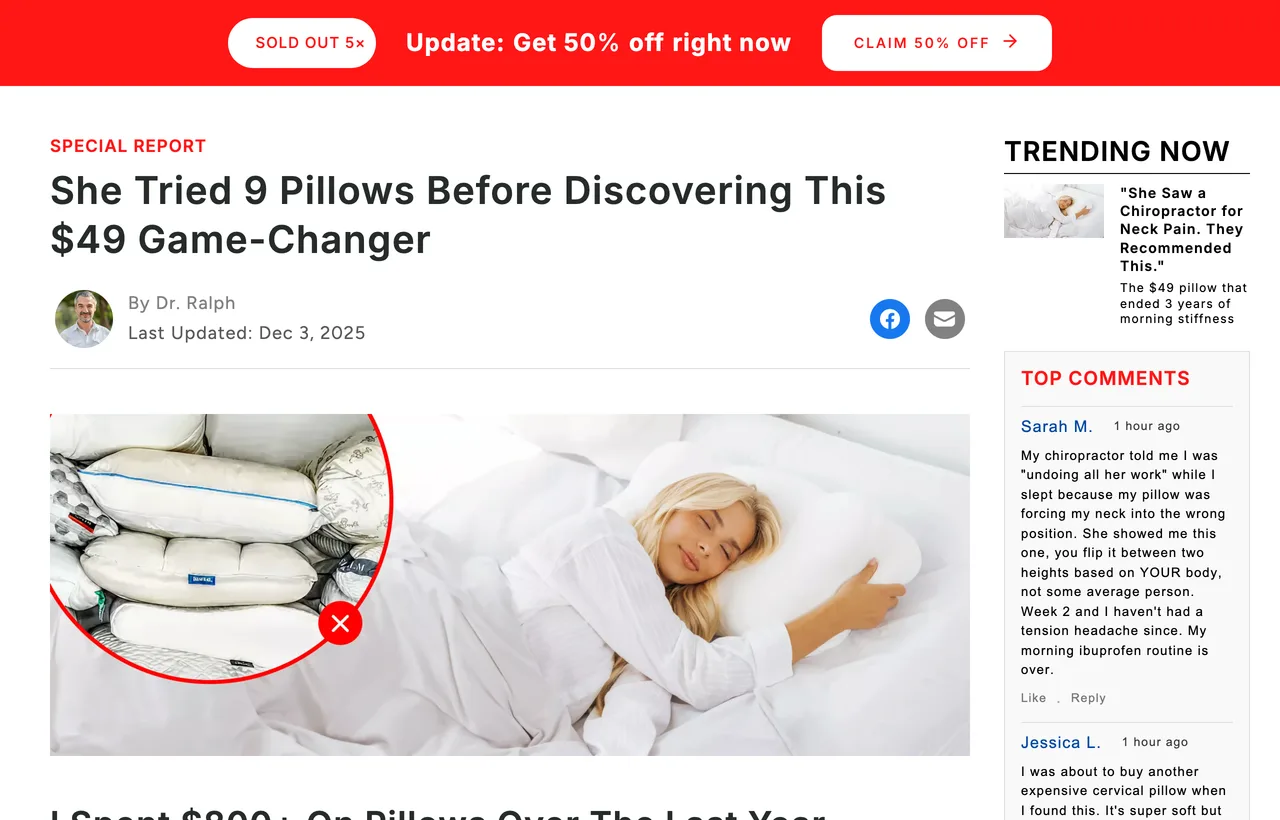
Ten of the 44 pages carry a Facebook-styled comment thread by our read, seven of which show the literal "Like · Reply" row a grep can find. Every one of those threads is static HTML: hardcoded names, hardcoded like counts, a reply box that does nothing, and no Facebook or Disqus embed anywhere in the file. Two further pages carry a three-card like-count module instead of a thread.
Nine of the ten came out of the page-by-page read. The tenth is Mellow, whose archived HTML carries a Top Comments sidebar with five Reply rows: the text extract we grep against dropped that sidebar, which is why the correction we first published here said nine. The HTML had it the whole time. Ten is the number, and the reason you are reading about it is that a correction is only worth anything if we correct it again when it is wrong.
None of the nine original thread pages carries a Facebook script of any kind, not a comments SDK and not the Meta pixel. Mellow's page loads the pixel and nothing else. The pixel appears on 16 of the 44 pages overall (an fbevents.js load or an fbq( call, with connect.facebook.net on 13 of them), never alongside a comments embed.
- A rating count printed as text with no review widget behind it. The same figure, "3,791", appears on five pages belonging to two unrelated advertisers.
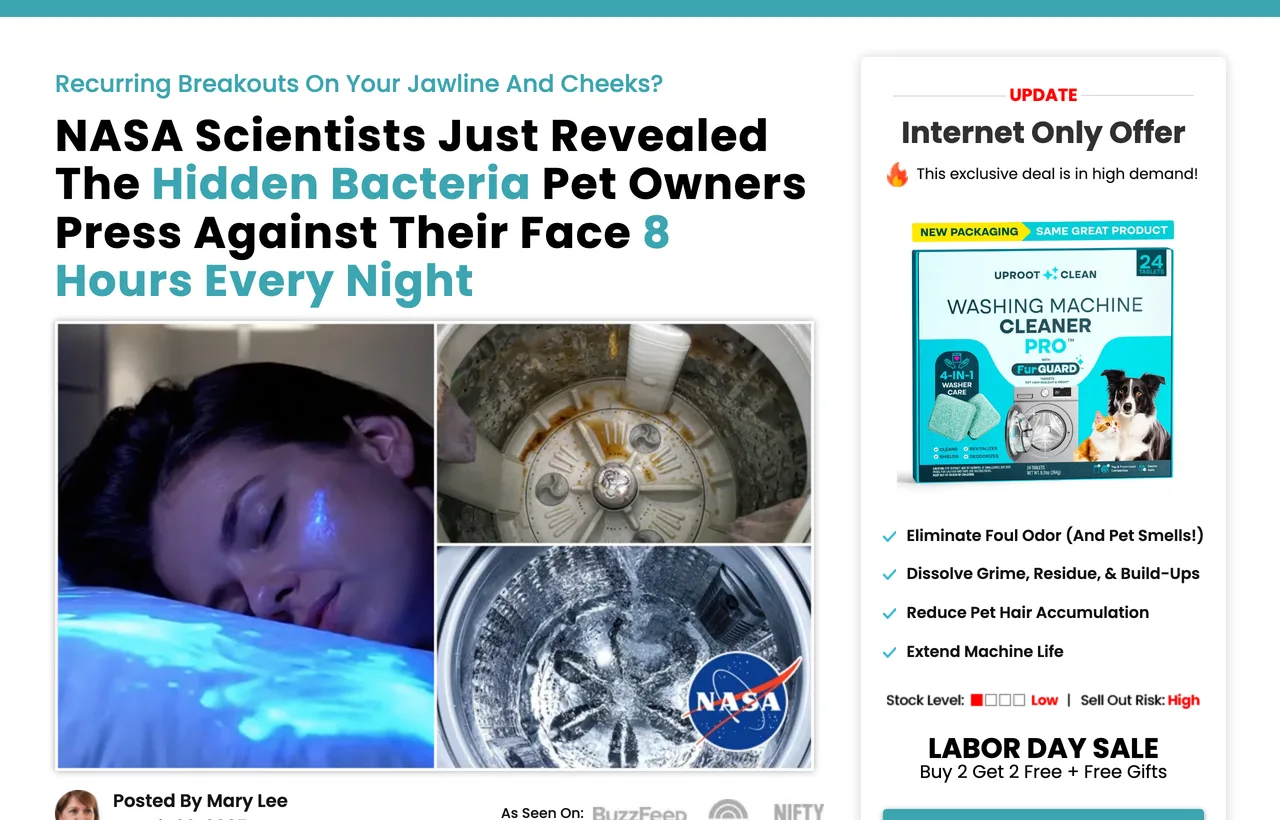
- The same physician byline on pages from two different advertisers. "Dr. Blane Schilling" bylines a sciatica page for one brand and a bunion page for another, and we could not verify those credentials from the page or a public register. The simplest explanation is a shared template. We cannot confirm who produced either page.
One more device in this family never made it into our counts, and you can see it in the Uproot frame further up this page: an "As Seen On" row beside the byline carrying the BuzzFeed, TODAY and NIFTY logos. That is what the page displays, and we did not verify it, which is the whole problem with it. A logo is not a story. The same frame composites a NASA roundel onto the product photo, and the headline attributes the finding to NASA scientists; the page cites nothing a reader could follow. A reader who wanted to check has nothing to click, so the row does the same borrowed-authority job the unverifiable byline does, moved from a person to an institution.
Structurally, a comment thread here is an objection-handling section wearing social clothes, and the questions in it are the ones the body never answered: does it work at my age, how long is shipping. That structure is worth stealing. Leave the static markup where you found it: the honest version is the same shape filled with quotes harvested from your own reviews, labeled as reviews.
10. How the pages label themselves
Fourteen of the 44 print a standalone Advertorial, Advertisement or Sponsored line at the top, and one more prints "SPECIAL REPORT" instead. Twenty-six carry a disclosure word somewhere on the page, usually a footer disclaimer well below the offer. Eighteen carry no disclosure word anywhere at all. So the corpus splits three ways: 14 labeled at the top, 12 carrying the word and nothing more, 18 carrying nothing. Mellow's "SPECIAL REPORT" page falls in the 12, because a special report is not a disclosure, whatever it is doing at the top of the page. Those are different things, and only the first is a label a reader meets before reading.
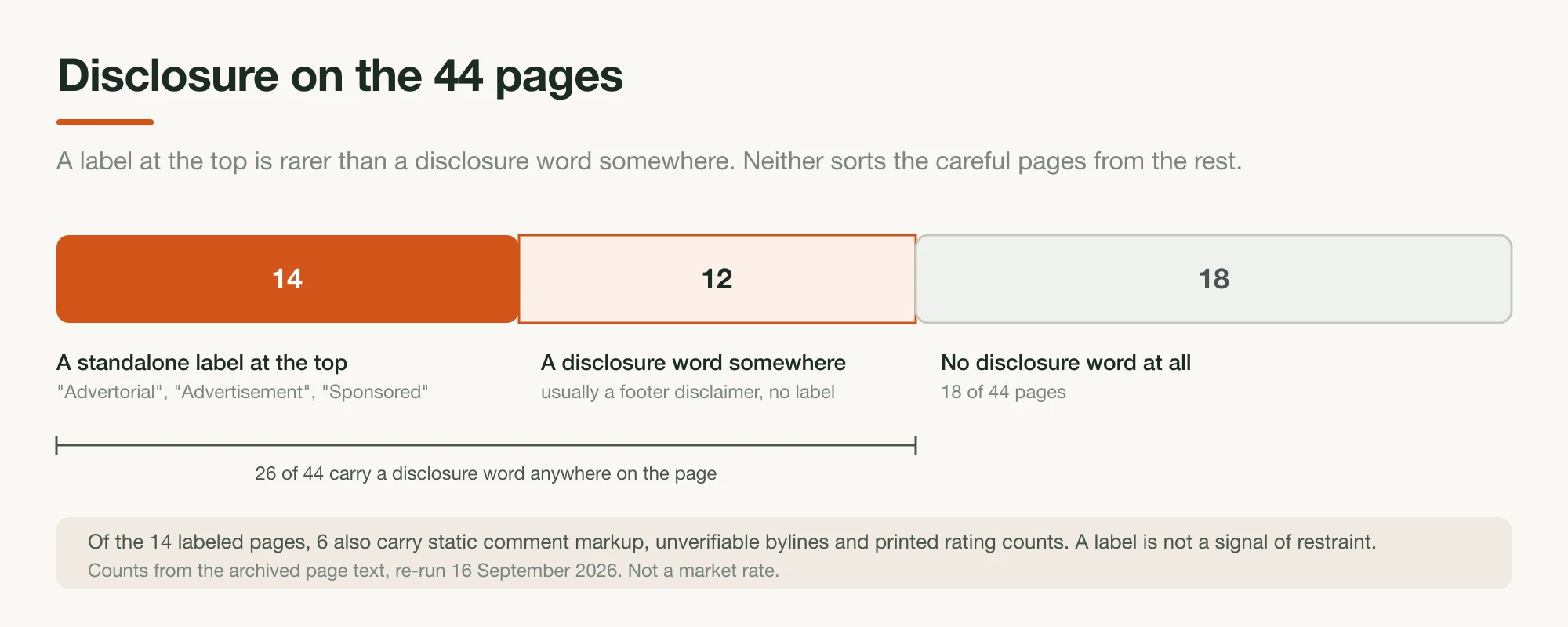
| What we counted | Pages |
|---|---|
| A standalone Advertorial / Advertisement / Sponsored label line | 14 of 44 |
| A disclosure word anywhere on the page | 26 of 44 |
| No disclosure word anywhere on the page | 18 of 44 |
| Self-labeled pages that also carry the devices counted in section 9 | 6 of the 14 |
That last row is the finding. The label does not sort the careful pages from the ones we would not copy: six of the fourteen also carry static comment markup, unverifiable bylines and printed rating counts. Those devices are not confined to the six, either. Section 9 counts comment markup on ten pages and the same rating figure on five, spread across labeled and unlabeled pages alike. Labeling is a floor, and the FTC disclosure rules judge placement and clarity long before they ask whether the word is on the page at all.
One independent measurement exists on disclosure, and it is not about Facebook ads. Papadogiannakis, Papadopoulos, Kourtellis and Markatos studied 186,124 ad URLs across 450 news sites in 59 countries between October 2024 and February 2025, and reported that 44% of advertorials promote health-related products, 42% of disclaimers fall below W3C contrast thresholds, and 69% use smaller fonts than the median page text ("Paid to Look Like Truth: The Prevalence and Dark Patterns of Advertorials in News Outlets," the arXiv preprint, arXiv:2602.12810, submitted to ACM Internet Measurement Conference 2026, read 16 September 2026). A large shallow sample of news-ad advertorials beside our small deep one, and its health finding lands where our category skew does.
11. The house style
The 44 pages read as though one person wrote them. The register is plain and short: one and two-sentence paragraphs, fragments used as punctuation, first person that pivots to "you" at the close. We computed no readability score, so treat that as a description with no number behind it.
The tic that gives the genre away is "actually", on 33 of the 44 pages and more than 130 times in total. "Actually worked." "An actual doctor." It borrows the credibility of a correction, which is what every one of these pages is performing. The other constant is structural: near the close, almost every page runs an honesty beat where the narrator admits a limit before asking for the sale. That beat is the easiest thing on this list to reproduce truthfully.
12. What the pages are built on
Twelve of the 44 were built on Funnelish, identifiable from the comment left in the page source: "This website was created in Funnelish". The rest run on the brands' own stacks. Where those Funnelish pages send the click, and why several hand the sale straight back to Shopify, is answered in the Shopify funnel builders roundup.
Production slop ships live and seems to cost nobody anything. Across seven named pages we found a blank template variable printed as-is, two different publish dates on one page, a <title> still carrying a sibling page's headline, and markup carrying paste artifacts associated with ChatGPT and Notion (those artifacts come from pasting text out of a writing tool into a page; a page that was built rather than pasted never picks them up). All of that was running as an ad, which says polish is not what you are competing against. The structure is. For where the click goes after the button, we counted 27 recorded destinations in the paid-traffic funnel guide.
What we would steal, and what we would not
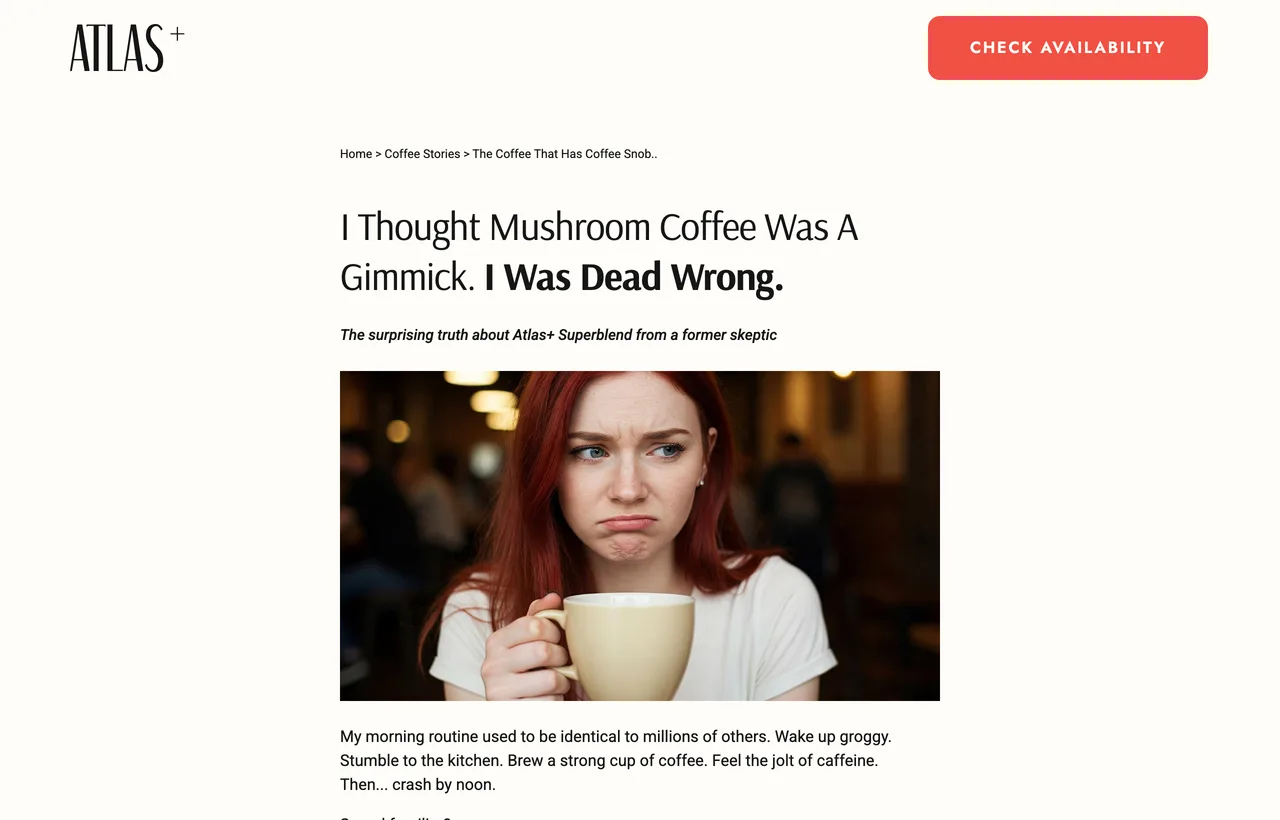
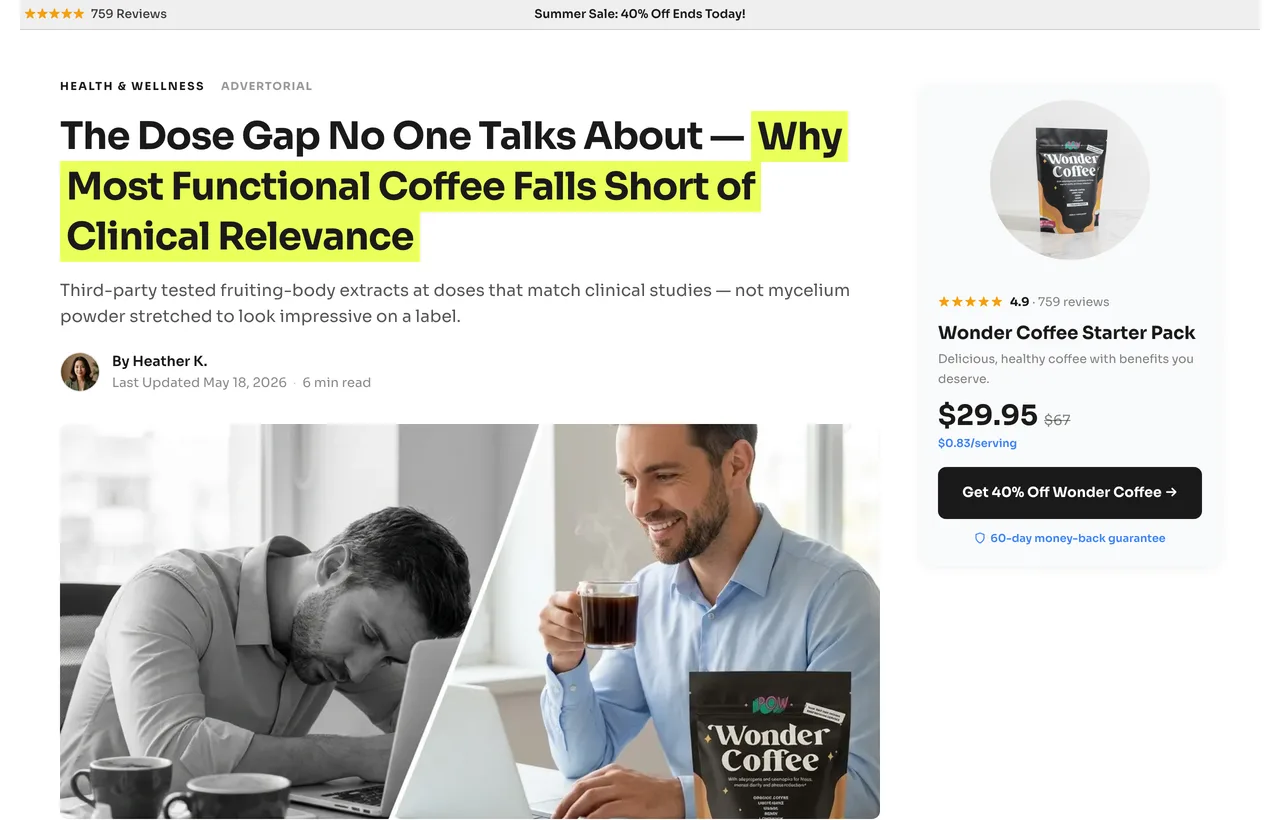
Almost everything structural here is reproducible without any of the devices that only look like proof, and the corpus proves that itself. In our June 2026 archive, Atlas, Blissy and 8 Sheep ran the same beats, the same reveal discipline and the same offer vocabulary as the pages carrying those devices, and they were sitting on the same list, ranked by the same score. Blissy is a 12-item listicle and not an advertorial arc, so read it as the same discipline in a different format.
Steal the structure: the failed-alternatives ladder with real prices, discovery that arrives socially rather than from an ad, one retellable analogy for the mechanism, the honesty beat before the close, risk reversal within a line of every button, and the narrator matched to the riskiest claim on the page. Steal the production model too, which is the biggest idea in the corpus. Freeze the skeleton, rotate one slot per variant, let the variants tell you which lever matters.
Do not copy the five things that only look like proof: a comment thread that is static HTML, a rating count printed as text with nothing behind it, a byline whose credentials a reader cannot check, a press-logo row with no story a reader can open, and a cause named on the page that you cannot find in the medical literature. Each fills a slot the honest version also fills. Real customer quotes in a thread layout, a real review count, a real named author, a logo you can link to the piece it came from, and a real mechanism do objection handling, social proof, authority and re-diagnosis in the same skeleton.
Our own two examples of the genre run that way, and both were built with Landra. You hand it your product or brand URL and name the buyer you are chasing; it reads the brand and the catalog behind that URL, works out the angle, and writes the whole optimized advertorial or listicle around them. Headline, section order, the long-form copy, the proof blocks and the images, laid out mobile-first in DTC conversion components you can click and edit, then published straight to Shopify, a Landra URL or an HTML export. The reason it belongs on this page: the production model behind these 44 pages, one frozen skeleton with rotated slots, is the expensive half to build by hand and the cheap half to generate. 14-day free trial, then from $19/mo.
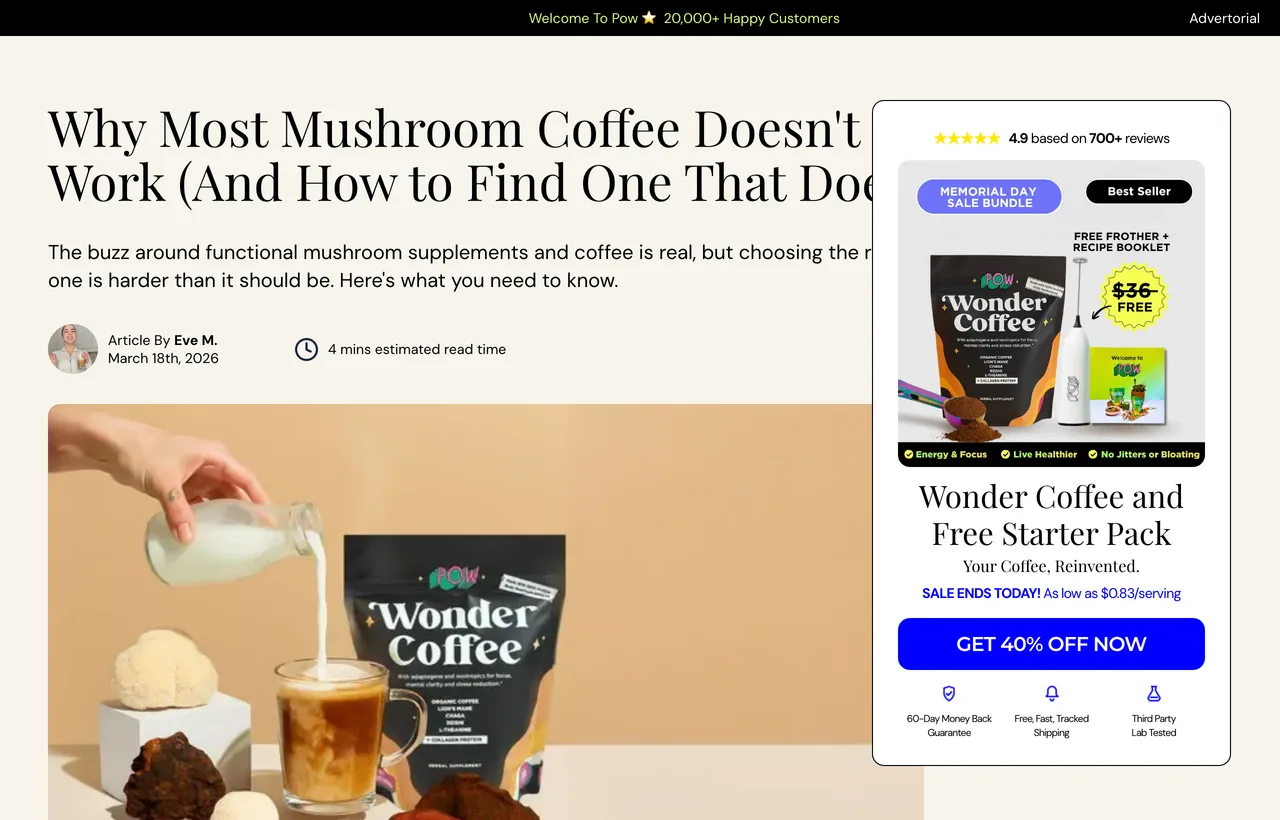
Read the two frames below as exhibits, not as a spotless standard. Both carry a first-name house byline ("By Heather K." on one, "Article By Eve M." on the other). Those are house bylines, and we are naming them as such here because the page does not. Both also run a today-only sale bar with no date on it, "Summer Sale: 40% Off Ends Today!" across the top of the first and "SALE ENDS TODAY!" in the offer card of the second, which is the same framing this corpus runs and which we would rather fix than defend.
So the line we will actually stand behind is narrower than that. On both pages the advertorial label is above the fold, as a grey eyebrow under the reviews bar on the first and right-aligned in the black top bar on the second. Neither page carries a comment thread. And the star ratings on both are our store's review total, though the two frames print different ones, 759 reviews on the first and "700+" on the second, which is our own staleness to fix. That is the list. Everything else on those pages is furniture you should judge the way you judged the other 44.
What this corpus cannot tell you
Every number here is a count of pages. None of it is a rate. Forty-four pages is one aggregator's list on one day, and 35 of them are sibling variants from 12 advertisers, so they are not independent observations. A count of 37 of 44 means 37 pages here and nothing about advertorials anywhere else. The category mix is sleep, pain, detox and hair; if you sell jackets or headphones, this corpus describes a neighborhood you do not live in.
It also cannot tell you what converts. We hold no conversion data on any page, no ROAS, no AOV, and no idea what any of these pages did for the account running it. The ranking we sampled is an aggregator's authority score, and any page here could be a losing test nobody has switched off yet. Because the archive is server-rendered HTML, every feature count is a floor: whatever the A/B tools on those seven pages were injecting, we never saw it.
Four numbers in our own June notes did not survive the recount, and one of the four corrections did not survive either. Publishing them is cheaper than defending them.
| What our June notes said | Where the number stands now |
|---|---|
| Countdown or timer markup on 42 of 44 pages | 12 of 44 |
| 12 pages carry a Facebook-styled comment thread | 10 by our read, 7 of which show the literal "Like · Reply" row. We first published 9: the text extract had dropped Mellow's comments sidebar, the HTML carries it |
| "actually" used 134 times across 33 pages | More than 130 uses across 33 pages; the old total included two pages we had skipped |
| Reveal delay measured in words, 6 to 2,624 | Not reproducible from the archive. Published as percentage bands instead, by narrator type |
The countdown correction is the one that changes the advice. Read our June notes and you would have concluded a countdown is table stakes here. It is not, at least not in this sample: 12 of 44 carry the markup, and urgency is mostly doing its work in sentences. That is the cheaper and more honest lever, and it sat in the data the whole time behind a number we had not re-run.
Frequently asked questions
Is this a market rate?
No. Every figure here is a count of pages inside one 50-page sample taken from a single aggregator on 11 June 2026, and 35 of the 44 pages are sibling variants from 12 advertisers, so they are not independent observations. A count of 37 of 44 means 37 pages in this corpus, not 84% of advertorials anywhere. Do not project any of it onto the market.
How did you count?
We archived the server-rendered HTML and extracted text of every page on 11 June 2026, then re-ran every count against that archive with ripgrep on 16 September 2026, subtracting the six pages we skipped. Qualitative calls, such as narrator archetype and where the product is first named, come from a page-by-page read recorded per page. Two things make every count a floor. Anything injected client-side by an A/B tool never reached the archive, and the text extract we grep against can drop markup the HTML carries: it dropped one page's comments sidebar, which is how our first published correction undercounted comment threads.
Why 44 and not 50?
The source list held 50 pages. One was already dead when we fetched, so 49 downloaded. Of those, two were client-rendered quiz funnels with no server-rendered text to read, and three were offer or product pages wearing advertorial headlines rather than advertorials. That leaves 44 analyzed pages: 41 advertorials and 3 listicles.
Do these advertorials convert?
We have no idea, and neither does anyone quoting them. We hold no conversion data on any page in this corpus. The only performance claim available is that each page was running as a Facebook ad when we sampled it on 11 June 2026, ranked by the aggregator on its own authority score, which we treat as a rough proxy for spend or longevity and never for conversion rate.
What narrator do most Facebook-ad advertorials use?
In this corpus there is no single winner. Two archetypes tie at 14 pages each: an expert or doctor byline, and a journalist narrating a named customer whose claims live inside quotation marks. First-person customer confession accounts for 9 pages, brand voice for 5, and a celebrity or insider for 2. The choice tracks how risky the claim is, not how good the writer is.
Do advertorial landing pages label themselves as ads?
Fourteen of the 44 print a standalone Advertorial, Advertisement or Sponsored line at the top, and one more prints "SPECIAL REPORT". Twenty-six carry a disclosure word somewhere on the page, usually a footer disclaimer, which leaves 18 of the 44 carrying no disclosure word anywhere. Labeling and honesty are separate variables in this sample: six of the fourteen also carry static comment markup, unverifiable bylines and printed rating counts.
How many advertorials use a countdown timer?
Twelve of the 44 pages carry countdown or timer markup, matched as the strings "countdown" or "timer" in the archived HTML, and 11 of those match "countdown" alone. We published the correction rather than the memorable number.