
Twelve of them carried the same comment in the page source: <!-- This website was created in Funnelish -->.
That was the count when we pulled 50 live Facebook-ad advertorials in June 2026 and analyzed 44. Funnelish was the most common named page platform in the set by a wide margin, and Funnelish sells a complete funnel with its own checkout. Nine of those twelve pages had a CTA destination we could record. Five of the nine sent the click straight back to the brand's own Shopify product page, past the checkout the brand was already paying for. They had bought a funnel and used a page.
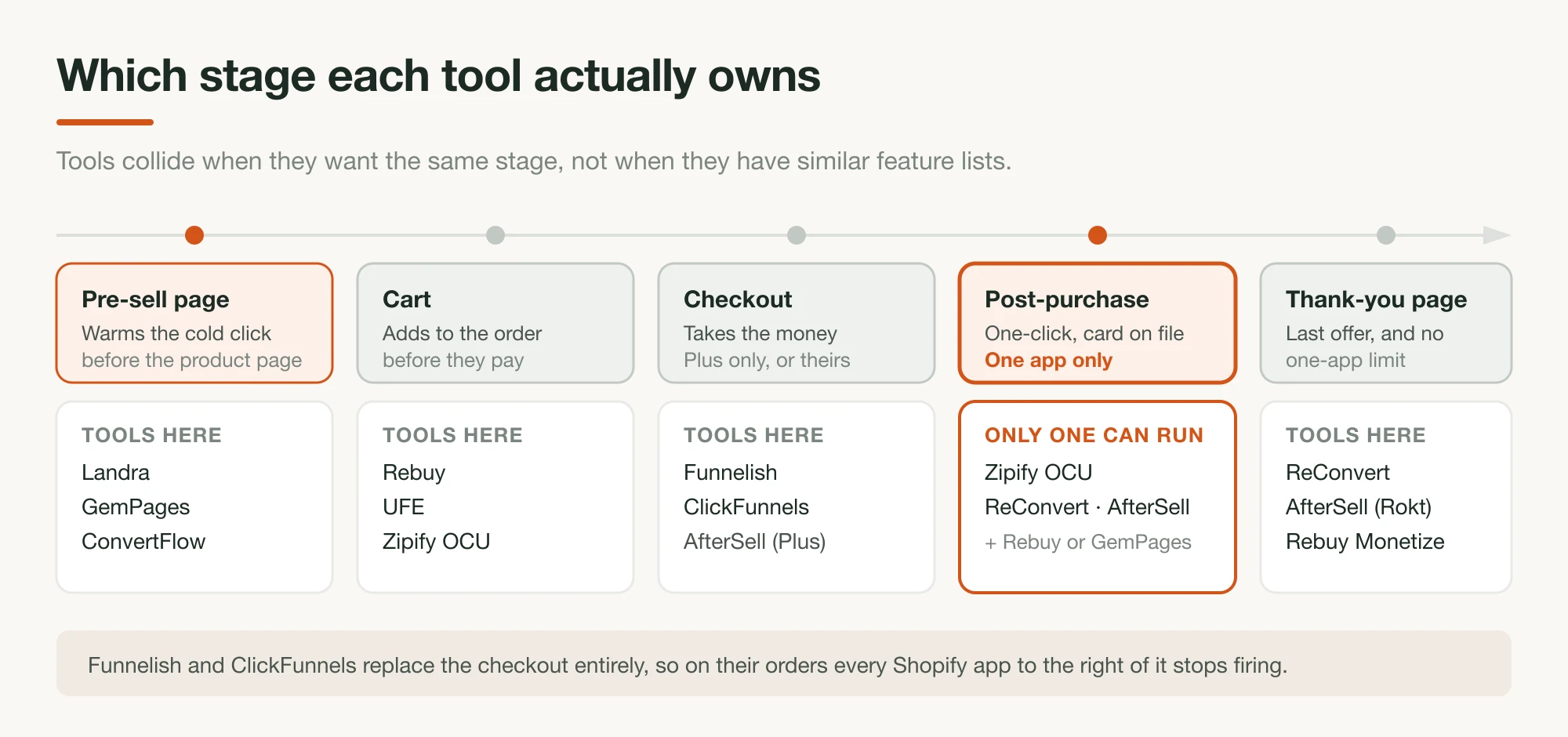
That is the argument of this guide. A Shopify funnel gets assembled from parts, and no single tool has to do everything. A funnel app does one of five jobs on a store: it builds the page that warms the click, it works the cart, it runs offers inside checkout, it runs the one-click offer straight after payment, or it works the thank-you page. Those last two look like one job and are not, which turns out to matter more than any feature on this page. Not all ten below are Shopify App Store apps, and two replace Shopify checkout entirely rather than plugging into it. That changes what else you can install, so every entry states whose checkout it uses.
Where to go, depending on what you're shopping for:
- Building the page itself (editors, templates, speed): the best Shopify landing page builders and the best advertorial software.
- Deciding who takes the money and what runs after checkout: this guide.
- Getting off ClickFunnels specifically: ClickFunnels alternatives.
How we picked these ten
Four filters. A tool had to touch money or the order rather than just the layout, state whose checkout it uses, publish pricing we could read on its own site or App Store listing in September 2026, and have a limit we could name. Adoption was counted where a listing exists and flagged where the footprint is thin.
- It touches the transaction. Pure page builders live in our other roundups. A tool here owns the cart, the checkout, the post-purchase offer, or the pre-sell page feeding all three.
- Whose checkout, stated plainly. The fork the rest of the stack hangs off, and the thing most roundups skip.
- Verified, dated pricing. Read on 2 September 2026. Where two of a vendor's own sources disagree, both are printed rather than reconciled.
- A named limit. Volume caps, plan gates, slot collisions. Every entry has one.
Cart abandonment is why any of this exists: Baymard Institute puts the documented average at 70.22%, across 50 studies spanning 2006 to 2025 (read 3 September 2026). Funnel tooling is a set of attempts to move that number at different points on the path.
The ten Shopify funnel builders
Read this as a parts catalogue, not a leaderboard. Each entry names the job it owns, whose checkout it uses, verified September 2026 pricing, adoption, its real limit, and what it pairs with. Three of the ten want the same single socket in your Shopify admin no matter how you set them up, and up to six want it depending on which package or feature you turn on. That is the most useful thing to know before installing anything.
1. Funnelish: best for an own checkout without ClickFunnels pricing
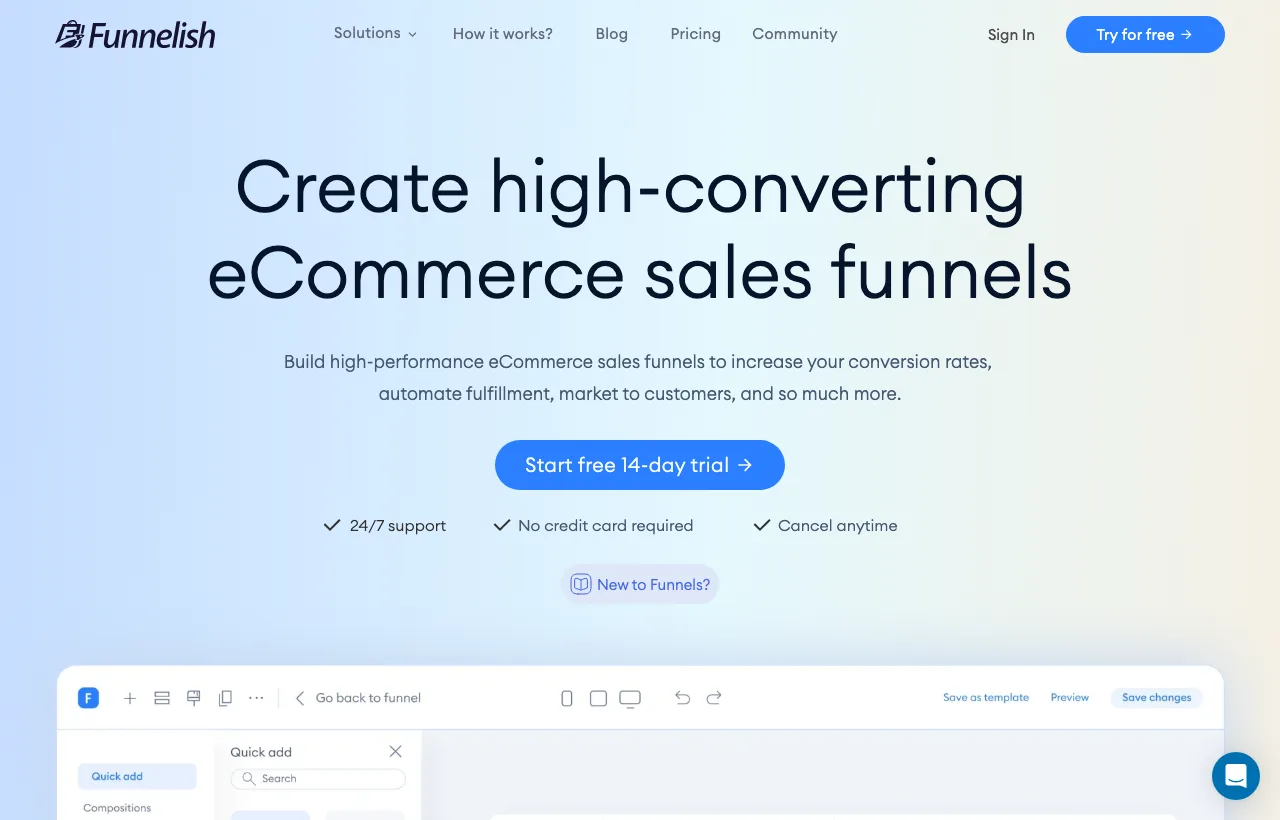
Funnelish is a full funnel platform with its own checkout: pre-sell page, offer step, order bump, one-click upsell, with gateways you connect directly (Stripe, Airwallex, PayPal, Checkout.com, NMI, Klarna, Apple and Google Pay, COD, and the European methods). It self-describes as running "either as a standalone platform or as a powerful extension of your Shopify store."
- Pricing (funnelish.com/pricing, September 2026): Basic $49/mo ($41 annual), PRO $99 ($83), Advanced $249 ($208), Enterprise custom. 14-day trial, no added processing fee.
- Adoption: 4.0 on Trustpilot from 64 reviews, September 2026. No Shopify App Store listing.
- The limits: payment routing and gateway pools sit on the $249 Advanced tier, five times the entry price. And running its checkout means Shopify's post-purchase extension never fires, so every Shopify upsell app here becomes dead weight on those orders.
- Pairs with: nothing on the Shopify post-purchase side while its checkout is live. As a page host only, it pairs with any Shopify upsell app.
2. ClickFunnels: best for a complete funnel platform run outside Shopify
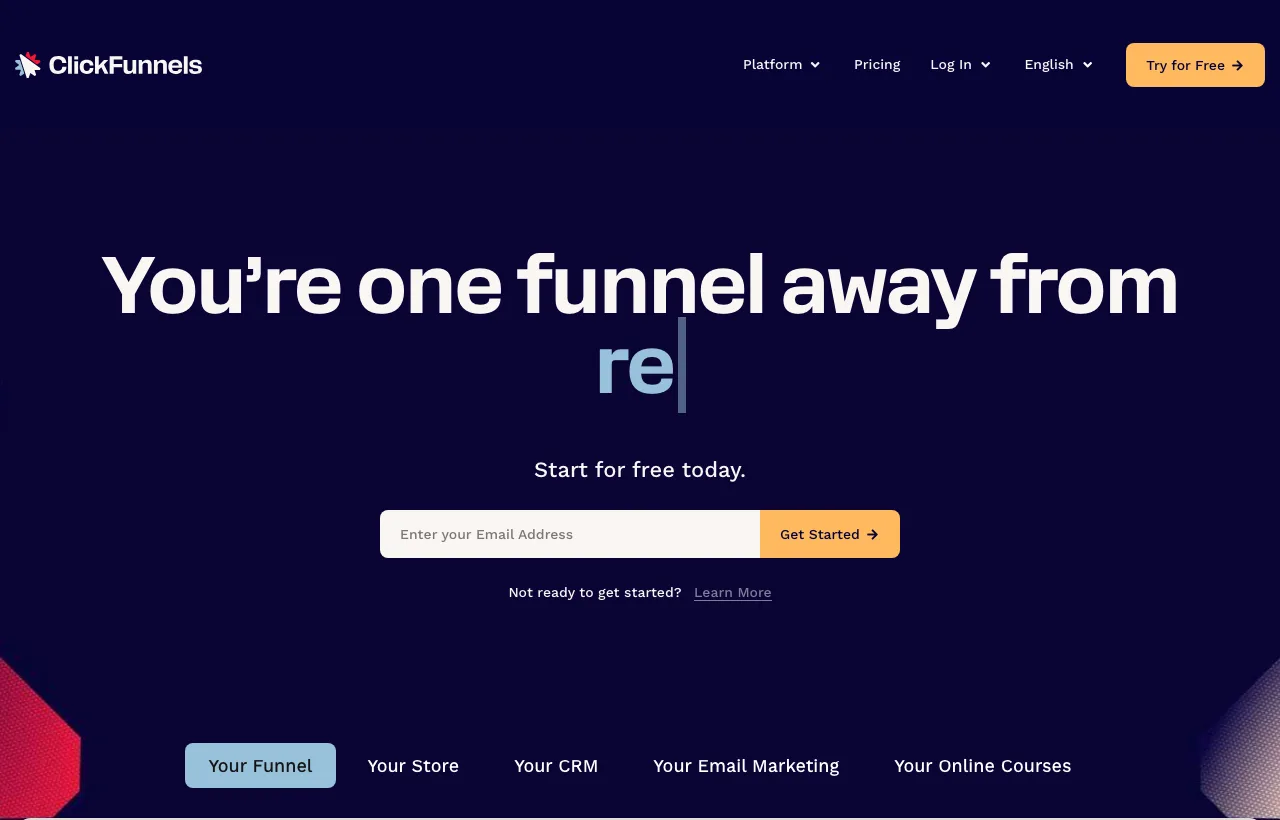
ClickFunnels is the best-known platform in the category: a complete funnel platform with its own checkout, run alongside a Shopify store rather than inside it. Its own support documentation for the Shopify integration states that the integration "will send shipping information but will not accept payment."
- Pricing (clickfunnels.com/pricing, September 2026): Launch $97/mo ($81 annual), Scale $197 ($164), Optimize $297 ($248), Dominate $5,997/yr. 14-day trial, 30-day money-back.
- The limits: each funnel product syncs into Shopify as a separate order, so a two-product funnel produces two orders to pick, pack, and reconcile. Order fragmentation is enough of an operator cost that third-party apps exist purely to consolidate them, and it never shows up in a comparison table.
- Pairs with: the email and CRM you were going to buy anyway. Not with Shopify post-purchase apps, for the same reason as Funnelish.
3. Zipify OneClickUpsell: best for upsells at every placement from one app
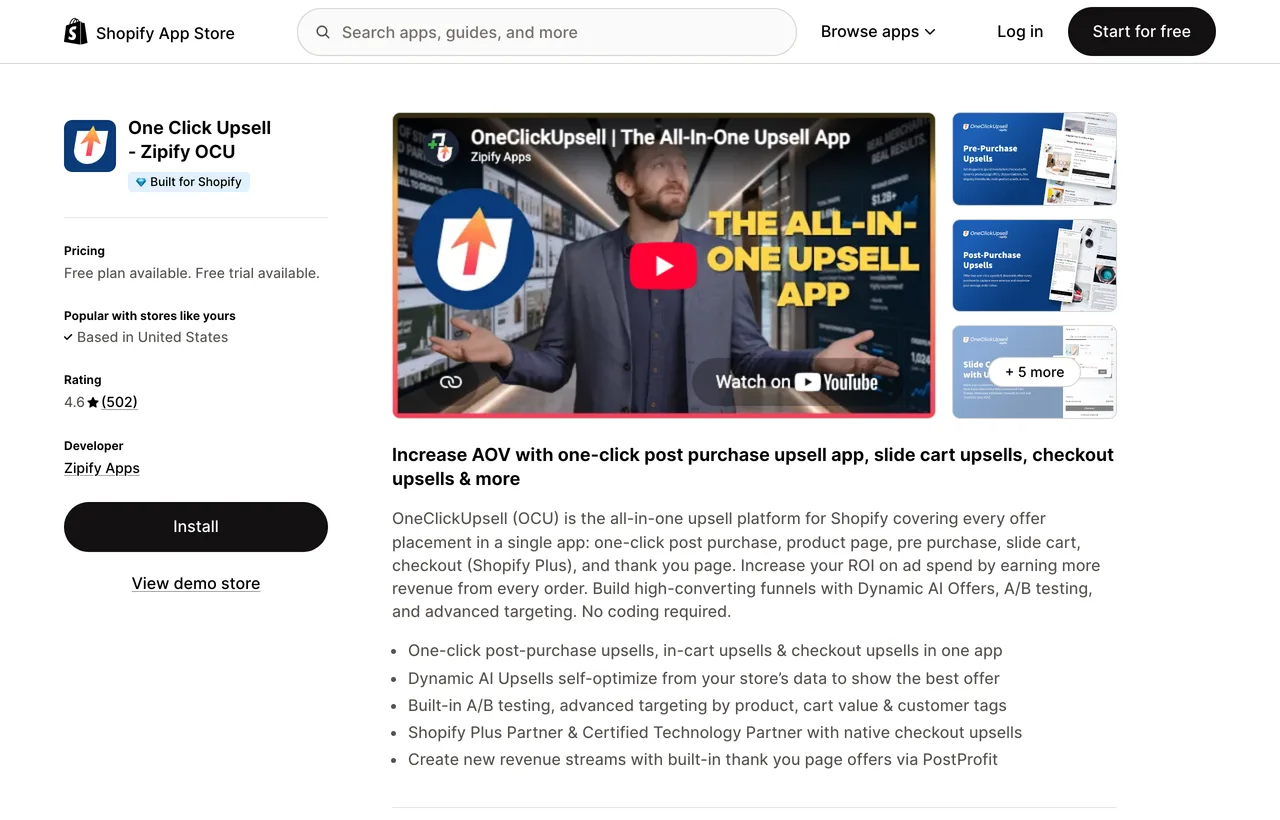
Zipify OneClickUpsell uses Shopify's checkout and covers more placements than anything else here: the post-purchase extension, plus thank-you page, slide cart, product page, and pre-purchase offers. It's a different product from Zipify Pages, the page builder in our Shopify builder roundup.
- Pricing (App Store listing, September 2026): free for development stores; Unlimited $8/mo plus a fee that scales with upsell revenue; Zipify Plus by quote, Plus only. 30-day trial.
- Adoption: 4.6 stars from 502 reviews, September 2026, listed since 9 October 2020.
- The limits: the $8 sticker is not the working price, because the revenue-scaled fee is the real line item. Checkout-page upsells need Plus. And it wants the single post-purchase slot.
- Pairs with: any page tool. Not with another post-purchase app.
4. Upsell.com ReConvert: best for the most widely adopted post-purchase app on this list
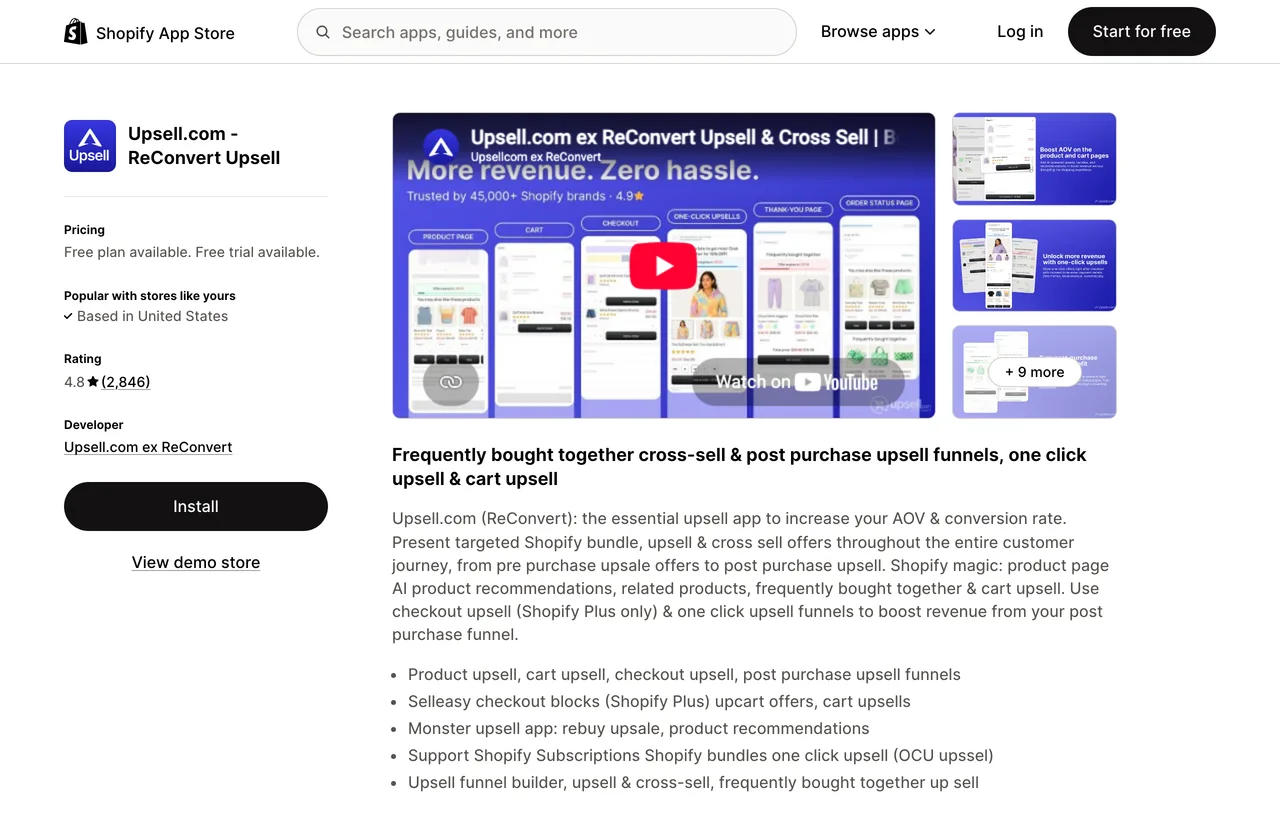
Upsell.com ReConvert Upsell is the widest-adopted post-purchase app on this list at 4.8 stars from 2,846 reviews, September 2026. It uses Shopify's checkout and treats its two placements as distinct: the one-click offer runs through Shopify's post-purchase extension, the thank-you page block runs after. (reconvert.io now redirects to upsell.com, and the listing reads "Upsell.com ‑ ReConvert Upsell.")
Its two pricing sources disagree, so both are here, unreconciled:
- App Store listing (September 2026): $4.99/mo up to 50 orders, $9.99 up to 100, $19.99 up to 200. Free for development stores, 14-day trial.
- upsell.com/pricing (September 2026): a longer ladder. Growth from $4.99 up to 2,000 orders, Scale up to $499 at 10,000, Elite up to $999 at 20,000, Enterprise above that.
- The limits: which ladder applies depends on where you signed up, so read the plan you're on. Checkout upsells require Plus and the Elite tier. And it wants the single post-purchase slot.
- Pairs with: any page tool, any cart tool. Not with another post-purchase app.
5. AfterSell: best for checkout-page upsells on Shopify Plus
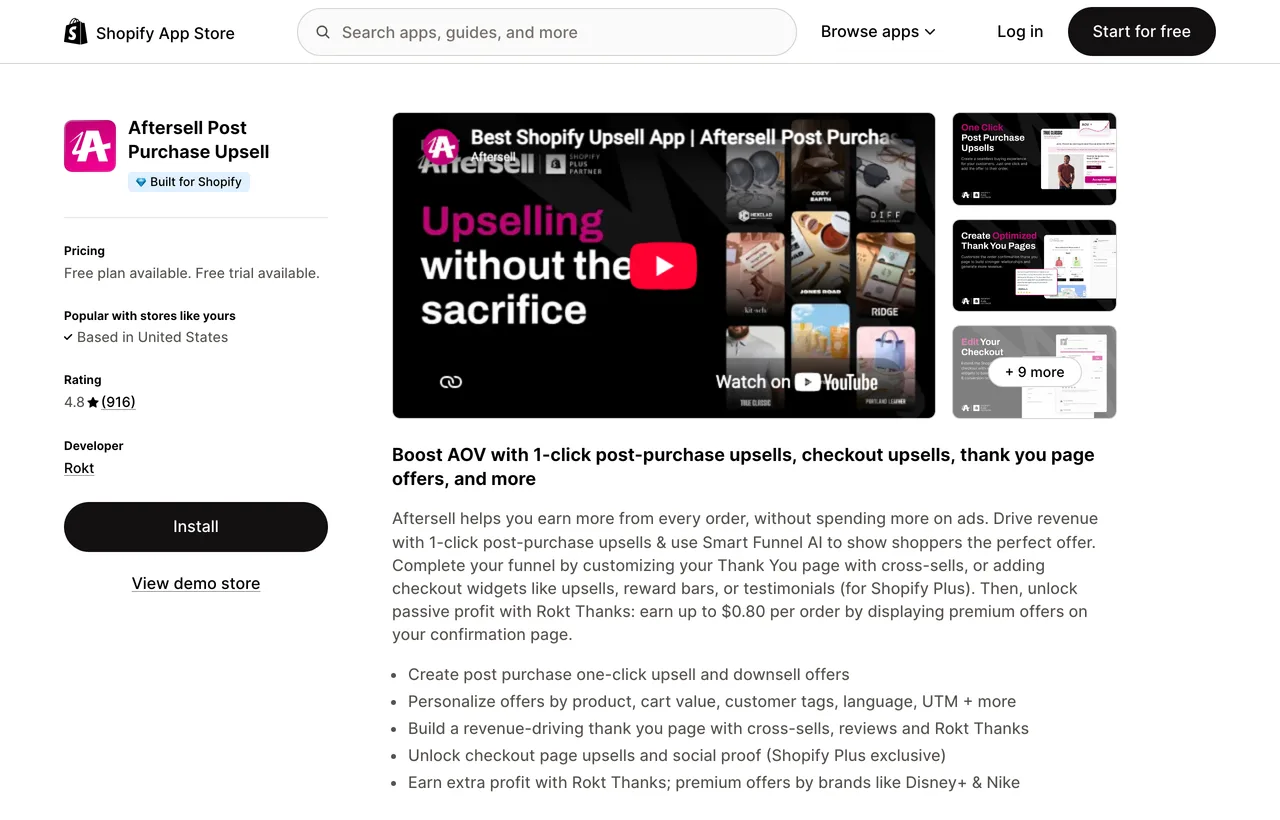
AfterSell uses Shopify's checkout and is the strongest option for offers on the checkout page itself, if you're on Plus. Listed on the Shopify App Store under the developer Rokt (Beam Commerce Inc.) as of September 2026, at 4.8 stars from 916 reviews, 94% of them five-star.
- App Store listing (September 2026): free for development stores; $34.99/mo for 0 to 500 orders, $54.99 for 501 to 1,000, $99.99 for 1,001 to 2,000. 30-day trial.
- aftersell.com/pricing (September 2026): four modules sold separately. Cart Drawer $29.99/mo (200 orders, requires Rokt UpCart), Checkout $99/mo (200 orders, Plus only), Post Purchase Upsell $34.99/mo (500 orders), Rokt Thanks free at unlimited orders and earning "$0.30–$0.80 per order," Enterprise custom above 10,000 orders/mo.
- The limits: the checkout module is the reason to pick AfterSell, and it's Plus-only at $99/mo. Cart Drawer needs Rokt UpCart on top. The post-purchase module wants the single post-purchase slot.
- Pairs with: any page tool. Rokt Thanks is the module to look at when your post-purchase slot is already spoken for.
6. Rebuy: best for the cart and AI recommendations
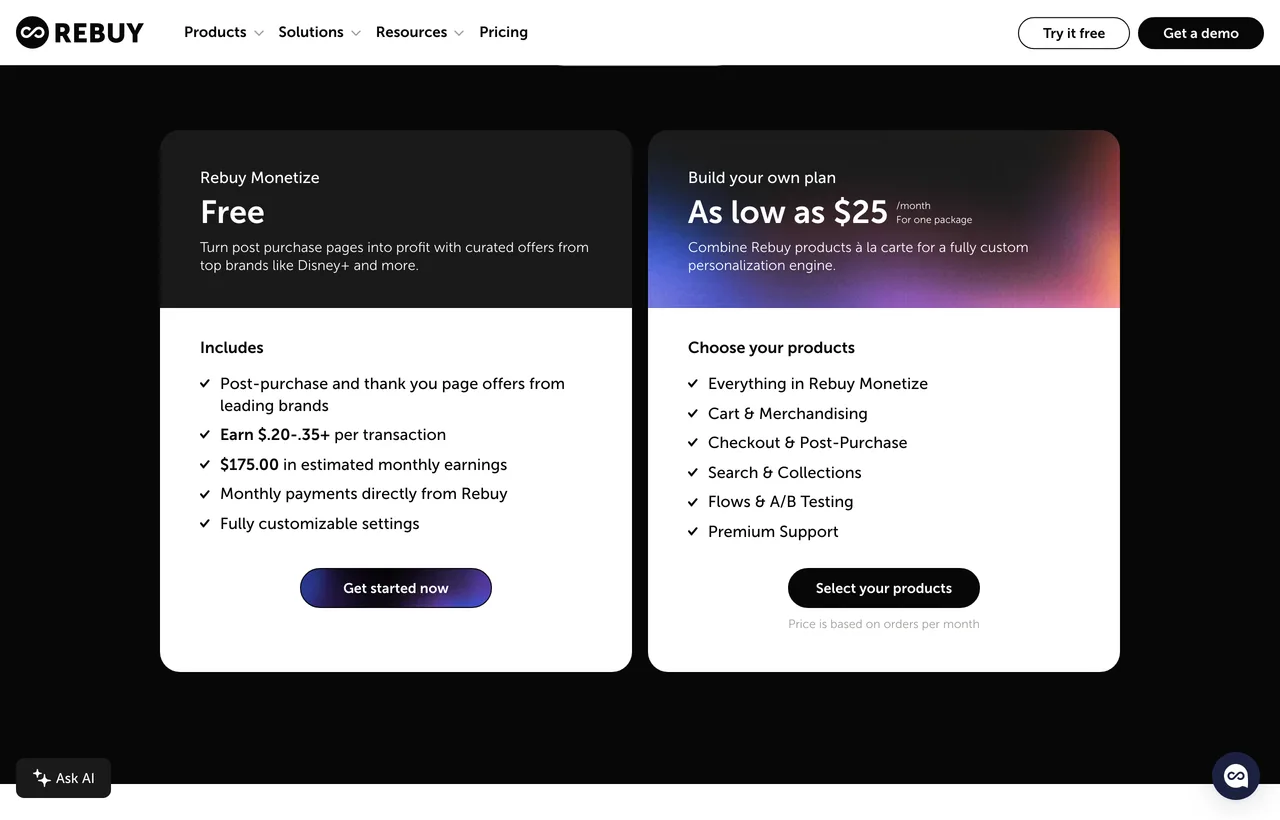
Rebuy uses Shopify's checkout, and its centre of gravity is the slide-out cart and the recommendation engine feeding it, not the post-checkout offer. That is what makes it pairable rather than redundant. 4.7 stars from 748 reviews, September 2026, listed since 23 May 2019.
- Pricing (rebuyengine.com/pricing, September 2026): Rebuy Monetize at $0/mo, which is not a plan you pay for but one that pays you: Rebuy fills your post-purchase and thank-you pages with offers from third-party brands and its pricing page advertises "Earn $.20-.35+ per transaction" back to the merchant; Build Your Own Plan from "as low as $25/month for one package," usage-priced by order tier from 250 to 50,000+ orders a month, 14-day trial; Platform One at $534/month at the 250-order baseline, scaling with volume, 30-day trial. Annual saves 10%, billing runs "on a prorated 30-day cycle (not monthly)," and Rebuy claims an ROI Guarantee.
- The packages: Cart & Merchandising, Checkout & Post-Purchase, Search & Collections, Flows & A/B Testing, with bundling advertised to save "up to 30%." Checkout Extensions are marked Plus-exclusive on Rebuy's own pricing page.
- The limits: the highest floor here at the platform tier, and usage pricing means a good month raises the bill.
- Pairs with: a dedicated post-purchase app, with one thing to check first. Build Your Own Plan is modular, so you can buy Cart & Merchandising and skip Checkout & Post-Purchase. But its own pricing page lists "Everything in Rebuy Monetize" inside every plan, and Monetize places post-purchase and thank-you offers of its own. We could not confirm whether that claims Shopify's post-purchase extension or only the order-status page. Check which app holds the slot in your admin before you count it free for Zipify OneClickUpsell or AfterSell.
7. GemPages: best for the page and the post-purchase funnel from one vendor
GemPages uses Shopify's checkout and is the only Shopify-checkout vendor here selling the page and the post-purchase funnel on one subscription. (Funnelish and ClickFunnels bundle both too, on their own checkout, which is the distinction that matters here.) It also markets "Pre-sales Pages (Advertorials & Listicles)" by name, a category most page tools don't label at all. 4.9 stars from 4,203 reviews, September 2026.
- Pricing (gempages.net/pages/pricing, September 2026): free for 1 page; Build $29/mo (promoted at $23), Optimize $59 ($47), Enterprise $199 ($159). 30-day money-back.
- The limit that matters: post-purchase upsell volume is capped at roughly $100/mo on Build, and only goes unlimited from Optimize at $59. A store doing real upsell revenue is on the $59 plan, not the $29 one.
- Pairs with: one post-purchase app, if you'd rather run a specialist there. It doesn't have to be GemPages' own.
8. UFE Upsell Funnel Engine: best for pre-purchase bundles and quantity breaks
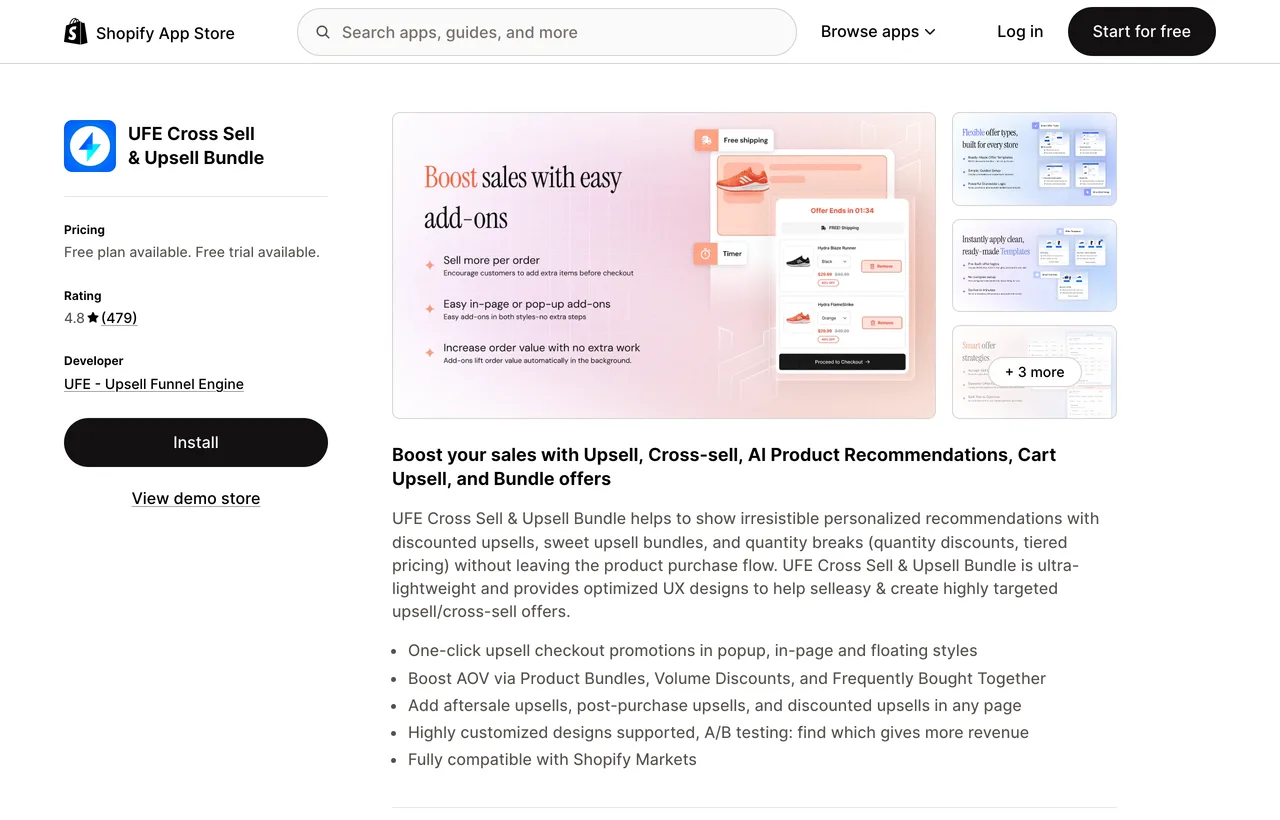
UFE Upsell Funnel Engine uses Shopify's checkout and works the stages before the sale: BOGO, volume and quantity breaks, cart offers, product-page offers. 4.8 stars from 479 reviews, September 2026, listed since 17 October 2019. The App Store lists it as UFE Cross Sell & Upsell Bundle.
- Pricing (App Store listing, September 2026): free up to 50 orders/mo; Pay Per Use $9.99/mo; Unlimited $299/mo. 7-day trial.
- Why it earns a slot mechanically: on the cart and product page it doesn't consume the post-purchase socket, which is a concrete reason to run it beside a post-purchase app rather than instead of one.
- The limits: the jump from $9.99 to $299 is steep with nothing in between. Its listing also claims "aftersale upsells, post-purchase upsells," and we could not confirm whether that runs through Shopify's post-purchase extension or a thank-you-page widget. Check it in the admin before you stack it.
- Pairs with: Zipify OneClickUpsell or another post-purchase app, on different stages.
9. ConvertFlow: best for quiz funnels and segmenting visitors before the offer
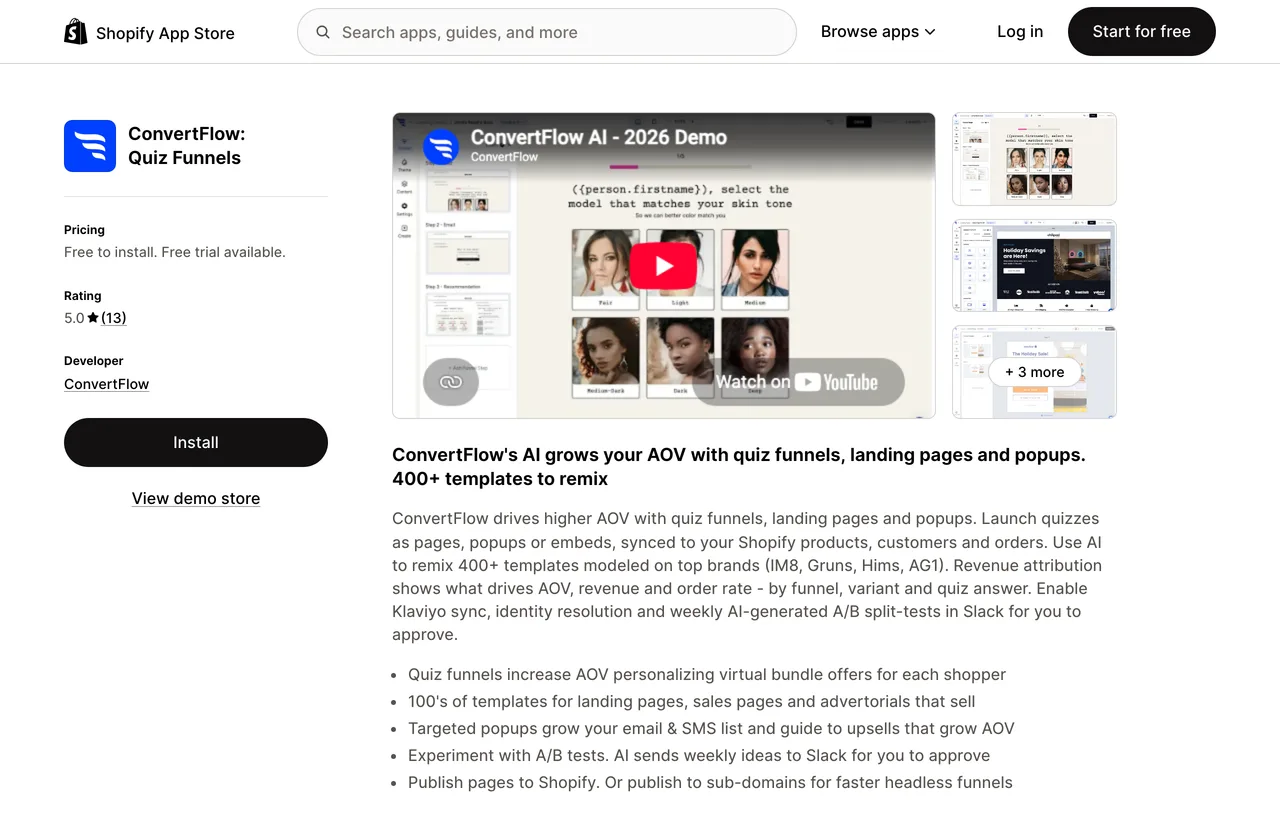
ConvertFlow is the only entry that owns the question of which offer a visitor sees: quizzes, on-site campaigns, popups, segmentation. It sits alongside Shopify's checkout without touching it.
- Pricing (App Store listing, September 2026): free for 3 campaigns; Personal $29/mo (10k views), Prime $99 (30k views, 25 campaigns), Pro $299 (100k views). 30-day trial, overage $30 per extra 10k views.
- Adoption, honestly: a real CRO platform with a light Shopify App Store footprint, at 5.0 stars from 13 reviews as of September 2026, listed since 17 December 2020. Read the rating as directional, not as evidence of scale.
- The limits: view-based pricing punishes high-traffic stores, and segmentation only earns its fee if you have distinct offers to route people to.
- Pairs with: a page tool that can produce a different pre-sell page per segment. Segmenting traffic and then sending every segment to the same page is spend without a payoff.
10. Landra: best for the pre-sell page that feeds the funnel
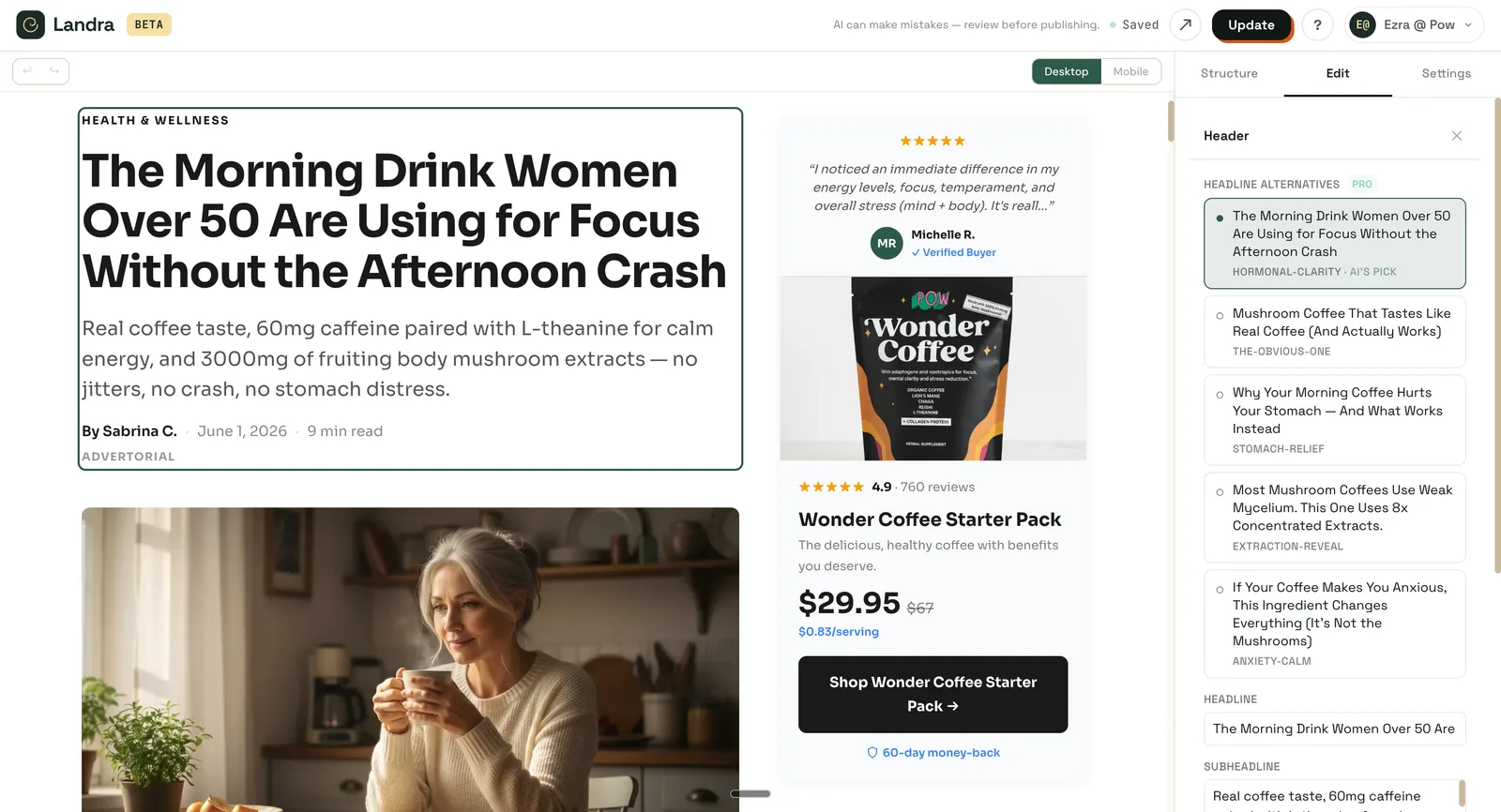
Landra is not a funnel app. It builds the page that feeds the funnel: the advertorial or pre-sell page between the ad and the offer, on Shopify's checkout (or a Landra URL, or an HTML export). You give it your product or brand URL, it analyzes your brand and products to understand what you sell and who you sell it to, then writes a fully optimized advertorial or listicle landing page: headline, section structure, long-form copy, and images, laid out in DTC conversion components rather than dropped on a blank canvas. Then a click-anything visual editor, mobile-responsive out of the box, and publishing straight to Shopify with no copy-paste step.
Said plainly, because this is a funnel roundup: Landra does not do checkout, order bumps, or post-purchase upsells. Its Shopify App Store listing is new and carries no reviews yet as of September 2026, and it never touches the post-purchase slot. If your funnel needs an offer after the sale, you pair it with one of the nine above.
- Pricing (September 2026): Starter $19/mo, Pro $79, Pro Plus $199, with a 14-day free trial. There is no free tier.
- The limits: one stage, done well. If your bottleneck is the cart or the checkout, this is the wrong purchase.
- Pairs with: any single post-purchase app, cleanly, because there is zero stage overlap.
Since we're on our own list, the bias is worth naming. Building Landra's publishing path put us at the same fork this guide is about: host the page and the checkout ourselves, or publish into the merchant's store and leave the money where it already works. We picked the second. A pre-sell page's job is to warm a cold click and hand over a decided buyer, and the moment it also owns the transaction you inherit gateway approvals, chargebacks, tax, and the terms question further down this page. So Landra publishes straight to Shopify and the merchant's checkout stays theirs. It's a design call, not a virtue, and it's exactly why Landra can't do the upsell half of this list.
Tools we left off, and why
Three names surface constantly in this search and don't belong in a Shopify stack, for three different reasons: one runs on the wrong platform entirely, one has no App Store presence to verify, and one doesn't claim a Shopify integration on its own pricing page. All three are real products. None is a Shopify funnel builder in the sense this guide uses.
- CartFlows is WordPress and WooCommerce only and does not work with Shopify. It calls itself the "#1 WordPress funnel builder" and carries 200,000+ active installs at 4.8 stars from 506 reviews as of September 2026. Enormous, and irrelevant here.
- Lightfunnels is an own-checkout platform with no Shopify App Store listing we could find in September 2026.
- CheckoutChamp is a direct-response funnel platform whose own pricing page doesn't state a Shopify integration. From $300/mo plus 1% of gross sales.
The ten compared side by side
Whose checkout a tool uses is the load-bearing column: it decides whether Shopify's post-purchase extension fires at all, and therefore whether the rest of the stack does anything. The last column is the collision warning. Three of these ten want the same single select field in your Shopify admin whatever you do; two more want it only if you buy a particular package, and one we couldn't confirm either way.
| Tool | Whose checkout | The funnel job it owns | Entry price (Sept 2026) | Wants the one post-purchase slot? |
|---|---|---|---|---|
| Funnelish | Its own | Whole funnel, own checkout | $49/mo | No (disables Shopify's) |
| ClickFunnels | Its own | Whole funnel outside Shopify | $97/mo | No (disables Shopify's) |
| Zipify OneClickUpsell | Shopify's | Upsells at every placement | $8/mo + revenue fee | Yes |
| Upsell.com ReConvert | Shopify's | Post-purchase and thank-you | $4.99/mo | Yes |
| AfterSell | Shopify's | Checkout-page and post-purchase | $34.99/mo (listing) | Yes |
| Rebuy | Shopify's | Cart and recommendations | $0 (Monetize), from $25/mo | Unclear, check your admin |
| GemPages | Shopify's | Store pages plus a post-purchase funnel | Free (1 page), then $29/mo | Only if you use its funnel |
| UFE Upsell Funnel Engine | Shopify's | Pre-purchase bundles, quantity breaks | Free (50 orders/mo), then $9.99/mo | Unconfirmed, check it |
| ConvertFlow | Shopify's | Which offer a visitor sees | Free (3 campaigns), then $29/mo | No |
| Landra | Shopify's | The pre-sell page before the offer | $19/mo (14-day trial) | No |
What Shopify lets these apps do
Most constraints in this category are Shopify's, not the vendors'. Post-purchase and thank-you offers are available on all plans; upsells on the checkout page itself are Shopify Plus only. A non-Plus store therefore has exactly three sockets to work: cart, post-purchase, thank-you. Everything below is quoted from Shopify's own developer documentation.
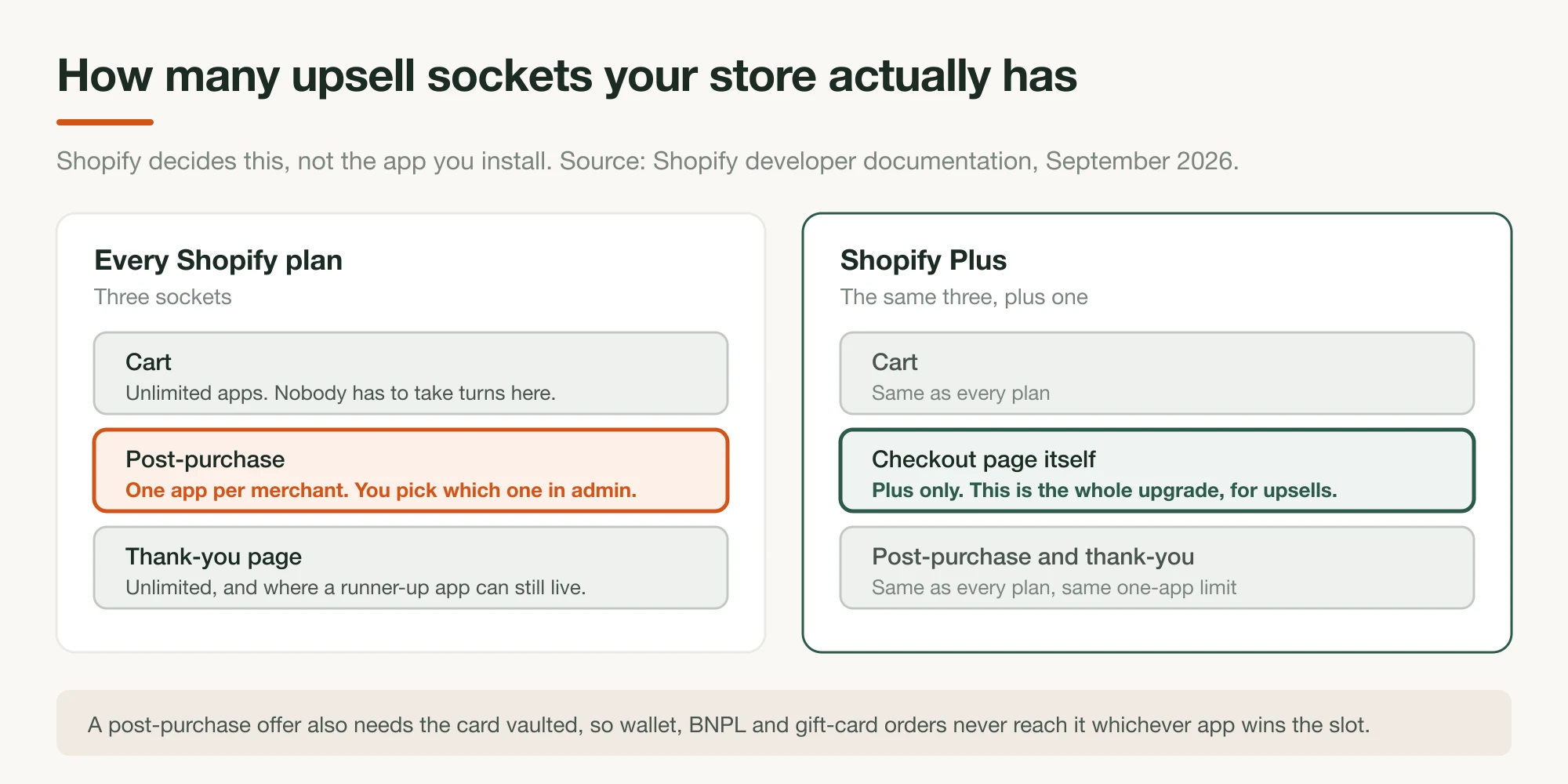
One app per merchant. From Shopify's post-purchase product offers documentation: "Only one app can be selected for post-purchase product offers. Merchants with multiple apps that have the post-purchase checkout extension need to select which app appears on the post-purchase page." Read that as a single select field in your admin. It is the thing that quietly breaks stacks.
The checkout page is Plus-only. Shopify's checkout UI extensions documentation states that "Checkout UI extensions for the information, shipping, and payment steps are available only to stores on a Shopify Plus plan." One rule, which is why AfterSell's checkout module, Rebuy's Checkout Extensions, and ReConvert's checkout upsells are all gated the same way.
Cards must be vaulted, and wallets are out. Shopify requires that "the customer's credit card must be vaulted before the post-purchase offer is displayed," and suppresses the offer when "the customer chooses to check out with an installment service or a wallet service (such as Klarna, Affirm, AfterPay, Apple Pay, Amazon Pay, or Google Pay)," or when "the initial purchase was made with a gift card or any payment method other than a credit card." Gateways requiring CVN/CVV retention are unsupported: "Braintree, Payflow Pro, PayPal Payments Pro, and Eway."
That exclusion is bigger than it reads. According to the Worldpay Global Payments Report 2026, built on a survey of more than 63,000 consumers across 42 markets, digital wallets accounted for 56% of global and 40% of US online transaction value in 2025. Read that carefully rather than subtracting it. Shopify's exclusion list names Klarna, Affirm, AfterPay, Apple Pay, Amazon Pay and Google Pay, and it doesn't name Shop Pay in either direction, so the 40% doesn't map cleanly onto your own wallet mix. Confirm the actual split against your own orders. The practical effect stands either way: a real share of your buyers never see the upsell you're paying a monthly fee for, and no app's dashboard breaks that share out for you.
Three offers, then it stops. "A customer can accept a maximum of three post-purchase offers for each checkout." And fulfillment gets held: "Shopify places a hold on fulfillment for all orders undergoing a post purchase cross-sell flow," released when the customer reaches the Order status page or "one hour after submission of the initial checkout" if they abandon. Tell your 3PL before you install if you run same-day dispatch.
It is also still labeled beta. Shopify's documentation describes post-purchase extensions as "in beta," which is worth sitting with, because it is the surface the whole upsell category is built on. The three post-purchase apps in this guide carry 4,264 App Store reviews between them as of September 2026 (ReConvert 2,846, AfterSell 916, Zipify OneClickUpsell 502), and every one of those installs depends on an extension Shopify still describes that way. The same docs record the sunset dates: checkout.liquid for in-checkout pages stopped working 13 August 2024, Thank You and Order Status support ended for Plus on 28 August 2025, and script tags on Thank You and Order Status were sunset for non-Plus stores on 26 August 2026, one week before this guide was written. If an agency hands you a funnel spec that runs on thank-you-page script tags, it's out of date.
What Shopify's terms say about an external checkout
Shopify's Terms of Service, last updated 1 August 2026, say at §4.5: "You agree to use Shopify Checkout for any sales associated with your online store."
Own-checkout platforms describe themselves as sitting alongside the store. Funnelish says it runs "either as a standalone platform or as a powerful extension of your Shopify store." ClickFunnels' Shopify integration documentation says it "will send shipping information but will not accept payment." In both cases the transaction happens on the platform and the order lands in Shopify as a record.
We could not confirm how Shopify treats that boundary in practice, and Shopify has published no guidance naming this architecture. We are not saying anyone is violating anything. We are saying this is a question with real money attached and no public answer, and that unverified is a different thing from fine. If you're about to route revenue through a checkout that isn't Shopify's while keeping a Shopify store, ask Shopify directly first, in writing.
How to combine them
Assembly comes down to two hard rules. Two Shopify post-purchase apps cannot both run, because the admin makes you pick one. An own-checkout platform and a Shopify post-purchase app cannot both run on the same order, because that order never passes through Shopify checkout. Everything else is fair.
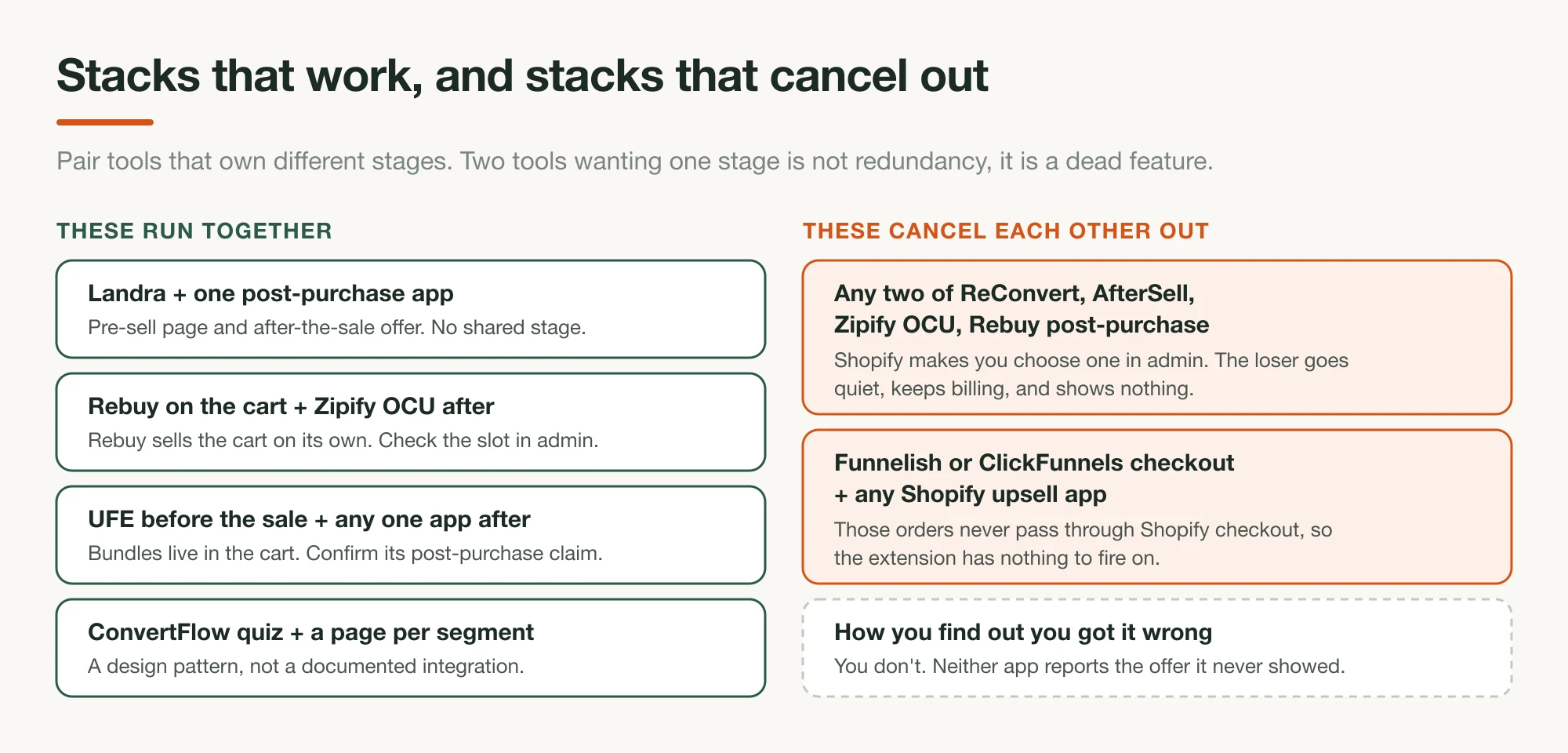
Combinations that work:
- A pre-sell page tool plus one post-purchase app. Landra or GemPages owns pre-click through add-to-cart; the upsell app owns post-checkout. The order runs through Shopify checkout, so the extension fires. Zero overlap.
- Rebuy on the cart plus a dedicated post-purchase app. Build Your Own Plan is modular, so Rebuy's cart is available without buying its Checkout & Post-Purchase package. Rebuy is not the all-or-nothing purchase most operators assume. The caveat is the one in its entry above: Monetize rides along with every plan and places its own post-purchase and thank-you offers, and we could not establish from the public documentation whether that occupies Shopify's single post-purchase slot. Treat this pairing as likely rather than proven, and confirm in the admin.
- UFE on the cart and product page plus Zipify OneClickUpsell after checkout. Different stages, no slot contention, subject to confirming UFE's own post-purchase claim in the admin.
- ConvertFlow segmenting the visitor, then a different pre-sell page per segment. Treat this as a design pattern rather than a documented integration; we verified no native connection between the two.
- Landra plus GemPages. Not a conflict. The cold-traffic advertorial or listicle in one, the rest of the store's pages in the other.
Combinations that cannot both run:
- Any two of ReConvert, AfterSell, Zipify OneClickUpsell, or Rebuy's post-purchase package. Only one gets selected. They coexist only if one holds the post-purchase extension and the other is restricted to thank-you or order-status placements.
- An own-checkout platform plus a Shopify post-purchase app on the same order. Funnelish running its own checkout, ClickFunnels, Lightfunnels, and CheckoutChamp all take the transaction out of Shopify checkout, so the post-purchase extension never fires. Operators get this wrong routinely, then file a support ticket about an upsell app that "stopped working."
What 44 real advertorial funnels did with the platform they bought
Back to the corpus from the top. Of the 44 pages we analyzed, twelve were built on Funnelish, identified by the <!-- This website was created in Funnelish --> comment left in the archived HTML. Nine of those twelve had a CTA destination recorded in our notes, and they split close to evenly:
- Funnelish as the whole funnel (CTA into a Funnelish checkout or offer step): four pages, across three brands. Zephta on two pages, Treatmedy on one, Karma Items on one.
- Funnelish as the page host only (CTA back to the brand's own Shopify product page): five pages, across two brands. Uproot on three pages, GroundingWell on two.
Read the second line carefully, because it is the one worth being pedantic about. Five of the nine ran the click back to the brand's own Shopify product page, but those five pages belong to just two brands. Nine pages across five brands shows the pattern exists. It does not size it, and we are not turning it into a rate or projecting it onto the market. What it does show is the thesis in the wild: brands paying for a platform with its own checkout, then handing the sale back to Shopify anyway.
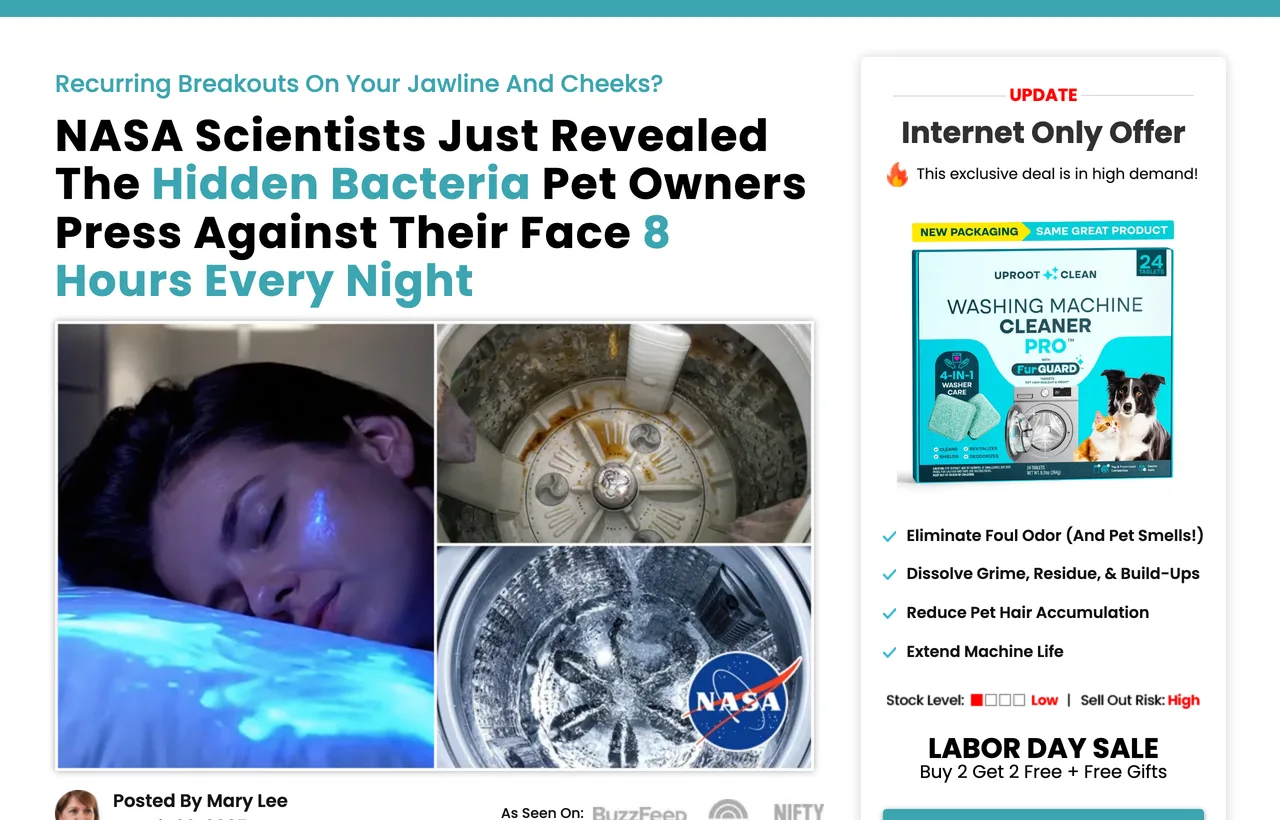
Both architectures are still live, and we re-checked where each one actually sends the click on 2 September 2026 rather than trusting the June capture. Uproot's page serves img.funnelish.com assets and every CTA resolves to uprootclean.com/products/uproot-washing-machine-cleaner-pro?click_from=funnelish — Funnelish tagging its own handoff on the way out of the funnel it sold. Karma Items' page at go.karmaitems.com/expert-healer-secret-adv is also Funnelish, and its CTAs resolve to go.karmaitems.com/tibetan-bracelet-of-fortune, a Funnelish offer step. Same platform, opposite decisions about who takes the money.
One honest note on the Uproot page: the creative has rotated since our June capture. The URL and the architecture are unchanged, but the headline running today is a pet-hair and skin angle rather than the washing-machine angle we archived. Advertorials get re-cut constantly, which is the point of testing them, and it is why the screenshot above is dated.
What the upsell numbers actually prove
Less than the category implies. There is no independent, audited figure for post-purchase upsell AOV lift. Every number quoted in this space traces back to a vendor's own merchant base, including the ones formatted to look like research. Two figures that circulate widely in funnel-builder roundups have no primary source we could locate at all: a 20% average-order-value lift attributed to a McKinsey ecommerce revenue report, and a study said to cover 1,847 businesses attributed to Focus Digital. We looked for both and found only secondary blogs citing each other. If you see either quoted at you, ask where it came from.
That is not an argument against upsell apps. The mechanics are sound: the customer has already paid, a second decision costs them almost nothing, and the incremental order costs you no ad spend. It's an argument against buying one because a roundup quoted a percentage at you. Run the offer for a month and read your own numbers, which will be the only figure in this category anyone has actually audited. Note what the two independent figures on this page are doing. Baymard's 70.22% measures the problem. Worldpay's wallet share measures a constraint on the fix. Neither one measures the fix working, and nobody has published a figure that does.
How to choose
Pick by the stage that is costing you money, then check for collisions. That is the whole method, and it deliberately produces a different answer per store instead of a winner. A store bleeding cold traffic at the pre-sell page and a store with flat AOV after checkout should not end up buying the same tool. If you can't yet name which stage is costing you, start with the process guide instead of the parts catalogue: how to build an ecommerce sales funnel for paid traffic walks all five stages and the number to read at each one.
- The pre-sell page is your bottleneck (cold traffic bouncing off the product page): Landra if you want the finished, optimized advertorial or listicle produced for you and published into Shopify; GemPages if you want the page and a post-purchase funnel on one bill. Start with the pre-sell page format, and the native ad funnel breakdown if your traffic comes from Taboola or Outbrain.
- The cart is your bottleneck (add-to-carts that don't grow): Rebuy for recommendations, UFE for bundles and quantity breaks.
- AOV after the sale is your bottleneck: one post-purchase app, and only one. ReConvert for the widest adoption of the three, Zipify OneClickUpsell for the most placements, AfterSell if you're on Plus and want the checkout page too.
- The checkout itself is your bottleneck (you need order bumps and a flow Shopify won't give you): Funnelish at $49/mo or ClickFunnels at $97/mo, with the terms question settled first and the order-fragmentation cost priced in.
- You don't know which visitors want which offer: ConvertFlow to segment, then a distinct page per segment.
Then run the collision check before installing anything. Count how many tools on your shortlist want Shopify's single post-purchase slot. If the answer is more than one, one of them is about to be an expensive no-op.
Frequently asked questions
What is a Shopify funnel builder?
A Shopify funnel builder is any tool that shapes the path from ad click to repeat order: the pre-sell page before the product page, offers in the cart, upsells inside checkout, and the one-click offers that run after the customer pays. Some are Shopify App Store apps that work with Shopify checkout. Others are standalone platforms that host their own checkout and sync the orders back into Shopify as records.
Can you run two post-purchase upsell apps on Shopify at once?
No. Shopify's developer documentation states that only one app can be selected for post-purchase product offers, and a merchant with several installed has to pick which one appears. Two can coexist only if one holds the post-purchase slot and the other is restricted to thank-you or order-status placements.
Do I need Shopify Plus for checkout upsells?
For upsells on the checkout page itself, yes. Shopify's checkout UI extensions documentation limits extensions on the information, shipping, and payment steps to stores on a Shopify Plus plan. Post-purchase and thank-you page offers are available on all plans, which is why a non-Plus stack works the cart, the post-purchase page, and the thank-you page instead.
Is it against Shopify's terms to use an external checkout like ClickFunnels or Funnelish?
We can't tell you. Shopify's Terms of Service say you agree to use Shopify Checkout for any sales associated with your online store. Funnel platforms host checkout on their own domain and sync orders into Shopify as records, and Shopify has published no guidance naming that architecture. We could not confirm how Shopify treats the boundary in practice. Ask Shopify directly before you route revenue through it.
What is the best Shopify funnel builder?
There isn't one, and picking by ranking is how stacks end up colliding. Pick by the stage that is actually costing you money: the pre-sell page, the cart, the post-purchase slot, or the whole checkout. Then check that your shortlist doesn't contain two tools that both want Shopify's single post-purchase socket.
How much do Shopify funnel apps cost?
As of September 2026 the range is wide. Post-purchase apps start in single-digit dollars per month and scale with order volume or upsell revenue (Zipify OneClickUpsell from $8/mo, Upsell.com ReConvert from $4.99/mo, AfterSell from $34.99/mo on its App Store listing). Own-checkout platforms start higher: Funnelish $49/mo, ClickFunnels $97/mo. Page tools run $19 to $199/mo.
Why don't my post-purchase offers show for some customers?
Shopify's documentation lists the exclusions. The card has to be vaulted, so orders paid with a wallet or installment service (Apple Pay, Google Pay, Amazon Pay, Klarna, Affirm, AfterPay), a gift card, or any non-credit-card method never see the offer. Several gateways are unsupported too (Braintree, Payflow Pro, PayPal Payments Pro, Eway). Note what the list does not say: Shop Pay is named neither as excluded nor as supported, so check your own order data before assuming which of your wallet payments are affected.