

The most powerful general-purpose builder isn't automatically the best landing page builder for agencies. A tool can offer impressive design control and still slow delivery through complex workspaces, unclear publishing ownership, limited testing, or a poor client handoff.
Agencies should judge platforms against the workflow they sell. That means comparing production speed, client and workspace management, reusable systems, publishing flexibility, traffic and testing limits, design control, and page type. A DTC performance team building advertorials for cold social traffic has different needs from a SaaS agency matching paid search ads to segmented experiences, and both differ from a web studio maintaining high-fidelity client sites.
Dedicated campaign platforms such as Instapage and Unbounce prioritize paid-media experimentation. Landingi, Duda, and Wix Studio emphasize agency operations. Webflow gives design teams deeper control, while Shogun is built around Shopify commerce. Leadpages and Swipe Pages focus on efficient campaign deployment. Landra is the specialist option for AI-generated DTC pre-sell pages, not a universal replacement for broader web platforms.
The roundup applies the same practical lens to all ten tools. Agencies can also use Receiver's guide to landing-page conversion optimization when defining the conversion goal before choosing a platform.
Table of Contents
- 1. Landra
- 2. Instapage
- 3. Unbounce
- 4. Leadpages
- 5. Swipe Pages
- 6. Landingi
- 7. Webflow
- 8. Duda
- 9. Wix Studio
- 10. Shogun for Shopify
- Top 10 Landing Page Builders for Agencies, Feature Comparison
- Choose by Bottleneck, Not by Feature Count
1. Landra
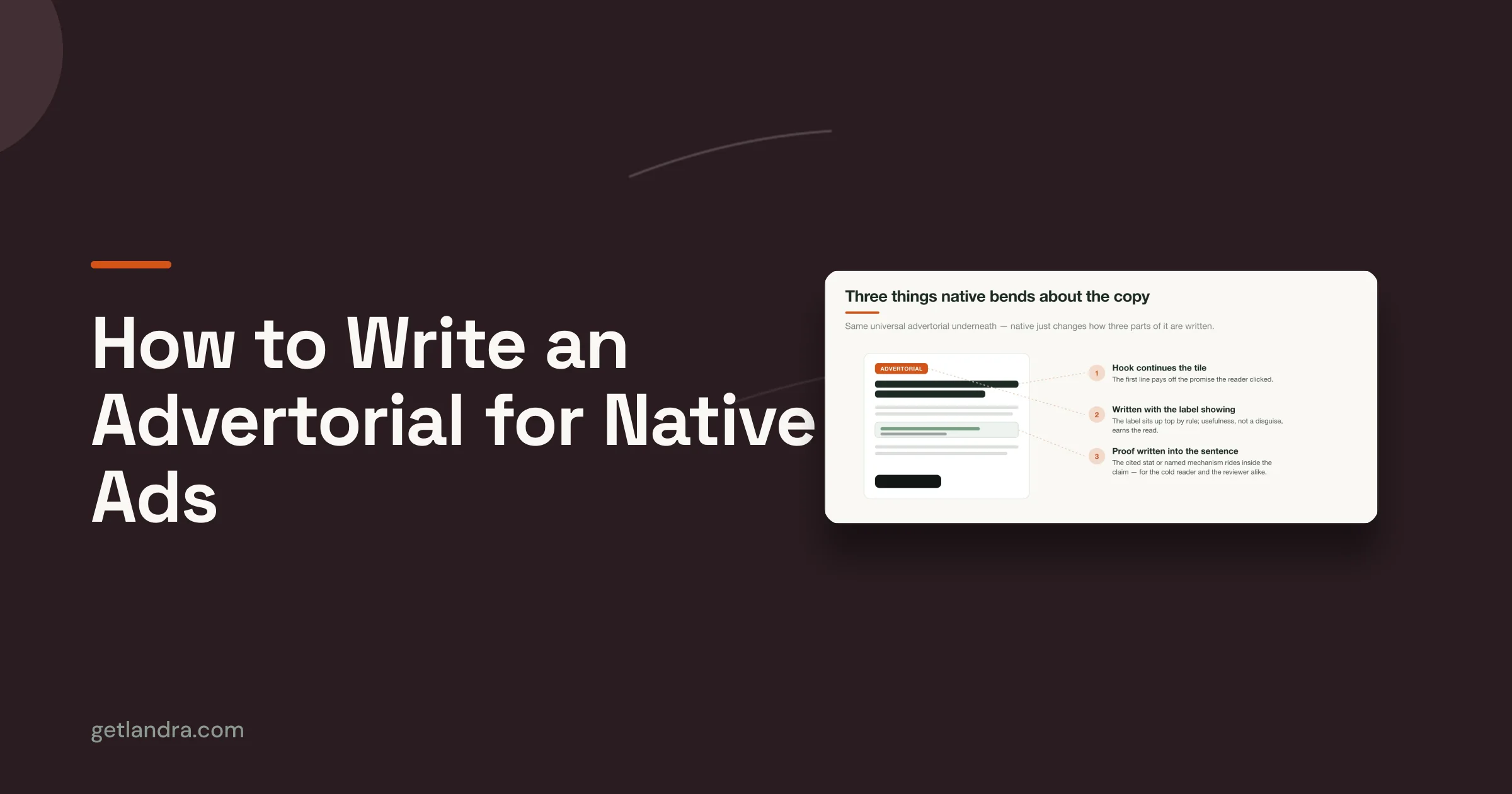
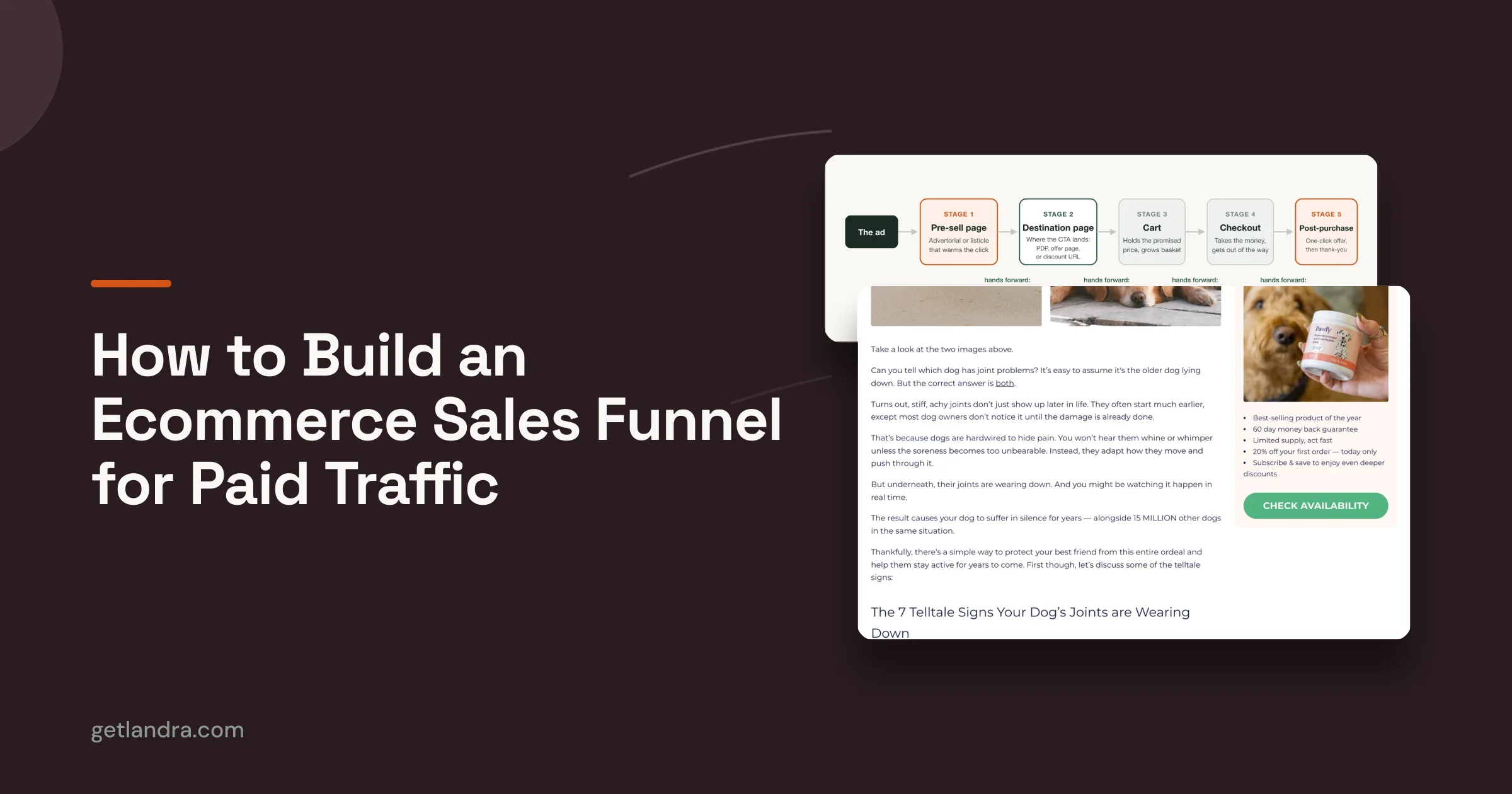
Landra is the strongest fit when an agency needs to turn a DTC product into a usable pre-sell experience quickly. The workflow starts with a product or brand URL. Landra analyzes the available brand context, including product information, proof, reviews, voice, and ingredients, then generates an editable advertorial, listicle, or presell page designed for a direct-response campaign.
The practical advantage is speed. A page can be generated and prepared for publishing in under five minutes, with outputs available through Shopify, a Landra-hosted URL, Webflow, or HTML export. That gives an agency options when the client wants to keep the existing storefront, publish outside the store, or hand the asset to a developer.
Best agency use: Rapidly producing and testing DTC advertorials, listicles, and warm-up pages for paid social traffic.
The visual editor keeps the team in control. Copy, headlines, images, sections, and structure can be edited inline, while saved brand context, headline options, duplication, and AI rewriting support repeatable production. Pro users also get AI image generation. Free tools such as the Headline Analyzer, Conversion Rate Calculator, and Advertorial Compliance Checklist add useful pre-launch checks without requiring another platform.
Where Landra fits, and where it doesn't
Landra is not a full replacement for a high-touch creative process. A client that needs a bespoke design system, complex integrations, or a complete marketing site may be better served by Webflow or a custom build. Agencies should also review generation, storage, and feature limits across Starter, Pro, and Pro Plus before committing to high-volume delivery.
Landra's own materials cite 2–3× higher conversion than standard product pages and a first-party comparison reporting a 46% reduction in CAC when the same ads ran to a Landra advertorial instead of a product detail page. Those are product-reported claims, not independent benchmarks, so agencies should validate them with the client's own traffic, offer, attribution, and compliance setup.
For teams serving Shopify and Webflow merchants, Landra's narrow focus is its advantage. It removes much of the copy, structure, and layout work from the first draft while preserving editorial control and multiple publishing paths. Visit Landra for the platform and current plan details.
2. Instapage
Instapage is designed for agencies whose operating model revolves around paid-media alignment and structured experimentation. Its strongest workflow connects the ad, audience, and landing-page experience rather than treating the page as an isolated asset.
AdMap helps teams connect Google Ads campaigns with the intended landing pages, while ad-to-page personalization supports different experiences for audiences or messages. Experience Manager and Collections are useful when an agency needs to create related page variants without rebuilding every component from scratch. Reusable blocks also support production consistency across campaigns and clients.
Collaboration and experimentation
Instapage suits larger teams that need a visible review process. Visual collaboration and commenting let strategists, designers, copywriters, and clients review work inside the page workflow instead of scattering feedback across email and project-management tools. Its testing and optimization capabilities make it a natural choice for agencies that manage ongoing CRO rather than one-off campaign launches.
That depth creates a trade-off. Higher-tier pricing is sales-led and quote-based, which makes budgeting less straightforward for smaller agencies or teams with irregular client volume. The platform can also be excessive for a simple lead-generation page that needs a quick launch, basic tracking, and a straightforward handoff.
Agencies should buy Instapage for the relationship between paid media, personalization, collaboration, and testing, not merely for its visual editor.
Instapage is a better fit when the agency has enough campaign complexity to use those systems consistently. If the work is primarily DTC pre-sell production, a specialist workflow may be faster and easier to operate. Compare the two approaches in this Instapage vs Landra comparison, especially if client pages must move between a campaign tool and an existing commerce stack.
Explore Instapage when the agency needs enterprise-oriented paid-media operations and can support a sales-led buying process.
3. Unbounce
Unbounce remains a practical choice for paid-traffic agencies that want a familiar landing-page and testing workflow. Its central operating idea is simple: create page variants, send traffic to them, and use optimization tools to improve the chance that visitors see the stronger experience.
Smart Traffic routes visitors toward better-performing variants after the system has enough activity to make a routing decision. The feature is useful for agencies managing several messages or layouts at once, although it shouldn't replace a clear testing hypothesis. Teams still need to define what changed, which audience saw it, and whether the result matters to the client's actual business goal.
The agency packaging question
Unbounce supports landing pages alongside popups and sticky bars, which helps agencies manage the broader click-to-conversion experience without adding another page tool. Paid tiers support unlimited pages, while visitor and domain allowances vary by plan. That distinction matters for agencies because page volume and traffic volume don't always grow together.
A low-page-volume account with heavy paid traffic can reach a limit sooner than expected. Conversely, an agency running many small campaigns may care more about page, domain, and client organization than raw visitor capacity. Agency and Concierge packages are intended for larger operations, but pricing is quote-based, so the buying conversation should include expected campaign volume and account structure.
The platform is less compelling when the agency only needs a fast, content-led DTC pre-sell page. It becomes more attractive when CRO is a retained service and the team needs a repeatable testing environment.
Use Unbounce when paid-media experimentation is central to delivery. For teams comparing a mature CRO platform with a DTC-focused workflow, review these Unbounce alternatives for DTC brands before choosing based on reputation alone.
4. Leadpages
Leadpages makes a strong operational case for agencies that want public pricing and predictable traffic planning. Its plans include unlimited traffic, which removes one common budgeting variable for campaigns that may scale unevenly. That doesn't eliminate every limit, but it makes forecasting easier when an agency manages paid campaigns whose visitor volume can change quickly.
A/B testing begins at the Grow tier, while Optimize adds Smart Traffic and heatmaps. Scale adds more agency-oriented capacity and full auto-optimization. Dynamic text replacement and lead enrichment help teams maintain message relevance when the same basic page serves different campaigns or audiences.
Straightforward deployment with tier boundaries
The platform's value is less about extreme design freedom and more about shipping conversion-focused pages without a sales-led procurement process. Agencies can standardize a workflow around templates, testing, and page deployment, then choose a tier based on how much optimization the account requires.
The limitations are important. Team seats and workspaces are reserved for higher tiers, so agencies should confirm whether the selected plan supports the intended client permissions. HTML Publisher also excludes testing and heatmaps until the account is upgraded, which can create a mismatch between the preferred publishing method and the preferred optimization workflow.
Leadpages is a good fit for agencies that need many campaign pages and don't want traffic caps complicating client proposals. It is less suited to teams requiring deep commerce-native page control or highly bespoke design systems.
Procurement check: Confirm whether the publishing option you want includes the testing and analytics features your retainers promise.
Leadpages can also work alongside a content-first pre-sell process. Teams creating ranked editorial pages may find an AI listicle generator useful before bringing the finished concept into a broader campaign workflow. See Leadpages for current plans and feature availability.
5. Swipe Pages
Swipe Pages is built around speed, mobile delivery, and paid-campaign execution. AMP support and CDN hosting make it relevant to agencies whose traffic comes largely from mobile ads and paid search. The platform also includes server-side A/B testing and dynamic text replacement, so the team can test page experiences without relying only on visual changes.
Its agency structure is one of the clearest reasons to shortlist it. Agency plans provide client sub-accounts, roles, and support for multiple custom domains. Global scripts and reusable blocks help the production team carry tracking and proven components across accounts without manually recreating them.
Strong mobile workflow, smaller ecosystem
Swipe Pages makes sense for a paid-social or PPC agency that values rapid deployment and a lightweight account structure. The page builder doesn't need to be the center of a full website operation. It can function as a focused delivery layer for campaign pages, particularly when the client wants the agency to manage publishing and testing.
Traffic allowances still require attention. Heavy campaigns can create overage exposure, so an agency should model expected traffic before placing a high-volume account on an Agency plan. The ecosystem is also smaller than that of longer-standing competitors, which may affect integrations, internal familiarity, or client comfort during handoff.
The platform's performance orientation doesn't automatically solve message mismatch. A fast page with the wrong offer or weak ad continuity can still underperform. Agencies should pair the technical setup with clear campaign-specific copy and a defined conversion event.
Explore Swipe Pages if mobile speed, client sub-accounts, and reusable paid-media assets matter more than broad website functionality.
6. Landingi
Landingi is a strong candidate for agencies that need administration to scale alongside page production. Its Agency Hub includes client sub-accounts, agency branding, user management, audit logs, and organizational controls. Those features address a problem that visual builders often underplay: keeping multiple clients, collaborators, permissions, and publishing assets separated.
The distinction between entry plans and agency functionality matters. Agency features begin at Scale, so a small team may need to upgrade before it can use the account structure that makes the platform attractive in the first place. Traffic and domain limits can also create additional charges when client activity exceeds the selected plan.
A management-first choice
Landingi supports the practical components of campaign delivery, including reusable page structures, forms, integrations, API access, and AI credits through plan-based allowances. The agency can create a client workspace, assign access, maintain branding, and preserve a record of changes. Audit logs are particularly useful when several people touch a live campaign or when a client asks who changed a page.
That operational depth doesn't make it the best choice for every page type. A DTC team producing editorial pre-sell pages may value generation speed more than account administration. A design studio seeking precise visual systems may find Webflow more flexible. Landingi sits between those extremes, with a clear emphasis on managed multi-client production.
Agencies should test the full approval and handoff path, not just the editor. Confirm whether clients can access the right assets, whether domains are allocated cleanly, and whether the plan supports the number of collaborators who will review campaigns.
Visit Landingi when client separation, auditability, and structured agency administration are core requirements.
7. Webflow
Webflow is the strongest option in this list for agencies that treat landing pages as part of a broader design system. Its visual environment supports high-fidelity marketing pages, CMS-driven content, reusable components, and built-in publishing. Agencies can build a campaign page, then extend the same system into a microsite or a larger marketing experience without changing platforms.
Workspace roles, guest access, and Freelancer or Agency setups support client collaboration. That makes Webflow useful when the client expects a polished review process and eventual ownership transfer. The agency can keep design and content standards centralized while giving the client controlled access to the relevant project.
Control creates implementation work
Webflow's strength is also its cost in time. A page that would take minutes in a specialist campaign tool can require more setup, responsive decisions, CMS planning, and QA in Webflow. That isn't a weakness for a design-led agency, but it can be inefficient for a team testing many low-longevity ad concepts.
Pricing and seat structure can become complex across multiple sites and collaborators. Agencies should map who owns each Workspace, who pays for site plans, and how a client receives the finished site. They should also confirm current limits and features, particularly because Webflow's 2026 product structure includes updated site plans, Workspace capabilities, and AI credits.
Choose Webflow when the page must belong to a durable design system. Choose a specialist campaign tool when the page mainly exists to test an offer quickly.
Webflow is also a useful publishing destination for tools that generate campaign pages outside a traditional web workflow. For agencies balancing speed with brand control, that distinction can prevent overbuilding.
See Webflow when pixel-level control, CMS capability, and a professional handoff matter more than the shortest possible launch path.
8. Duda
Duda is built for agencies that deliver managed web presences, not just isolated campaign pages. Its white-label editor, dashboards, client portal, branded emails, and multi-site controls keep the agency visible throughout the client experience. Roles, permissions, and status tags support a production team handling several sites and review stages at once.
That operating model suits agencies that bundle hosting, maintenance, and ongoing page work. Reusable sections help standardize builds, while the AI Stack can accelerate parts of site creation and optimization. The agency can keep a common production method across clients without exposing the underlying vendor relationship.
White-label depth depends on plan
Duda's strongest white-label capabilities sit on higher plans, so agencies should distinguish between a platform that permits branded pages and one that supports a fully branded client operation. Pricing varies by plan and scale, and add-ons may apply. The right comparison isn't just monthly software cost. It's whether the client portal, branded communication, permissions, and site management justify the operating model.
Duda is less focused on specialized landing-page experimentation than Instapage or Unbounce. Agencies that need advanced paid-media testing may need additional analytics or optimization tools. Teams that already use Duda for client websites, however, can benefit from keeping campaign pages in the same environment.
The platform works best when the agency sells a continuing service. For a one-off advertorial or a short-lived paid-social test, its broader site-management structure may add more process than value.
Explore Duda if white-label client operations, managed hosting, and multi-site administration are central to the agency offer.
9. Wix Studio
Wix Studio combines visual site building with agency workspace operations. Its centralized dashboard covers client sites, billing, subscriptions, support, and reports, while built-in CRM tools and collaboration features reduce the need to assemble a separate client-management layer around every project.
That makes Wix Studio attractive to agencies that want one environment for multiple sites and client relationships. A companion mobile app also supports monitoring and support away from a desk. For an agency owner or account team, that can simplify routine oversight, although it doesn't replace a proper campaign measurement process.
A broad platform with variable costs
Wix Studio isn't a dedicated landing-page testing platform. It is better understood as a professional web environment that can produce campaign pages within a larger site operation. Agencies can use it for branded marketing pages, supporting content, and client sites, but teams seeking mature ad-to-page experimentation may prefer Instapage or Unbounce.
Pricing depends on each site's plan and apps rather than one flat agency price. That can make client profitability harder to model when projects use different site requirements or add-ons. White-labeling is also less granular than on platforms designed specifically for resellers.
The platform is a sensible fit when client management and web presence matter as much as campaign-page speed. It is less efficient when the agency needs to generate and test many narrow landing-page concepts with minimal site overhead.
Review Wix Studio if centralized client operations, CRM, billing, and multi-site collaboration are more important than a specialized CRO workflow.
10. Shogun for Shopify
Shogun is the commerce-specific choice for agencies working inside Shopify. Its visual builder supports landing pages, product pages, collection pages, blog content, and reusable sections. That range lets an ecommerce team connect campaign production with merchandising instead of maintaining a separate page system outside the storefront.
Shopify-native publishing is the key operational advantage. Agencies can create campaign experiences in the same commerce environment that handles products and collections, then use scheduling, analytics, templates, and content syncing where the selected tier supports them. Higher tiers add capabilities such as unlimited pages and advanced CMS or custom-code access.
Best for storefront-centered delivery
Shogun is a good fit when the client wants the agency to work directly within Shopify and when campaign pages need to interact with catalog content. A team can move from a landing page to a product page or collection experience without rebuilding the commerce connection elsewhere.
The limitation is equally clear. Shogun is strictly Shopify-focused, so it is less useful for agencies serving clients across Webflow, custom storefronts, and other platforms. Higher-tier features may also be necessary for agencies that need broad page volume, advanced content operations, or custom code.
Shogun doesn't replace a dedicated pre-sell generator when the agency needs a narrative advertorial or listicle drafted from a product URL. It does provide a strong destination for commerce teams that want visual control while preserving Shopify-native workflows.
Visit Shogun when Shopify publishing, catalog management, and DTC merchandising are the agency's primary constraints.
Top 10 Landing Page Builders for Agencies, Feature Comparison
| Product | Core features (✨) | Performance & quality (★) | Pricing / value (💰) | Best for (👥) |
|---|---|---|---|---|
| 🏆 Landra | ✨ AI advertorial, listicle & presell generators; visual inline editor; Shopify/Webflow/HTML publishing; saved brand context; AI images (Pro) | ★★★★★ Mobile‑first, <5‑min pages; 2–3× conv vs PDP; 46% CAC reduction (first‑party) | 💰 Starter/Pro/Pro‑Plus; 14‑day trial + first page free; far cheaper & faster than agencies | 👥 DTC Shopify/Webflow merchants, performance teams, small agencies |
| Instapage | ✨ 1:1 ad‑to‑page personalization, Experience Manager, AdMap, collaboration | ★★★★ Best‑in‑class ad‑to‑page mapping; mature A/B & experimentation | 💰 Enterprise‑leaning, sales‑led pricing (higher cost) | 👥 Enterprise paid‑media teams & agencies |
| Unbounce | ✨ Smart Traffic AI routing, A/B testing, popups & sticky bars | ★★★★ AI traffic routing, strong CRO features | 💰 Tiered pricing; agency/concierge quote tiers; caps on lower plans | 👥 Paid‑traffic agencies and CRO teams |
| Leadpages | ✨ Unlimited traffic, A/B testing, heatmaps, dynamic text replacement | ★★★★ Fast deploys, clear CRO tiers | 💰 Public pricing; good value for volume campaigns | 👥 Small teams, marketers needing quick rollouts |
| Swipe Pages | ✨ AMP + CDN hosting, server‑side A/B, agency sub‑accounts, global blocks | ★★★★ Speed‑first for mobile/paid social | 💰 Agency plans generous but watch for overages on heavy campaigns | 👥 PPC/paid‑social agencies focused on mobile performance |
| Landingi | ✨ Agency Hub: client subaccounts, white‑label, user mgmt, API | ★★★ Scales for multi‑client operations | 💰 Flexible plans + add‑ons; extra charges possible beyond limits | 👥 Agencies managing many clients and resellers |
| Webflow | ✨ Pixel‑level design & CMS, workspace roles, component reuse | ★★★★ High‑fidelity pages; stronger design control (heavier setup) | 💰 Complex seat/site pricing; good for design‑led projects | 👥 Agencies needing brand‑accurate marketing pages |
| Duda | ✨ Full white‑label editor, multi‑site dashboard, AI build tools | ★★★ Agency‑centric with strong client/seat management | 💰 Tiered pricing; some white‑label on higher plans | 👥 Agencies standardizing builds & reselling hosting |
| Wix Studio | ✨ Centralized client dashboard, billing, CRM, mobile app | ★★★ All‑in‑one client management; easy monitoring | 💰 Per‑site plan pricing; less granular white‑label | 👥 Agencies wanting integrated billing & CRM |
| Shogun (Shopify) | ✨ Shopify‑native visual builder, global sections, analytics & scheduling | ★★★★ Deep Shopify integration; speeds testing & merchandising | 💰 App/tier pricing on Shopify; advanced features on higher tiers | 👥 Shopify merchants and ecommerce agencies |
Choose by Bottleneck, Not by Feature Count
A landing page builder for agencies should solve the part of delivery that currently consumes the most time or creates the most risk. A long feature list doesn't tell you whether the platform will separate client workspaces correctly, publish where the client needs it, or let the team test without unexpected limits.
Use the following matrix as a workflow shortlist:
- Fast DTC advertorials and pre-sell tests: Choose Landra when the agency needs URL-to-page generation, editable direct-response structure, and publishing to Shopify, Webflow, a Landra URL, or HTML.
- Mature paid-media experimentation: Choose Instapage or Unbounce when ad-to-page alignment, personalization, A/B testing, and optimization are central to the retainer.
- Transparent pricing and uncapped traffic: Choose Leadpages when public plan information and unlimited traffic are more valuable than deep custom commerce functionality.
- Mobile speed and focused campaign delivery: Choose Swipe Pages when AMP, CDN hosting, sub-accounts, and paid-social performance are the main requirements.
- Structured multi-client administration: Choose Landingi when sub-accounts, agency branding, permissions, audit logs, and organizational controls justify an agency-tier plan.
- Design systems and high-fidelity builds: Choose Webflow when the landing page needs to become part of a durable CMS, component, or brand system.
- White-label client operations: Choose Duda for managed, branded web delivery, or Wix Studio when client billing, CRM, support, and multi-site management should sit in one workspace.
- Shopify-native merchandising: Choose Shogun when the agency needs to create campaign, product, collection, and content pages inside Shopify.
The market context supports treating this category as infrastructure rather than a minor campaign add-on. One 2026 estimate values the landing-page-builder market at USD 0.7 billion in 2025, projects about USD 0.8 billion by the end of 2026, and forecasts a 14.3% CAGR from 2026 to 2036, reaching roughly USD 3.1 billion by 2036. The same estimate gives all-in-one website designing platforms a projected 64.0% share, which reinforces the appeal of workflows that combine creation, publishing, and iteration. See the Future Market Insights landing-page-builder analysis for the source and methodology.
Independent conversion data explains why agencies should evaluate the page experience separately from the homepage or product page. Unbounce's 2024 benchmark analyzed 41,000 landing pages and 464 million visits, reporting a 6.6% median landing-page conversion rate. Its supporting analysis reports that email traffic converted at 19.3%, while performance varied by channel, industry, and device. Those figures shouldn't become a promise for any individual client, but they show why message match and dedicated campaign pages deserve their own testing process. Review the Unbounce Conversion Benchmark Report before setting internal targets.
A separate market estimate valued the category at USD 527.60 million in 2023 and projects USD 1.45 billion by 2030, with a 15.56% CAGR from 2024 to 2030. That forecast points to expanding demand for repeatable production systems, but agencies should still prioritize workflow fit over category growth. The figures come from Virtue Market Research's market report.
User satisfaction also varies across products. An independent analysis of nine landing-page builders found an average satisfaction rate of 82%, with the highest product at 93% and the lowest at 65%. That spread is a useful warning against assuming interchangeable editors. Editing speed, template quality, client access, and iteration friction can determine whether a platform works in daily agency operations. Read the customer-feedback analysis of landing-page software as one input, not as a substitute for testing your own workflow.
Before buying, validate the details that affect delivery:
- Publishing destinations: Confirm whether the platform supports the client's domain, Shopify, Webflow, HTML, or another required output.
- Traffic and testing limits: Check visitor allowances, overages, conversion caps, A/B testing access, and whether optimization features are restricted by tier.
- Seats and permissions: Test how clients, freelancers, strategists, and developers receive access without seeing unrelated accounts.
- Reusable assets: Verify whether templates, blocks, scripts, brand context, and variants can move across campaigns or remain trapped in one workspace.
- Handoff expectations: Decide who owns the page, domain, analytics, tracking scripts, and billing after launch.
- Measurement requirements: Map the conversion event, attribution setup, and reporting responsibility before comparing visual features.
Use a structured feature comparison scoring approach, then run a practical shortlist process. First, identify the page type, whether it's an advertorial, listicle, lead-generation page, paid-search variant, storefront page, or broader microsite. Next, map the agency workflow from brief to draft, review, approval, publishing, testing, reporting, and handoff.
Finally, test one representative campaign in the leading tools. Measure not only conversion performance, but also production time, revision cycles, client access, publishing friction, tracking reliability, and the team's ability to create the next variant. The best choice is the platform that removes your actual bottleneck without creating a new one somewhere else.
Landra turns a product or brand URL into an editable, mobile-first advertorial, listicle, or presell page for DTC campaigns, with publishing options for Shopify, Webflow, a Landra URL, and HTML. If rapid pre-sell production is your agency's bottleneck, visit Landra and test the workflow against one real client campaign.