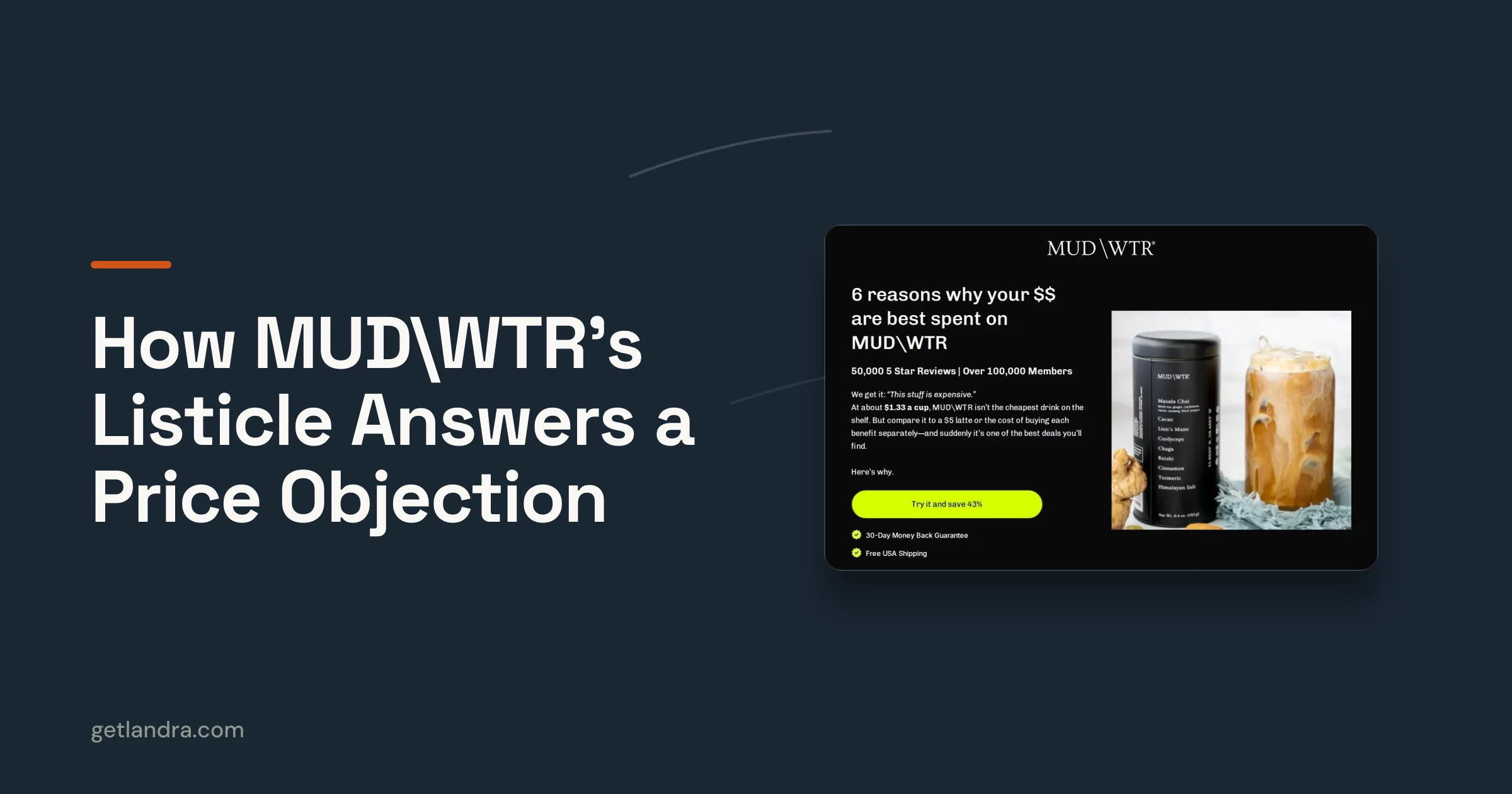
I ran paid ads for Pow, my functional matcha and coffee brand, for five years. Ads can be relatively cheap and easy to produce, but landing pages are extremely difficult to get right.
Supplement brands have one more problem on top of that. Meta's rules for health products are stricter than for almost anything else you can sell on Facebook, and Meta can check the page, not just the ad. So for supplements, the landing page has two jobs. It has to sell, and it has to stay inside the rules.
I read Meta's current policy pages on 27 Oct 2026. This post goes through what they say, how each rule shows up on a landing page, and what the page needs to do the selling.
Does Meta check the landing page for supplement ads?
It can. Meta's help page About ads in review lists what its review may include, and one item is "Ad destination (where an ad directs people, such as a Facebook page or website)." The same page says "Most ads are reviewed within 24 hours" and that ads "may be reviewed again, including after they are live."
That last part matters for supplement brands. An ad can get approved, spend for a week, and then get pulled when someone looks at the page it sends people to. If your ad copy is careful and your page says "Cures your thyroid," the page is the problem.
Meta also says what it wants the ads to focus on. From its personal attributes policy: "ads should focus on the benefits of the product or service being advertised." That's good advice for the page too.
What Meta's health rules say, and how they land on the page
Supplements sit under Meta's Health and Wellness policy (last change in the log: 22 Jul 2026) and its Privacy Violations and Personal Attributes policy. Here is what each rule says, word for word, and what it means on your page.
| Meta's rule (quoted) | What it means on the page |
|---|---|
| Ads for "dietary, health, or weight loss or weight gain products and services must be targeted to people at least 18 years or older." | Set 18+ in the ad set. Protein products are exempt as "General food products." |
| No "Claims (including those from health professionals or health organizations) to cure, heal, or eliminate" diseases on its list: "Diabetes, Herpes, Thyroid, Psoriasis, Ebola, Cancer, Autism, Alzheimer's, Parkinson's, Amyotrophic Lateral Sclerosis (ALS), Human immunodeficiency virus (HIV)" | No "cures" or "reverses" anywhere, including quotes from a doctor on the page. Meta adds: "This does not apply to claims about treating or managing symptoms." |
| No "clickbait tactics in a health, weight loss, or weight gain context, such as sensational language with exaggerated or extreme claims, or promises of specific outcomes within a set timeframe without disclaimers or qualifiers." | "Lose 20 lbs in 2 weeks" with no qualifier fits that description. If you state a timeline, give the real one and qualify it. |
| Weight loss supplement ads can show the product's "impact of using it, and clearly indicate the time taken to achieve noticeable results." | Say how long results take, in plain words, near any result you show. |
| No "statements of inferiority about physical appearance (i.e., terms, descriptions, or questions that are negative and attack an individual's appearance, specific body parts, or hygiene)." | No "Embarrassed by your belly?" headlines. Talk about the product and the result, not what's wrong with the reader. |
| Ads can't "Imply knowledge of Medical information of a user or user's family." | No "Do you have..." or "Your bloating..." headlines. Describe who the product is for instead. |
Meta's own examples for the last rule are useful. It marks "Do you have diabetes?" and "Depression getting you down? Get help now." as not allowed. It marks "New diabetes treatment available" as allowed. The policy also says ads can "Use "you/your" language without a personal attribute." So "you" is fine. "You" plus a health condition is the problem.
The Advertising Standards intro adds one more line every supplement page should pass. Meta prohibits "content implying or attempting to generate negative self-perception in order to promote diet, weight loss or other health related products."
How to rewrite the lines that get supplement ads rejected
Here is the pattern from Meta's examples applied to lines that break the rules above.
- "Do you have trouble sleeping?" becomes "A magnesium blend for better sleep."
- "Tired of your bloated belly?" becomes "Made for bloating after meals."
- "Lose 20 lbs in 30 days!" becomes "Most customers notice a change after about 8 weeks of daily use" (only if that's what your own data shows).
- "Reverses diabetes naturally" becomes a claim about what the product does, that you can back up, with no disease named as cured.
- A doctor quote that says "cures" goes. Meta's rule names "health professionals or health organizations" too.
Then read the whole page as the reviewer would. Headline, subheads, image captions, testimonials, the FAQ, the fine print. Testimonials are where the banned claims usually hide, because a customer wrote them and nobody edited them.
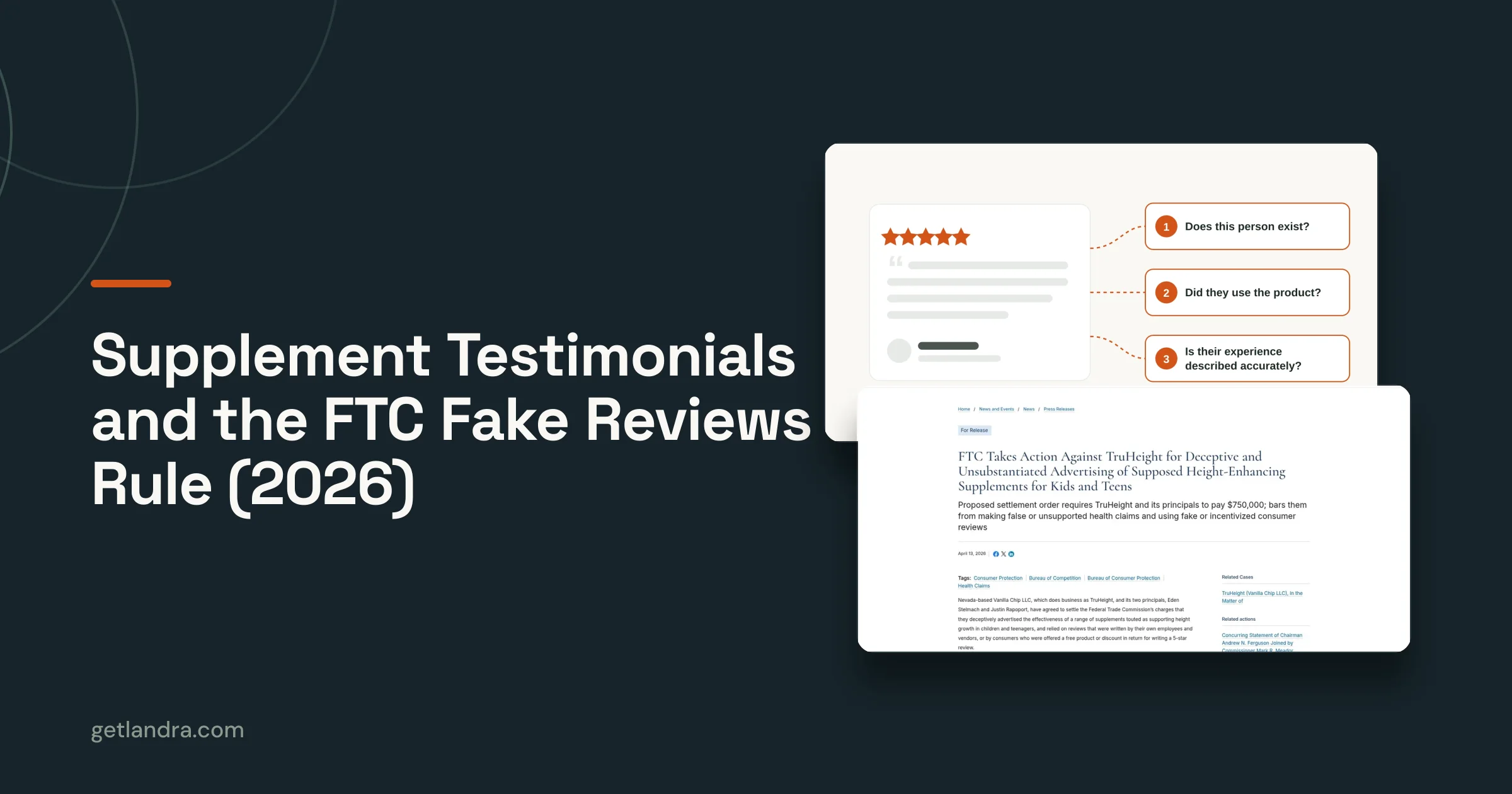
For the US, the FTC also has rules on how you use testimonials and reviews. I covered those in supplement testimonials and the FTC Fake Reviews Rule. Meta's rules and the FTC's rules are separate, so a page has to pass both.
What the landing page needs to sell supplements
Passing review gets the ad running. It doesn't get anyone to buy. Supplement buyers from a cold Meta ad don't know you, and they've seen a lot of supplement claims. Here's what I'd put on the page.
1. The same claim the ad made, in the headline. The reader clicked on one claim. If the ad said "the greens powder that doesn't taste like grass," the page opens on taste, not on your founder story. More on this in the Facebook ads landing page guide.
2. A reason to choose you over the category. Your reader has probably seen supplements like yours before. Grüns answers that in its listicle, which, when we loaded it on 10 Oct 2026, opened on "5 Reasons Why Millions Are Ditching Green Powders for Grüns." Each reason answers something greens powder buyers already dislike, like taste and mess.

3. What's in it and how much. Ingredients and amounts per serving, with a short line on why each one is there. This is where you can be specific without making a disease claim.
4. How long it takes. For weight loss products, Meta requires it in the ad. I'd put it on the page for every supplement. A buyer who expects results in three days cancels on day four.
5. Proof that stays inside the rules. Reviews with specifics, ratings, third-party testing if you have it. Check every testimonial against the table above before it goes on the page.
6. A guarantee written plainly. Nutrafol's offer page, when we captured it in Aug 2026, put "Get results in 6 months or your money back" at the center, and the conditions to qualify were also the instructions for taking the product. If you have a guarantee, make the terms the same everywhere on the page.

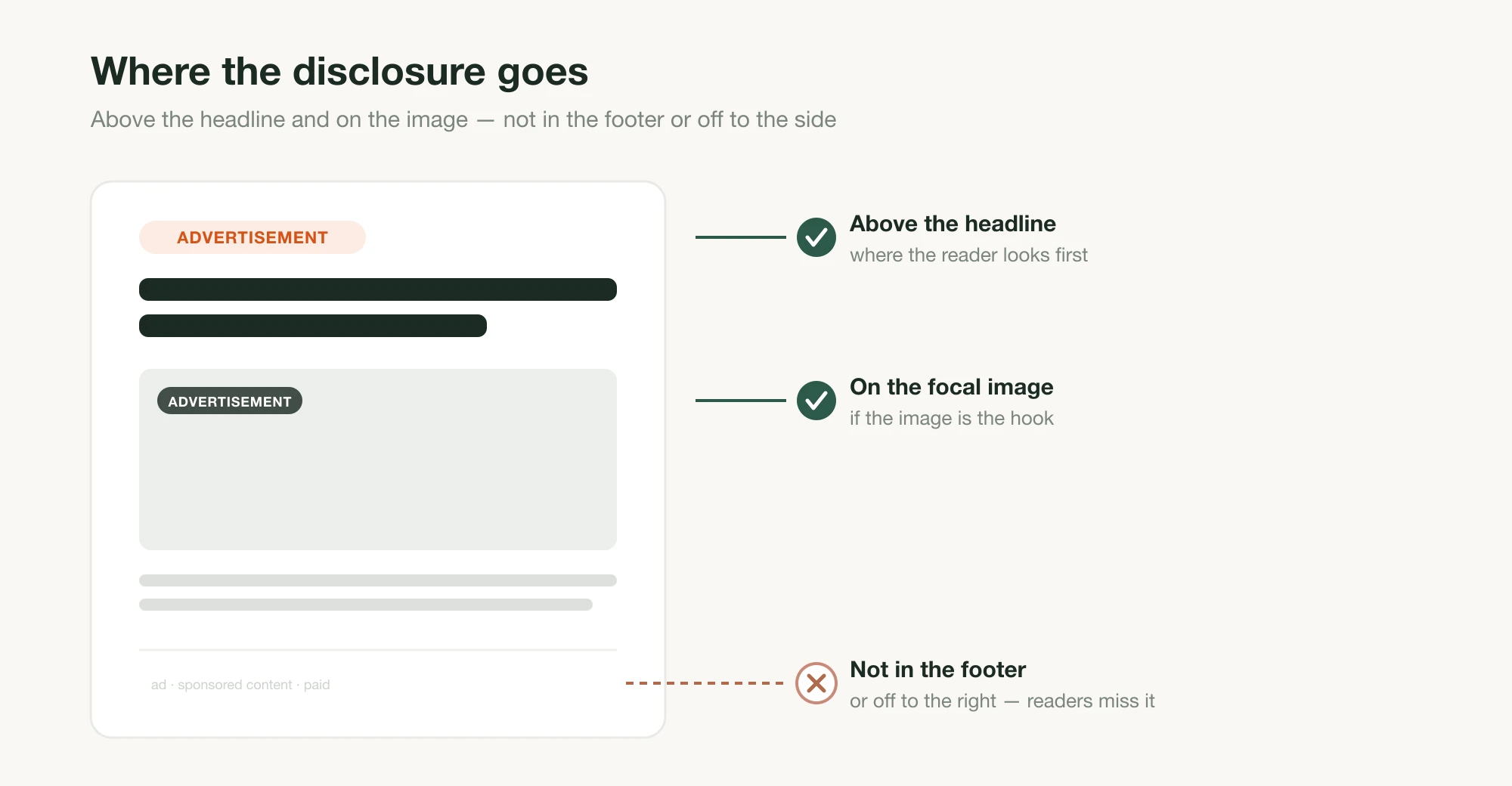
7. A clear label if the page reads like an article. Advertorials and listicles are ads formatted as content. Put an "Advertisement" label at the top. The advertorial disclosure guide covers where it goes.
Product page, advertorial or listicle for supplement ads?
For cold traffic, I'd test a landing page against your product page before anything else. At Pow our product page converted around 2.5%. When I started testing dedicated presell pages, conversion went to 4-5%. Your numbers will be different, so run the test on your own account: same ad, two links, judged on cost per purchase.
Which format to test first depends on the product. A product with several separate benefits fits a listicle. A product that needs a story or a problem explained first fits an advertorial. I compared both for supplement brands in listicle vs advertorial for supplement brands, and the homepage vs landing page post covers when the homepage is still the right link.
A checklist before you launch
- Ad set targets 18+ (unless it's a protein or general food product).
- No "cure", "heal", "eliminate" or "reverse" next to a disease name, anywhere on the page.
- No headline or subhead asks the reader about their health or body.
- Any result with a timeline says how long it takes, and is qualified.
- Testimonials and expert quotes read through for the same claims.
- The headline repeats the ad's claim.
- Ingredients and amounts are on the page.
- The guarantee says the same thing everywhere it appears.
- An "Advertisement" label sits at the top of any advertorial or listicle.
Build the page faster
Writing a new compliant page for every ad angle is the slow part. With Landra you paste your product URL and get an advertorial or listicle written, laid out for mobile, with images and the disclosure in place. You edit every line before it goes live, so you still read it against Meta's rules. You can create your first page free. Publishing is on the 14-day trial, then plans from $19/mo.
Frequently asked questions
Can you run Facebook ads for supplements?
Yes. Meta's Health and Wellness policy allows ads for dietary and health supplements, including weight loss supplements, as long as the ads target people at least 18 years old and avoid the claims the policy bans, like curing a disease on its list or sensational promises of results within a set time.
Does Meta review my landing page or only the ad?
Both can be reviewed. Meta's help page "About ads in review" lists "Ad destination (where an ad directs people, such as a Facebook page or website)" among the parts of an ad its review may include, and says ads can be reviewed again after they are live. A page with a banned claim can get a compliant ad rejected.
Why do supplement ads get rejected on Facebook?
Meta's policy text names these: implying you know the reader's health condition ("Do you have diabetes?"), claims to cure a disease on Meta's list, promises of a specific result in a set time with no qualifier, language that attacks how someone looks, and targeting people under 18.
Do protein powder ads need 18+ targeting on Meta?
No. The Health and Wellness policy says its age restrictions don't apply to "General food products, including protein products." Supplements sold for a health or weight result still need 18+.
Should supplement ads go to a product page or a landing page?
For cold traffic, a landing page built for the ad. The reader clicked on one claim and needs that claim answered before a buy box. Keep the product page for people who already know the brand.