

More CRO software won't automatically produce more conversions. For a DTC brand buying traffic from Meta or TikTok, an advanced experiment dashboard can become an expensive distraction if the page loads slowly, the tracking is incomplete, or the test takes place after most mobile visitors have already left.
The useful question isn't which platform has the longest feature list. It's whether the software can help you diagnose friction in short, mobile-first sessions, create relevant pre-sell experiences, and make decisions when privacy changes have weakened the signals behind attribution. Conversion rate optimization software works when it improves the quality and speed of decisions, not when it adds more reports.
Table of Contents
- Why Most CRO Software Fails DTC Brands
- Core Features That Actually Move the Needle
- Evaluation Criteria for Paid Social Funnels
- Implementation and Integration Considerations
- Measurement and Attribution in a Privacy-First World
- Real-World Use Cases and ROI Examples
- Building a Sustainable CRO Program
Why Most CRO Software Fails DTC Brands
The common assumption is that more CRO features equal better results. That logic works poorly for paid social. A DTC visitor arriving cold from an ad usually doesn't behave like a desktop visitor researching an enterprise purchase. The session is often mobile, the ad promise creates a narrow expectation, and the page has a brief opportunity to establish relevance before the visitor scrolls away.
Many platforms were designed around controlled website experiments, broad analytics, and longer consideration cycles. Those capabilities still matter, but they can underperform when a brand sends impatient traffic to a product page that loads slowly or asks for too much trust too soon. A statistically elegant test can't rescue a weak message match or a confusing first screen.
The feature problem
Demo environments make visual editors, audience rules, recordings, and personalization look equally valuable. They aren't. For paid social funnels, the highest-value workflow usually starts with three practical questions:
- Did the page render quickly enough for the visitor to see the offer?
- Did the opening section match the ad's promise?
- Could the visitor understand why the product was relevant without navigating through distractions?
Performance deserves priority because the gap is widespread. Core Web Vitals guidance sets Largest Contentful Paint below 2.5 seconds, Interaction to Next Paint below 200 milliseconds, and Cumulative Layout Shift below 0.1 as practical thresholds, while a 2026 summary of 2025 benchmarks reported that only 48% of mobile sites and 56% of desktop sites passed all three (CartFlows' landing-page statistics). A tool that adds scripts, flicker, or layout instability can undermine the experience it's supposed to optimize.
Practical rule: If a CRO platform makes the first meaningful interaction slower, test the implementation before testing the headline.
What DTC teams should prioritize
Start with software that exposes mobile friction and connects insights to a page change. Heatmaps, recordings, funnel events, and page variants are useful when they answer a specific question. They become noise when a team watches sessions without a hypothesis or launches variants without a clear primary conversion event.
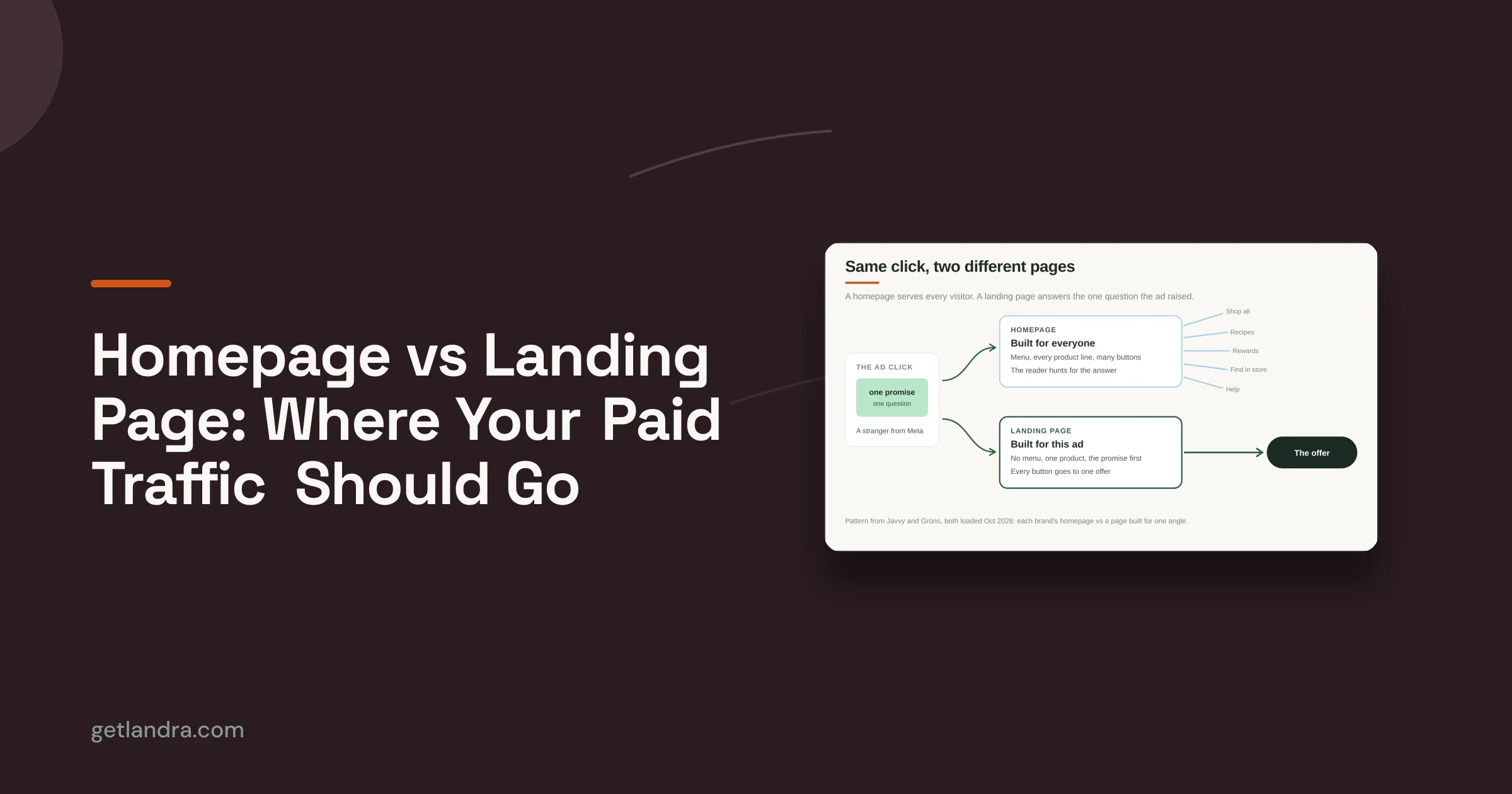
A pre-sell page can also solve a problem that testing software can't create from scratch. It gives cold traffic a structured explanation before checkout, which is especially useful when a product needs education, comparison, or proof. For a practical checklist of page-level improvements, ShipTeaser's conversion rate tips offers a useful companion resource.
The right stack may be smaller than the one shown in the demo. A fast page, clean event model, reliable checkout measurement, and disciplined prioritization usually beat a crowded dashboard.
Core Features That Actually Move the Needle

A DTC team doesn't need every feature equally. It needs a connected workflow that moves from observation to diagnosis, from diagnosis to a page change, and from that change to a commercially meaningful measurement.
Testing is for decisions, not decoration
A/B testing remains valuable when the hypothesis is narrow and the outcome is tied to revenue. Test the first-screen message, offer framing, proof placement, or checkout path when you can isolate the change and keep the success metric clear. Don't split traffic across several unrelated ideas and then treat the winning color or button label as a durable insight.
Testing tools are strongest when they support clean variant control, audience segmentation, quality checks, and consistent reporting. They're weaker when teams stop a test because an early result looks exciting or judge a landing-page change only by clicks rather than completed purchases.
Behavioral tools show where to investigate
Heatmaps can reveal ignored sections, repeated taps, and scroll-depth patterns. On mobile, though, a heatmap can mislead. A dense cluster near the top may reflect a small viewport, while a low-click section might still contain the information that resolves purchase hesitation. Use the visual pattern to form a question, then validate it against funnel behavior.
Session recordings add context. One recording can show a broken interaction or an unexpected form problem, but a large library of recordings can also become procrastination disguised as research. Filter by device, landing page, campaign, and failed event before watching anything.
Analytics should tie these observations together. Funnel reports, cohort comparisons, revenue events, and product-level outcomes matter more than a generic engagement score.
Personalization is not dynamic text
Simple dynamic text replacement changes a phrase based on a campaign or query. A personalization engine can alter content, proof, recommendations, or page structure based on behavioral and contextual signals. That creates more relevance, but it also introduces more measurement complexity and more opportunities to overfit a small audience.
For DTC teams building advertorials, listicles, or other warm-up pages, the page itself is part of the experiment. Teams can build pre-sell pages that convert and then compare message angles, proof sequences, and calls to action rather than limiting tests to a product-detail template.
A practical priority order is:
- Analytics first: Define the events and revenue outcomes.
- Behavioral evidence next: Find friction worth investigating.
- Testing after diagnosis: Change one meaningful variable or a coherent experience.
- Personalization selectively: Use it when the segment has a clear reason to receive a different experience.
Evaluation Criteria for Paid Social Funnels
Feature comparisons rarely reflect the conditions under which paid social funnels succeed or fail. Evaluate conversion rate optimization software against the page, platform, traffic, and measurement constraints you have.
| Criteria | All-in-One Platforms | Specialized Testing Tools | Landing Page Builders |
|---|---|---|---|
| Mobile speed impact | Broad functionality can add implementation weight, so audit scripts carefully | Often leaner for experiments, but dependencies still matter | Can produce fast pages when templates and assets are controlled |
| Shopify and Webflow integration | Usually offers wider connections, but setup can be complex | Strong for experimentation, with commerce validation requiring care | Typically useful for publishing and variant creation, with analytics configured separately |
| Testing velocity | Supports many workflows, though governance is essential | Deep experiment control, but may need other tools for page production | Fast page iteration, with statistical analysis often handled elsewhere |
| Pre-sell page support | Depends on the platform's content and publishing model | Usually tests existing experiences rather than creating editorial pages | Strong when the builder supports advertorial and listicle structures |
| Best fit | Teams wanting one operating layer | Teams with mature experimentation ownership | Teams prioritizing rapid page production and message testing |
Four tests to run before buying
First, load a realistic mobile page through the platform. Don't rely on a desktop demo. Check whether the visual editor, analytics script, personalization layer, and tag manager create a noticeable delay or layout shift.
Second, verify the integration path. Shopify teams should confirm how variants, cart events, checkout transitions, refunds, and subscription outcomes are passed back into reporting. Webflow teams should check publishing, custom code, event ownership, and whether an exported page remains maintainable.
Third, inspect the experiment controls. You want audience exclusions, traffic allocation, guardrails, primary and secondary metrics, and a way to document hypotheses. A platform that makes launching easy but stopping, interpreting, and archiving difficult will create operational noise.
Finally, test whether the tool supports the actual funnel. A product page, advertorial, quiz, and pre-sell listicle have different jobs. A tool that performs well for organic landing pages may not support the rapid message alignment needed for paid social. The same discipline applies beyond a Shopify store. Teams evaluating channel performance can also review guidance on how to improve Etsy ad ROAS, then ask whether their CRO stack can connect ad context to the landing experience.
Choose an all-in-one platform when one owner can govern the entire data model. Choose specialized testing software when your pages and analytics already work and experimentation depth is the constraint. Choose a landing page builder when production speed and message variation are holding back the program.
Implementation and Integration Considerations
Buying the software is straightforward. Installing it without slowing the storefront or corrupting the data is the work.
Start with the stack, not the experiment
Document every tool that touches the page. Include Shopify apps, Webflow embeds, consent management, analytics, pixels, tag managers, chat widgets, personalization scripts, and checkout integrations. Record which system owns each event. Duplicate ownership creates inflated counts, while missing ownership creates blind spots that look like conversion problems.
Use this implementation sequence:
- Select the smallest useful deployment: Begin with one page type and one primary conversion event.
- Audit current scripts: Remove redundant tags before adding a CRO layer.
- Confirm platform compatibility: Check Shopify theme behavior, Webflow publishing, custom HTML exports, and checkout boundaries.
- Test in staging: Validate page rendering, variant assignment, consent behavior, and event firing on real mobile devices.
- Launch with monitoring: Watch speed, errors, purchase events, and traffic allocation before interpreting performance.
- Review the integration: Keep a change log so a conversion movement can be connected to a specific deployment.
The pre-sell page and product page should usually have separate responsibilities. Use the pre-sell experience to establish relevance, explain the problem, and organize proof. Use the product page and checkout to confirm offer details, answer final objections, and complete the transaction. Sending both page types through the same vague conversion event makes it difficult to know where the experience helped.
Client-side and server-side trade-offs
Client-side testing is fast to deploy because the browser changes the experience after the page request. That convenience can introduce flicker, extra JavaScript, and dependence on browser-side signals. Server-side testing can avoid some rendering issues, but it demands more engineering and careful coordination with templates, caching, identity, and commerce events.
Don't run several client-side tools on the same page unless you can clearly assign responsibility. Competing scripts may overwrite elements, assign users inconsistently, or slow the first interaction. A useful diagnostic resource is Landra's heat map tutorial, especially when you're deciding which page behavior deserves instrumentation rather than adding tracking everywhere.
Keep the first launch narrow. A clean implementation on one high-value entry page teaches more than a broad rollout with uncertain events.
Measurement and Attribution in a Privacy-First World
Paid social CRO decisions now rely on incomplete signals. Third-party cookies are disappearing, client-side testing is being phased out, and privacy rules keep narrowing what platforms can observe. According to Accelero's 2026 CRO predictions report, more than 60% of CRO programs are forecast to use AI for hypothesis generation, test analysis, or personalization by the end of 2026 (Accelero's CRO predictions). The practical response is not to abandon measurement. It is to rank signals by how independently the business can verify them.
Use attribution as several imperfect views, not one source of truth. Ad platforms can support campaign optimization, analytics can describe onsite behavior, and the store or payment system should remain the reference for completed orders and revenue. If those systems disagree, trace the event path before calling a landing-page variant a winner.
Use a measurement hierarchy
Start with completed orders, revenue, qualified leads, and downstream customer actions that the business can verify outside the CRO vendor. Add landing-page views, product clicks, add-to-cart actions, and checkout starts to explain where movement occurs. Engagement metrics can diagnose attention, but they should not decide a paid social test on their own.
Page speed belongs in that diagnostic layer. Landing-page benchmark coverage reports an estimated conversion decline of roughly 7% for each one-second delay beyond the 2.5-second LCP threshold, along with a 5.1% median conversion rate for pages loading under 2.5 seconds versus 3.4% for pages over 4 seconds (Digital Applied's landing-page data points). Treat these as benchmark context, not a forecast for one store. Check performance before attributing weak results to ad creative, copy, or personalization.
AI personalization can reduce the need to run a separate classic A/B test for every audience, but it also makes validation harder. Require the tool to explain its inputs, define the audience, preserve a holdout or comparison where practical, and report against a business metric that can be checked in the store. A polished recommendation inside the vendor interface is not proof of incremental revenue.
Behavioral analytics can reveal friction faster than classic A/B testing. One report states that 68% of high-performing stores use behavioral analytics rather than A/B testing as their primary optimization method, but treat that claim as directional context rather than an operating rule (Build Grow Scale's CRO trends recap). Use find your CVR for paid social to keep the basic rate calculation visible, then add incrementality checks when platform attribution is uncertain. For TikTok teams, this new creator guide to measuring TikTok offers tracking context without replacing store-level validation.
Real-World Use Cases and ROI Examples
The most useful CRO examples are often less dramatic than software demos. They involve a specific bottleneck, a narrow intervention, and enough operational discipline to separate a genuine improvement from a noisy result.

Consider a skincare brand sending cold social traffic directly to a product page. The ad makes a problem-focused promise, but the product page opens with technical specifications and a broad navigation menu. Recordings show visitors reaching the page, scanning briefly, and leaving before the proof section. The useful intervention isn't a button-color experiment. It's a pre-sell page that carries the ad's angle forward, explains the problem in plain language, introduces the product as a response, and sends qualified visitors to the product page.
A second scenario involves a brand that has plenty of traffic but unreliable experiment conclusions. The team runs several variants at once, changes offers during the test, and relies on a platform-reported conversion event that doesn't reconcile with store orders. The apparent winners keep changing. The fix is operational: freeze the offer, define the event taxonomy, assign one primary outcome, and use behavioral evidence to decide which hypothesis deserves a controlled test.
A winning variant is not a learning unless you can explain why it won and reproduce the measurement.
A third brand uses AI to generate multiple audience-specific openings. That can speed up creative production, but the team doesn't allow the model to decide the final winner from a thin signal. They use the recommendations to create hypotheses, keep a comparison experience, and review order quality rather than accepting a higher click-through rate as proof of commercial value.
The implementation burden matters. Someone must own the page, the event model, the experiment log, and the weekly review. Without that owner, CRO software produces attractive evidence without a repeatable decision process.
The following video offers additional context on conversion optimization workflows. Treat it as supplementary education, not a substitute for validating your own store data.
Building a Sustainable CRO Program
A sustainable CRO program doesn't chase every possible test. It creates a reliable rhythm for finding friction, selecting high-value hypotheses, shipping changes, and recording what the team learned.
Build the operating rhythm
Assign one accountable owner, even if several people contribute. The owner doesn't need to write every page or analyze every session, but they must control prioritization and ensure that a result becomes a decision. Paid media, creative, merchandising, engineering, and customer support should feed the backlog because conversion problems often appear across those functions.
Use a simple prioritization model:
- Business importance: Does the issue affect revenue, acquisition efficiency, checkout completion, or customer quality?
- Evidence strength: Did analytics, recordings, support messages, or ad comments reveal the friction?
- Implementation effort: Can the team ship the change safely without introducing performance or tracking risk?
- Learning value: Will the result inform more than one page, audience, or offer?
AI can accelerate hypothesis generation, copy variations, segmentation ideas, and test analysis. It shouldn't replace judgment about sample quality, business context, or measurement integrity. The strongest workflow uses AI for breadth and humans for selection, validation, and accountability.
Match the program to maturity
A new team should establish clean events, reliable revenue reporting, page-speed monitoring, and a small backlog before purchasing an enterprise experimentation layer. A growing team can add structured testing, segmentation, and recurring behavioral reviews. A mature team may need server-side experimentation, stronger holdout design, and governance across multiple storefront experiences.
The market's development supports this broader view. Historical estimates cited by Matomo placed CRO software at $771.2 million in 2018 and projected it at $1.932 billion by 2026, implying a 9.6% CAGR, reflecting the category's movement into a broader growth stack (Cognitive Market Research's CRO software report). Independent estimates also place the market in the low single-digit billions in the mid-2020s, with one estimate reporting US$2.436 billion in 2024 and a forecast of US$4.063 billion by 2030 at an 8.9% CAGR (Credence Research's market report). The exact totals vary by methodology, but the operating lesson is consistent. Buyers need a durable measurement and experimentation process, not another isolated widget.

Start by auditing one paid-social funnel, identifying its first meaningful friction, and verifying its revenue event. Then choose the lightest tool that can diagnose and address that problem. Review results on a consistent cadence, archive failed ideas with their reasoning, and expand the stack only when the current process produces trustworthy learning.
Landra generates editable, mobile-first advertorials, listicles, and pre-sell pages from a product or brand URL, with publishing options for Shopify, Webflow, Landra-hosted URLs, and HTML export. If paid social traffic is reaching a product page before it has enough context, visit Landra to create and test a focused pre-sell experience.