
The popular advice is to pick one platform and eliminate the other. That framing creates the wrong decision for most DTC teams. Funnelish and Shopify aren't direct substitutes, because they operate at different layers of the ecommerce stack.
The more useful question is simpler and harder: where should the transaction happen, and which system should own the customer, order, payment, fulfillment, and post-purchase record? A funnel can improve a paid campaign while creating reporting and support problems if it becomes a parallel commerce system. Shopify can provide operational stability while a specialized funnel controls a narrow, high-intent buying journey.
Table of Contents
- Why This Comparison Is Usually Asked Wrong
- Shopify as Commerce Infrastructure and Funnelish as Conversion Layer
- Checkout Control, Payments, and Performance Trade-offs
- Where Pre-sell Pages Fit the Workflow
- Pricing, Capacity, and Growth Fit
- Implementation Steps That Protect Measurement
- When to Choose Funnelish, Shopify, or Both
- DTC Buyer Decision Checklist
Why This Comparison Is Usually Asked Wrong
A Funnelish vs Shopify comparison usually starts with a feature checklist. That approach rewards the platform with more boxes, not the architecture that protects margin. A landing-page editor, an upsell function, a product catalog, and an order-management system solve different problems.
Funnelish and Shopify occupy different layers of the ecommerce stack, so treating them as direct competitors obscures the actual choice. Funnelish is primarily a conversion-funnel system for landing pages, custom checkouts, order bumps, upsells, downsells, thank-you pages, analytics, and testing. Shopify is the broader store infrastructure that supports the merchant's core storefront and commerce operations.
That distinction matters after the customer clicks “buy.” If a separate funnel owns checkout, the team must confirm how orders synchronize, how discounts and refunds are recorded, how subscriptions are managed, and whether customer data remains available to email, support, analytics, and fulfillment teams. A funnel that produces a clean conversion report but fragments the operational record can create expensive work downstream.
Compare the transaction layer, not the feature list
| Business question | Shopify | Funnelish |
|---|---|---|
| What is it primarily responsible for? | Storefront and commerce infrastructure | Direct-response conversion journeys |
| Where does it fit? | Catalog, payment, order, and fulfillment system | Pre-sell, checkout, and offer-sequencing layer |
| Best operating context | Broad store operations and multiple commerce workflows | Paid-traffic campaigns and controlled buying paths |
| Main evaluation risk | App and checkout complexity | Parallel data and payment operations |
| Can it work with the other? | Yes, as the system of record | Yes, with orders synchronized to Shopify for fulfillment |
The same architectural discipline helps when evaluating other ecommerce stacks. A practical WooCommerce vs Shopify comparison is useful because it also separates storefront ownership, maintenance, integrations, and operational control instead of reducing the choice to visual features.
Practical rule: Decide which platform owns the order before deciding which platform builds the page.
For a DTC operator, the right outcome may be Shopify only, Funnelish connected to Shopify, or a pre-sell page that routes qualified visitors into either destination. The answer depends on SKU complexity, payment requirements, post-purchase workflows, and whether the incremental revenue from a controlled offer flow exceeds the cost of maintaining it.
Shopify as Commerce Infrastructure and Funnelish as Conversion Layer
Shopify runs the commerce operation. It covers the storefront, catalog, payments, orders, fulfillment, and the merchant infrastructure supporting those functions. That makes it a practical system of record when a business manages more than one campaign path, product, market, or sales channel.
Shopify's scale illustrates this infrastructure role. In 2016, Shopify had approximately 377,500 merchants, processed $15.4 billion in GMV, and generated about $389 million in revenue. By 2024, merchants on the platform processed approximately $292.3 billion in GMV, about 19 times the 2016 figure. 2024 GMV also grew 24% from 2023's $235.9 billion. These figures come from Shopify historical statistics and milestones. They describe a broad commerce platform, not just a page builder.
Funnelish starts with the buying sequence between an ad click and a completed order. It lets operators shape campaign pages, focused offers, custom checkouts, order bumps, and one-click upsells, then compare offer flows through native A/B testing. The operational value is control over the path, not a replacement for every store process.
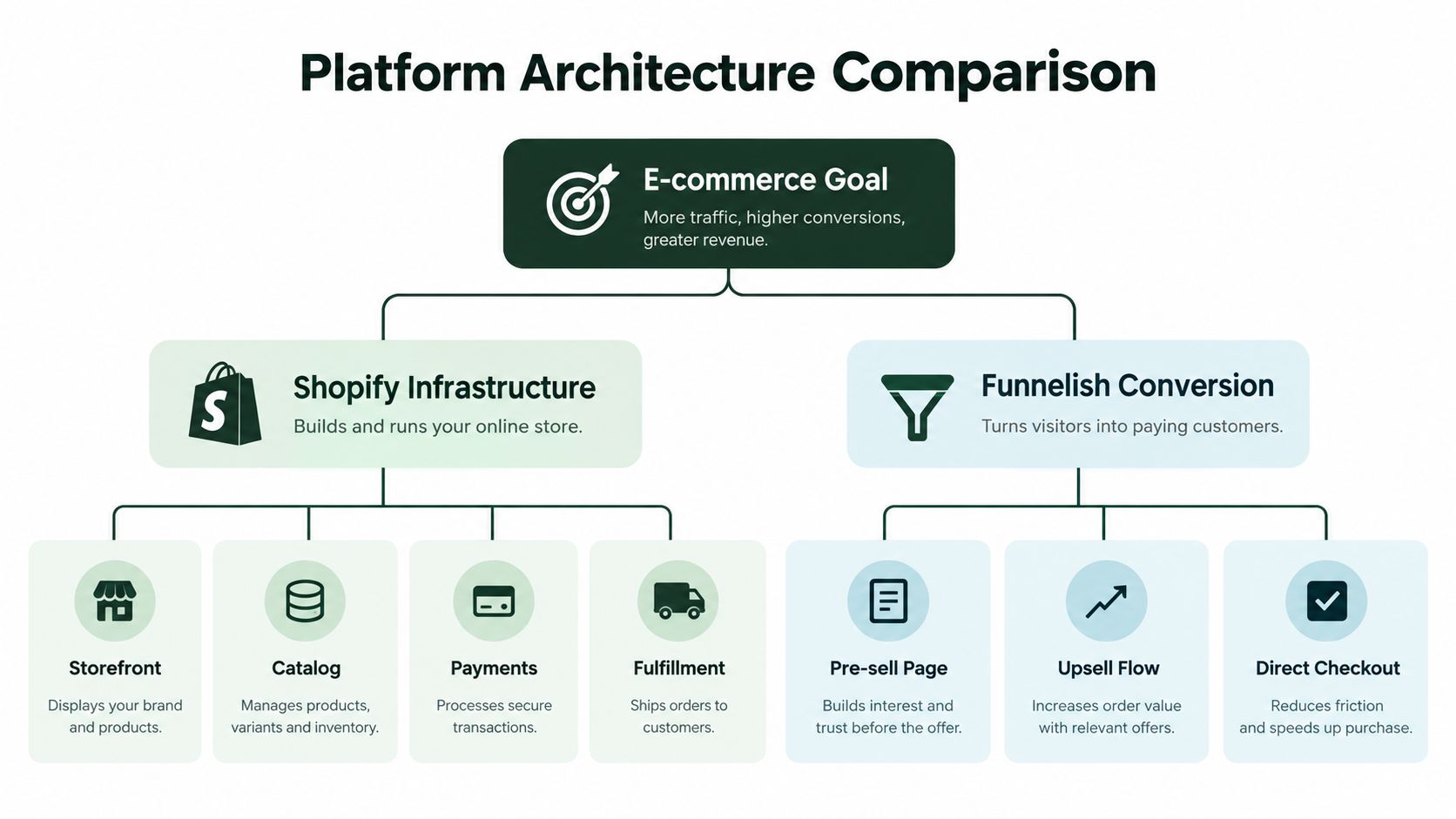
The architectural difference
A Shopify-first route usually works like this:
- Paid or organic traffic reaches a storefront or product page.
- Shopify presents the catalog, checkout, payment options, and order flow.
- Shopify and connected tools pass the order into fulfillment, support, retention, and reporting workflows.
A Funnelish-assisted route adds a conversion layer:
- Traffic reaches a campaign-specific page.
- The visitor moves through a focused offer and checkout sequence.
- Orders synchronize with Shopify, allowing the broader store to retain fulfillment and operational continuity.
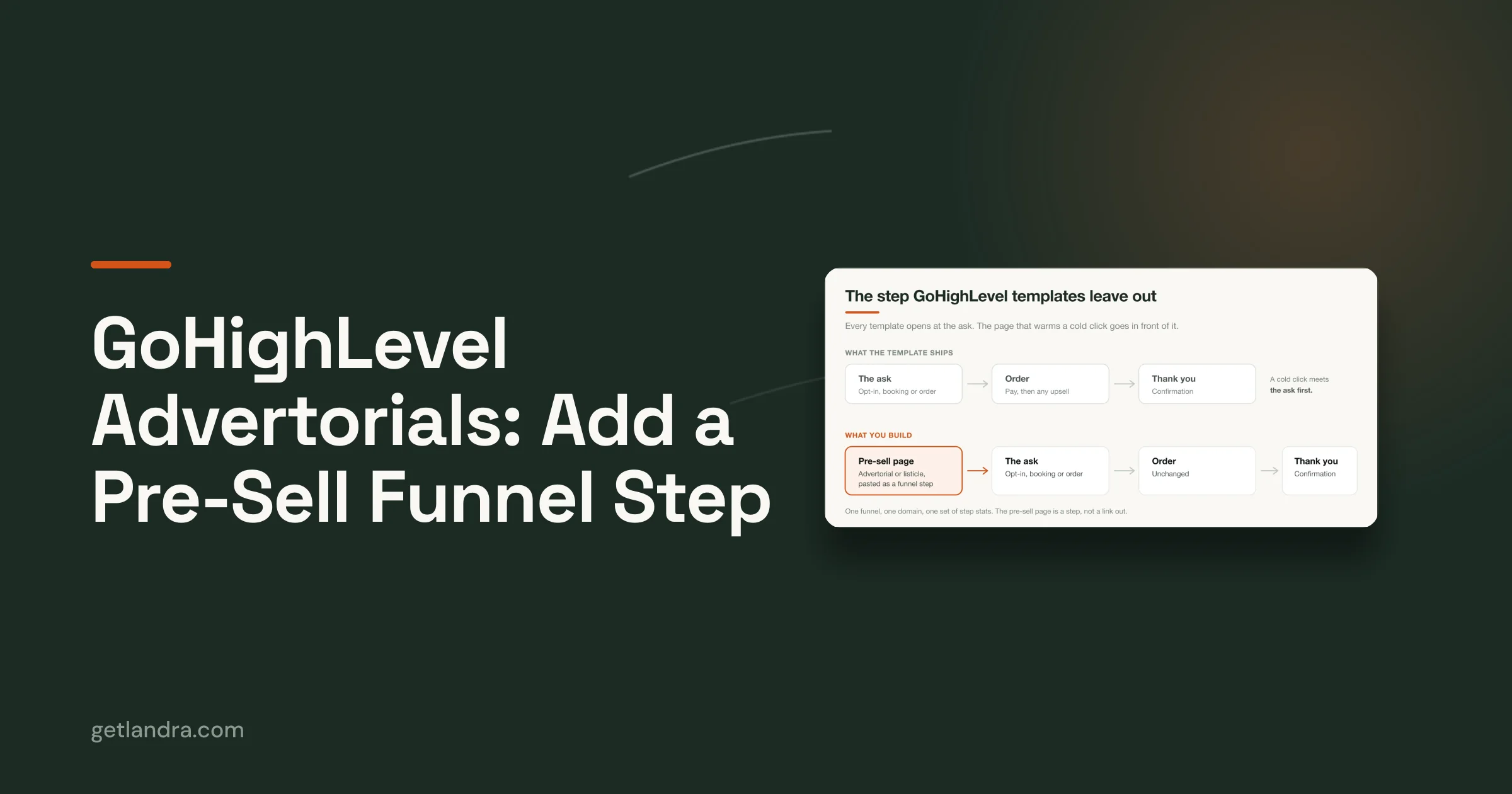
Operators can generate pre-sell pages for Shopify without turning each campaign into a separate commerce system. Funnelish handles message sequencing and offer intent, while Shopify can retain ownership of inventory, customer records, fulfillment, and post-purchase workflows.
That division matters as operational complexity grows. A single-product campaign may need one offer, one checkout, and one post-purchase path. A mature store may require variants, inventory rules, international payments, subscriptions, tax handling, refunds, customer accounts, and multiple channels. Putting those responsibilities in the wrong layer creates duplicate data, harder support workflows, and less reliable reporting.
Shopify provides operational breadth. Funnelish provides direct-response control. Treating them as complementary layers lets the team test conversion paths while keeping order ownership and post-purchase data continuity explicit. That structure also leaves room to adapt campaign and mobile buying experiences without rebuilding the underlying commerce operation.
Checkout Control, Payments, and Performance Trade-offs
Checkout is the point where stack design affects both conversion work and daily operations. There is no controlled head-to-head conversion benchmark between Funnelish and Shopify, so the practical difference is how much control the team wants over the buying sequence, and how much integration risk it can absorb.
Funnelish gives operators more control over payment-form elements, order bumps, one-click upsells, and downsells without relying on custom API workarounds. It can connect with merchant-owned processors such as Stripe, NMI, PayPal, Airwallex, and Checkout.com. Available customer payment methods depend on the gateway and market, but may include cards, digital wallets, Klarna, iDEAL, Bancontact, SEPA Direct Debit, and cash on delivery.
Shopify takes a more standardized approach. Its checkout infrastructure supports broad merchant operations and can handle up to 40,000 checkout starts per minute per store, according to Shopify's checkout and commerce updates. That scale is useful when reliability, predictable payment handling, and operational consistency matter more than customizing every step of an offer.
Checkout and Payment Trade-offs
| Dimension | Funnelish | Shopify |
|---|---|---|
| Checkout model | Customizable, direct-response flow | Standardized commerce checkout |
| Offer mechanics | Order bumps, one-click upsells, and downsells | Broader native checkout and ecosystem model |
| Gateway approach | Connects external merchant-owned processors | Uses Shopify's standardized payment and checkout infrastructure |
| Payment flexibility | Depends on connected gateway and market configuration | Native and market-specific options within Shopify's ecosystem |
| Main risk | Gateway setup, recurring billing, webhooks, and reporting continuity | App behavior, checkout customization limits, and dependency management |
| Best test metric | Completed orders and incremental AOV after operational costs | Reliability, completion, payment success, and contribution margin |
Funnelish can create more opportunities to increase average order value because the merchant controls the order bump and post-purchase sequence. The extra revenue only counts if authorization, order synchronization, refunds, and fulfillment remain reliable. A failed payment, duplicate order, or split support workflow can remove the apparent gain.
Shopify's developer guidance places weight on checkout responsiveness. External app requests should use internal timeouts so a slow dependency does not block checkout, while storefront apps are evaluated partly through their effect on Lighthouse performance scores. A lighter funnel is not automatically better if its payment settings or webhook chain creates instability.
The test is not “Which checkout looks better?” It is “Which route creates more profitable completed orders under the same traffic conditions?”
Use the DTC conversion playbook to structure the experiment around business outcomes. Keep the campaign page mobile-first, use identical product and campaign identifiers, and compare landing-page-to-purchase rate, checkout completion, payment failure rate, latency, AOV, refund rate, and contribution margin. Funnelish earns its place when added offer sequencing generates enough incremental value to cover its integration and payment-operational burden.
Where Pre-sell Pages Fit the Workflow
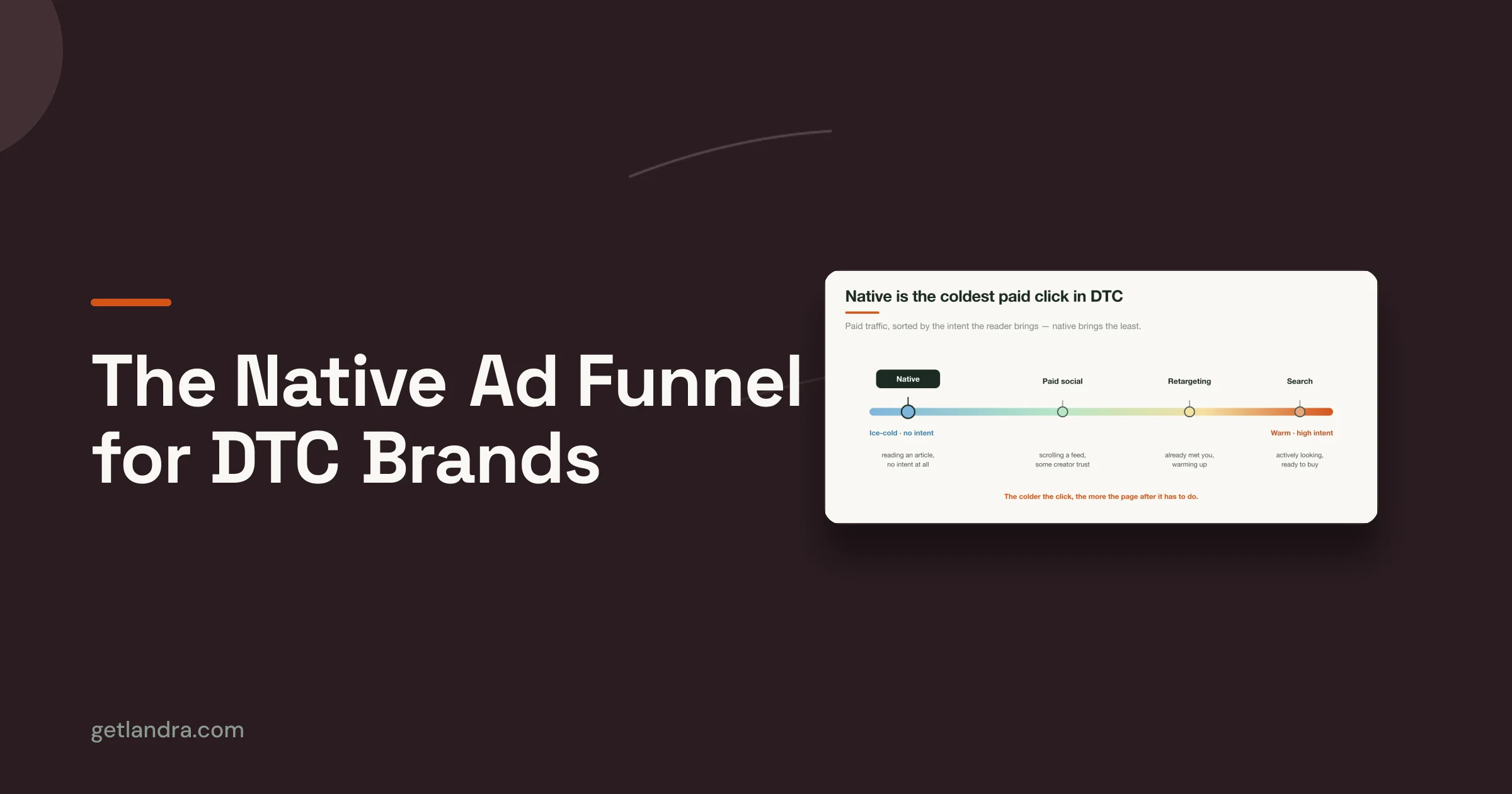
Cold paid traffic often reaches a product page before the visitor understands the problem, the product's relevance, or the reason to trust the offer. A product detail page has to serve browsing, comparison, navigation, merchandising, and purchase intent at the same time. That broad job can dilute the message of an ad built around one specific pain point.
A pre-sell page gives the campaign a narrower job. An advertorial can develop the problem and explain the product in an editorial format. A listicle can organize benefits, objections, alternatives, and proof into a sequence that prepares the visitor for the offer. The destination can still be a Shopify product page, or it can be a specialized Funnelish checkout for visitors who are ready to buy directly.
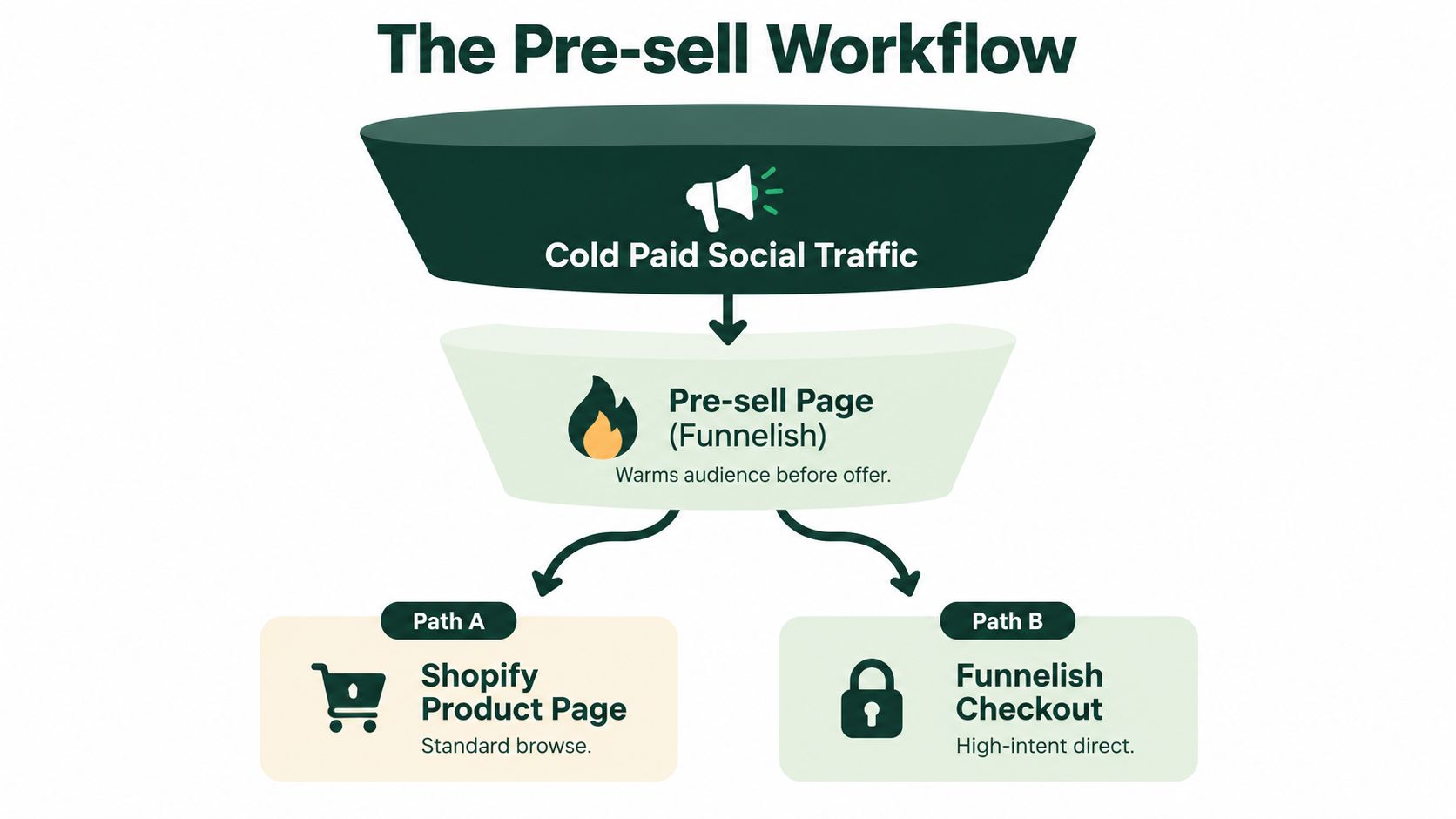
Route traffic by intent
The practical workflow is:
- Cold audience: Send paid-social visitors to a page that continues the ad's promise instead of dropping them into a generic storefront.
- Engaged visitor: Use the pre-sell page to answer the objection that keeps the visitor from progressing.
- Qualified buyer: Route to a Shopify product page when browsing, variant selection, or standard store behavior matters.
- High-intent buyer: Route to a Funnelish checkout when a focused offer, order bump, or post-purchase sequence is central to the campaign.
This is also why page quality can't be judged only by the checkout destination. Teams should evaluate message match, mobile reading speed, clarity of the offer, evidence placement, and the number of unnecessary exits. Guidance on landing page optimization for DTC brands can help teams assess those elements before changing the transaction layer.
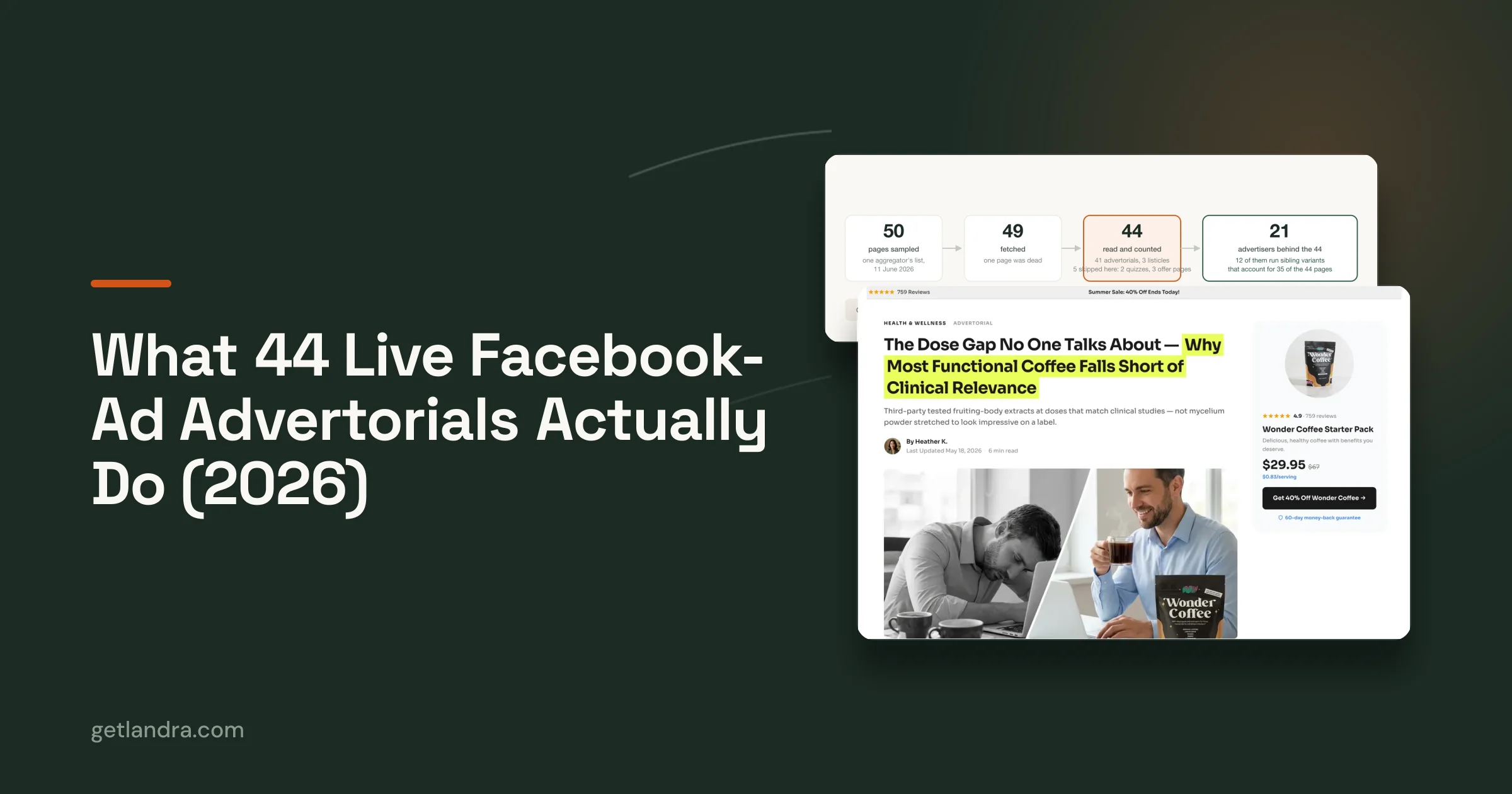
A first-party test reported on this page found a 46% CAC reduction when the same ads were routed to a Landra advertorial instead of a product page, with benchmarks citing 2–3× higher conversion than product pages. That result should be treated as a campaign-specific signal, not as a universal promise. The correct follow-up is to hold the ad, audience, offer, and checkout route as constant as possible, then isolate what the pre-sell experience contributes.
The operational benefit of this model is flexibility. A Shopify-first brand can add a pre-sell route without rebuilding its store. A Funnelish-led campaign can place the pre-sell page directly before its controlled checkout. Either way, the page should have a clear owner, consistent tracking, and a defined reason for the route it uses.
A team can create a presell landing page for a specific product and then publish the page into the existing workflow rather than forcing the entire brand to adopt a new storefront architecture.
The strongest setup usually treats pre-sell as a traffic-routing decision, not a replacement for commerce infrastructure. That keeps the campaign focused without making the store responsible for every persuasion task at the first click.
Pricing, Capacity, and Growth Fit
Funnelish is easier to budget around funnel usage, while Shopify costs reflect a broader commerce operation. Reported Funnelish pricing starts at approximately $49 per month, or about $41 per month when billed annually. The entry tier supports up to 20,000 monthly visitors and 20 funnels. A higher tier reported at approximately $83 per month annually supports up to 100,000 visitors, 50 funnels, five domains, and five stores. These figures appear in the Funnelish platform overview. Treat them as planning figures, not a fixed quote. Pricing tiers change frequently, so confirm current limits on Funnelish's pricing page before committing budget.
The subscription makes sense when the team has a defined campaign use case. Compare its cost with the value of controlled checkout paths, testing, order bumps, and upsells. The software fee is only one part of the calculation. Include payment processing, implementation time, tracking maintenance, support training, reconciliation, and the work required to resolve synchronization issues.
Shopify has a wider cost structure because it serves as the core commerce environment. The operating budget may include apps, payment services, themes, and integrations. That can increase recurring software spend, yet keeping one order and checkout system may reduce maintenance work as product volume and operational complexity grow.
Match spend to operating reality
| Growth situation | Sensible starting point |
|---|---|
| One focused paid-traffic offer | Funnelish layer or a Shopify campaign route |
| Broad catalog and regular merchandising | Shopify-first |
| Several paid campaigns with distinct offers | Shopify plus selective Funnelish use |
| International or subscription-heavy operation | Shopify-first until integration ownership is proven |
| Testing a new acquisition angle | Pre-sell page before changing the core checkout |
Capacity limits are planning inputs, not performance guarantees. A visitor allowance says nothing about profitable conversion, and a larger plan cannot repair weak offer economics. Before upgrading, identify the binding constraint: traffic volume, funnel count, domains, stores, payment requirements, or operational workload.
The most cost-effective setup preserves contribution margin as the business becomes harder to operate. A low subscription can become expensive when refunds, failed payments, and customer records require manual handling. Choose the layer that adds conversion control without creating a second system the team cannot support.
Implementation Steps That Protect Measurement
A funnel test becomes unreliable when the route changes more than the checkout. New URLs, different product identifiers, inconsistent campaign parameters, and separate analytics events can make a winning dashboard impossible to trust.
Start with a controlled implementation. Keep the campaign, audience, product, price, creative, and attribution conventions consistent. If Funnelish receives traffic that Shopify would otherwise receive, the team should know exactly which visitors took each path and which order belongs to which route.
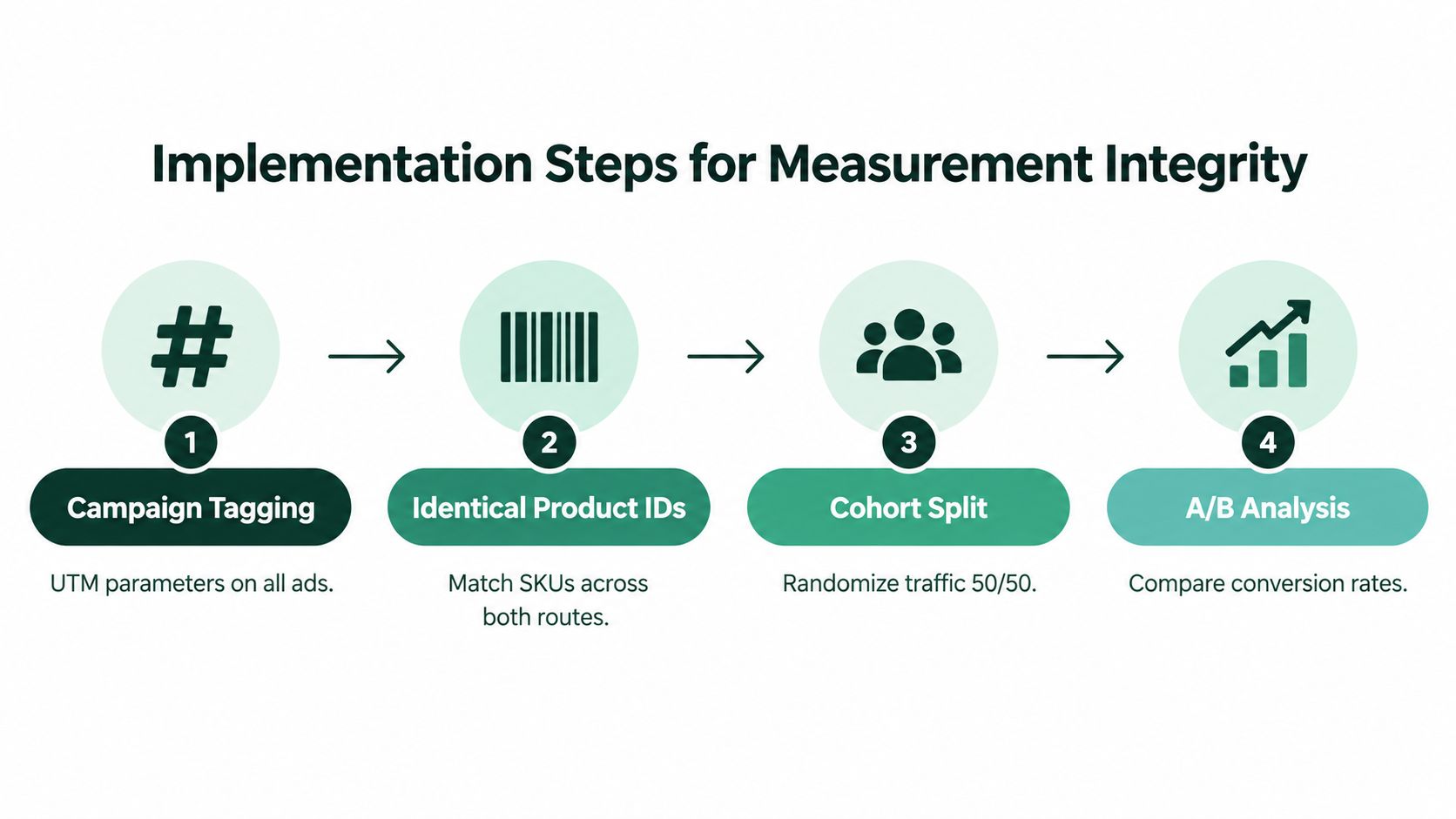
A practical rollout protocol
Tag every campaign route. Use the same campaign and product identifiers in ad URLs, the pre-sell page, the checkout, and the analytics destination. Don't allow one route to use a campaign name while another uses an internal page label.
Match product identifiers. Map the same SKU, variant, offer, and discount logic across Shopify and Funnelish. This prevents a conversion result from being distorted by different products, bundles, shipping rules, or eligibility conditions.
Create comparable cohorts. Split traffic according to a defined allocation and preserve the same audience and ad conditions. The supplied testing visual recommends a 50/50 traffic split, but the correct allocation depends on the campaign's risk tolerance and traffic volume.
Review the complete economics. Track landing-page-to-purchase rate, checkout completion, payment failure rate, latency, average order value, refund rate, and contribution margin. A higher AOV isn't a win if refunds or payment failures rise with it.
Funnelish documentation describes native customizable payment-form elements and one-click upsell and downsell capability without API workarounds, which can reduce funnel friction and create more opportunities to increase AOV. The relevant Funnelish technical documentation supports evaluating those mechanics directly rather than assuming the feature will improve every offer.
Measurement standard: Report both the conversion result and the operational cost of producing it.
Run a quality check before scaling traffic. Place a test order, test a failed payment, verify discount behavior, confirm the order reaches fulfillment, check refund handling, and inspect the customer record in the tools used by support and retention. Only then should the team treat the funnel as a performance asset rather than a page experiment.
When to Choose Funnelish, Shopify, or Both
Choose Shopify first when the business has a broad catalog, multiple markets, recurring orders, or several sales channels. These operations require one dependable record across inventory, customer accounts, discounts, subscriptions, refunds, tax, fulfillment, and reporting. Funnelish can still support campaign execution, but the core commerce system should remain accountable for operational truth.
Choose Funnelish as an added layer when the offer has a clear direct-response structure: focused paid traffic, a limited product path, and a genuine role for order bumps, upsells, or post-purchase offers. The team must also be able to own payment checks, webhook monitoring, refunds, and data synchronization. Funnelish earns its place when the offer sequence produces incremental completed orders or AOV that the standard Shopify route cannot produce cleanly.
Choose both when each platform has a defined job. Shopify can retain the storefront, customer record, fulfillment connection, and reporting foundation, while Funnelish runs a campaign-specific checkout or post-purchase sequence. This arrangement contains the operational risk of experimentation and gives the team a fallback when the funnel creates support or reconciliation problems.
Use complexity as the boundary
The risk operators underestimate is this: a dedicated funnel may improve campaign-level conversion while weakening the merchant's system of record, especially for multi-SKU, international, subscription, or omnichannel businesses, as noted in Shopify's market and checkout updates. Shopify's checkout customization, regional payment support, VAT-ID validation, address validation, and improving mobile checkout reduce the gap that older comparisons often assume.
That does not make Funnelish irrelevant. It raises the proof required before deployment. The team should compare incremental contribution after payment fees, tracking gaps, support workload, refunds, repeat-purchase effects, and reconciliation time. A funnel with a higher visible conversion rate can still reduce margin if it disrupts customer data or creates manual operational work.
Start with the simplest architecture that preserves measurement and post-purchase continuity. Add Funnelish when its specific offer mechanics produce measurable incremental profit, not because its feature list appears more advanced.
Decision boundary: Add a funnel when it creates measurable incremental contribution and the team can keep the operational record accurate.
DTC Buyer Decision Checklist
Use this checklist in the stack review, before committing engineering or media budget:
- Transaction ownership: Which platform should own the order, customer record, discount, refund, subscription, and fulfillment event?
- Offer complexity: Does the campaign need an order bump, one-click upsell, downsell, or a sequence that Shopify's standard route can't support cleanly?
- Catalog structure: Are customers choosing among many SKUs, variants, bundles, or recurring products?
- Payment coverage: Are the required gateways and local payment methods available, configured, and tested for each market?
- Mobile behavior: Does the route load quickly, remain readable, and preserve a low-friction payment experience on mobile?
- Data continuity: Can the team reconcile ad spend, landing-page behavior, checkout events, orders, refunds, and contribution margin in one reporting process?
- Operational capacity: Who owns webhook failures, payment disputes, order mismatches, customer support questions, and future platform changes?
- Test design: Can the team compare Shopify-direct and Funnelish routes with matching product identifiers, campaign tags, and offer conditions?
- Growth path: Will the chosen architecture still work as the brand adds markets, subscriptions, SKUs, wholesale activity, or omnichannel sales?
A Shopify-only setup is often the safest foundation for operationally complex brands. Funnelish is more defensible as a specialized layer for controlled acquisition and monetization. A hybrid workflow becomes attractive when a focused pre-sell page and offer sequence can improve campaign economics without breaking the merchant's source of truth.
Landra generates editable, mobile-first advertorial and listicle pre-sell pages from a product or brand URL, with publishing options for Shopify, a hosted URL, Webflow, or HTML export. Use Landra to build a controlled pre-sell route, then test whether warmer traffic improves your existing Shopify or Funnelish transaction flow.