

Most advice on picking a landing page builder for Shopify is stuck on the wrong question. It compares widget libraries, template counts, and how smooth the drag-and-drop editor feels. That matters far less than people think.
For a paid social brand, the primary bottleneck is usually one of two things. You either can't build pages fast enough, or you can't write pages that deserve traffic in the first place. Those are different problems, and they need different tools.
If you're sending cold Meta or TikTok traffic to Shopify, a page doesn't win because it looks polished. It wins because it loads fast, matches the ad's promise, builds belief, and asks for the sale only after the page has earned that ask.
Early in the process, use this filter.
| Tool type | Best for | Main strength | Main weakness | Best fit |
|---|---|---|---|---|
| Layout builders | Teams that already have copy and a funnel strategy | Design control inside Shopify | Still leaves you staring at a blank page for copy | Brands with a copywriter, designer, or proven funnel |
| Content generators | Teams that need pages written and structured fast | Produces the narrative and layout direction | Less useful if your only issue is visual customization | Brands scaling paid social and testing many hooks |
| Shopify native editor | Basic store pages | Simple and built in | Too rigid for serious campaign work | Low-complexity pages, not cold traffic funnels |
Table of Contents
- Choosing a Landing Page Builder Is Not About Widgets Anymore
- Why Shopify's Native Editor Fails High-Growth Brands
- Layout Builders vs Content Generators The Two Paths
- Comparing Top Shopify Layout Builders for Paid Social
- When to Choose an AI Content Generator Like Landra
- The High-Converting Page Formats for Cold Traffic
- Implementation Tips and Testing Best Practices
Choosing a Landing Page Builder Is Not About Widgets Anymore
The category is growing fast, but most buyers still evaluate it like it's 2019. The landing page builders market was valued at USD 0.7 billion in 2025 and is projected to reach USD 3.1 billion by 2036, with All In One Website Designing Platforms holding a 64.0% share. That tells you businesses rely heavily on these tools. It doesn't tell you whether the tool solves your actual bottleneck.
Two different jobs get lumped together
A lot of teams say they need a landing page builder for Shopify when what they really need is one of these:
- A layout tool that lets them control spacing, sections, mobile order, hero design, and page structure.
- A content tool that helps them produce the actual argument, story, and persuasion layer that gets cold traffic to care.
Those aren't interchangeable.
A layout builder helps when your team already knows what the page should say. A content generator helps when the blank page is the problem, and your traffic economics don't leave room for long copywriting cycles.
Practical rule: If your team can already outline a winning advertorial or listicle from scratch, start with a layout builder. If not, design flexibility won't save the campaign.
What paid social teams should care about
High-performing Shopify pages usually aren't just prettier versions of product pages. They do a specific job. They bridge the gap between ad click and product conviction.
That means the buying criteria should look more like this:
- Can the tool support pre-sell formats like advertorials, listicles, and offer pages?
- Can your team launch and revise quickly without waiting on design or dev?
- Does the publishing setup preserve speed for cold traffic?
- Can you create variants fast enough to test angles, hooks, and offers?
Most comparison posts never ask those questions. They obsess over visual widgets because that's easy to screenshot. The harder question is whether the tool helps you reduce wasted spend.
Why Shopify's Native Editor Fails High-Growth Brands
Shopify's native editor is fine for basic pages. It isn't built for aggressive paid acquisition.
The problem isn't that it looks simple. The problem is that serious DTC brands need control over narrative flow, proof placement, modular testing, and mobile-specific sequencing. Native Shopify tools don't give enough flexibility for that, especially when you're trying to match cold traffic intent.

Native pages break when the funnel needs persuasion
A product page can answer questions for warm traffic. Cold traffic needs more than answers. It needs framing.
That usually means a page with a stronger headline hierarchy, more deliberate section order, better social proof placement, education before the offer, and more room for modular testing. Shopify's default setup tends to push brands back into theme constraints. You end up editing around the system instead of building the page your campaign needs.
For high-growth brands, that creates three immediate issues:
- Slow campaign iteration because every meaningful change turns into theme work or workaround stacking.
- Weak narrative control because the page structure isn't designed for advertorial or listicle-style persuasion.
- Compromised CRO execution because trust, social proof, urgency, and offer sequencing get treated like design details instead of conversion levers.
Performance is part of conversion, not a technical side note
Design flexibility only matters if the page still performs. Shopify's own landing page benchmark data shows that landing pages loading within one second convert at three times the rate of pages taking five seconds, and nearly 40% of marketers credit video as the top element improving landing page conversion.
That matters because native setups often leave brands in an awkward middle ground. The page isn't flexible enough to build the funnel they want, but once they start patching around those limitations with theme edits and scattered add-ons, performance gets harder to protect.
If you're buying traffic every day, your landing page editor is not a design tool. It's part of your CAC model.
What high-growth brands actually need instead
The stores that outgrow the native editor usually need the same three things.
| Need | Why it matters |
|---|---|
| Faster page deployment | Paid campaigns need page variants without dev bottlenecks |
| Better content structures | Cold traffic rarely converts on bare product-page logic |
| Cleaner testing workflows | Winning pages come from iterations, not one polished draft |
The native editor can support store content. It struggles with campaign content. That's the line that matters.
Layout Builders vs Content Generators The Two Paths
Once you stop judging tools by widgets, the category gets clearer. There are really two paths.
One path gives you a better canvas. The other helps you fill the canvas with something worth reading.

Layout builders give control, not the argument
Tools like PageFly, GemPages, and Shogun fit the layout builder bucket. They help marketers and designers build custom pages inside Shopify without relying as heavily on developers.
That's useful when the team already has:
- a clear offer
- proven copy
- a designer or strong visual direction
- enough CRO maturity to know what sections belong where
These tools are best understood as production infrastructure. They make building easier. They don't solve the persuasion problem for you.
A team can have a powerful builder and still publish weak pages if the copy is generic, the offer is soft, or the page asks for the sale before building belief.
Content generators solve the blank-page problem
The second path is the content generator. This category matters more than most builder roundups admit.
For a lot of Shopify brands, the slowest part of page creation isn't section spacing or mobile styling. It's writing the page. Specifically, writing pages that educate, pre-sell, and transition a skeptical reader from curiosity to intent.
The underserved question in this category is simple: how do you build a Shopify landing page that includes a full advertorial or listicle without handing the job to an agency or spending days writing it internally?
The reason this matters is operational, not theoretical. Teams often need multiple angles, multiple hooks, and multiple pre-sell narratives running against the same product. That's hard to do if every test starts with a blank document.
A pretty page with weak copy is still a weak page. Most cold traffic failures happen there, not in the border radius settings.
Which path fits your team
Use this decision filter.
| If this sounds like you | Better path |
|---|---|
| “We have good copy, but our pages are too rigid.” | Layout builder |
| “We know our audience, but we can't produce advertorials fast.” | Content generator |
| “We need more branded control inside Shopify.” | Layout builder |
| “We keep sending traffic to pages that don't educate enough.” | Content generator |
A lot of brands need both over time. But they usually need one first.
If your main issue is page design, buy better layout control. If your main issue is that your team can't consistently produce persuasive pre-sell content, buying another drag-and-drop tool won't fix the actual leak.
Comparing Top Shopify Layout Builders for Paid Social
Most reviews compare PageFly, GemPages, and Shogun like they're website design apps. For paid social, that framing is too shallow. The real question is whether the builder helps you launch fast without damaging performance.
That matters because a 2025 Shopify performance report found that 62% of page speed losses in paid funnels come from third-party plugin bloat, and native, plugin-free pages often convert 2.3x higher for cold audiences due to faster load times. If you're evaluating a landing page builder for Shopify, architecture belongs near the top of the list.
PageFly
PageFly is popular for a reason. It's accessible, flexible enough for diverse requirements, and easy to get moving with if you need custom campaign pages quickly.
For paid social teams, the upside is speed of execution. The risk is that marketers often keep stacking elements, integrations, and embellishments until the page becomes heavy. That's not PageFly's fault alone, but it's a real operating pattern.
Best fit:
- Lean teams that need fast design control
- Brands with existing copy
- Operators willing to watch page weight closely
Weak fit:
- Teams expecting the builder to generate the persuasion layer
- Stores with messy app stacks and no performance discipline
GemPages
GemPages often appeals to merchants who want templates and easier visual assembly. It can work well if your brand already knows the format it's trying to build.
Its biggest trade-off is common across many template-led builders. Teams can ship pages that look complete without asking whether the page earns the click. In paid social, a finished-looking page and a convincing page are not the same thing.
GemPages works better when the operator brings a direct-response lens to the build. It works worse when the template becomes the strategy.
Shogun
Shogun tends to suit teams that want more control and can handle a steeper workflow. It can be a solid option for stores with more technical resources or a stronger internal design system.
The trade-off is operational. If the tool gives you more power but fewer people on your team can use it confidently, velocity can drop. In growth marketing, that cost manifests subtly. Fewer variants launched. Slower test cycles. More dependence on specialists.
What to judge beyond the feature grid
Use a stricter scorecard than most app roundups.
Publishing architecture
Does the page stay close to native Shopify delivery, or does it depend on extra layers that can slow cold traffic funnels?Variant creation speed
Can your team duplicate a winner, swap the hook, change proof order, and relaunch without friction?Direct-response template quality
The best template isn't the prettiest one. It's the one built for intent, proof, education, and action.Mobile editing discipline
Most paid social traffic hits mobile first. If the mobile experience feels like an afterthought, the builder isn't built for your use case.
The best builder for paid social isn't the one with the most elements. It's the one your team can use to ship fast pages without slowing them down.
If your work lives in Meta and TikTok funnels, it's worth reviewing these paid social landing page considerations for Shopify stores before choosing a tool. The wrong publishing setup can erase gains you thought would come from better design.
When to Choose an AI Content Generator Like Landra
Most Shopify brands don't need more layout freedom first. They need help designing, optimizing, and writing high-quality landing pages. That's the gap generic builder reviews skip.
The missing question is content production. Can your team produce a convincing advertorial, listicle, or pre-sell page fast enough to support paid testing? In many brands, the answer is no.

The use case is bigger than design
The strongest reason to use an AI content generator is not convenience. It's throughput.
Verified market data says 89% of top DTC brands now use pre-sell pages, and a 2025 study found that manual advertorial creation takes 3 to 5 days and costs over $2,000, while automated tools can produce on-brand drafts in under 5 minutes. That's a major difference in how fast a team can test angles.
If your paid social program depends on testing fresh hooks, objections, and awareness levels, long content cycles become expensive even before you count media spend. The ad team moves faster than the landing page team. That mismatch drags performance.
Situations where this category makes sense
An AI content generator is usually the better choice when one or more of these are true:
- Your product needs education before the shopper is ready for a direct product page.
- Your CAC is under pressure and you need better pre-sell, not just prettier design.
- Your team lacks in-house copy depth for advertorials or listicles.
- You need multiple message angles fast for cold audiences.
- You're tired of agency lead times for every new page concept.
This is especially relevant for stores selling products that need context, comparison, explanation, or belief-building. If the customer doesn't immediately understand why the product matters, the page has to do more narrative work.
What this changes in practice
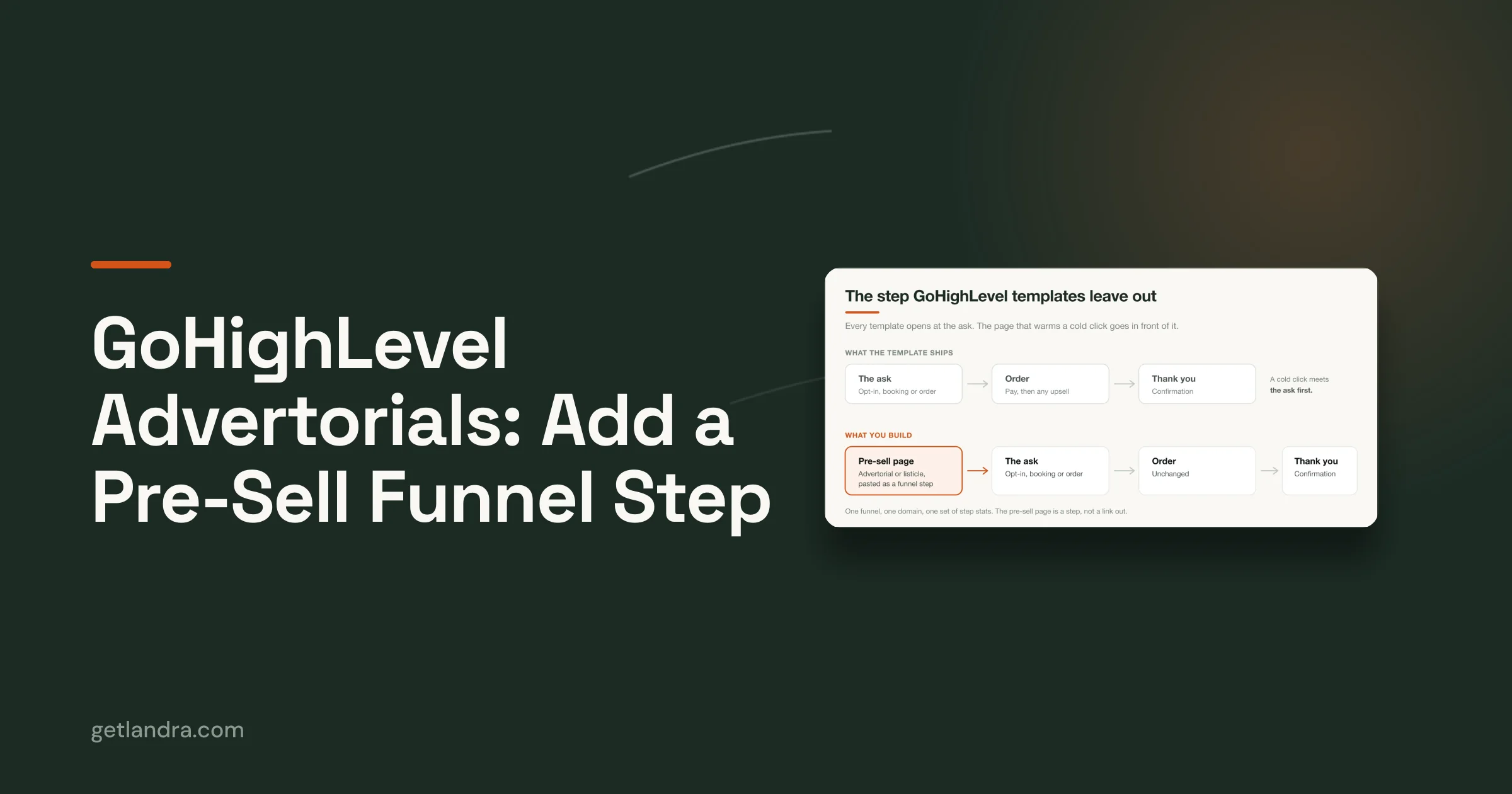
A content generator changes the operating model. Instead of starting with an empty canvas, the team starts with a draft built around a known format.
That matters because advertorials and listicles aren't random long-form pages. They have structure. The lead has a job. The body has a job. The proof sequence has a job. The CTA timing has a job.
When the tool helps with that structure, the team can spend more time refining the offer, cleaning up claims, tightening the hook, and aligning the page to the ad. That's a much better use of time than trying to write every first draft from scratch.
For a broader view of what separates this category from traditional builders, this breakdown of the best AI landing page builder options for ecommerce is a useful reference point.
The High-Converting Page Formats for Cold Traffic
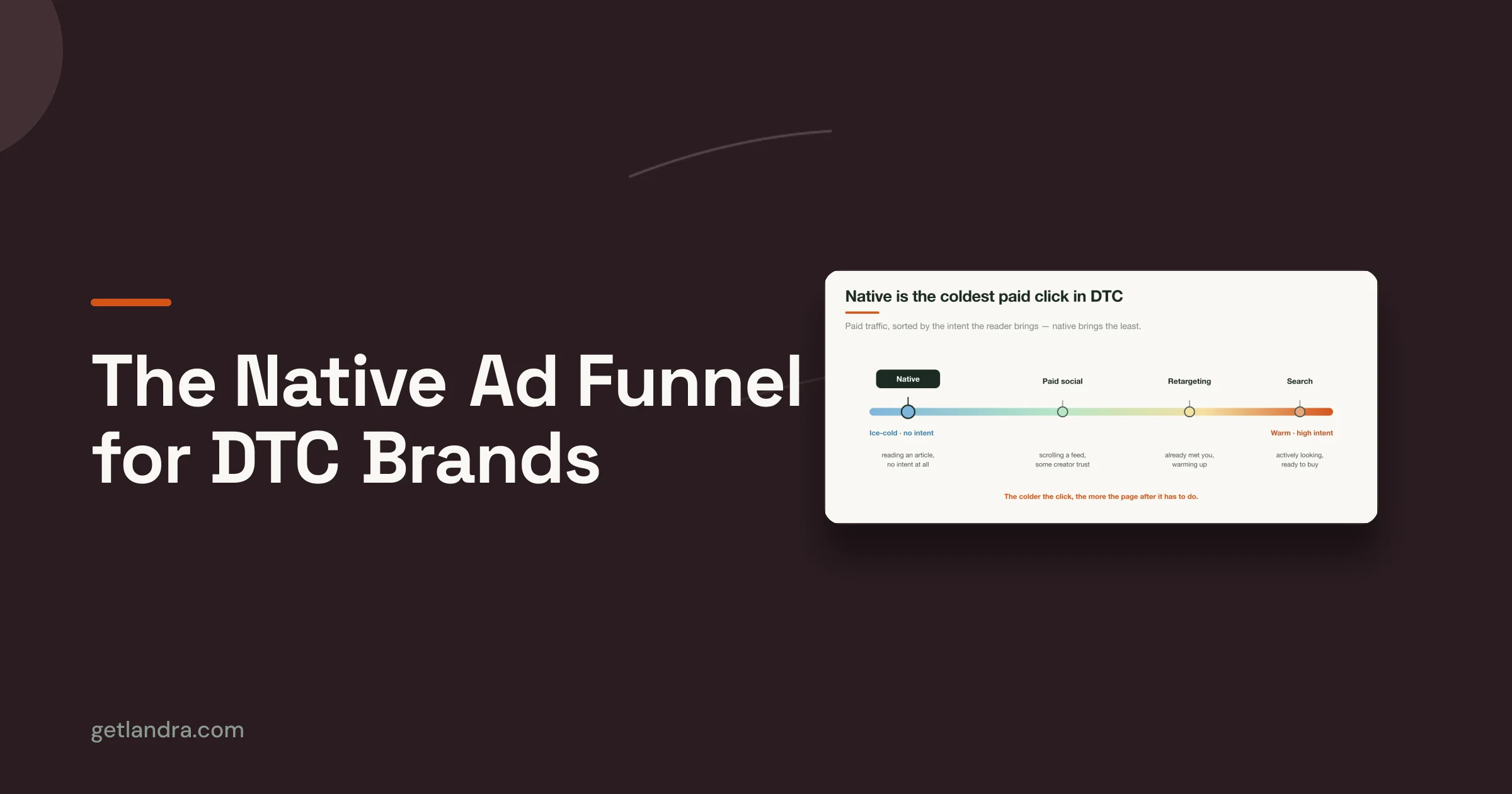
Cold traffic usually doesn't fail because the shopper hates the product. It fails because the page asks for commitment before creating understanding.
That's why the best Shopify page formats for paid social tend to educate first. They don't force a straight jump from ad click to product decision.

Advertorials work when belief has to be built
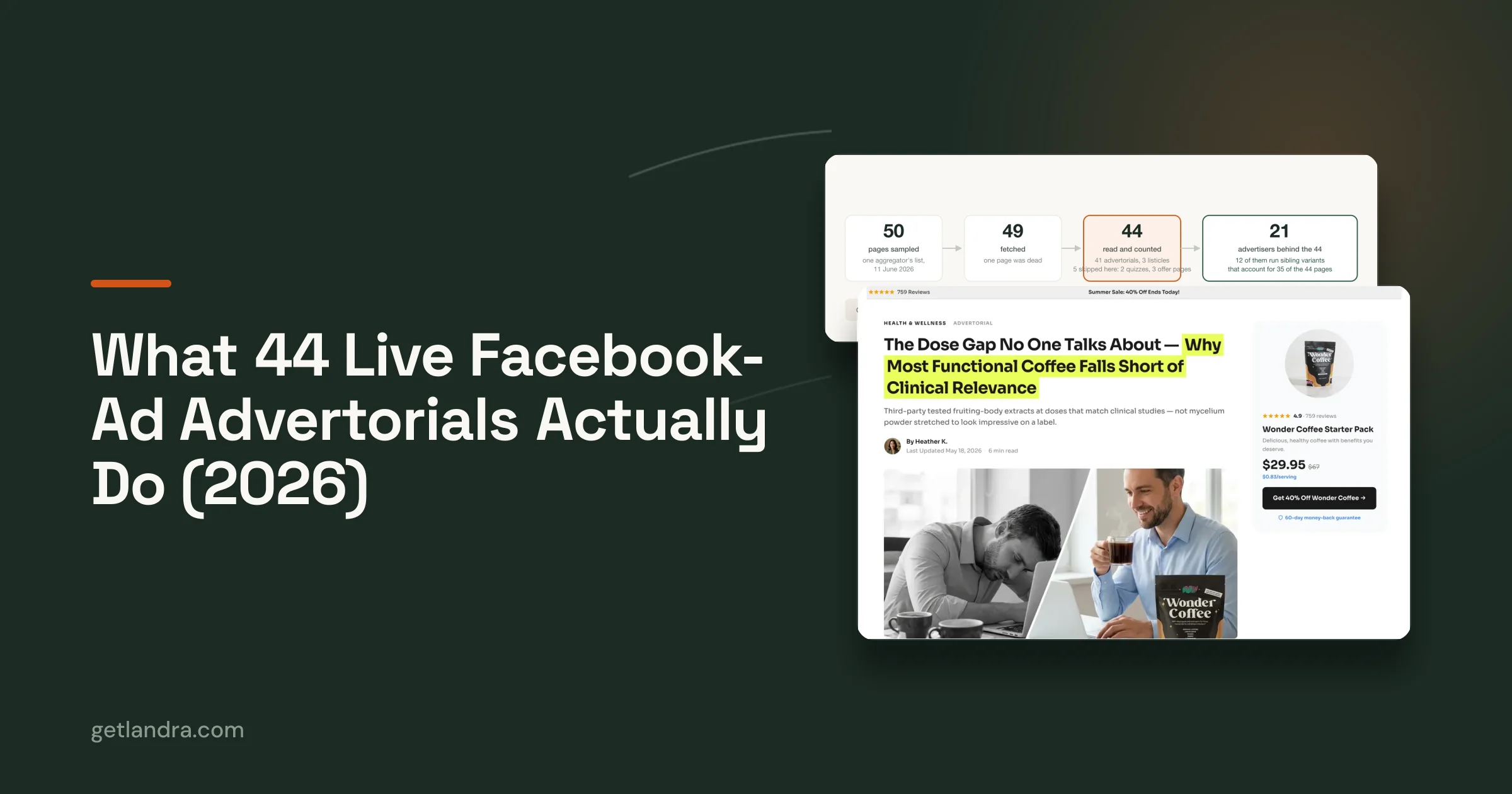
An advertorial sits between editorial content and sales content. It doesn't open with "buy now." It opens with a problem, a story, a surprising mechanism, or an angle that lowers resistance.
That's why this format works so well for products that need some education. Verified data says advertorial landing pages are statistically the highest-converting page type for products requiring education and for traffic from Facebook and Instagram.
A strong advertorial usually does four things in sequence:
- Frames the problem in language the audience already uses
- Builds curiosity around a new solution or overlooked cause
- Introduces the product naturally after the reader is leaning in
- Transitions into proof and action without feeling abrupt
Listicles convert because they're easy to scan and easy to trust
Listicles are effective for a different reason. They break the argument into small, digestible chunks.
The same verified source notes that listicle landing pages can achieve conversion rates of 8.4% when replacing traditional product pages. That makes sense operationally. A cold visitor can skim a ranked or structured page much faster than they can decode a standard PDP.
They also work well when your offer benefits from comparison, feature framing, or objection handling in a more editorial tone.
Cold traffic rarely wants a catalog page. It wants a reason to care, then a reason to trust, then a reason to click.
Offer pages still matter, but only after the pre-sell
Offer pages can work very well once the audience is warmed up. They make the deal, bundle, incentive, or urgency mechanic clear.
But for cold traffic, they usually work best after the shopper has already consumed some educational framing. That's why advertorials, listicles, and educational offer pages tend to outperform direct product pushes in social funnels.
If you're mapping formats to campaigns, this collection of Shopify landing page templates for pre-sell formats can help you think in structures instead of just page designs.
Implementation Tips and Testing Best Practices
The most common mistake brands make is optimizing for style over substance. Clean design helps. It doesn't replace CRO basics.
A landing page builder for Shopify only becomes valuable when the page gets the fundamentals right.
Build the page around decision friction
Before you test colors, ask what stops the click from becoming intent.
Value proposition clarity
The first screen should explain what the product is, who it's for, and why this page deserves attention.Trust and proof
Social proof, review language, product credibility, and reassurance need to show up before major asks.Offer strength
If the incentive is weak or unclear, no builder will rescue it.Urgency and CTA timing
Good pages don't hide the ask, but they also don't force it too early.
Test structure before polishing details
Teams often waste time tweaking design before testing the big levers. Start higher up the page logic stack.
Test:
- Headline angle
- Page type such as advertorial versus listicle
- Offer framing
- Proof order
- CTA frequency
Verified guidance on listicle structure says high-converting listicle pages typically contain 5 to 10 items with strategically placed CTAs, including early curiosity-driven calls and midway prompts, not just a single CTA at the end. That's a practical reminder that CTA placement is part of page strategy, not an afterthought.
Keep your workflow simple
Use one builder well instead of stacking too many apps around the same page flow. Write one control version. Duplicate it. Change one major variable at a time.
If the team can't explain why a variant should win, the test probably isn't focused enough.
If your team needs more than a drag-and-drop builder and wants a faster way to create advertorials, listicles, and other pre-sell pages for Shopify, Landra is built for that workflow. It helps DTC brands turn product URLs into editable, mobile-first pages quickly, so you can spend less time staring at blank pages and more time testing angles that can lower CAC.