

A founder opens Meta Ads Manager and sees plenty of activity. The clicks are coming in, the creative is getting attention, and the product page is receiving visitors. Yet the checkout data stays stubbornly quiet. The problem usually isn't that paid social failed. It's that cold visitors were sent to a page designed for people who already understand the product, trust the brand, and are close to buying.
A modern lead generation funnel gives those strangers a more useful path. The ad earns attention, an editorial pre-sell page builds relevance, a focused offer captures contact information, and a short nurture sequence turns interest into purchase intent. The mechanics matter because benchmark data puts B2B visitor-to-lead conversion around 1% to 3%, with substantial leakage before qualification begins, as reported in B2B lead generation funnel benchmarks.
Table of Contents
- The Cold Click That Never Converts
- The Five Stages of a Lead Generation Funnel
- Why Product Pages Leak Cold Paid Traffic
- Building a Paid Social Funnel That Captures Leads
- Nurturing Leads from Capture to Customer
- What Lift Looks Like in Practice
- The Funnel Failures That Cost DTC Brands
- Your One-Page Funnel Checklist and 30-Day Test Plan
The Cold Click That Never Converts
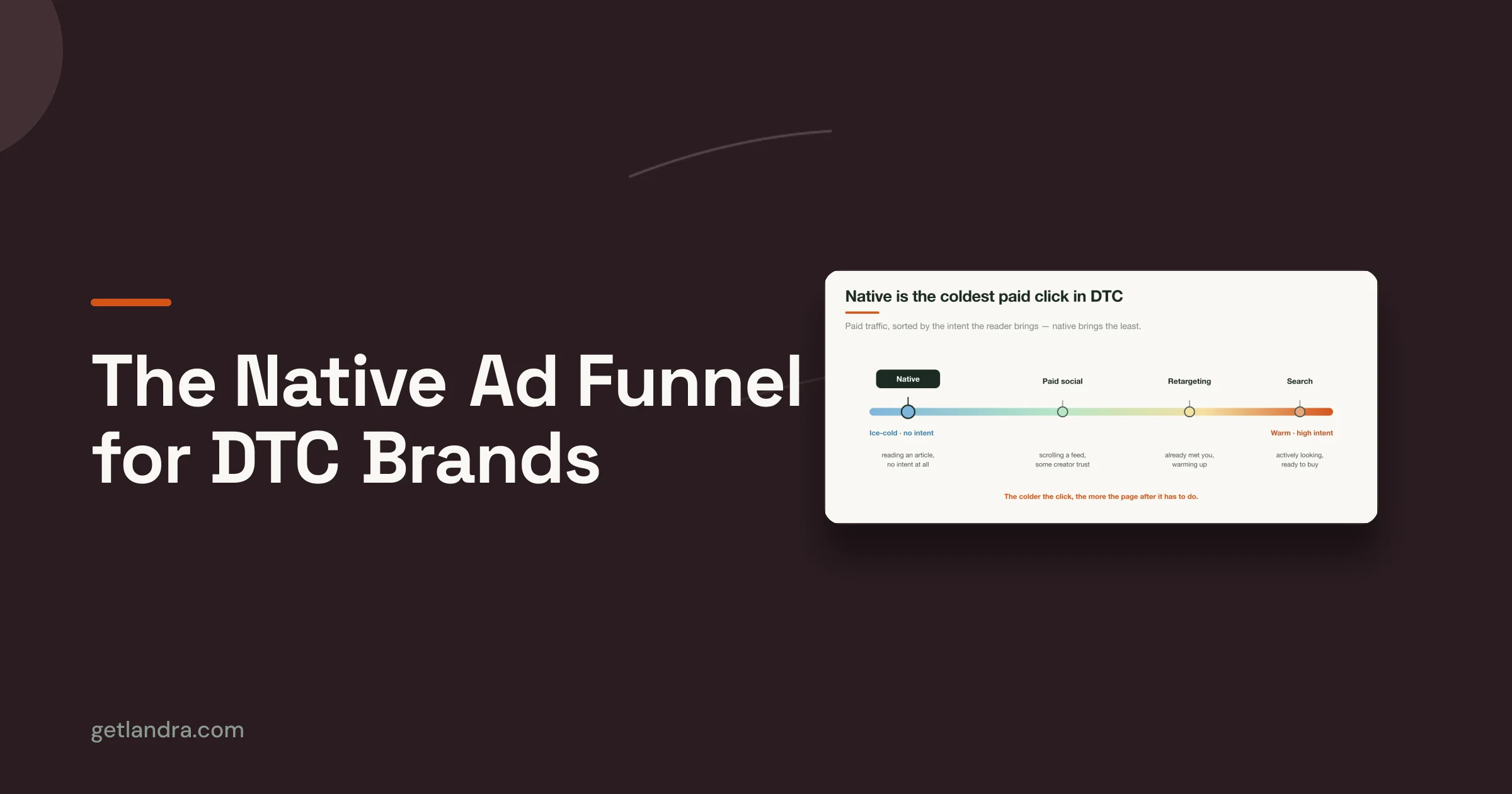
A DTC founder checks the monthly dashboard and sees a familiar contradiction. Paid social generated thousands of link clicks, but only a small number of visitors added a product to cart, and fewer completed checkout. The campaign looks active from the platform's perspective, yet the economics damage the brand.
That outcome often starts with the destination. The ad speaks to a problem, a frustration, or a compelling transformation. The product detail page opens with a product image, price, variants, shipping information, and an Add to Cart button. A stranger who clicked because the problem felt familiar is suddenly asked to evaluate the product before the brand has explained why this solution deserves consideration.
The page isn't necessarily badly designed. It's performing a different job. A PDP supports a buyer who already knows what they're looking for. Cold traffic needs context first.
Operator rule: Don't ask a cold visitor to make a product decision when they haven't made a problem decision yet.
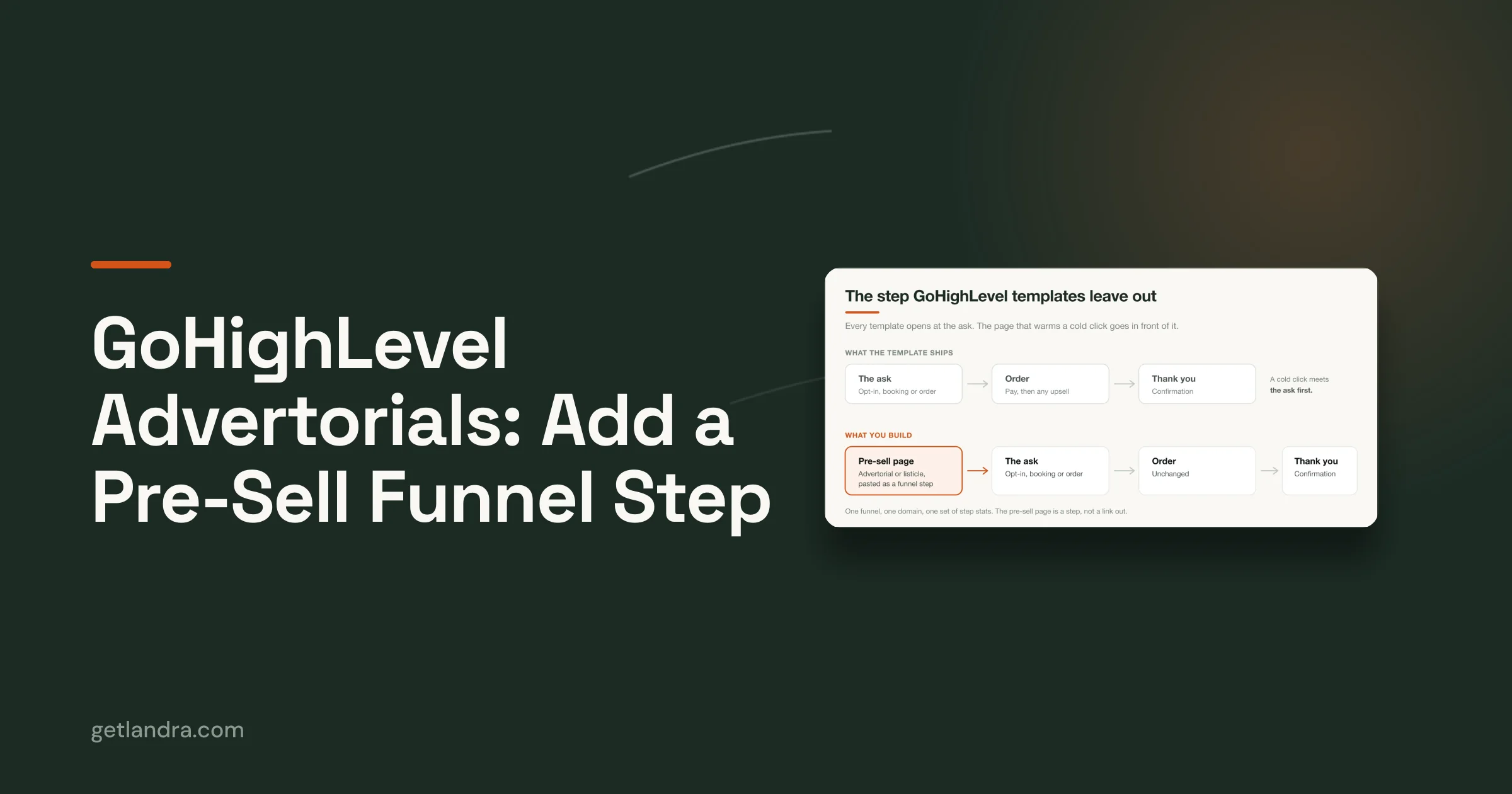
The pre-sell page creates that missing stage. It translates the ad's promise into an editorial narrative, shows why the problem matters, introduces proof, and presents a lower-friction next action such as a quiz, sample request, waitlist, or discount capture. The product page still closes the sale, but it no longer has to educate and persuade from scratch.
Click quality also depends on what happens before and after the click. Teams improving Shopify acquisition should review how YipSMS Inc. boosts Shopify CTR, particularly when ad engagement and onsite action don't move together.
The rest of this guide treats the funnel as a measurable chain, from thumb-stop to nurture to purchase, so you can identify the leak instead of blaming the traffic.
The Five Stages of a Lead Generation Funnel
A funnel works when each stage has a distinct job. Awareness shouldn't be judged by purchases alone, and a lead capture page shouldn't be evaluated with the same event as a checkout page. Tracking every stage against one conversion event hides whether the problem is weak creative, poor page engagement, excessive form friction, or failed follow-up.

Awareness earns attention
The first stage introduces the problem or desired outcome to people who don't yet know the brand. Paid video, creator content, short-form demonstrations, and problem-led static ads work here because they compete for attention before they compete for purchase intent.
Track CPM and three-second views as directional signals. If the audience isn't stopping, the landing page can't rescue the campaign. The practical question is whether the opening visual and first line make the intended audience recognize their situation quickly.
Interest earns the next click
Interest begins when the viewer understands why the message might matter. The asset could be a demonstration, a founder explanation, a customer problem, or a sharp comparison. The KPI that matters is click-through rate to the next step, not engagement in isolation.
A high-engagement ad with weak outbound clicks may entertain people without creating curiosity. A useful breakdown by audience type and creative angle can be supported by resources that help teams find lead generation strategies per sector, since the strongest hook depends on the market's language and buying context.
Consideration qualifies traffic
The pre-sell page handles the education that a cold PDP often skips. It should answer the visitor's immediate questions, preserve the ad's promise, establish credibility, and make the next action feel like a natural continuation.
Measure scroll depth and time on page together. Time without scroll can indicate confusion, while shallow scroll can indicate a mismatch between the ad and the headline. The useful signal is whether visitors consume enough of the argument to reach the offer.
Intent captures a contact
Intent becomes observable when a visitor completes a form, quiz, sample request, or waitlist action. The primary KPI is form or quiz completion rate, but quality must sit beside volume. A discount may produce many contacts who only want a lower price, while a product-fit quiz can reveal stronger purchase motivation.
Keep the form proportional to the value exchanged. Ask for information you can use, not information your team merely wants to store.
Conversion turns intent into revenue
The final stage converts a warmed prospect into a customer. Customer acquisition cost and assisted conversion are the useful measures because the last click doesn't always receive credit for the pre-sell page, email, SMS, or retargeting exposure that shaped the decision.
A healthy funnel assigns one primary KPI to each stage, then connects those metrics in sequence. That view shows whether you need a new hook, a clearer advertorial, a shorter form, or a stronger nurture path.
Why Product Pages Leak Cold Paid Traffic
A product detail page assumes prior knowledge. The visitor should already understand the category, recognize the problem, and have enough trust to evaluate price, ingredients, sizing, shipping, or features. A cold Meta or TikTok click doesn't carry that context with it.
The mismatch appears in several places:
- Creative continuity breaks: The ad promises a specific outcome, but the PDP hero image presents the product without reinforcing that promise.
- Benefits arrive too late: Product copy lists features before explaining why the visitor should care.
- Proof hides below the fold: Reviews and demonstrations may be available, but mobile visitors don't see them before facing the purchase decision.
- The CTA jumps too far: Add to Cart is the only action, even when the visitor needs education or reassurance first.
The supplied brief doesn't provide a verified DTC PDP conversion benchmark, so it would be misleading to attach precise PDP or pre-sell performance figures here. The broader funnel benchmarks do show why the first capture stage deserves attention. Visitor-to-lead conversion commonly sits around 1% to 3% or 2% to 5%, while later lead-to-MQL and MQL-to-SQL stages often convert at higher rates, according to lead conversion rate benchmarks.
The pre-sell page supplies the missing context
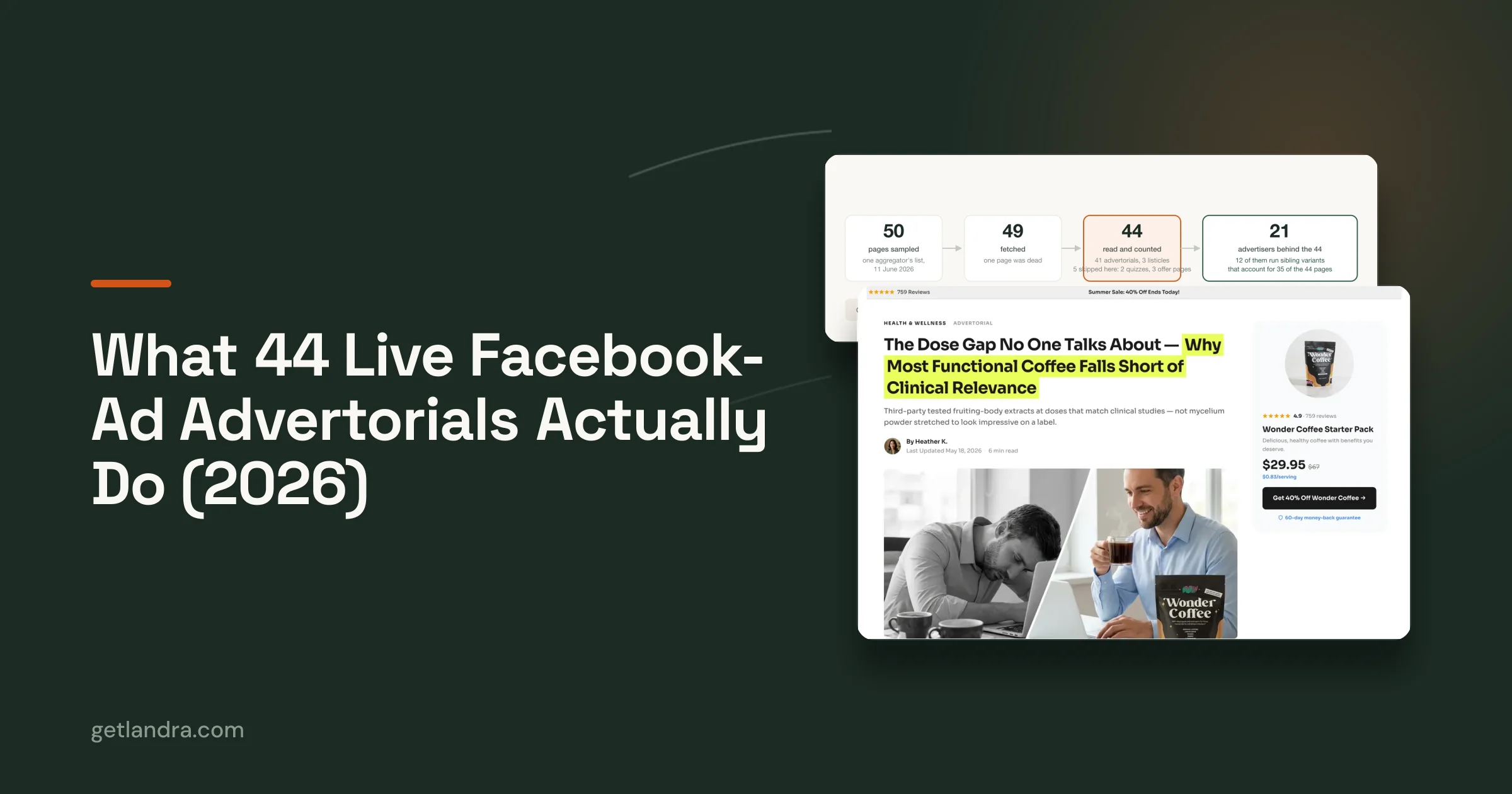
An editorial pre-sell page isn't a decorative detour. It gives the ad somewhere to continue its argument. The strongest versions preserve the original hook in the first screen, explain the problem in plain language, introduce the product as a response, and offer one clear action before the visitor reaches the PDP.
That action might capture an email, start a quiz, or send the visitor to a product page with substantially more understanding. The right choice depends on buying friction and intent. A familiar replenishment product may need a quick offer, while a novel formulation may need education and proof.
| Metric | Direct to PDP | Via Pre-Sell Page |
|---|---|---|
| Primary job | Close a purchase | Build context before the purchase |
| Cold-traffic message | Often compressed into product copy | Continued from the ad headline |
| First action | Usually Add to Cart | Quiz, email, sample, or product-page click |
| Main diagnostic | PDP conversion and cart progression | Page engagement, capture, and assisted purchase |
| Typical risk | Asking for commitment too early | Adding a step without enough relevance |
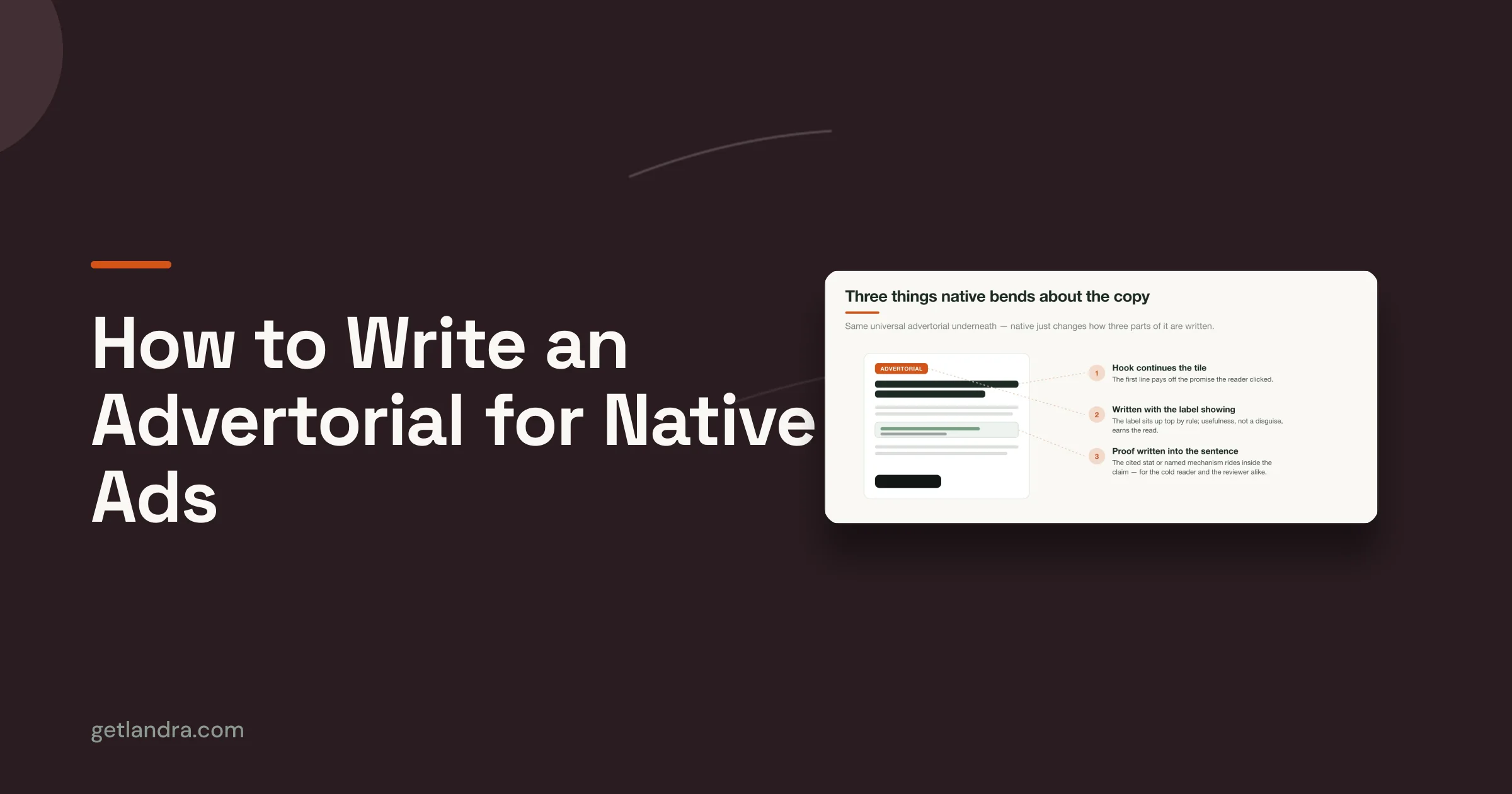
Teams creating editorial pages can use an AI advertorial creation guide as a reference for structuring the narrative. The important principle isn't automation itself. It's maintaining message continuity from ad to page to offer.
Building a Paid Social Funnel That Captures Leads
A paid-social funnel starts with the audience's intent and the promise carried from ad to page. Meta and TikTok broad targeting can work when the creative names a specific problem. Lookalikes are useful when the seed audience reflects customers, not low-intent subscribers. Competitor-curious audiences require careful positioning because comparison language may attract research without purchase urgency.
Match the audience hook to the page
Choose one audience hypothesis, then build the editorial pre-sell page around it. A problem-solution hook should lead to a page that explains the problem and demonstrates the mechanism. A social-proof hook should open with credible customer evidence and clarify who the product is for. A founder-story hook should connect the founder's reason for building the product to the visitor's frustration.
The page should continue the ad's argument rather than introduce a new thesis. If the ad promises help with a specific routine problem, repeat that promise in familiar language on the first screen. Message match often contributes more than another testimonial or feature block because it confirms that the click led to the expected answer.
Choose the lead magnet by intent
A quiz can qualify visitors by preference or problem severity. A discount can capture price-sensitive shoppers. A sample request can create product experience. A waitlist fits situations where availability or a launch gives people a reason to act.
Choose the magnet based on the action the visitor can complete naturally after reading the page. A form asking for email, phone, preferences, and multiple quiz answers may expand the database while reducing completion and making intent harder to interpret.
A Landra-style pre-sell page can bridge the paid click and lead magnet. An automated listicle creation tool can support comparison-led angles when the audience is evaluating options.

Keep the page mechanically simple
Place a bold hook line, a three-bullet promise, and one primary CTA above the first major proof section. Put supporting details below the initial decision point. Visitors should understand the offer, its relevance, and the next step without working through a crowded layout.
The video below shows the broader paid-social funnel workflow. Use it as a process reference, then test each recommendation against the audience, offer, and post-capture behavior.
Nurturing Leads from Capture to Customer
The form submission is a handoff, not a conversion finish line. Capture the context that explains why the person opted in, then use that context to decide what they see next.
At minimum, preserve the source campaign UTM and lead magnet ID in the CRM. Those two fields keep the original promise attached to the contact after the click disappears from view. Add declared intent when the form or quiz can collect it without creating unnecessary friction.
A practical first-week sequence
Send the delivery or confirmation message immediately. Follow with a second email or SMS touch within the first hour if the offer warrants a reminder, then provide useful education around the next day. A later message should address the most likely objection with proof, explanation, or product guidance. A re-engagement branch can catch people who opened or clicked but didn't take the next action.
The exact channel mix depends on consent, product category, and buying cycle. For fast DTC decisions, SMS can deserve priority because it supports direct replies and timely reminders. Don't assume a message belongs in the sequence because it exists. Every touch should answer a question, remove a concern, or make the next action easier.
Score behavior, then change the offer
Use page depth, email clicks, repeat visits, quiz answers, and product-page views as practical signals. A lead who returns to the PDP and interacts with product information belongs in a different retargeting audience from someone who only downloaded a general guide.
| Lead Magnet | Capture Fields | Week 1 Cadence | Retargeting Trigger | Expected Window |
|---|---|---|---|---|
| Product-fit quiz | Email, answers, source UTM | Results delivery, guidance, objection response | Completed quiz plus product-page visit | Short buying cycle |
| Discount | Email, consent, campaign UTM | Code delivery, product education, reminder | Code view or checkout start | Immediate purchase consideration |
| Sample request | Email, product preference, location if needed | Confirmation, usage guidance, follow-up | Sample confirmation plus return visit | After product experience |
| Waitlist | Email, product or launch interest | Confirmation, education, launch updates | Launch-page return or click | Launch-dependent cycle |
Move a high-intent contact into product-focused retargeting with an offer that reflects their behavior. Teams looking to turn leads into customers on autopilot should still define the exit rules themselves. Automation can deliver the sequence, but the business must decide when nurture ends and purchase-focused messaging begins.
What Lift Looks Like in Practice
The useful comparison is the measurement design, not reported case studies. The available evidence does not provide verified numerical results for the skincare or fashion scenarios in the brief. A numbers-first teardown covering CTR, dwell time, capture rate, qualified-lead cost, SMS reply rate, or repeat-purchase changes would require invented data. Responsible funnel analysis keeps hypothetical outcomes separate from observed performance.
Run the same audience and creative concept against two destinations, a direct PDP and an editorial pre-sell route. Keep budget allocation and attribution window consistent. Compare the full path instead of choosing the most flattering metric.
| Metric | PDP Only | PDP + Pre-Sell Page | Delta |
|---|---|---|---|
| Ad click-through rate | Record observed baseline | Record observed variant | Variant minus baseline |
| Pre-sell engagement | Not applicable | Track scroll and time | Establish new baseline |
| Lead capture rate | Record if no capture exists | Record form or quiz completion | Variant minus baseline |
| Qualified lead cost | Calculate from qualified contacts | Calculate from qualified contacts | Compare efficiency |
| Product-page purchase rate | Record purchase progression | Record assisted progression | Compare by route |
| Customer acquisition cost | Record revenue and spend | Record revenue and spend | Compare full path |
The next test should separate volume from intent. A gated discount may collect more contacts, while a style quiz or fit assessment may generate fewer contacts with clearer preference signals. Capture rate alone cannot choose the winner. Compare downstream engagement, returns to the product page, replies, purchases, and repeat behavior across the same observation period.
The pre-sell route earns its place only when the added step improves the economics after capture. A higher lead count with weak product engagement can increase workload without improving acquisition efficiency.
Measurement principle: A lead is not automatically an improvement. It becomes an improvement when the extra contact produces better economics downstream.
Use the DTC conversion statistics guide for experiment-planning context. Do not import a benchmark into your dashboard unless its definition, traffic source, offer, and attribution method match your test.
The Funnel Failures That Cost DTC Brands
A DTC funnel can lose qualified paid-social traffic at the handoff between stages. Diagnose that break before increasing spend. Cold clicks need a clear path from ad promise to editorial pre-sell page, lead capture, nurture, and product page.

- Offer-message mismatch: Does the ad promise carry through the headline, pre-sell argument, lead magnet, and product page? Any break can reduce capture or product engagement.
- Slow mobile experience: Can a new visitor understand the offer and reach the CTA quickly on a mobile connection? One benchmark reports about 4.2% conversion for mobile pages loading under 1.8 seconds, falling to roughly 1.68% at 3 to 4 seconds and 0.62% at 5 seconds or more, as documented in mobile landing-page speed benchmarks.
- Weak nurture: Does each follow-up reflect why the visitor opted in and return them to relevant product proof?
- Over-capture: Are phone, email, and detailed answers required when a lighter exchange could identify intent?
- Premature retargeting: Are cold visitors receiving discount ads before education, proof, or product relevance?
Slow loading often gets misdiagnosed as a page persuasion problem. If the visitor leaves before the offer renders clearly, button-color changes will not help. Check first paint, headline visibility, form usability, and the distance between the ad promise and the first screen. These checks connect each failure to a measurable lift opportunity rather than an abstract funnel definition.
Your One-Page Funnel Checklist and 30-Day Test Plan
Use this checklist before changing budgets:
- Audience: The targeting hypothesis and creative angle describe the same problem.
- Page: The first screen repeats the ad promise and presents one clear next action.
- Offer: The lead magnet matches the visitor's buying intent.
- Mobile: The page loads quickly and keeps proof and CTA access straightforward.
- Form: Every field earns its place through qualification or follow-up utility.
- CRM: Source campaign UTM and lead magnet ID survive the submission.
- Nurture: Contacts receive relevant messages and move to retargeting when behavior signals intent.
- Reporting: Each stage has one primary KPI, with revenue and assisted conversion reviewed downstream.
The 30-day sprint
Week 1 audits the existing route, checks event tracking, validates UTMs, and records the current PDP baseline. Week 2 launches one controlled comparison, usually the existing PDP against a message-matched pre-sell page. Week 3 isolates either the creative hook or the audience hypothesis, never both in the same test. Week 4 documents the winning combination, records the new baseline, and queues the next single-variable experiment.
Call a test a winner only when it produces at least a 30% lift in lead capture rate and reaches 95% confidence through the platform's built-in A/B tool, as specified in the testing brief. Treat that threshold as a decision rule, not a guarantee of profitability. Revenue, qualified-lead cost, and customer acquisition cost still decide whether the change deserves wider deployment.
Ship one variable, measure one number, decide one way.

Landra generates editable, mobile-first advertorials, listicles, and pre-sell pages from a product URL, then supports publishing to Shopify, a hosted URL, Webflow, or HTML. Visit Landra to create a message-matched bridge between your paid social ads, lead capture offer, and product page.