
A bridge page is a page between an ad and the offer. People click the ad, land on the bridge page, read it, and then click through to the page that takes the order.
It goes by a few names. Affiliate marketers say bridge page or prelander. DTC brands usually say presell page, advertorial or listicle. We covered the naming in prelander vs presell page.
This post is about the part that costs money: Google Ads names bridge pages in a policy that gets ads disapproved. Here's what that policy says, word for word, and what it means for a brand that runs a page before the product page.
Where the name comes from
The term comes from affiliate marketing. Ahrefs' glossary entry, loaded 15 November 2026, describes it this way: "A bridge page is a specific landing page used in affiliate marketing whose purpose is to send the prospect to the destination page on another [site] via an affiliate link."
Its example is an ad for a weight loss course. The click goes to a page on website A "explaining all the benefits of this new course". The buy button goes to "the actual offer on website B", and website A gets the commission.
A DTC brand runs the same shape of page, with one difference. The offer after the click is the brand's own product page. That matters for what you can change and measure, and the prelander post covers it. For Google's review, the question is the same for both: does the page offer anything on its own?
What Google Ads says about bridge pages
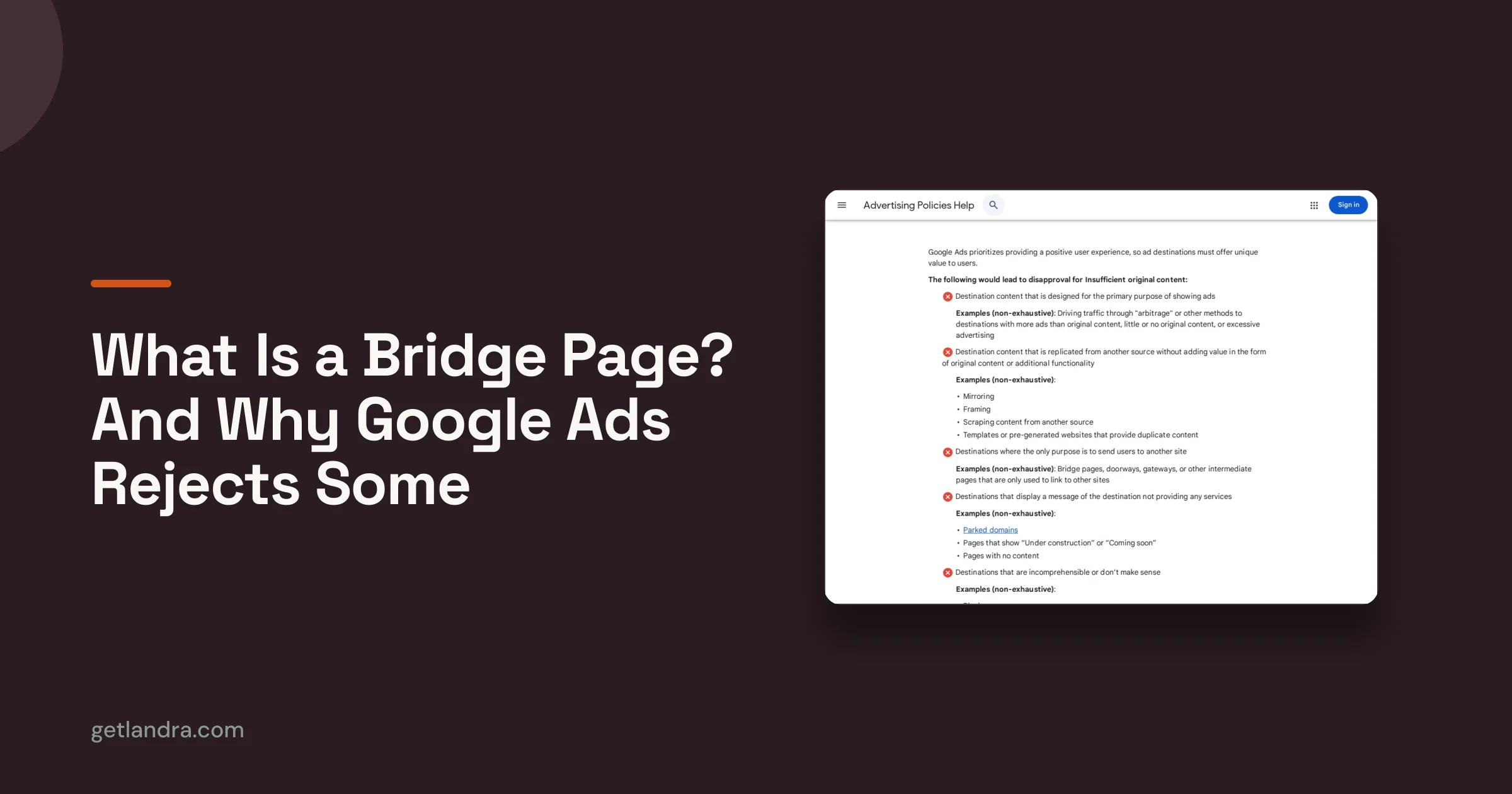
Google Ads has a policy called Insufficient original content. It sits under Destination requirements, the rules for the page an ad sends people to.
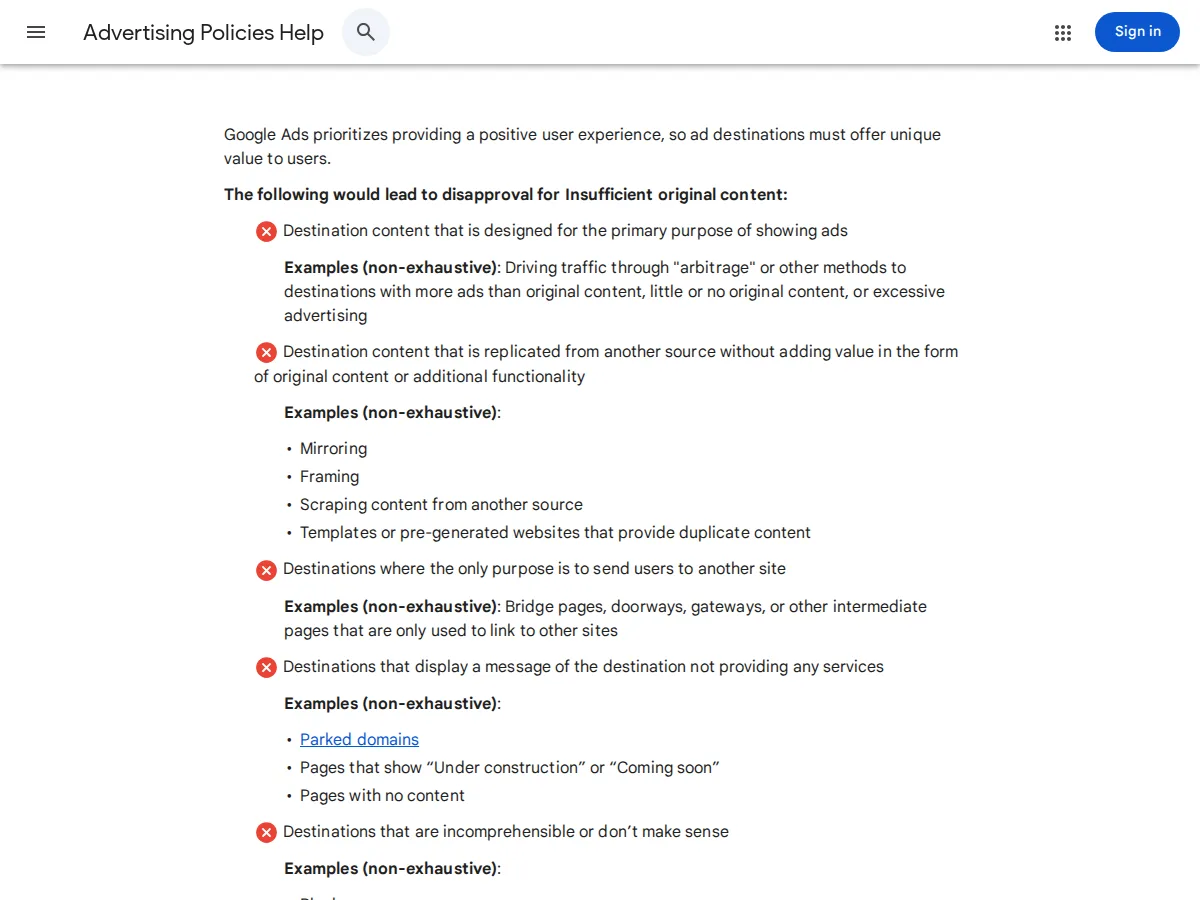
The policy opens: "Google Ads prioritizes providing a positive user experience, so ad destinations must offer unique value to users." Then it lists five things that "would lead to disapproval". The third one names bridge pages:
Destinations where the only purpose is to send users to another site. Examples (non-exhaustive): Bridge pages, doorways, gateways, or other intermediate pages that are only used to link to other sites
The other four are worth knowing too, because a thin page before the product page can hit more than one:
- Pages built to show ads. "Destination content that is designed for the primary purpose of showing ads", for example "more ads than original content, little or no original content".
- Copied pages. "Destination content that is replicated from another source without adding value". The examples include "Mirroring", "Framing", "Scraping content from another source" and "Templates or pre-generated websites that provide duplicate content".
- Bridge pages, quoted above.
- Pages that say they offer nothing. Parked domains and pages that show "Under construction" or "Coming soon".
- Pages that make no sense. "Blank pages" and "Pages with gibberish landing page content".
The page also says what happens if you break it: "Violations of this policy won't lead to immediate account suspension without prior warning. Google will issue a warning at least 7 days before suspending your account."
The word that matters is "only"
Read the bridge page line again. It covers pages "only used to link to other sites" and destinations where "the only purpose is to send users to another site".
So a page that sits between the ad and the offer is not banned for being in between. It gets disapproved when sending people on is all it does.
Google's fix, from the same page: "Focus on providing the user with useful, unique, and original content on your landing page. Don't overload the destination with ads, regardless of how relevant the ads are to your ad text."
Google doesn't publish a word count or a list of what counts as enough. Some blogs give a number. Treat that as their advice, not as Google's rule.
Here's how the two kinds of page usually look side by side:
| A bridge page that only links | A presell page with its own content | |
|---|---|---|
| What's on the page | A headline and a button | A story, a problem, how the product works, reasons to buy |
| Where the text is from | Copied from the offer page or a template | Written for this page and this audience |
| Could someone stop here and learn something? | No | Yes |
| What the button does | The only thing the page offers | The next step after reading |
An advertorial or listicle that explains a problem and how the product solves it is the second kind. A page that repeats the product page's headline and puts a big button under it is closer to the first.
Google Search has its own rule: doorway abuse
If your bridge page is also meant to rank in search, a different policy applies. Google Search's spam policies, last updated 28 August 2026, define doorway abuse:
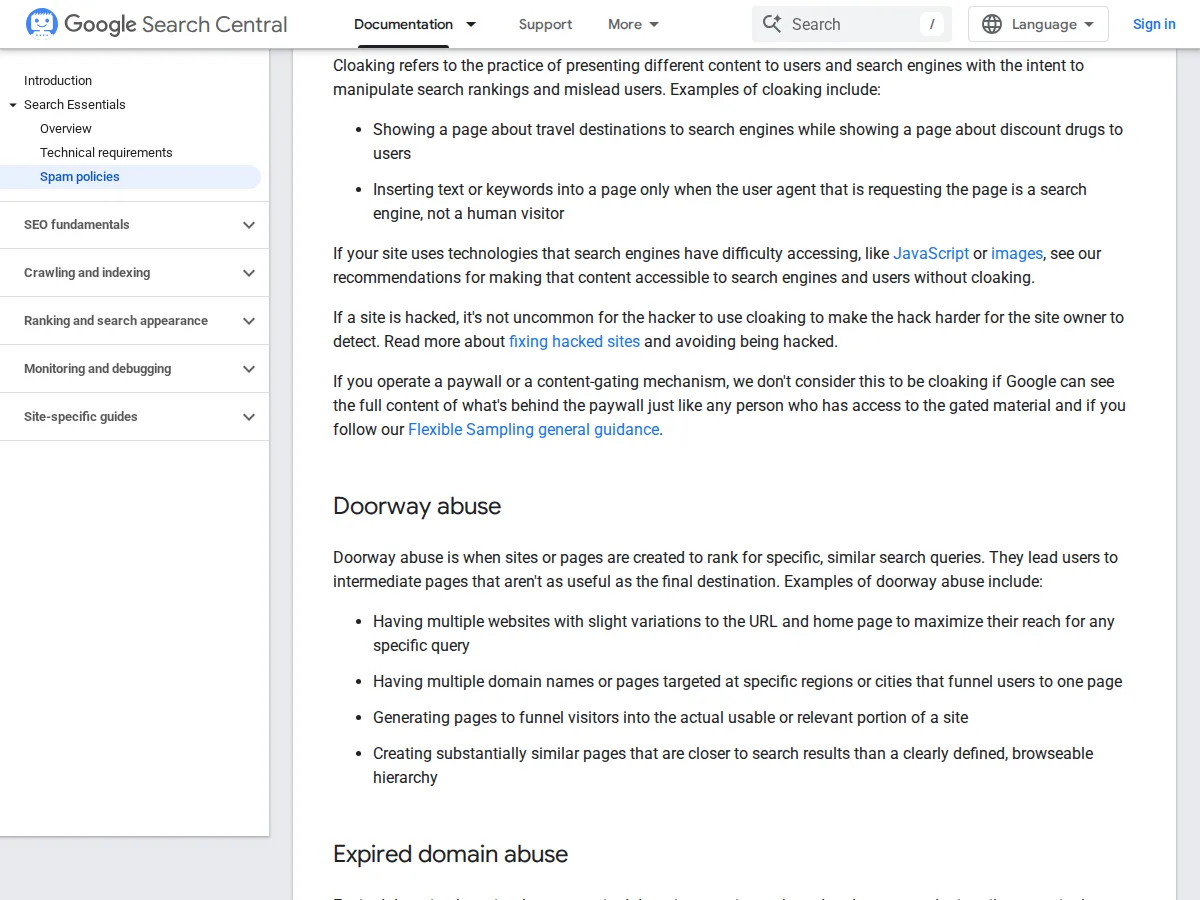
"Doorway abuse is when sites or pages are created to rank for specific, similar search queries. They lead users to intermediate pages that aren't as useful as the final destination." The examples include "Having multiple domain names or pages targeted at specific regions or cities that funnel users to one page" and "Creating substantially similar pages that are closer to search results than a clearly defined, browseable hierarchy".
For a brand, the risk shows up when one presell page gets copied many times with a city or a keyword swapped, and every copy is indexed. If you run ten versions of a page for ten ad angles, that's normal ad testing. Keep the test versions out of search (a noindex tag does that) unless each one is worth finding on its own.
The same policy page has a section on thin affiliation. It describes pages where "product descriptions and reviews are copied directly from the original merchant without any original content or added value". It also says: "Not every site that participates in an affiliate program is a thin affiliate." The examples of good affiliate pages include "original product reviews, rigorous testing and ratings" and "product comparisons".
A checklist before you send Google Ads traffic to a bridge page
These come straight from the two policies above. They don't guarantee approval. Google reviews each destination itself.
- The page stands on its own. Someone who never clicks the button should still learn something about the problem or the product.
- The words are written for this page. Not pasted from the product page, a supplier, or the template it was built from.
- No ads for other companies. Google's first reason for disapproval is pages "designed for the primary purpose of showing ads".
- The page is finished. No "Coming soon", no placeholder text, no blank sections.
- One page per ad angle, not one per keyword. Many near-copies indexed in search is what the doorway policy describes.
- The page matches the ad. That's a separate review, but a page that talks about something other than the ad is the fastest way to lose the click. Our message match worksheet walks through the check.
If you also run the page on native networks, they have their own rules on labels and claims. See what native networks reject on landing pages, and for disclosure, advertorial disclosure and the FTC.
Should a DTC brand use a bridge page at all?
If your product needs explaining before people buy, a page before the product page is worth testing. Ads are cheap and easy to make. Getting the page right is the hard part, and a product page often can't do the explaining on its own. We wrote about when each one wins in presell page vs product page.
Test it the simple way: same ads, half to the product page and half to the presell page. Judge it on cost per purchase, not on clicks to the product page. How to measure a presell page has the setup.
Where Landra fits
Landra builds the kind of page Google's policy asks for: an advertorial or listicle from your product URL, with the story, layout and images written for that page (14-day trial, plans from $19/mo). We recommend checking your page to make sure we got everything right before it goes live.
Frequently asked questions
What is a bridge page?
A page between an ad and the offer. People land on it, read it, and click through to the page that takes the order. Affiliate marketers call it a bridge page or prelander. DTC brands usually call it a presell page, an advertorial or a listicle.
Does Google Ads allow bridge pages?
Not when the page is only there to send people somewhere else. Google Ads lists "Bridge pages, doorways, gateways, or other intermediate pages that are only used to link to other sites" under its Insufficient original content policy. A page with its own useful, original content is not what that line describes.
How much content does a bridge page need to pass Google Ads review?
Google does not give a number. Its fix for this policy says to focus on "useful, unique, and original content on your landing page" and not to "overload the destination with ads". Word counts you see online are other people's advice, not Google policy.
What is the difference between a bridge page and a doorway page?
Doorway abuse is a Google Search spam policy about pages built to rank for "specific, similar search queries". A bridge page is about where your ad traffic lands. One page can be both if you make many near-copies of it to rank in search.
Is a bridge page the same as a prelander?
Yes, as a page. Bridge page, prelander and presell page all describe a page between the ad and the offer. The difference is mostly who uses which word.