
A quiz funnel sends people from an ad to a short quiz. They answer a few questions, and the last screen shows the product that fits their answers.
It's one of the three common presell formats, next to the advertorial and the listicle. All three sit between the ad and the product page. The difference is what they do with the visitor. An advertorial or listicle explains the product, while a quiz asks a few questions and then picks a product for the shopper.
So the useful question for a DTC brand is whether your shoppers need help choosing a product or help understanding it.
What the quiz benchmarks actually measure
Most quiz numbers you'll find come from quiz software companies. They're useful, but read the small print, because they don't count the same people.
| Source | Who it counts | What it reports |
|---|---|---|
| ConvertFlow benchmark (Sep 2026), 2,120 quiz campaigns | Everyone who viewed it | 5.2% placed an order. Average order $264. 44.2% engaged with the quiz. |
| RevenueHunt benchmark, cited Feb 2026 | People who finished it | 5.5% placed an order, "about 1 in 18" |
| CUUP case study (Visual Quiz Builder) | People who took it | 8.1% purchase rate over six months, 115,000 completions, 58% completion rate |
ConvertFlow's sample only includes quizzes that were "live at least 30 days" with "100+ unique viewers" on Shopify stores. Quizzes that were switched off early aren't in it. RevenueHunt counts people who finished, which leaves out everyone who quit halfway. CUUP's case study is titled "2.5x Conversions", but the page doesn't say what the 2.5x is compared against.
The most useful line in the ConvertFlow report is the split by price. The median order rate was 1.7% for baskets under $50, 6.1% for $50 to $150, and 3.8% for $150 and up. ConvertFlow marks the under-$50 and $150+ numbers as directional. Read that as a hint, not a rule: a quiz seems to earn its place on mid-priced products where getting the right one matters.
For comparison, our 2026 landing page benchmarks cite typical ranges for ad traffic from MHI Growth Engine (Feb 2026): about 2 to 5% for an advertorial, 1.5 to 3.5% for a product page, and 3 to 8% for a quiz. Those ranges overlap a lot. The format alone won't decide your result.
When a quiz is the right page
A quiz works when the shopper can't buy until they've picked something, and picking is hard on their own.
We went through Ollie's dog food quiz on 12 November 2026. The start screen says "Start the 3 minute quiz", with "Applied: 70% off + free gift" above it. It has six steps. The first five ask for the dog's name, sex, spay status, weight and activity level, and each one tells you why it's asked:
- Sex: "Sex affects metabolism and calorie needs"
- Spay status: "Spayed and neutered pups need less calories."
- Weight: "Tell us her ideal weight", with "2.5 more years together" and "Keeping your dog at a healthy weight can help them live longer" under the field
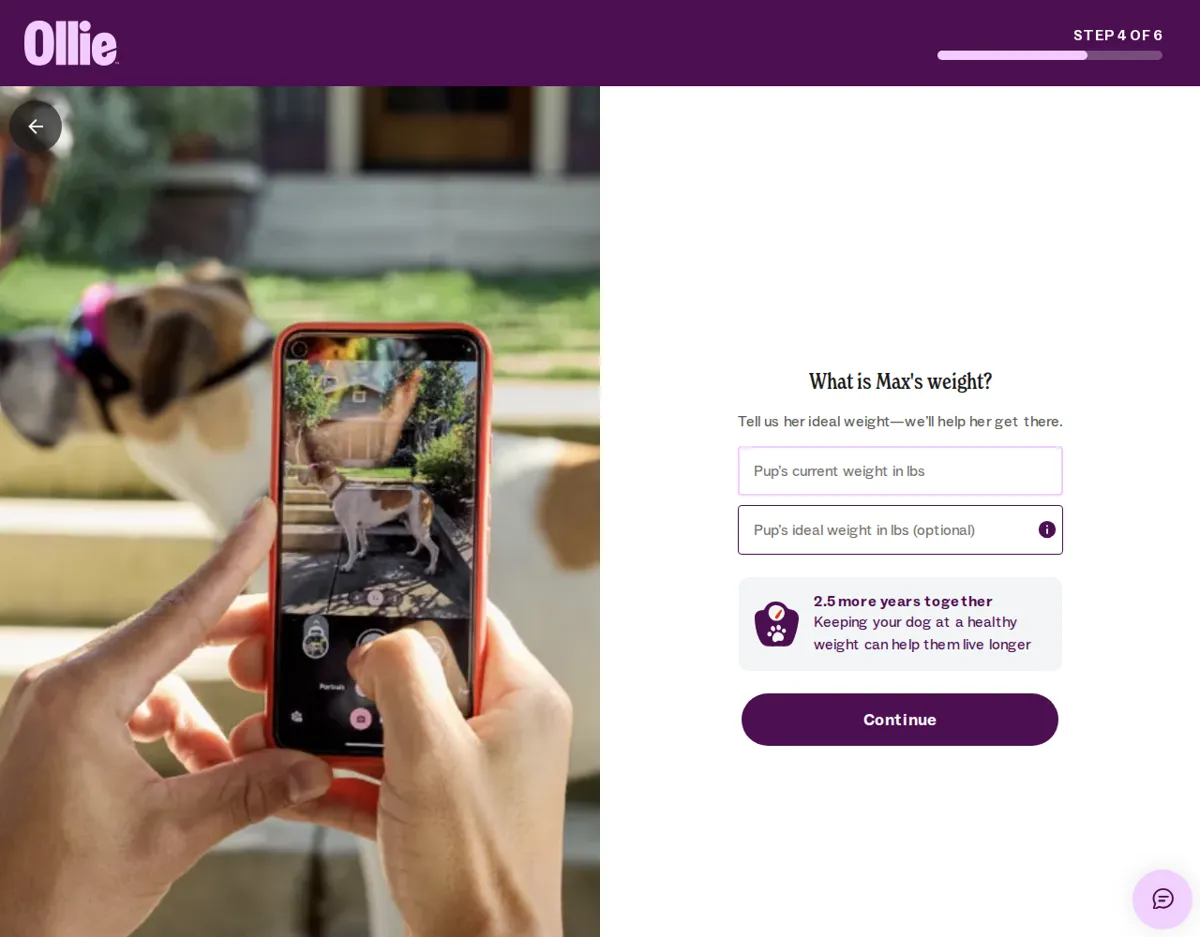
Ollie can't sell a fresh food plan without knowing how much food to send. The quiz collects what the order needs and explains each step as it goes.
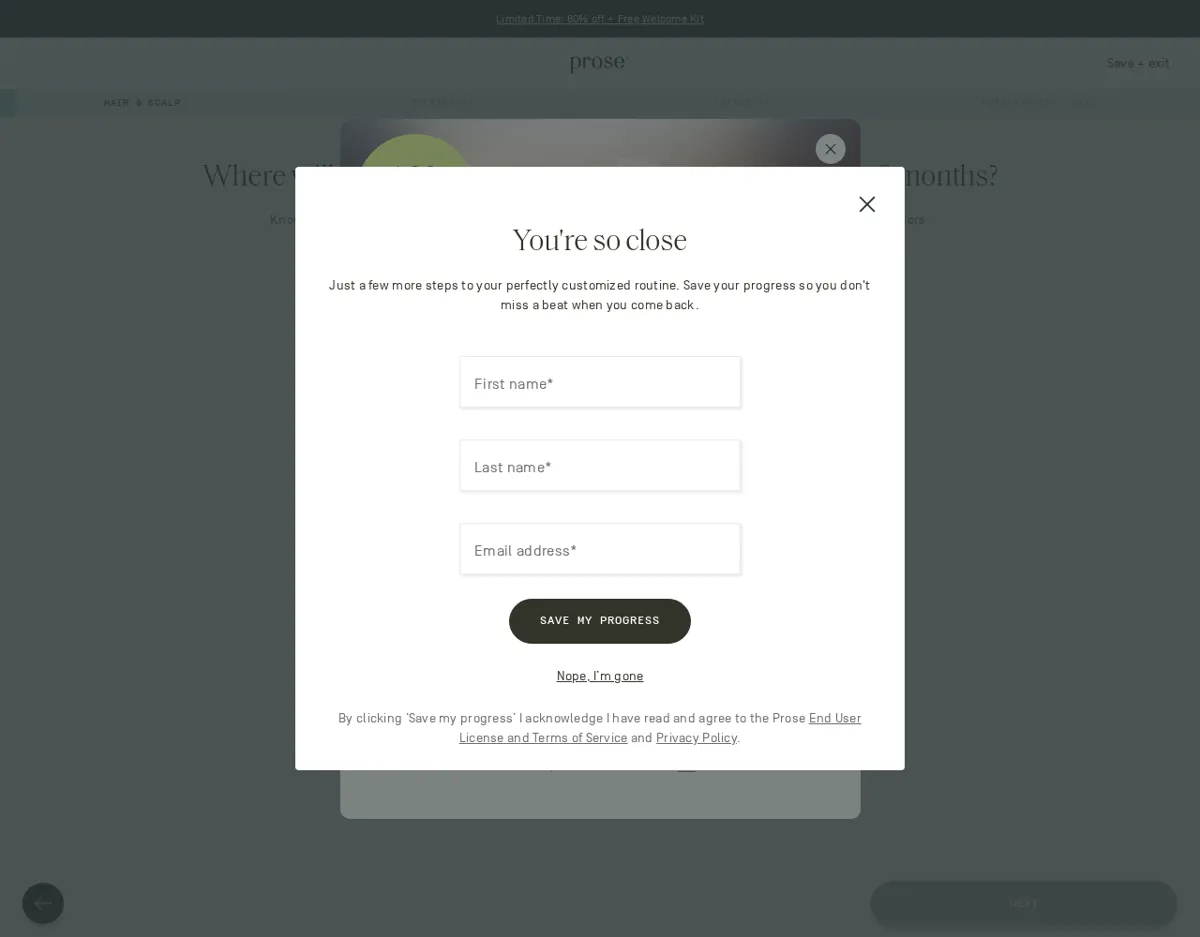
Prose's hair consultation opens the same way: "We'll ask a series of questions to better understand your lifestyle, environment, and unique hair needs so we can formulate your custom routine." The product is made from the answers, so the quiz is the only sensible first page. The quiz is split into four labelled parts across the top ("Hair & Scalp", "Treatments", "Lifestyle", "Preferences & Goals"), so people can see how far along they are. When we clicked "Save + exit" early on, a box titled "You're so close" asked for a name and email to "Save your progress so you don't miss a beat when you come back."
CUUP sells bras, and the hard part is size. Its case study says the quiz explains bra fit between questions and asks for an email during the quiz.
What these have in common: more than one product or a product built to order, and a question the shopper can't answer alone (which size, which formula, how much).
When a presell page is the right page
If you sell one main product and the shopper's question is "why should I buy this?", a quiz doesn't answer it. It asks questions and then shows the one product you were going to show anyway.
RevenueHunt, which sells quiz software, says the same. In its post on quizzes vs collection pages, it says a store where every customer wants the same basic product is "probably not" a good fit for a quiz. It also says not to send branded search and email traffic to a quiz, because those people already know what they want.
That's where an advertorial or a listicle does better. It explains the problem, how the product solves it and why it's different from what people have tried. Presell pages educate and build trust before people see the product. Our guide to presell page formats shows how brands use each one.
Some brands use both: an advertorial for new visitors from ads on the hero product, and a quiz on the site for people choosing between options.
How to build a quiz page that sells
If your product passes the test above, a few things show up in every quiz we loaded:
- Keep it short. ConvertFlow's playbook says "3-5 questions will be plenty for many use cases." Ollie uses six and tells people up front it takes three minutes.
- Say why you're asking. Every Ollie question has one line on why it matters. That line also teaches the shopper something about the product.
- Ask only what changes the pick. If an answer doesn't change which product people see, cut the question.
- Decide where the email ask goes. CUUP asks for it during the quiz. Prose asks when someone tries to leave. ConvertFlow's playbook puts the email or SMS form after the last question. Test both, and watch where people quit.
- Send the result to a page that sells the pick. The result page needs the product, the reason it was picked (in their own answers), proof and one button. Sending people to a grid of products makes them choose all over again.
- Match the ad. If the ad promised "find your shade in 60 seconds", the first screen should say that. Our message match worksheet covers the check.
How to test it
Send the same ads to the quiz and to your current page, and judge both on cost per purchase and CAC. Completion rate tells you if the quiz is too long. It doesn't tell you if it makes money.
Give it time. RevenueHunt advises staying with the new page for at least 28 days, because the first week often looks worse. Our presell page measurement guide covers the setup.
Where Landra fits
Landra doesn't build quizzes. It builds the other two formats: advertorials, listicles and presell pages from a product URL, with the copy, layout and images done for you (14-day trial, plans from $19/mo).
If your product needs explaining more than it needs choosing, that's the page to test first. When I tested a Landra page against our old product page on Pow (same ads, same product), CAC dropped 46%. That's one test on my own brand, not a promise. We recommend checking your page to make sure we got everything right before you send ads to it.
Frequently asked questions
What is a quiz funnel?
A quiz funnel is a short quiz that sits between an ad (or another traffic source) and the product. People answer a few questions and get a product pick based on their answers, often with an email ask along the way.
What is a good conversion rate for a quiz?
ConvertFlow's September 2026 benchmark of 2,120 Shopify quiz campaigns reports that 5.2% of quiz viewers placed an order on average. RevenueHunt reports 5.5% of people who finished a quiz placed an order. Both are vendor data from live quizzes, so treat them as a rough range, not a target.
How many questions should a quiz have?
Fewer than you think. ConvertFlow's quiz playbook says "3-5 questions will be plenty for many use cases." Ollie's dog food quiz has six steps and calls itself a "3 minute quiz".
Is a quiz better than a presell page?
Only when the shopper has to choose. If you sell one main product that needs explaining, an advertorial or listicle usually does that job better. Test both against your product page with the same ads and judge them on cost per purchase.