

You're staring at the same dashboard numbers every morning, and one thing keeps happening. The polished brand spot that took a designer, a motion editor, and a week of revisions keeps getting outpaced by a shaky creator clip shot on an iPhone in bad light. That's the moment many teams start asking the wrong question, whether UGC is “trendy,” instead of the useful one, whether this is a paid-creative advantage worth systematizing.
The short answer is yes, if you treat user generated content ads as a performance format with rules, not as a social media mood. The best teams don't ask creators to be random. They brief for hooks, test against control creative, route cold traffic into pages built to continue the promise, and kill anything that starts to feel manufactured. The result isn't just more “authentic” ads, it's a repeatable acquisition workflow that can survive platform changes and creative fatigue.
Table of Contents
- The Ad Account That Started Looking Strange
- What User Generated Content Ads Actually Are
- Why UGC Ads Outperform Polished Creative on Paid Social
- UGC Ad Formats That Work for Cold DTC Traffic
- A Production Workflow That Ships UGC Ads Weekly
- The Authenticity Trap and How to Avoid It
- Pairing UGC Ads With Pre-Sell Pages and Advertorials
- Measuring, Scaling, and Staying Compliant
The Ad Account That Started Looking Strange
The founder thought the account had a tracking problem. The clean brand video, the one with the studio backdrop and the expensive color grade, kept losing auction share to a scrappier clip that looked like it was filmed between errands. The creator was talking too fast, the framing was slightly crooked, and the comments were full of people asking if the product really worked.
That's usually the first clue that the account isn't broken. The feed is telling you something more useful than your internal taste. A polished asset signals “ad” immediately, while a rougher creator clip can buy a few more seconds of attention before the audience decides whether to keep scrolling.
Practical rule: if a weaker-looking video keeps winning the thumbstop battle, don't default to “the algorithm likes uglier content.” Check whether the hook is sharper, the offer is easier to understand, or the message arrives sooner.
The trap is to treat that outcome as a fluke. It's not always a creative miracle, and it's not always a platform quirk either. More often, it's the market rewarding a format that lowers resistance in cold inventory, especially when the audience hasn't met the brand before.
That's why the decision isn't whether to make everything look handmade. It's whether to build a paid-creative system around user-style assets that can be tested, iterated, and scaled like any other acquisition channel. Once you think about it that way, you stop debating aesthetics and start asking a better set of questions, which hooks work, which formats fail in prospecting, and what the landing experience needs to do after the click.
What User Generated Content Ads Actually Are
User generated content ads are paid ads built from creator-shot or customer-shot material. The asset can be a testimonial, an unboxing, a phone-recorded demo, or a talking-head clip, but the important part is where it lives, as paid media in front of a defined audience, not just as a post on someone's profile.
That distinction matters because the term gets used loosely. Organic UGC posts are unpaid and native to the creator's feed. Influencer campaigns are creator-led brand partnerships, often distributed through paid amplification or whitelisting. Polished brand creative, even when it includes a real person, is still studio production with a brand-first finish. UGC ads sit in the middle, they borrow the language of peer content while serving a paid acquisition job.
The scale tells you this isn't a niche experiment anymore. The Interactive Advertising Bureau says creator economy ad spend more than doubled from $13.9 billion in 2021 to $29.5 billion in 2024, and is projected to reach $37 billion in 2025. The IAB also describes that as 26% year-over-year growth and about 4x faster than total media-industry growth, which is a strong signal that brands are budgeting for creator-style paid creative as a recurring line item, not a side project. The same broader market picture places UGC content spending above $10 billion in 2025, up from about $9 billion in 2024 in one forecast, which reinforces how mainstream the format has become. That creator-economy growth context is documented in the IAB report summary on creator economy ad spend.
Working definition: “UGC” can mean the raw asset or the paid ad built from it. Performance marketers care about the second one, because that's the version you buy against, test against, and scale.
Once you use that definition, the production choices make more sense. You're not trying to post a cute customer video. You're building a direct-response asset that happens to feel native to the feed.

Why UGC Ads Outperform Polished Creative on Paid Social
The reason these ads often win is simple. They look less like a pitch before the user has decided to listen. In cold feed environments, that lower perceived ad resistance matters more than production polish, because people decide in a split second whether they're being sold to or being shown something useful.
The performance case is already visible in the numbers. Multiple industry sources report that UGC ads achieve 4x higher click-through rates than traditional ads, while social posts featuring UGC can deliver 10.38x higher conversion rates than non-UGC posts. The trust signal is part of the same story, because one compilation cites 92% of consumers trusting UGC more than traditional advertising, and another says 84% of millennials are influenced by UGC in what they buy. Those figures are collected in a 2025 UGC statistics roundup from Go Viral Global.
The mechanism behind the win
A polished ad announces intent immediately. A creator clip delays that judgment long enough for the viewer to process the problem, the use case, or the proof. That delay is valuable on Meta and TikTok, because early engagement signals shape whether the platform keeps serving the asset, and whether a person gives you a second or third beat of attention.
There's also a cognitive shortcut at work. Viewers are used to trusting peer voice more than brand voice, especially when the message comes from someone who looks like the buyer, not the advertiser. That's why UGC is strongest when it feels specific, not theatrical. Vague praise won't carry an offer. Concrete language about pain, use case, or outcome usually does.

The point isn't that every brand should abandon high-production assets. It's that polished creative and UGC solve different jobs. Use UGC when you need attention from strangers, then use stronger brand assets later in the funnel when familiarity is higher.
UGC Ad Formats That Work for Cold DTC Traffic
The best format depends on what the buyer already knows, how skeptical they are, and how much explanation the product needs. UGC is not a universal acquisition strategy. Industry guidance says it tends to work best in cold-prospecting DTC, mid-AOV ecommerce, problem-aware audiences, and high-skepticism categories, while it tends to underperform in branded search, warm retargeting, and premium-positioning or high-ACV B2B contexts. That pattern is documented in Opascope's UGC ad guidance.
Fast format-fit reference
| Format | Best funnel stage | Best AOV range | Primary strength |
|---|---|---|---|
| Talking-head testimonial | Cold to warm | Mid-AOV | Builds trust quickly |
| Unboxing | Cold | Lower to mid-AOV | Makes the product feel tangible |
| Before and after | Cold | Mid-AOV | Shows visible change fast |
| Get-ready-with-me | Cold discovery | Mid-AOV | Feels native in beauty and personal care |
| Problem-callout hook | Cold prospecting | Any where the problem is obvious | Stops the scroll early |
| B-roll with voiceover | Warm to cold | Mid-AOV | Gives more context without losing pace |
How to choose without overthinking it
Talking-head testimonials work when the buyer needs social proof more than education. They're useful for products with straightforward value and a buying decision that depends on trust. Unboxings tend to work when the product has visual appeal or a simple reveal, because the first few seconds create curiosity before the pitch lands.
Before-and-afters are the strongest when the transformation is legible on camera, but they need care. If the comparison looks too engineered, the ad can feel like a gimmick. GRWM-style clips fit beauty and fashion because they already speak the language of native social content, and problem-callout hooks are a strong opener when the audience already feels the pain and just needs a reason to keep watching.
Use this filter: if the product needs explanation, choose a format that buys time. If the product needs trust, choose a format that sounds like a peer. If the product needs urgency, lead with the problem, not the brand story.
The smartest teams don't copy a competitor's winning ad frame by frame. They match the format to the audience's level of awareness, then judge whether the creative helps a cold click move toward purchase.
A Production Workflow That Ships UGC Ads Weekly
A weekly UGC cadence breaks as soon as the brief gets vague. Creators can't read your mind, and “be authentic” isn't a production instruction. The process starts with a roster, a hook, and a clear expectation for the first three seconds, because that's where most ads are won or lost.
The creator source doesn't have to be complicated. Some teams keep an in-house roster of reliable faces. Others use creator platforms or source customers who already speak naturally about the product. The selection standard should be simple, they need to sound believable on camera and hit the brief without turning the ad into a monologue.
What the brief should actually contain
A useful brief names the audience, the core pain point, the objection to overcome, and the exact opening line or framing angle you want tested. It also gives creators permission to speak like humans, not brand reps. Ask for the hook in the first three seconds, not the product history in the first thirty.
You can keep the filming specs tight without making the content feel overproduced. Vertical 9:16, clean audio, captions, and enough light to see the product are essential. Past that, the goal is consistency, not cinema.
The practical workflow can be supported by editing tools that remove repetitive cutting work. If you're handing off raw clips to a freelancer, a tool like the BlitzReels product demo tool can speed up versioning without forcing the team into a clunky post-production loop. For internal workflow design, teams usually benefit from documenting the handoff process in something like automatic content creation systems, even if the final ads still need human judgment.
A simple test design keeps everyone honest. Run a two-week head-to-head with three UGC variants against three existing creatives at equal budget. Hold the landing page constant, then compare what the creative itself is doing before you start blaming the page, the audience, or the channel.
The Authenticity Trap and How to Avoid It
The worst advice in this category is “just be authentic.” Authenticity is not a style, it's a perception. A UGC ad can be edited, captioned, and structured, and still feel real if the voice is believable and the message doesn't smell like a commercial script written by committee.
Where polished UGC fails
Polished UGC usually fails for three reasons. It sounds over-rehearsed, it looks too clean, or it uses generic praise that could belong to any brand in the category. Once that happens, the content loses the one advantage it had over studio ads, which is the feeling that a real person is talking.
The fix isn't to make everything messy. Captions help, jump cuts keep pace, and pattern interrupts can make a piece easier to watch without stripping out realism. Structured scripts are fine too, as long as the delivery still sounds conversational and the creator's wording doesn't get flattened into corporate copy.
Practical rule: edit for clarity, not perfection. If the cut removes the human cadence, you've probably gone too far.
The bigger risk is authenticity fatigue. Audiences get better at spotting ads that only pretend to be casual. That means creative should rotate before it starts to feel familiar, and creators should vary enough that the feed doesn't look like it was assembled from the same template.
The goal is to keep the content legible as an ad while preserving the feeling that someone used the product. That balance is fragile, but it's manageable if the team reviews the asset for perceived realism, not just production quality.
Pairing UGC Ads With Pre-Sell Pages and Advertorials
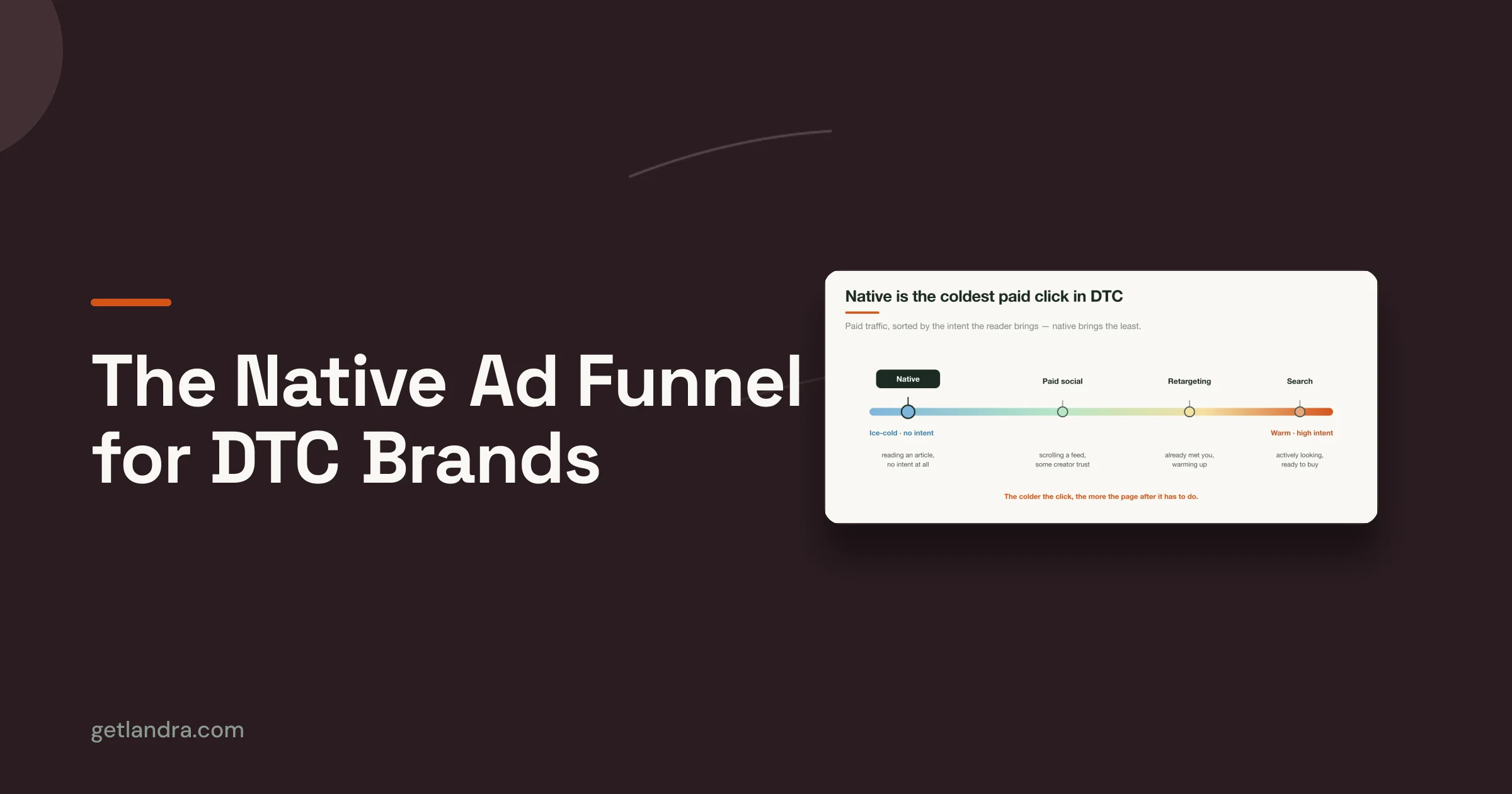
The most common UGC failure isn't the creative itself. It's the mismatch between the promise in the ad and the page that follows. A cold user clicks because the ad feels like a conversation, then lands on a product page that behaves like a closing machine. That jump is where a lot of accounts leak money.
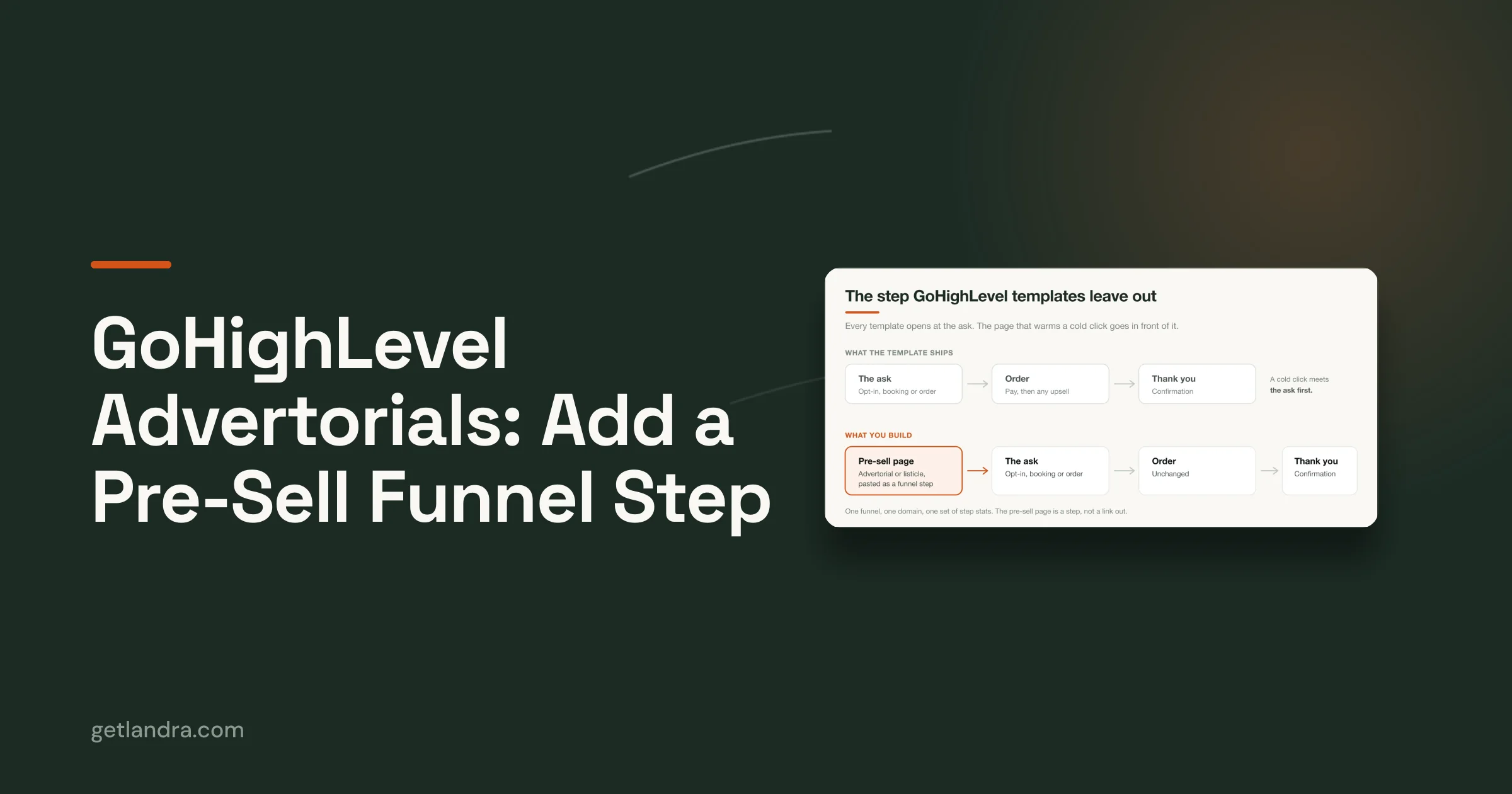
A pre-sell page or advertorial bridges the gap. It mirrors the hook from the ad, adds context, and lets the user warm up before they see the buy button. That matters most when the ad is doing top-of-funnel work, because the click wasn't a purchase signal yet. It was a curiosity signal.
The strongest pairing is usually a UGC ad that opens a problem or desire, followed by a page that expands the same angle with proof, explanation, and a softer path to the product. If you're sending cold traffic straight to a PDP built for people already ready to buy, you're asking the ad to do the page's job too.
That routing choice can change the economics fast. Landra reports a first-party test showing a 46% CAC reduction when the same ads were routed to a Landra advertorial instead of the product page, which is exactly the kind of compounding effect this strategy is designed to achieve. A practical pre-sell page guide is available in how to write a pre-sell page, and the core logic is the same whether you're working with an advertorial, a listicle, or a narrative warm-up page.
Speed matters here too. If a winning UGC angle emerges on Monday, the page has to catch up before the creative burns out. The faster the team can spin up a matching pre-sell page, the easier it is to preserve the message-market fit while the ad is still fresh.
Measuring, Scaling, and Staying Compliant
If you measure UGC like generic branded content, you'll miss what matters. The useful metrics are the ones that tell you whether the hook is landing and whether the creative is carrying enough of the journey to justify more spend. On paid social, that usually means hook rate, hold rate, thumbstop ratio, CPA, and creative-level CAC.
For a deeper framework on how those numbers fit together, see ad performance metrics. The point is not to worship any one metric. It's to tell the difference between an asset that gets attention and one that produces efficient purchases.
What to watch before scaling
Scale a winner when the creative is still buying you clean attention and the CPA isn't drifting because the audience has already seen the asset too many times. Kill or refresh when the hook rate falls off, the holds get weaker, or the ad starts looking familiar enough that comments stop reflecting genuine curiosity. That's usually the first sign that the creative has aged out of its useful life.
Compliance belongs in the same workflow, not as an afterthought. Paid partnership disclosures, music rights, likeness permissions, and category-specific claim rules all need to be checked before launch. If you need a broad refresher on campaign policy basics, compliance essentials for social campaigns is a useful starting point.
Scaling checklist: brief three creators, run the head-to-head test, send the winner into a dedicated pre-sell page, then refresh before the ad starts to feel too familiar.
The teams that keep winning don't just make more UGC. They run a loop. They source fast, test against control creative, watch the right metrics, route clicks into pages that match the ad's frame, and replace stale assets before fatigue drains the account.
If you want a faster way to turn product URLs into cold-traffic pre-sell pages that match a winning UGC angle, visit Landra. It's built for DTC teams that need to ship advertorials and presell pages quickly, then keep iterating as creative changes.