

Creative accounts for 47% of an ad's effectiveness, ahead of reach at 22% and brand at 15%, according to a widely cited Nielsen-based analysis summarized by Ad Creative Testing. That changes the job. If the message, visual, offer, and format can explain more performance variation than distribution alone, then advertising creative testing isn't a finishing touch for a design team. It's a growth system.
The hard part is that many teams still test like designers, changing a button color, headline adjective, or background image and calling the result a lesson. Those tweaks can matter, but they rarely answer the strategic question: which concept gives the algorithm and the buyer a stronger reason to act?
A disciplined system starts with a hypothesis, produces meaningfully different variants, isolates the landing-page experience, and uses predefined rules for killing, scaling, or iterating. It also accepts an uncomfortable operating reality: most concepts won't become winners. The job isn't to predict the winner perfectly. It's to generate enough useful attempts, identify durable signals, and move budget toward the ideas that earn it.
Table of Contents
- Why Advertising Creative Testing Decides Performance
- Build Testable Hypotheses and Map Creative Elements
- Choose Your Test Design and Statistical Guardrails
- Set Up Tracking Metrics and Platform Execution
- Analyze Results and Decide What to Kill Scale or Iterate
- Avoid Common Pitfalls and Speed Up Your Iteration Loop
Why Advertising Creative Testing Decides Performance
Creative carries 47% of an ad's effectiveness in the Nielsen-based framing. Other digital-campaign analyses summarized by Ad Creative Testing place its contribution as high as 56% of sales lift, while brand-advertising summaries approach 70%. Methodologies differ, so these figures are directional rather than interchangeable. The practical conclusion is stable: creative needs systematic measurement because it influences whether the right person notices, understands, believes, and continues.

Changing targeting whenever CPA moves often treats noise as a diagnosis. Changing only colors treats a strategic problem as decoration. The more useful test asks whether a different promise, proof mechanism, customer situation, or format improves the path from impression to purchase.
Cosmetic variation versus concept exploration
Cosmetic testing keeps the idea fixed while changing its execution. A team might compare a blue background with a cream background or move a testimonial below the product shot. Those refinements can improve a direction that already earns attention and conversion, but they rarely explain why the concept works.
Concept-level testing changes the reason the ad exists. For a skincare brand, that could mean:
- Problem angle: Focus on irritation caused by harsh routines.
- Outcome angle: Focus on a simpler path to calmer-looking skin.
- Proof angle: Lead with customer experience, ingredients, or demonstrations.
- Identity angle: Speak to shoppers who want a low-maintenance routine.
Each variant should express a meaningfully different answer. If every ad shares the same promise, opening, and visual structure, the result only ranks minor production choices.
Recent coverage of Meta's Andromeda-era ranking describes an environment that rewards creative variety and distinct signals. Five near-identical ads provide limited information for the platform and even less for the team. Concept exploration gives the ranking system more signals to evaluate and gives marketers a clearer basis for the next brief.
Practical rule: Test the idea before optimizing the decoration.
A valid test has a clear unit of learning
Name the variable, stabilize the surrounding conditions, and define the decision before launch. Changing the angle, video format, audience, offer, and landing page together may produce a commercially useful result, but it cannot isolate the cause.
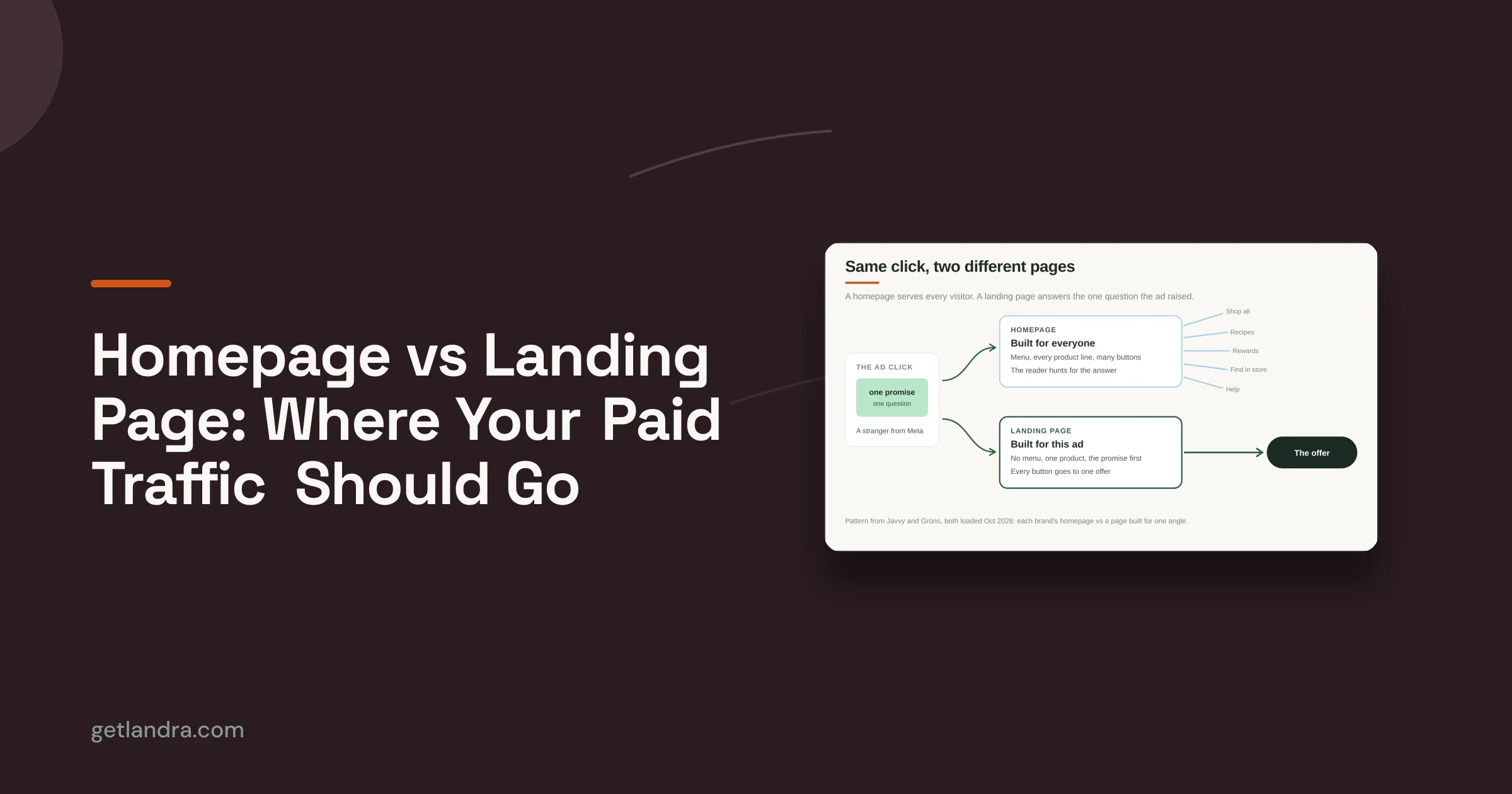
The landing page deserves its own layer. Hold the destination experience constant while comparing creative, then test page changes separately. Otherwise, a stronger conversion rate may come from the page rather than the ad, and CPA improvements can be assigned to the wrong lever.
A disciplined loop looks like this:
- Identify a business problem, such as weak cold-traffic conversion.
- Form a hypothesis about the message or experience causing it.
- Build variants that express distinct answers.
- Deliver them under comparable conditions.
- Read primary and diagnostic metrics together.
- Turn the result into the next creative brief.
Sparse data requires decision rules rather than confident storytelling. Use early results to screen clear losers, but avoid treating a small lead as a durable winner. Compare CPA or conversion rate with attention and engagement signals, then ask whether the result supports a repeatable concept.
The benchmark summarized by Jeena Tech's 2026 creative-testing analysis reports that only about 4% to 8% of Meta ad creatives become winners, with smaller advertisers around 3.8% and enterprise accounts around 8.2%. In that benchmark set, 50% to 53% were losing ads discarded before 28 days, 38% to 46% were mid-range, and winning creatives captured about 55% of total spend.
Those figures support a production system built for repeated attempts, fast screening, and controlled budget allocation. The goal is not to predict the winner perfectly. It is to find durable signals, isolate what caused them, and give spend to concepts that continue to earn it.
Build Testable Hypotheses and Map Creative Elements
A vague brief produces vague learning. “Make a stronger ad” gives a copywriter and editor room to create, but it doesn't give the team a testable question. A useful hypothesis connects a specific audience situation to a specific message and expected behavior.
Use this sentence pattern:
For [audience or traffic state], presenting [angle or promise] through [format and hook] should improve [primary metric] because [reason].
For example, a DTC supplement brand might write: “For cold visitors unfamiliar with the product, leading with the daily problem rather than the ingredient list should improve conversion rate because the ad will establish relevance before asking the viewer to evaluate the formula.” That statement gives the team something to build and something to challenge.

Separate the major variables
Map the creative before production. I use five fields because they stop teams from hiding several changes inside one “new concept”:
- Angle: The core pain, desire, belief, or identity being addressed.
- Hook: The opening verbal or visual interruption that earns attention.
- Format: UGC, static, carousel, demonstration, founder-led video, or another presentation style.
- Offer: The price framing, bundle, guarantee, education-first invitation, or product promise.
- Audience: The segment, awareness state, and motivation the ad assumes.
The testing order recommended in a paid-social creative-testing playbook is angles first, then hooks, formats, and audiences. That sequence makes practical sense. A new audience can create a temporary lift, but a strong message tends to remain useful across audience expansion. Start with the largest strategic question, then refine the delivery.
For cold traffic, an angle usually deserves priority because the buyer may not understand the problem or product yet. For warm retargeting, the hook or proof sequence may matter more because the viewer already has context. The test should reflect the traffic state instead of forcing one universal template across the funnel.
Create an element inventory
Before writing variants, list the parts that can change:
- Opening frame and first spoken line.
- On-screen headline and supporting copy.
- Product demonstration or lifestyle scene.
- Proof type, such as review, comparison, ingredient explanation, or mechanism.
- Call to action and offer presentation.
- Presell page headline, opening image, and first proof block.
Then mark each variant with a single primary change. A concept test may change the angle while keeping the format consistent. A hook test may preserve the angle, offer, and visual body while changing only the opening. This documentation prevents a common failure mode, where a team celebrates a winner without knowing whether the lesson was the promise, the actor, or the discount.
AdCrunch's bring your own creative announcement is useful context for teams building structured asset workflows. The broader lesson is operational: keep source assets, hypotheses, versions, and outcomes connected so each sprint adds knowledge instead of starting from a blank page.
Write the expected result before launch. If the angle wins on CTR but loses on conversion rate, that isn't a failed test. It may mean the promise attracts attention but creates an expectation the page or product doesn't satisfy.
Choose Your Test Design and Statistical Guardrails
Test design is a trade-off between control, speed, and the amount of interaction you want to understand. A/B testing is usually the cleanest starting point. Multivariate testing can reveal combinations, but it consumes more traffic and makes attribution harder. Factorial designs can expose interactions between variables, yet they demand disciplined planning and enough volume to support the combinations.
| Test Design | Best For | Sample Needed | Risk If Misused |
|---|---|---|---|
| A/B | One major question, such as angle A versus angle B | Lowest of the three options | Treating a small or noisy difference as a durable winner |
| Multivariate | Refining several page or ad elements when traffic is healthy | More observations across each combination | Confusing interaction effects with the impact of one element |
| Factorial | Understanding how selected variables work together | Highest requirement because combinations multiply | Producing an unreadable result when the test has too many factors |
A/B testing also works well for concept-level exploration when each arm is meaningfully different. The point isn't that A/B means “small change.” It means the comparison has two defined alternatives. You can compare two radically different messages while maintaining the same audience, budget logic, optimization event, and destination.
For teams operating inside Meta, a dedicated creative testing framework for Meta Ads can help translate that principle into campaign structure. Platform-native testing features may distribute spend more evenly than ordinary delivery, but they don't rescue a weak hypothesis or an underpowered test.
Guardrails that prevent premature decisions
The playbook cited earlier uses several practical thresholds:
- 1,000+ impressions per creative for initial assessment.
- 100+ clicks for a stronger CTR read.
- 50+ conversions for conversion-rate significance.
- At least 7 days of runtime to allow platform learning to settle.
- A kill rule around CPA 50% above target within 72 hours.
- A scale rule when CPA is about 20% below target, provided enough volume potential remains.
These are guardrails, not laws. If your conversion volume is sparse, the responsible decision may be “continue collecting evidence,” not “declare a winner.” If a creative violates the kill rule quickly and wastes budget, extending it for ceremonial statistical purity is also poor management.
The multivariate vs A/B tests for DTC comparison is helpful when choosing whether a page or funnel experiment deserves multiple variables. For most paid-social creative sprints, start narrower. Learn which concept deserves more attention before testing the interaction between its headline, image, proof block, and CTA.
Kill rule: Stop a clear budget leak when it materially misses the CPA target and has had enough initial delivery to justify the decision.
Scale rule: Increase exposure only when the result beats the target, the conversion signal is credible, and the concept has room to reach more buyers.
Avoid editing live variants mid-test. If you must change tracking, destination, or compliance details, apply the change consistently and record it. Otherwise, you'll compare different versions of the test rather than different creatives.
Set Up Tracking Metrics and Platform Execution
Most creative tests lose signal before launch. A broken purchase event, inconsistent UTMs, mismatched landing-page copy, or an unrecorded edit can make a clean concept look weak. Operational discipline matters because the platform only sees the events you send, and your dashboard only explains the labels you maintain.

Build the measurement layer first
Check the full path from impression to purchase:
- Confirm that ViewContent, AddToCart, and Purchase events fire on the intended actions.
- Standardize UTMs by source, medium, campaign, ad set, and creative identifier.
- Choose one primary decision metric, usually CPA, conversion rate, or revenue efficiency.
- Keep diagnostic metrics such as CTR, CPC, hook retention, and landing-page engagement.
- Test every destination link on mobile before publishing.
CTR tells you whether the ad earns the click. Conversion rate tells you whether the click survives the page and offer. CPA combines both with cost, so it should generally drive the business decision, while diagnostic metrics help explain why the result happened. A practical reference for organizing those measures is Landra's ad performance guide.
The landing page deserves its own control. Sending one creative to a product detail page and another to an advertorial creates a compound test. You may still discover the better ad-and-page package, but you won't know whether the creative or destination caused the difference.
Use the page as an isolation layer
For cold traffic, a pre-sell page can carry the argument between the ad and checkout. Build one page around the problem angle, another around the mechanism or proof angle, and keep the ad-to-page promise aligned. Then test the creative while holding the destination constant, or test the destination while holding the creative family constant.
Landra can generate editable advertorial and listicle-style presell pages from a product or brand URL, and teams can duplicate variants, edit the first screen or opening section, and publish to Shopify, a hosted URL, Webflow, or HTML. That makes the landing-page layer practical for teams that need to isolate message continuity without rebuilding every page from scratch.
Meta and TikTok still require platform-specific QA. Check aspect ratios, captions, safe zones, thumbnails, event optimization, and naming conventions. On Meta, concept diversity matters because delivery systems evaluate creative signals, not just audience settings. On TikTok, the first seconds, native pacing, spoken clarity, and creator context often determine whether the viewer understands the ad before the offer appears.
This video provides a useful visual reference for the operational side of campaign execution:
Don't let a clean dashboard create false confidence. Reconcile platform purchases with your analytics and store data, watch for delayed attribution, and keep a launch log containing the exact creative, URL, audience, optimization event, and start time.
Analyze Results and Decide What to Kill Scale or Iterate
Sparse data changes the job from ranking ads to managing uncertainty. Recent reporting cited by The State of Ad Creation 2026 says the share of creatives receiving only 100 to 500 views rose from 18% to 31%, while only about 1% to 2% exceed 1M views. Most variants therefore won't reach comfortable scale, especially early in their life.

Read results in layers rather than sorting one column from highest to lowest. Start with spend and conversion volume, then inspect CTR, conversion rate, CPA, and revenue efficiency. A high CTR with weak conversion rate often points to a promise mismatch, poor qualification, or a landing-page problem. A low CTR with strong post-click behavior may indicate a good offer that needs a better hook.
Use three operating buckets
Winners have a credible primary result and a concept that can support additional production. Scale them gradually, create adjacent executions, and preserve the original as a control. Don't assume the exact same edit will remain dominant forever.
Losers consume budget without producing a plausible path to recovery. Kill them when they breach the predefined rule, but record the reason. “Low CTR” is less useful than “mechanism angle failed to earn attention for cold traffic while proof angle held conversion rate.”
Mid-range creatives deserve the most thoughtful treatment. They may have a strong angle with a weak hook, or a good click rate with an unconvincing page. Keep the concept, change one element, and send the new version into the next sprint.
The benchmark summarized by Jeena Tech found that winning creatives captured about 55% of total spend, while losing and mid-range ads made up the remaining distribution. That concentration supports a two-speed system: screen broadly, then concentrate budget on proven directions rather than forcing equal spend across every idea indefinitely.
Make decisions with incomplete evidence
A short window can show a directional signal without proving a stable winner. Treat early data as a triage tool. If the ad has very low delivery, no conversion, and a clear CPA problem, cut it to protect budget. If it has promising CTR but too little post-click volume, extend the test or move the hypothesis into a stronger hook. If the platform gives one variant most of the delivery, don't confuse delivery preference with causal proof.
For each decision, log:
- What changed.
- Which metric moved first.
- Whether the landing page confirmed or contradicted the promise.
- What the next variant will preserve.
- What the next variant will challenge.
That turns a result into a prioritized backlog. The goal isn't a permanent winner. It's a growing library of angles, hooks, proofs, formats, and page openings that your team can recombine intelligently.
Avoid Common Pitfalls and Speed Up Your Iteration Loop
The most expensive mistake is testing the wrong level. Five ads that use the same promise, same opening, and same visual language may produce a ranking, but they won't help you discover a new growth direction. Cosmetic changes are useful after a concept works. They're a poor substitute for concept exploration when the account lacks a reliable message.
Sparse signal creates the second trap. Teams kill ads after a handful of impressions, celebrate a cheap click before conversion data arrives, or extend an obvious loser because the creative “might still learn.” Set the rule before launch, distinguish directional evidence from confirmation, and protect the decision metric from diagnostic metrics that look better in isolation.
A weekly sprint can stay fast without becoming careless:
- Review the backlog: Pull concepts from customer objections, support tickets, reviews, comments, and past winners.
- Choose the strategic question: Select one angle, audience state, or promise to investigate.
- Produce distinct variants: Change concepts first, then hooks and formats around the strongest direction.
- Duplicate the page layer: Create a matching advertorial or listicle opening when the ad promise changes.
- Launch with controls: Keep audience, optimization, budget logic, tracking, and destination rules consistent.
- Run the decision window: Apply the kill, extend, scale, and iterate rules without mid-test improvisation.
- Write the learning: Save the conclusion beside the asset, not in a scattered chat thread.
Creative fatigue also deserves a diagnosis rather than a reflex. The practical guidance in this discussion of how to fix digital ad fatigue is useful because fatigue can come from repeated concepts, repeated formats, narrow audience conditions, or a promise that no longer feels fresh. Replacing the image while preserving the same message may only delay the decline.
Speed comes from reducing production friction, not lowering standards. A visual editor that duplicates an existing page, a controlled asset library, and clear naming can shorten the path from learning to new launch. Landra automates brand-controlled content for teams that need editable presell-page drafts while retaining control over copy, images, and structure. Use that kind of workflow to test the opening, frame, and proof sequence alongside the ad, while still changing one meaningful variable at a time.
Landra gives DTC teams a practical way to generate and duplicate editable advertorial and listicle presell pages for paid-social creative tests, then publish them through existing storefront and web workflows. Visit Landra to build a page variant around your next creative hypothesis and keep the ad-to-checkout message aligned.