
Your ads are bringing people to the store, but revenue isn't keeping pace with spend. The marketing dashboard shows a conversion lift, the finance report looks flat, and nobody can explain whether customers changed their behaviour or the tracking changed underneath them.
A conversion rate optimisation specialist should resolve that disagreement, not add another dashboard. The job is to diagnose why visitors don't buy, test credible improvements, and establish whether those improvements produce more profitable orders.
Table of Contents
- What a Conversion Rate Optimisation Specialist Does Each Week
- KPIs That Show a Specialist Is Working
- How a Testing Cycle Runs From Hypothesis to Rollout
- Skills and Toolset a Specialist Works With
- How to Evaluate CRO Candidates Before You Hire
- Career Path and Salary Benchmarks
- Practical Tests and Pre-Sell Pages in Action
- Pick Your First Test or Hire This Month
What a Conversion Rate Optimisation Specialist Does Each Week
A conversion rate optimisation specialist finds where visitors stop short of a defined action, such as a purchase, lead form submission or signup, and runs controlled changes to address the problem.
The role grew out of web analytics, usability, direct-response marketing and experimentation. That's why the specialist sits between marketing, UX, engineering and merchandising rather than working only on landing-page copy.
Think of the specialist as a mechanic for your funnel. They listen to the symptoms, check the evidence and inspect the connections before replacing a part.
Core responsibilities and their outputs
| Responsibility | Typical task | Output |
|---|---|---|
| Diagnose funnel friction | Compare product-page-to-cart, cart-to-checkout and checkout-to-purchase rates by device | Ranked list of leaks with estimated revenue impact |
| Form hypotheses | Pair session recordings and survey answers with funnel data | Written hypothesis naming the change, audience and expected effect |
| Design and run tests | Set sample size, duration and primary metric before launch | Test brief and launch checklist |
| Analyse results | Check statistical confidence and segment by device, source and new versus returning visitors | Win, loss or inconclusive verdict with supporting evidence |
| Improve page speed | Audit mobile loading and layout stability with Lighthouse | Engineering ticket explaining the problem and expected impact |
| Coordinate teams | Brief copywriters, designers, developers and merchandisers | Shipped variant and changelog |
| Audit accessibility | Check form labels, keyboard checkout and contrast | Acceptance criteria attached to each test |
A normal week includes checking live experiments, investigating suspicious events, reviewing customer feedback and preparing implementation briefs. The visible page edit may be the smallest part of the work.
Mobile performance belongs in that remit. In an analysis of 11 million mobile advertisements and landing pages across 213 countries and territories, Google found that the average mobile landing page took about 15 seconds to load fully.
For paid-social DTC traffic, a slow page or unstable mobile layout isn't solely a developer's problem. The specialist should connect the technical fault to the buying journey and help prioritise the fix.
Before approving a job specification, check:
- Ownership: Does the person diagnose, test and analyse, or merely execute edits?
- Commercial accountability: Is a revenue or profit metric named?
- Funnel coverage: Does the remit include mobile and checkout, not just landing pages?
KPIs That Show a Specialist Is Working
Primary metrics decide the result. Diagnostic metrics explain it. For ecommerce, completed purchase is usually the primary business action, while clicks, bounce, engagement depth and checkout initiation help explain where behaviour changed.
A pre-sell page can generate fewer product-page clicks yet produce better-qualified buyers. Judging it on click-through alone could lead you to reject the more valuable experience.
KPIs for CRO work and what they reveal
| KPI | Formula | What It Reveals |
|---|---|---|
| Conversion rate | Purchases ÷ sessions | Whether traffic becomes buyers |
| Revenue per visitor | Revenue ÷ visitors | Traffic value, including order size |
| Checkout completion rate | Purchases ÷ checkout starts | Friction in forms, payment and errors |
| Mobile load time, measured with LCP | Time until the largest visible content element renders | How quickly the main content appears |
| Landing-page bounce rate | Single-page sessions ÷ sessions, for a traditional bounce definition | Whether visitors continue beyond the landing page |
| Refund-adjusted revenue per visitor | (Revenue − refunds) ÷ visitors | Purchase quality after refunds |
| Paid acquisition cost | Ad spend ÷ purchases attributed to that spend | Whether gains survive media costs |
Keep definitions consistent. GA4's bounce metric uses non-engaged sessions, so it isn't interchangeable with the traditional single-page formula. Likewise, ad spend divided by purchases isn't a fully loaded customer acquisition cost unless it includes the relevant acquisition costs and counts newly acquired customers.
Before testing, calculate your ecommerce conversion rate and record the denominator, date range and purchase definition alongside it.
Checkout deserves its own baseline. Baymard's checkout usability research estimates that the average large ecommerce site could achieve a 35% conversion-rate increase through checkout design improvements alone, without changing price, assortment or acquisition strategy.
Separate behavioural improvement from tracking changes
Consent choices, browser restrictions and platform attribution mean your observed audience may be incomplete. Reconcile analytics purchases with first-party order records, check duplicate transaction events and compare tracking coverage between variants.
Don't assume unobserved visitors behave like observed visitors. Report the experiment's statistical interval separately from uncertainty caused by missing measurement, then explain what conclusions remain defensible.
Practical rule: A higher tracked conversion rate isn't a win until you've checked what happened to the denominator and the money.
A consent implementation can change recorded sessions. A broken purchase event can change recorded orders. A discount can increase purchases while reducing contribution margin or bringing forward orders customers would have placed later.
Set a baseline for every decision metric before launch. Judge commercial success using profit per visitor, revenue per visitor and refund-adjusted revenue, not the dashboard's headline lift alone.
How a Testing Cycle Runs From Hypothesis to Rollout
A controlled experiment turns an informed recommendation into a decision you can defend. It also gives the team a stopping rule, so an attractive daily result doesn't become an excuse to declare victory.
Use the workflow below to keep diagnosis, execution and rollout connected.
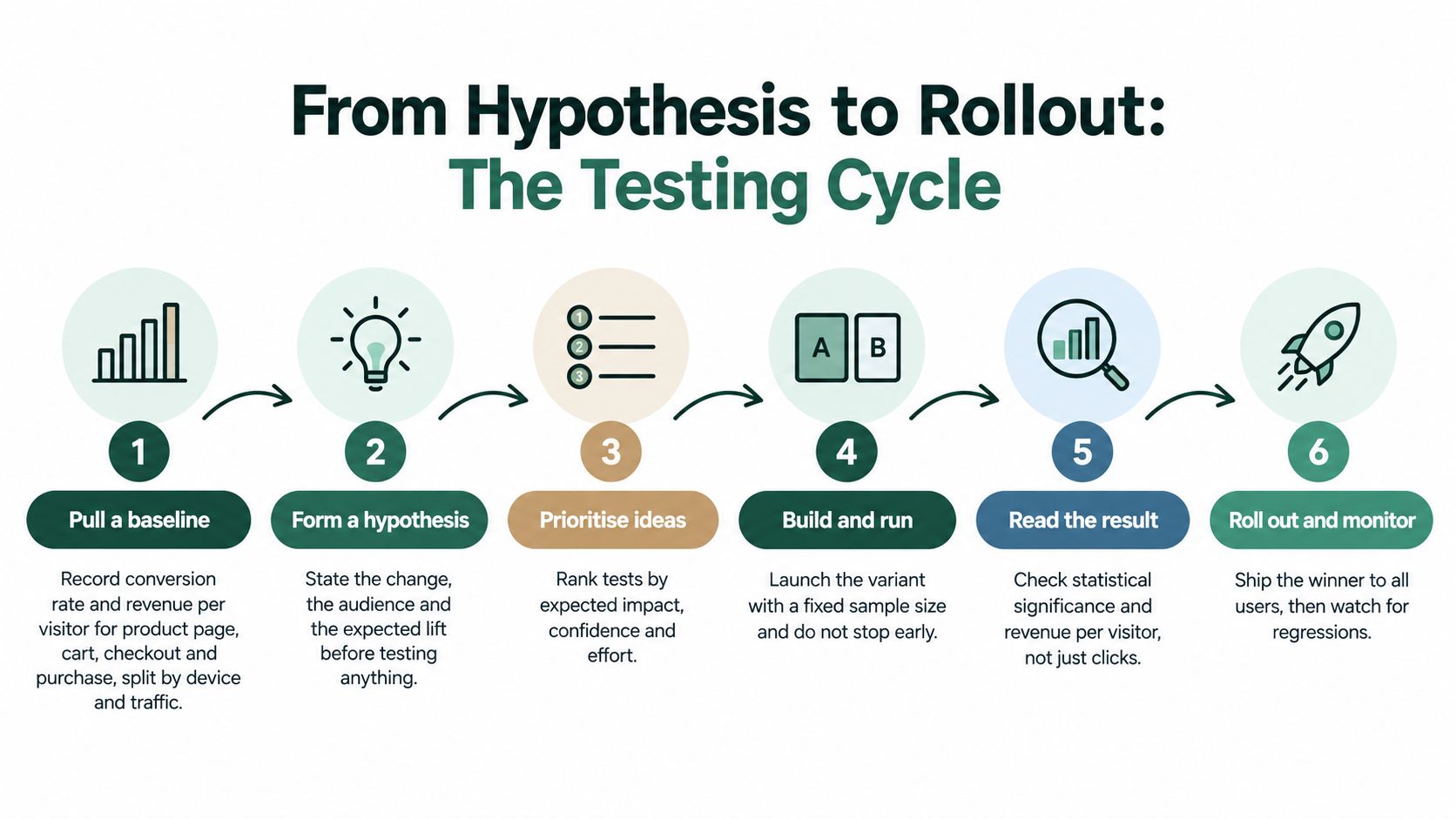
Pull a baseline. Record stage progression, purchase conversion and revenue per visitor, split by device and traffic source. Check event quality before treating the funnel as a reliable description of customer behaviour.
Locate the most valuable leak. Rank opportunities by plausible revenue impact, confidence and implementation effort. A large percentage drop on a low-volume page may matter less than a smaller checkout problem affecting your main acquisition audience.
Write a falsifiable hypothesis. Use the structure: changing X for audience Y will move metric Z because of reason R. To build stronger conversion testing hypotheses, name the observed obstacle rather than offering a design preference.
Plan the experiment before launch. Set the primary metric, guardrails, minimum worthwhile effect, sample requirement and duration. Specify assignment rules, exclusion criteria and how you'll handle returning visitors.
Run to the planned decision point. Monitor for broken pages, assignment problems and commercial harm, but don't act on daily leaders. If traffic is too limited to detect a worthwhile effect, choose qualitative research or a larger, coherent change instead.
Decide and document. Roll out a credible commercial win, record a loss, or investigate an inconclusive result. After deployment, verify that the implementation matches the tested variant and monitor for regressions.
Technical hypotheses deserve the same discipline as copy changes. Google's Mobile Site Speed Playbook reports that 53% of visitors leave when a page takes longer than three seconds to load, based on a study of 900,000 mobile landing pages spanning 126 countries.
That finding justifies investigating speed. It doesn't predict the lift your store will receive from a particular engineering change.
Keep the decision auditable
Common mistakes include stopping after a strong week, changing acquisition traffic mid-test and selecting clicks when the business needs purchases. Record promotions, inventory issues and tracking releases because they can complicate interpretation.
For an additional explanation of testing, use this video alongside a written experiment brief.
Maintain a test log containing the hypothesis, implementation, result, uncertainty, commercial interpretation and next action. A useful programme produces reusable knowledge, including from losing tests.
Skills and Toolset a Specialist Works With
The strongest specialist can explain why a result deserves trust without hiding behind a platform's winner badge. They understand sampling, false positives, statistical power and the difference between a detectable effect and a commercially worthwhile one.
They also need customer research skills. Interviews, surveys and session reviews should help them distinguish confusing language from weak product relevance, missing reassurance or an interaction failure.
Copy and layout judgement matter, but so does enough HTML and CSS knowledge to inspect an implementation. A specialist should notice when a variant changes more than intended, breaks an event listener or behaves differently on a mobile browser.
CRO toolset by job
| Category | Example tools | Used for |
|---|---|---|
| Web analytics | Google Analytics 4 | Funnel reports, event tracking and cohort comparisons |
| Behaviour research | Microsoft Clarity, Hotjar | Session recordings, heatmaps and scroll depth |
| A/B testing | VWO, Optimizely, AB Tasty | Variant delivery, traffic splits and experiment reporting |
| Page speed | PageSpeed Insights, Lighthouse, WebPageTest | Loading performance, layout stability and waterfall diagnosis |
| Reporting | Looker Studio, spreadsheets | Revenue per visitor, test logs and stakeholder reporting |
| Storefront and pages | Shopify, Webflow, hosted pre-sell page builders | Building, editing and publishing variant pages |
| Sample size | Sample-size calculators | Estimating required visitors and planning duration |
This is a starting map, not a shopping list. Start with trustworthy analytics and an experiment-delivery method, then add recordings and performance diagnostics to answer specific questions.
A presell page and analytics tool comparison can help separate page production from measurement requirements. A page builder creates the experience; analytics and experimentation tools establish what happened after visitors received it.
Buy tools around the questions
Before buying a session-recording tool, decide which interaction you need to inspect. Before adding another reporting platform, establish who owns transaction reconciliation and metric definitions.
Recordings require consent-aware configuration and appropriate masking. Server-side measurement also needs privacy controls; moving collection off the browser doesn't justify ignoring a visitor's choices.
A modest stack with reliable events is more useful than an expensive stack whose numbers nobody can reconcile.
The final skill is communication. A good brief gives a designer the behavioural problem, gives a developer testable acceptance criteria and gives a founder a decision with limitations stated plainly.
Page-generation software can reduce production effort by turning a product URL into an editable advertorial, listicle or pre-sell page. That's useful when writing and publishing variants is the bottleneck, but it doesn't replace experiment design or commercial analysis.
How to Evaluate CRO Candidates Before You Hire
Ask candidates to defend a decision, not display a gallery of winning pages. A credible practitioner can explain how they handled weak evidence, implementation constraints and a result that didn't support their original hypothesis.
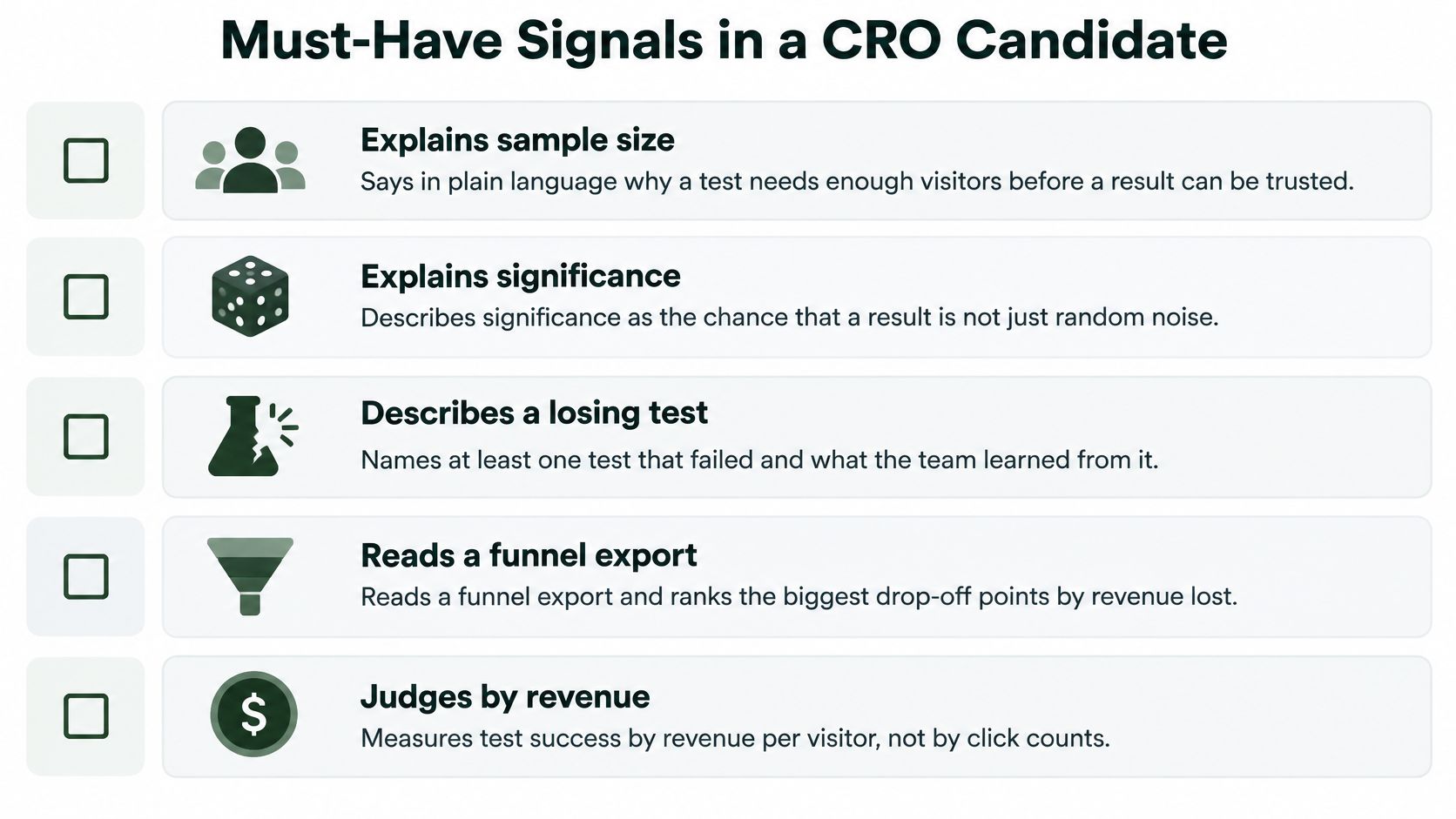
They should describe sample size in plain language and explain significance without claiming it means the probability that a hypothesis is true. They should also distinguish statistical confidence from commercial importance.
The checklist below is a useful interview prompt, but ask candidates to explain each item rather than recite terminology.
Give candidates a realistic work sample
Use an anonymised funnel export covering a short trading period. Include device, source, landing page, cart, checkout, purchase and revenue fields, plus notes about tracking gaps or promotions.
Ask candidates to rank hypotheses, write a test brief and identify what they can't conclude. Keep the task tightly scoped and compensate substantial assessment work rather than requesting a free optimisation strategy.
A strong response separates device and source effects, identifies missing denominators and asks whether the export reconciles with order records. It estimates opportunity without pretending every abandoned checkout represents recoverable revenue.
For external hiring support, We Are Distributed's resource for finding CRO talent for your team offers a route to specialist candidates. Use the same assessment criteria for contractors and permanent hires.
Treat accessibility as an acceptance criterion
Askem's ecommerce accessibility overview notes that EU accessibility requirements began applying to covered consumer products and services on 28 June 2025. Candidates working in relevant markets should understand that accessibility isn't an optional experiment variant.
Ask how they would check form labels, keyboard operation, focus visibility, contrast and error announcements. A capable specialist includes disabled participants in qualitative research and doesn't declare a universal winner when an average improvement hides harm to a particular interaction group.
Known barriers should be fixed, not preserved merely to create a control condition.
Watch for these red flags:
- Guaranteed lifts: They promise a percentage improvement before inspecting the funnel.
- Cosmetic portfolios: Their examples stop at button colours and headline swaps.
- Perfect records: They claim every experiment won.
- Tracking certainty: They treat analytics as complete without checking coverage.
- Checkout avoidance: They discuss persuasion but ignore forms, payments and errors.
Your job specification should require diagnosis, experiment design, statistical reasoning, mobile and checkout work, and written reporting. Don't make ownership of those responsibilities implicit.
Career Path and Salary Benchmarks
Web analytics, UX research, performance marketing and front-end development all offer routes into CRO. Analysts bring measurement discipline, researchers bring interviewing skills, marketers understand audience intent, and developers can spot implementation risks.
Each background has gaps to address. A performance marketer may need stronger statistical skills; an analyst may need practice translating evidence into page changes that can be measured against commercial outcomes.
Progression follows ownership
A junior analyst supports tests and reporting. A specialist owns experiments and a funnel roadmap. A lead coordinates the programme across teams, while a head of growth or conversion takes responsibility for budgets, staffing and commercial reporting.
| Level | Experience | Typical Scope |
|---|---|---|
| Junior CRO analyst | Early-career, working with supervision | Runs tests, edits pages and reports results |
| CRO specialist | Independently owns experiments | Owns a test roadmap for a funnel |
| Senior CRO specialist or lead | Demonstrated cross-team programme ownership | Sets strategy across channels and teams |
| Head of growth or conversion | Budget and people-management experience | Owns budget, reporting and the testing team |
A 2025 salary compilation from Landingi reports approximately $55,794 annually for US conversion-rate optimisation specialist roles with one to three years of experience. Use this as an early-career specialist reference, not as a guaranteed salary for every junior title. The figure is useful only when the role's scope and employment terms are comparable.
Agency work can expose specialists to different products and funnels. In-house roles can build deeper customer knowledge and longer experiment histories. Either route can develop sound judgement, but the title or setting alone does not show whether someone has owned decisions or measured their commercial impact.
Hiring judgement: Benchmark compensation against responsibility, not title alone.
For other levels and regions, set a local range using current job postings and recent salary surveys. Compare location, employment type, benefits, technical expectations and budget ownership. Don't extrapolate a senior salary ladder from a single early-career figure. When tracking is partial, evaluate whether the candidate can distinguish a measured result from an instrumentation artefact and explain how that uncertainty affects the business decision.
Practical Tests and Pre-Sell Pages in Action
A useful experiment starts with a recognisable buying obstacle, not a fashionable page format. Baymard's 2025 checkout benchmark reports that 63% of mobile sites perform at a mediocre-or-worse level, which makes mobile checkout a sensible place to investigate.
Inspect the interaction on an actual phone before proposing a redesign.
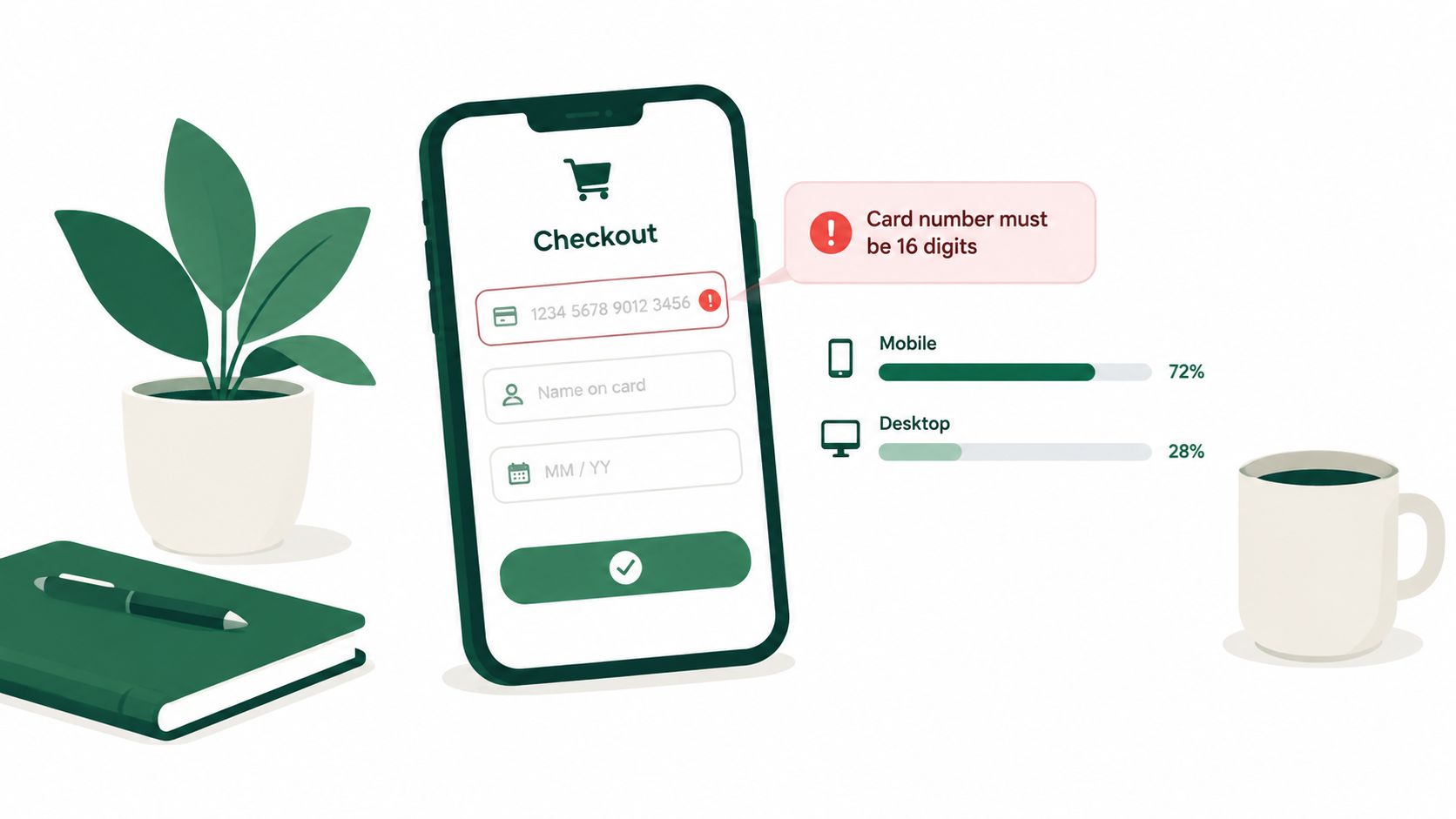
Mobile checkout with specific error recovery
Say customers reach checkout but repeatedly submit an invalid address field. The specialist reviews validation behaviour, removes unnecessary inputs and replaces a generic error with a field-specific instruction.
The primary outcome is completed purchase, with refunds as a guardrail. The specialist also checks error recurrence and completion by device to determine whether the proposed mechanism improved.
Don't combine this with new discounts and payment messaging unless you deliberately want to evaluate the whole package. Otherwise, you won't know which change deserves credit.
A pre-sell page against the product page
Consider a cold paid-social audience encountering a product that needs explanation. Compare the existing product page with a problem-led advertorial or listicle while holding the ad, audience, offer and intended purchase destination constant.
A pre-sell page is a reasonable hypothesis when shoppers need education, comparison or reassurance. For a straightforward impulse purchase, the extra reading and click may be unnecessary friction, so direct product-page traffic should remain a credible contender.
Use purchases to decide the result, with engagement and click-through as diagnostics. An editable page generator can help create and duplicate variants, while publishing to Shopify, Webflow, a hosted page or HTML keeps production compatible with the existing storefront.
Accessible checkout forms
Suppose keyboard users can't identify which field caused submission to fail. Add explicit labels, visible focus and clear error states, then verify the interaction with keyboard and screen-reader users.
Correct the known accessibility defect rather than withholding access for an experiment. If you compare alternative accessible designs, report task completion, errors and purchase outcomes by relevant interaction needs without collecting unnecessary sensitive information.
These scenarios don't come with guaranteed outcomes. Their value is that each connects a specific obstacle to an observable behavioural change and a commercial decision.
Pick Your First Test or Hire This Month
If your store has steady traffic and a meaningful page comparison, start with a focused audit and a bounded experiment. If nobody can diagnose the funnel, check the analysis and write a defensible decision, hire or contract that capability before scaling spend.
Useful hiring triggers include acquisition spend growing faster than revenue per visitor, checkout performance not measured by device and experiments scattered across private spreadsheets. For specialist recruitment support, GENTY recruitment can help you find conversion optimisation experts.
Leave the next meeting with an owner
- Choose the comparison: Select a product page and pre-sell alternative for a clearly defined paid-social audience.
- Assign measurement ownership: Name the person responsible for order reconciliation and tracking checks.
- Set commercial guardrails: Agree on the primary outcome and refund-adjusted revenue before launch.
- Check feasibility: Calculate the required sample before committing traffic or a finish date.
- Review the draft: Use a Conversion Rate Calculator and Headline Analyzer as pre-launch checks, not as evidence that a page will win.
Collect a representative baseline that includes your normal trading pattern, rather than forcing a short window that misses promotions or buying cycles. Write the decision rule before anyone sees results.
Take this sentence into the meeting: measure profit per visitor, test a coherent change, and treat every result as evidence rather than a verdict on someone's taste.
Visit Landra to turn a product URL into an editable advertorial, listicle or pre-sell page and duplicate it into test variants. Publish to your preferred storefront or export HTML, then evaluate the page against your existing experience using purchases, profit per visitor and refund-adjusted revenue.