
Most CRO tool roundups hand you a list of ten logos and imply you need all of them. You need far fewer. I ran paid ads for my own DTC brand for five years. When I started sending that traffic to presell pages instead of the product page, conversion went from around 2.5% to 4-5%. What helped was never measured in tool count. It was measured in questions answered. Every useful conversion rate optimization tool answers exactly one of three:
- Where do people drop off? Behavior analytics: heatmaps, scroll maps, session recordings.
- Which version wins? A/B testing: split traffic, measure, call a winner.
- Why did they leave? On-site surveys: ask the visitor, in their words.
If a tool doesn't help you answer one of those for a page you are sending traffic to this month, it is shelfware. Below: the tools for each question, what they cost as of 1 October 2026 (checked on each vendor's own pricing page), and what a small DTC team should actually buy at each budget level.
Which CRO tools answer which question?
Nine tools cover nearly every DTC need. Clarity, Contentsquare (which now includes Hotjar) and FullStory show where people drop off. Convert, Wingify (VWO plus AB Tasty) and Optimizely tell you which version wins. Contentsquare Voice of Customer, Zigpoll and KnoCommerce tell you why people leave or buy. Here is the full grid.
| Tool | Question it answers | Best for | Starting price (checked 1 Oct 2026) |
|---|---|---|---|
| Microsoft Clarity | Where do people drop off? | Every small team, from day one | Free, no traffic limits |
| Contentsquare (incl. Hotjar) | Where do people drop off? | Teams that want recordings plus surveys in one account | Free up to 200k monthly sessions, Growth from $49/mo ($39/mo billed annually) |
| FullStory | Where do people drop off? | Teams with a developer who will tag events | Free up to 30,000 sessions/mo, paid plans on request |
| Convert | Which version wins? | The first paid testing tool for a growing brand | $299/mo billed annually, $399 month to month (100K tested users/mo) |
| Wingify (VWO + AB Tasty) | Which version wins? | Mid-market teams that also want personalization | Quote only, 30-day free trial |
| Optimizely | Which version wins? | Enterprise teams with an experimentation program | Quote only |
| Contentsquare Voice of Customer | Why did they leave? | On-site feedback next to your recordings | Free up to 100 responses/mo, Growth from $99/mo ($79/mo billed annually) |
| Zigpoll | Why did they leave? | Cheap exit-intent and on-site surveys on Shopify | Free up to 50 responses/mo, Standard $29/mo |
| KnoCommerce | Why did they buy? | Post-purchase attribution and buyer surveys | Starter $19/mo, 7-day free trial |
Two things changed this year that most older roundups miss. Hotjar's site now redirects to Contentsquare and says "Hotjar is now part of Contentsquare." And both VWO's and AB Tasty's pricing pages now redirect to Wingify, which opens with "AB Tasty and VWO have united." If you are comparing VWO against AB Tasty in 2026, you are comparing one company's two legacy products.
Where do people drop off? Behavior analytics tools
Behavior analytics shows where visitors stall, scroll past, or quit, using heatmaps and session recordings. For a small DTC team, Microsoft Clarity answers this question for free with no traffic cap. Paid tools like Contentsquare and FullStory earn their cost only when you need more retention, segmentation, or event tagging than Clarity gives you.
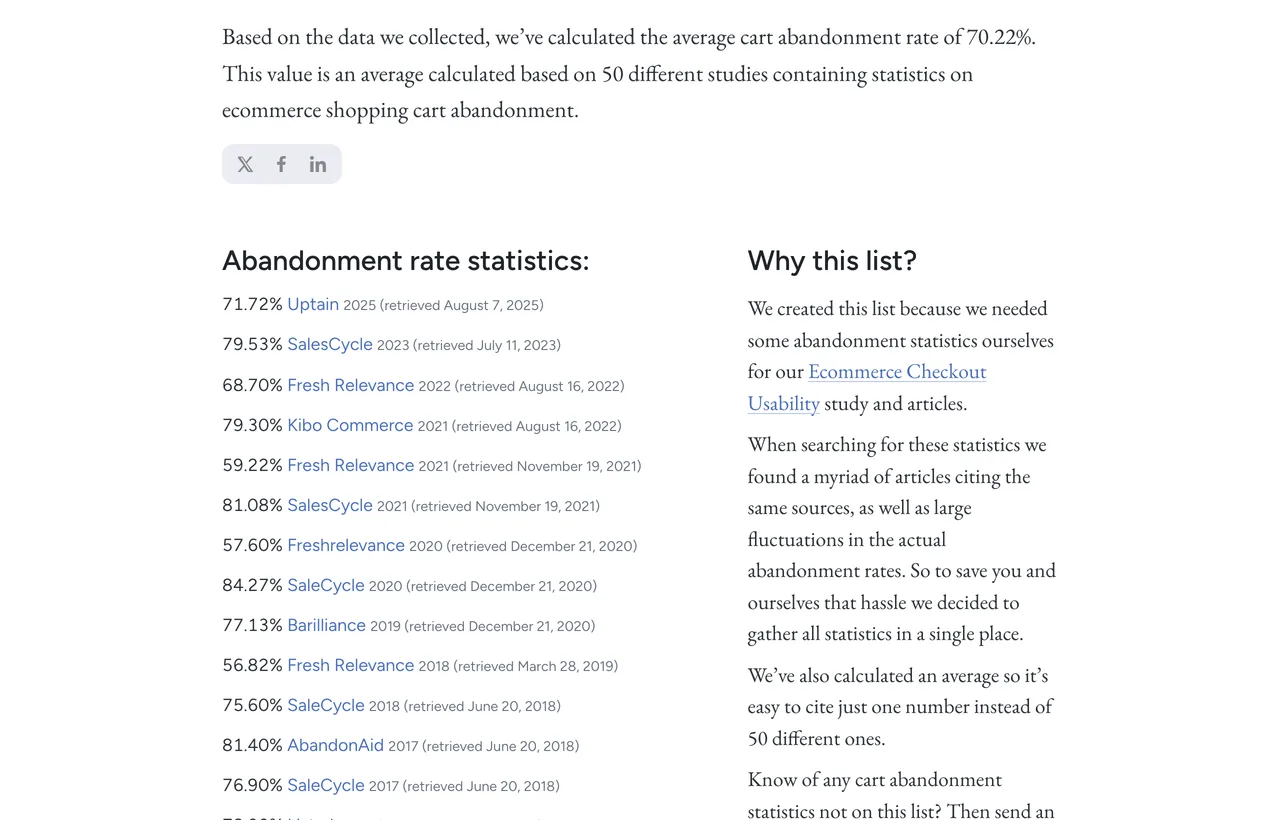
The best-known drop-off number in ecommerce is the cart. Baymard Institute puts the documented average cart abandonment rate at 70.22%, averaged across 50 studies, and its top checkout reason is "Extra costs too high (shipping, tax, fees)" at 40% (both read 1 Oct 2026). That is useful context, but for a paid-traffic brand the bigger leak usually sits earlier: on the landing page, before anyone sees a cart. That is what a recording tool is for.
Microsoft Clarity
Best for: every small team, from the first day you run ads.
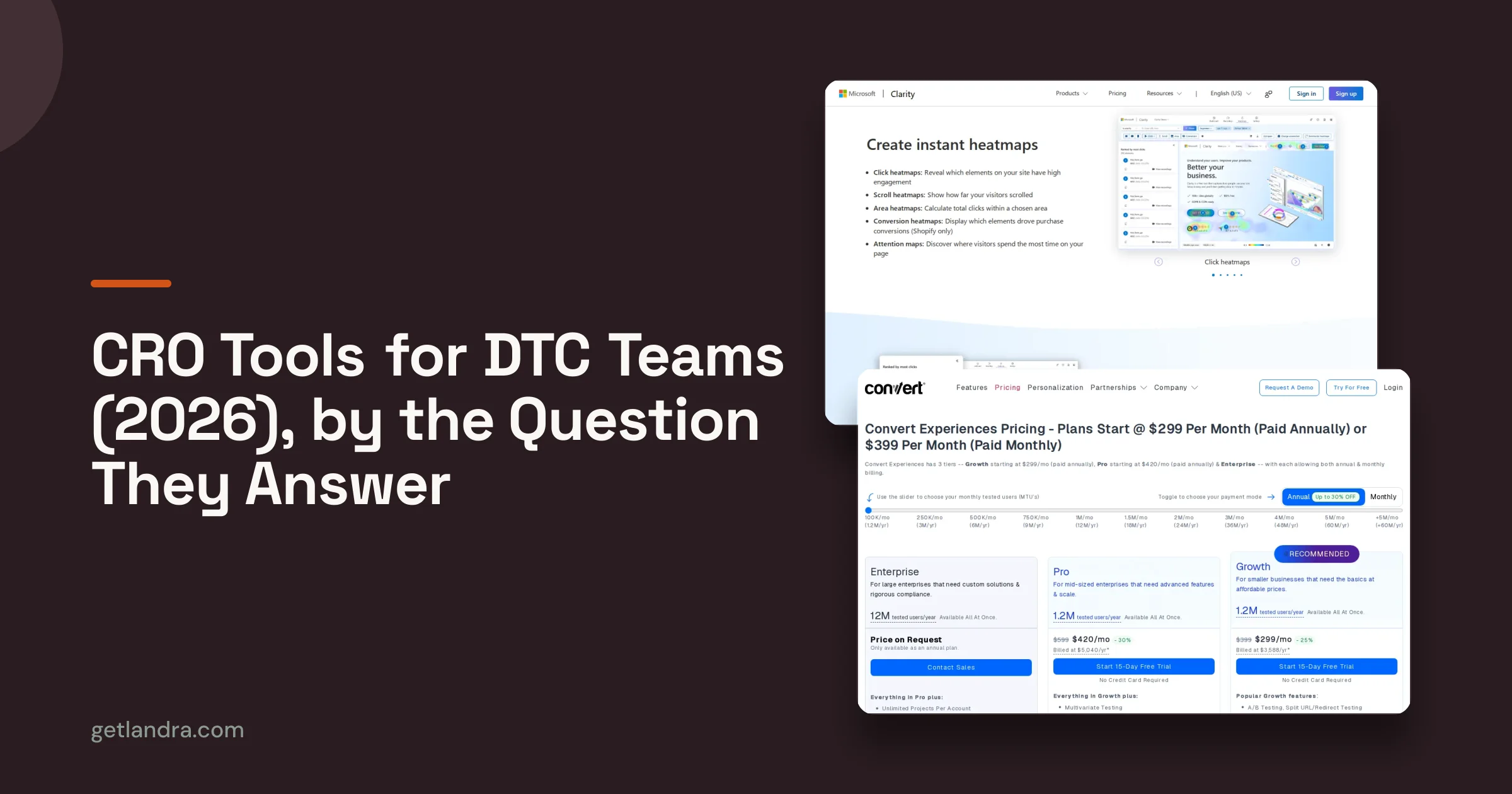
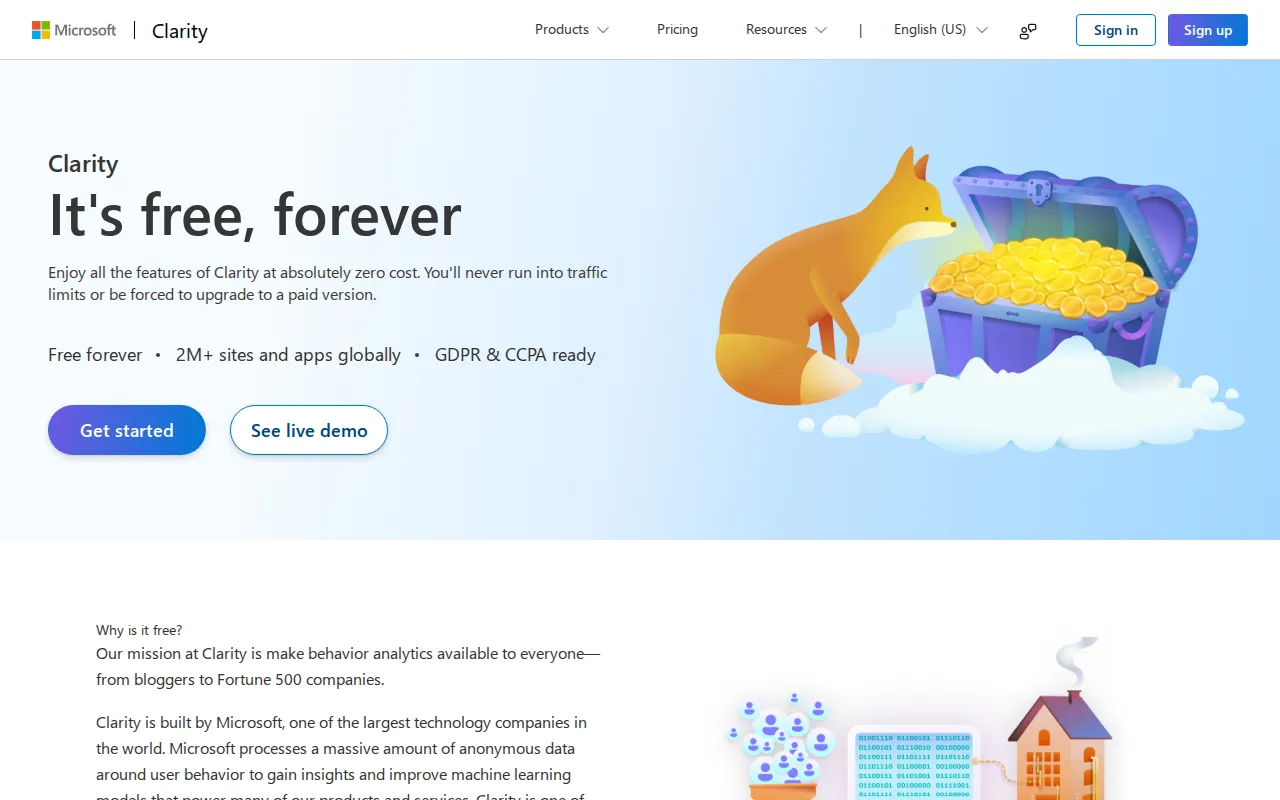
Clarity's pricing page is one line: "It's free, forever." It adds that "You'll never run into traffic limits or be forced to upgrade to a paid version." On that page it lists always-on recordings, click, scroll, area and conversion heatmaps, rage click and dead click insights, 40+ segmentation filters, and Copilot summaries of sessions and heatmaps. Its heatmaps page (shown at the top of this post, captured 1 Oct 2026) notes that conversion heatmaps, which show the elements that drove purchases, work on Shopify only. For most DTC brands that's exactly the platform you're on.
My view: there is no good reason for a small DTC team to pay for heatmaps before it has squeezed everything out of Clarity. Install it, filter recordings to visitors from one ad campaign landing on one page, and watch twenty sessions. You will find more in that hour than in a month of dashboards.
Contentsquare (now including Hotjar)
Best for: teams that want recordings and on-site surveys in one account.
Contentsquare's Experience Analytics has a free plan that includes 200k monthly sessions and one project. Growth starts at $49 a month, or $39 a month billed annually, for 7k monthly sessions and 7k replays, with Pro and Enterprise marked "Let's talk." Former Hotjar users land here now. The practical reason to pay is pairing replays with its Voice of Customer surveys (below) in one place.
FullStory
Best for: teams with a developer who will instrument events properly.
FullStory offers a free plan its pricing page calls "a permanent version of our platform designed for individuals and small teams," with 30,000 sessions a month and 12 months of data retention. Its paid Business, Advanced and Enterprise plans show "Request pricing & demo" rather than a price. It is a strong tool, but it rewards a team that will define events carefully. Without that, you get roughly what Clarity gives you free.
Which version wins? A/B testing tools
An A/B testing tool splits live traffic between versions of a page and tells you which one converted better, with enough confidence to act. The tool matters less than the traffic. Convert is the only tool here with a public price. Wingify and Optimizely are quote only. Before any of them, check whether your page gets enough visitors to reach a result.
How much traffic does an A/B test need?
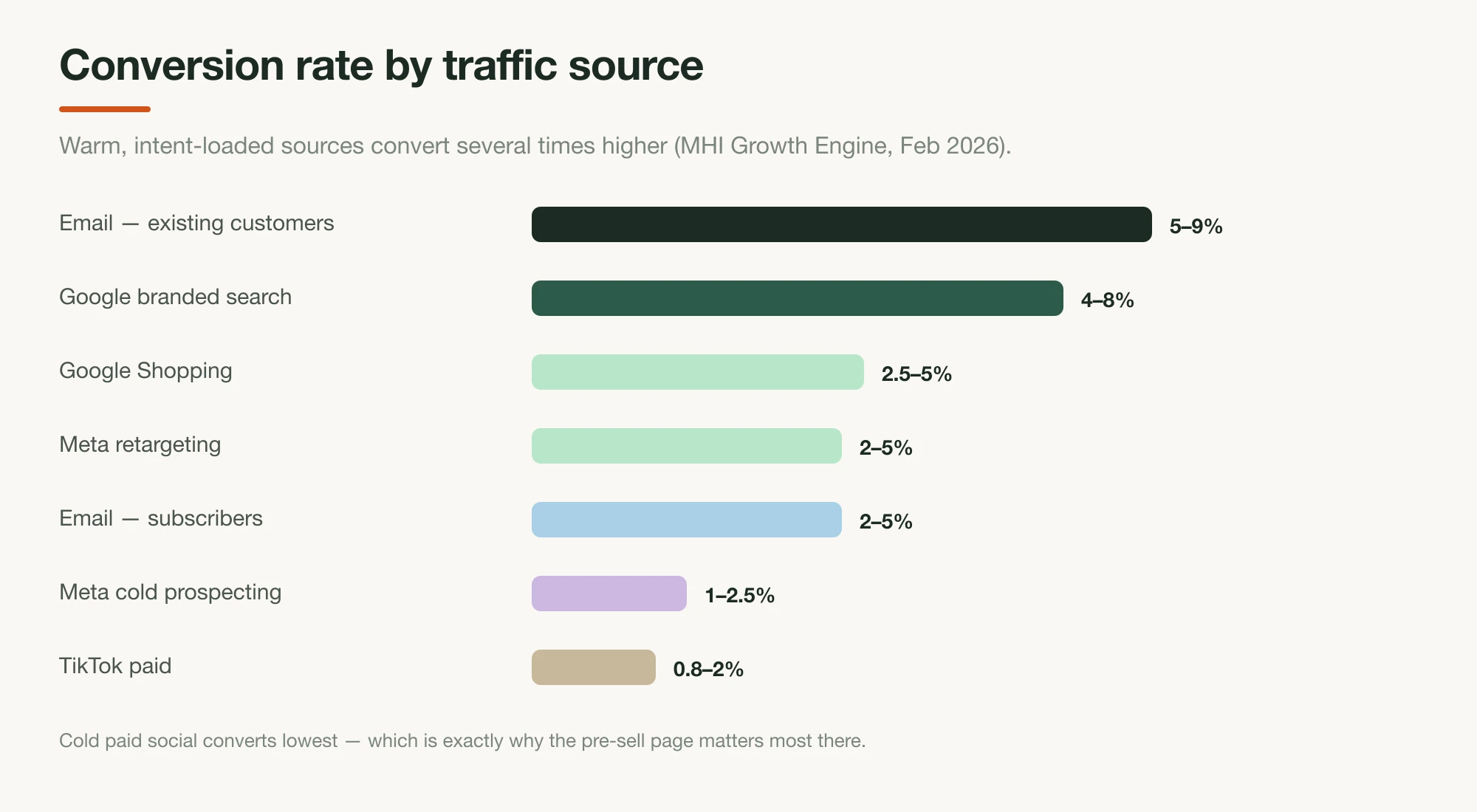
This is the question that decides whether you should buy a testing tool at all, and most roundups skip it. Cold traffic converts low: MHI Growth Engine (17 Feb 2026) puts Meta cold prospecting at 1 to 2.5% and TikTok paid at 0.8 to 2%, session to purchase. Low baselines need big samples.
Here is the math, using the standard two-proportion sample size formula at 95% confidence and 80% power (our calculation, so plug your own numbers into any sample size calculator):
| Baseline conversion rate | Lift you want to detect | Visitors needed per variant |
|---|---|---|
| 2% | 30% (to 2.6%) | about 9,800 |
| 2% | 20% (to 2.4%) | about 21,100 |
| 1.5% | 20% (to 1.8%) | about 28,300 |
| 2% | 10% (to 2.2%) | about 80,700 |
Now set that against what tests actually return. Convert's own 2026 data on its A/B testing stats page reports that "60% of completed A/B tests deliver under 20% lift." So most tests produce lifts that a page with 20,000 visitors a month per variant can't reliably detect. The same page notes the most common test sample is 10K to 50K visitors (37% of experiments).
The consequence for a small brand is the most useful thing in this article: if your page can't reach about 20,000 visitors per variant within a few weeks, a testing tool will mostly hand you "inconclusive." You don't fix that with a better tool. You fix it by testing bigger differences (more on that below).
Convert
Best for: the first paid testing tool for a growing DTC brand.
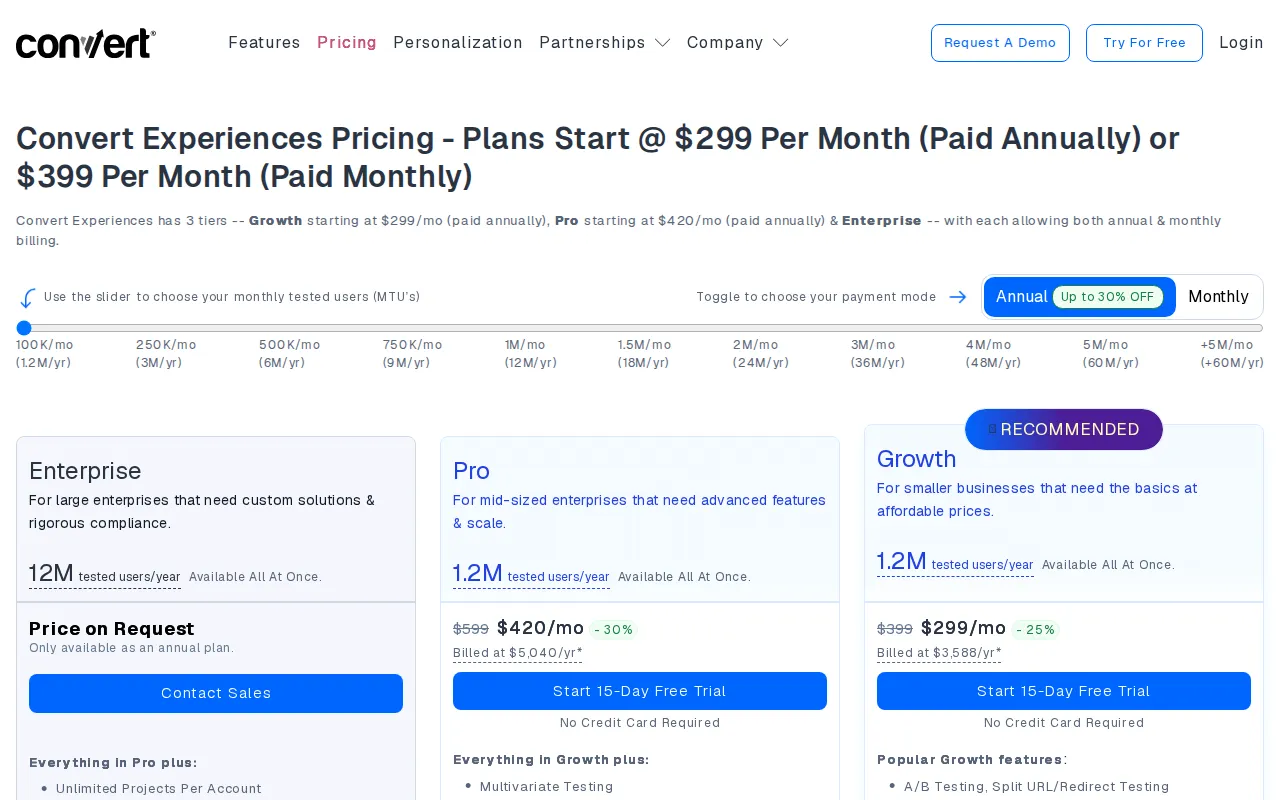
Convert publishes its prices, which sets it apart from the other two testing tools here. Growth is $299 a month billed annually ($3,588 a year) or $399 month to month, with 100K tested users a month. Pro is $420 a month annually or $599 monthly. There is a 15-day free trial with no credit card. If you have the traffic from the table above and one person who owns testing, this is where I would start.
Wingify (VWO and AB Tasty)
Best for: mid-market teams that want testing and personalization from one vendor.
Visit VWO or AB Tasty's pricing page today and you land on Wingify. Web experimentation and personalization each come in Growth, Pro and Enterprise tiers, with no prices shown. The FAQ says pricing depends on "traffic volume, selected products & plans, implementation scope" and asks you to "reach out to our team who can provide a quote designed for your business." There is a 30-day free trial with no credit card.
Optimizely
Best for: enterprise teams running a formal experimentation program.
Optimizely's pricing page says "Every Optimizely plan is individually packaged" and routes you to a demo. It is built for organizations with dedicated experimentation staff and the traffic to feed many tests at once. A small DTC team buying it before it has a testing habit is paying for software it can't use yet.
Why did they leave? On-site survey tools
Survey tools ask visitors directly what stopped them, which turns a recording's "where" into a "why." Use an on-site or exit-intent survey for people who left, and a post-purchase survey for people who bought. Those are different audiences, and mixing them up means asking the wrong people the question you care about.
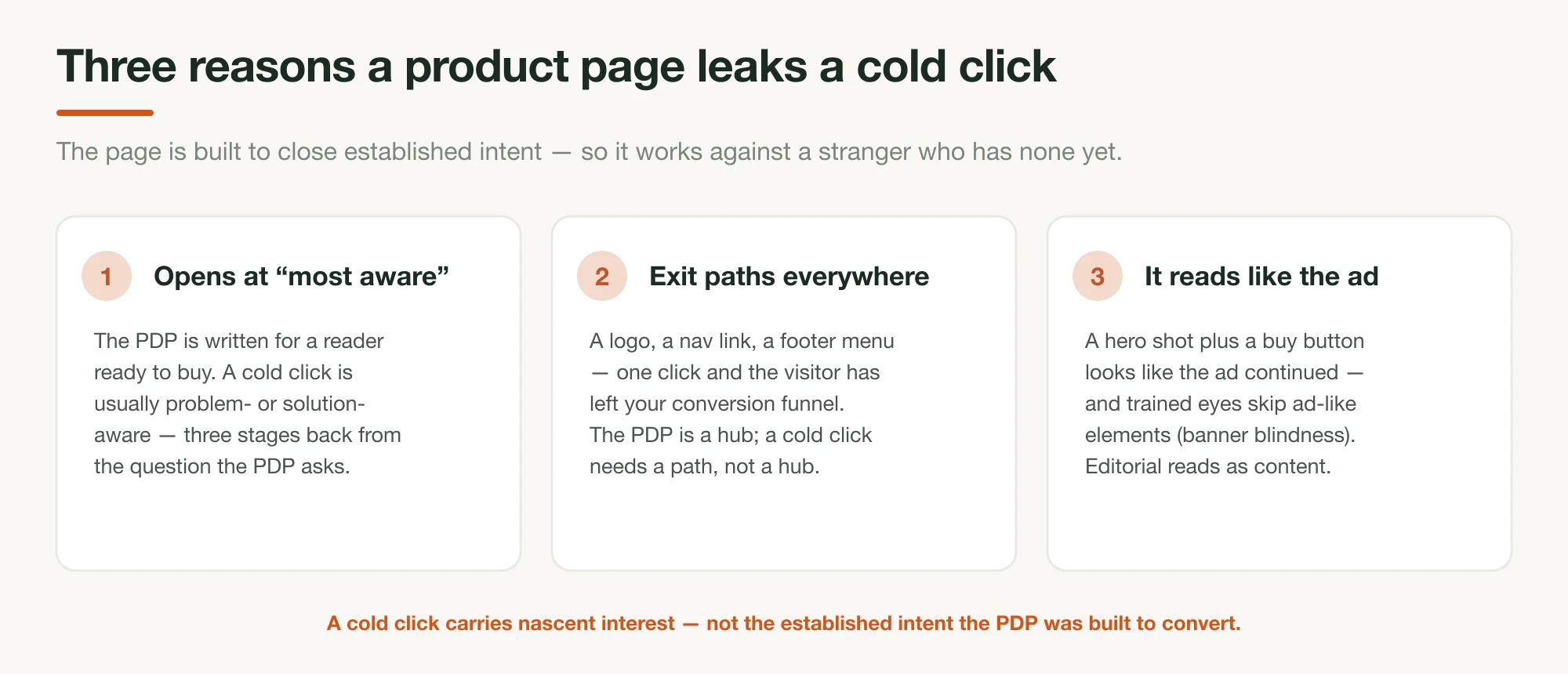
A recording shows a visitor scrolling to the price and leaving. It can't tell you whether the price was the problem, the shipping, or that they just wanted to compare. A one-question survey on exit can. Keep it to one open question ("What stopped you from ordering today?") and read the raw answers yourself before you tag them.
Contentsquare Voice of Customer
Best for: on-site feedback that sits next to your session replays.
Contentsquare's Voice of Customer product has a free plan with up to 100 monthly survey and feedback responses. Growth starts at $99 a month, or $79 billed annually, for 500 monthly responses. The reason to choose it is the pairing: if you already run Contentsquare for replays, surveys live in the same account.
Zigpoll
Best for: cheap exit-intent and on-site surveys for Shopify stores.
Zigpoll's free Lite plan includes unlimited surveys and up to 50 responses a month, and Standard is $29 a month for 200 responses. It runs on-site popups and embeds, exit-intent surveys, email, SMS, and Shopify post-purchase and order status pages. For a team on Clarity's free tier, this is the cheapest way to add the "why."
KnoCommerce (and why post-purchase is a different question)
Best for: learning where buyers came from and why they bought.
KnoCommerce describes itself as a post-purchase survey platform. Starter is $19 a month with a 7-day free trial. Fairing does similar work (free up to 200 transactions a month, Core $49 a month). Both are valuable. Neither answers "why did they leave," because they only ever ask people who stayed. Buy them for attribution and buyer language, not for diagnosing drop-off.
A test is only as good as the variants you run
Most small-team tests fail before they start because the two versions barely differ. Given the sample sizes above, a button color or headline tweak rarely produces a lift you can detect. The tests worth running at DTC traffic levels compare genuinely different pages: a different angle, a different format, or a pre-sell page against sending traffic straight to the product page.
This is where I disagree with the standard CRO advice to "start small and test one element at a time." That advice comes from teams with enterprise traffic. At a few thousand visitors a week, one-element tests mostly come back inconclusive, and you burn months learning nothing. Test the big swing first, then refine the winner.
Big swings that are worth a test slot on cold traffic:
- Pre-sell vs straight to product page. Same ad, two destinations. We break down why the pre-sell page vs product page gap exists for cold clicks.
- Advertorial vs listicle. Same product, two formats, often suited to different ad angles. See advertorial vs listicle: which converts better.
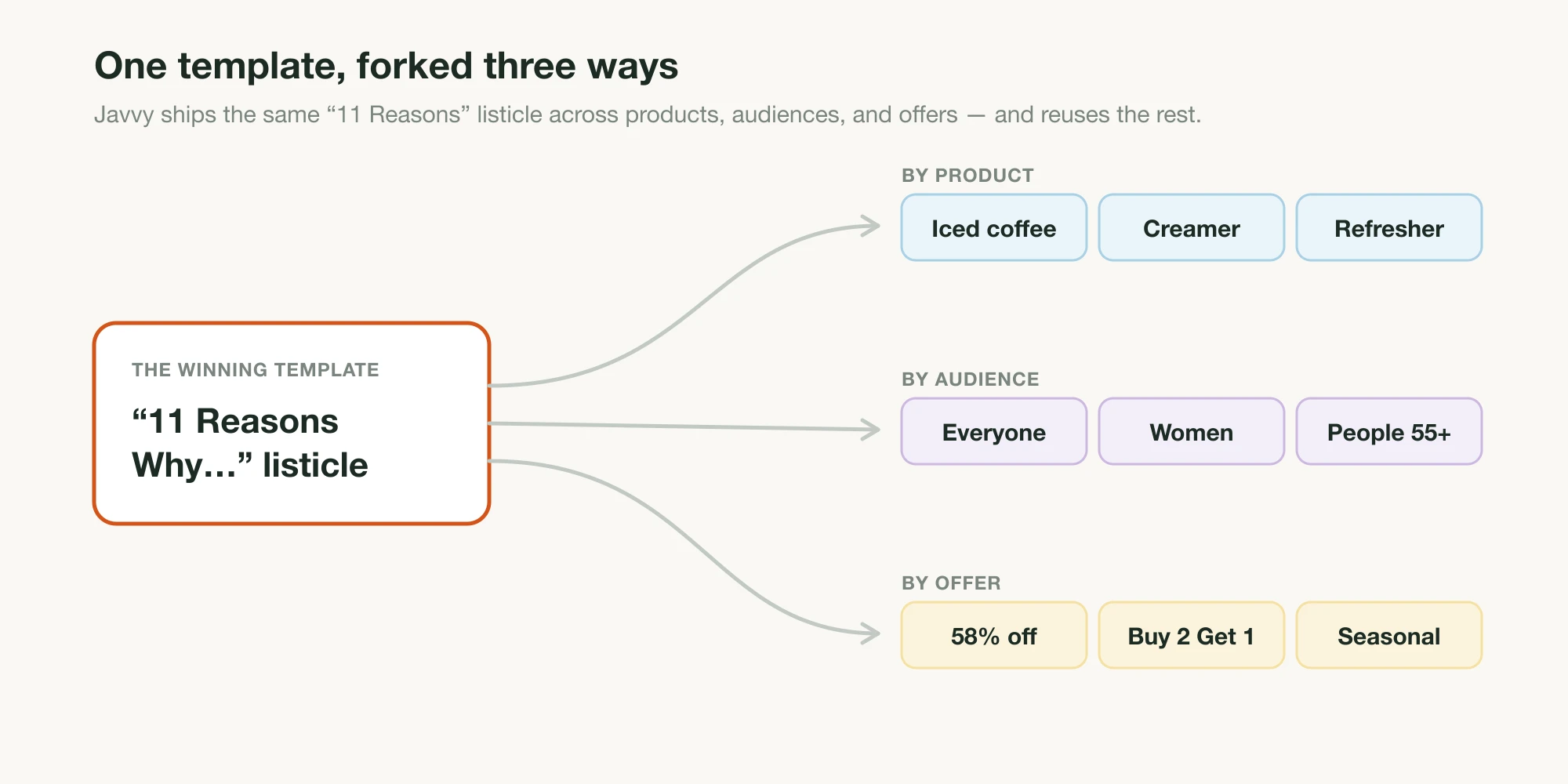
- Angle A vs angle B. The same page rebuilt for a different audience or problem, the way Javvy forks its template in our Javvy listicle teardown.
The catch: every one of those variants is a full page someone has to build, and that is usually where small teams stall. A testing tool can't make the second version for you. That's the job Landra does: the complete conversion-built advertorial, listicle or pre-sell page for your product and audience, laid out in proprietary DTC components with its images, editable in a click-anything visual editor, and published straight to Shopify. 14-day trial, plans from $19/mo. Browse real pages in our examples library to see what a genuinely different variant looks like.
What a small DTC team actually needs at each budget
Spend in the order the questions get answerable. At zero budget, Clarity plus one free survey covers drop-off and why. Add a paid testing tool only when one page can reach about 20,000 visitors per variant within a few weeks. Enterprise suites come last, when you have people whose job is running experiments.
This is our signed view, and the reasoning behind each step.
$0 a month: diagnose first
- Microsoft Clarity on every landing page, recordings filtered by campaign.
- One free survey: Zigpoll (50 responses a month) or Contentsquare Voice of Customer (100 a month) as a one-question exit survey on your main paid landing page.
- Your own baseline: conversion rate per landing page per traffic source, from Shopify or GA4. Our DTC conversion benchmarks give you context, but your number is the one that matters.
Why this first: the first round of fixes (a broken mobile layout, a missing shipping answer, a dead click on an image people think is a button) doesn't need a test. It needs someone to watch the recordings and fix the obvious.
Under about 20,000 visitors per variant: test big, test cheap
If you have ad traffic but not testing-tool traffic, run your big swing without a testing tool: two ads identical except the destination URL, one to page A and one to page B. It is not a clean randomized test, because Meta optimizes delivery for each ad separately, so treat it as directional. A large, consistent gap on the same creative is still a real signal. A small gap is noise.
Steady traffic on one page: add one testing tool
Once a single page can feed about 20,000 visitors per variant in a few weeks, buy one testing tool. Convert at $299 a month billed annually is the cheapest published price here. Trial Wingify too if you want personalization later. Don't buy both, and don't add a paid behavior tool at the same time. Clarity is still doing that job.
A team whose job is experimentation: then go enterprise
Optimizely, Wingify's upper tiers and FullStory's paid plans make sense when you have an analyst or a CRO lead running several tests at once across high-traffic pages. Before that, the bottleneck isn't the software. It's traffic, and it's having variants worth testing.
Where to start this week
Install Clarity today, add one exit survey to your main paid landing page, and watch twenty filtered recordings before you buy anything. Then write down the biggest difference you could test, and check it against the sample size table before you pay for a testing tool.
If the answer is "we don't have enough traffic yet," that's normal for most small brands, and it's useful to know. Spend the time on a second page that's genuinely different from the first, and let the ad split tell you which direction to go.
Frequently asked questions
What are the best conversion rate optimization tools for a small DTC brand?
Start with Microsoft Clarity (free, no traffic limits) for heatmaps and session recordings, plus one cheap on-site survey such as Zigpoll (free up to 50 responses a month) or Contentsquare Voice of Customer (free up to 100). Add a paid A/B testing tool like Convert only once a single page gets tens of thousands of visitors a month.
Is Microsoft Clarity really free?
Yes. As of 1 October 2026, Clarity's pricing page says "It's free, forever" and that "You'll never run into traffic limits or be forced to upgrade to a paid version," covering recordings, heatmaps, rage and dead click insights, and its Copilot summaries.
How much traffic do I need to run an A/B test?
It depends on your baseline conversion rate and the lift you want to detect. With a standard two-proportion calculation at 95% confidence and 80% power, a 2% conversion rate needs about 21,000 visitors per variant to detect a 20% relative lift, and about 81,000 per variant to detect a 10% lift.
What happened to Hotjar and VWO?
As of 1 October 2026, hotjar.com redirects to Contentsquare, whose page says "Hotjar is now part of Contentsquare." VWO's and AB Tasty's pricing pages both redirect to wingify.com, which says "AB Tasty and VWO have united." Pricing for Wingify is quote based.
Do post-purchase surveys tell me why visitors did not buy?
No. Post-purchase tools like KnoCommerce and Fairing only reach people who bought, so they answer where buyers came from and why they bought. To hear from people who left, you need an on-site or exit-intent survey that fires before the order.
Which A/B testing tool is cheapest for Shopify brands?
Of the tools here, Convert is the only one that publishes a price: Growth is $299 a month billed annually ($399 month to month) with 100K tested users a month and a 15-day free trial. Wingify (VWO and AB Tasty) and Optimizely are quote only.