

The popular advice is simple: test more hooks, produce more variations, and keep improving click-through rate. That advice is incomplete. Direct response ads don't fail only because the creative missed attention. They often fail because the page after the click gives cold visitors no convincing reason to continue. A strong ad can create curiosity, but the landing experience has to convert that curiosity into trust, understanding, and action.
Direct response advertising has always been accountable to a response. Montgomery Ward launched in 1872, Sears, Roebuck & Co. followed in 1893, and Claude Hopkins later advanced measurable advertising through split testing and reason-why copy, according to this history of direct response advertising. The medium has changed from catalogues and response cards to paid social and tracked funnels. The operating principle hasn't.
Table of Contents
- Why Most Direct Response Campaigns Fail Before the Click
- The Mechanics Behind Direct Response Advertising
- Choosing the Right Channels for Your Campaign
- Building Creative and Hooks That Convert Cold Traffic
- Why the Landing Page Decides Your Campaign Fate
- Measuring What Actually Matters in Direct Response
- Your Implementation Playbook for Direct Response Campaigns
Why Most Direct Response Campaigns Fail Before the Click
Direct response campaigns rarely fail because the team lacks another hook. They fail when the ad and the destination page make different arguments. CTR can rise while CPA worsens if the post-click experience leaves cold traffic confused, unconvinced, or unsure what to do next.
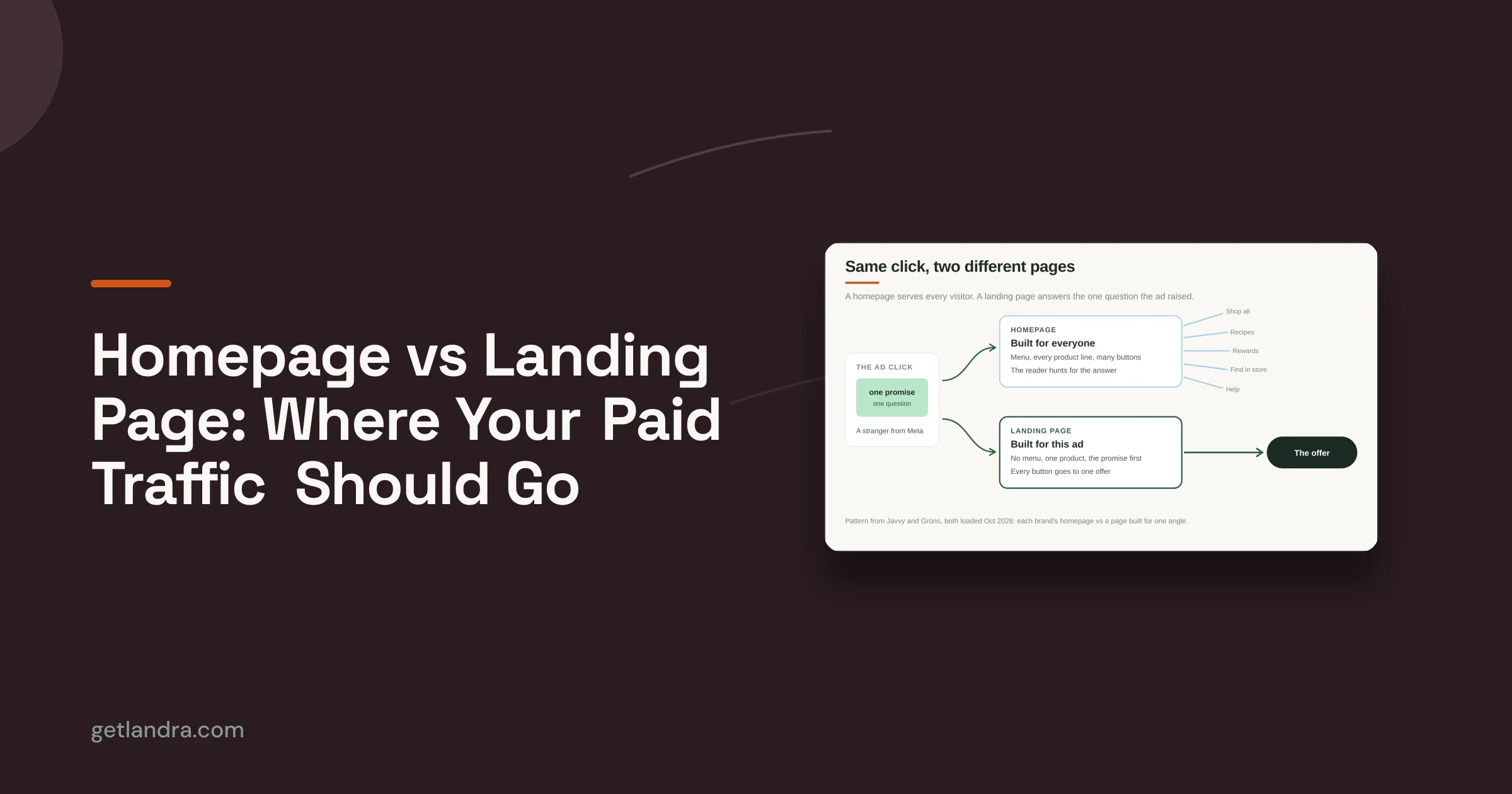
Paid-social visitors arrive with limited context. Someone scrolling Instagram or TikTok was not necessarily searching for your product. The ad interrupted an existing activity, so the visitor may be curious, skeptical, distracted, and unfamiliar with the brand at the same time. Sending that person to a generic homepage or crowded product page creates a context gap before the offer has earned attention.
The ad might lead with a specific problem, mechanism, or transformation. The product page might open with a product name, a navigation menu, competing links, and copy written for people who already understand the category. The visitor then has to rebuild the argument alone. That extra work costs conversions.

The ad is a promise, not the whole argument
A direct response campaign operates as a connected sequence:
- The ad earns attention by naming a relevant problem or desire.
- The transition preserves context so the visitor recognizes the promise.
- The post-click page builds belief with explanation, proof, and clear expectations.
- The offer makes action reasonable by reducing friction and uncertainty.
A weak transition forces the page to restart the sale. A weak page makes the creative work harder than it should. Creative testing can improve the first step, but it cannot repair a landing page with an irrelevant headline, missing proof, or a purchase request that arrives before the product's value is clear.
Paid-social benchmarks cited by Improvado place average click-through rates around 0.8% to 1.5% and post-click conversion rates around 1.2% to 2.8%, depending on industry and offer strength, in its TikTok advertising guide. The same guide indicates that landing pages below 1.0% conversion rate generally need optimization. These figures make the page a practical diagnostic point, not a visual detail to revisit after creative testing.
Practical rule: If the ad earns qualified clicks but the landing page does not convert, stop treating the campaign as a hook problem.
Sustainable scaling requires the complete journey to work together. Match the ad's language to the page headline, build a pre-sell or landing-page structure for cold intent, and make the next action obvious. Creative still determines who stops. The post-click experience determines who continues.
The Mechanics Behind Direct Response Advertising
Direct response advertising is a system for turning attention into a measurable business action. That action might be a purchase, lead, booking, app install, call, or qualified form submission. Brand advertising can build future demand, while direct response requires a defined response mechanism and a way to connect spend with the result.
The model predates digital media. Montgomery Ward's mail-order catalogue and Sears' catalogue model gave consumers a direct way to respond. Claude Hopkins advanced the discipline in the early 1900s through measurable results, split tests, and reason-why copy, as documented in the history of direct response advertising. A pixel, event manager, and conversion API now perform a more advanced version of the work once handled by a coupon code or order card.

Four components must agree
The offer gives the prospect a reason to act now. It may be a product, trial, consultation, bundle, lead magnet, or risk-reversal structure. A strong ad cannot compensate for an offer that feels unclear, expensive, or poorly matched to the audience.
The creative turns that offer into a message that earns attention. It identifies the problem, frames the benefit, demonstrates the product, and sets up the next step. Effective creative also pre-qualifies the click. A specific promise brings more relevant visitors to the page than a vague claim designed only to generate curiosity.
The landing page carries the argument past the click. Its headline, proof, explanation, and call to action must match what the ad promised. Cold traffic often needs education and evidence, which may require a pre-sell page before the product page. High-intent searchers may need less explanation and a faster route to checkout. If the post-click experience asks visitors to reconstruct the offer, the campaign pays for attention that never becomes action.
Measurement connects that action to cost. Operators need reliable event tracking, campaign naming, channel reporting, and a consistent attribution view. Without those foundations, teams optimize for clicks, impressions, or platform-reported conversions instead of commercial outcomes.
The economic test comes before scale
A campaign's viability depends on the relationship between customer acquisition cost, average order value, contribution margin, and lifetime value. If the first order produces less contribution than acquisition costs, and repeat purchase has no credible path to profitability, increasing spend only expands the loss.
Direct response remains a major advertising category. One industry estimate places U.S. direct response marketing spend at $215 billion in 2022, while another estimates global spending at $523.4 billion in 2022, as compiled by direct response marketing industry statistics. The same source reports podcast direct response ad revenue of $12,304.3 million in 2024, with a projection of $21,461.1 million by 2030 and a projected 7.6% CAGR from 2025 to 2030. Those figures show the category's scale. They do not make a weak funnel profitable.
The operator's job is to make every handoff accountable. An impression should produce a meaningful click, the click should lead to a relevant post-click experience, and the page should drive an action the business can evaluate against its economics. CPA is shaped by the entire path, not the ad alone.
Choosing the Right Channels for Your Campaign
Channel selection changes the campaign before the first ad is written. Each platform delivers a different mixture of intent, attention, creative behavior, and post-click expectations. Treating every source as interchangeable usually produces mismatched ads and landing pages.
| Channel | Traffic Temperature | Best Creative Format | Typical CPM Range | Ideal Use Case |
|---|---|---|---|---|
| Meta | Cold to warm, depending on audience | UGC, demonstrations, statics, creator-style video | Varies by auction and audience | Broad prospecting, retargeting, and DTC conversion campaigns |
| TikTok | Mostly cold and discovery-led | Native-feeling short video, creator content, fast demonstrations | Varies by auction and audience | Products that can be understood visually or through a strong problem hook |
| Google Search | High intent | Responsive search ads and tightly matched copy | Varies by query and competition | Capturing existing demand and solving a clearly expressed problem |
| YouTube | Cold to warm | Demonstrations, testimonials, explainers, longer video | Varies by inventory and audience | Products that need education, visual proof, or repeated exposure |
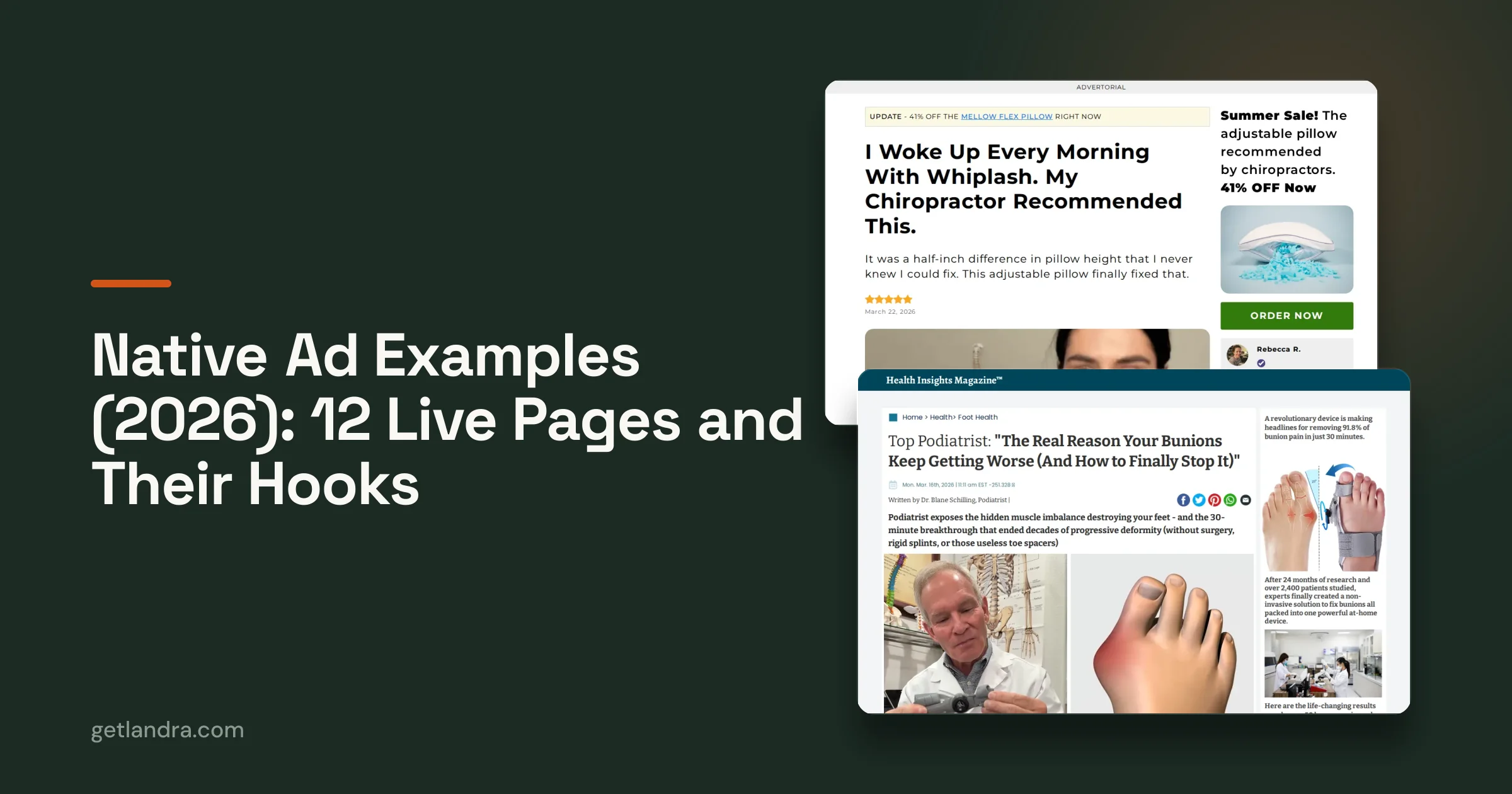
| Native platforms | Cold, often editorially oriented | Advertorials, listicles, editorial-style headlines | Varies by publisher and placement | Education-heavy offers and audiences comfortable with article-based discovery |
The matrix's qualitative labels matter more than the temptation to compare channels on a single efficiency metric. Search traffic often arrives with stronger declared intent, but the auction can make acquisition economics difficult for competitive categories. Meta gives DTC teams broad prospecting capacity and mature conversion optimization, but the ad has to create demand rather than harvest it.
TikTok rewards creative that belongs in the feed. A polished commercial can work, but an overly produced asset may create distance. The viewer needs to understand the problem quickly and see why the product deserves attention. Native advertising can support a different route, especially when the offer requires an advertorial or listicle to explain the problem before the product appears.
Match the channel to the funnel
Use a direct product page when the visitor already understands the category, the offer is simple, and the ad carries enough proof to support immediate evaluation. Use a pre-sell page when cold traffic needs context, when the problem is unfamiliar, or when the product's mechanism requires explanation.
A layered channel plan often makes more sense than forcing one source to do every job. Search can capture demand created by paid social. YouTube can supply education before a retargeting campaign asks for the purchase. Meta can prospect broadly, while native placements can test editorial angles that later inform social creative.
Budget decisions also need to reflect the wider portfolio. Recent survey data cited by Fusion5 found that 42% of global advertisers planned to increase performance marketing spend in 2025, while 78% planned to increase addressable and connected TV investment and 75% planned to increase retail media investment, showing reallocation across channels rather than simple category expansion in this 2025 direct response trends analysis. The implication is practical: marketers need incrementality, attribution, contextual targeting, and first-party data, not just more platform-level conversions.
Building Creative and Hooks That Convert Cold Traffic
Cold traffic doesn't owe your brand attention. The opening has to make the viewer recognize a problem, see a new possibility, or question an assumption before the scroll continues. A useful creative system separates the hook, the explanation, the proof, and the CTA, so the team can test the message without rebuilding every asset from scratch.

Three hook families worth testing
Problem agitation names a recognizable pain and sharpens its consequence. For a skincare product, that might be a visual showing why a routine keeps producing inconsistent results. For a software product, it could expose the workflow step that causes leads to disappear. Specificity beats broad language such as “transform your life.”
Social-proof interruption uses a testimonial, creator reaction, review pattern, or customer demonstration to break the feed's rhythm. The asset should show the product in use and make the proof easy to understand without requiring a long caption. A UGC-style video can open with the customer's frustration, then demonstrate the change and explain the reason behind it.
Curiosity framing creates a gap between what the viewer assumes and what the ad intends to reveal. It works when the page resolves the question. A curiosity hook that promises one thing and lands on another may earn cheap clicks, but it damages conversion quality.
The first seconds need a visible pattern interrupt. The middle should make the problem concrete. The closing should direct the viewer to a page that continues the same argument. That sequence is more useful than chasing a single “winning” format.
Strong creative doesn't hide the offer. It gives the right person enough context to want the next explanation.
Build modularly, then adapt by platform
Write several openings for one body, then several bodies for one offer. Test changes to the promise, audience problem, proof type, visual demonstration, and CTA separately enough to understand what caused the result. A static image, creator video, screen recording, product demo, and testimonial can all express the same strategic angle in different formats.
TikTok usually benefits from lo-fi pacing, natural delivery, and native visual language. Meta can support polished UGC hybrids, clear demonstrations, and static ads with strong visual hierarchy. Native placements need editorial formatting and headlines that earn the article click without disguising the commercial destination.
For teams using generative tools, a practical resource on AI ad creative with Claude can help with ideation and structured variations. Use AI to expand hypotheses, not to replace customer research or proof. You can also organize angles into reusable listicle frames for cold traffic when the product benefits from comparison, education, or ranked recommendations.
The strongest workflow is not “make more ads” in isolation. It is make more coherent arguments, then carry the best argument into the landing page.
Why the Landing Page Decides Your Campaign Fate
The landing page is where a click becomes a buying decision. Yet many teams spend days refining the ad and send the resulting traffic to a product detail page designed for existing shoppers. That page may be perfectly functional for branded traffic and still be wrong for a cold visitor who needs a reason to care.
A pre-sell page creates the missing transition. An advertorial can introduce the problem in an editorial voice, explain the mechanism, surface proof, and then move the reader toward the product. A listicle can organize alternatives, benefits, or buying criteria into a format that feels easier to scan. A quiz can collect information while helping the visitor understand which outcome matters.
Unbounce's benchmark dataset reports a 6.6% median conversion rate across industries, based on more than 57 million conversions, 41,000 landing pages, and 464 million pageviews, in its conversion benchmark report. The benchmark isn't a promise for every campaign. It does establish why a dedicated landing environment deserves measurement rather than dismissal.
Direct product pages versus pre-sell pages
The right structure depends on traffic, offer complexity, and visitor awareness. The following comparison uses qualitative decision criteria rather than unsupported vertical-specific performance claims.
| Funnel Type | Best Fit | Main Strength | Common Failure |
|---|---|---|---|
| Direct to product | Warm traffic, high-intent search, familiar category | Short path to evaluation and checkout | Asks cold visitors to understand the product without enough context |
| Advertorial pre-sell | Problem-aware but brand-unaware visitors | Builds belief through narrative, education, and proof | Becomes editorial decoration without a clear commercial transition |
| Listicle pre-sell | Comparison-led shopping and broad problem awareness | Makes benefits and alternatives easy to scan | Uses generic rankings that don't support a real decision |
| Quiz funnel | Products with meaningful personalization | Turns discovery into an interactive experience | Adds friction when the questions don't improve the recommendation |
A high-performing pre-sell page usually mirrors the ad's hook in the headline, uses a mobile-first reading flow, introduces proof before the offer, and keeps the CTA visually consistent. It doesn't conceal the commercial intent. It earns the offer by answering the questions that stopped the visitor from buying immediately.
The transition matters as much as the page itself. If the ad discusses a specific problem and the advertorial begins with a generic brand story, the chain breaks. If the page builds urgency but the product page resets the conversation, the visitor has to start evaluating again.
Video can support this sequence when it demonstrates the product or removes uncertainty. Teams reviewing media placement should consider resources on how to improve landing page video performance rather than embedding video as decoration. For broader page architecture, the Landra landing page strategy offers another framework for matching structure to conversion intent.
Measuring What Actually Matters in Direct Response
CTR and CPM tell you how the platform is delivering attention. They don't tell you whether the business can acquire customers profitably. Direct response teams need a measurement stack that follows the user from impression to click, landing-page engagement, lead or checkout event, purchase, refund, and contribution after advertising.
Start with a simple funnel dashboard. Track each stage by campaign, creative angle, audience, placement, and landing-page variant. If the click rate is weak, inspect the promise and opening. If clicks are healthy but landing-page engagement collapses, inspect message match, page speed, and the first screen. If visitors reach checkout but don't purchase, investigate offer clarity, trust, payment friction, and fulfillment expectations.

The metrics that govern decisions
CPA measures the cost of acquiring the defined conversion. Define the conversion first. A lead, first purchase, qualified appointment, and profitable customer aren't interchangeable.
ROAS compares attributed revenue with ad spend, but it can flatter campaigns that receive credit for demand created elsewhere. It should be reviewed alongside contribution margin, refunds, discounts, shipping, payment costs, and the expected value of repeat customers.
Contribution margin after ad spend answers the question that platform dashboards often avoid: does the campaign leave money available to operate and grow? A campaign can show attractive revenue while weakening the business if the underlying margin is negative.
Measurement principle: Optimize the metric that survives contact with the income statement.
Attribution needs caution. Last-click reporting can understate paid social's influence when a user discovers a product through a feed, returns later through search, and purchases through a branded session. That doesn't mean every reported conversion belongs to paid social. It means channel credit should be tested against incrementality through structured experiments, geographic comparisons, or holdouts where the business can support them.
For teams consolidating data from Meta, TikTok, Google, Shopify, and analytics tools, these implementation steps for unified analytics can help establish consistent definitions and reporting. Keep the test hierarchy disciplined. Test the offer before polishing a minor headline, then test the core hook, format, audience, and landing experience in a sequence that preserves learning.
A dedicated page can materially change the diagnosis. Unbounce reports the 6.6% median conversion rate cited earlier, and its benchmark context reinforces the value of measuring landing pages as a distinct asset rather than treating the website as one undifferentiated destination. Teams comparing page types can also review conversion rates for listicles, while keeping their own traffic quality and economics as the final judge.
Your Implementation Playbook for Direct Response Campaigns
Build the campaign in an order that protects learning. Start with the offer, audience, and desired conversion event. Write down the promise, the proof available to support it, the objections likely to block purchase, and the page type that can resolve those objections.
Days one through seven
Day one: Audit the product page, reviews, customer language, existing creative, and offer economics. Decide whether cold traffic needs a direct product destination, advertorial, listicle, or another pre-sell format.
Days two and three: Create a message matrix. Pair audience problems with hooks, proof types, demonstrations, and CTA language. Produce several creative concepts, but keep the underlying offer consistent enough to compare them.
Days four and five: Build the landing experience. Match the ad headline to the opening page promise, remove unnecessary navigation, place proof near moments of doubt, and make the CTA route obvious on mobile.
Days six and seven: Install and test tracking. Confirm that the platform events, analytics events, checkout events, and revenue reporting agree as closely as possible before launch.
Days eight through fourteen
Launch a controlled set of ads rather than an unstructured library of variations. Watch the handoff from impression to click to page engagement to conversion. Early decisions should focus on clear failure points, not emotional reactions to a single result.
Use this priority order:
- Offer and audience fit
- Hook and promise
- Creative format and proof
- Landing-page architecture and copy
- Minor visual and CTA refinements
Don't change every layer at once. If the offer, audience, creative, and page all change together, the account may produce a better number without teaching the team why.
Days fifteen through thirty
Reallocate toward coherent winners, then expand horizontally through new audiences, placements, and message angles. Vertical budget increases should follow evidence that the funnel remains economically sound, not because a platform reports more conversions.
Refresh creative before fatigue becomes obvious in declining engagement and weaker conversion quality. Duplicate the strongest page structure to test a new angle, but retain enough of the original to identify the variable responsible for the change. By the end of the first month, you should know which promise earns qualified attention, which page resolves resistance, and whether the contribution after advertising supports further scale.
Landra generates editable advertorial and listicle pre-sell pages from a product or brand URL, with publishing options that include Shopify, a hosted URL, Webflow, and HTML export. If your paid-social funnel needs a faster way to produce and compare cold-traffic landing experiences, visit Landra and evaluate whether its page workflow fits your testing process.