

Most Facebook ads optimization advice is built around motion, not progress. Change the bid. Test a new thumbnail. Trim the headline. Duplicate the ad set. Wait three days. Repeat. A lot of teams stay busy doing this while their acquisition cost barely moves.
That's because most “optimization” happens too low in the stack. People start inside Ads Manager because it feels controllable. But if the offer is weak, the traffic is mismatched, or the post-click experience collapses trust, no amount of tactical tweaking inside Meta will save the account.
The numbers make that painfully clear. In 2025, average Facebook ad CTR for traffic campaigns across industries was 1.71%, while lead generation campaigns averaged 2.59%. Average lead campaign conversion rate came in at 7.72%, down from 8.67% the year before, while Meta also reported a 14% increase in ad costs alongside only a 6% rise in impressions, according to WordStream's 2025 Facebook ads benchmarks. More clicks don't matter much if the funnel leaks after the click.
The practical way to handle Facebook ads optimization is diagnosis first, fixes second. You need a framework that tells you what to touch, in what order, and what not to waste time on. That usually means looking beyond the ad itself and judging the entire path from impression to purchase.
Table of Contents
- Your Optimization Efforts Are Probably Wasted
- The Diagnostic Toolkit Every Media Buyer Needs
- A Triage System for Prioritized Fixes
- A Repeatable Framework for Testing Angles and Creative
- How to Scale Winning Ads Without Breaking Them
- The Ultimate Lever The Pre-Sell Landing Page
Your Optimization Efforts Are Probably Wasted
Most underperforming accounts don't have an optimization problem. They have a prioritization problem.
A media buyer sees rising costs and starts “working the account.” Budgets get nudged. Audiences get split. copy gets rewritten. Placements get excluded. None of that is necessarily wrong. It's wrong when those changes happen before anyone identifies the actual constraint.
The most common mistake is trying to fix a post-click problem with pre-click adjustments. If an ad gets attention but the page doesn't carry that intent forward, the account stalls. You can improve CTR and still lose money. You can lower CPC and still buy low-quality traffic. You can find a decent audience and still send them into a page that gives them no reason to buy today.
Most optimization is just account activity that avoids the harder question: why didn't the buyer convert after they clicked?
That's why random tweaking usually backfires. When you touch too many levers at once, you lose the ability to diagnose cause and effect. Meta gets blamed for volatility that the team created itself.
A better approach is blunt:
- First, identify the failure point. Is the issue the ad, the audience, the offer, or the page?
- Second, rank fixes by expected impact. Some changes move economics. Others just create the illusion of control.
- Third, protect signal quality. If testing is messy, the data becomes storytelling material instead of decision material.
If you want Facebook ads optimization to produce actual gains, treat the account like a system. The ad is just one part of it. In DTC, a clean message path from hook to checkout matters more than constant account tinkering.
The Diagnostic Toolkit Every Media Buyer Needs
Before changing anything, build a view of the account that answers one question fast: where is the breakdown happening?

Start with benchmarks, then read the relationships
Benchmarks matter, but only as a starting point. In 2025, average Facebook ad CTR for traffic campaigns was 1.71%, and lead gen campaigns averaged 2.59%. Average CPC ranged from $0.26 to $0.30, CPM ranged from $1.01 to $3.00, average CPL was $5.83, and Facebook advertising delivered roughly 4x ROI, with 70% of advertisers reporting positive ROI within three months, according to Marketing LTB's Facebook ads statistics roundup.
Those numbers are useful. They are not your strategy.
What matters more is how your metrics interact:
| KPI | What it tells you | What to question when it looks wrong |
|---|---|---|
| CTR | Ad relevance and hook strength | Is the angle weak, or is the audience cold and mismatched? |
| CPC | Cost to earn attention | Are you paying for poor creative, poor targeting, or both? |
| CPM | Cost to access the auction | Is competition high, or is your audience too narrow? |
| Conversion rate | Post-click efficiency | Is the page carrying intent, or dropping it? |
| CPA | Total acquisition efficiency | Is the problem before the click or after it? |
| ROAS | Business outcome | Are you generating profitable demand or just cheap clicks? |
A high CTR with weak conversion rate usually points to message mismatch or landing page friction. A low CTR with an acceptable conversion rate usually means the offer works, but the ad package isn't earning enough qualified clicks. Those are very different problems, and they require different fixes.
Practical rule: Never judge an ad by CTR alone. If the click quality is bad, the account will hide the real problem until spend accumulates.
That's also why post-click analysis matters. If your ad promise and landing page don't line up, users feel the disconnect immediately. Teams that need a better handle on that gap should study the mechanics behind improving conversion rates on landing pages, because many ad problems are really page problems wearing ad metrics.
Use a kill or keep decision tree
Good media buying needs decision logic, not hope. One structured approach uses 3 to 7 day optimization cycles and hard thresholds such as CPM above $45, CTR below 1.2%, or CPA above target × 1.5 to decide whether an ad set should be killed or kept. Benchmarks from that method show 25 to 35% lower CAC by cutting waste earlier, based on this Meta ad set optimization decision tree walkthrough on YouTube.
The useful part isn't the exact threshold. It's the discipline.
Here's the operating logic:
- Kill fast when spend is meaningful and the signal is clearly weak. Don't wait out bad economics just because the ad looks promising.
- Tweak only when one variable is obviously responsible. If CTR is weak but the offer is solid, creative earns the blame.
- Leave stable winners alone. A lot of account damage comes from touching ad sets that are already doing their job.
The issue isn't a need for more knobs. It's a need for fewer excuses to keep bad ad sets alive.
A Triage System for Prioritized Fixes
The fastest way to waste money is to optimize in the wrong order.
Initial efforts often focus on targeting and ad manager settings because those are easy to change. But in DTC, the biggest gains usually come from fixing the things buyers experience. The ad gets the click. The offer and the landing page close the gap between interest and purchase.

Start where the money is won or lost
Think of optimization like emergency triage. You don't start with cosmetic improvements when the core system is failing.
Here's the order that makes sense:
Offer and landing page
If the value proposition is muddy, the product feels overpriced, the page is slow, or the purchase path creates doubt, everything upstream gets punished. Good traffic won't rescue a weak destination.
Creative and copy
Once the page can convert, the ad package becomes the main lever. Now your job is to earn the click with the right angle, proof, and visual format.
Targeting
Audience work matters, but it's often overrated. A lot of “bad audience” complaints are really “bad message” or “bad page” complaints.
Bid strategy and placements
These can sharpen performance, but they rarely fix a broken funnel. They are finishing tools, not rescue tools.
What to fix first in practice
A simple audit usually makes the priority obvious.
If CTR is acceptable and CPA is bad, stop obsessing over hooks and thumbnails. Inspect the page. Check whether the ad promise appears immediately on the destination. Check whether the page answers the buyer's likely objections. Check whether mobile users can understand the offer without hunting.
If CTR is weak and the page converts decently, the offer probably isn't being framed well enough in the ad. That's a creative problem.
If everything is mediocre, the account usually has a positioning problem. The brand is asking the ad to do too much because the product story hasn't been compressed into a sharp, believable promise.
Good Facebook ads optimization starts with the first point of friction the customer feels, not the first lever the media buyer can click.
This matters even more for cold traffic. A cold prospect rarely lands on a product page ready to buy. They need context. They need belief. They need a reason to care before they need a dropdown selector and an add-to-cart button.
That's why the “just send traffic to the PDP” habit underperforms so often. The product page is built to close. Cold traffic often needs a bridge first.
A Repeatable Framework for Testing Angles and Creative
Creative testing fails when the structure is sloppy. Many teams aren't genuinely testing. They're rotating assets and calling it learning.
The fix is simple. Separate angle testing from creative testing, then give Meta enough signal to make a useful decision.

Separate the message from the execution
An angle is the core sales argument. Problem aware. Benefit led. Founder story. Social proof. Comparison. Ingredient credibility. Convenience. Price justification.
A creative is how that argument gets expressed. UGC video. Static image. Founder clip. Testimonial montage. Native-looking reel. Comparison chart.
Don't mix those two layers in the same test and expect clean answers.
One practitioner-led take on this argues that teams should test angles at the ad set level and run 3 to 5 ads per angle so Meta can compare executions within a coherent message bucket. That same source notes only 12% of top-tier DTC programs test angles this way, and those teams report 30 to 40% higher ROAS because the data compounds instead of scattering, according to this Reddit discussion on angle testing and research in Facebook ads.
Whether you prefer broader or tighter clustering, the principle is what matters: keep the message family together long enough to see what Meta and the market prefer.
Build tests Meta can actually learn from
Meta needs enough event volume to stabilize. An ad set needs about 50 optimized conversions in 7 days to exit the learning phase. Fragmenting budget across too many ad sets is one of the most common mistakes because none of them reach that threshold, based on LeadsBridge guidance on Meta Ads best practices.
That has two immediate implications:
- Consolidate when signal is thin. Fewer ad sets with more volume beat a graveyard of underfed tests.
- Change one variable at a time. The same LeadsBridge guidance warns that making multiple simultaneous changes resets learning and muddies interpretation. Their methodology notes 30 to 40% better prediction accuracy when teams isolate one variable and allow at least a day for calibration.
A clean testing structure looks like this:
Ad set level for angle
One angle per ad set. Keep the audience and optimization event stable.
Ad level for execution
Test several versions of that angle with different formats, openings, or proof styles.
Post-click continuity
Send the angle to a page experience that matches it. If the ad sells “why this works,” the page shouldn't open with generic lifestyle fluff.
Clear naming
If your naming convention is a mess, your analysis will be too.
For teams building the post-click side of those tests, it helps to map creatives into a fuller sales funnel template for paid social traffic, so each angle has a logical next step instead of dumping every click onto the same destination.
What usually ruins creative testing
Most wasted spend comes from predictable bad habits:
- Too many variables at once: New hook, new audience, new bid, new page. Then nobody knows what caused the result.
- Calling winners too early: A few purchases can flatter weak creative.
- Editing individual ads mid-flight: That usually creates confusion without solving the underlying issue.
- Starving tests: If the ad set can't gather enough events, the algorithm can't help you much.
“Test in a way that preserves interpretation. If the data can't tell you what happened, the spend bought entertainment.”
Creative testing should feel boring in structure and interesting in output. That's how you know it's working.
How to Scale Winning Ads Without Breaking Them
Scaling is where a lot of decent accounts get wrecked. Teams find a winner, get excited, and force more budget through a setup that isn't ready to hold it.
The first problem is usually technical. The second is behavioral.
Scaling fails when data quality fails
If your tracking is weak, scaling decisions get made on partial truth. Server-side tracking via Meta CAPI matters because browser-only tracking can miss up to 40% of conversions due to privacy blockers. Campaigns using server-side tracking and dynamic budget rules achieve 18 to 22% lower CPA and 12 to 15% higher ROAS in 2026, according to Stape's analysis of Facebook ad optimization with CAPI.
That same source makes another point many buyers miss. Dynamic rules work best when they're tied to quality signals, not vanity metrics. It recommends automatic rules that increase budgets 15 to 20% for ad sets with CPC below $0.50 and CTR above 2.5%. The point isn't to copy the exact rule blindly. The point is to scale what is already proving efficient under clear conditions.
Stape also notes that mobile-first vertical formats such as 4:5 for feed and 9:16 for Reels occupy 30% more screen real estate and reduce load-time abandonment by 15%, improving CPM efficiency and conversion rates by 10 to 12% in its cited benchmarks. That's a creative production issue, but it shows up during scaling because the account starts spending harder into placement realities.
Use rules, not mood swings
There are two sane ways to scale:
| Scaling path | Best use case | Main risk |
|---|---|---|
| Vertical scaling | Existing ad set is stable and still efficient | Pushing budget too hard and destabilizing delivery |
| Horizontal scaling | You want new pockets of demand without overloading one ad set | Duplicating into weak variations that don't deserve budget |
The practical rule is simple. Increase spend gradually, then watch whether efficiency holds. If performance slips, don't keep forcing spend because the ad “used to work.” Pull back and inspect whether the issue is fatigue, audience saturation, weak tracking, or a page that no longer carries the volume.
A lot of buyers overcomplicate this. Scaling isn't cleverness. It's restraint.
Stable scaling comes from protecting what made the ad work in the first place: clear signal, clean data, strong page experience, and enough patience to avoid shocking the system.
The Ultimate Lever The Pre-Sell Landing Page
Most brands spend weeks trying to improve the ad and almost no time improving what happens after the click. That's backwards.
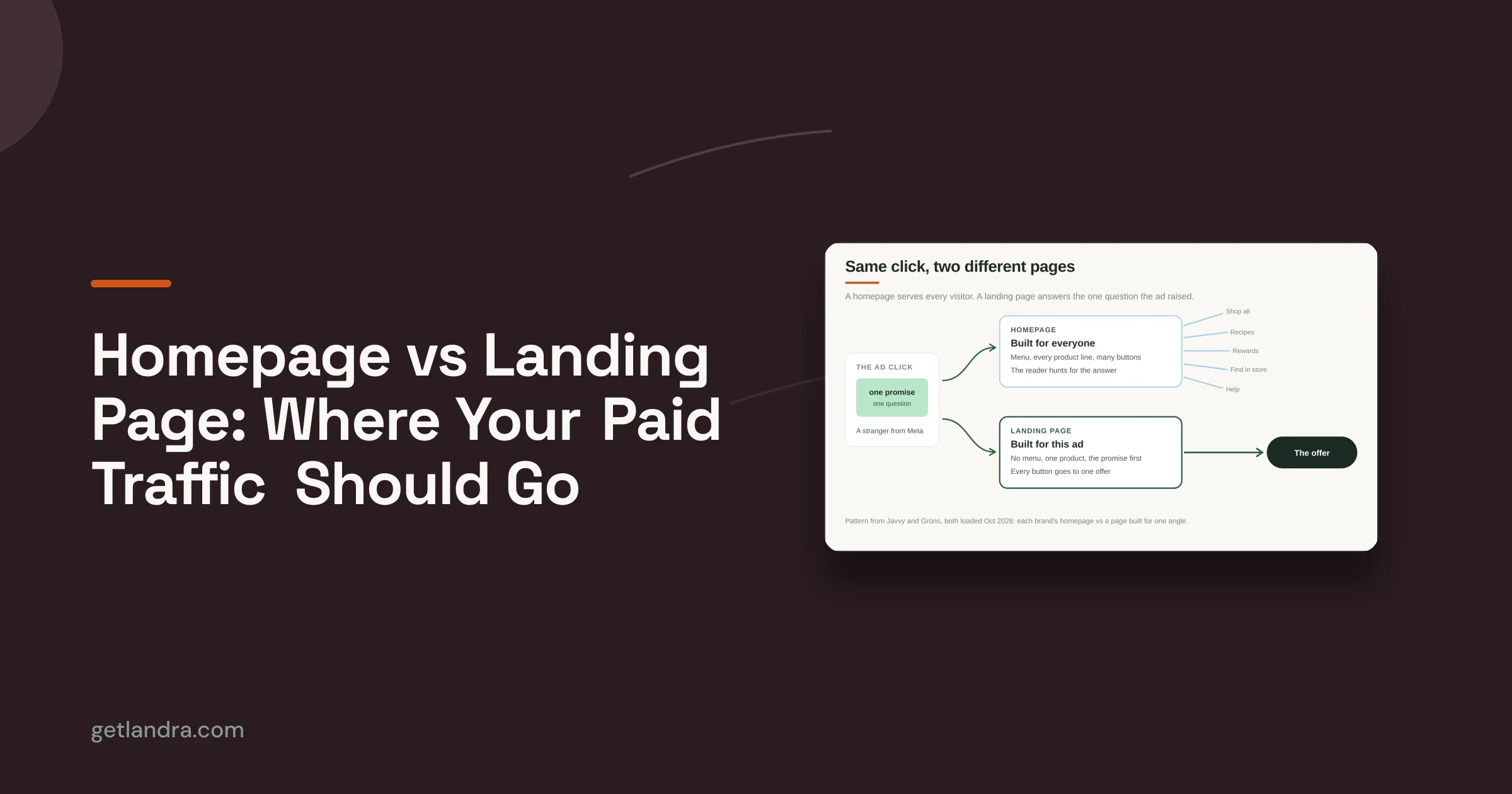
A cold Facebook click rarely wants a product page first. A product page is built for people who already buy the category, already trust the claim, or already know the brand. Cold paid social traffic is usually earlier than that. It needs a bridge.

Why the product page often loses the sale
A standard PDP tends to do five things badly for cold traffic. It asks for commitment too early. It assumes category knowledge. It buries the core claim. It mixes every product detail with every purchase path. It often feels transactional before it feels persuasive.
That creates a familiar pattern in Ads Manager. CTR looks respectable. Sessions arrive. CPA stays ugly. The traffic wasn't necessarily bad. The page did not convert curiosity into buying intent.
This is the missing link in a lot of Facebook ads optimization conversations. The ad's job is to create momentum. The landing experience either compounds that momentum or kills it.
What a strong pre-sell page does
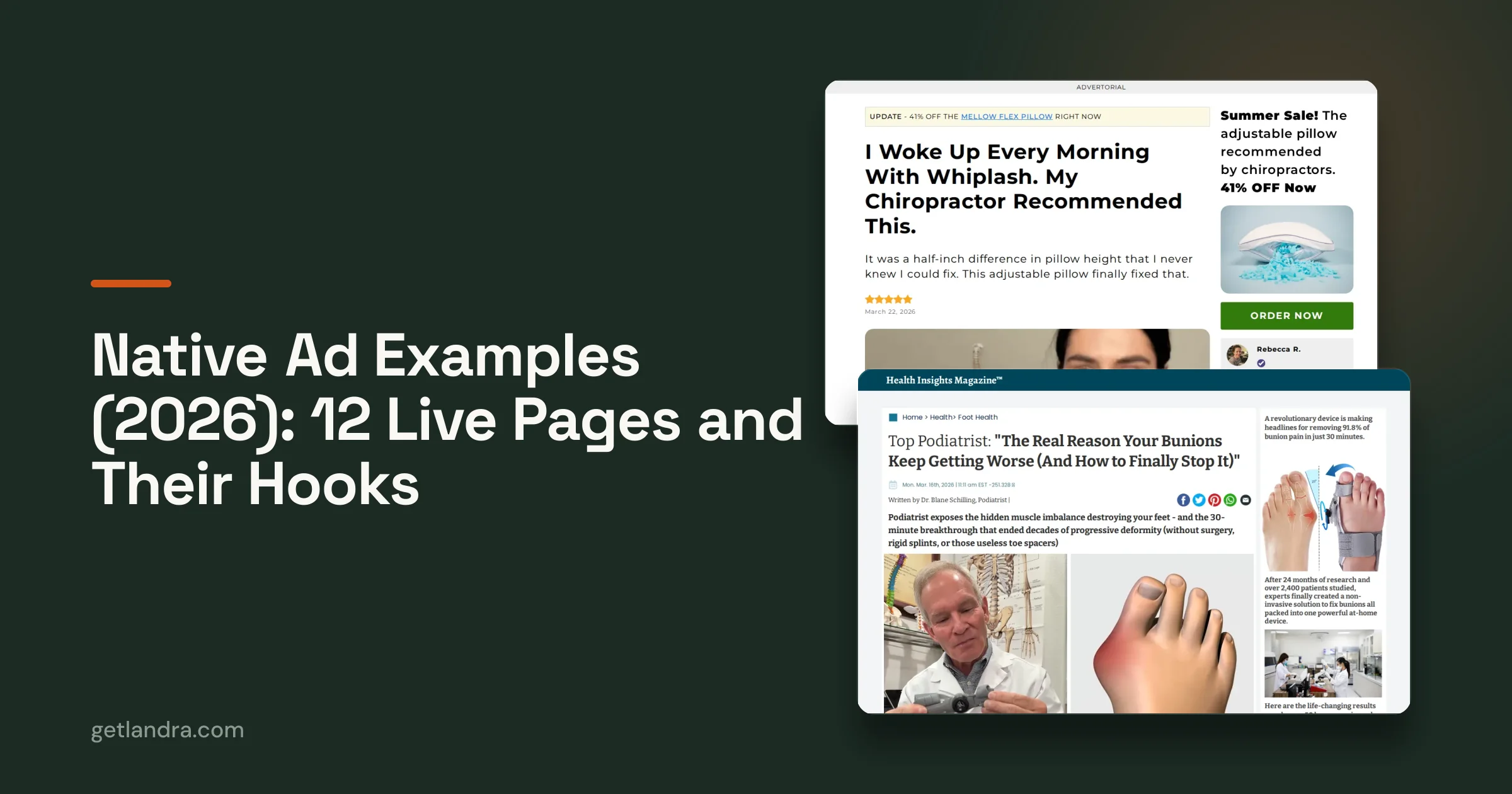
A good pre-sell page sits between the ad and the product page. It can look like an advertorial, a founder story, a comparison page, a listicle, or an educational sales page. Format matters less than function.
It should do a few specific jobs well:
- Expand the hook: If the ad opens a curiosity loop, the page should satisfy it fast.
- Build belief: Explain why the product matters, why the mechanism is credible, and why now.
- Handle objections: Price, skepticism, usage friction, and alternatives should be addressed before the PDP asks for the sale.
- Warm the click: By the time the visitor reaches the product page, they should feel informed, not interrupted.
That's the difference between traffic that bounces and traffic that arrives pre-sold.
For a clearer breakdown of this distinction, compare a pre-sell page versus a product page in this direct-response guide. The core issue isn't design preference. It's traffic temperature and message fit.
Match the ad promise to the page experience
The simplest way to think about this is message scent. If the ad says, “Why most collagen products fail,” the landing page can't open like a generic storefront. If the ad says, “The ingredient change that helped me sleep through the night,” the page needs to continue that exact narrative thread.
That continuity matters more than another round of bid edits.
This walkthrough gives a useful visual example of the kind of page experience that can bridge paid social traffic into a stronger sales path:
The practical takeaway is straightforward. When an ad gets attention but account economics stay stubborn, stop assuming the ad is the problem. Often the most impactful fix is building a better step between click and cart.
If you've already done the hard part and found a resonant angle, don't waste that demand by sending it somewhere that ignores the conversation the ad started.
If you want to launch and test pre-sell pages faster, Landra is built for that exact job. It turns a product URL into editable advertorials, listicles, and mobile-first pre-sell pages that DTC teams can publish quickly, iterate without dev bottlenecks, and align tightly with paid social angles.