

You can usually tell when a DTC funnel is stuck before the dashboard makes it obvious. Spend is still flowing into Meta and TikTok, creative is getting refreshed, audience lists are being swapped, and the site conversion rate barely moves. The problem is rarely that people stopped buying. It's usually that the promise in the ad and the promise on the page don't line up, so cold traffic bounces before the product story ever lands.
That's why sales funnel optimization for DTC is really a promise-matching problem first and a media problem second. The brands that win don't just buy more clicks, they route those clicks into pages that earn the next step, remove friction, and keep the message coherent all the way to checkout.
Table of Contents
- Why Most DTC Funnels Plateau Before They Break
- Diagnosing the Worst Leak Before You Touch Anything
- Pre-Sell Pages vs Product Pages as the Routing Decision
- Writing and Testing Headlines, Advertorials, and Listicles Fast
- Measuring Lift the Way Performance Teams Actually Do
- Mistakes That Quietly Drain Your DTC Funnel Budget
- Your Weekly Sales Funnel Optimization Loop
Why Most DTC Funnels Plateau Before They Break
A skincare brand can spend $180K a month across Meta and TikTok and still feel stuck at a 1.1% site CVR. The easy reaction is to blame creatives, then audiences, then bidding. Those knobs matter, but they're usually not the reason the funnel plateaus.
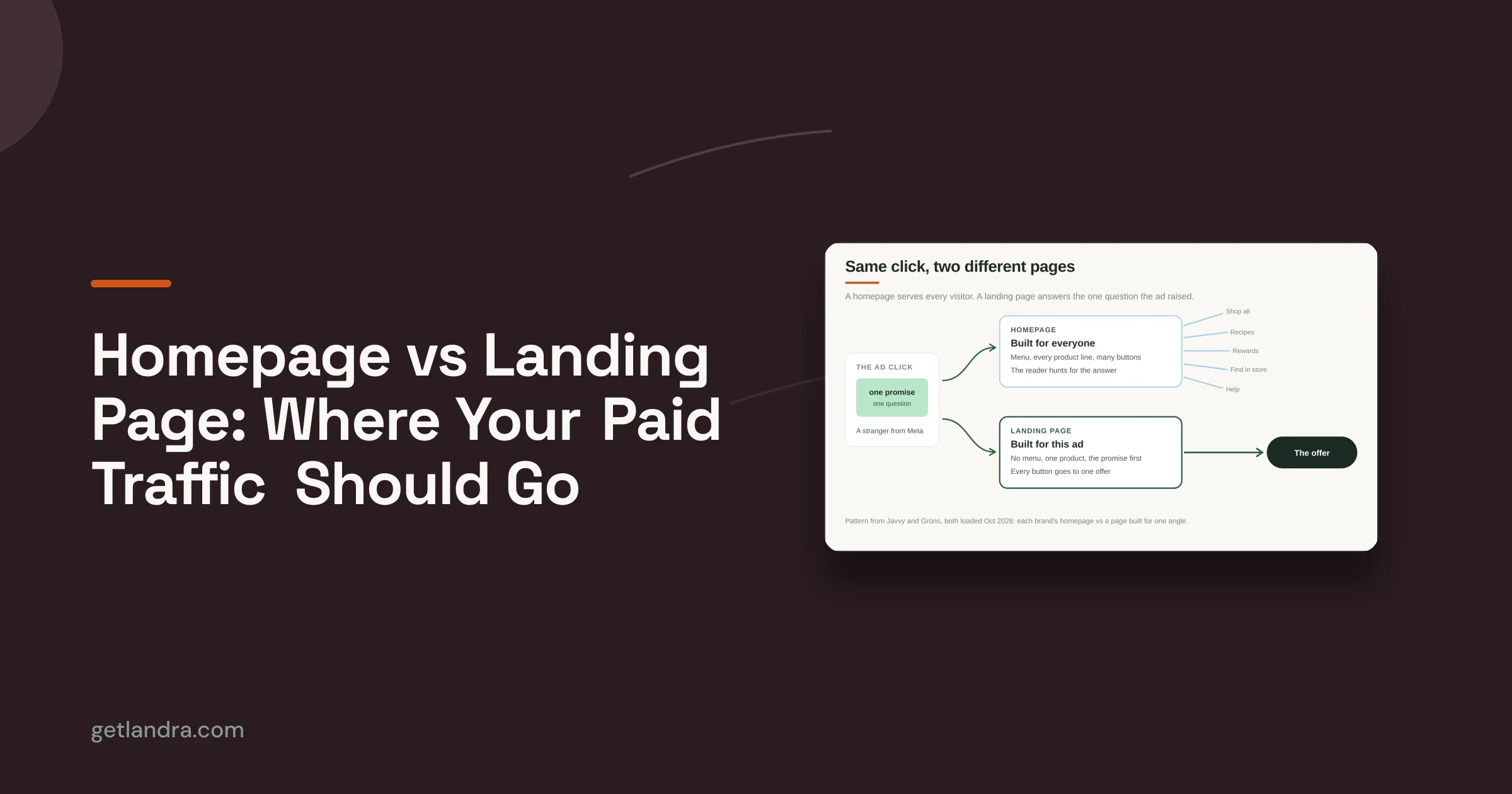
The deeper issue is routing. A cold viewer clicks an ad because the hook made a promise, then lands on a PDP that starts somewhere else entirely. The ad talked about a specific outcome, a specific pain point, or a specific identity, while the product page jumps straight to ingredients, variants, reviews, and navigation clutter. That gap is where conversion dies.
The click is the contract
The first job of the page is to honor what the ad implied. If the creative promised a faster routine, a cleaner ingredient story, or a better way to solve a familiar problem, the landing experience has to continue that sentence immediately. When it doesn't, the platform doesn't need to “learn” anything mysterious, the visitor just leaves.
That's why a plateau often looks like a traffic issue from the outside and a message issue from the inside. The funnel isn't broken at the bottom. It's leaking at the handoff point where intent should have been reinforced but wasn't.
Practical rule: if the page can't restate the ad promise in plain language within the first few seconds, it's probably the wrong routing destination.
Benchmark data backs up the idea that these early and middle stages matter more than many teams admit. Lead-to-customer conversion in B2B typically averages only 2% to 5%, and the biggest leakage often happens between MQL and SQL, where conversion is commonly just 15% to 21% (sales funnel statistics). The exact percentages differ in DTC, but the pattern is the same. Early leakage compounds.
Why the algorithm isn't the villain
A lot of teams keep changing media inputs because that's the loudest feedback loop. Creative fatigue is real, but when the page is mismatched, fresh creative just gives you a new way to lose the same visitor. The click is expensive. Wasting it on a page that starts too late is the bigger mistake.
The useful mental model is simple. If ad, page, and offer don't form one coherent story, the funnel will look “flat” even when top-of-funnel demand is healthy. That's not a signal to add more complexity. It's a signal to inspect the handoff.
Diagnosing the Worst Leak Before You Touch Anything
Start by mapping the funnel into five stages, ad click, landing view, add-to-cart, checkout start, and purchase. Then measure each step inside the same cohort, not as blended averages. CRO guidance is clear that blended totals can hide a severe bottleneck, while stage-level analysis shows where the money is disappearing (conversion rate optimization statistics guide).

The goal isn't to “improve conversion” in the abstract. It's to find the biggest dollar hole first. A weak landing view with strong checkout performance calls for a different fix than a healthy landing view with a leaky checkout. Prioritize the largest absolute loss, not the most emotional complaint in Slack.
Three checks that expose silent killers
A promise match score is the simplest diagnostic. Read the ad, then read the page header and first screen. If a stranger can't tell they belong together, the score is low. That's a routing problem, not a design problem.
A time-to-first-fold engagement check tells you whether visitors are interacting before they scroll past the opening block. If they don't pause, click, or keep reading, the page probably isn't earning attention quickly enough. On cold traffic, that usually means the page is asking for trust before it has given any.
A checkout friction audit catches the most obvious payment and form failures, but it should come after the earlier stages. Teams often start here because checkout is easy to inspect. That's backwards if the page above it is already losing most of the traffic.
For DTC teams, the same stage logic maps cleanly onto a simple reference. The breakdown in ecommerce conversion funnel stages is useful because it forces discipline around where the leak sits instead of treating the funnel as one blur.
Fix one leak, measure it in the same cohort, then move to the next. If you patch three stages at once, you won't know which change paid off.
Discipline is restraint. Don't touch every page element just because the numbers look ugly. Fix the worst leak, confirm the movement, then work down the stack.
Pre-Sell Pages vs Product Pages as the Routing Decision
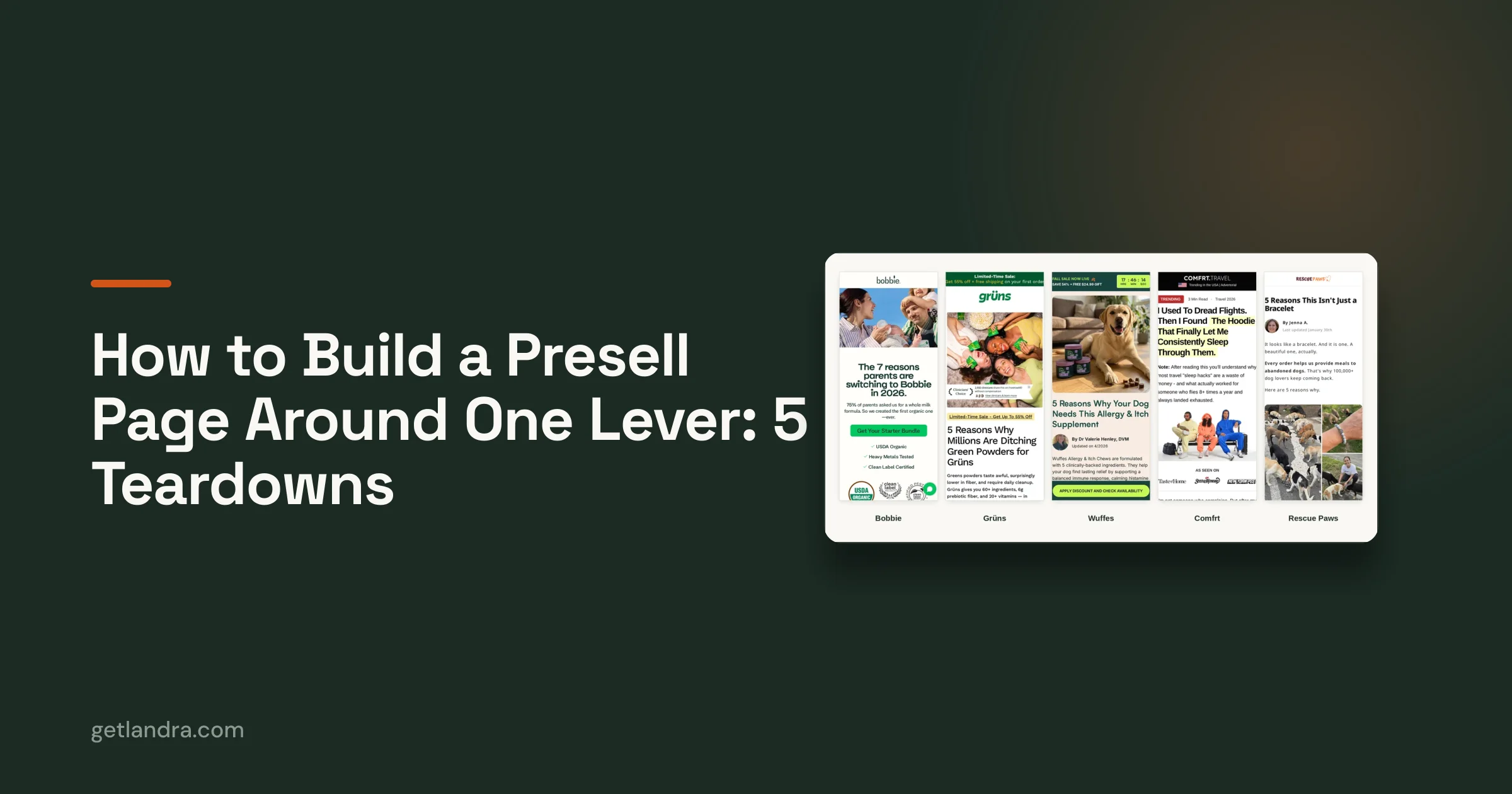
A PDP is built for a visitor who already believes the product category is relevant. A pre-sell page is built for someone who needs context, proof, and a reason to care before they hit the product page. That difference matters more on cold paid social than almost any visual tweak.
The strongest routing evidence in the brief is blunt. A single pre-sell page has reportedly outperformed PDP routing by roughly 2–3× on click-to-purchase, alongside a 46% CAC reduction in a first-party test cited by the publisher's materials. That's not a small optimization. It's a routing decision that changes the economics of the campaign.
Which page wins for which traffic
Cold Meta and TikTok traffic usually arrives with weak category certainty and short attention. A pre-sell page works better there because it translates the ad promise into a story, adds proof, and removes the pressure to “figure it out” on the product page. The page warms the visitor before handing them off.
Branded search, retargeting, repeat buyers, and obvious high-intent traffic are different. Those visitors already have context, so a PDP can work well because it keeps the path short. If the user already knows what they want, don't add another editorial layer just to be clever.
| Dimension | Pre-Sell Page | Product Page (PDP) |
|---|---|---|
| Primary job | Build intent and context | Convert existing intent |
| Best traffic | Cold paid social, new SKU launches, education-heavy offers | Branded search, retargeting, repeat buyers |
| Main strength | Story, proof, and offer sequencing | Direct access to product details and checkout path |
| Main risk | Too much copy if the angle is weak | Too little context for cold traffic |
| Funnel role | Warm-up before purchase | Close the sale |
If you want a deeper breakdown of the routing trade-off, the presell page strategy insights piece is a useful companion because it frames the same choice as a traffic-temperature problem instead of a page-style preference.
The routing rule that actually holds up
Use the page that matches the temperature of the traffic. That's the whole test. If the audience is cold, the page needs to do more work than a PDP usually does. If the audience is warm, compress the path and keep friction low.
A lot of brands get stubborn here. They prefer the PDP because it feels “real,” or they prefer a pre-sell because it feels more strategic. Preference doesn't matter. The click source does.
Writing and Testing Headlines, Advertorials, and Listicles Fast
Cold traffic rewards clarity faster than it rewards polish. The opening line has one job, it has to make the visitor feel like the page is answering the same question the ad just raised. If the promise match is off, everything that follows becomes harder.
A fast workflow starts with three headline angles, each written for a different kind of attention. Outcome-led headlines promise the result. Mechanism-led headlines explain why the result is believable. Objection-led headlines answer the reason someone would hesitate. The point isn't to be clever, it's to give the same offer three distinct entry points.
Headline and hero combinations that earn the scroll
Pair each headline with a single hero image and a single CTA. Too many choices blur the message, and cold traffic doesn't need a menu. It needs a reason to keep reading.
- Outcome-led: lead with the result the buyer wants, then support it with proof.
- Mechanism-led: show the method, ingredient stack, or system that makes the result feel credible.
- Objection-led: name the friction directly, then remove it before it becomes a bounce.
For advertorials, the structure that holds up is simple. Open with the problem in plain language, agitate the cost of inaction, then spend the final third on the resolution and offer. If the product gets buried too early, the page reads like a brand essay. If it appears too late, the visitor never gets to the point.
Listicles work differently. A strong listicle front-loads the most contrarian or useful item, then uses item two for the product placement. That keeps the page from reading like an ad dressed up as content. If the list feels useful first, the recommendation feels earned.
The listicle creation for e-commerce resource is relevant here because it reflects the exact structure that makes ranked content work for pre-sell traffic.
Writing rule: the page should look like it was built to answer the ad, not like it was adapted from a blog post after the fact.
One practical way to move fast is to build variants from shared blocks. Tools such as Landra can generate editable, mobile-first pre-sell pages from a product URL, which makes it easier to swap headlines, hero images, and section order without rebuilding the whole page. That matters because the fastest test is usually the one you can launch while the campaign is still fresh.
Measuring Lift the Way Performance Teams Actually Do
Performance teams stop trusting platform ROAS the moment attribution starts drifting. The cleaner read is blended CAC by source, because it's harder to fool yourself with view-through credit or delayed platform reporting. If the new route looks better there, the lift is real enough to matter.
The second number is stage-level conversion in one funnel view, from impression to landing to ATC to checkout to purchase. That gives you the shape of the problem instead of a generic winner label. If landing improves but ATC falls, the page might be over-educating and under-selling.
The three numbers that survive a finance review
A simple measurement stack is enough:
| Funnel Metrics Dashboard Snapshot | Baseline PDP Route | Pre-Sell Variant | Delta |
|---|---|---|---|
| Blended CAC by source | Higher | Lower | Directional improvement if spend holds steady |
| Landing-to-ATC rate | Baseline | Should hold or improve | Shows whether the page creates real intent |
| ATC-to-purchase rate | Baseline | Should not collapse | Confirms downstream quality |
| Incremental lift versus holdout | Control route | Test route | Proves the route adds orders |
| Creative spend impact | Included | Included | Keeps the read honest |
The third number is incremental lift against a holdout. Even a simple geo holdout or a budget pause on the original route can tell you whether the new page is adding orders or just moving them around. Without that, you're only guessing.
For a broader measurement lens, the universal optimization framework is a helpful companion because it reinforces the discipline of measuring change at the right level instead of trusting surface-level wins. The same logic applies here, if the test doesn't hold up across cohorts, it isn't a decision yet.
The guide to listicle conversion rates is also worth keeping nearby when you're evaluating content-style routes, because content format can change the shape of the funnel, not just the top-line click.
Set the decision threshold before the test starts. If you don't know what a real win looks like, every decent-looking chart becomes a false positive.
Mistakes That Quietly Drain Your DTC Funnel Budget
The most expensive mistakes are rarely dramatic. They're the small habits that feel sensible in isolation, then destroy signal. Routing every paid social click to the PDP because it ranks well in organic is one of them.
Another common one is sending TikTok traffic to a page built for Google traffic. Those audiences don't arrive with the same frame of mind, so the same page can look broken even when the ad was fine. Teams then blame creative, when the issue is that the page never matched the channel.
The budget drains that show up as “optimization”
Treating the pre-sell page as a one-off build is another trap. A page like that should be a template with swappable headlines, hero images, and CTAs. If every test requires a redesign, your iteration speed collapses.
Optimizing for landing-page CTR instead of CAC is even worse. It rewards curiosity clicks that don't buy, which makes the top of the funnel look healthier than it is. High click-through with weak purchase quality is expensive noise.
- Routing all paid social directly to the PDP: works for warm traffic, not usually for cold social.
- Over-splitting ad sets too early: starves the algorithm before it learns.
- Shipping one winner and stopping: turns optimization into a one-time event instead of a system.
- Reading bounce rate without context: confuses mismatch with creative failure.
- Building too many page variants by hand: slows testing until the opportunity passes.
The brands improving CAC consistently treat funnel work like a content pipeline. They don't wait for a launch cycle to test another angle. They ship, measure, kill, and move.
Your Weekly Sales Funnel Optimization Loop
The cadence matters more than the individual test. Funnel work compounds when Monday's diagnosis becomes Tuesday's creative brief, which becomes Wednesday's traffic split, which becomes Thursday's readout. If the loop is consistent, the wins start stacking.
Monday is for the numbers. Pull stage-by-stage conversion and CAC from the prior week, then flag the weakest step first. Don't start with the best-performing ad or the prettiest page, start with the leak.
Tuesday is for variants. Generate three to five new headline or angle options from the worst-performing section, then build them from shared blocks so the test stays fast. If you need to write from scratch every time, the loop gets too slow to matter.
Wednesday is launch day. Ship the variants to split-test traffic and pause underperformers at a fixed impression threshold. That keeps weak pages from eating budget while they're still learning nothing.
A simple operating rhythm
- Monday: pull stage-level CR and CAC, isolate the weakest step.
- Tuesday: write new angles, headlines, or offers from that weak point.
- Wednesday: deploy the variants to test traffic.
- Thursday: review lift by stage and calculate true CAC after creative spend.
- Friday: document the insight, kill the losers, queue next week's tests.
Thursday is for truth, not celebration. Review lift by stage, then calculate the actual CAC delta after creative spend. A variant that improves clicks but hurts downstream purchase quality is not a win.
Friday is for memory. Write down what worked, what didn't, and what the next test should challenge. The goal isn't a single winning page. It's a system that gets cheaper and faster every cycle.
If you want a faster way to build and iterate pre-sell pages, Landra turns a product URL into an editable, mobile-first advertorial or listicle that you can publish quickly and test against the PDP route. It's built for the exact kind of promise-matching and routing work covered here, so you can launch variants, compare CAC, and keep the funnel moving without waiting on a long production cycle.