
Every high-converting advertorial starts with one of a handful of openings. Here are five proven ones: the pattern, when to use it, and a fill-in skeleton you can copy. (For the full page structure each one feeds into, see how to write an advertorial; for the headline craft, advertorial headlines that convert; for the section-by-section skeleton itself, plus the listicle equivalent, see free advertorial and listicle templates.)
Five advertorial templates you can swipe
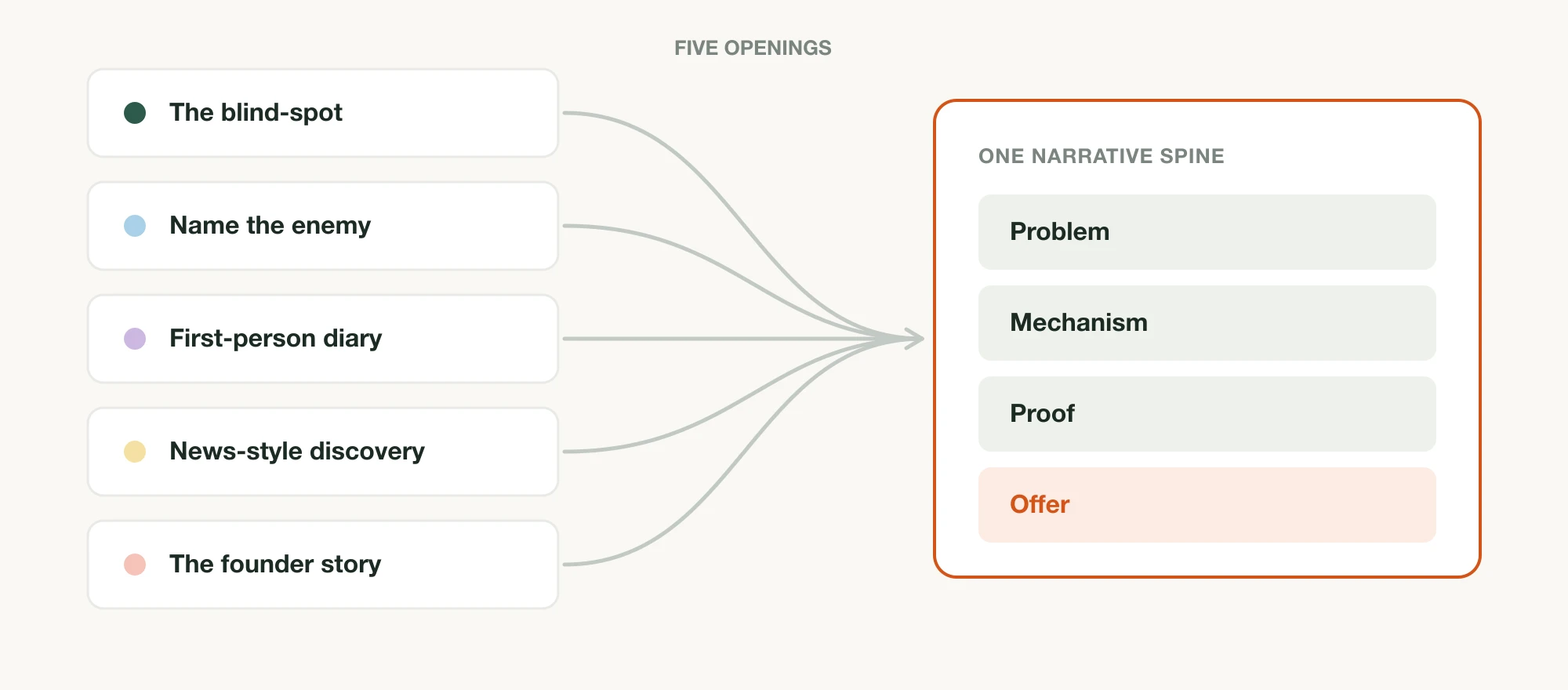
Almost every winning advertorial opens one of five ways: the blind-spot, name-the-enemy, the first-person diary, the news-style discovery, or the founder story. Each is a hook, not a whole page; it earns the read, then hands off to a proven body. Below, every template pairs a real, live DTC example with a skeleton you fill in with your own product, audience, and proof.
1. The blind-spot ("here's what everyone in this category gets wrong")
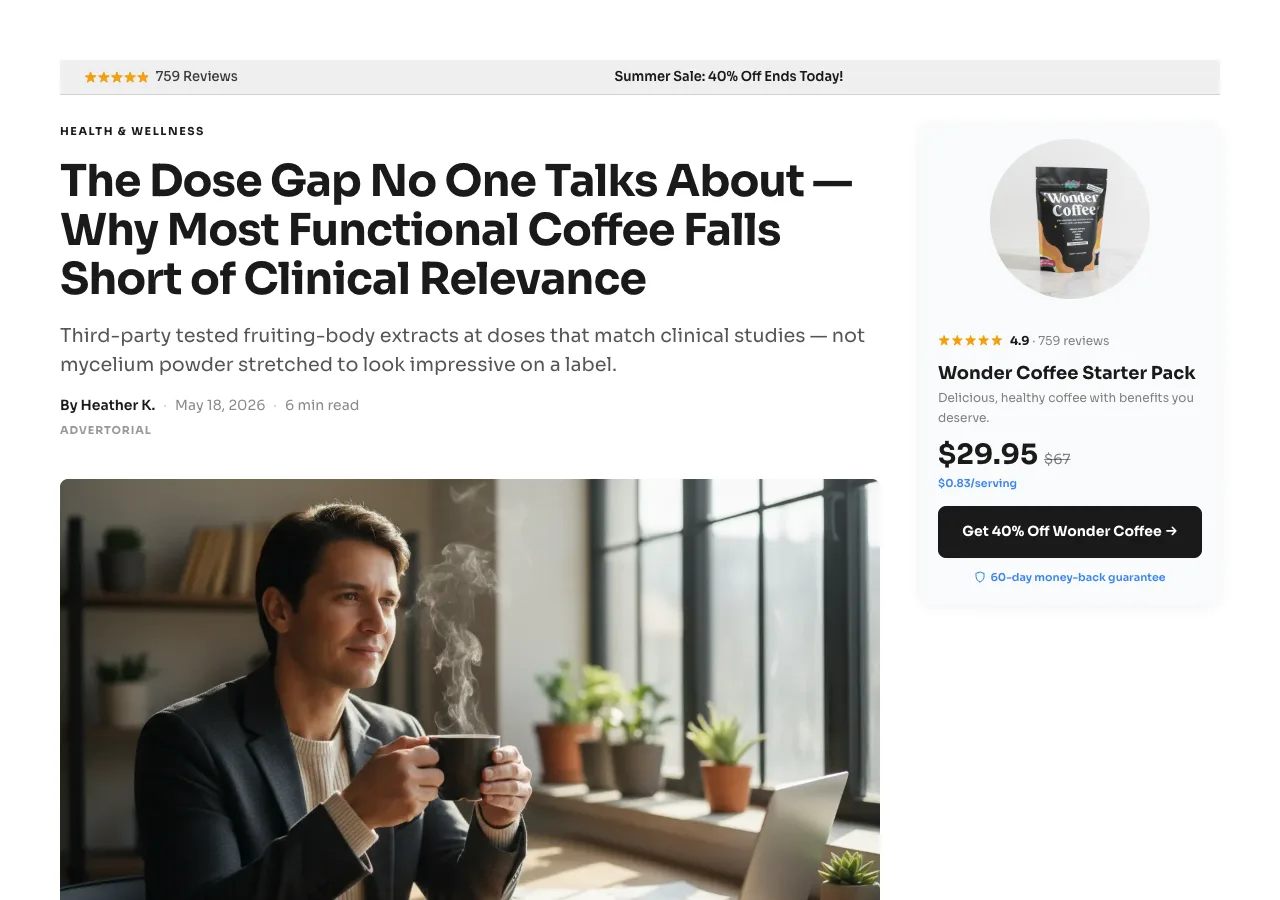
What it is: open on the lie or oversight the whole category shares, not your product, so your product becomes the obvious fix once the gap is named.
When to use it (DTC): crowded categories where every brand makes identical claims (supplements, skincare, functional coffee). It works on cold, skeptical traffic that has been burned by the same promise before.
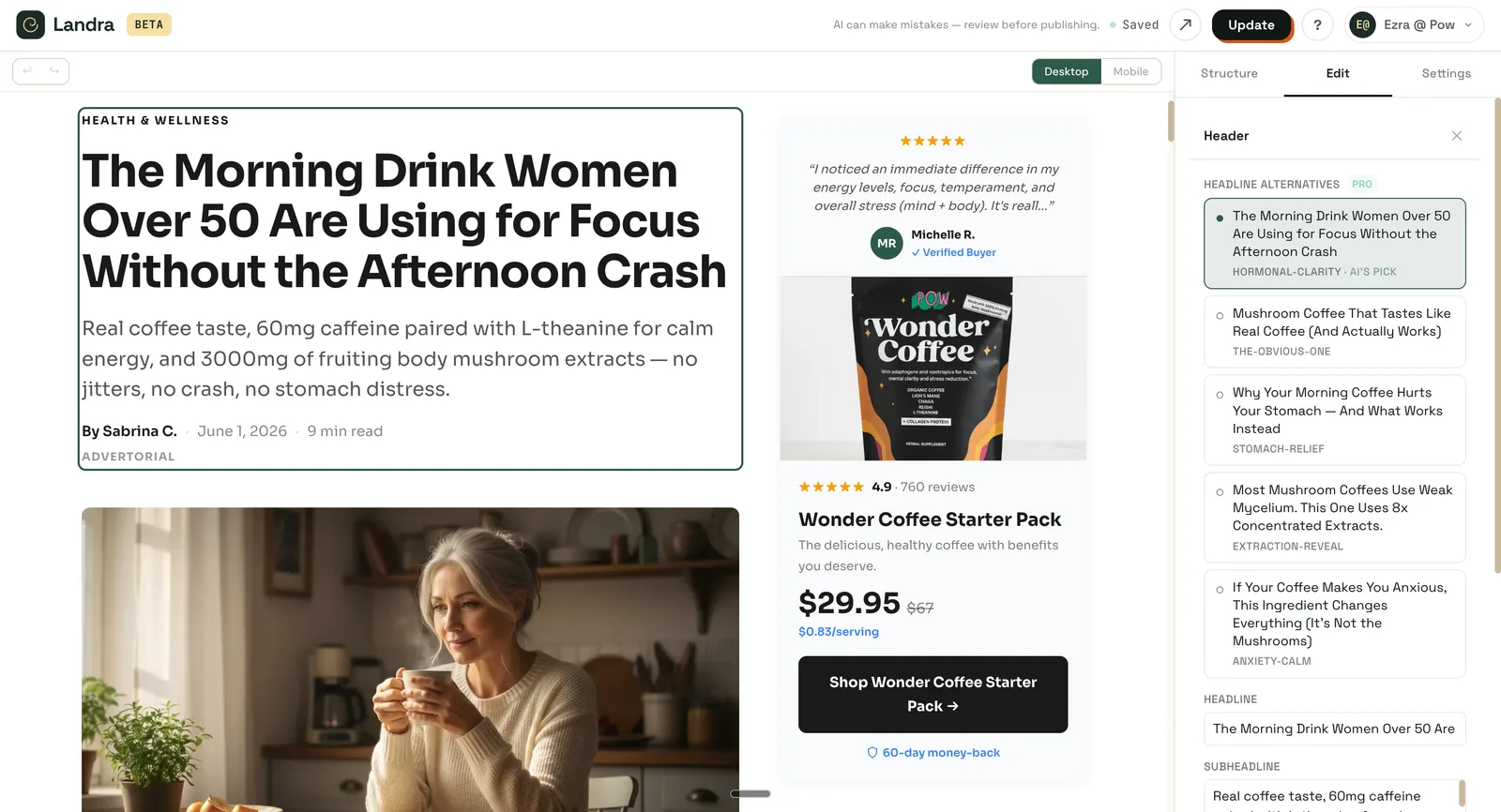
Real example: Pow's "The Dose Gap No One Talks About" opens, "You've read the ads. Mushroom coffee that balances energy, sharpens focus, calms the jitters. The category language is identical — every brand promises the same transformation…", then names the thing nobody checks (the dose). (This page was built with Landra.)
Fill-in skeleton:
Every [category] makes the same promise: [the three identical claims]. So the difference can't be the promise — it's [the thing nobody checks: dose, sourcing, what actually ships]. Here's what most [category] gets wrong, and how to tell.
2. Name the enemy (the villain: incumbent, ingredient, or industry)
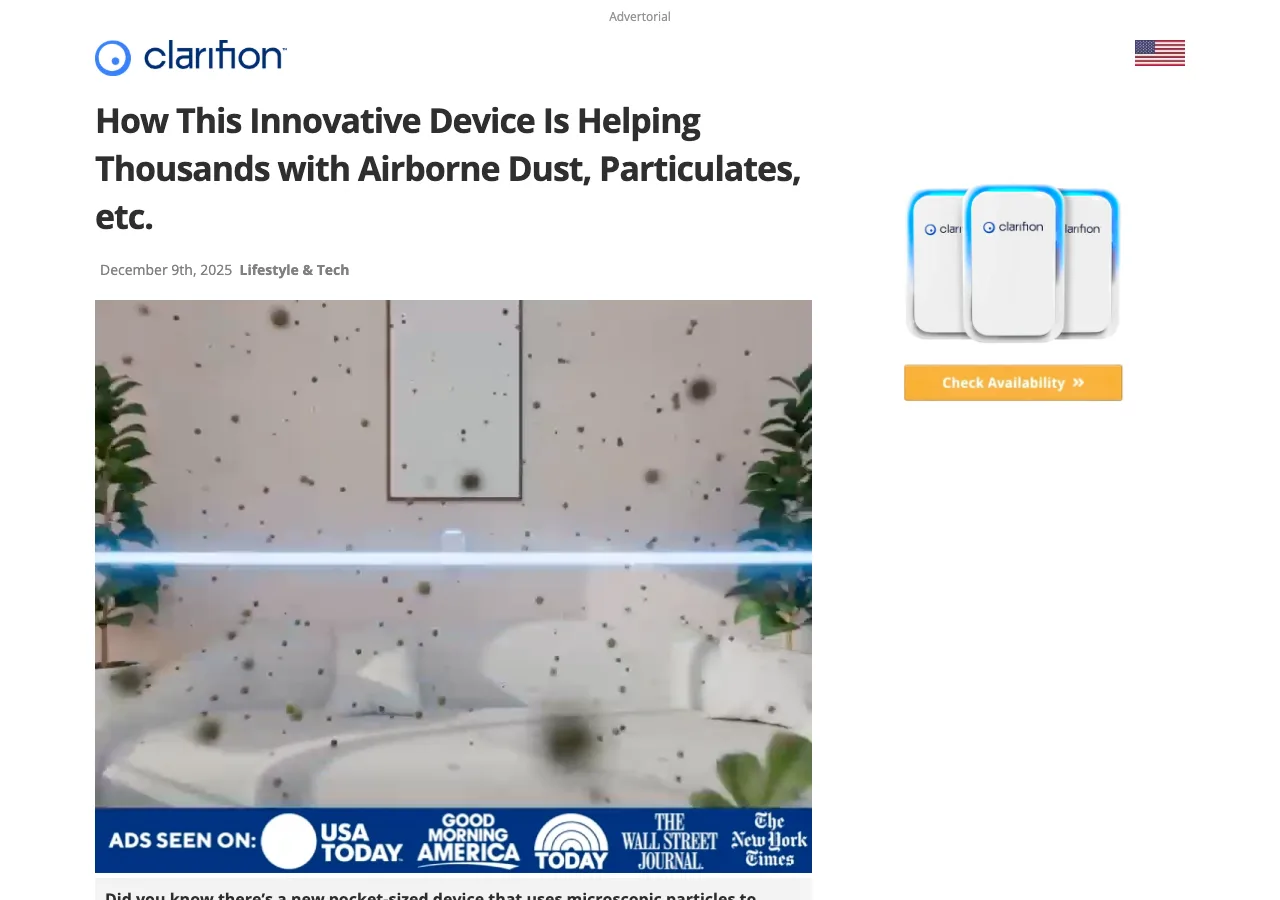
What it is: open on a shared adversary (an overpriced incumbent, a toxic ingredient, a complacent industry), then position your product as the smarter alternative.
When to use it (DTC): challenger brands undercutting a category run by big names, or "clean / free-from" products defined against a villain ingredient. It channels resentment the reader already feels.
Real example: Clarifion (clearly labeled "THIS IS AN ADVERTORIAL…") opens: "For years, the air purifier industry has been controlled by a handful of big brands who never had a reason to innovate or lower their prices."
Fill-in skeleton:
For years, the [category] industry has been run by [the incumbents / a villain ingredient] who [never had a reason to change / quietly overcharged you]. That's finally changing — because of [your product's difference].
3. The first-person diary ("I tried it for X days")
What it is: a real, first-person testimonial narrative: the writer's own struggle, what they tried, and what finally worked.
When to use it (DTC): emotional, identity-driven problems (skin, weight, hair, sleep) where a relatable narrator lowers a cold reader's guard better than a clinical pitch.
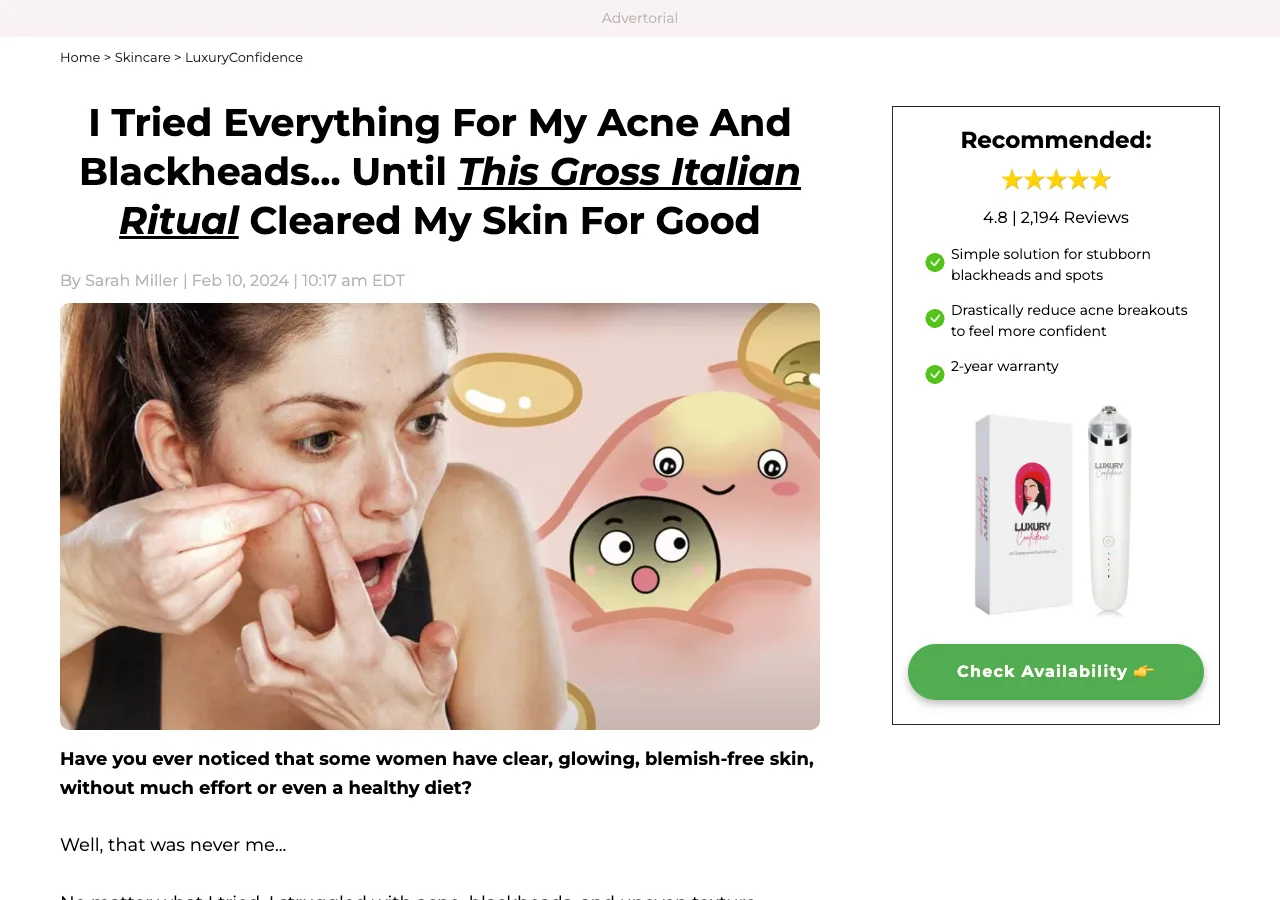
Real example: LuxuryConfidence's "I Tried Everything For My Acne And Blackheads… Until This Gross Italian Ritual Cleared My Skin For Good" (labeled "Advertorial," narrated by a named writer) opens on the reader's envy of other people's clear skin before turning to the narrator's own story.
Fill-in skeleton:
I tried everything for [problem] — [the failed fixes] — and nothing worked. Then I [discovered / was told about] [product or mechanism]. [X days] later, [the specific, falsifiable result].
4. The news-style discovery ("Why everyone's switching to…")
What it is: frame the page as a discovery — a "why X happens, and what to do about it" editorial — leading with a stat or a mechanism rather than a pitch.
When to use it (DTC): products with a real "why this happens" story (metabolism, water quality, sleep cycles). It performs on cold paid traffic that responds to curiosity and news framing.
Real example: Obvi's "Why 89% of Women Can't Lose Weight After 30 (It's Not What You Think)" styles itself as an editorial with a byline and carries an "advertisement" disclosure in the footer.
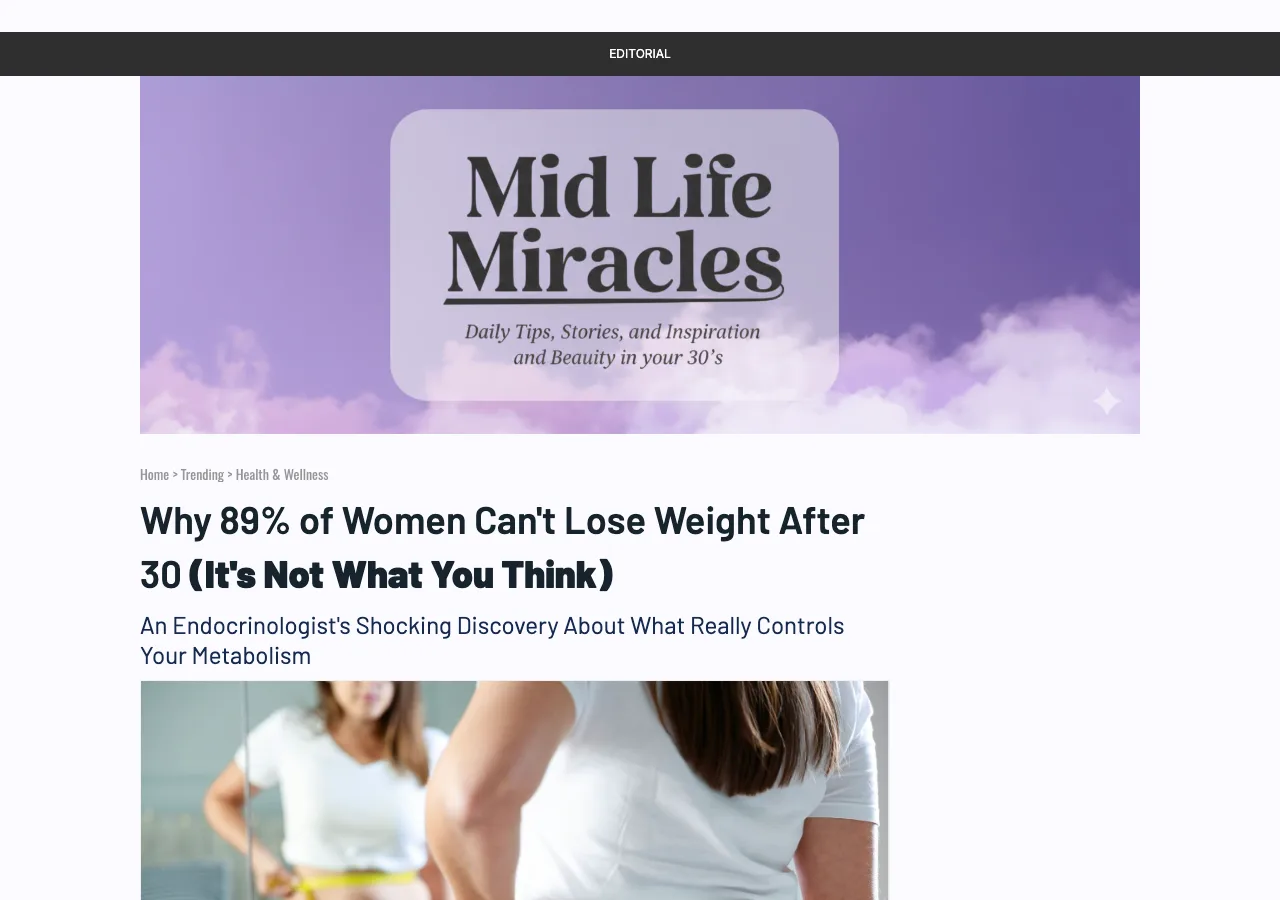
The line you don't cross: that same page presents itself under a publication-style name and invokes an expert a reader can't independently check. Template the editorial structure — the stat, the mechanism, the discovery framing — but never fabricate a publication or an expert byline. Disclose the page as an ad and use a real expert or none. (Full rules: advertorial disclosure and FTC compliance.)
Fill-in skeleton:
Why [surprising, substantiated stat about your audience]? [The non-obvious reason.] New research points to [mechanism] — and a simple shift in [behavior or product] that's helping [audience] [outcome]. (Disclose as an ad. Real expert, or none.)
5. The founder story (the honest origin)
What it is: a named founder or expert tells, in their own voice, why they built the product — the compliant counterpart to the fake-newsroom move.
When to use it (DTC): brands with a real, credentialed founder or origin (a vet, a chemist, a parent who couldn't find what they needed). It builds durable trust and survives scrutiny.
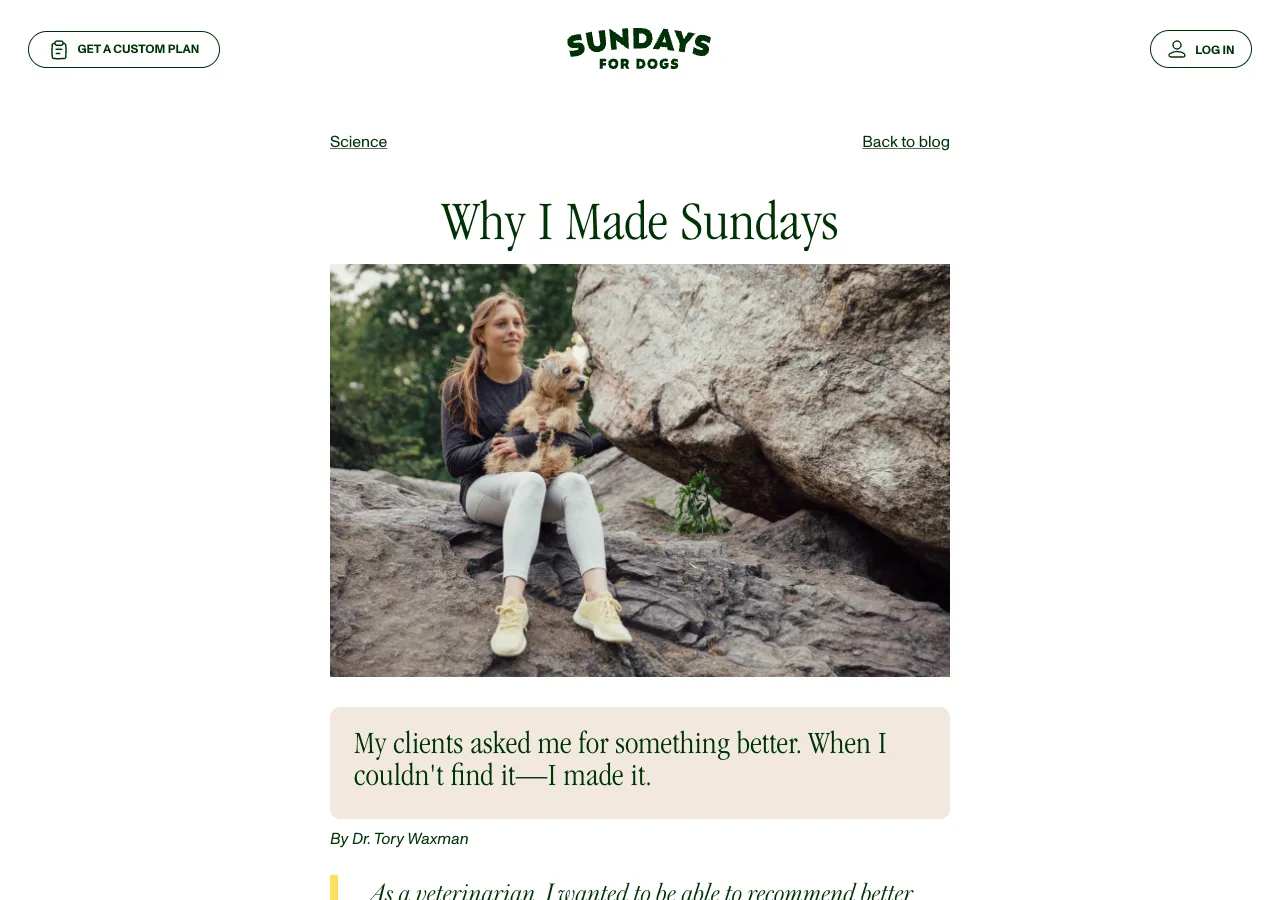
Real example: Sundays for Dogs' "Why I Made Sundays", by veterinarian Dr. Tory Waxman, opens: "My clients asked me for something better. When I couldn't find it — I made it."
Fill-in skeleton:
I'm [name], and I [credential: vet, chemist, the problem I lived]. I couldn't find [a product that did X], so I made it. Here's what I learned, and why [product] is built the way it is.
The patterns across all five
Different openings, same DNA. Every template above:
- Leads with the reader or the problem, never the product. The brand name shows up late.
- Runs roughly 70% education, 30% pitch. You earn the read before you ask for the sale.
- Hands off to one repeated CTA pointing at a single destination.
- Discloses honestly. The editorial feel is the advantage; faking a newsroom or an expert is the line that turns a smart ad into a liability.
The proven formulas underneath the openings
Each opening is a hook that feeds one of a few classic bodies. Naming them helps you finish the page:
- AIDA: Attention, Interest, Desire, Action: the foundation, from E. St. Elmo Lewis in 1898 (overview).
- AIDCA: AIDA with an added Conviction step before Action. Conviction is exactly the proof block an advertorial leans on: reviews, guarantees, social proof.
- PAS: Problem, Agitate, Solution: a direct-response classic (Copyblogger). Name the problem, deepen it honestly, resolve it. It maps almost one-to-one onto a problem-led opening.
- FAB: Features, Advantages, Benefits: translate what the product is into what it does for the reader, the move inside your "explain the solution" section.
A blind-spot or name-the-enemy hook usually runs into PAS; a diary or founder story runs into AIDCA. Pick the hook for your traffic, then let one of these carry the body.
The full-page skeleton. Stitch the parts together and a complete advertorial looks like this — fill the brackets, and keep roughly 70% of the words on education before the pitch:
["Advertisement" — disclose it as an ad] [Opening hook — one of the five above] [Problem: name what the reader is struggling with, and agitate it honestly] [Mechanism: explain why the problem happens — the part that earns the read] [Introduce the product as the fix the mechanism points to] [Proof: reviews, results, a demo, a real credentialed voice] [Offer + a single, repeated CTA to the product page]
For the prose that fills each block, see how to write an advertorial.
Make a template your own
A swipe file turns into sameness the moment you paste it verbatim. Two habits keep a template from reading like one. First, fill the brackets with specifics only you have (your real mechanism, your real numbers, your real founder), because the specificity is what separates a template from a templated page. Second, rewrite the seams in your brand's voice so the skeleton disappears by the final draft; the reader should feel like they are reading an article, not a form. If that polish is the slow part, Landra reads and understands your brand from the URL, then writes the page for you to edit the specifics.
Pick your opening
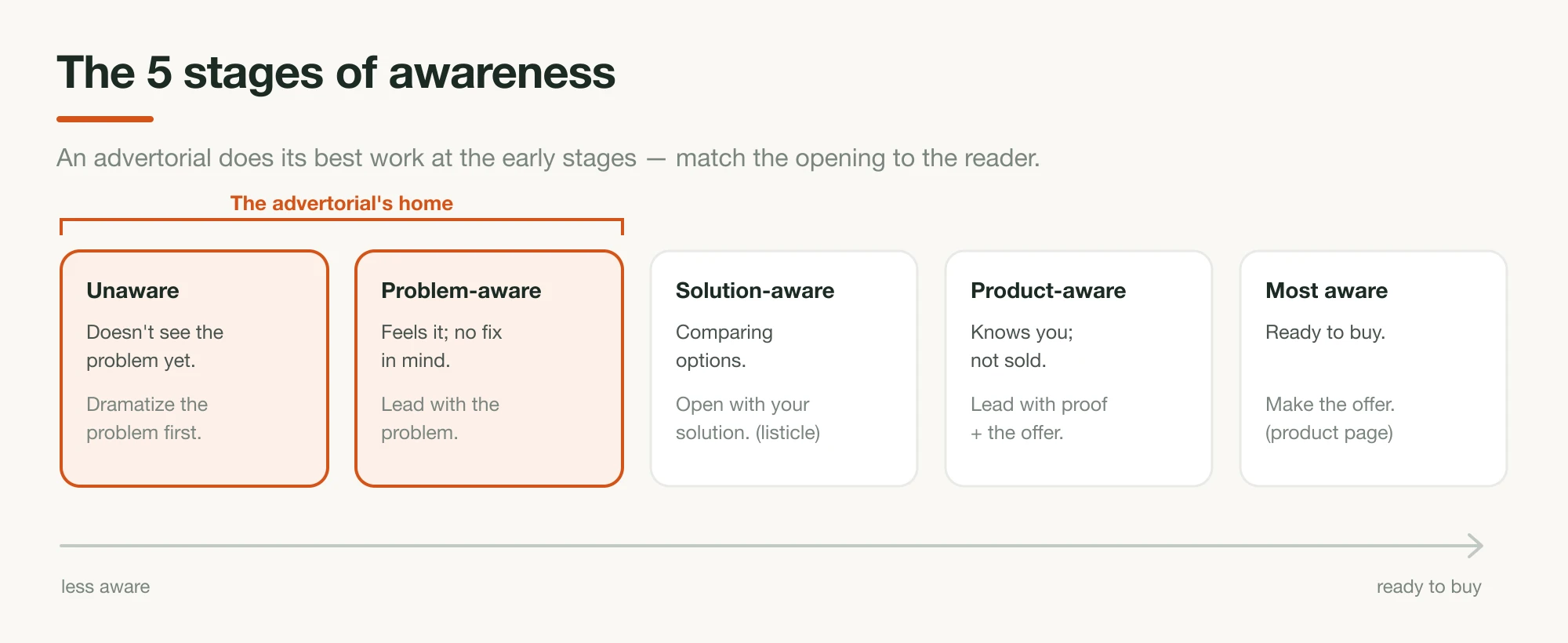
Match the template to your product and your traffic, not your mood:
- Crowded category, skeptical cold traffic → blind-spot or name-the-enemy.
- Emotional, personal problem → first-person diary.
- A real "why this happens" mechanism → news-style discovery (real expert, disclosed).
- A genuine, credentialed founder → founder story.
Often two openings fit the same product, so write both and let conversion rate decide. Take a magnesium sleep supplement for women over 40. The blind-spot door: "Every magnesium brand promises better sleep, so the difference isn't the promise — it's the form, and most use the cheapest one your body barely absorbs." The first-person diary door: "I'd tried every sleep aid on the shelf and still woke at 3am — until a pharmacist friend asked which form of magnesium I was actually taking." Same product, same proof, two ways in. Run both: the opening you would never have guessed often beats the one you were sure of, which is the whole case for testing more than one.
Then build the body with PAS or AIDCA, prove every claim, and disclose the page as an ad. To see these same openings torn down in full pages, read advertorial examples that convert; to choose between an advertorial and a listicle for a given campaign, see advertorial vs listicle.
Frequently asked questions
What is an advertorial template?
A reusable skeleton for a pre-sell page — most often a proven opening (blind-spot, name-the-enemy, first-person diary, news-style discovery, or founder story) handed off to a classic copy body like PAS or AIDCA. You fill the brackets with your product, audience, and proof.
What is the best advertorial copy formula?
There is no single best — match the opening to your traffic. Cold, skeptical buyers respond to a blind-spot or name-the-enemy hook; emotional problems suit a first-person diary; a real founder should tell the founder story. All five feed the same problem to mechanism to proof to offer body.
What is the AIDCA formula?
Attention, Interest, Desire, Conviction, Action — AIDA with an added Conviction step. Conviction is the proof an advertorial leans on: reviews, guarantees, and social proof that turn a cold reader's doubt into belief before the call to action.
What is the PAS copywriting formula?
Problem, Agitate, Solution — a direct-response classic. Name the reader's problem, deepen it honestly, then resolve it with your product. It maps almost one-to-one onto an advertorial's problem-led opening.
How do I write an advertorial opening?
Start on the reader, not the product — a category blind spot, a shared enemy, a first-person struggle, a surprising discovery, or your real origin story. The product should not appear until you have earned the read (roughly the first 70% is education).
Can I copy these advertorial templates exactly?
Copy the structure, not the specifics — and never the deception. Fill the skeletons with your own product and real proof, disclose the page as an ad, and never invent a publication or an expert byline — and where a real example leaves you unable to verify its source, treat that as the line, not the model.
How long should an advertorial be?
Most run 800–2,000 words. There is no fixed count — length is driven by how much warming your cold traffic needs, not a target. Lead with education (roughly the first 70%) and stop when the reader has every reason to act.