
The most popular positioning advice says to write a clear statement, align the team, and repeat it consistently. That's a decent start, but a sentence in a brand deck doesn't change what a cold prospect sees in a paid-social ad or a pre-sell page. A useful brand positioning strategy has to travel from what the business believes about its product to what a buyer recognizes, remembers, and considers choosing.
For a DTC brand, that makes positioning an operating document, not a line of copy. It should shape the audience angle, the page structure, the proof you lead with, and the questions you use to tell whether buyers are getting the intended message.
Table of Contents
- Why Most Positioning Statements Never Reach a Buyer
- The Inputs You Need Before You Write a Single Word
- Choosing a Positioning Frame That Matches Your Buyer
- Turning the Position into a Messaging Hierarchy That Ships
- AI Disclosure as a Positioning Variable You Can Test
- A Positioning Scorecard You Can Run Before and After Launch
- A 30-Day Launch Plan and the Traps to Avoid
Why Most Positioning Statements Never Reach a Buyer
A positioning workshop can end with a sentence everyone likes and no customer ever encounters. The team adds it to a deck, returns to its usual ads, and wonders why performance hasn't changed. The failure isn't necessarily the sentence. It's that nobody translated it into the surfaces where buyers make sense of the offer.
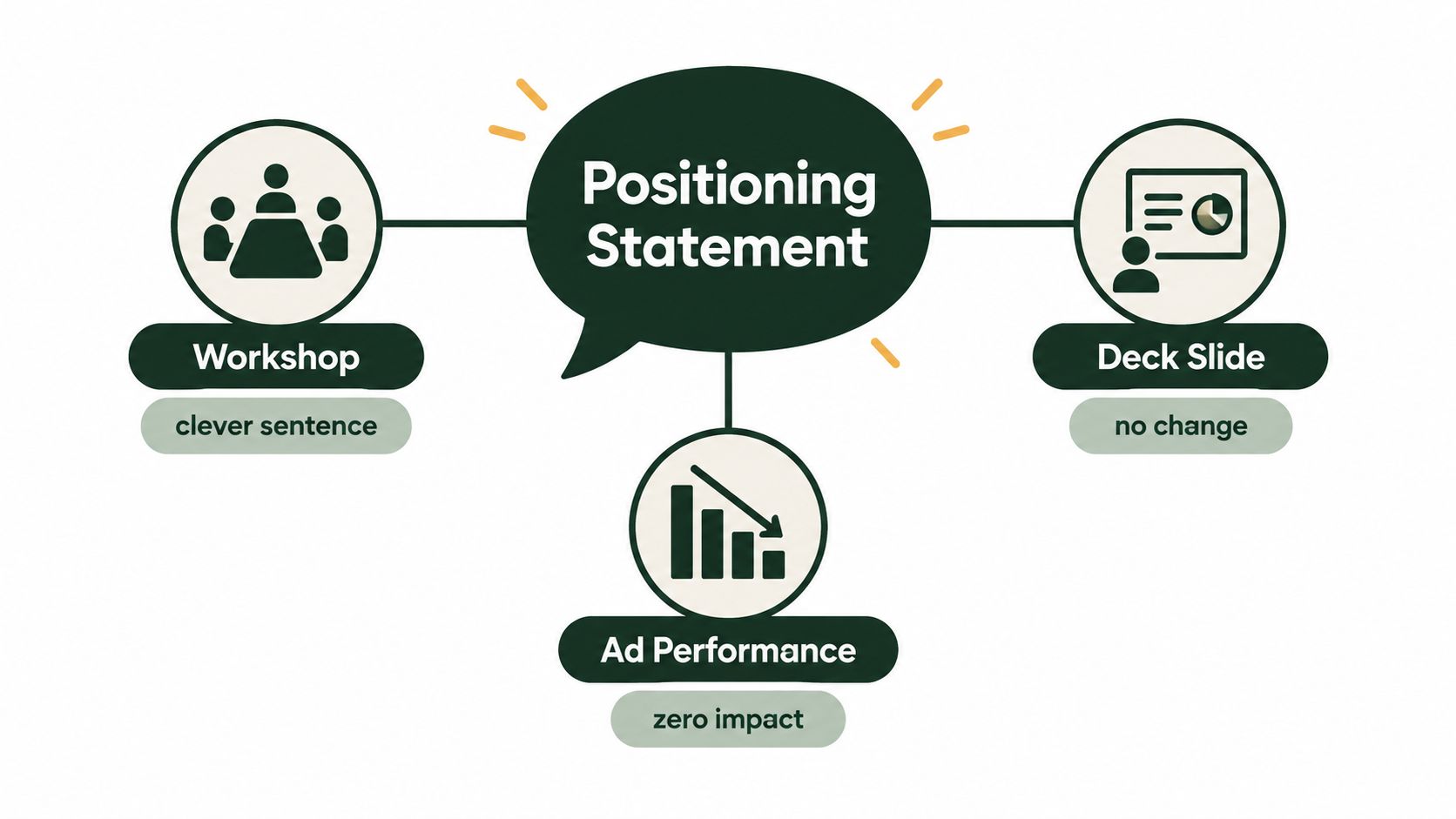
“Uniquely authentic” may sound polished in a meeting, but it doesn't tell a copywriter which pain point to open with, what evidence to show, or how to distinguish the product from a dozen similar options. Cold traffic doesn't reward a sentence for sounding strategic. Buyers need to recognize their situation, understand why this product is relevant, and see a reason to believe the claim.
Positioning has to survive execution
Treat the statement as the top line of a working system. It needs to define who the page is for, which buying situation it addresses, what difference the product promises, and what proof supports that promise. From there, the system should feed into paid-social hooks, pre-sell advertorials or listicles, product detail pages, and the messaging hierarchy that connects them.
That flow matters because an ad can attract attention for a benefit the page never substantiates. A pre-sell page can educate a buyer about a problem while the product page falls back on generic feature language. In both cases, the campaign has a message handoff problem, not just a copy problem.
Practical rule: If the team can't point to the ad hook, page headline, proof block, and buyer question that express the position, it isn't operational yet.
A five-minute audit is simple: open a recent ad and the page it sends people to. Can a buyer see the same audience, problem, difference, and reason to believe in both? If not, revise the working document before commissioning another deck or round of creative. Teams looking for help connecting strategy to execution can also review Leaping Lemur Media marketing services as a reference for how marketing services are presented.
The Inputs You Need Before You Write a Single Word
Don't start with a template. Start by collecting evidence that can fill it. A position built from founder instinct alone often sounds coherent internally and interchangeable to buyers.
Audit the competitive shelf
Choose direct competitors that sell a similar product to a similar buyer, then include alternatives that solve the same problem in a different way. Review their landing pages, paid ads, product pages, reviews, and offer language. Record what each brand claims, who it appears to target, and what proof it puts forward. The useful finding isn't that a competitor says “quality.” It's whether several competitors use the same proof, promise, or problem framing, leaving a meaningful customer concern unanswered.
A practical way to organize the work is to build a message map with columns for audience, problem, promised outcome, product mechanism, proof, and objections. Use it to compare your own materials with competitor materials, not to collect slogans.
Listen to buyers in their own words
Interview customers who bought, customers who considered the product but didn't buy, and people who chose another option. Ask what was happening when they started looking, what they considered, what felt confusing, and which evidence helped them decide. Then look for the same language in product reviews, support conversations, and relevant public discussions. Capture phrases and situations, but don't treat every comment as a universal truth.
Buyers may praise a feature because it matters to them. Your job is to find out whether that feature is also a reason other prospects choose the brand.
Audience definitions are more useful when they connect a person to a buying situation and a message angle, rather than stopping at age or lifestyle. For a practical primer on applying audience segments to creative, see persona based marketing for paid social.
Audit the offer and the proof
Read your own product page and ads as a skeptical buyer would. List the concrete product attributes, offer terms, claims, reviews, demonstrations, guarantees, and objections the page addresses. Mark which claims have support and which are merely aspirations. If a brand name is part of the decision, a process guide such as this resource to check a Spanish company name can help clarify what a naming review involves, though naming alone won't establish differentiation.
The result should be a short, ranked evidence file: buyer situations, repeated concerns, credible points of difference, and proof you can publish. That's what a positioning framework needs to work with.
Choosing a Positioning Frame That Matches Your Buyer
The frame determines what the buyer notices first. A competitive frame makes the alternative visible. An aspirational frame sells an identity or desired state. An attribute-led frame foregrounds a product feature, while a proof-led frame makes evidence the reason to believe. Choosing among them is a decision about your buyer and your category, not a design preference.
Consider a hypothetical skincare brand. If shoppers already know the category and compare formulas, an attribute-led position may make a specific ingredient or texture relevant. If they're skeptical of broad beauty promises, a proof-led approach may work better, provided the brand has credible evidence to show. A supplement brand with a clear use case may lead with that situation; a brand competing in a crowded “daily wellness” space may need to explain its mechanism and support the explanation, rather than claim it's just more effective.
These are not claims about particular companies. They show why the same product can take different positions depending on what the buyer knows and what competitors already own. Before choosing, compare competitor pages and offers using a structured process such as how to compare Shopify competitors. The point is to identify the space your message can credibly occupy, not to borrow a rival's wording.
| Frame | Best Fit Awareness | Typical DTC Category | Risk If Overused |
|---|---|---|---|
| Competitive | Buyer knows the category and is comparing options | Beauty or apparel with recognizable alternatives | The brand sounds reactive and keeps competitors central |
| Aspirational | Buyer wants a better-feeling identity or outcome | Fitness, lifestyle, or premium personal care | The promise becomes vague without product relevance |
| Attribute-led | Buyer is evaluating product characteristics | Skincare, home goods, or supplements | Features blur together if the benefit isn't clear |
| Proof-led | Buyer doubts category claims or wants reassurance | Wellness, personal care, or products with considered claims | Evidence overwhelms the message if it isn't tied to a buyer concern |
Make the frame earn its place
Start with the buying situation, then ask what kind of message would help that buyer decide. If prospects already understand the problem but can't distinguish products, lead with difference. If they're unsure the promised result is credible, lead with proof. If they want the outcome but don't see themselves in the category, an aspirational frame may help, as long as the product can support it.
A frame isn't a permanent identity. It's the organizing choice that makes one audience angle and one reason to choose easier to understand. Pick the frame your evidence supports, not the one that sounds most impressive in a strategy meeting.
Turning the Position into a Messaging Hierarchy That Ships
Once you've chosen a frame, translate it into copy that works at different levels of attention. A buyer scrolling past a paid-social ad needs a sharp entry point. A reader on a pre-sell page needs a coherent argument. A product page needs the offer, proof, and objections handled without changing the core promise.
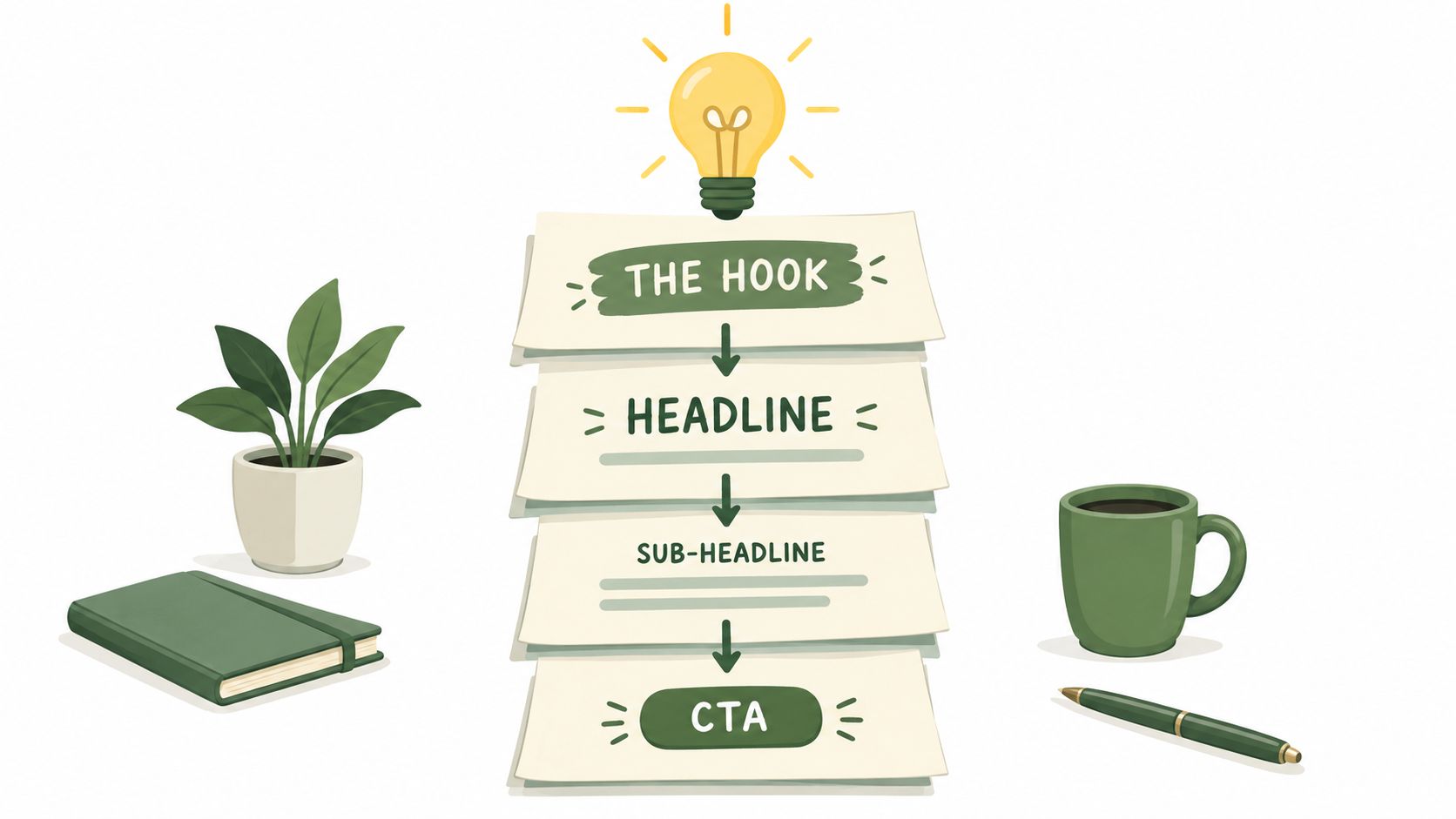
Build a hierarchy with a root promise, angle variations, and proof points. For example, a hypothetical skincare brand might choose the root promise “a simpler routine for skin that feels dry by midday.” That isn't a verified product claim; it's a structure for showing how a position can be made specific. Angle variations could focus on the frustration of reapplying products, the appeal of a shorter routine, or the desire to understand what's in the formula. Each variation should still lead back to the same promise.
Proof points should come from the brand's actual product information and customer evidence. If the brand has a relevant ingredient explanation, use it to clarify the mechanism. If customer reviews describe the experience, select accurate, representative language. Don't use a dramatic hook that the page can't substantiate.
Map the hierarchy onto the page
An advertorial can open with a recognizable buyer problem, explain why common approaches haven't resolved it, introduce the product mechanism, and present supporting evidence before the offer. A listicle can make the same position scannable by organizing options or considerations around the buyer's decision, then showing where the product fits and why.
For headline options, section rewrites, and more examples of direct-to-consumer value propositions, see Landra's guide to DTC value props. Landra is one tool that analyzes a brand site and uses saved brand context to help draft editable, mobile-first advertorials and listicles. Whatever tool you use, review every claim and edit the page against the positioning document before publishing.
A useful pre-publish check is whether the hook earns the click, the headline confirms the same audience and problem, the body supports the difference, and the call to action asks for a coherent next step. If one element introduces a different promise, the hierarchy has broken.
A short video can add another perspective on how a message moves from strategy into marketing execution:
AI Disclosure as a Positioning Variable You Can Test
A brand's production choices can affect what its message means. That matters when the position depends on human expertise, personal care, or authenticity. Using AI to work faster may make sense operationally, but the way the brand uses and describes it can influence whether buyers trust the content.
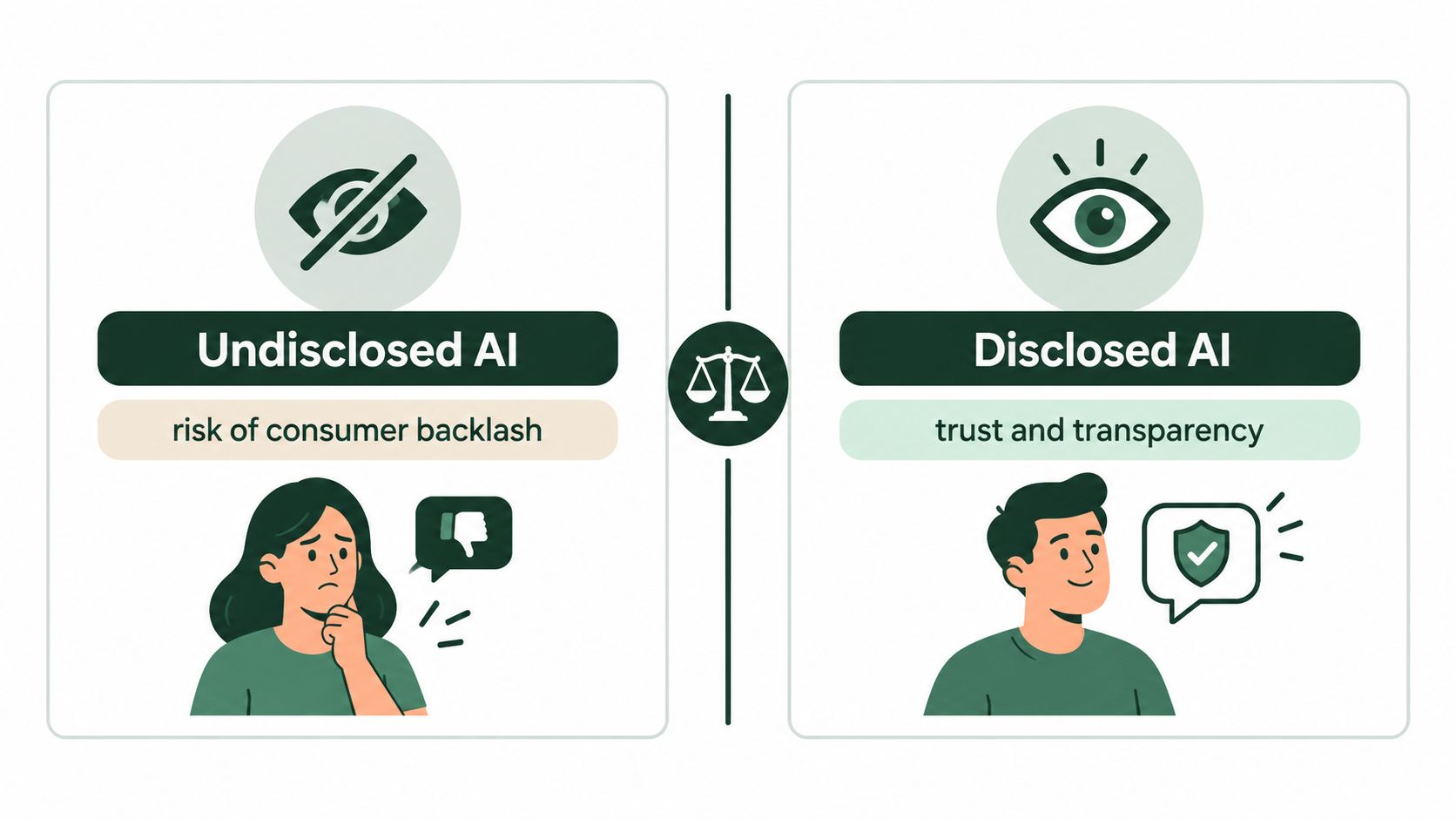
The evidence makes disclosure worth testing, not assuming. Global research across 14 markets found that more than 80% of consumers believe AI-created text, images, and video should be clearly labeled, while 62% say transparency about AI use would increase trust, according to RWS's Unlocked 2025 research. A separate U.S. survey reported that 50% would rather buy from brands that don't use generative AI in consumer-facing content, and 68% frequently question whether online content is real. Those findings don't dictate one answer for every DTC brand. They do make it risky to assume production method has no bearing on brand credibility.
Test the disclosure, not just the workflow
You can compare three message approaches:
- Undisclosed assistance: Use the content without mentioning AI. This may be operationally convenient, but it leaves buyers to interpret what they see without context.
- Clear disclosure: Tell readers where AI contributed. This tests whether transparency supports the brand's credibility and distinctiveness.
- Human-reviewed content: Explain that a person checks the material for accuracy, voice, and relevance. This can clarify the role of human judgment without implying that every word was written manually.
Keep the offer and audience consistent while testing the disclosure language. Then compare trust, comprehension, perceived distinctiveness, and willingness to choose. Don't assume a disclosure improves conversion, or that silence automatically damages it. The useful answer is the one that fits the promise and holds up with your buyers.
A Positioning Scorecard You Can Run Before and After Launch
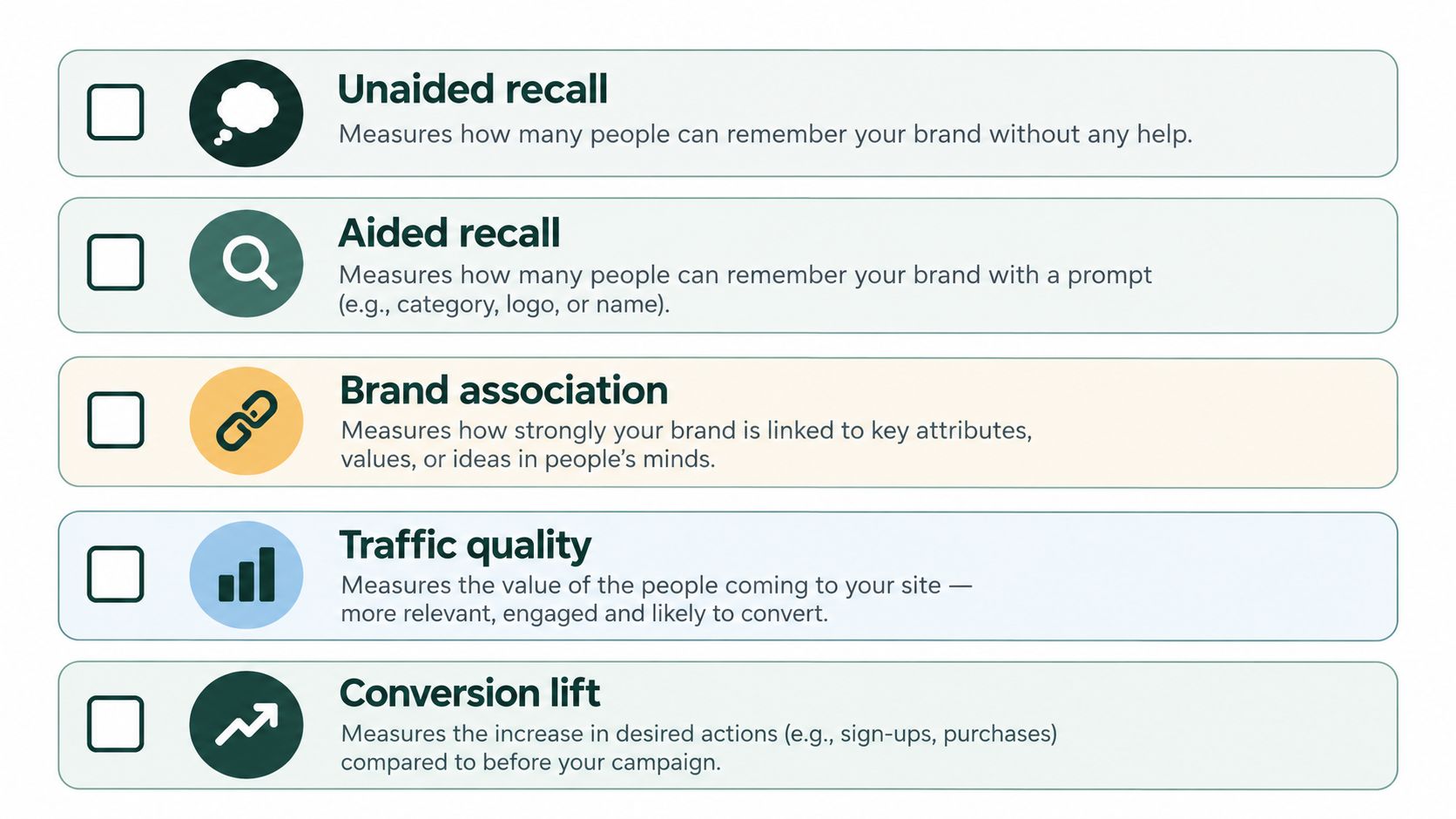
A positioning statement can read well in a brand book and still fail where it counts: in a buyer's memory. Measure whether target buyers connect your brand to the buying situation and benefit you intend, whether that association sets you apart, and whether it supports consideration. Awareness alone cannot show whether people remember the right thing.
Ask questions buyers can answer
Survey category buyers before and after they see the relevant campaign or page. Keep the wording and method consistent so the results can be compared. Ask about the intended buying situation, not just general brand awareness.
| What to measure | Example question | What it diagnoses |
|---|---|---|
| Unaided recall | “Which brands come to mind for this situation?” | Whether the brand comes to mind without a prompt |
| Attribute association | “Which brand do you associate with this benefit?” | Whether buyers connect the intended promise to the brand |
| Competitor confusion | “Which brands seem similar in what they offer?” | Whether the point of difference is clear |
| Perceived relevance | “How relevant does this brand feel to your needs?” | Whether the audience and buying situation match |
| Willingness to choose | “Which option would you consider choosing?” | Whether the associations connect to consideration |
Then compare those responses with branded search, direct traffic, new-customer mix, and conversion by audience angle. Read each measure on its own terms. A pre-sell page may attract relevant visits without improving brand recall; a message may strengthen an association without giving buyers a reason to choose. Combining everything into one score can hide where the positioning is working, or where it breaks.
Read the pattern, not just the conversion rate. A short-term ad win may come from a compelling offer or strong creative, while buyers still associate the brand with a different benefit.
For paid traffic, compare audience angles and page versions while keeping survey questions aligned with the campaign language. Use Landra's conversion testing guide for practical guidance on controlled page experiments. The results should shape a specific decision: revise the position, strengthen its proof, or change how the message reaches buyers. That scorecard makes the positioning statement a working document, tied to the page and campaign rather than filed away after approval.
A 30-Day Launch Plan and the Traps to Avoid
A positioning plan should end with a live page and a way to learn from buyers. Use the month to move from evidence to execution, rather than spending the entire time refining a sentence.
| Timing | Work to complete | Output |
|---|---|---|
| Week one | Review competitors, interview buyers, audit the offer and proof | A ranked evidence file |
| Week two | Choose the audience, buying situation, frame, and point of difference | A working positioning document |
| Week three | Write the messaging hierarchy and draft a pre-sell page | A page tied to the position |
| Week four | Launch paid-social creative variations and establish the survey baseline | A test plan with clear measures |
As you review the work, watch for warning signs. Buyers can't paraphrase the promise. The difference sounds like language every competitor could use. The team loves the hook, but customers don't recognize their own problem in it. The positioning statement has no page, ad, or proof block built against it.
Those signs don't always mean the whole strategy is wrong. They may indicate a mismatch between audience, frame, claim, or evidence. Return to the discovery notes and find the break before you relaunch the same language.
Positioning earns its place when a buyer can recognize the situation, understand the difference, and see why the brand deserves consideration.
Landra turns a product URL into editable, mobile-first pre-sell pages, including advertorials and listicles, with saved brand context to help keep messaging aligned. If you're ready to put your positioning to work across paid-social traffic and page variants, visit Landra to explore the platform.