

Most persona guides give you a fictional name, a stock photo, and a paragraph about age, income, and lifestyle. That advice is incomplete for paid social. A cold visitor from Meta or TikTok doesn't convert because your team invented a convincing biography. They convert when the ad, pre-sell page, proof, and offer fit the visitor's current problem, awareness, objections, and intent.
That makes persona based marketing less like branding and more like classification. You're assigning a message path to a real or inferred behavior pattern, measuring what happens next, and updating the model when the data disagrees. Used this way, personas can reduce message-market mismatch. Used carelessly, they add friction, exaggerate assumptions, and make a short cold-traffic journey harder to understand.
Table of Contents
- Understanding Persona Based Marketing Beyond Demographics
- Why Pre-Sell Funnels and Paid Social Need Personas
- Building and Validating Data-Driven Buyer Personas
- Mapping Personas to Messaging and Landing Page Elements
- Applying Personas to Landra Pre-Sell Page Templates
- Metrics, Testing Strategies, and When to Simplify
- Executing Your Persona Based Marketing Strategy
Understanding Persona Based Marketing Beyond Demographics
A demographic avatar answers questions such as who someone is. A useful paid-social persona answers a more valuable question: what does this person need to believe before taking the next step?
That distinction has historical roots. The first widely cited persona, “Kathy,” is attributed to software designer Alan Cooper in 1985, while later accounts place the broader introduction of personas into product and marketing work in the late 1990s. The practice evolved from design and user-experience methods, where teams represented observed users, into a structured marketing method for organizing customer research. The history of buyer personas captures that movement from qualitative design artifact to research-based marketing tool.
A static profile might say that a customer is a certain age and interested in wellness. A dynamic model looks for signals such as the problem that brought the visitor to the page, the claim that earned the click, the product detail they examined, and the objection that stopped the purchase. Those signals can support different treatments even when two visitors share similar demographics.
The useful unit is a decision pattern
For a DTC funnel, I'd define a persona through five practical fields:
- Trigger: What happened immediately before the visitor started looking?
- Desired outcome: What change are they trying to create?
- Resistance point: Why might they distrust the product or delay buying?
- Proof requirement: What evidence would make the offer credible?
- Next-step tolerance: How much information will they process before acting?
This structure prevents teams from turning personas into fictional biographies. It also gives media buyers and copywriters something they can use. A pain-point-driven visitor may need a problem-led explanation. A skeptical researcher may need transparent product details and proof before seeing a strong call to action. Someone already comparing solutions may respond better to a concise best-of or comparison frame.
Practical rule: If a persona doesn't change the headline, proof order, page structure, or test plan, it isn't doing operational work.
The evidence supports treating personas as more than audience labels. Cintell reported that 71% of companies exceeding revenue and lead goals had documented personas, compared with 37% of companies meeting goals and 26% of companies missing them, as summarized in buyer persona benchmarks. That relationship doesn't prove that documentation alone caused performance. It does show why mature teams connect persona work to execution rather than leaving it inside a presentation.
The shift from intuition to evidence is the important milestone. Your persona should be a hypothesis about behavior, not a permanent description of a person.
Why Pre-Sell Funnels and Paid Social Need Personas
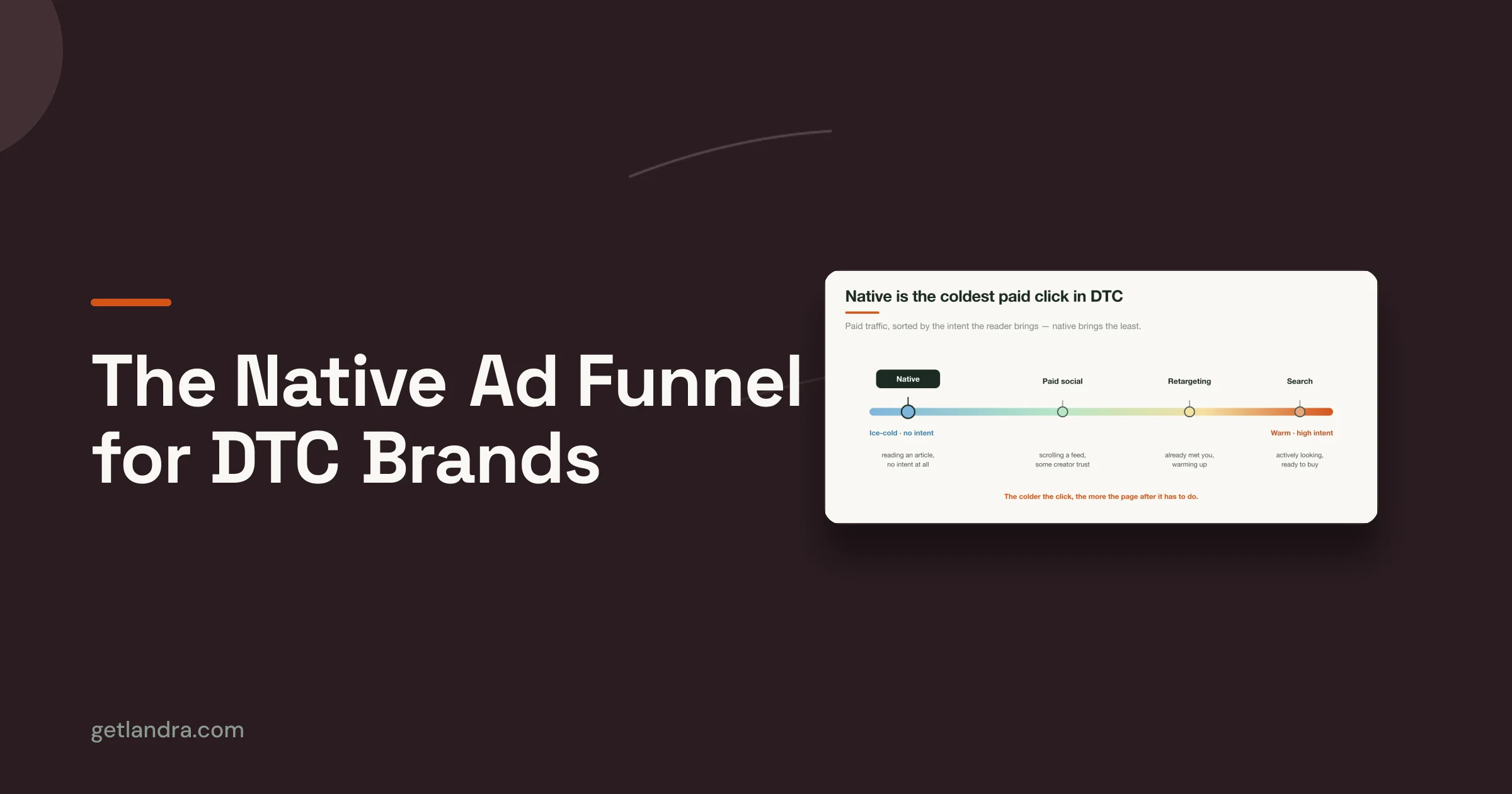
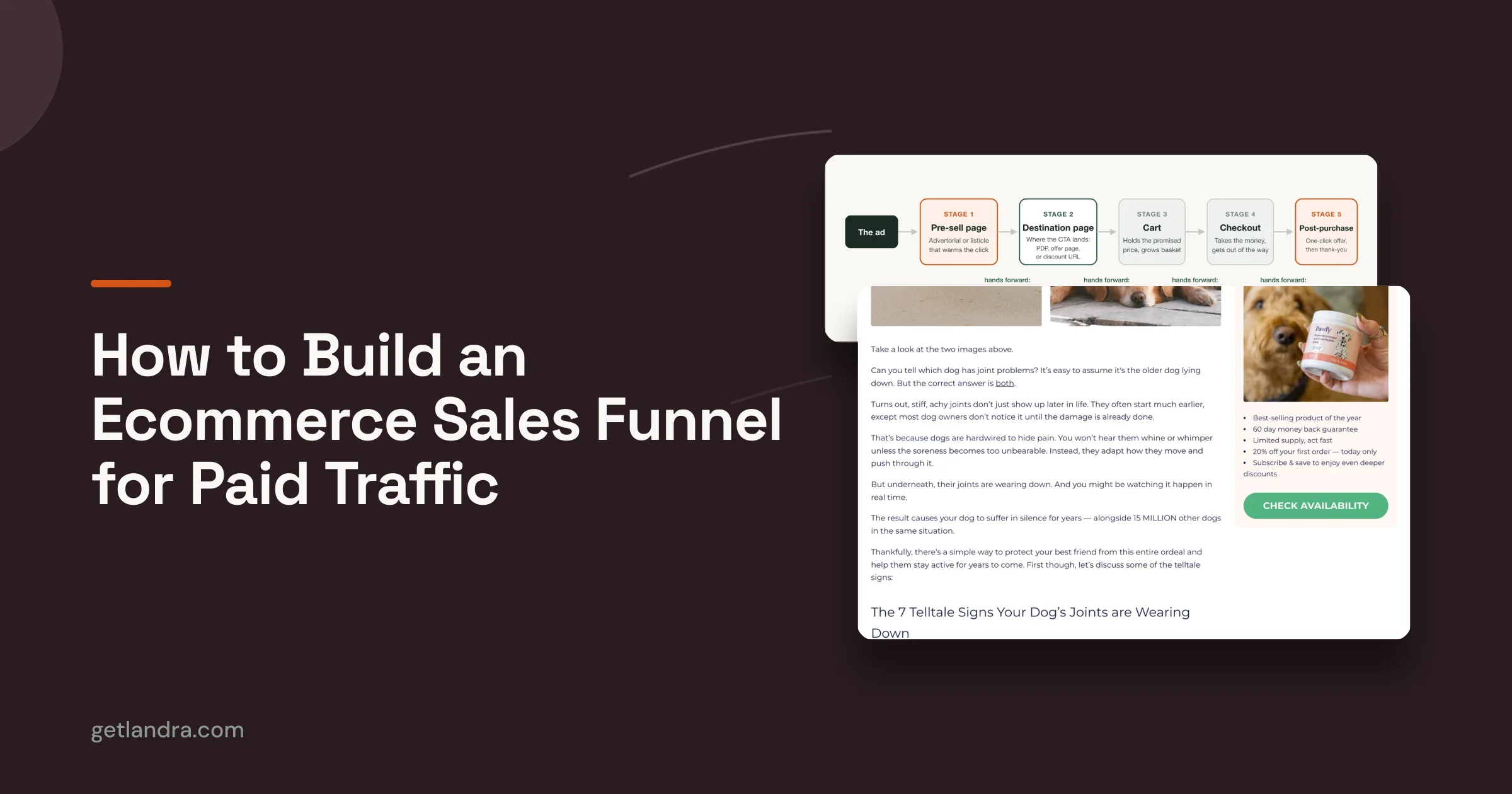
Cold paid-social traffic rarely needs more brand language. It needs a faster path from the ad's promise to a credible reason to continue. A visitor may recognize the problem while knowing nothing about your brand, mechanism, claims, or offer. Sending that visitor straight to a standard product page often assumes purchase readiness the ad has not created.
The resulting leak is usually structural. An ad frames a specific frustration, then the product page opens with a generic name and forces the visitor to reconstruct relevance, understand the category, assess proof, and judge credibility. Navigation, variants, reviews, and other choices add friction before the visitor has decided the product fits.
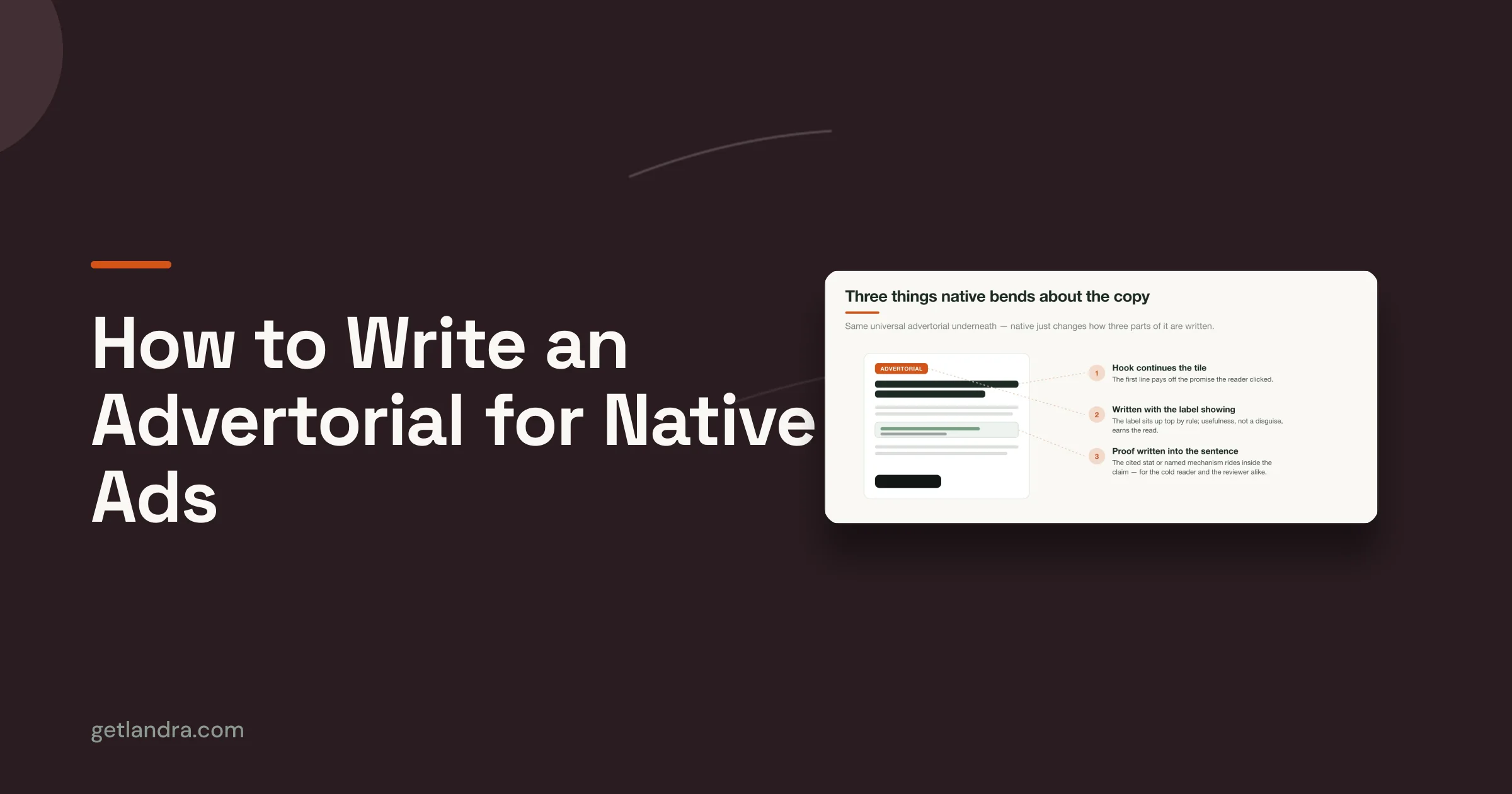
A persona-based pre-sell page changes that sequence. It can name the problem first, explain why familiar approaches may have failed, introduce a relevant mechanism, and address the objection most likely to stop action. An advertorial suits visitors who need context and explanation. A listicle can suit visitors comparing solutions. The format matters less than matching the page to the visitor's awareness and the ad angle that produced the click.

Match the page to the click
Classify the click by behavior and message, not by a persona name alone. If the ad promises relief from a specific frustration, the pre-sell page should continue that conversation. A broad brand introduction resets the visitor's context and weakens the handoff.
Use this sequence as a working control:
- Ad promise: Record the problem or outcome that earned the click.
- Opening hook: Reflect that tension in plain language.
- Mechanism: Explain why the product could address the problem.
- Proof: Place evidence against the visitor's dominant concern.
- Offer transition: Send the visitor to the product page after fit is clear.
Personalization can also hurt conversion. A page built around an overly narrow profile may exclude adjacent buyers, repeat the ad too exactly, or add claims and detail that slow comprehension. Cold traffic needs enough classification to remove context and trust gaps, not so much customization that every segment receives a thin, expensive page.
Execution quality is the business case. Persona-led personalization has been associated with websites becoming 2 to 5 times more effective for targeted users, email open rates doubling, click-through rates rising 5 times in some campaigns, and personalized emails driving 18 times more revenue than broadcast emails, as reported in the benchmark summary linked earlier. Those figures are directional, not a promise for every advertorial. The offer still needs credibility, a fast mobile experience, compliant claims, and continuity with the ad.
For media-side discipline, use the Facebook ad optimization playbook. Keep traffic optimization connected to page classification. A cheaper click from a broad audience cannot compensate for a pre-sell page addressing the wrong problem.
Test the same meaningful ad angle against a default product page and a persona-aligned pre-sell page. Compare downstream conversion and acquisition economics, rather than time on page alone. Longer reading can signal clarity, but it can also signal confusion.
Building and Validating Data-Driven Buyer Personas
Creating a persona takes an afternoon. Proving that it predicts different behavior takes a measurement process.
Start with the data already attached to your funnel. Pull ad angles, landing-page entries, product views, checkout starts, purchases, refund signals, customer support themes, and CRM fields where available. Add qualitative input from reviews, customer conversations, sales notes, and support tickets. The point isn't to collect every possible attribute. It's to find repeated combinations of trigger, goal, resistance, and action.
A four-step validation loop
1. Collect signals. Separate observed behavior from interpretation. “Clicked a problem-led ad and read the mechanism section” is an observation. “Values education” is an interpretation that still needs testing.
2. Draft a small set of classifications. Give each segment a clear behavioral definition. For example, one segment might be problem-aware but solution-skeptical. Another might be product-aware and comparison-oriented. Keep demographic details only when they change targeting, creative, compliance, or offer decisions.
3. Test against held-out data. An expert framework recommends validating persona models against data that wasn't used to build them, targeting roughly 70 to 85% correct classification, while retaining an explicit unknown bucket for 10 to 20% of users until enough behavioral or CRM enrichment arrives. The framework and its implications are outlined in customer persona analysis. Treat those ranges as design guidance, not a universal law.

4. Activate and refine. Assign a page angle, proof order, and offer treatment to each usable classification. Review whether the assignment predicts conversion quality, not just clicks. If a segment doesn't produce a distinct response, merge it or replace it with a simpler intent state.
A multi-dimensional score can make this more consistent than a single demographic rule. Deloitte's Personalization Affinity Score, for example, sums five survey responses across experience, spend, loyalty, engagement, and satisfaction. The resulting 0 to 25 score can be grouped into skeptics, observers, opportunists, and fanatics, as described in Deloitte's customer personalization perspective. For a cold-traffic page, you don't need to copy the model. You can borrow the principle: combine several signals before escalating personalization intensity.
Keep an unknown state deliberately. Anonymous traffic often doesn't contain enough evidence for a confident persona assignment. Showing a highly specific page to an incorrectly classified visitor can create a worse experience than showing a clear, broadly relevant problem-led page.
Teams that need structure can use a workshop or research process to activate audience personas, but the deliverable should feed a testable system. A polished document is not validation. A segment earns its place when it changes a decision and predicts a measurable outcome.
Mapping Personas to Messaging and Landing Page Elements
A persona earns its place on a cold-traffic pre-sell page only when it changes a conversion decision. Do not build variants by swapping a name in the headline. Classify visitors by observable intent, then test changes to the argument, proof order, visual emphasis, and call to action.
A skeptical visitor may need ingredient details, sourcing, safety information, or product mechanics before seeing a strong offer. Someone prioritizing convenience needs to understand how the product fits an existing routine. A comparison-oriented visitor may respond to a clear breakdown of alternatives, trade-offs, and use cases. These classifications should remain testable. If a personalized version does not improve engagement or conversion, simplify it.

Let the first objection set the page sequence
The headline should name the problem or desired outcome in the same terms as the ad. The visitor should understand the use case without decoding the product category. Use lifestyle imagery to support emotional relevance, or show the product in use when practicality is the concern.
Proof should answer the objection closest to the purchase decision. Reviews mentioning ease of use support a routine-focused visitor. Specifications and transparent explanations give a skeptical visitor reasons to continue. Social proof reduces uncertainty, but it cannot substitute for answers about price, effort, safety, fit, or trust.
Build the page in a sequence that limits unnecessary cognitive load:
- Opening: Continue the ad's language and confirm relevance.
- Problem framing: Show the frustration or cost of the current situation.
- Explanation: Describe the product mechanism without overclaiming.
- Proof block: Place evidence beside the claim it supports.
- Objection handling: Address the concern most likely to stop the purchase.
- CTA: Match the next action to the visitor's readiness.
An AI landing page creator can help create and duplicate these variants, but the testing discipline matters more than the tool. Keep the structure and offer stable, change one persona-driven variable, and hold the traffic source steady enough to read the result.
Use personalized marketing tactics selectively. Personalizing the opening problem and proof sequence can clarify relevance. Personalizing every sentence can make the page feel engineered, slow comprehension, and hurt conversion when the classification is uncertain. For anonymous cold traffic, a broadly relevant page often beats a highly customized one built on weak evidence.
Applying Personas to Landra Pre-Sell Page Templates
Cold paid traffic rarely justifies a separate funnel for every customer profile. Build a small set of page frames around observable intent, then test whether each classification changes the visitor's decision.
A visitor who knows the product category but still needs differentiation may fit a product-led listicle. Introduce the product early, organize its benefits around the ad's promise, and place supporting proof near the relevant claims. The format can sell directly, provided it does not hide the commercial purpose.
A visitor who recognizes the problem but has not chosen a solution needs a different sequence. A problem-led listicle can begin with the frustration, explain why previous attempts may have failed, and present the product as a relevant response. Use this frame when the dominant objection is, “Why hasn't what I tried worked?”
For a visitor comparing alternatives, a best-of listicle can define selection criteria, compare options, and position the product against the factors that matter to that audience. Keep the comparisons defensible. Unsupported superiority claims may produce an attention spike, then reduce trust and conversion.

Use narrative when consideration is high
An editorial-style advertorial works when the visitor needs context before evaluating the offer. It can introduce the category, surface a recognizable problem, explain the mechanism, and present testimonials or product evidence gradually. Keep the commercial relationship clear, claims accurate, and the route to the product visible. A narrative that delays the offer too long may improve engagement while weakening purchase intent.
Start the build with the audience signal and angle, not the template label. Define the trigger, carry the ad promise into the page, select the frame, and identify the objection that must be answered before the CTA. Review each section for continuity. If the page starts with “best products for a problem” while the ad promised a specific mechanism, the visitor must do the positioning work.
Landra's pre-sell page AI tool can generate editable advertorial and listicle drafts from brand and product context. Use the output as a working hypothesis. Verify claims, remove generic copy, and align every major page element with the ad, offer, and confidence level of the classification. When that evidence is weak, the broader frame is usually safer than forced personalization.
Metrics, Testing Strategies, and When to Simplify
Personalization can reduce conversion when it asks cold traffic to process too many distinctions. A pre-sell page that names an unfamiliar audience, uses insider language, and changes its argument for every small segment can create doubt instead of relevance. The practical question is whether classification changes the decision path enough to justify the added cognitive load.
Test two variables separately: classification quality and creative quality. First check whether the visitor is assigned to the right group using signals available before or during the click. Then test whether that group's page improves the purchase decision. If one visitor could reasonably fit several personas, classify by job-to-be-done or intent state instead.
Let the page earn deeper personalization
Use a detailed persona only when it changes the objection, proof requirement, or buying context. A simpler readiness model is better when the main difference is how much explanation the visitor needs.
| Traffic State | Product Complexity | Recommended Approach | Primary Metric |
|---|---|---|---|
| Cold and unknown | Low | Simple problem-led page | Purchase conversion rate |
| Cold and problem-aware | Moderate | Persona-led problem framing | Conversion rate lift |
| Engaged and solution-aware | Moderate | Differentiated proof sequence | CPA and checkout progression |
| Comparison-oriented | High | Best-of or comparison structure | Purchase rate and refund or regret signals |
| Mixed or uncertain | Any | Broad page with controlled personalization | Conversion stability across segments |
For a cold-traffic advertorial, isolate one change at a time. Keep the offer, price, and checkout path fixed, then test the classification-driven headline, opening frame, proof order, or CTA language. This keeps the result attributable to the page experience rather than to a different commercial proposition. A useful control is the broad problem-led page. It shows whether personalization adds value beyond clearer positioning.
The benchmark framework cited earlier reports persona-targeted programs commonly generating 10 to 30% conversion-rate lift or 10 to 20% CPA reduction versus generic campaigns. Treat those ranges as planning hypotheses, not forecasts. Your read should include conversion rate and CPA, alongside refund or regret indicators and repeat purchase behavior where available.
Immediate conversion can hide poor fit. Recent research cited in the contrarian persona discussion reports that personalization created negative experiences for 53% of customers, with those customers 3.2 times more likely to regret a purchase and 44% less likely to buy again. These findings support a narrow rule: personalize the problem and proof only as far as the evidence supports. Relevance does not require aggressive specificity.
Operational limits matter too. StackAdapt reported that fragmented systems, disconnected tools, and limited measurement make scalable personalization difficult, while 77% of agency marketers said proving results remains hard, as summarized in the same research source. Keep the test manageable: duplicate one page, change the headline and proof sequence, preserve the offer, and compare downstream economics.
For category context, review Shopify listicle conversion rates, then validate the benchmark against your own traffic. If a persona page wins engagement but loses purchases, simplify it. If two groups respond to the same argument, merge them. The strongest model is the one the funnel can classify consistently and the team can improve.
Executing Your Persona Based Marketing Strategy
Persona based marketing should sit inside the paid-social operating system, not inside a static brand document. Use observed triggers, goals, objections, and behavior to define segments. Then connect each segment to an ad angle, pre-sell frame, proof order, CTA, and measurement plan.
Start with an audit of your current traffic. Identify which visitors remain unknown, which ad promises create the strongest downstream behavior, and where the default product page asks for too much trust too soon. Build one problem-led pre-sell page for the largest credible pain-point segment and test it against the existing product detail page.
Keep the model honest. If the segment doesn't classify reliably, simplify it into a job-to-be-done or intent state. If personalization improves clicks but worsens purchase quality, reduce its intensity. Your goal isn't to describe every customer perfectly. It's to reduce message-market mismatch at the moment a cold visitor decides whether to keep reading.
Landra generates editable, mobile-first advertorials and listicles from your product or brand URL, so you can turn a validated audience angle into a pre-sell page without rebuilding the layout from scratch. Visit Landra, create a problem-led variant for your highest-confidence segment, and test it against your current product page.