

Most DTC teams still treat direct to consumer advertising as a paid-media contest. They ask which creative has the lowest cost per click, which audience can absorb more budget, and whether the platform's algorithm can find cheaper buyers. Those questions matter, but they're often asked too early. If the page after the click doesn't explain the product at the visitor's awareness level, the ad is only purchasing more expensive exits.
The stronger model is a full-stack system: ad promise, pre-sell experience, product page, checkout, and retention must work as one sequence. Paid social creates attention, but the landing experience determines whether that attention becomes consideration. Owned channels then decide whether the first purchase can support sustainable customer acquisition.
Table of Contents
- Why Most DTC Advertising Fails Before the Click
- The Evolution of Direct to Consumer Advertising
- Mapping the Core DTC Advertising Channels
- Building Pre-Sell Pages That Lower Customer Acquisition Cost
- Aligning Ad Creative with Landing Page Messaging
- Measuring What Matters in DTC Campaigns
- The Modern DTC Playbook for Sustainable Growth
Why Most DTC Advertising Fails Before the Click
The popular advice is familiar: test more creatives, scale the winning ad set, and blame the algorithm when customer acquisition cost rises. That playbook can improve media efficiency when the funnel already converts. It can't repair a broken transition between the ad and the offer.
A cold prospect usually isn't ready for a product page written for someone who has already compared ingredients, read reviews, and decided to buy. The ad may introduce a problem or a new mechanism, while the product page immediately presents price, variants, and a purchase button. That creates a message and awareness mismatch. The visitor has questions, but the page assumes commitment.

The leak sits between attention and intent
An ad can win the auction while the funnel loses the customer. A compelling hook may generate curiosity clicks, but curiosity isn't purchase intent. If the landing page doesn't continue the story, visitors must reconstruct the connection themselves. Most won't.
The practical audit starts with the first five seconds after arrival:
- Promise continuity: Does the headline answer the same question or problem raised in the ad?
- Audience fit: Is the page written for a skeptic, an active researcher, or a ready buyer?
- Proof sequence: Does evidence appear before the visitor is asked to trust the brand?
- Next-step clarity: Is the transition to the product page natural rather than abrupt?
This is why landing pages deserve the same testing discipline as creative. Change the opening angle, proof order, page depth, and CTA language before concluding that the audience or platform is exhausted.
Practical rule: If the ad earns the click but the page cannot explain why the product matters, scaling traffic only scales the leak.
DTC advertising is a system, not a dashboard
The health sector makes the point clearly. A national survey of 771 U.S. adults found that 25% reported responsiveness to DTC drug advertising, but responsiveness varied from 7% among people taking no prescription drugs to 45% among those taking five or more medications, according to the national survey on responsiveness to DTC drug advertising. The lesson for consumer brands is broader than pharmaceuticals: relevance depends heavily on what the audience already knows and experiences.
A pre-sell page gives the brand room to create that relevance. It can identify the problem, explain the category, address skepticism, and introduce proof before asking for the sale. The ad still matters, but the page carries the heavier persuasion burden.
The Evolution of Direct to Consumer Advertising
DTC advertising predates Shopify, Meta, and TikTok. Infomercials established the basic structure: demonstrate a problem, show a product in use, answer objections, and make the next action obvious. QVC refined that model through live product demonstrations and repeated explanation. Modern landing pages inherit the same logic, even when the format looks more editorial and the conversion happens on a mobile screen.
Prescription-drug marketing provides an important regulatory example. The 1938 Federal Food, Drug, and Cosmetic Act and the 1962 amendments strengthened federal authority over drug safety and efficacy before public promotion. The FDA's 1997 guidance then allowed broadcast advertisements to present the “major risks” while directing consumers to more complete information elsewhere. That shift helped trigger the late-1990s expansion of consumer-facing pharmaceutical promotion, as described in the FDA-linked review of DTC pharmaceutical advertising.

Each channel shift changed the growth model
The Congressional Research Service reports that U.S. prescription-drug DTC spending grew from about $791 million in 1996 to $4.774 billion in 2007, an increase of roughly 536%, with spending about six times higher in 2007 than in 1996. The same summary notes that a related GAO review found spending rose almost 20% per year from 1997 through 2005 in the Congressional Research Service summary.
Digital commerce applied the same direct-response principles with faster feedback. Search captured existing demand, social platforms created scalable discovery, and storefront software reduced the friction of launching offers. Brands such as Warby Parker demonstrated how content and search could support a direct relationship, while Dollar Shave Club showed how distinctive video could create attention that later supported paid distribution.
The platform environment has since become more fragmented. Privacy changes reduced the reliability of some user-level signals, while creative fatigue and rising competition made paid-social arbitrage less dependable. TikTok-native content, creator partnerships, Google's intent capture, and email retention now work as interconnected parts of the acquisition stack.
The historical pattern is consistent: when a channel becomes crowded or less measurable, operators need stronger first-party data and better conversion infrastructure. The creative may open the door, but the brand's owned experience determines what happens after entry.
Mapping the Core DTC Advertising Channels
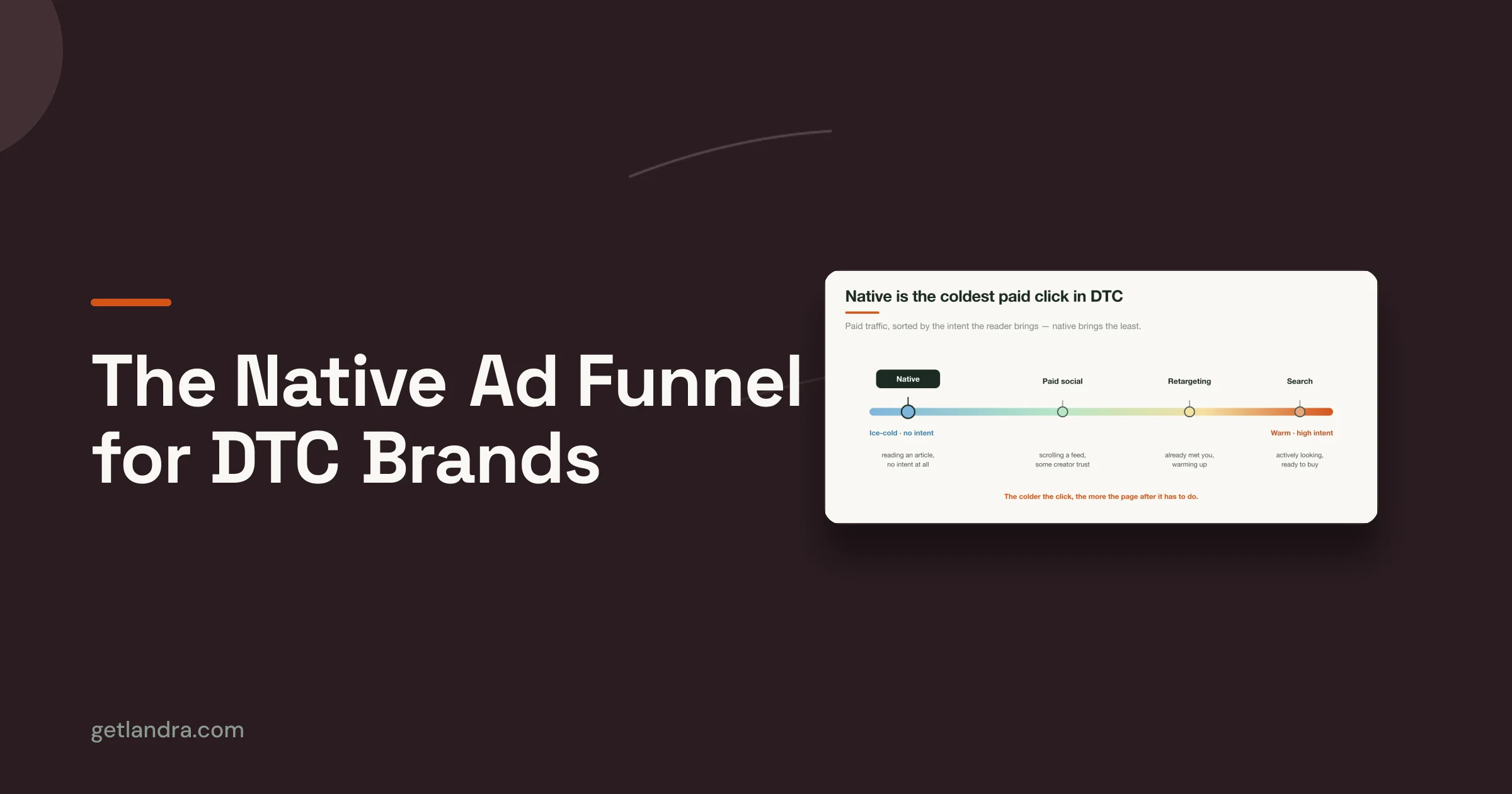
Channel selection should follow product economics, audience awareness, creative supply, and existing demand, not whichever platform is receiving the most attention. Meta can generate broad discovery, Google can capture active intent, TikTok can create cultural momentum, influencers can transfer trust, and email or SMS can recover value after the first visit. Each channel solves a different part of the customer journey.
| Channel | Avg CPM / CPC | Audience Intent | Creative Burnout Rate | Best For | Typical ROAS Range |
|---|---|---|---|---|---|
| Meta and Instagram | Varies by auction, audience, and creative | Low to medium | Medium to high | Visual products and scalable prospecting | Varies by category and margin |
| TikTok | Varies by auction and creative fit | Low to medium | High | Awareness, demonstrations, and creator-native storytelling | Varies by category and offer |
| Google Search and Shopping | Varies by query competition | Medium to high | Low to medium | Capturing existing demand | Varies by demand and product economics |
| Influencer partnerships | Varies by creator, format, and agreement | Medium | Medium | Trust-building in crowded categories | Varies by attribution and reuse rights |
| Email and SMS | Low incremental distribution cost after capture | High among subscribers | Medium | Retention, recovery, and repeat purchase | Varies by list quality and lifecycle design |
Meta and Instagram
Meta remains useful when a brand has strong visual proof and enough creative variation to sustain cold prospecting. Broad targeting can help the platform find buyers, but automation doesn't fix weak positioning. A product with a long explanation or a trust deficit often needs a pre-sell page before the product detail page.
Instagram placements reward polished visual assets, while Reels and creator-style executions often need a more native feel. Teams should judge the channel on blended acquisition economics, not only platform-reported return.
TikTok
TikTok is strongest when the product can be demonstrated quickly, connected to a recognizable problem, or placed inside a compelling personal story. Its weakness is creative burnout. A winning concept can lose force when the audience sees repetitive variations that preserve the surface style but remove the original tension.
The comparison between TikTok and Facebook changes by product, creative maturity, and objective. The HiveHQ e-commerce ad strategy comparison is useful for teams deciding whether a platform difference reflects audience behavior or a mismatch between creative format and channel culture.
Search, Shopping, creators, and owned channels
Google Search and Shopping work best when demand already exists. They capture shoppers who can name a category, problem, or product, but they won't create broad demand efficiently for an unfamiliar mechanism. Influencers can supply credibility, yet vague tracking and weak usage rights can make partnerships difficult to scale.
Email and SMS are the retention layer. Capture should begin before purchase where appropriate, and post-purchase flows should reduce uncertainty, support usage, request reviews, and create a reason to return. A brand that treats every new customer as a fresh paid acquisition event will struggle even when its front-end campaigns look profitable.
Building Pre-Sell Pages That Lower Customer Acquisition Cost
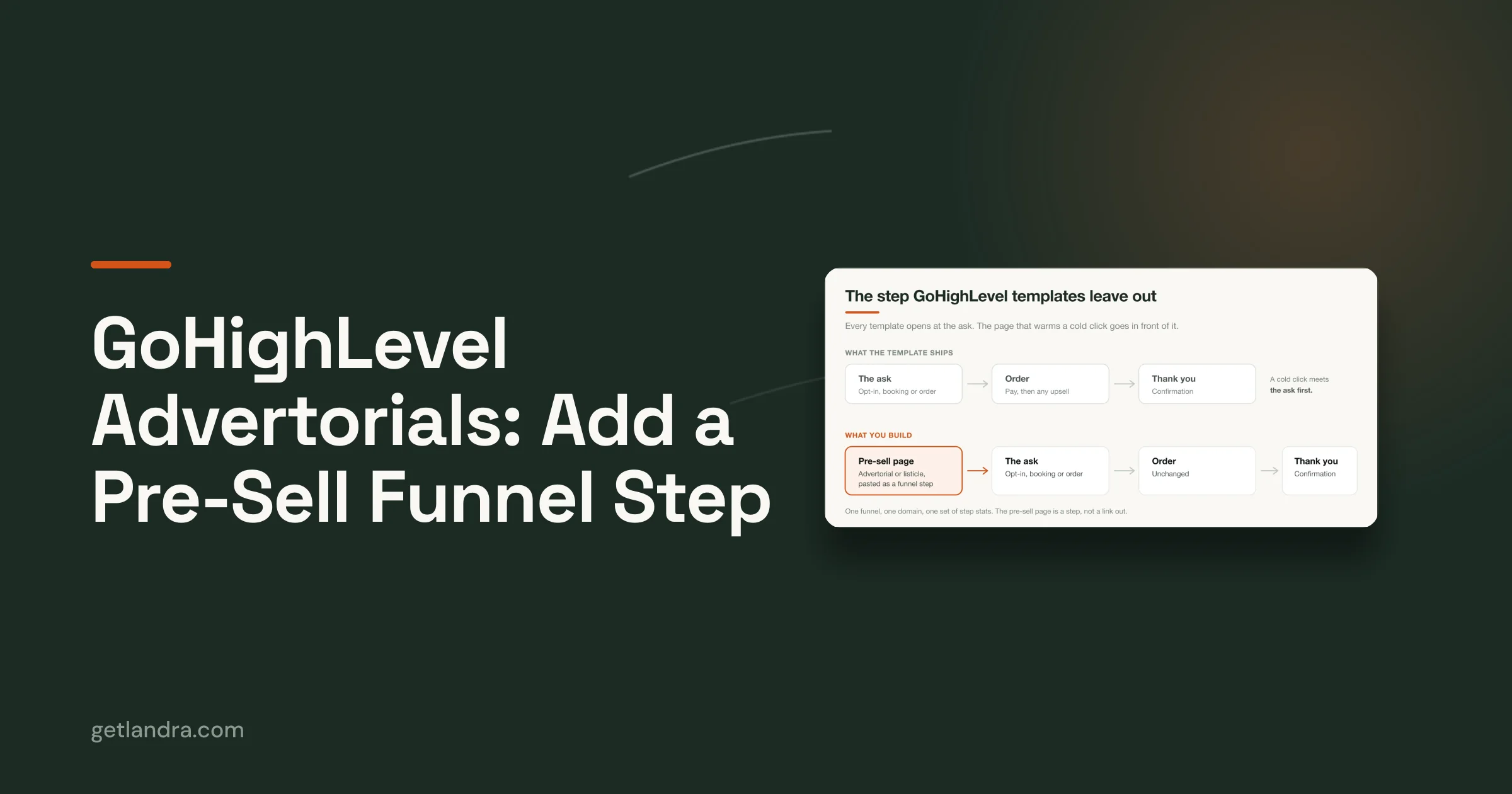
Sending cold traffic directly to a product page is efficient only when the visitor already understands the category, the problem, and the reason to trust the brand. For unfamiliar products, the page needs to perform education before it performs merchandising. A pre-sell page creates that bridge.

Start with the page's job
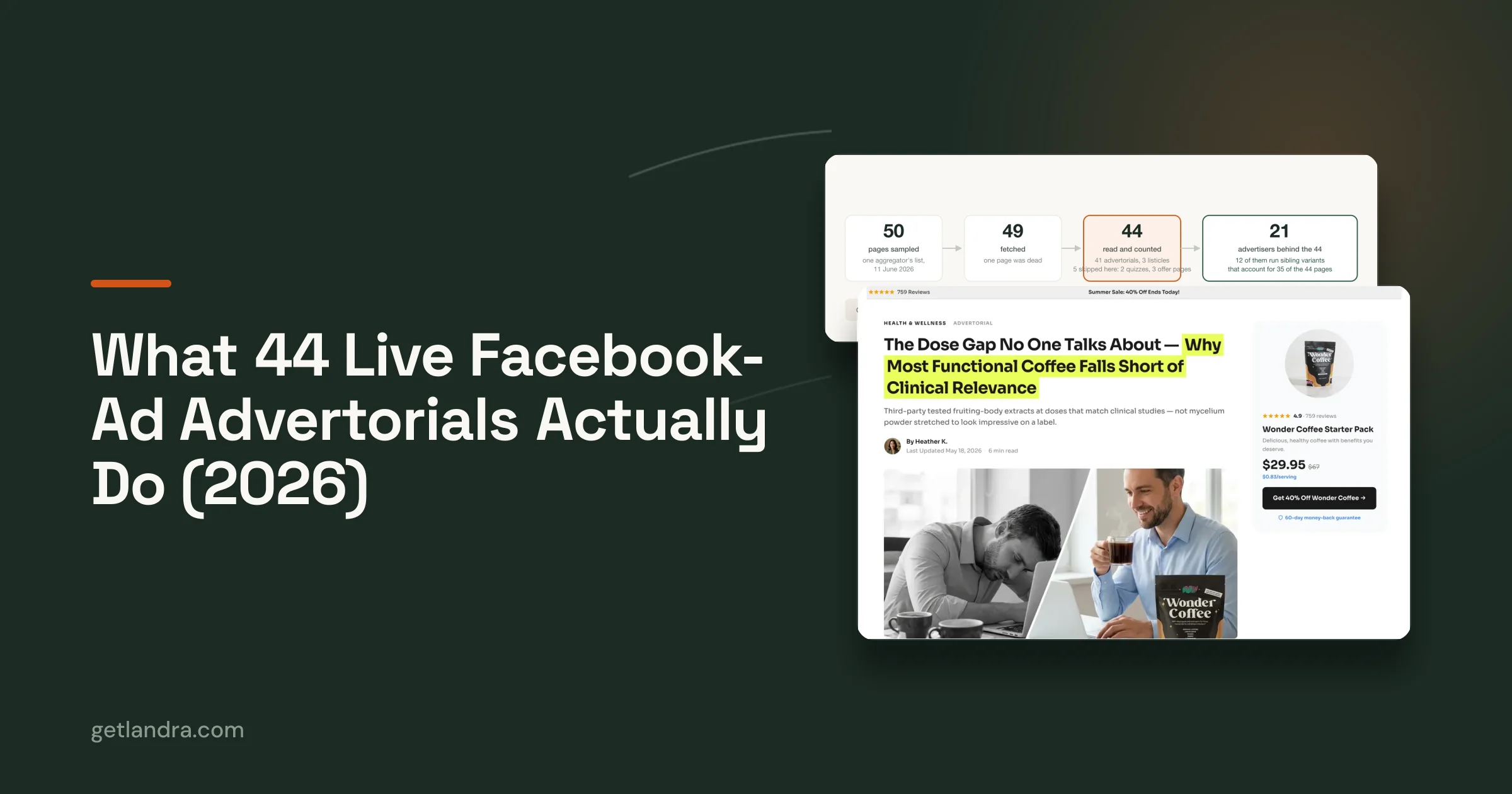
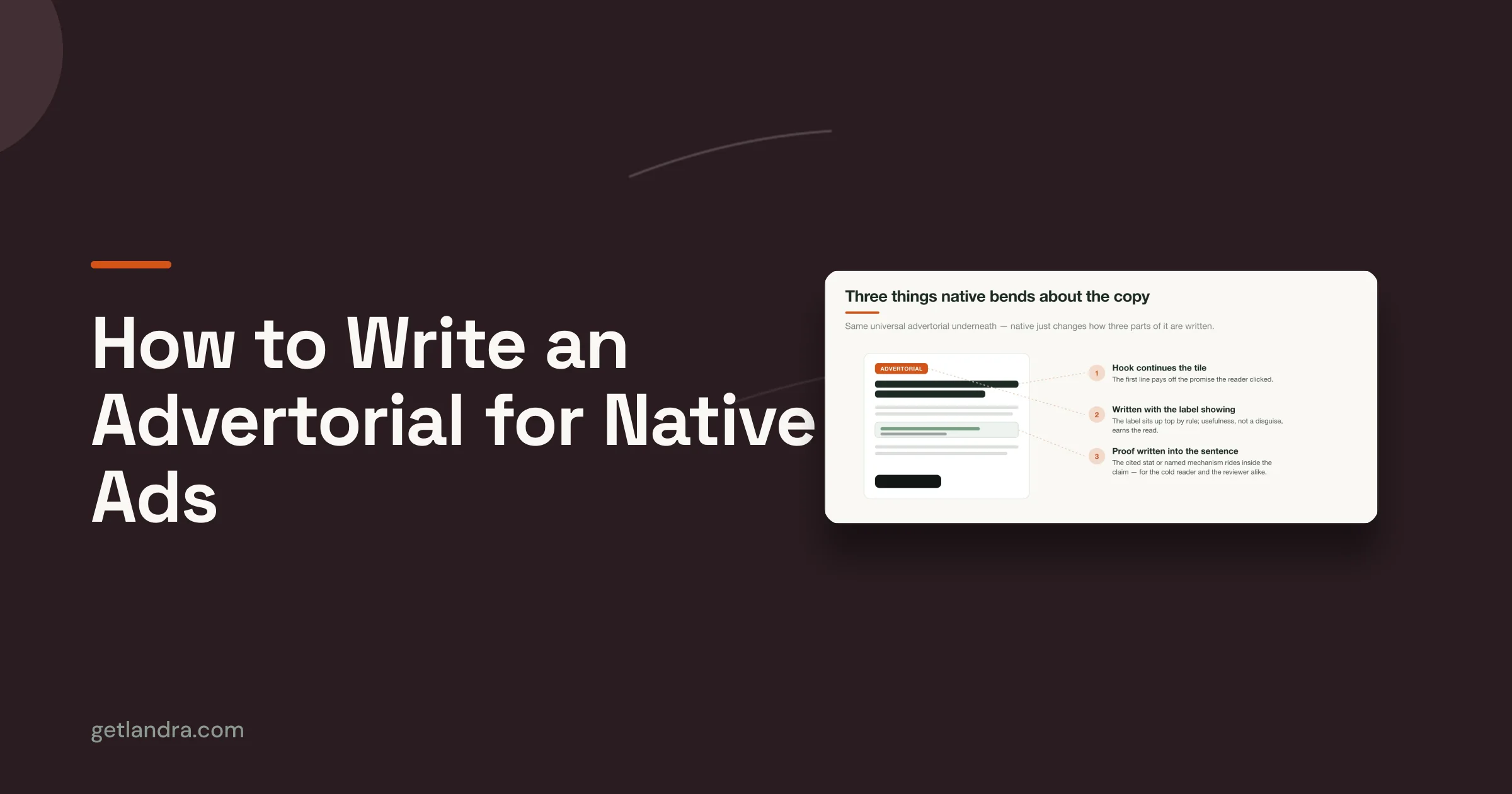
An advertorial should feel like a useful explanation with a relevant product inside it. A listicle should help the reader compare options or recognize the right solution. Neither format should pretend to be independent journalism when it is sponsored content. Clear disclosure protects trust and keeps the page aligned with the brand's actual claims.
Use the simplest format that resolves the visitor's hesitation:
- Mirror the entry point. Carry the ad's central problem, visual cue, or mechanism into the headline and opening.
- Name the friction. Describe why the problem persists and why common solutions may not fit this audience.
- Introduce the mechanism. Explain what the product does in plain language, without hiding behind technical phrasing.
- Stack proof progressively. Use reviews, demonstrations, ingredients, comparisons, guarantees, or expert information where substantiated.
- Answer objections before the CTA. Address fit, usage, price, safety, shipping, returns, and expectations.
- Make the transition soft. Move readers to the product page with a CTA that reflects the next logical step, such as viewing the formula or checking availability.
The opening shouldn't promise a transformation the product page can't support. Strong pre-sell copy narrows the gap between curiosity and informed consideration.
Match depth to awareness
A problem-aware visitor needs recognition and explanation. A solution-aware visitor needs differentiation and proof. A product-aware visitor may need only reassurance, offer clarity, and friction removal. Sending all three audiences through the same long page creates unnecessary reading for some and insufficient persuasion for others.
A long-form advertorial suits products that require context, education, or credibility. A listicle works when the buyer is comparing approaches and wants a structured decision. A concise educational page can outperform both when the audience already understands the problem but doesn't yet know the brand.
For a practical production workflow, use this resource on creating a DTC pre-sell page alongside your own customer research. Read reviews for the exact objections customers raise, then build sections around those objections rather than filling a template mechanically.
Treat the page as a testable asset
Create variants by changing one meaningful variable at a time: the opening problem, mechanism explanation, proof order, or CTA. Keep the ad angle and audience stable when diagnosing the page. Otherwise, the team won't know whether performance changed because the page improved or the traffic changed.
A pre-sell page also creates a cleaner learning loop. Scroll depth, outbound clicks, product-page engagement, checkout starts, and purchases show where the argument loses momentum. The goal isn't to make every visitor read everything. It's to give the right visitor enough confidence to continue.
Aligning Ad Creative with Landing Page Messaging
The fastest way to waste a paid click is to make the ad and landing page tell different stories. A user sees a video about a specific skin concern, clicks, and lands on a generic brand page. Or the ad promises a simple routine while the page opens with a complicated product catalog. Both assets may look polished, but the funnel feels unreliable.
Build a scent trail
A scent trail carries recognizable cues from the first impression to the next action. The words don't need to be identical, but the visitor should immediately understand that the page continues the ad.
Audit four layers:
- Verbal cue: Repeat the problem, audience, or mechanism that earned attention.
- Visual cue: Preserve the product, environment, color treatment, or person where it supports recognition.
- Emotional cue: Maintain the same tone, whether the ad is reassuring, urgent, curious, or practical.
- Proof cue: If the ad uses a review or demonstration, make related evidence visible near the opening page experience.
An ad about simplifying a morning routine should lead to a page that explains simplification, not a homepage that asks visitors to browse. An ad featuring a comparison should lead to a page with comparison logic. Continuity reduces cognitive friction because the visitor doesn't need to decide whether the click took them to the right place.
Pair message with awareness
Creative angle and page depth must match. A broad symptom hook needs education and qualification. A mechanism-led ad needs explanation and evidence. A product-name search or retargeting ad can usually move faster toward offer details.
The landing page is often the bottleneck because teams test it less aggressively than the ad. Start with the highest-traffic combinations and compare the complete path, not isolated click metrics. If the ad's click-through rate is strong but the page's next-step rate is weak, revise the page before producing another batch of creatives.
Use this copywriting guide for DTC brands to formalize the connection between hook, argument, proof, and action. Then annotate each ad with its intended awareness level and verify that the destination page fulfills that promise above the fold.
A landing page should make the click feel correct, not merely profitable.
Measure continuity, not just conversion
A useful diagnostic compares performance by message angle. Track the ad's click quality, the page's engagement, the transition to the product page, checkout initiation, and completed purchase. A mismatch usually appears as a sharp drop between two stages, while weak offer economics may remain weak throughout the funnel.
This approach prevents a common mistake: replacing a potentially valuable audience because the destination experience failed to meet it. Fix the handoff first.
Measuring What Matters in DTC Campaigns
A high click-through rate can hide poor commercial performance. Impressions and clicks describe distribution, not whether the brand can acquire customers at an economically sensible cost. The measurement stack should connect media spend to contribution, retention, and cash recovery.
Use a KPI hierarchy
Start with the business outcome, then work backward:
- Blended CAC: Total acquisition spend divided by new customers across paid and attributable channels.
- Contribution after marketing: Revenue minus product, fulfillment, payment, support, returns, and acquisition costs.
- LTV to CAC: A directional view of whether retained customer value can support acquisition.
- Payback period: How quickly gross contribution recovers the initial acquisition investment.
- Funnel diagnostics: Click quality, page engagement, product-page transitions, checkout starts, and purchase rate.
Last-click reporting often undervalues pre-sell pages because the page influences consideration while another channel receives the final conversion credit. That doesn't mean every assisted interaction deserves equal credit. It means teams should compare cohorts, landing paths, and blended economics instead of treating one attribution window as reality.
The longitudinal evidence on prescription DTC advertising illustrates why intermediate signals matter. In the FDA-linked evidence review, only 4% of patients reported seeing a doctor solely because of an advertisement, while 30% to 35% discussed the advertisement with a doctor. The review also cites evidence that brief statin-commercial exposure increased the odds of low-risk patients receiving a high-cholesterol diagnosis by 16% to 20% and starting statins by 16% to 22%. The implication is practical: advertising can shift behavior through consideration and conversation, not only through an immediately trackable click.
Set stage-appropriate decision rules
The exact targets depend on margin, repeat purchase, and cash constraints. Use the following table as a decision framework, not a universal benchmark.
| KPI | Validation Stage | Growth Stage | Scale Stage |
|---|---|---|---|
| Blended CAC | Establish a reliable baseline by offer and audience | Keep within the contribution model | Protect margin while expanding reach |
| Conversion rate | Find the weakest funnel transition | Test page, offer, and creative combinations | Monitor deterioration by cohort |
| LTV to CAC | Build an early retention view | Include repeat purchase and refunds | Use cohort quality to set scaling limits |
| Payback period | Confirm cash recovery is plausible | Match spend increases to recovery speed | Prevent growth from creating a cash gap |
| Owned-channel capture | Begin collecting consented contacts | Improve flows and segmentation | Make retention a larger part of blended revenue |
Run disciplined tests
Before launch, document the hypothesis, primary metric, audience, destination page, offer, and stopping rule. Avoid changing the ad, page, and price simultaneously. On launch day, watch spend pacing, tracking integrity, checkout errors, refund signals, and the quality of traffic before judging creative winners.
For teams testing editorial formats, review relevant listicle conversion stats, but don't import a benchmark without checking the underlying traffic, offer, device mix, and attribution method. A page that performs well for one category may fail when the product requires different proof or a longer decision cycle.
The Modern DTC Playbook for Sustainable Growth
The next DTC winners won't treat paid acquisition as the entire growth engine. They'll use advertising to create demand and then rely on pre-sell infrastructure, first-party data, community, content, and retention to convert and compound that demand.
That shift matters because paid channels are volatile. Audience signals change, creative fatigue arrives, and platform automation can make targeting decisions less transparent. A brand with useful email flows, SMS permission, organic education, customer reviews, and post-purchase support has more ways to recover value from every acquired customer.
Compliance also belongs in the growth model, especially for health, wellness, supplements, and prescription-related campaigns. In the United States, proposed restrictions on drug DTC advertising and expanded oversight of social media promotion show why marketers need claims review, disclosure discipline, and risk-aware creative. The current House bill on prescription drug advertising reflects that policy pressure. Regulation isn't only a legal concern. Clear claims can reduce confusion, complaints, refunds, and platform risk.
The operating model is straightforward:
- Use paid social for discovery and message testing.
- Route cold traffic through a page that earns consideration.
- Capture consented first-party contacts.
- Build post-purchase education and replenishment flows.
- Review performance through blended economics and cohort quality.
- Refresh creative only after confirming the destination experience works.
Landra generates editable advertorial and listicle pre-sell pages from a product or brand URL, with publishing options for Shopify, a hosted URL, Webflow, or HTML export. It can fit a workflow where growth teams need to create and compare paid-social landing experiences without rebuilding every page from scratch.
The playbook isn't about spending more. It's about making each dollar travel through a better system.
If your paid traffic is earning clicks but losing momentum before checkout, use Landra to create an editable advertorial or listicle that matches your ad angle and warms up cold visitors. Build the page, publish it to your existing stack, and test the full path from creative to purchase instead of scaling a leaky funnel.