
Most advice about Google Ad Quality Score gets it backward. People talk like the number is a control knob you can twist higher if you just write enough new headlines or keep massaging bids, but Google treats it as a diagnostic snapshot, not a live lever. If you want lower CPC and better positions, stop chasing the score itself and start fixing the weakest component on the keywords that are burning spend.
That's the mindset behind Come Together Media LLC on Quality Score, and it's the only one that's useful in a DTC account. The visible 1 to 10 number is a summary of what Google thinks about your relevance and usefulness compared with other advertisers on the same search. The money sits in the details underneath it.
Table of Contents
- The Uncomfortable Truth About Quality Score
- What Google Ad Quality Score Measures
- Why Quality Score Exists and How It Got Here
- How Quality Score Shapes CPC and Ad Rank
- Where to Fix It First and What to Change
- DTC Scenarios and Realistic Benchmarks
- Measurement Workflow That Actually Works
- Putting It Together and Common Follow-Up Questions
The Uncomfortable Truth About Quality Score
The most common mistake is treating Google Ad Quality Score like a trophy. Teams celebrate a 7, panic at a 4, and waste hours trying to “raise the score” when the actual problem is usually narrower, cheaper, and more fixable than that. Google's own diagnostic is telling you where the friction sits, not handing you a direct bidding lever.
Stop optimizing the vanity number
If a keyword cluster is expensive, the question isn't “How do I get this from a 5 to a 7?” The question is, which component is holding it back, and which change will move the auction economics next week. For a DTC brand, that usually means one of three things, expected CTR, ad relevance, or landing page experience.
Practical rule: treat Quality Score as triage. Fix the weakest component first, then verify with conversion data whether the change actually paid.
A lot of accounts look busy and underperforming because the team keeps reworking things that don't matter much. Better bidding alone rarely cures a relevance problem. Better creative alone won't save a page that breaks the promise made in the ad.
The right workflow is blunt. Find the keywords with the worst economics, inspect the component statuses, and make the cheapest change that improves the user experience Google is measuring. If that sounds less glamorous than “raise your Quality Score,” good. It is. And it works better.
What Google Ad Quality Score Measures
Google Ad Quality Score is a keyword-level diagnostic on a 1 to 10 scale, not a control you can turn up to improve performance. Google evaluates three components, expected CTR, ad relevance, and landing-page experience. Each receives a status of Below average, Average, or Above average, based on how your ad compares with advertisers shown for the same search during the previous 90 days. Google's support docs describe the visible score as a comparison, not a permanent grade Google Ads Quality Score help.
Treat it as a snapshot, not a final exam
A keyword can receive a different assessment next month because the comparison set changes. Competitors adjust their ads and bids, search behavior shifts, and the auction context changes. The same ad therefore will not keep the same assessment forever.
The visible number helps diagnose an account, but it is not the auction formula. Google separates this retrospective score from the quality signals used when ads compete. Use the component statuses to identify what needs fixing, then judge the change through CPC, ad rank, and conversion performance. Chasing the number itself creates busywork.
| Component | Rating Scale | Compared Against | What It Signals |
|---|---|---|---|
| Expected CTR | Below average, Average, Above average | Advertisers who appeared for the same search in the last 90 days | Whether your ad is likely to earn clicks relative to competitors |
| Ad Relevance | Below average, Average, Above average | Same search context and competitor set | Whether the ad message matches the query theme |
| Landing-Page Experience | Below average, Average, Above average | Same search context and competitor set | Whether the post-click page is useful and aligned |
Use this client-ready explanation: Quality Score is Google's comparative diagnosis of click likelihood, message match, and landing-page usefulness, not a universal grade.
Why Quality Score Exists and How It Got Here
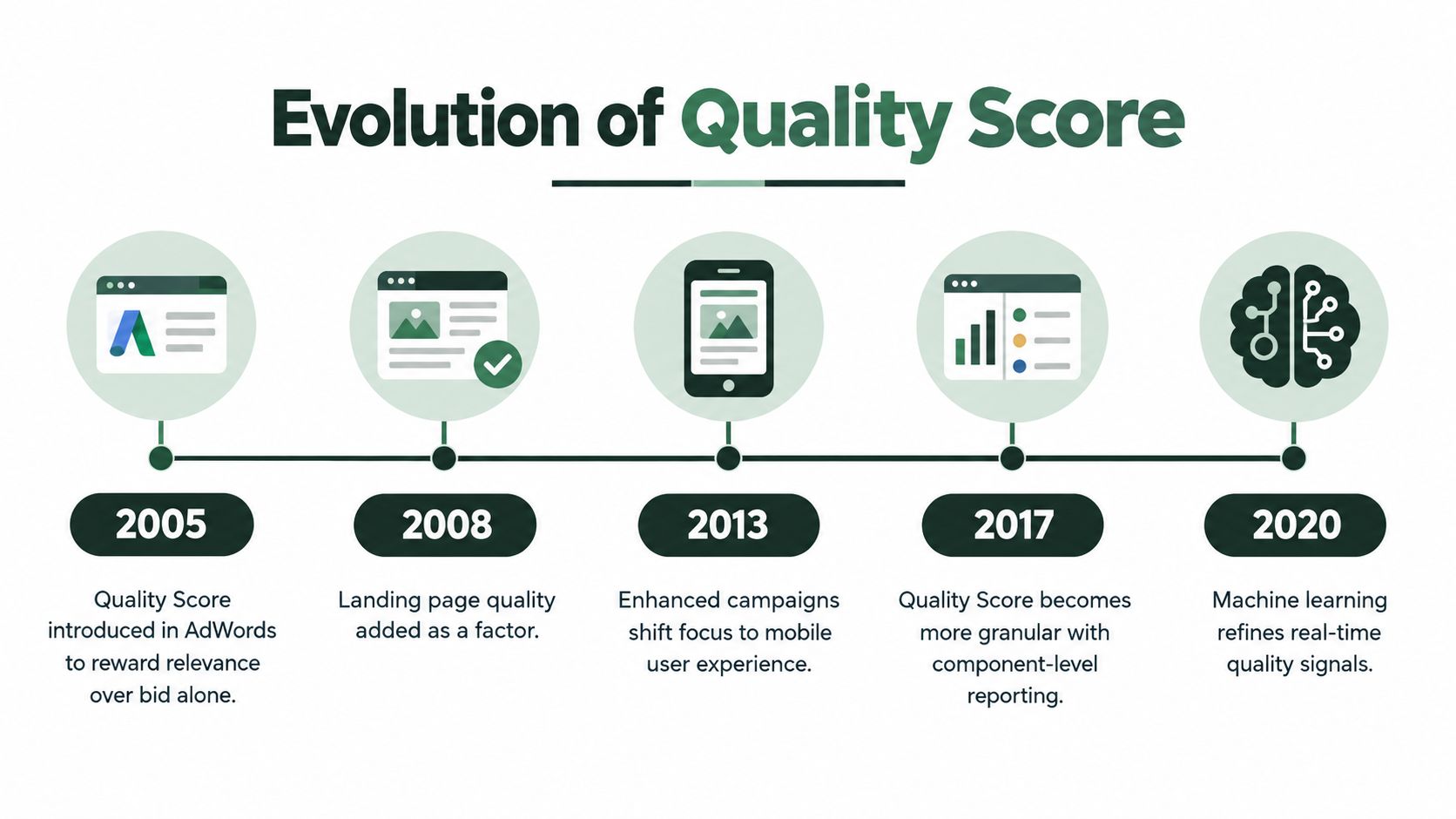
Google introduced Quality Score in August 2005 as part of AdWords' effort to evaluate ad quality and set minimum keyword bids Google Ads Quality Score history. It was a direct move to reward relevance and user experience in the auction, instead of letting the highest bidder win by default.
Why the milestone matters for marketers
Google said higher Quality Scores could lower the minimum bid needed for a keyword to become eligible to show, and that quality also affected ad ranking. Copywriting, keyword targeting, and landing-page alignment became part of media efficiency, not just creative polish. Relevance started affecting cost.
The reporting change mattered too. On May 15, 2017, Google added optional historical columns for Quality Score and its components, with historical values available from January 22, 2016 onward Google Ads release notes. Advertisers could finally see when quality improved or slipped instead of staring at a frozen current score.
A keyword can look strong today and weaker next month because the comparison set changed. The visible score is a retrospective diagnostic, while the auction keeps changing. Use the score as a clue, and use the auction as the place where performance is won.
How Quality Score Shapes CPC and Ad Rank
The cleanest way to think about the economics is this. Better relevance and a better landing experience improve the signals Google uses in real time, and those signals influence Ad Rank and the price you pay. Google says the visible 1 to 10 score is not used directly in the auction, which is exactly why people get confused when a “bad” score doesn't always mean bad performance Google Ads auction-time quality guidance.
The cost advantage is indirect, not automatic
A simple bidding example makes the point. If one advertiser bids $3 and another bids $2, the lower bidder can still win if the quality signals are stronger. That's the whole system working as intended. Google isn't rewarding brute force, it's rewarding usefulness.
Useful rule: if your ad looks strong on the surface but still pays too much, don't stare at the score. Check whether the query, the ad promise, and the post-click page all line up.
Here's the practical chain. Query-specific relevance and a useful landing page influence user response. Those responses feed the auction's quality systems. Those systems affect Ad Rank, which then affects both position and cost. The visible score helps you diagnose where the chain is weakest, but it isn't the chain itself.
The trap is obvious. A campaign can show a decent score and still overpay if competition is brutal or if the account is weak on the exact query set that matters. The opposite can happen too, a weak score can still produce profitable clicks if the downstream conversion path is tight. That's why the number is a diagnosis, not a dial.
For DTC advertisers, the work starts after the click. If the page doesn't carry the promise made in the ad, you're paying for friction.
A helpful companion read on measurement tradeoffs is the paid search KPIs for e-commerce framework, especially if you're deciding whether a keyword is profitable or just cheap on the front end.
Where to Fix It First and What to Change
Start with expected CTR. It is usually the fastest thing to move because you can change the message without rebuilding the whole funnel. Then fix ad relevance, which usually means tightening structure so the ad and query are about the same thing. Landing-page experience matters just as much, but it is usually the slowest and most expensive lever to change.
1. Expected CTR first
Rewrite headlines so they sound like the search term, not a brand manifesto. Add negatives so irrelevant queries stop inflating impressions that never had a real chance to click. Use pinned headlines when you need message control, especially on high-spend terms that keep drifting off theme.
The logic is simple. Google compares your click performance against advertisers in the same search context, so tighter message match usually makes the ad look more useful. That can move the visible expected CTR component in the right direction.
2. Ad relevance second
Tighten ad groups to single-intent themes. Cut broad buckets that force one ad to speak to five different reasons someone might search. Align the headline with the query theme, not just the product category.
Messy structures keep producing mediocre relevance signals even when the copy is polished. If the search term and the ad are trying to do too many jobs, Google reads the mismatch.
3. Landing-page experience third
Match the page to the ad promise. Speed up mobile load. Reduce clutter. If the ad says a product solves a specific problem, the page should open with that problem and answer it fast.
For teams comparing campaign cleanup approaches, FOMOchat's campaign recovery playbook is a useful reminder that weak campaigns usually fail at message and page alignment before they fail at bidding. Landra's guide to DTC PPC uses the same logic in a broader account strategy context.
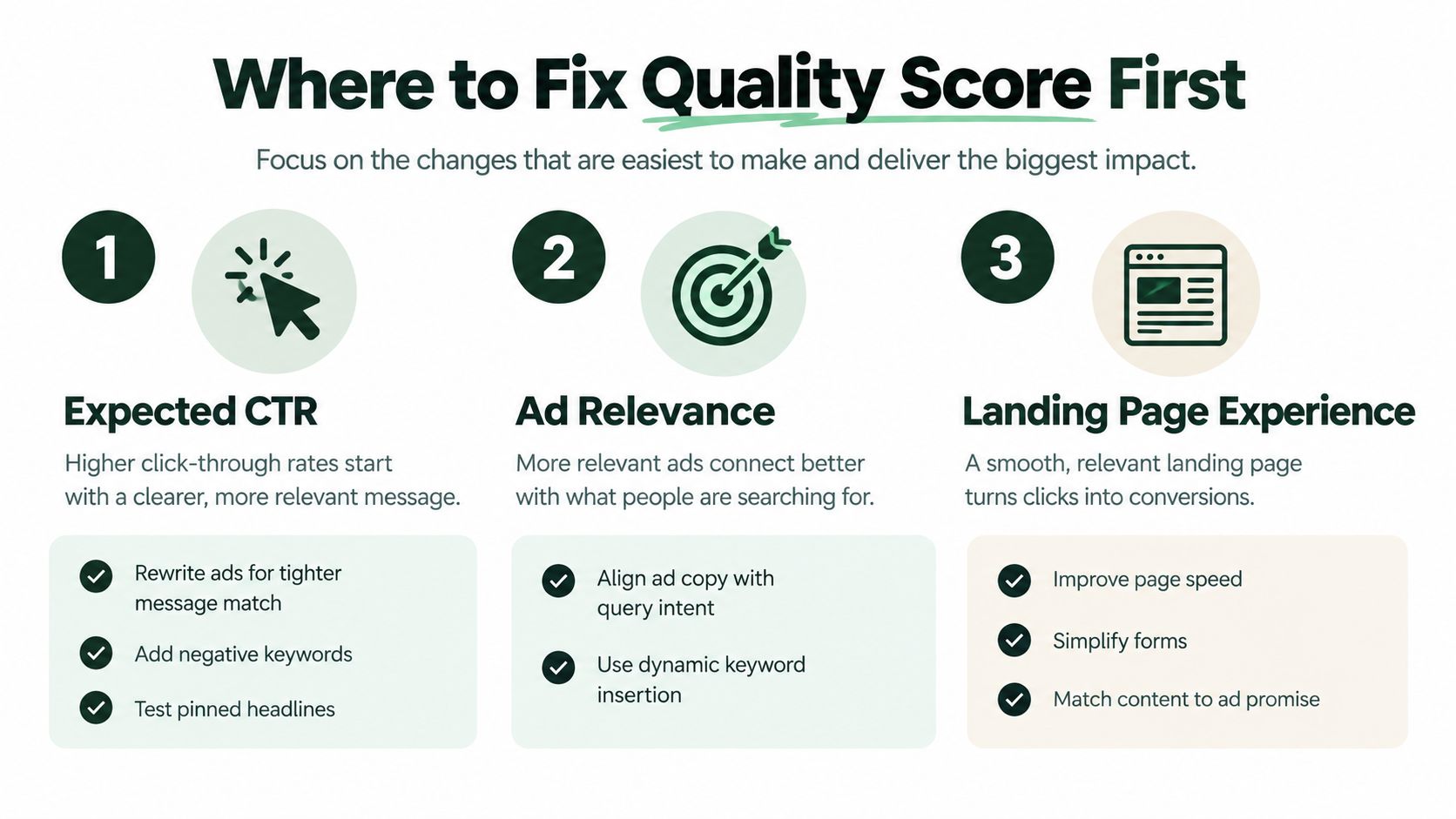
For most DTC brands, I would rank the fix order as expected CTR, then ad relevance, then landing-page experience. The page still matters, but ad copy and structure are usually faster to correct and easier to test. Optimize the inputs that change quickly first, then use the page to remove friction that keeps good clicks from turning into revenue.
DTC Scenarios and Realistic Benchmarks
A supplement brand running cold search traffic often sends clicks straight to a product detail page. That usually creates a mismatch between the search promise and the page experience. Moving the same traffic to a tight advertorial pre-sell page can make the post-click path feel more coherent, which is the kind of change that can improve both expected CTR signals and landing-page experience over the next reporting window.
Three patterns that show up in DTC accounts
A beauty brand with a sprawling ad group is a different problem. The account has too many intents jammed into one bucket, so the ad can't look highly relevant to all of them at once. Breaking that structure into smaller intent themes usually gives the highest-spend terms a cleaner relevance signal, which is where improvement tends to show up first.
A commodity pet brand often loses the battle on the page itself. The ad headline and the landing page headline should feel like one conversation, not two disconnected assets. When the page mirrors the ad promise and the mobile experience is easier to use, the landing-page experience component has a better chance of moving out of the danger zone.
I'm not calling those outcomes guaranteed lifts. They assume you're measuring the right thing, using clean query data, and not mistaking accidental clicks for intent. If a page raises clicks but hurts purchases, the page didn't improve the business, it attracted worse traffic.
A simple interpretation rule works across all three scenarios. If a change improves the component status and also improves qualified conversion behavior, keep it. If it only improves the visible score while post-click performance gets worse, roll it back. That's the discipline that keeps DTC teams from optimizing theater.
Measurement Workflow That Actually Works
Review Quality Score on a weekly cadence, but don't review the score alone. Pull keyword-level Quality Score, the three component statuses, impression-weighted CTR, cost per qualified visit, conversion rate, and return on ad spend. If you only watch the 1 to 10 number, you'll miss the difference between a cheap click and a valuable click.
The reports to pull each week
- Search keyword report: Look for the themes that carry the most spend and the weakest component status.
- Component breakdown report: Check whether the problem is clickability, message match, or page experience.
- Landing page report: Compare the pages behind the worst keywords with the pages behind the best ones.
- Conversion report: Judge whether traffic quality improved after the change, not just whether the score moved.
The warning sign is straightforward. If a page lifts CTR but conversion rate drops, the ad is pulling in lower-intent traffic, not better traffic. If the page gets more clicks and more qualified visits, you've probably fixed a real bottleneck.
When a component sits Below average for two reporting cycles, be direct. Rewrite the ad for tighter query match, split the ad group, or fix the page promise. Don't keep nudging bids and hoping the score heals itself. It won't.
The cleanest way to think about it is this, Quality Score is a triage input, not a primary KPI. Use it to find the problem, then use business metrics to decide whether the fix was worth keeping. That's also where DTC ad metrics by funnel stage helps, because it keeps you from confusing top-of-funnel click quality with actual commercial value.
Putting It Together and Common Follow-Up Questions
Review the component statuses before you look at the number. Fix expected CTR before ad relevance when money is tight, then fix the page when the promise is broken after the click. That's the playbook, and it's the one that lowers CPC without turning your account into a vanity project.
Why does Quality Score change when nothing changed? Because your comparison set changed. Does pausing poor keywords help? Sometimes, but only if they're dragging budget and never convert. How long do fixes take to show up? Long enough that you should measure by trend, not by tomorrow's screenshot. Are broad match keywords automatically lower quality? No, but they do widen intent, which makes visible scores noisier.
The bottom line for DTC brands is simple. Google Ad Quality Score is a free diagnostic that rewards tight copy, tight keyword themes, and tight landing pages. Treat it that way and you'll pay less per click, earn better positions, and stop wasting time trying to max out a number that was never the actual target.
If you want pages that align better with ad promise before the click, Landra generates mobile-first pre-sell landing pages for DTC brands from a product or brand URL. Use it when you want to test message match, improve landing-page relevance, and move the right Quality Score components without rebuilding the whole site.