
The most popular PPC advice is often the least useful once a DTC account has enough automation in place. Marketers still spend hours adjusting bids, expanding keyword lists, and adding negatives, while the bigger problem sits after the click: the ad promises one thing, the landing page presents another, and the conversion system sends weak or incomplete signals back to the platform.
To optimize PPC marketing profitably, treat the account as a signal-design system. Your ad, audience, page format, checkout experience, and measurement setup must work together. Google Ads search campaigns recently averaged a 6.64% click-through rate, a $5.42 cost per click, and an 8.18% conversion rate across a 12-month dataset from April 2025 to March 2026, according to WordStream's PPC benchmarks. Those figures aren't targets for every brand, but they show why relevance after the click matters as much as auction mechanics.
Table of Contents
- The Shift from Keyword Tinkering to Signal Design
- Structuring Campaigns for Intent and Channel Context
- Bidding Tactics and Budget Allocation Strategies
- Matching Ad Creative to Pre-Sell and Product Pages
- Measuring What Matters in a Privacy-First Era
- Troubleshooting Common PPC Leaks and Quick Wins
The Shift from Keyword Tinkering to Signal Design
Manual bid adjustments and negative keyword lists still have a place. They protect budgets from irrelevant queries, expose waste, and help you understand how demand behaves. But they shouldn't remain the center of your PPC optimization process when automated bidding is making decisions across devices, audiences, placements, and signals you can't inspect at keyword level.
The more important question is: what information does the platform receive when a person clicks your ad?
A prospect who lands on a fast page, reads a relevant explanation, views credible proof, and completes a meaningful purchase gives the algorithm a stronger signal than someone who clicks, gets confused, and leaves. If both clicks are treated as equivalent traffic, the platform has less reason to find people who resemble your profitable customers.
I call this signal design, the deliberate alignment of four elements:
- Ad promise: The headline and creative establish a specific expectation.
- Page experience: The first screen and supporting content fulfill that expectation immediately.
- Conversion event: The account records an action that reflects business value, not just engagement.
- First-party data: Your store or CRM helps validate which conversions become profitable customers.
This changes the optimization order. Instead of beginning with bids, start with the handoff from ad to page. A search ad about a specific skin concern should lead to a page that addresses that concern, not a generic collection page. A social ad built around a customer problem may need a short educational pre-sell page before it asks for a purchase.
For practical guidance on message alignment in ads, think beyond matching a keyword to a headline. Match the user's awareness level, emotional context, offer, and next action. A high-intent searcher may need a product page. A cold social visitor may need proof and explanation first.
Practical rule: Optimize the path that produces the conversion signal, not just the auction setting that produces the click.
Search and display performance also illustrate why context matters. Search ads average around 6.64% CTR, while display ads average about 0.57%, according to CXL's CTR benchmarks. Search intent, tightly matched copy, and a conversion-focused destination deserve different treatment from interruption-based display traffic.
The compounding advantage comes from repetition. Better alignment improves the immediate post-click experience, cleaner conversion data improves automated decisions, and better traffic makes the next round of testing more informative. Keyword work remains useful, but it becomes one input into a broader system.
Structuring Campaigns for Intent and Channel Context
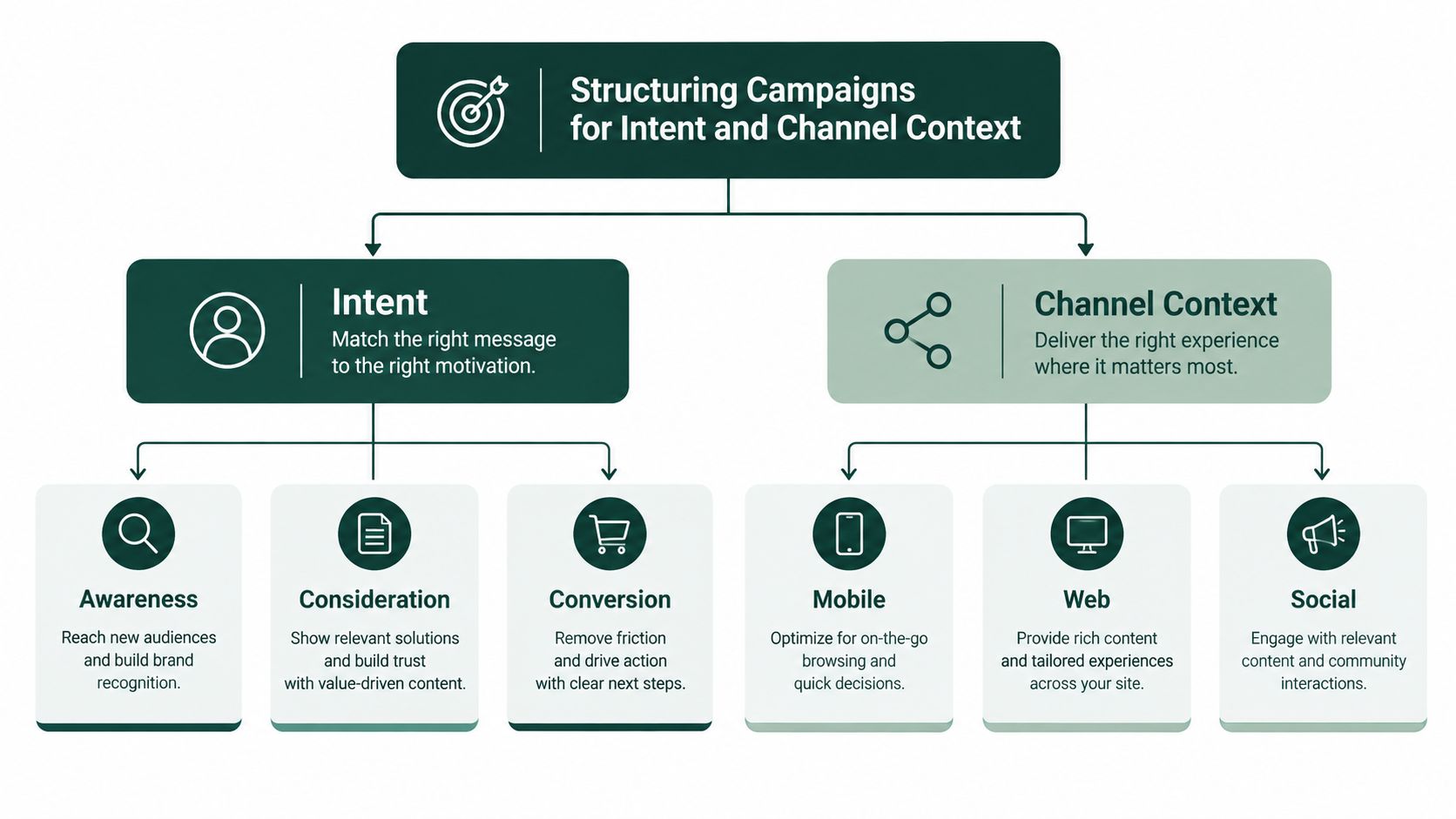
A single global conversion rate can make a healthy account look weak or a weak account look healthy. Branded search, non-branded search, Shopping, paid social, and retargeting attract people with different levels of awareness. They should not share the same benchmark, budget logic, or landing page by default.
Start by separating traffic into intent tiers.
Build the account around intent
Branded campaigns capture people who already know your company or product. Send them to a product page, collection page, or offer-specific destination when the query is direct. The page should remove uncertainty quickly, with price, availability, reviews, shipping information, and a clear purchase path.
Non-branded search campaigns require tighter query grouping. Separate problem-led searches from comparison searches and product-category searches. A person searching for a solution may need education and proof before seeing the product. Someone searching for a specific product type may be ready for a more direct page.
Shopping campaigns should route visitors according to the product and query context. Product pages work when the feed, image, title, price, and page all answer the same immediate question. If the product requires explanation, use a supporting pre-sell route where the campaign setup allows it, or test the product page against a message-matched intermediary page.
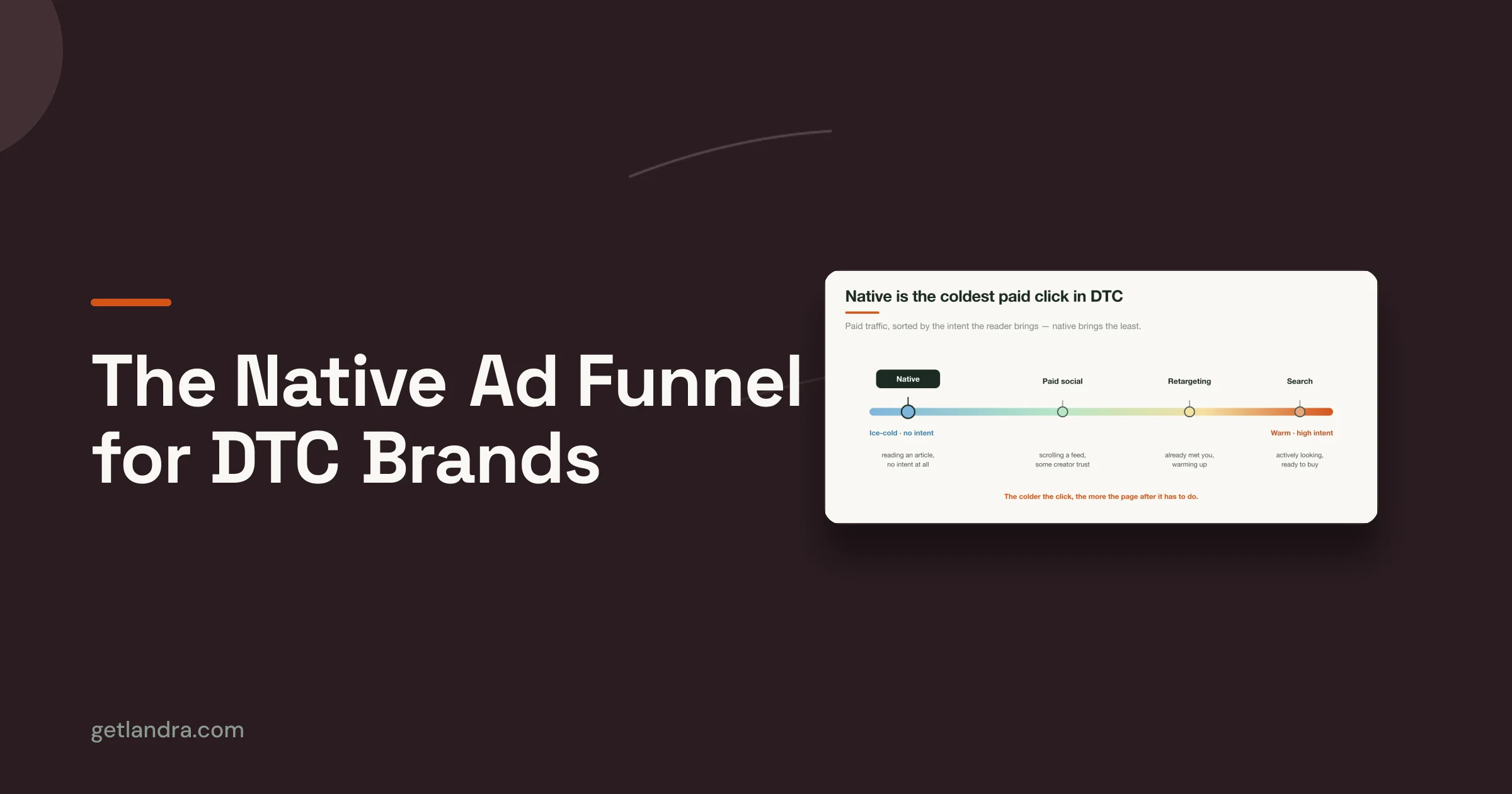
Paid social needs a separate logic. Users often aren't searching for your product when they see the ad, so the creative must establish the problem and the reason to care. A direct product page can work for familiar, low-friction products, but cold traffic often needs a narrative bridge.
Compare performance within the same context
DTC benchmark summaries place paid social around 1% to 3%, paid search at 2% to 5%, Google Shopping at 2.5% to 5%, and branded search at 4% to 8%, according to MHI Growth Engine's landing-page benchmarks. These ranges aren't interchangeable scorecards. A branded campaign can have a higher conversion rate because users already know what they want, while a non-branded campaign may be doing valuable demand creation with a lower rate.
Measure each segment against its own role:
- Branded: Impression coverage, conversion efficiency, new-customer share, and assisted demand.
- Non-branded: Qualified conversion rate, CPA, query quality, and downstream revenue.
- Shopping: Product-level profit, feed quality, conversion rate, and return by SKU.
- Paid social: Creative-level attention, assisted conversion behavior, new-customer economics, and post-click engagement.
- Retargeting: Incremental revenue, frequency, and whether the audience would have converted without the ad.
Use dedicated page variants wherever the promise changes. A comparison ad shouldn't land on a page written for a generic product search. If you're weighing channel roles, Landra's ad platform comparison offers useful context for distinguishing demand capture from demand creation.
Campaign structure should make the answer visible. If one campaign combines branded, generic, and shopping intent, you won't know whether a page improved performance or whether the mix changed.
For teams evaluating the broader economics of paid distribution, how self-service ads drive revenue is a useful resource because it frames advertising as a repeatable revenue process rather than a collection of isolated clicks.
Bidding Tactics and Budget Allocation Strategies
Automation doesn't remove the need for judgment. It changes where judgment matters. Once campaigns are segmented properly, your job is to give each bidding strategy enough reliable conversion information without forcing immature campaigns to optimize against targets they haven't earned.
Maximize Conversions is generally the cleanest starting point for a campaign with limited historical data and a trustworthy conversion action. It gives the system room to explore rather than imposing a rigid CPA target too early. The trade-off is less cost predictability while the algorithm learns.
Target CPA becomes more useful after the campaign has a stable pattern of qualified conversions. Set it too aggressively and the platform may restrict reach. Set it too loosely and you may buy volume that doesn't support your economics. Judge it against contribution margin and customer quality, not an arbitrary account average.
Target ROAS fits businesses with reliable revenue values and enough purchase data to distinguish high-value customers from low-value transactions. It can protect efficiency, but it may under-deliver when the account needs to discover new buyers or when conversion values arrive with delay.
The wrong target can make an efficient campaign look healthy while quietly starving it of demand.
Budget allocation should reflect learning needs. Do not spread a limited budget across many near-identical campaigns just to create more labels in the account. Fragmentation can leave each campaign with too little useful data, making automated decisions less stable. Consolidate where intent and landing-page experience are actually shared, then separate campaigns where the business question is different.
Reserve a controlled portion of spend for testing. A new page or pre-sell angle needs enough exposure to produce a directional answer, but it shouldn't be judged against a mature campaign with a different audience mix. Change one major variable at a time, keep the ad promise consistent when testing the page, and evaluate conversion rate alongside CPA and revenue quality.
The post-click experience also affects effective acquisition cost. Mobile traffic needs a narrow layout, readable copy, obvious CTA placement, and fast interaction. Current PPC guidance emphasizes sub-2 to 3 second mobile load times, strong proof near the CTA, and segmented landing pages in discussions of AI-driven PPC trends. Treat speed and layout as bidding inputs in practice, even when the ad platform doesn't expose them as a simple manual lever.
Track the full chain:
- Spend and clicks.
- Landing-page engagement.
- Conversion rate.
- CPA and revenue.
- New-customer contribution.
- Refunds, repeat purchases, or qualified lead outcomes.
A campaign that produces cheap conversions but weak customers is feeding the wrong signal. Bidding automation can optimize exactly what you tell it to optimize.
Matching Ad Creative to Pre-Sell and Product Pages
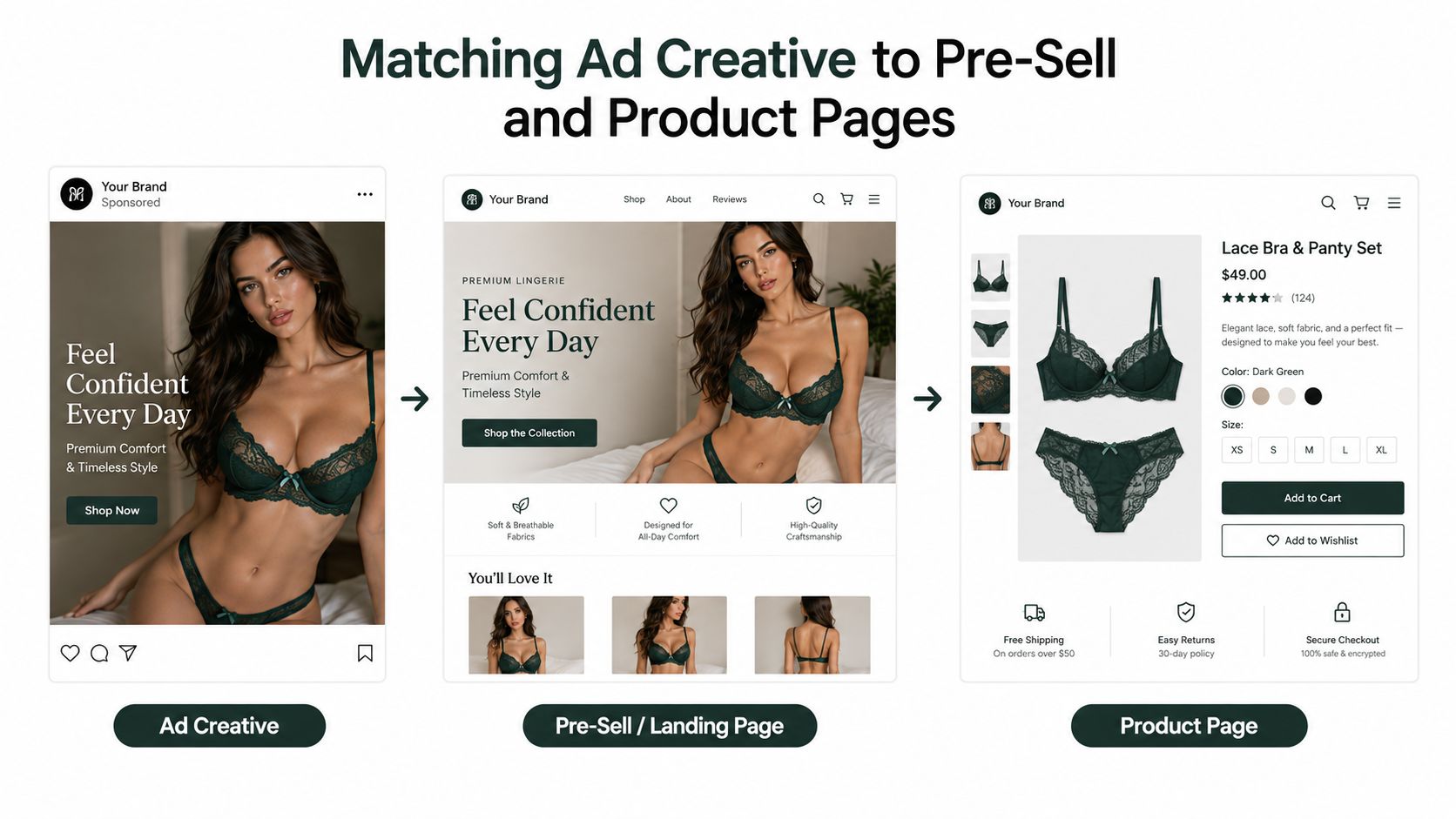
Sending cold traffic directly to a product detail page is convenient, but convenience isn't the same as relevance. A PDP assumes the visitor is ready to evaluate a product. Cold social traffic often hasn't accepted the problem, understood the category, or decided that your solution deserves attention.
That distinction determines the page format.
A product page works best when the ad has already done the explanation. The visitor recognizes the product, understands its use, and wants to verify practical details. The PDP should then make the decision easy with a clear offer, proof, useful specifications, and a visible path to checkout.
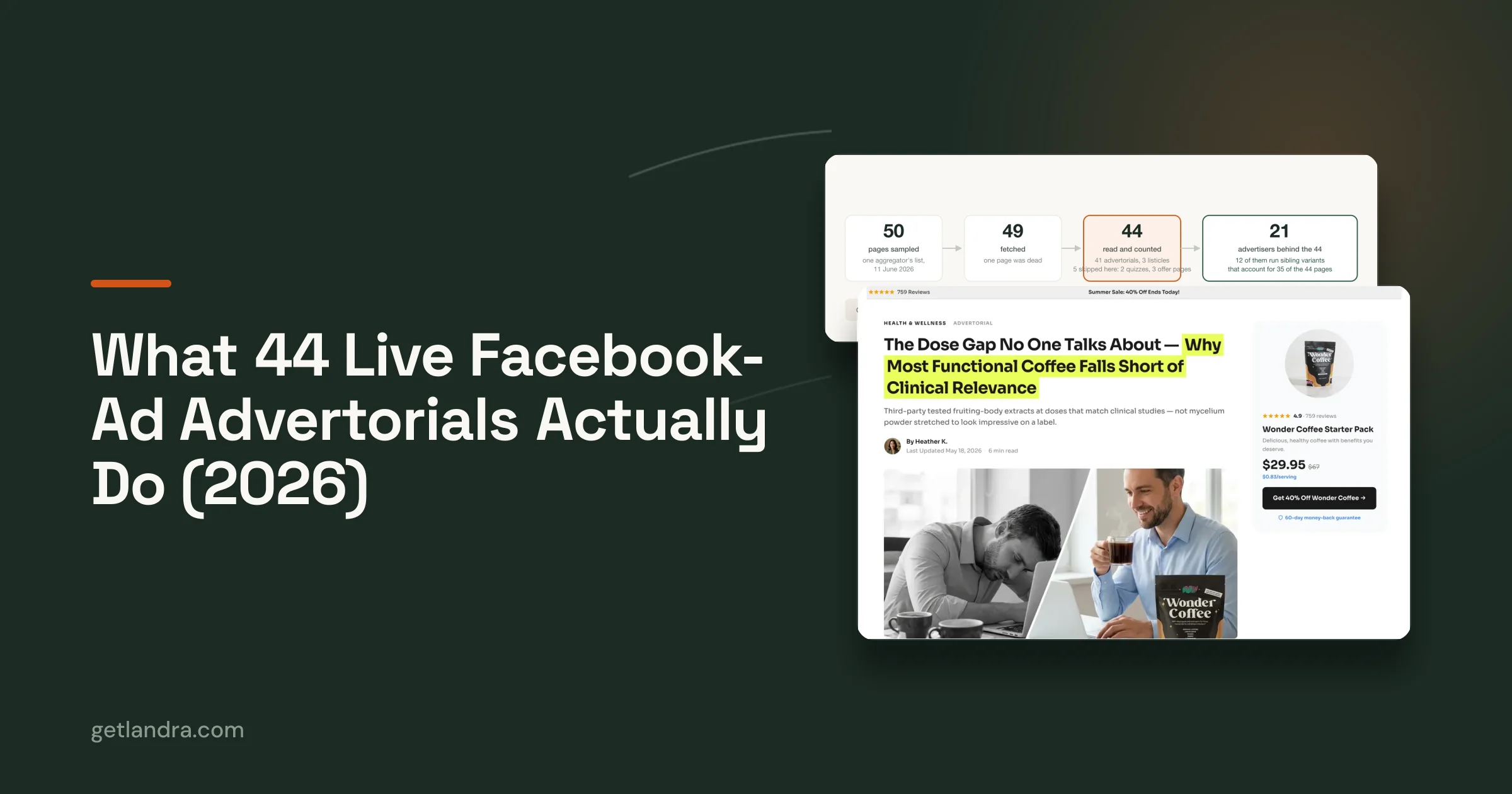
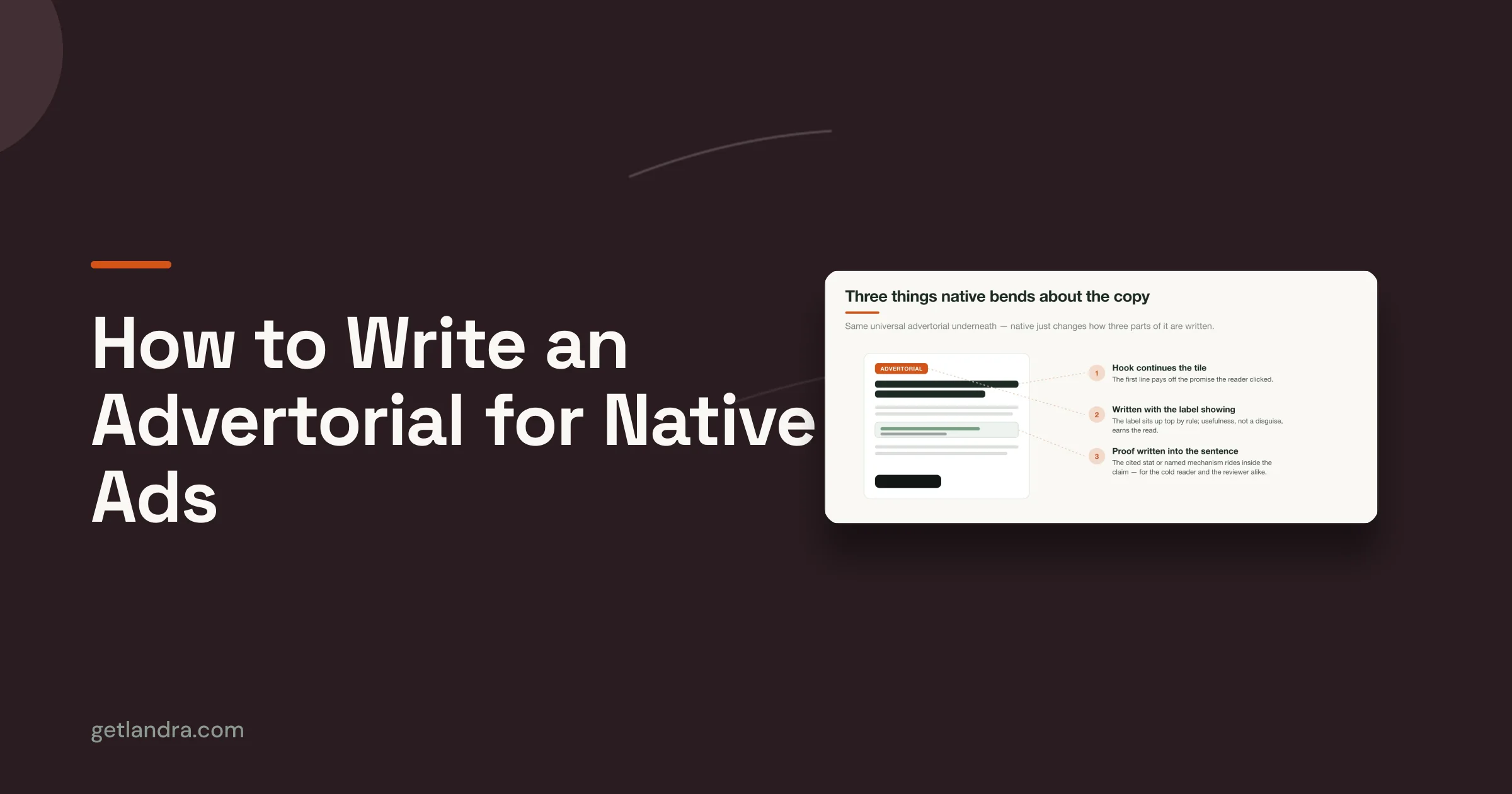
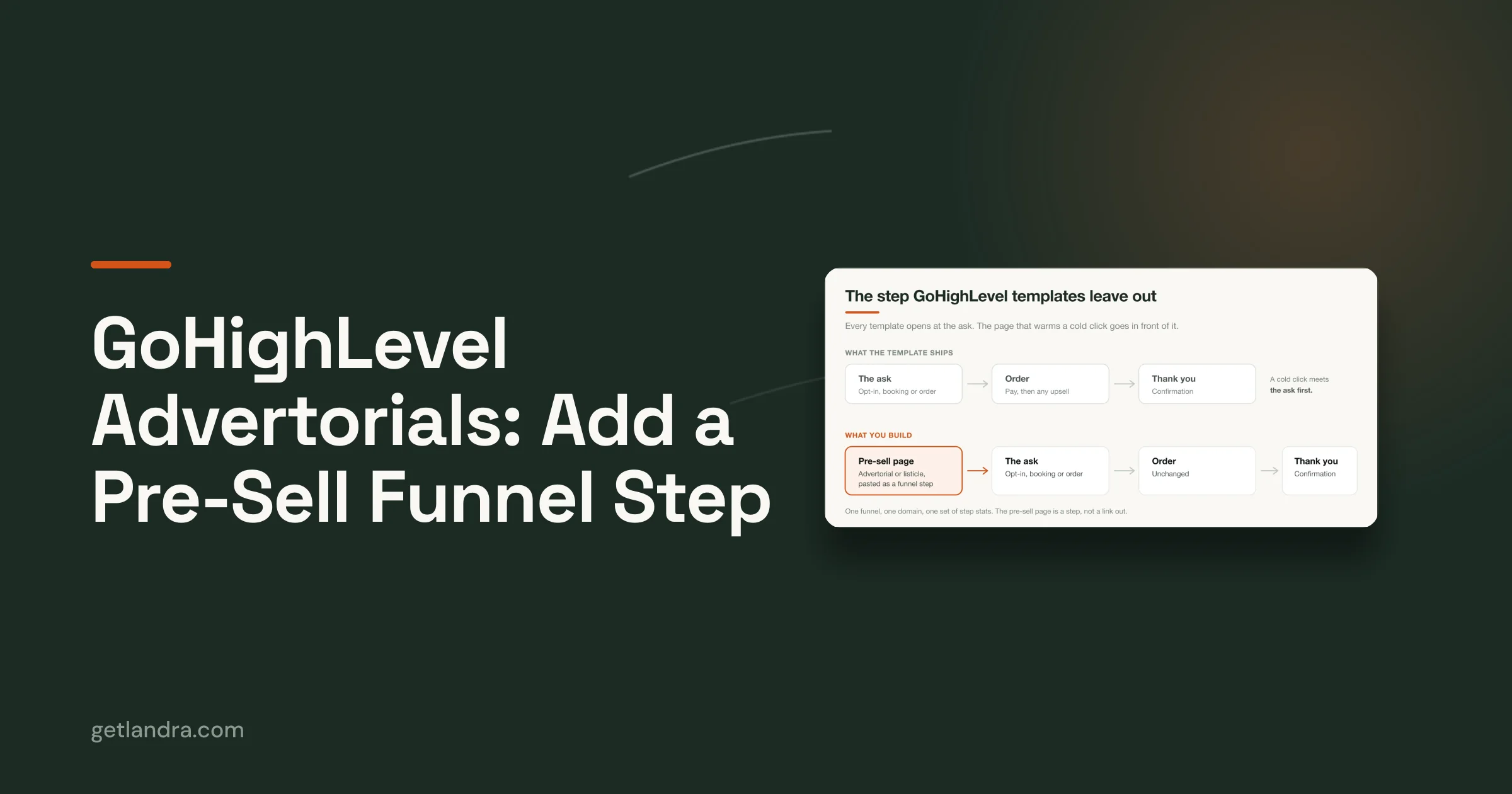
A pre-sell page works when the visitor needs context. It can explain the problem, introduce a mechanism, compare approaches, present evidence, and then transition to the product. An advertorial gives the story an editorial structure. A listicle organizes the decision around several reasons, use cases, or mistakes to avoid.
The common objection is that extra content creates friction. Sometimes it does. But removing every step from a cold journey can create a different problem, the visitor reaches checkout without enough confidence. That's curated friction, not clutter. The page adds only the information needed to move someone from curiosity to informed action.
Choose the route by awareness level
Use a direct PDP when:
- The ad names the product clearly.
- The visitor is searching for a known solution.
- The price and category involve little explanation.
- Reviews and practical details resolve the main objections.
Test a pre-sell page when:
- The ad leads with a problem or frustration.
- The product category is unfamiliar.
- The product needs demonstrations or education.
- The purchase carries meaningful perceived risk.
- Cold traffic clicks but doesn't progress on the PDP.
For a problem-led ad, the page opening should continue the same conversation. Don't move from “why your current routine may be failing” to a generic product headline. Repeat the central concern in plain language, then earn the transition to the offer through explanation and proof.
High-consideration products benefit from narrative sequencing. Start with the reader's situation, identify the cost of the problem, explain what alternatives miss, and introduce the product as a logical response. Keep claims supportable, show evidence close to the relevant assertion, and avoid turning the page into a disguised exaggeration.
Creative consistency matters across formats. A video ad that demonstrates a product should lead to a page where that demonstration is easy to find. A testimonial ad should lead to proof, not a hero banner that forces the visitor to search. Teams working on video acquisition should also consider thumbnail and analytics optimization, since the pre-click packaging and post-click experience need to form one coherent path.
Testing should isolate the routing decision. Keep the audience, offer, and ad angle stable, then compare PDP traffic with a relevant advertorial or listicle. Record the page type in UTMs and analytics so the result doesn't disappear inside an all-traffic report. Building an advertorial with AI can shorten the production cycle when the team needs several editorial angles, but human review still has to verify claims, tone, compliance, and offer accuracy.
Landra is one option for this workflow. It generates editable, mobile-first advertorial, listicle, and pre-sell pages from a product or brand URL, with publishing options for Shopify, Webflow, a hosted URL, or HTML export. The important point isn't the tool itself. It's the ability to create controlled page variants quickly enough to test the handoff rather than assuming the PDP is always the right destination.
Measuring What Matters in a Privacy-First Era
A landing-page test is only as useful as its measurement. If the ad platform records a purchase inconsistently, fails to capture consented events, or receives only shallow engagement signals, automated bidding may select for the wrong audience even when the page is improving the customer journey.
Build measurement from the business outcome backward. Define the primary event first, then map the supporting events that explain movement toward it. For ecommerce, that may include product view, add to cart, checkout, purchase, refund, and repeat purchase. For lead generation, a form submission isn't enough if only a portion of submissions become qualified opportunities.
Create a reliable first-party signal path
Use consistent UTMs for campaign, ad group, creative, audience, and page variant. Pass those values into analytics and, where appropriate, your store or CRM. A pre-sell page should not appear as anonymous traffic that later gets credited to the product page without preserving the original source and variant.
Enhanced conversions, server-side tracking, and consent-aware measurement can help recover signal quality where browser-based tracking is incomplete. They don't eliminate the need for governance. Confirm that events are deduplicated, consent rules are respected, and revenue values match the store or CRM rather than accepting the ad platform's report without validation.
Last-click attribution is easy to read but often too narrow for a cold-traffic journey. In-platform ROAS can also overstate the value of a channel when multiple platforms claim the same customer. Compare platform reporting with an internal view that includes gross margin, refunds, new-customer revenue, and repeat behavior.
Use page variants as explicit dimensions in reporting. Ask:
- Does the pre-sell route change conversion rate?
- Does it change CPA without harming order value?
- Does it produce better new-customer quality?
- Does it shift more conversions into view-through or assisted paths?
- Does the result hold after excluding obvious tracking anomalies?
The goal isn't to force every decision into one attribution model. It's to make the uncertainty visible. Automated bidding needs timely conversion data, while finance needs a broader view of profitable customer acquisition. Those requirements can coexist when the team labels events clearly and reconciles ad data against first-party records.
The most valuable signal is not always the earliest conversion. A completed purchase, a qualified lead, or a customer who remains profitable tells you more than a page view. Feed the platform the deepest reliable event available, then use softer events for diagnosis rather than as the main optimization target.
Troubleshooting Common PPC Leaks and Quick Wins
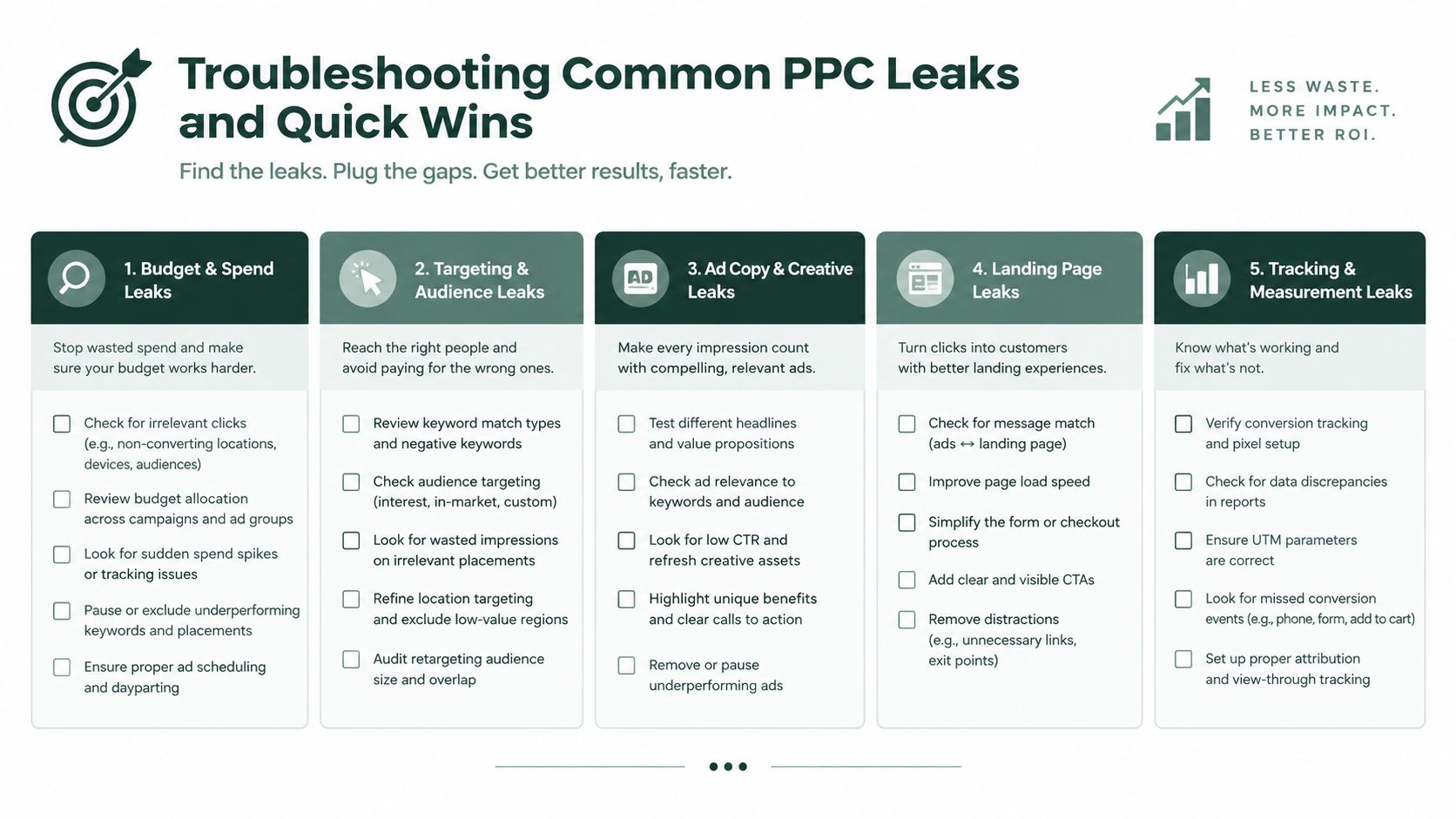
Most PPC leaks are diagnosable. The account may have a bidding issue, but it may also have a broken handoff, poor query quality, weak creative rotation, or a conversion event that rewards the wrong behavior. Work through the journey in order, from impression to revenue.
Start with the query and creative
Open the search-term report and classify queries by intent. Add negatives for terms that clearly cannot produce a useful customer, but don't block ambiguous queries before checking their actual conversion and revenue behavior. For social campaigns, review the first seconds of the creative, the opening claim, and whether the visual makes the product's use obvious without sound.
Then compare the ad with the landing-page opening. The ad headline, primary visual, page headline, and first CTA should feel like one continuous message. A click-through rate above your account norm won't help if the page creates an immediate mismatch.
Inspect the page on a real phone
Don't rely only on desktop previews. Load the page on a mobile device and check the first interaction, image behavior, sticky elements, form fields, checkout transition, and consent experience. Remove distractions that don't support the campaign objective, but keep the proof and explanation that cold visitors need.
Use this diagnostic sequence:
- Message match: Does the page fulfill the exact promise made by the ad?
- Page format: Is a PDP appropriate, or does the audience need a pre-sell explanation?
- Proof placement: Can visitors find reviews, demonstrations, guarantees, or evidence near the decision point?
- CTA clarity: Is there one dominant next action, or does navigation scatter attention?
- Technical reliability: Do analytics events fire once, with the correct value and page-variant data?
- Offer consistency: Do price, shipping, discount, subscription terms, and inventory match the ad?
Revive stalled campaigns methodically
Refresh the creative when the audience has seen the same angle repeatedly, but don't change every variable at once. Create a new opening around a different customer problem, objection, demonstration, or proof point. Keep the destination aligned with that angle so the test measures the creative and page combination rather than producing another ambiguous result.
If clicks remain healthy but purchases are weak, test the page route before changing bids. Compare the PDP with a problem-led listicle or advertorial, especially for cold social traffic and products requiring explanation. If purchases are present but quality is poor, replace the shallow conversion signal with a deeper event or import qualified customer outcomes from your CRM.
If performance drops suddenly, check operational causes first:
- Tracking changes: Confirm that tags, consent behavior, deduplication, and purchase values still work.
- Feed errors: Verify product availability, prices, images, and disapprovals.
- Audience overlap: Look for competing campaigns bidding against the same people.
- Budget pressure: Check whether a target is restricting delivery or a campaign is losing eligible traffic.
- Offer changes: Confirm that the page still reflects the promotion and fulfillment promise.
Optimization should produce a learning record. Log the hypothesis, audience, ad, page, event, dates, and decision rule. Over time, that record becomes more valuable than a pile of disconnected bid edits because it tells you which signals consistently attract profitable customers.
Landra helps DTC teams generate editable advertorial, listicle, and pre-sell pages that sit between paid traffic and the product page, with publishing options for Shopify, Webflow, hosted URLs, and HTML. If your campaigns are getting clicks but the post-click journey is leaking conversions, visit Landra to create a message-matched page variant and test the route with your existing ads.