

Most Google Ads vs Facebook Ads comparisons start with the wrong question: which platform is cheaper or converts better? That framing pushes marketers toward a false winner and hides the decision that controls profitability. Google captures people who already express demand. Facebook, now part of Meta, creates attention and demand before a buyer searches. The landing page between the ad and the checkout then determines whether that traffic has a chance to convert.
In 2026, the platforms are too large to dismiss. Meta is forecast to generate $243.46 billion in worldwide net ad revenue, compared with $239.54 billion for Google, with projected global digital ad shares of 26.8% and 26.4%, respectively, according to Marketing Dive's coverage of the eMarketer forecast. The practical lesson isn't that Meta has replaced Google. It's that both ecosystems deserve a job matched to their strengths.
| Funnel question | Google Ads | Facebook and Instagram Ads |
|---|---|---|
| What does the platform primarily capture? | Existing search and shopping demand | Discovery, interest, and social attention |
| Core intent signal | Query, product search, or commercial behavior | Person-level behavior, engagement, and audience signals |
| Strongest funnel role | Bottom-funnel demand capture | Awareness, prospecting, creative testing, and retargeting |
| Typical offer requirement | Specific, relevant, immediately useful | Educational, visual, trust-building, and emotionally engaging |
| Best post-click destination | Product, collection, or query-matched page | Pre-sell, advertorial, or message-matched landing page |
| Main measurement risk | Over-crediting active search intent | Over-crediting clicks and ad views |
The rest of this guide treats the channels as complementary buying systems, not interchangeable traffic sources. If you're also evaluating the wider Shopify stack, you can browse marketing apps for Shopify to see which supporting tools fit around acquisition, conversion, and retention.
Table of Contents
- Stop Asking Which Platform Wins
- How Each Platform Matches Ads to Buyer Intent
- Criteria-by-Criteria Comparison of Google Ads and Facebook Ads
- What 2026 Benchmarks Say About Cost and Conversion
- Attribution, Incrementality and the True ROAS Question
- Why the Post-Click Page Decides the Winner
- Choosing the Right Channel Mix for Your DTC Brand
Stop Asking Which Platform Wins
The platform that wins the auction can still lose the business. A cheap click from someone who was casually scrolling isn't equivalent to a costly click from someone comparing products with a wallet open. Likewise, a Google conversion may reflect demand your brand created elsewhere, while a Meta conversion may include a buyer who would have returned through search or direct traffic anyway.
That's why forcing Google and Meta into a single ranking creates three predictable mistakes:
- Budget gets judged by the wrong metric. A lower CPC looks attractive until the visitor needs education, comparison, and repeated exposure before buying.
- Creative gets mismatched to intent. A product-page ad can work for a specific Google query but feel abrupt in a social feed where the audience didn't ask for the product.
- Attribution gets mistaken for causation. Each platform can report credit for a sale that involved multiple touchpoints.

Use intent and discovery as the operating model
Google is a demand-capture system. Someone searches for a product, category, problem, or brand, and your ad competes for that expressed interest. Meta is a discovery system. The platform finds people whose behavior suggests they might respond to an offer, then uses creative and engagement signals to create the next step.
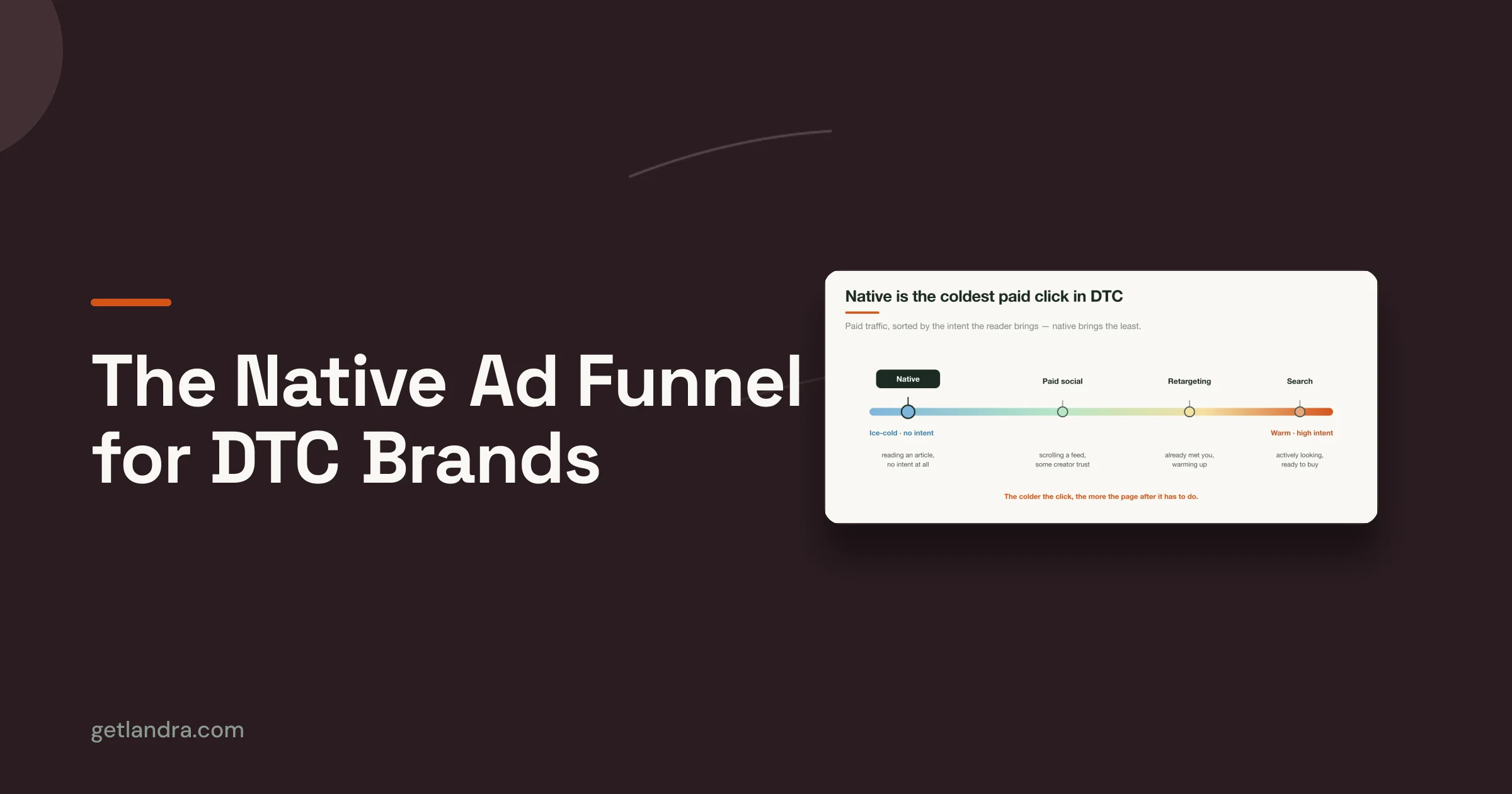
That distinction changes the question from “Which channel is better?” to “Where is this buyer in the decision process?” Google usually deserves priority when the product has clear search demand and the query reveals urgency. Meta usually deserves priority when the product needs demonstration, visual proof, lifestyle context, or a persuasive introduction.
Practical rule: Assign every campaign a funnel job before you assign it a budget. If the job is capture, start with Google. If the job is discovery, start with Meta.
The post-click experience is the hidden third variable. A strong Meta ad can generate inexpensive traffic, but a generic product page may ask a cold visitor to understand the problem, trust the brand, and justify the purchase without enough context. A well-matched pre-sell page can turn that same visit into a considered buying journey. The channel didn't change. The route did.
How Each Platform Matches Ads to Buyer Intent
Google and Meta don't identify opportunity in the same way. Google starts with what a person is doing now. Meta starts with what the platform knows about a person's behavior and likely interests.
Google reads the query
Search campaigns enter auctions connected to live queries. Shopping campaigns use product information and commercial context, while Performance Max can distribute across Google inventory using conversion goals, creative assets, audience signals, and machine learning. Audience inputs can refine delivery, but the central advantage remains the buyer's active request.
A search for a named product or a problem with a clear solution gives the ad a natural opening. The copy can answer the query directly, and the landing page can continue the same conversation. That's why learning how paid search advertising works matters before treating Google as just another source of clicks.
Meta reads the person
Meta's Advantage+ audience systems, broad targeting, lookalikes, and engagement signals help the platform find likely responders without requiring a buyer to search for the product. The advertiser supplies the offer, creative, conversion event, and customer data. Meta then uses on-platform behavior and delivery feedback to expand toward people who appear likely to engage or convert.
That structure gives Meta more room to introduce unfamiliar products, but it places a larger burden on the ad and landing page. The visitor may not understand the category, recognize the brand, or believe the claim yet. Education and proof need to arrive before the checkout request.
| Signal type | Google Ads | Facebook and Meta Ads |
|---|---|---|
| Immediate intent | Search query and commercial wording | Feed behavior and engagement patterns |
| Product context | Search, Shopping, and product information | Creative, catalog data, and observed interests |
| Audience refinement | Demographic, in-market, remarketing, and customer signals | Advantage+ expansion, broad audiences, lookalikes, and custom audiences |
| Creative role | Clarifies relevance to an existing need | Creates attention and develops the need |
| Strong offer style | Specific, direct, and query-matched | Demonstrative, educational, visual, and proof-led |
| Optimization feedback | Search, click, conversion, and value signals | Engagement, click, view, conversion, and audience signals |
For teams producing many visual variations, an AI-powered ad creation platform can support the creative testing burden that Meta creates. It doesn't remove the need for a clear offer or accurate measurement, but it can make discovery-focused iteration more practical.
The reusable mental model is simple: Google reads the query, Meta reads the person. Google is usually more forgiving when the product already matches a known demand. Meta rewards advertisers who can earn attention, explain the product quickly, and make the next click feel worthwhile.
Criteria-by-Criteria Comparison of Google Ads and Facebook Ads
A useful comparison starts with the work each platform assigns to the team. Google captures demand that already has language. Meta creates demand through creative. The landing page then decides whether either source produces profitable customers.
Targeting and audience control
Google's strongest targeting mechanism is intent. Keyword selection, search themes, Shopping context, and query relevance place an ad near an active need. Demographic and audience signals add context, but they do not replace a buyer stating what they want.
Meta builds audiences around discovery. Broad delivery, Advantage+ expansion, lookalikes, custom audiences, and engagement behavior help advertisers reach people who resemble existing customers or respond to a creative angle. That makes Meta useful for products without obvious category searches. It also puts more pressure on the ad to explain the problem, product, and reason to act.
The practical split is clear. Use Google to capture known demand. Use Meta to create interest where the buyer may not yet be searching.
Creative formats and testing
Meta leads on creative range. Feeds, Stories, Reels, carousels, images, and video support demonstrations, testimonials, comparisons, founder stories, and problem-focused hooks. The cost is creative fatigue. Media buyers need a steady supply of meaningful angles, not minor color changes that leave the message unchanged.
Google Search is more text-constrained, though Shopping, YouTube, and Performance Max add visual formats. Search's restraint can still work in its favor. The ad maps tightly to the query, and the landing page can continue that promise without asking the buyer to decode an unfamiliar category. Shopping and video expand the format mix, while Search remains the clearest lower-funnel instrument.
Bidding, inventory, and cost structure
Google's inventory covers Search, Shopping, YouTube, Display, apps, Gmail, and Performance Max placements. Meta reaches users across Facebook, Instagram, Messenger, Reels, Stories, and related placements. Both platforms offer scale. The constraint is whether the campaign turns that inventory into customers who support margin.
A 2026 benchmark summary reports Google Search at $5.42 CPC, compared with $0.70 for Facebook traffic campaigns and $1.92 for Facebook lead campaigns. It also reports a 6.66% Google Search CTR, a 7.52% Google conversion rate, 1.71% CTR for Facebook traffic campaigns, and 2.59% CTR for Facebook lead campaigns. These figures come from Whatagraph's PPC benchmarks.
Meta's lower CPC helps with reach and testing. It does not prove a lower acquisition cost. Cheaper clicks often carry less purchase intent, so the post-click page must do more work through education, proof, and a focused offer.
Measurement and optimization
Google and Meta both provide conversion tracking, automated bidding, audience tools, and modeled reporting. Their dashboards do not follow identical attribution rules. Google has traditionally centered reporting on last-click or data-driven approaches tied to search activity, while Meta can include click-through and view-through credit, as discussed in this attribution comparison.
| Criteria | Google Ads | Facebook and Meta Ads |
|---|---|---|
| Structural advantage | Capturing declared demand | Creating and nurturing interest |
| Targeting depth | Query-led and commercially precise | Behavior-led and audience-expansive |
| Creative range | Text-constrained in Search, visual in Shopping, YouTube, and Performance Max | Strong across visual and social placements |
| Typical buying challenge | Managing query quality and relevance | Preventing creative fatigue and weak click quality |
| Best test variable | Query, offer, landing-page relevance | Hook, format, proof, audience, and pre-sell flow |
| Main reporting caution | Search may receive credit for demand created elsewhere | View-through and click windows may overstate causal impact |
The winning setup is not the one with the lowest displayed CPC. It is the one where intent, creative, landing page, and measurement model agree.
What 2026 Benchmarks Say About Cost and Conversion
Benchmark numbers are useful only when they change a decision. For a DTC operator, the important distinction is between paying for attention and paying for a buyer who can support margin.
One 2026 benchmark summary reports Google Search at 6.66% CTR, $5.42 CPC, and 7.52% conversion rate across industries. In the same source, Facebook traffic campaigns show 1.71% CTR and $0.70 CPC, while Facebook lead campaigns show 2.59% CTR and $1.92 CPC. Those numbers describe different campaign objectives, so they shouldn't be treated as a clean ecommerce head-to-head. They do show the core tradeoff: Meta can buy visits more cheaply, while Google Search generally brings stronger intent.
A separate benchmark summary cited by Shopify reports 7.52% average Google Ads conversion rate versus 7.72% for Facebook Ads, with $5.26 Google CPC versus $1.72 Facebook CPC, and 6.66% Google CTR versus 0.9% Facebook CTR. The small conversion-rate difference in that benchmark doesn't erase the strategic distinction. Meta can perform strongly when the page and offer make form capture fast, while Search still benefits from a buyer actively looking for a solution. See how listicles boost conversions when deciding whether cold social visitors need more context before a product page.
| Metric | Google Search | Google Performance Max | Facebook and Instagram |
|---|---|---|---|
| CPC | $5.42 | Not provided in the verified benchmark | $0.70 traffic campaigns, $1.92 lead campaigns |
| CTR | 6.66% | Not provided in the verified benchmark | 1.71% traffic campaigns, 2.59% lead campaigns |
| Conversion rate | 7.52% | Not provided in the verified benchmark | 7.72% in Shopify's cited benchmark, objective-dependent |
| Primary interpretation | High-intent demand capture | Automated cross-property delivery | Lower-cost discovery and lead generation |
The right break-even calculation is straightforward:
Break-even CPA = contribution margin per order.
Then compare each platform's actual blended CPA against that ceiling, not against its CPC. If a product contributes $30 after product cost, shipping, payment fees, returns, and fulfillment, an acquisition cost above $30 loses money before overhead. If a Meta campaign produces cheap clicks but only a small share reaches checkout or completes payment, its displayed CPC advantage has no economic value.
Run the math by funnel stage:
- Estimate contribution margin. Use the money left after variable order costs, not revenue.
- Set the maximum allowable CPA. Include the acceptable profit buffer rather than assuming break-even is the target.
- Measure post-click conversion. Separate landing-page visits, product views, add-to-cart events, checkout starts, and purchases.
- Compare new-customer economics. Returning customers and branded searches can make a channel look healthier than its prospecting traffic really is.
A cheaper click is only cheaper if it produces a customer at a lower cost under the same attribution and margin rules.
Meta should usually receive the first test when the product depends on discovery and visual explanation. Google should usually receive the first test when buyers search for the category or product with clear commercial language. Don't scale either channel until the conversion path, not just the ad manager, produces acceptable economics.
Attribution, Incrementality and the True ROAS Question
Platform-reported ROAS is an optimization signal, not proof that an ad caused a sale. Meta may credit a purchase after a click or view, while Google claims the same order after a later search interaction. Add both dashboard figures together and you overstate performance.
Privacy changes have made customer journeys harder to observe, while server-side tracking has improved event transmission. Better tracking helps platforms optimize, but it does not establish incrementality. A conversion can be measured accurately and still be incorrectly attributed.

Read dashboards with a measurement hierarchy
Use platform reporting for operational choices, including creative rotation, bid changes, audience exclusions, and budget pacing. Use blended reporting to judge financial performance. Tools covering multi-platform ad performance can consolidate evidence, but they cannot answer the causal question alone: would the customer have purchased without the ad?
A practical quarterly test can remain focused:
- Choose comparable regions. Hold out, or reduce exposure in, a defined geographic group while normal activity continues elsewhere.
- Keep the offer stable. Avoid changing pricing, landing pages, and media pressure during the same test.
- Compare incremental outcomes. Review new customers, revenue, and contribution margin across exposed and control areas.
- Repeat the test. Smaller brands can see noisy results, so repeat testing before making a permanent budget change.
Measurement rule: Use reported ROAS for in-platform optimization. Do not use it alone to set total channel investment when Google and Meta influence the same customer journey.
Track spend, new-customer revenue, contribution margin, blended CPA, branded search behavior, and direct traffic beside platform conversions. Landra's DTC ad playbook offers a framework for connecting these measures to the funnel instead of treating CTR as a business result.
The last-touch channel gets credit for the order. The stronger channel is the one that increases purchases against a credible control. That distinction decides whether a lower-funnel Google conversion or a discovery-focused Meta campaign deserves more budget.
Why the Post-Click Page Decides the Winner
The landing page is the variable most Google Ads vs Facebook Ads comparisons leave out. That omission is expensive because the two channels deliver visitors with different levels of awareness.
A Google visitor often arrives after typing a specific query. A product page or collection page that mirrors that query can move directly into features, price, availability, proof, and checkout. A cold Meta visitor arrives in a feed interruption. They may like the problem the ad describes without yet believing that your product is the right answer.

Match the page to the visitor's awareness
Sending cold social traffic straight to a conventional product detail page often creates a context gap. The page may open with a product name, technical features, and a buy button, while the visitor still needs answers to more basic questions:
- Why does this problem matter?
- Why should I believe this solution?
- How does it work in real life?
- What makes this product different?
- What evidence reduces the perceived risk?
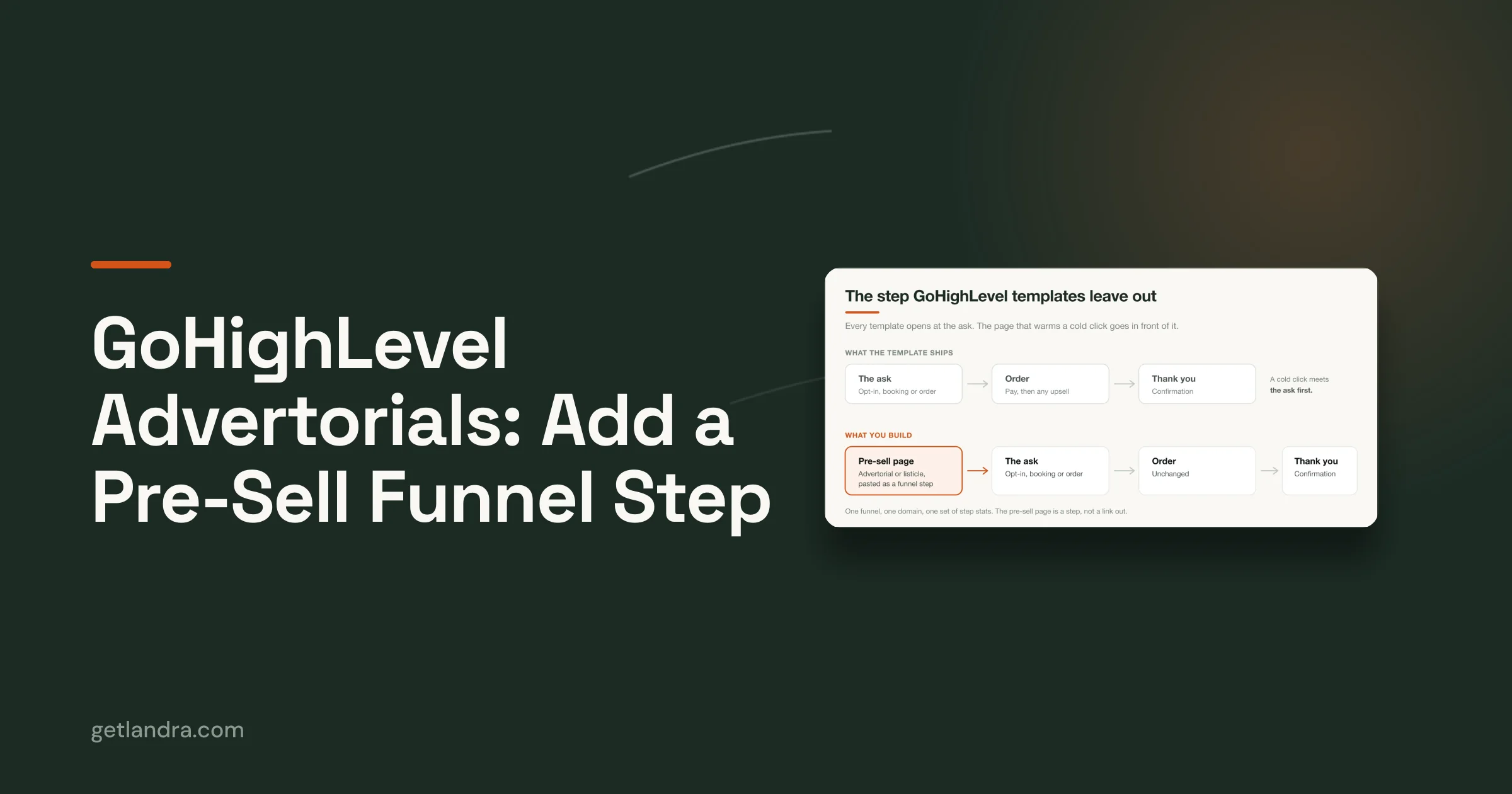
An advertorial or listicle can handle that education before the visitor reaches the product page. It can connect the ad's hook to a recognizable problem, introduce the product as a solution, present proof, and preserve a clear route to checkout.
Apply a simple routing rule
Use Google Search traffic on the page that best fulfills the query. That might be a product page for a named product, a collection page for a category, or a focused service page for a specific need. Remove irrelevant navigation and make the first screen confirm that the visitor landed in the right place.
Use Meta prospecting traffic on a pre-sell page when the product needs explanation or trust-building. The ad should promise the same angle the page develops. A creative about a daily discomfort shouldn't land on a generic catalog page. It should land on content that explains the discomfort, presents the relevant mechanism, and makes the offer feel like a logical next step.
Landra can generate advertorial and listicle pre-sell pages from a product or brand URL, with editing and publishing options for ecommerce teams. Treat that type of tool as part of the acquisition system, not as a cosmetic landing-page upgrade. The page is where cheaper discovery traffic either earns its cost or exposes it.
Choosing the Right Channel Mix for Your DTC Brand
Start with product behavior, not platform loyalty. Ask whether buyers search for the product by name, whether the category needs demonstration, how quickly customers decide, and how much contribution margin remains after fulfillment and returns.
The table below gives a starting direction. The percentages are recommended planning ranges, not verified market benchmarks. Adjust them after your own blended CPA and incrementality evidence.
| AOV bracket | Category example | Google Ads % | Facebook Ads % | Notes |
|---|---|---|---|---|
| Lower | Food, replenishment, everyday home goods | 30% | 70% | Use Meta for discovery and creative testing, then build retargeting and branded search |
| Mid-range | Apparel, beauty, lifestyle products | 40% | 60% | Route cold traffic through a message-matched pre-sell experience |
| Higher | Specialty home, considered wellness, premium products | 60% | 40% | Use Google for active research and Meta for education, proof, and assisted demand |
| Search-led category | Named products, technical goods, problem-specific solutions | 70% | 30% | Capture high-intent queries first, then use Meta to expand demand |
| New category or novel offer | Products buyers may not search for directly | 30% | 70% | Prioritize explanation, demonstrations, and creative iteration |
These ranges reflect a practical distinction. Brands with short consideration cycles and visible branded or category search should weight more budget toward Google. New launches with little organic traction should usually give Meta more room to create awareness, test positioning, and build audiences.
Rebalance with three business signals
Repeat purchase cycle: Products bought frequently can tolerate more discovery spending because future orders may improve customer economics. Products bought rarely need stricter first-order margin discipline.
Average margin: Higher contribution margin gives both channels more room, but it doesn't excuse weak measurement. A large margin can hide an inefficient campaign until volume increases.
Search behavior: If buyers know the product category and use clear commercial queries, Google can capture existing demand. If they discover the product through lifestyle content, demonstrations, or social proof, Meta has the stronger opening.
Review the mix quarterly using a compact checklist:
- Profit: Is each channel below the allowable new-customer CPA?
- Intent: Are Google queries producing qualified demand rather than irrelevant clicks?
- Discovery: Are Meta creatives introducing a problem or benefit clearly enough?
- Page alignment: Does each ad lead to a page that matches its promise?
- Incrementality: Did a controlled test show additional purchases beyond platform claims?
- Capacity: Can the team produce enough fresh creative and landing-page variants?
- Scale: Is performance holding as spend expands, or is one platform reaching a ceiling?
Don't split spend evenly because symmetry feels fair. Give Google the job of harvesting demand, give Meta the job of creating and developing it, and use the post-click page to make each handoff credible.
Landra generates editable, mobile-first advertorials, listicles, and pre-sell pages from a product or brand URL, giving DTC teams a practical way to align cold Meta traffic with the right buying context. Visit Landra to build a page that supports your channel strategy instead of sending every visitor to the same product page.