

The biggest native advertising network isn't automatically the best choice for a DTC brand. A large inventory pool can deliver impressions and clicks, but it can't guarantee that visitors will understand the message, trust the page, or continue from an advertorial to a product detail page.
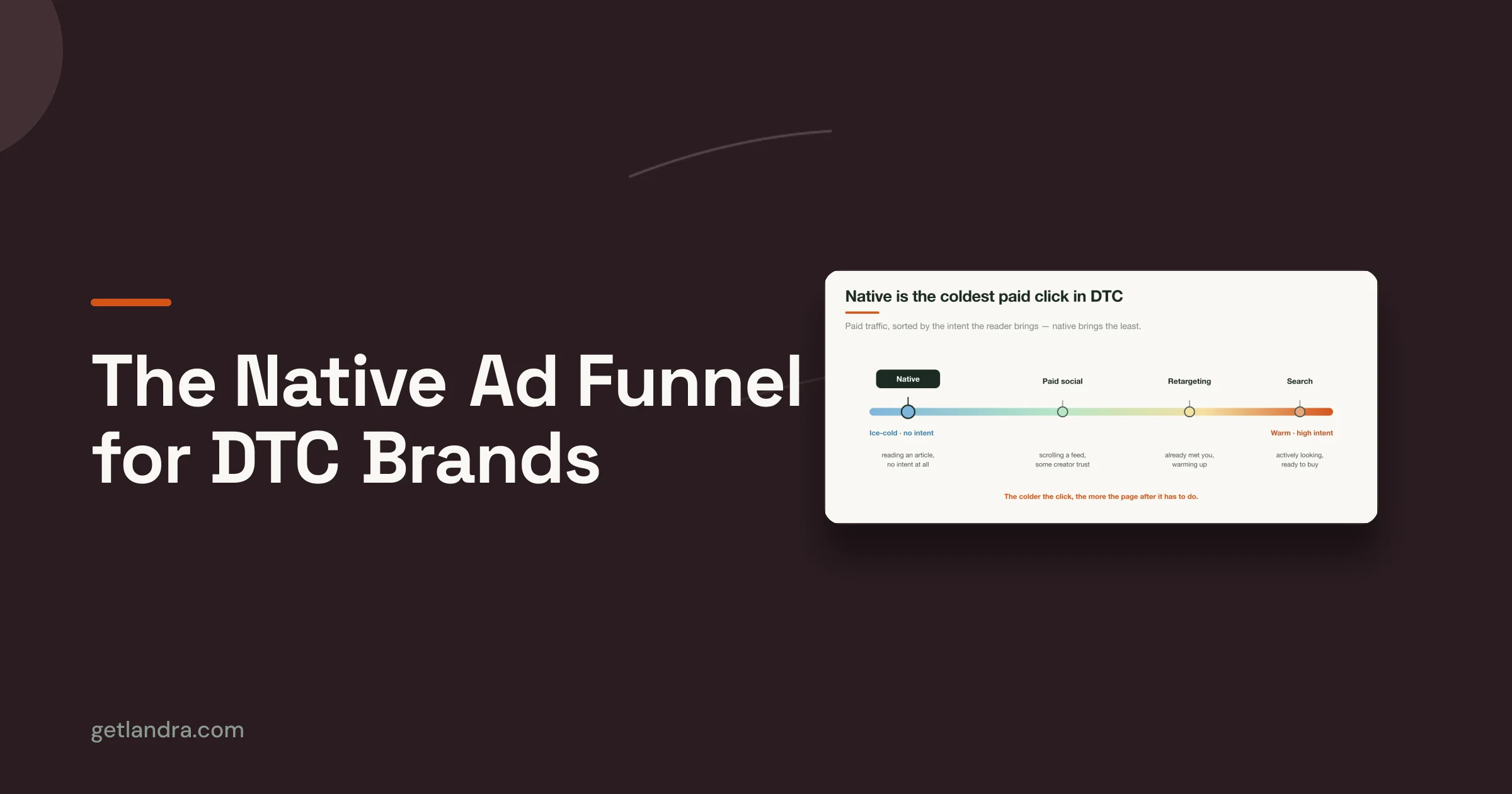
Native advertising platforms distribute ads designed to match the surrounding editorial or feed environment. For cold DTC traffic, that first click often works better when it leads to a relevant advertorial, listicle, or other pre-sell page instead of dropping visitors directly onto a product page built for shoppers who already know the brand. The right path depends on targeting control, traffic quality, buying complexity, placement management, and how naturally the platform supports the pre-sell experience.
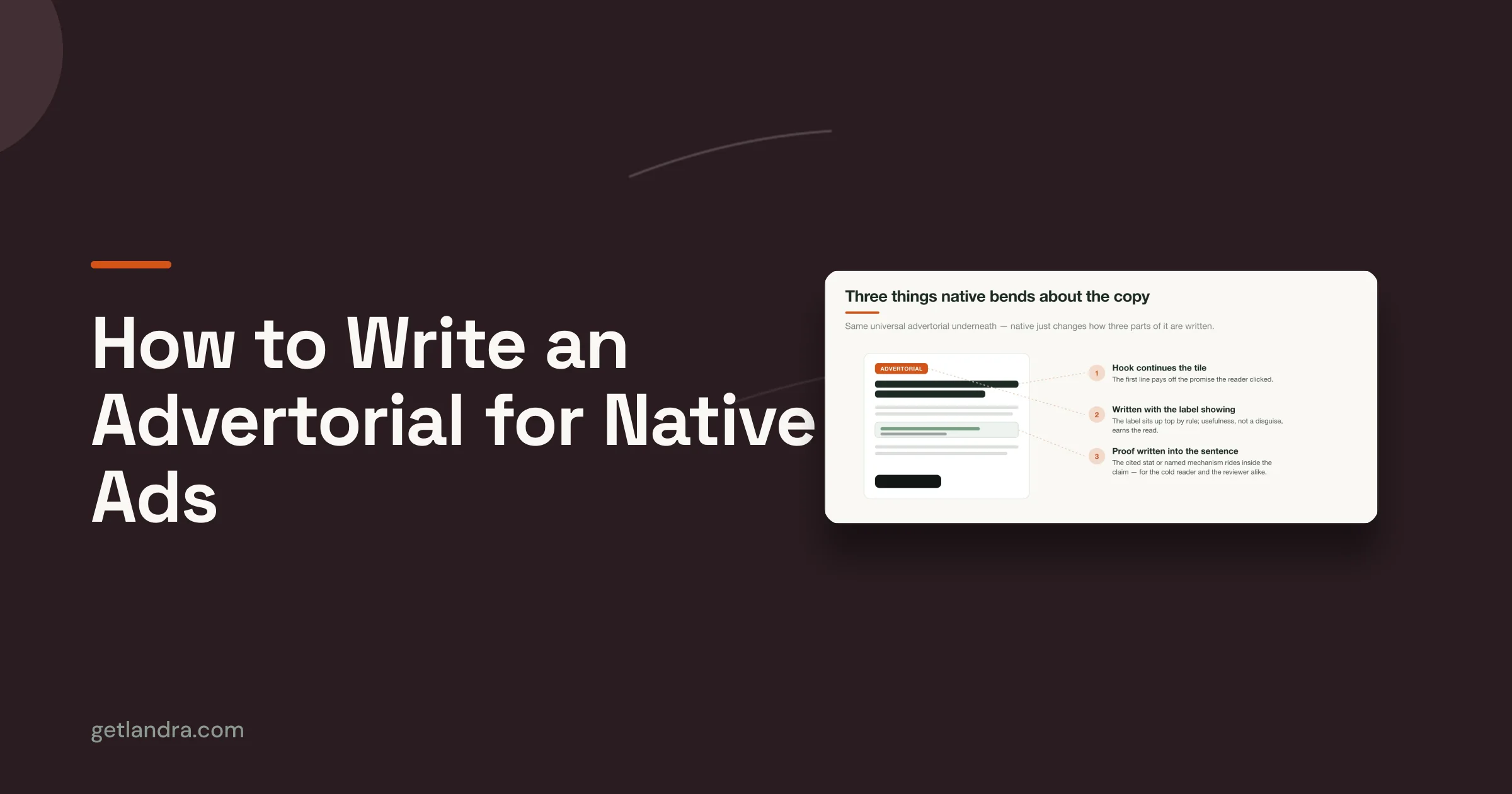
This list evaluates ten native advertising platforms through that full funnel. It also considers the implementation layer, because a campaign can have strong inventory and still underperform if the landing page fails to carry the ad's promise. For teams developing that bridge, AutoSEO content strategy offers useful context on building content around acquisition intent. Landra is relevant here as a publishing and implementation option, not as an advertising platform. It can turn a product URL into an editable, mobile-first advertorial or listicle that can be published through an existing commerce stack.
Table of Contents
- 1. Taboola Realize by Taboola
- 2. Outbrain
- 3. Yahoo DSP Native via Yahoo Advertising
- 4. MGID
- 5. Revcontent
- 6. Nativo
- 7. StackAdapt
- 8. TripleLift
- 9. Dianomi
- 10. Sharethrough STX Exchange
- Top 10 Native Ad Platforms Comparison
- Route the Click Before You Optimize the Campaign
1. Taboola Realize by Taboola
Taboola is a strong starting point when a DTC team needs substantial open-web native distribution and has the operational discipline to manage the resulting placement mix. Its Realize platform is positioned for performance advertisers, while the company's commercial relationship with Yahoo powers native advertising across Yahoo properties and other publisher environments. That combination makes Taboola useful for campaigns that need scale around an advertorial or listicle rather than a narrow, publisher-specific buy.
The platform's creative workflow matters for teams testing multiple hooks. Realize includes GenAI AdMaker capabilities intended to help advertisers create creative variants, while publisher, topic, and brand-safety controls help teams narrow where ads appear. The controls don't remove the need for active optimization. Native placements can vary substantially by publisher, app, device, and context, so a low-cost click shouldn't be treated as evidence of qualified demand.

Where Taboola fits the DTC funnel
Taboola's best strategic fit is a message-matched path from native unit to pre-sell page. The ad can introduce a problem or editorial angle, the advertorial can explain the category and product mechanism, and the product page can handle final evaluation. Teams should build exclusion lists and review publisher-level behavior before increasing spend.
Practical rule: Treat Taboola's reach as an opportunity to discover qualified placements, not as proof that every placement deserves more budget.
Creative iteration also needs structure. Test different angles, but keep the advertorial's opening aligned with the ad image and headline. Landra's Taboola creative best practices can support that alignment when the campaign requires a dedicated pre-sell page.
2. Outbrain
Outbrain suits advertisers that want native discovery campaigns with a clear direct-response path and access to a broader programmatic buying model. Its core experience places native units across publisher environments, while Outbrain DSP can extend campaigns into display and video inventory without abandoning native creative principles. That gives a DTC team room to compare native click paths with adjacent formats inside a more unified buying approach.
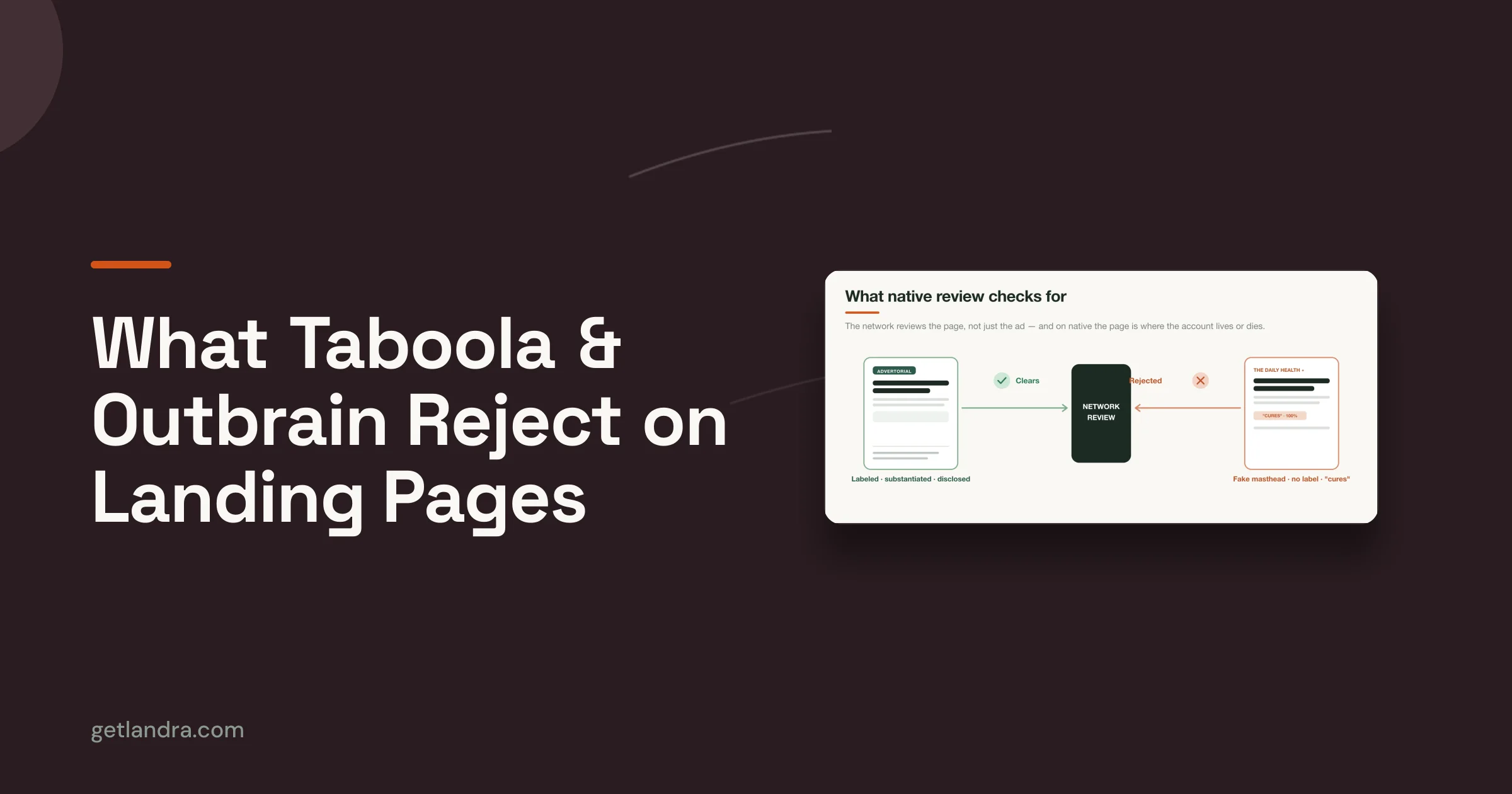
The platform also provides documentation and policy guidance for creative and landing-page requirements. That support is useful for advertorial campaigns because the pre-sell page must remain persuasive without becoming misleading or obscuring its commercial purpose. A page that looks editorial but fails to disclose its advertising relationship can create trust and compliance problems, especially when the visitor believes they're reading independent content.
The main trade-off
Outbrain can work well when the advertiser has a steady testing cadence. Creative fatigue can arrive quickly in discovery environments, and the same headline-image combination may lose efficiency before the underlying offer stops working. Refreshing the creative while preserving the strongest message match helps separate fatigue from a weak funnel.
A practical Outbrain workflow is to test one pre-sell concept with several creative angles, then compare not only click-through behavior but also engagement with the pre-sell and progression to the product page. Independent native benchmark reporting places standard content-recommendation widgets roughly around 0.05% to 0.3% CTR on desktop and 0.1% to 0.5% on mobile, with mid-article in-feed units generally outperforming below-article footers. Those ranges come from Open Ad Library's native CTR benchmark reporting, and they reinforce why placement-level analysis matters more than a network-wide average.
3. Yahoo DSP Native via Yahoo Advertising
Yahoo DSP is better suited to teams that want native buying inside a broader programmatic operation. Instead of treating native as an isolated channel, the platform lets advertisers manage native alongside display, video, and connected TV activity. That consolidation can simplify audience planning and reporting, but it also raises the technical bar compared with a focused self-serve native network.
Yahoo's owned-and-operated ecosystem provides native supply, while partner inventory expands the available buying environment. The platform also gives buyers access to Yahoo first-party audience data and publisher workflows such as Backstage. For a DTC brand, that can support prospecting and retargeting strategies that need more than contextual placement alone.
Who should use it
Yahoo DSP makes sense when the team already understands programmatic campaign setup, audience definitions, frequency management, deal structures, and reporting interpretation. It's less attractive as a first native test for a small team that wants to launch quickly without a specialist buyer.
One operational issue deserves attention. Some Yahoo native supply is also powered by Taboola, so teams using both platforms should coordinate campaigns and monitor overlap. Without that coordination, the advertiser may create unnecessary duplication, complicate attribution, or compare two buying paths that draw from related inventory.
The platform's AI and agent-oriented optimization direction may help simplify some decisions over time, but automation still depends on clean conversion signals and sensible controls. A DSP can optimize toward the event it receives. It can't repair a weak advertorial, a mismatched offer, or a product page that fails to answer the visitor's questions.
See Yahoo DSP's native advertising capabilities
4. MGID
MGID offers an accessible route into native performance campaigns, particularly for teams that want self-serve onboarding, contextual targeting, and quick testing. Its open-web network supports campaigns aimed at advertorials and listicles, while targeting options can include contextual, interest, and demographic signals. The platform's appeal is operational simplicity, but simplicity at launch doesn't eliminate the need for close traffic-quality management.
For smaller DTC teams, MGID can be useful because the campaign setup is less dependent on a full programmatic buying operation. Real-time reporting and flexible spend options make it easier to assess whether the creative angle and pre-sell concept deserve further testing. The resulting data should still be segmented by geography, device, publisher, and placement. A blended average can hide weak sources that consume budget without creating meaningful product interest.
Why context matters
Contextual targeting is especially useful when the product needs an explanation before the sale. A product tied to sleep, skincare, nutrition, or household problems may benefit from appearing beside content that already reflects the visitor's concern. That doesn't mean the surrounding article proves intent. It means the ad has a better chance of starting a relevant conversation.
MGID requires proactive placement curation because inventory quality can differ by geography and publisher. Teams should identify weak placements early, compare downstream behavior, and keep the pre-sell page honest about the product's role. For faster page production, an automated listicle creation workflow can help teams produce editable variants without treating generation as a substitute for review.
5. Revcontent
Revcontent is built around performance-oriented native distribution and a relatively direct testing experience. Its self-serve platform provides granular reporting, and the company positions its widgets as lightweight and ready for a cookieless environment. That positioning makes it relevant to DTC marketers looking for an open-web test that doesn't require a large enterprise media operation from the outset.
The platform's practical value depends on how carefully the advertiser manages supply. Open-web scale can include strong placements and low-quality sources in the same campaign, so site and app exclusions aren't an afterthought. They're part of the buying strategy. Revcontent's account support is oriented toward performance and return on ad spend workflows, which can help teams translate placement data into action rather than stopping at click volume.
A lower barrier still needs discipline
Revcontent may be appropriate when the team wants to validate a pre-sell concept before building a larger programmatic stack. The advertiser can begin with a narrow audience and a small set of message angles, then evaluate whether visitors continue through the advertorial and reach the product page with meaningful intent.
The key decision isn't whether a source generates cheap traffic. It's whether the source produces visitors who behave like potential buyers after the click. Exclude placements that generate shallow visits, misleading engagement, or a mismatch between the ad promise and the landing-page experience. Inventory quality can vary by market, so the first campaign should be treated as a controlled learning exercise.
6. Nativo
Nativo is a better fit for brands that view native as branded content rather than only as a click-out format. Its platform supports native display, video, and full native article experiences across publisher environments. That makes it useful when the campaign needs a longer editorial narrative, a hosted publisher experience, or measurement beyond the last click.
The “Native Article” approach can support advertorial storytelling inside a premium publication environment. For some products, that setting creates a more credible context than a generic recommendation widget. It also introduces more planning requirements. Premium inventory, custom formats, publisher coordination, and richer measurement can require more lead time and operational attention than a straightforward self-serve campaign.
Content quality becomes the buying constraint
Nativo's strategic fit depends on whether the brand has a story worth carrying through an editorial-style experience. A simple product offer may not justify a complex hosted article. A product that needs education, category framing, or a credibility-led explanation may benefit more from Nativo's format flexibility.
The team should define the intended post-click action before launch. Is the article designed to build awareness, increase consideration, move visitors to a product page, or support a broader media plan? Brand lift and intent measurements can complement click data, but they shouldn't replace a clear conversion path when the campaign has a direct-response objective.
For teams producing the content layer, Landra's AI advertorial tutorial describes an approach to creating a structured pre-sell draft that can then be edited for claims, tone, disclosure, and product accuracy.
7. StackAdapt
StackAdapt suits teams that want native inside a multi-format DSP with stronger control over audiences, data, and reporting. It supports programmatic native buying across exchanges and premium supply, alongside formats such as display, video, and connected TV. That makes it useful when the DTC marketer wants to compare native with other prospecting channels without separating every campaign into a different operating system.
The platform supports contextual, interest, lookalike, and retargeting approaches, plus data integrations that can help a team build more deliberate audience strategies. Those capabilities are valuable only when the advertiser can distinguish targeting precision from traffic quality. A narrowly defined audience can still receive weak inventory, and a broad contextual audience can still produce valuable visitors when the message and page fit the environment.
Control comes with setup work
StackAdapt requires more programmatic knowledge than a basic self-serve native network. The buyer needs to understand onboarding, audience construction, bid strategy, conversion tracking, supply selection, and possible platform or data costs. That extra effort can be justified for teams that expect to manage native as part of a wider media system.
A strong test would keep the pre-sell page constant while comparing contextual and audience-led approaches, or keep the audience constant while comparing two advertorial angles. Changing both at once makes the result harder to interpret. The next optimization decision should come from the weakest stage in the funnel, not from the metric that looks most attractive in the dashboard.
Explore StackAdapt native advertising
8. TripleLift
TripleLift is an exchange and supply-side platform with direct publisher relationships and a broad range of native and high-impact creative formats. Buyers can access its inventory through major DSPs, private marketplace deals, or TL Direct. That structure gives enterprise and agency teams more choice over how they obtain premium native supply, although it's less plug-and-play than a standalone self-serve network.
The platform's format range includes native video and other high-impact executions. This matters when the campaign needs to adapt the same core message to different content environments without making every unit look like a standard display ad. Publisher-level curation can also support brand-safety goals, but curated supply doesn't remove the need to judge whether the placement is useful for the particular DTC offer.
Choose access based on buying maturity
TL Direct may suit a team that wants curated access and support. DSP activation may make more sense when the buyer already has an established programmatic workflow and wants to compare TripleLift supply with other exchanges. The decision should reflect internal capability as much as inventory preference.
Premium placements may cost more than long-tail open-web supply, so the advertiser needs a matching funnel. A high-quality publisher environment can't compensate for a generic ad, a slow page, or a product claim that arrives without proof. Use the pre-sell page to preserve the context created by the placement, then judge performance at qualified engagement and purchase intent rather than at impression volume.
Explore the TripleLift platform
9. Dianomi
Dianomi specializes in finance, business, and luxury lifestyle environments, making it a targeted choice rather than a generalist native network. Its contextual and interest-based options can help products reach readers in high-affinity settings where credibility and tone matter. The platform works best when the DTC offer can make a convincing case to an audience that values expertise, financial confidence, professional identity, or premium positioning.
The publisher environment is also useful for pre-sell narratives that need a measured, expert voice. A dramatic headline that might attract attention elsewhere can feel out of place beside business or luxury content. Message fit therefore becomes part of traffic quality. The right visitor may be less interested in novelty and more interested in whether the product's mechanism, evidence, and value proposition hold together.
Specialized context versus broad scale
Dianomi's focused inventory can limit total reach compared with general native networks. That isn't necessarily a weakness. A narrower environment can be valuable when the product's buyer profile depends on context, especially for financial products, premium goods, or credibility-led categories.
The advertiser should build a pre-sell page that respects the audience's expectations. Lead with the problem and the decision criteria, explain the product without overstating the evidence, and make the transition to the product page explicit. Premium context can improve the quality of the conversation, but it doesn't guarantee conversion. The page still has to earn the next click.
10. Sharethrough STX Exchange
Sharethrough's STX Exchange provides a programmatic route to in-feed native inventory across site and app environments. Buyers generally access the supply through DSP integrations, private marketplace deals, or open-exchange setups. That makes Sharethrough more relevant to enterprise and agency buyers than to a small team seeking a simple native network with minimal trafficking work.
The platform emphasizes quality, viewability, contextual signals, pacing, and optimization resources. Those controls can help buyers avoid treating every impression as equivalent. A visible native unit in a relevant feed is a better starting point than an unseen or contextually disconnected placement, but visibility still only creates the chance for attention. It doesn't establish that the visitor is ready to buy.
A programmatic choice for mature teams
Sharethrough requires deal setup and trafficking familiarity. The team needs to understand how the PMP or open-exchange path affects supply, reporting, and optimization, then build a process for removing placements that fail downstream quality checks. This is a reasonable trade-off for buyers who already work through enterprise DSPs and want dependable premium supply.
A sensible test links the exchange data to on-site behavior. Track the ad interaction, pre-sell engagement, product-page arrival, and purchase event with consistent parameters. If the campaign produces strong visible delivery but weak progression after the click, the next move may be a placement exclusion or a revised page rather than a higher bid.
Explore Sharethrough's STX Exchange
Top 10 Native Ad Platforms Comparison
| Platform | Reach & Inventory | Target (👥) | Key strengths (🏆/✨) | Ease & Cost (💰) | Quality (★) |
|---|---|---|---|---|---|
| Taboola (Realize) | Massive open-web + Yahoo properties | 👥 DTC teams needing scale/native placements | 🏆 Massive reach; ✨ GenAI AdMaker; publisher controls | 💰 Scale-friendly; requires exclusions; enterprise pricing | ★★★★ |
| Outbrain | Large discovery feeds; native, video, carousel | 👥 Advertisers driving traffic to pre-sell pages | 🏆 Proven direct‑response; ✨ DSP option & strong docs | 💰 Flexible buying; needs active placement testing | ★★★★ |
| Yahoo DSP (Native) | Yahoo-owned + partner native supply via DSP | 👥 Teams wanting single DSP for native+channels | 🏆 Yahoo 1P data; ✨ integrated multi‑channel control | 💰 Programmatic setup & fees; higher complexity | ★★★★ |
| MGID | Open‑web network with contextual tools | 👥 Small teams/fast testers on modest budgets | 🏆 Quick start; ✨ contextual targeting for compliance | 💰 Low barrier; self‑serve & flexible spend | ★★★ |
| Revcontent | Performance native; cookieless-ready widgets | 👥 ROAS-focused advertisers testing pre-sells | 🏆 No minimums; ✨ account support for optimization | 💰 Low entry; needs proactive curation | ★★★ |
| Nativo | Premium publishers + "native article" units | 👥 Brands running long‑form on‑publisher advertorials | 🏆 Premium placements; ✨ brand‑lift & intent metrics | 💰 Premium budgets & longer lead times | ★★★★ |
| StackAdapt | Programmatic native across exchanges | 👥 Mid‑market teams managing multi‑channel DSPs | 🏆 Advanced targeting; ✨ strong usability & guides | 💰 DSP onboarding, platform fees, possible mins | ★★★★ |
| TripleLift | SSP/exchange with 90+ native formats | 👥 Buyers/agents needing high‑quality creative formats | 🏆 High‑quality supply; ✨ broad creative format set | 💰 Often requires DSP or TL Direct; premium cost | ★★★★ |
| Dianomi | Premium finance/business/luxury publishers | 👥 Finance/luxury DTC & credibility‑focused brands | 🏆 High‑affinity audiences; ✨ credibility/context boost | 💰 Niche scale; higher CPC/CPM | ★★★★ |
| Sharethrough (STX) | In‑feed native exchange; viewability focus | 👥 Programmatic buyers prioritizing viewability | 🏆 Quality‑screened supply; ✨ curated PMPs & viewability tools | 💰 DSP connection required; deal setup effort | ★★★★ |
Route the Click Before You Optimize the Campaign
The right native advertising platform depends on the job it needs to perform in the DTC funnel. Self-serve networks such as MGID and Revcontent are practical for fast testing, while Taboola and Outbrain suit brands that need broader native distribution and mature optimization workflows. DSPs such as Yahoo DSP and StackAdapt offer more cross-channel control, but they demand more programmatic knowledge. TripleLift and Sharethrough are stronger considerations for buyers seeking curated or premium supply through established DSP relationships. Dianomi fits audience-context needs, and Nativo fits campaigns where the branded-content experience is central.
The market itself supports treating native as a scaled media channel rather than a niche experiment. One independent estimate values native advertising at USD 105.88 billion in 2024 and projects USD 346.88 billion by 2033, with a 13.9% CAGR from 2025 to 2033. The same estimate reports that North America held 31.0% of regional revenue in 2024, closed platforms represented 55.6% of platform revenue, and in-feed native ads represented 42.7% of content-format revenue. Those figures come from Mordor Intelligence's native advertising market estimate. Scale is real, but scale still isn't performance proof.
Start by selecting one platform that matches both the audience and your team's operating capacity. Build a message-matched advertorial or listicle, publish it through the existing stack or a tool such as Landra, and use consistent tracking from the native unit through the pre-sell page and product page. Then exclude weak placements, compare traffic quality by source, and test creative angles before increasing delivery.
The measurement sequence matters. Don't optimize only to cheap clicks or a strong click-through rate. Compare whether visitors engage with the pre-sell, continue to the product page, and show qualified purchase intent. Native benchmark reporting indicates that mid-article and mobile placements can be more efficient than below-article inventory, but the advertiser still needs to validate the quality of those visitors in the actual funnel. The next optimization decision should target the weakest stage, whether that's creative relevance, placement quality, page speed, offer clarity, or checkout friction.
Compliance belongs in the same operating process. The FTC warns that native advertising can resemble news, feature articles, product reviews, and entertainment, and asks whether consumers can distinguish advertising from other content. The agency's online advertising and marketing guidance makes clear why disclosure and consumer recognition matter for advertorial-style campaigns. A pre-sell page should identify its commercial nature clearly, preserve an accurate relationship between ad and content, and avoid presenting marketing claims as independent reporting.
The wider regulatory environment adds further operational pressure. The Digital Services Act requires publicly accessible ad repositories for very large platforms, while the TTPA introduced labelling, funding disclosure, and targeting transparency requirements for political advertising from 10 October 2025, as summarized in the verified background for this analysis. DTC advertisers aren't political advertisers, but the direction is relevant. Buyers need stronger records of where ads run, how they're labelled, and what users are being asked to understand.
The right platform is the one whose inventory, controls, and buying model support the full route from native impression to qualified purchase intent. Choose the network or exchange that lets your team learn from that route, not merely the one that promises the largest audience.
Landra turns a product or brand URL into an editable, mobile-first advertorial, listicle, or pre-sell page that can be published to Shopify, Webflow, a Landra-hosted URL, or HTML. Use Landra to build and refine the page between your native ad and product checkout, then launch a clearer test of the complete DTC click path.