

Native ads fail when the click has nowhere useful to go. Making an ad look editorial is only the surface tactic. Results depend on whether the ad promise, audience awareness, pre-sell format, and checkout experience form one continuous path.
A cold TikTok user may need a fast, scannable listicle before considering a product. A Facebook user may respond better to a narrative advertorial that explains the problem, introduces proof, and earns the next click. Sometimes a direct product page is the right destination, especially when intent is already high. The mistake is treating every traffic source and product category the same.
These native advertising tips follow the complete DTC journey, from platform-specific creative through compliant pre-sell alignment, mobile performance, measurement, and rapid iteration. They also show where advertorials, ranked comparisons, or direct product pages fit best. Landra is relevant as an execution layer because it can generate, edit, duplicate, and publish advertorial or listicle pre-sell pages from a product URL.
Table of Contents
- 1. Match Native Ad Creative to Platform-Specific Traffic Patterns
- 2. Use Advertorials to Warm Up Cold Audiences Before Checkout
- 3. Leverage Listicles and Ranked Comparisons for High-Intent Audiences
- 4. Build Rapid Test-and-Learn Cycles with Page Duplication and Variants
- 5. Optimize for Mobile-First, Fast-Loading Pages on Paid Social
- 6. Integrate First-Party Brand Data to Personalize Native Ad Messaging
- 7. Use Compliance Checklists and Free Validation Tools to Stay Audit-Ready
- 8. Measure and Optimize Conversion Lift from Pre-Sell Pages vs. Product Pages
- 8-Point Native Advertising Tips Comparison
- Turn the Eight Tips Into One Testing System
1. Match Native Ad Creative to Platform-Specific Traffic Patterns
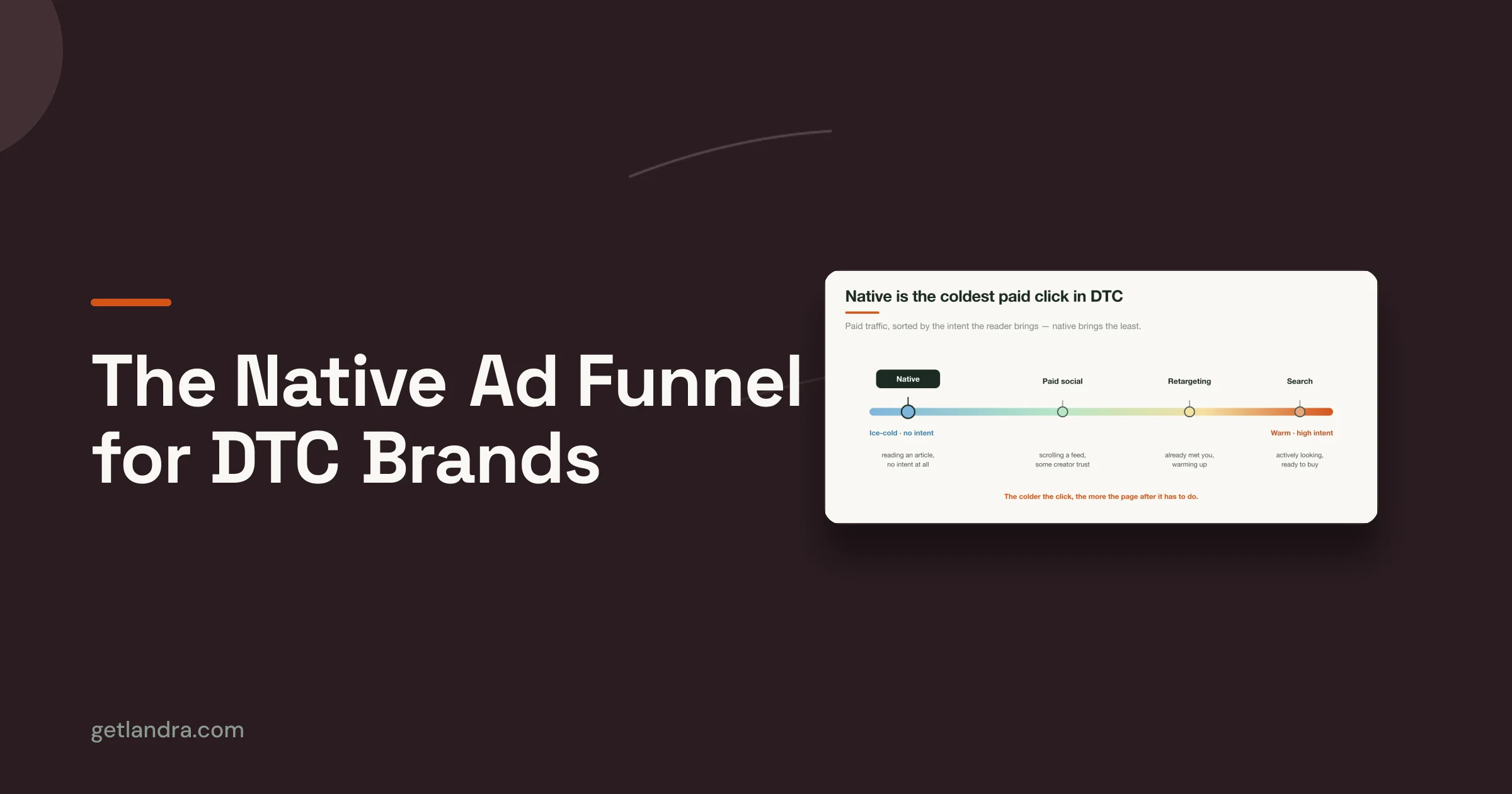
Native advertising performs better when the ad and landing page share the same reason for the click. Cold Meta and TikTok users differ in pacing, visual expectations, and tolerance for explanation, so a single page can create friction even when the offer is sound.
TikTok visitors usually need immediate clarity. Lead with a concise benefit, visible product context, and sections that scan quickly. Meta visitors may accept more explanation, especially when the product is unfamiliar or objections require proof. These are starting assumptions, not fixed rules. Confirm them with separate cohort reporting.
Adapt the page, not just the ad
A DTC brand sending TikTok traffic to a listicle can open with a specific question about the buyer's use case, then present short sections, product images, icons, and a clear recommendation. The same offer from Facebook may work better with an advertorial structure that introduces the customer problem, supplies supporting evidence, and moves toward the offer at a measured pace.
Landra's advertorial configurations support cold Meta and TikTok traffic. Its visual editor lets teams revise headlines, hero copy, images, and page structure without rebuilding each version. That reduces the cost of testing platform-specific openings.
Keep the core offer consistent. Change the opening to match the user's reason for arriving.
Build one working variant first, then isolate the variables that reflect platform behavior:
- TikTok opening: Use concise, benefit-focused language and faster visual progression.
- Meta opening: Add context, narrative detail, and proof before the primary CTA.
- Cohort reporting: Separate platform results so one channel does not hide the other's behavior.
- Headline testing: Test several angles while keeping the rest of the page stable.
Pair page experiments with a dedicated ShortGenius AI ad creative tool workflow, then evaluate the full ad-to-page path. A strong click-through rate is not enough if the landing page changes the promise or loses the visitor before the next action.

2. Use Advertorials to Warm Up Cold Audiences Before Checkout
A direct product page asks a cold visitor to understand the product, trust the brand, assess the offer, and buy in one step. That approach may suit a simple, familiar product, but it creates too much explanatory work for a page built mainly around product details.
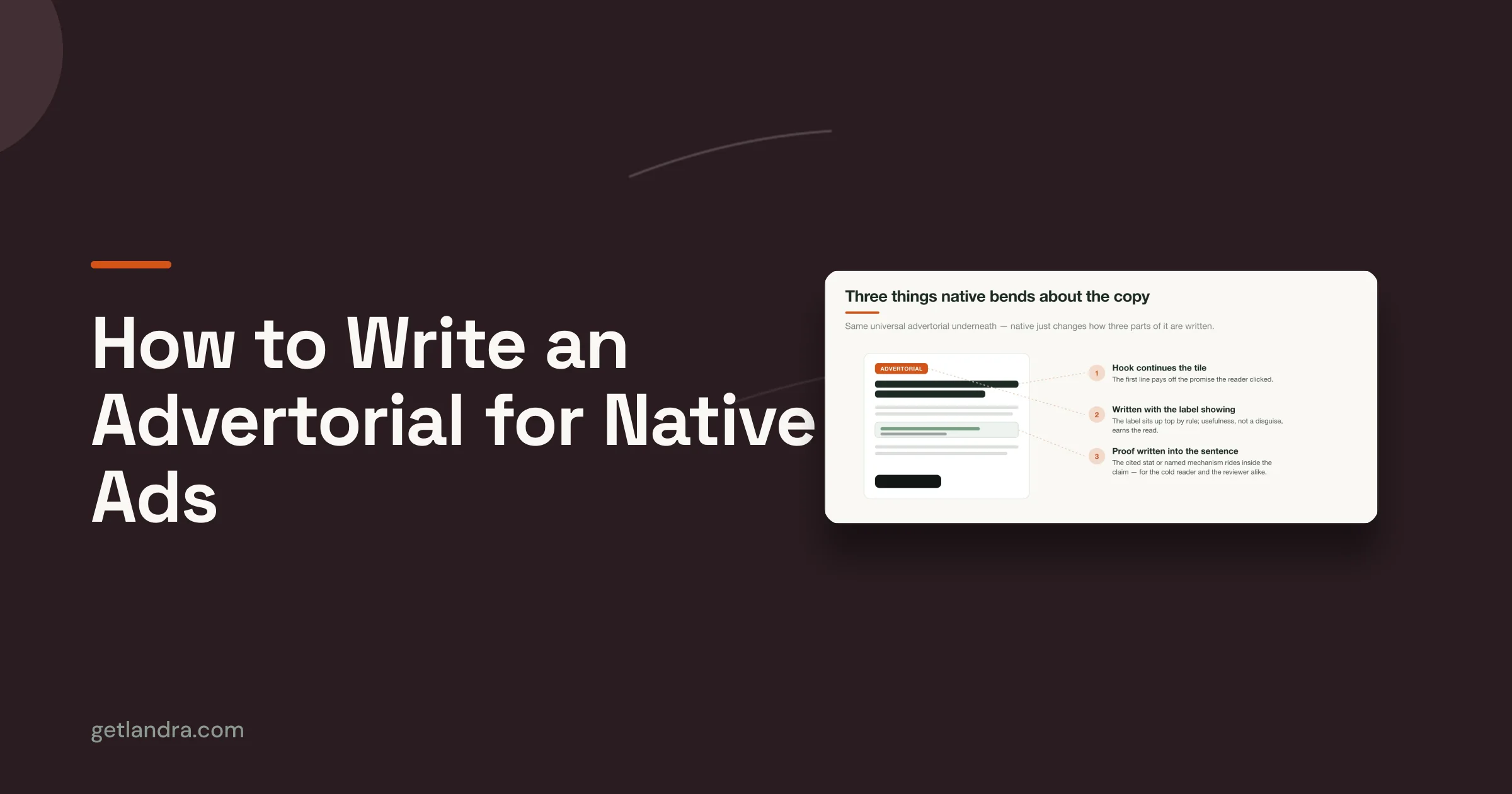
An advertorial gives cold traffic context before the purchase request. It can define a recognizable customer problem, explain why common approaches fall short, introduce the product as a possible solution, and address objections with relevant proof. Keep the commercial intent clear. An editorial-style structure should organize the decision, not hide the sponsorship.
Research in the Journal of the Academy of Marketing Science found higher click activity when native ads appeared in-feed and used less selling intent. The finding supports closer content congruence and restrained sales language in native formats, as summarized in the research on native advertising effectiveness.
Build the narrative around the buyer
Start with the audience's problem or desired outcome, then supply only the information needed for the next decision. A supplement advertorial might explain a daily concern, relevant ingredients, certifications, and customer experiences before presenting the product. A beauty page could focus on a defined skin concern, then clarify routine, expectations, and product fit.
Add proof early, but use only testimonials, before-and-after imagery, certifications, or credentials the brand can substantiate. Move the reader from awareness to consideration to intent. Place the checkout CTA after the visitor has enough information to act, and make that next step easy to find.
Landra's AI Advertorial Generator can analyze a brand website and produce an editable draft using its existing products, offers, and proof. See the guide to create AI advertorials for a practical walkthrough.
A pre-sell page should reduce uncertainty, not add another layer of reading for its own sake.
Test distinct narratives, such as lifestyle motivation against a more clinical product explanation. Judge each version across the full path from ad click to checkout, not by reading time alone. Keep the destination aligned with the ad's promise, disclose the sponsored nature of the page, and make the transition to checkout obvious. If visitors engage with the story but do not continue, test the proof order, CTA placement, and offer handoff before rewriting the entire page.
3. Leverage Listicles and Ranked Comparisons for High-Intent Audiences
Advertorials are useful when the visitor needs a story. Listicles are often better when the visitor is already comparing options and wants a structured answer.
A ranked page such as “best protein powders for weight loss” gives the reader a decision framework. A skincare guide organized by skin type can help a visitor identify the relevant category before recommending a product. The format creates useful separation between options, which can reduce decision paralysis without requiring aggressive sales copy.
Make the ranking credible
A listicle loses trust when every item exists only to make the featured product look perfect. Rank products or solutions against criteria the reader can understand, such as use case, formula, ease of use, price positioning, or suitability for a particular audience. If your product is strongest for one segment but not every segment, say so. Specificity is more persuasive than universal claims.
Useful variants include:
- Use-case ranking: Recommend products for travel, convenience, sensitive skin, or a defined routine.
- Performance ranking: Compare solutions by relevant product characteristics.
- Audience ranking: Create separate recommendations for beginners, experienced users, or different needs.
- Value ranking: Explain what the buyer receives relative to the price and commitment.
Visual elements matter because listicles are built for scanning. Use product images, concise summaries, comparison blocks, icons, and clear “best for” labels. Avoid burying the recommendation inside long paragraphs.
Landra's AI Listicle Generator can structure a ranked pre-sell page from a product or brand URL. You can also review conversion statistics for pre-sell pages when deciding which page format deserves a controlled test. For editorial-style review content, Taja AI can help write reviews that rank.

The trade-off is clear. A listicle can move a comparison-minded visitor efficiently, but it may feel too impersonal for a product that depends on emotional storytelling or education. Test the format against the audience's actual question, not the brand's preferred content style.
4. Build Rapid Test-and-Learn Cycles with Page Duplication and Variants
Native advertising improves through accumulated learning, not one perfect headline. Build a repeatable testing process that connects the ad's promise to the pre-sell page, offer framing, proof, and checkout action without rebuilding every asset.
Start with a specific hypothesis. A fitness brand might expect a time-saving angle to outperform an injury-recovery angle for a particular audience. Duplicate the baseline page, change the opening that reflects the ad, and keep the remaining experience stable enough to interpret the result.
A clean test has three parts: the audience and platform context, the variable being changed, and the downstream action that defines success. Changing the headline, hero image, CTA, testimonials, and offer together can produce a winner, but it leaves the reason unclear. Change one major element first, then use the result to choose the next experiment.
Use this sequence:
- Choose one hypothesis: Define the objection, desire, or motivation behind the test.
- Duplicate the baseline: Preserve the original page so the comparison remains available.
- Change one primary element: Start with the headline, hero copy, proof type, or CTA.
- Keep the pre-sell aligned: Make the page deliver the claim and tone established by the native ad.
- Tag the variant: Use UTM parameters or a consistent page naming system.
- Record the outcome: Track engagement and downstream actions, not only the initial click.
- Promote the learning: Use the strongest variant as the next baseline.
Landra's visual editor supports inline changes to headlines, copy, images, and structure. Its duplication workflow lets non-technical teams create versions without developer support. A brand can test pain-point openings such as time, cost, recovery, or body goals while keeping the underlying offer recognizable.
Run tests long enough to compare meaningful behavior, then prioritize the result that improves the full cold-traffic path rather than a click metric alone. A page that wins for one cohort is not automatically the best page for every cohort. Preserve the audience and platform context attached to each result, then test the winning idea where it has a reasonable chance of applying.
5. Optimize for Mobile-First, Fast-Loading Pages on Paid Social
A native ad can win attention and still lose the sale when its pre-sell page loads slowly, displays poorly, or makes the next step unclear. Paid social visitors often arrive on phones, so mobile behavior should shape the page from the start, not receive a late responsive adjustment.
Start with the published page on an actual phone. Can a visitor read the opening promise, understand the offer, and reach the next action without zooming, sideways scrolling, or dismissing intrusive pop-ups? Use a single-column layout, readable text, thumb-friendly buttons, and images that explain the product quickly. Keep decorative elements and repeated navigation from competing with the first useful action.
Speed and usability need separate checks. A compressed image may load faster but lose detail needed for product evaluation. Autoplay video or animation may increase persuasion in one audience while delaying useful content for another. Test the trade-off rather than removing every rich element by default.
Check large image files, scripts, and animations on a slower mobile connection. Chrome DevTools and Lighthouse can identify technical bottlenecks, while a manual phone review shows whether the page feels easy to use.
Use this review order:
- Compress images: Choose efficient formats such as WebP while retaining enough quality for evaluation.
- Control motion: Limit autoplay video and heavy animation when their added weight does not improve the decision.
- Clarify the CTA: Place the primary action where visitors understand the next step, then repeat it at sensible points during the scroll.
- Focus the first screen: Lead with the promise, relevant image, and a clear path into the page.
- Test the published version: Review the live Shopify, Webflow, Landra-hosted, or exported page instead of relying only on editor previews.
Landra supports mobile-first page construction, Shopify and Webflow publishing, a Landra-hosted URL, and HTML export. Its Conversion Rate Calculator can model possible funnel effects, but treat that output as a planning aid. Use analytics to judge whether a speed change improved the completed cold-traffic journey.
6. Integrate First-Party Brand Data to Personalize Native Ad Messaging
Cold traffic responds poorly to generic product language. A pre-sell page should carry enough brand-specific detail to make the ad, article, offer, and checkout feel like parts of one customer journey. That means using the approved product facts, customer vocabulary, offer structure, and proof that already exist inside the business.
Start with a source-of-truth review before creating new variants. Check the current product description, ingredients, certifications, pricing, shipping terms, reviews, and approved claims against the checkout experience. If the pre-sell page uses outdated information, even strong creative can create an expectation gap that reduces trust and complicates compliance review.
Build a usable brand context file
The most useful brand data is not every document the company has collected. It is the information that changes how a cold visitor interprets the offer.
For example, a supplement brand can provide its product page, ingredient documentation, certifications, approved testimonials, and offer details. A beauty brand can organize its tone, product distinctions, customer objections, and skin-type language before producing several advertorial angles. The page can then vary by audience or promise while keeping the underlying facts consistent.
A practical context file should include:
- Approved product facts: Ingredients, materials, features, use instructions, limitations, and distinctions from competing products.
- Customer language: Phrases from reviews, support conversations, surveys, and email replies that describe the problem and desired outcome.
- Proven positioning: Ad hooks, email themes, and landing-page messages that have already earned attention, treated as test inputs rather than permanent winners.
- Offer rules: Current price, bundles, discounts, guarantees, shipping terms, and eligibility conditions.
- Claim boundaries: Statements the brand can support, claims that need qualification, and wording that must not appear.
- Voice guidance: Preferred tone, banned phrases, product names, and distinctions between product lines.
Personalization should change the relevance of the message, not the truth of the offer. A visitor arriving from a hydration-focused ad might see a pre-sell angle organized around that concern, while another audience sees a comparison based on convenience. Both versions still need the same accurate price, product identity, and purchase conditions.
Landra can analyze a product or brand URL, save brand context, and generate editable advertorial or listicle drafts. Its inline editor allows marketers to correct wording, replace imagery, and reshape the page before publishing. Treat the generated copy as a working draft. A human reviewer should confirm factual accuracy, customer fit, evidence for each claim, and alignment between the pre-sell page and checkout.
Keep the source file versioned. Record which inputs produced each page variant, then update or retire variants when the product, offer, or approved claims change. That practice makes personalization easier to test without allowing old information to spread across the cold-traffic funnel.
7. Use Compliance Checklists and Free Validation Tools to Stay Audit-Ready
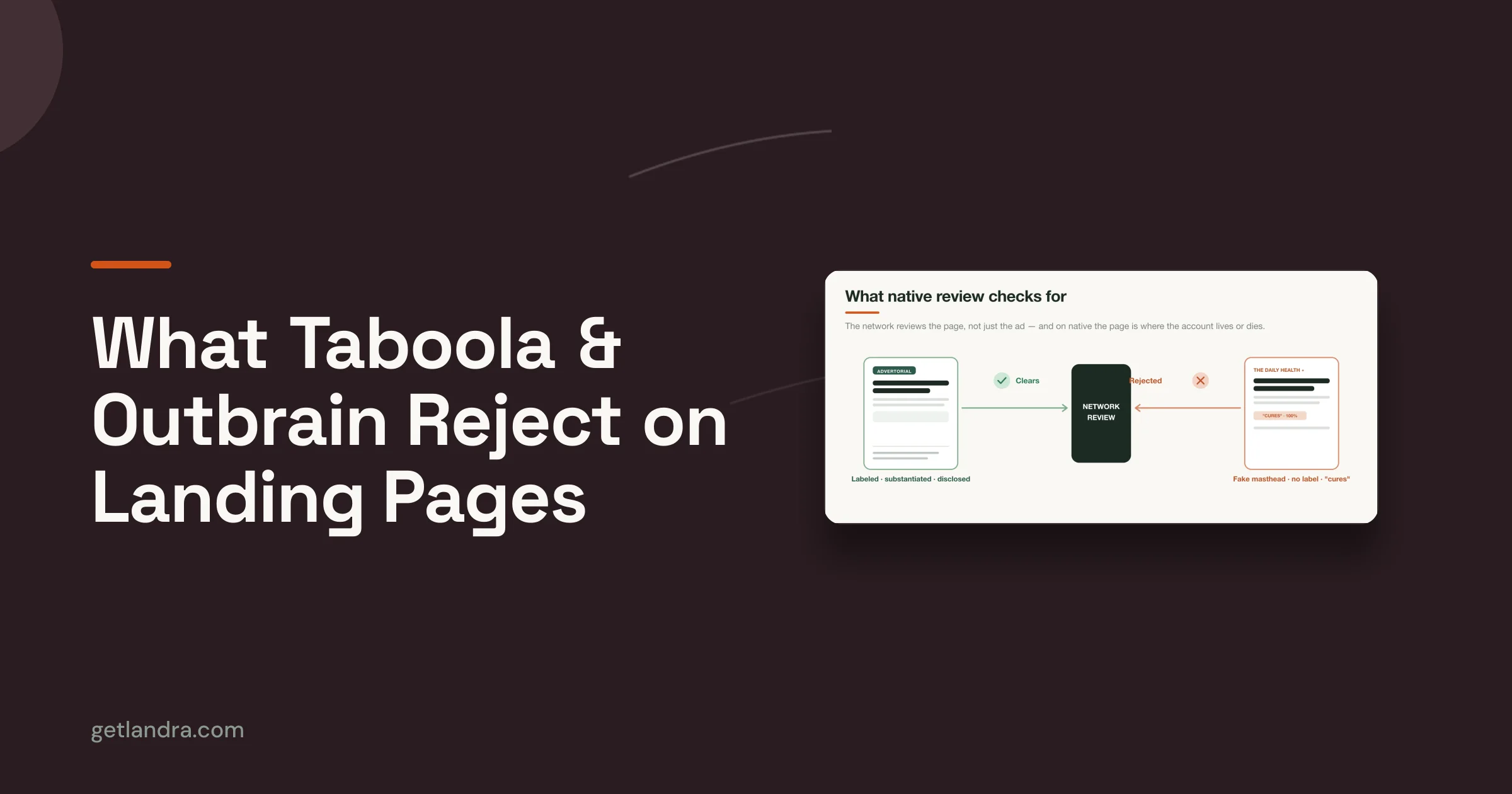
A native ad can match the surrounding editorial format without hiding its commercial purpose. Disclosure, claim accuracy, and offer consistency need to survive every handoff from ad creative to pre-sell page to checkout. A campaign that earns attention through ambiguity may create platform problems, customer complaints, or regulatory exposure later.
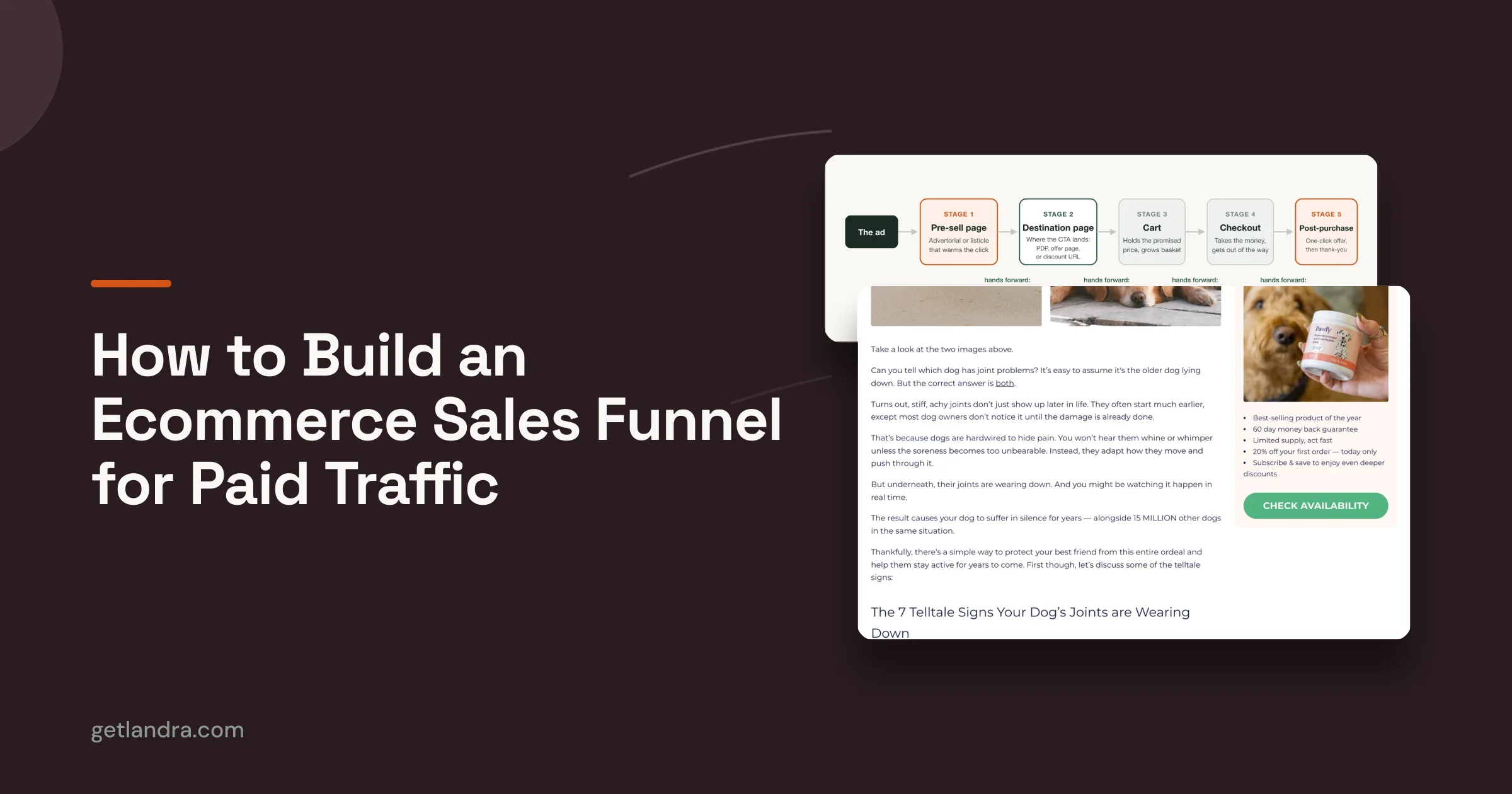
Build the review around the cold-traffic path. Start with the ad a visitor sees, then inspect the page that receives the click and the purchase experience that follows. The promise, product identity, price, terms, and evidence should remain consistent across all three stages.
Turn compliance into a launch gate
Use a short checklist inside the campaign workflow, with a named reviewer and a recorded approval date. The person writing the page can complete the first review, while legal or compliance specialists should assess higher-risk categories such as supplements, healthcare, beauty, and financial services.
Check these items before publishing:
- Commercial disclosure: Identify the page as sponsored or promotional, and place the disclosure where visitors can notice it before relying on the content.
- Claim evidence: Match health, medical, financial, performance, and comparative claims to documentation the brand can produce.
- Testimonials and endorsements: Verify that quoted customers, experts, imagery, and outcomes are genuine, accurately represented, and not stripped of important context.
- Offer consistency: Confirm the current price, discount, shipping terms, guarantee, subscription conditions, and eligibility requirements on every step of the route.
- Platform and publisher rules: Review the final ad, images, advertorial, tracking parameters, and destination page against the requirements of each distribution channel.
- Variant coverage: Approve every active headline, thumbnail, CTA, proof block, and page version. Reviewing only the control leaves unapproved combinations in circulation.
- Approval records: Save the reviewer, date, source evidence, edits, and final URL in the campaign file.
The EU has specific transparency expectations for native and branded content, as discussed in recent native advertising industry coverage. Landra's free Advertorial Compliance Checklist can organize a pre-launch review. It cannot determine whether a claim is legally supportable, so sensitive campaigns still require qualified human judgment.
Use validation tools before traffic arrives
A free checklist is useful when it catches omissions, not when it becomes a box-ticking exercise. Run the page through a final manual review in a logged-out browser, on a phone, and from the same ad route that a new visitor will follow. Confirm that disclosures remain visible, links work, prices match checkout, and no old offer appears in a cached or duplicated variant.
Keep evidence with the approved version. Store substantiation files, screenshots, platform approvals, and change history alongside the landing-page URL. Pause a variant when its offer, product, imagery, or claims change, then reopen review before sending paid traffic.
Audit readiness is a production habit. It lets the team test faster because each new version has a clear owner, review standard, and record of what changed. The goal is a persuasive pre-sell experience that earns attention through useful information, not a page that makes the commercial relationship difficult to recognize.
8. Measure and Optimize Conversion Lift from Pre-Sell Pages vs. Product Pages
Clicks show attention, not business impact. A pre-sell page can generate stronger engagement yet send fewer qualified visitors to checkout. It can also reduce immediate click volume while improving purchase quality. Measure the entire route before choosing a winner.
Run a controlled comparison between direct product-page traffic and traffic that first reaches an advertorial or listicle. Assign separate UTM parameters to each path, keep campaign context consistent where practical, and compare downstream behavior rather than judging performance by click-through rate alone.
Compare routes by commercial outcome
Review the sequence from ad engagement through page interaction, product-page arrival, cart activity, purchase, and customer quality. Subscription and repeat-purchase businesses should also compare later value, since a low-cost first order may not produce the strongest customer.
Use this scorecard:
- Route performance: Compare advertorial, listicle, and direct product-page paths.
- Acquisition efficiency: Review CAC and ROAS with conversion rate.
- Funnel friction: Locate abandonment on the pre-sell page, product page, and checkout.
- Customer quality: Compare repeat purchases and downstream value by cohort.
- Message fit: Connect results to the platform, audience, creative, and page variant.
Earlier research on native advertising found that natively formatted ads increased visits to an advertiser's information page compared with no-advertising conditions. That supports testing native formats as response-generating experiences, but it does not predict the result of a specific DTC funnel. Treat the finding as a reason to test, not as a performance guarantee.
Use Landra's Conversion Rate Calculator to set a planning threshold, then validate that threshold with first-party analytics. The key question is whether the route produces more completed purchases at an acceptable acquisition cost.
Define the control before traffic starts. Review the differences between pre-sell and product pages, then keep the offer, audience, attribution window, and checkout experience consistent. Change one major page variable at a time, record the result, and promote the stronger route only after purchase data supports the decision.
8-Point Native Advertising Tips Comparison
| Tactic | Implementation Complexity 🔄 | Resource Requirements ⚡ | Expected Outcomes 📊 | Ideal Use Cases 💡 | Key Advantages ⭐ |
|---|---|---|---|---|---|
| Match Native Ad Creative to Platform-Specific Traffic Patterns | Medium, requires platform-specific testing and creative variants 🔄 | Moderate, creative production (video/images), platform-specific assets, analytics ⚡ | ↑ engagement and lower CPA when aligned; uplift varies by platform 📊 | Cold Meta/TikTok audiences, multi-channel campaigns where native fit matters 💡 | ⭐ Better CTR/conversion through platform-native pacing and CTA placement |
| Use Advertorials to Warm Up Cold Audiences Before Checkout | Medium–High, long-form narrative and funnel design; testing required 🔄 | High, copywriting, design, social proof assets, editorial QA ⚡ | 2–3× higher conversions vs product pages; reported CAC reductions (e.g., ~46%) 📊 | Cold traffic for trust-sensitive products (supplements, beauty, DTC) 💡 | ⭐ Builds credibility and purchase intent before checkout |
| Leverage Listicles and Ranked Comparisons for High-Intent Audiences | Medium, research and fair comparison needed; SEO considerations 🔄 | Moderate, content research, comparison assets, visuals ⚡ | Strong engagement from comparison shoppers; good SEO/organic lift 📊 | High-intent users comparing options; content-led acquisition/SEO channels 💡 | ⭐ Scannable authority-building format that reduces decision paralysis |
| Build Rapid Test-and-Learn Cycles with Page Duplication and Variants | Low–Medium, tooling simplifies variants but needs test governance 🔄 | Low–Moderate, editor access, analytics, UTM tracking ⚡ | Test cycles reduced from weeks to hours; faster learning and iteration 📊 | Teams running frequent experiments or scaling creative permutations 💡 | ⭐ Accelerates optimization; enables non-technical A/B testing at scale |
| Optimize for Mobile-First, Fast-Loading Pages on Paid Social | Medium, performance work and design constraints; continuous monitoring 🔄 | Moderate, image/video optimization, front-end dev, performance tools ⚡ | Lower bounce, higher time-on-page, better ad relevance and conversion 📊 | Paid social traffic (TikTok, Meta) where >80% users are mobile 💡 | ⭐ Improved ad scores and conversion via speed and thumb-friendly UX |
| Integrate First-Party Brand Data to Personalize Native Ad Messaging | Medium, brand data ingestion and template setup; review loop 🔄 | Moderate, data cleanup, content inputs, review time ⚡ | Faster on-brand drafts, reduced editorial cycles, better messaging coherence 📊 | Brands with rich site content wanting consistent voice across pages 💡 | ⭐ Higher creative coherence and faster approvals from on-brand outputs |
| Use Compliance Checklists and Free Validation Tools to Stay Audit-Ready | Low, implement checklists and pre-publish scans; legal review required 🔄 | Low, team review time and occasional legal input ⚡ | Fewer disapprovals, lower regulatory risk, faster approvals 📊 | Regulated categories (health, supplements, finance, beauty) and publishers 💡 | ⭐ Reduces legal exposure and platform penalties with documented checks |
| Measure and Optimize Conversion Lift from Pre-Sell Pages vs. Product Pages | Medium–High, rigorous A/B framework and attribution needed 🔄 | High, sufficient traffic, analytics stack, UTM/pixel setup ⚡ | Quantified lift (often 2–3× conv; 30–50% lower CAC reported) and cohort LTV insights 📊 | Validating routing strategy for cold traffic and budget allocation decisions 💡 | ⭐ Data-driven justification for pre-sell investment and optimized funnels |
Turn the Eight Tips Into One Testing System
Native advertising becomes manageable when you treat it as a connected system rather than a collection of copy tricks. Start with the platform and audience. Define why the person is arriving, how much they already know, and what question the ad creates.
Then select the appropriate pre-sell format. Use an advertorial when the visitor needs context, trust, or education before evaluating the offer. Use a listicle when the visitor is comparing options and wants a scannable recommendation. Send traffic directly to a product page when the product is straightforward, the offer is already understood, or the audience has demonstrated stronger intent.
The page must continue the ad's promise. Match the headline, visual language, product framing, and first CTA to the creative that generated the visit. A page that switches from an educational ad to an aggressive sales pitch forces the visitor to reassess the entire experience.
Before launch, complete the compliance review. Confirm the sponsored disclosure, inspect claims, verify testimonials, and check each variant against platform requirements. Then test the page on mobile, review load behavior, and verify that the checkout destination contains the same offer and expectations.
Launch a controlled baseline rather than changing everything at once. Separate routes and cohorts in analytics, measure the complete funnel, and look beyond clicks. Conversion rate, CAC, ROAS, cart activity, repeat purchase behavior, and customer quality each answer a different question.
Once a page shows a promising pattern, duplicate it and test one meaningful variable. Change the opening angle, proof type, CTA, ranking logic, or offer framing, then preserve the rest of the experience. This approach turns every campaign into a source of reusable learning.
Landra can serve as an optional execution layer in that process. It can generate advertorials, listicles, and other pre-sell pages from a product or brand URL, use saved brand context, and let teams edit the result inline. Pages can be published through Shopify, a Landra URL, Webflow, or HTML export, while duplication supports rapid variant creation without custom development.
The tool won't replace strategy, evidence, or compliance ownership. It can reduce the distance between a funnel hypothesis and a live page, which gives DTC teams more opportunities to test the ideas that matter.
Use Landra to turn a product URL into an editable, mobile-first advertorial or listicle for cold paid-social traffic. Generate a starting page, review its claims and disclosure, publish it through your existing stack, and duplicate the strongest version for the next controlled test.