

You can usually spot the problem before the dashboard does. The ad gets the click, the product page gets the traffic, and the purchase rate stays stubbornly flat, so the team blames creative fatigue, audience mismatch, or a weak offer. In a lot of DTC accounts, the leak is simpler, the cold click is landing in the wrong place, with the wrong frame, and asking for the sale too early.
That's why sales funnel digital marketing works best when you treat the funnel as an attribution chain, not a classroom diagram. Cold traffic does not arrive in a buying mood, and the first page has to do the job of warming intent before the checkout ask appears. The brands that understand that difference stop optimizing for “more traffic” and start optimizing the first-click landing experience.
Table of Contents
- The Funnel Leak Most DTC Brands Miss
- What a Digital Marketing Sales Funnel Actually Is
- Mapping Channels and Tactics to Each Funnel Stage
- The Conversion-Control Point in a Cold-Traffic Funnel
- KPIs and Measurement That Actually Locate Bottlenecks
- A Sample DTC Funnel Built Around a Pre-Sell Page
- Why the Dark Funnel Breaks the Stage Model
- An Optimization Plan You Can Run This Week
The Funnel Leak Most DTC Brands Miss
A founder opens Meta Ads Manager and sees the familiar pattern, click volume is there, spend is moving, but purchases are lagging. The instinct is to blame the creative, then the audience, then the bid strategy. In practice, the page the click lands on is often doing the damage.
The first click is where the funnel gets real
Most beginner explanations of funnel marketing draw a clean line from awareness to interest to conversion, but cold social traffic doesn't behave that neatly. A recent industry summary says only 3% of website visitors typically convert on their first visit, while another says 96% are not ready to buy immediately, which is exactly why funnel design needs retargeting, nurturing, and staged messaging instead of a single product page alone. The same summary also shows how sensitive the end result is to page quality, with average landing page conversion reported at 2.35% in one benchmark and 5.31% or more for top performers, while another 2026 roundup cites average landing page conversion at 6.6% and top performers at 10–12%. Sales funnel statistics and landing page benchmarks
That gap matters because a cold click is not the same as a warm search visit. Someone coming from Meta or TikTok usually needs a bridge, not a hard sell, and if the page gives them no reason to keep reading, the funnel never starts. The loss happens before any neat “stage” model can claim ownership of it.
Practical rule: if the ad promise, page frame, and CTA don't line up, the account usually pays for the mismatch in CAC, not in clicks.
Why product pages leak cold traffic
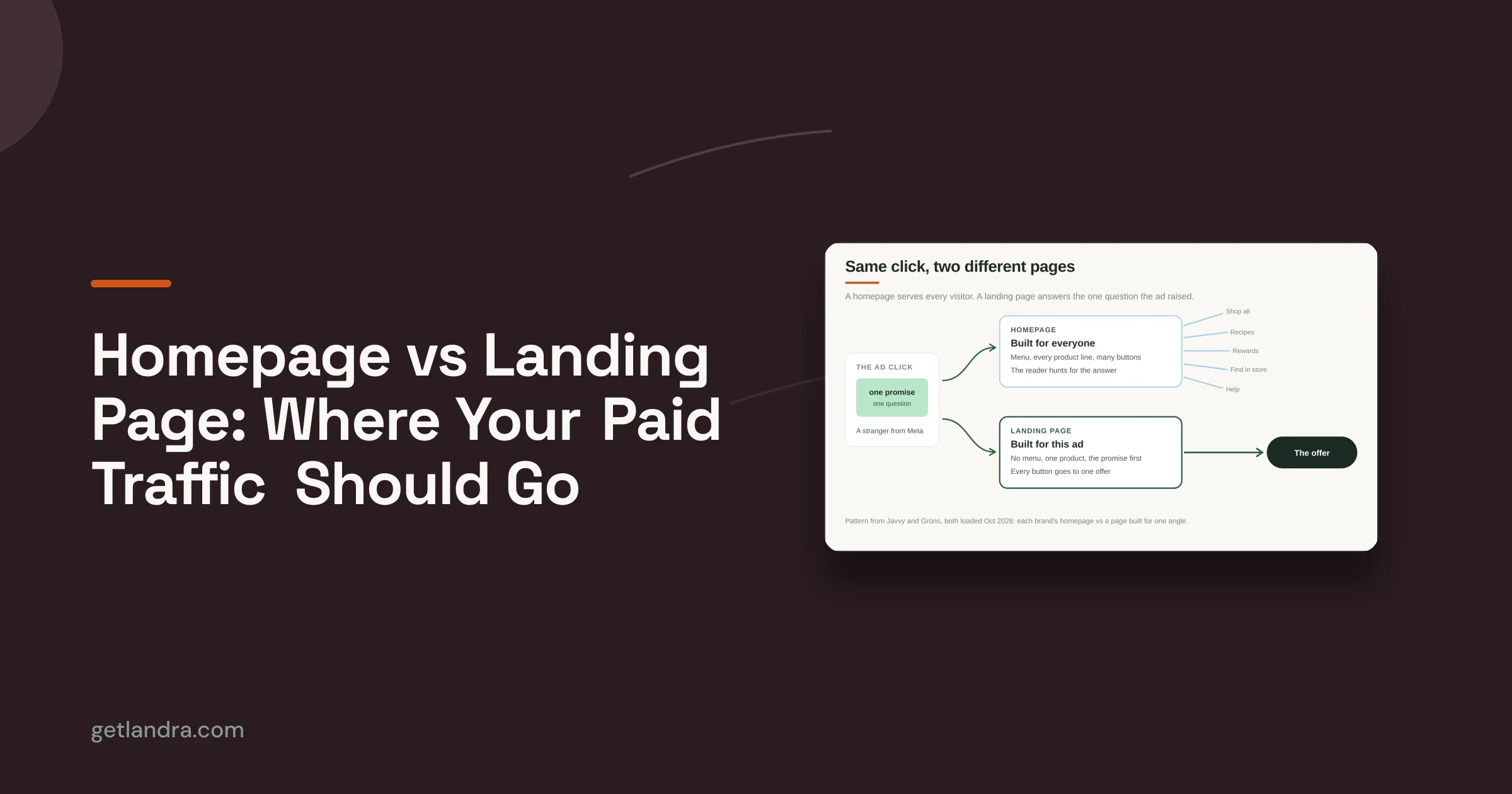
Product detail pages are built for shoppers who already know what they want. Cold traffic often arrives with curiosity, not purchase intent, and that means the page has to do three jobs at once, explain the product, earn trust, and persuade. That's too much friction for a first touch in most DTC categories.
A pre-sell layer changes the job of the click. Instead of forcing a purchase decision immediately, it uses narrative, education, and message match to move the visitor from “I'm not sure why I'm here” to “this might be worth considering.” That's the starting point of sales funnel digital marketing for paid social.
What a Digital Marketing Sales Funnel Actually Is
A working digital funnel is a staged system that moves a stranger from first awareness to repeat purchase, using paid traffic, content, capture, and follow-up as the mechanism. It's not a buzzword, and it's not just a website. It's the set of jobs your marketing stack has to perform in sequence.

The five stages as operational jobs
Awareness is where paid social, creator content, search, and other discovery channels introduce the brand to people who weren't looking for it yet. The job here is visibility and message fit, not a hard conversion ask.
Interest is the point where a visitor starts paying attention, usually by consuming a lead magnet, reading a comparison, or clicking through to learn more. This stage should create enough curiosity that the next step feels natural.
Consideration is where the brand helps the buyer compare options and lower perceived risk. A good funnel uses proof, context, and a pre-sell page here, not a naked product pitch.
Conversion is the moment the visitor takes the purchase action, often through a product page or checkout flow that now has a warmer audience behind it. The page has to finish the job cleanly.
Retention is the post-purchase system, email, SMS, education, and follow-up that turns a one-time buyer into a repeat customer.
What most teams under-build
The common mistake is treating these stages like content buckets instead of infrastructure jobs. Teams publish awareness content, maybe collect emails, then hope the product page closes the loop by itself. That's usually where the system thins out.
The funnel isn't a blog calendar. It's a sequence of handoffs, and every handoff needs its own asset.
If the current stack has traffic, a homepage, and a checkout flow but nothing that warms cold intent, the funnel is incomplete. That's the first thing to fix before adding more channel spend.
Mapping Channels and Tactics to Each Funnel Stage
The cleanest way to think about channel strategy is to stop asking which channel is “best” and start asking which job each channel should do. That keeps the stack from turning into a pile of duplicated effort.
The table below is the simplest useful map for sales funnel digital marketing in DTC.
| Funnel Stage | Primary Channels | Tactic | Common Misallocation |
|---|---|---|---|
| Awareness | Meta ads, TikTok ads, creator content | Reach a cold audience with a clear angle | Sending cold traffic straight to a product page |
| Interest | SEO, lead magnets, comparison content | Capture curiosity with a reason to engage | Expecting a homepage to educate and convert |
| Consideration | Pre-sell pages, advertorials, listicles | Warm intent and answer objections | Using the same generic landing page for every audience |
| Conversion | PDP, checkout, retargeting | Finish the purchase with fewer distractions | Retargeting before the visitor had enough context |
| Retention | Email, SMS, lifecycle flows | Drive repeat purchase and post-purchase education | Treating the first order as the end of the funnel |
The channel-stage fit matters because not every tactic belongs everywhere. Paid social is excellent for attention and efficient traffic capture, but it is usually weak when you ask it to do the whole job in one hop. Email is powerful after capture, but it cannot rescue a page that never earned the opt-in in the first place.
Where teams waste spend
One of the most common mistakes is running bottom-funnel retargeting logic against people who never reached a meaningful intent threshold. That's wasteful because the audience hasn't been warmed yet, so the message lands like pressure instead of relevance. Another mistake is pushing warm leads to a generic product page that doesn't reflect the angle that brought them in.
For teams that use lifecycle capture heavily, this email marketing for lead generation guide is a useful reminder that email works best after a clear opt-in moment, not as a substitute for one. The same logic applies to the rest of the funnel, the asset has to match the stage.
The win is to make each channel do one job well. That usually means fewer assets doing more precise work, not more assets doing the same work twice.
The Conversion-Control Point in a Cold-Traffic Funnel
Cold paid-social traffic is the harshest test in the whole stack because the user didn't come looking for you. They clicked out of interruption, not intent, and that makes the landing layer the control point.

Why the pre-sell layer changes the outcome
A product page assumes the visitor already understands the category, the offer, and the reason to buy now. A pre-sell page does something more useful for cold traffic, it aligns the ad promise with a narrative, then moves the visitor toward the product once the context is in place. That's why advertorials, listicles, and warm-up pages can outperform direct-to-PDP routes for cold audiences.
Independent guidance from Adobe frames the funnel as an attribution chain, traffic source to landing-page engagement to email or retargeting capture to purchase, and that sequence is the right way to think about optimization. Adobe's sales funnel overview makes the same point in a broader form, the step in the middle is where the rest of the journey gets enabled.
What the page has to do
A useful pre-sell page needs message match, meaning the headline and opening frame echo the ad. It also needs page speed, mobile-first layout, and a singular CTA, because cold social users won't dig through clutter to understand what to do next. CXL's guidance on the dark funnel and conversion behavior also points to clarity, singularity, and identification as the kinds of factors that help visitors move forward when the journey is messy. CXL on the dark funnel
Inline editorial control matters too. If the opener underperforms, the team should be able to duplicate the page, swap the lead, and test another angle without rebuilding the whole asset. That's a practical advantage, not a cosmetic one.
The short version is simple, the pre-sell page doesn't replace the funnel, it makes the first handoff viable. Without that handoff, the rest of the funnel is just expensive wishful thinking.
KPIs and Measurement That Actually Locate Bottlenecks
Traffic volume is a noisy metric. It can tell you that people arrived, but it can't tell you why they stopped moving.
The three metrics that matter most
In a digital sales funnel, the most useful KPIs are stage-to-stage conversion rate, lead velocity rate (LVR), and sales velocity because they isolate where throughput is slowing. If stage conversion is weak, the problem is relevance or friction. If lead velocity is sluggish, the issue is pipeline replenishment. If sales velocity drags, the bottleneck is deal-cycle speed.
For lean teams, those metrics belong in a spreadsheet before they belong in a BI stack, especially when average deal size is under $10K. That keeps the measurement system aligned with funnel mechanics instead of dashboard theater. Prospeo's metrics overview is a solid reference point for this diagnostic approach to funnel analysis. Sales funnel metrics for lean teams
What to ignore first
Vanity traffic numbers can look healthy while the funnel leaks at every handoff. A campaign with strong click volume but weak stage progression is not a traffic problem, it's a funnel problem. The fix is usually earlier in the chain than teams want to admit.
Measure the point of slowdown, not the volume of noise.
For teams that like a simple worksheet, the conversion rate calculator is a useful internal starting point for defining the math before layering on more tooling. Once those rates are visible, the team can tell whether the next move is better traffic, a better page, or a better follow-up sequence.
The goal of measurement isn't reporting. It's locating the exact hinge where prospects stop advancing.
A Sample DTC Funnel Built Around a Pre-Sell Page
A clean DTC flow starts when a Meta or TikTok ad sends a cold visitor to a pre-sell page, not straight to the product detail page. That first destination should look and feel like a bridge, not a brochure.
The flow from click to checkout
The ad does the first job, it creates curiosity with a single promise. The pre-sell page then takes over with education, proof, and message alignment, which keeps the visitor engaged long enough to understand why the product matters. If the page earns interest, the funnel can capture the visitor into email, then retarget non-converters, then send warmer traffic to the PDP or checkout.
That sequencing is the reason pre-sell pages keep showing up in strong paid-social funnels. Routing the same paid ads to a Landra advertorial instead of a product page produced a 46% CAC reduction in a first-party test, and the broader benchmark on the site cites 2–3× higher conversion on pre-sell pages versus product pages for cold traffic. Landra benchmark and positioning Those numbers line up with the practical reality of cold traffic, the page that warms the click usually wins the attribution battle.
What each asset is responsible for
- Ad creative: create a narrow expectation and match the opening promise.
- Pre-sell page: expand the idea, answer the first objections, and keep the visitor moving.
- Email capture: save the visitor if they're interested but not ready.
- Retargeting: bring back the people who engaged but didn't convert.
- Product page: finish the purchase once intent is warmer.
The pre-sell page writing guide is a useful reference if you're assembling the page itself, but the bigger strategic point is the handoff. The pre-sell layer doesn't exist to look clever. It exists to earn the next click.
A lot of teams try to skip this sequence and save time. In practice, they usually spend more time, and more money, trying to recover lost cold traffic later.
Why the Dark Funnel Breaks the Stage Model
A clean five-stage diagram assumes the whole journey is visible. In paid social, that assumption fails fast.

What sits outside the report
A buyer reads a Reddit thread, forwards a link in a private chat, hears a podcast mention, then searches later with different wording. Each touchpoint shapes the decision, but standard attribution rarely captures the chain cleanly. That gap is the dark funnel, the part of the buying journey where people learn, compare, and decide without leaving a tidy trail.
CXL's guidance on the dark funnel is useful because it accepts that some buying signals stay hidden. It points teams toward survey input, sales-team feedback, and the questions prospects ask, rather than pretending first-click or last-click explains the full path. Dark funnel guidance from CXL
What teams should do instead
Perfect attribution is the wrong target. Better signals matter more.
- Ask sales what buyers repeated: patterns in calls often surface the angle that is doing the work.
- Use prospect surveys: direct feedback can show what the dashboard misses.
- Watch directional UTMs: they will not tell the whole story, but they can show which entry points deserve more attention.
- Look for recurring questions: repeated objections often point to the missing pre-sell angle.
The dark funnel does not break the funnel model by itself. It breaks the idea that the visible stages explain everything. Strong teams keep measurement, but they also accept that part of the buying journey has to be inferred from patterns, not proven with perfect traceability.
An Optimization Plan You Can Run This Week
Start with the first click. If cold traffic is landing on a generic PDP, that's the first fix, because the page is probably asking for too much too soon.
Three moves that create a real signal
Audit the first-click experience. Verify whether cold traffic hits a pre-sell page, not a generic product page or form. If the landing layer doesn't warm intent, the rest of the funnel is compensating for that mistake.
Set up stage-level KPIs in a spreadsheet. Track stage conversion, LVR, and sales velocity in one place so the team can see where movement stalls. Keep it simple enough that people use it.
Duplicate one pre-sell variant and test it. Don't rebuild the page from scratch. Change the opening angle, headline, or editorial frame, then watch whether the handoff improves.
The point is to generate a clear learning loop fast. If the page is the bottleneck, the test should expose it. If the issue is elsewhere, the metrics will show that too.
If your paid social traffic is landing cold on a product page, fix that first. Review the first-click path, build a proper pre-sell layer, and give your team a cleaner measurement loop to work from. If you want a faster way to turn cold clicks into warmer intent, start with Landra today.