
Most published "AI copywriting prompts" are one-line templates with bracketed placeholders: swap in your product, get generic copy out. This list is different: ten prompting techniques for advertorial-style direct-response copy, each with the principle behind it, the source that backs it, and a full prompt you can paste into Claude and adapt. They assume you know what a good advertorial looks like; if you don't yet, read how to write an advertorial first, then come back for the prompting layer. For the tool-agnostic version of this workflow — what any AI ad copy generator does well, and how the winning hook becomes the page — see AI ad copy for advertorials and listicles.
Why the prompt matters more than the model
Bad AI copy is almost never a model problem; it's a brief problem. Today's frontier models write fluent persuasive prose; what they can't do is invent your customer's real objections, your product's proof points, or your brand's voice. Leave those out and the model fills the gaps with the most statistically average marketing copy imaginable.
Practitioners who run AI copy at volume keep landing on the same conclusion. Ad-copy specialist Murat Bock, writing at AdLibrary, puts it plainly: failure stems from weak briefs, not weak models. Anthropic's own prompting best practices say to treat Claude like "a brilliant but new employee who lacks context on your norms and workflows": the more precisely you explain what you want, the better the result. Every prompt below is an application of that one idea to direct-response copy.
The 10 prompts
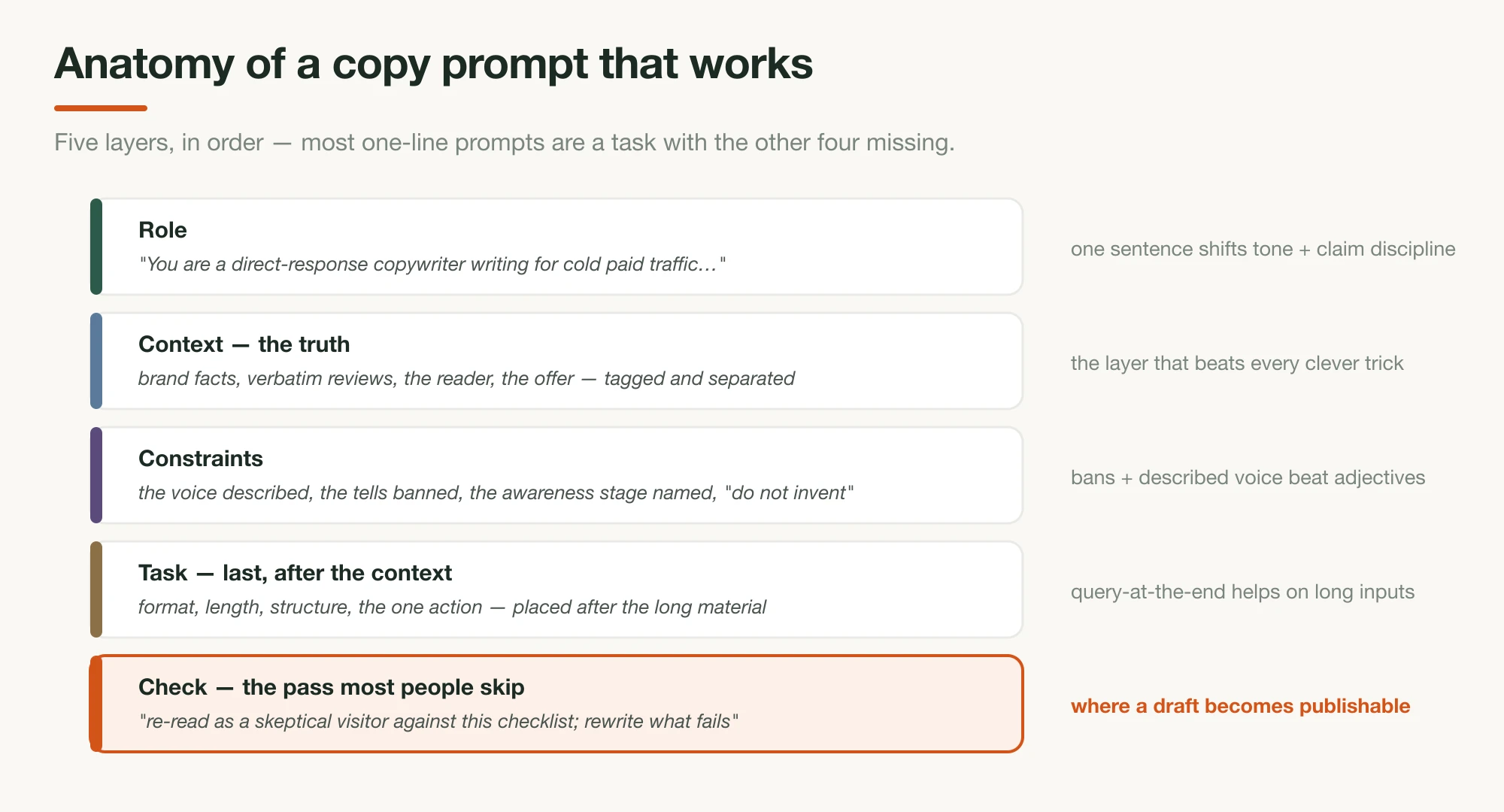
Each entry below is a technique, the principle behind it, and a prompt you can paste and adapt. They stack: the brief (#1) plus voice-of-customer grounding (#6) plus the self-critique pass (#9) is already a working pipeline, and the rest sharpen specific failure points.
| # | Technique | The failure it fixes |
|---|---|---|
| 1 | Brief it like a media buyer | Generic copy from a one-line ask |
| 2 | Set the role in one sentence | Essay tone instead of direct-response tone |
| 3 | Paste 3 examples, "match this register" | Voice that sounds like nobody |
| 4 | Separate facts from instructions (XML) | Instructions imitated as copy; facts treated as ideas |
| 5 | Name the awareness stage | A pitch aimed at a reader who isn't there yet |
| 6 | Feed real reviews, quote first | Marketing-speak instead of customer language |
| 7 | Ban the tells | Copy that reads as AI on sight |
| 8 | Demand checkable specifics | Vague claims a skeptic dismisses |
| 9 | Self-critique second pass | Shipping the first draft |
| 10 | Load brand context in a Project | Re-pasting everything, every chat |
1. Brief it like a media buyer, not a chatbot
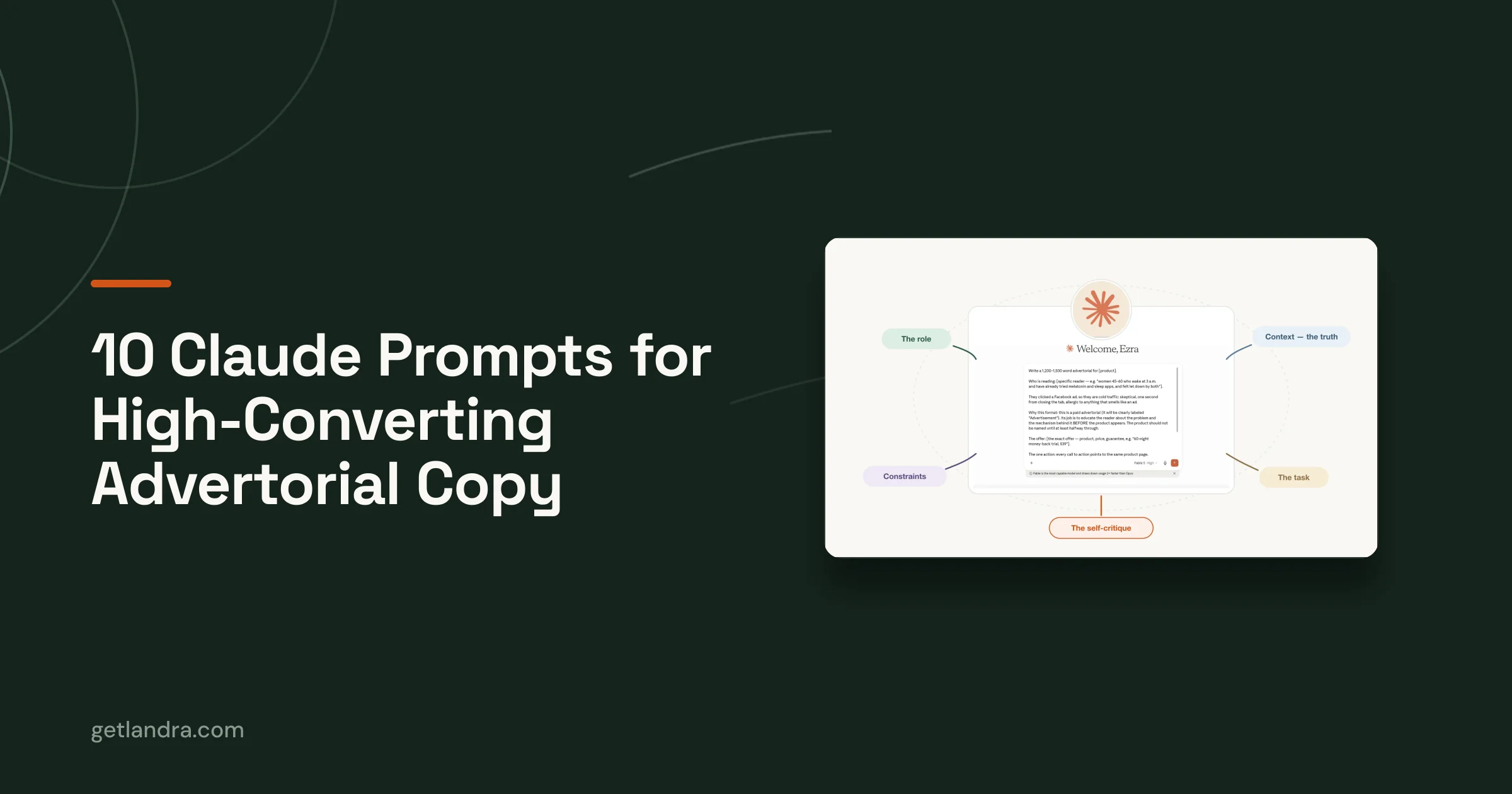
The single biggest upgrade is replacing "write an advertorial for my product" with the brief you'd hand a freelance direct-response copywriter: who the reader is, what they've already tried, what the offer is, where the traffic comes from, and why each constraint exists. Anthropic's best-practices doc offers a useful test: show your prompt to a colleague with minimal context and ask if they could follow it; if they'd be confused, so will the model. The same doc notes that explaining the motivation behind an instruction helps Claude generalize correctly, so say why: the reader clicked an ad and is skeptical, the page is paid media and will carry an ad label, the goal is one action.
Write a 1,200–1,500 word advertorial for [product].

Who is reading: [specific reader — e.g. "women 45–60 who wake at 3 a.m.
and have already tried melatonin and sleep apps, and felt let down by both"].
They clicked a Facebook ad, so they are cold traffic: skeptical, one second
from closing the tab, allergic to anything that smells like an ad.

Why this format: this is a paid advertorial (it will be clearly labeled
"Advertisement"). Its job is to educate the reader about the problem and
the mechanism behind it BEFORE the product appears. The product should not
be named until at least halfway through.

The offer: [the exact offer — product, price, guarantee, e.g. "60-night
money-back trial, $39"].

The one action: every call to action points to the same product page.
No email capture, no secondary links.

Before drafting, list the 3 biggest objections this specific reader will
have, and make sure the body answers each one.
That last line matters. Asking for the objections first forces the model to reason about the reader before it writes a word of copy.
2. Set the role in one sentence
Claude's behavior and tone shift measurably with a role, and per Anthropic's guidance, even a single sentence makes a difference. Don't ask for "an article." Install a direct-response copywriter with a specific job, traffic source, and taste. The role does quiet work everywhere: sentence length, claim discipline, how fast the copy gets to the point.
You are a direct-response copywriter who writes advertorials for cold
Facebook and TikTok traffic for DTC brands. You write like a sharp
magazine feature writer, not a marketer: short paragraphs, concrete
details, no hype. You treat every claim as something a skeptical reader
will try to disprove, so you only make claims the brand can back. You
know the reader gives you about two sentences to earn the next ten.

[then your brief from prompt #1]
3. Paste three examples and say "match this register"
Examples steer tone better than any adjective. Anthropic calls few-shot examples one of the most reliable ways to steer output (its docs recommend 3–5 well-chosen ones), and Bock's AdLibrary workflow lands on the same move: paste a few sentences of on-brand copy and say "match this register," because pattern-matching beats descriptions like "bold and direct." Use winning copy: your best-performing ad, an advertorial you admire, your founder's actual writing. (Our advertorial examples teardown is a good hunting ground for register-worthy openings.)
Here are three examples of the register I want. Study what they have in
common — sentence rhythm, how fast they get concrete, how they talk to
the reader — and match it. Do not copy any phrases from them.

<example>
[paste 3–6 sentences of copy whose voice you want]
</example>

<example>
[second example — a different topic, same voice]
</example>

<example>
[third example]
</example>

Now write the advertorial from the brief below in exactly that register.
Make the examples diverse in topic but consistent in voice; that's what teaches the model which part is the pattern.
4. Separate brand facts from instructions with XML tags
Long copy prompts mix four different things (facts, customer quotes, instructions, and the task), and when they blur together the model misreads which is which. Anthropic explicitly recommends wrapping each type of content in its own XML tag to reduce misinterpretation. The practical payoff: brand facts stay facts (not suggestions), and instructions stay instructions (not copy to imitate).
<brand_context>
[what the product is, the mechanism, ingredients/specs, founder story,
price, guarantee — only true, verifiable facts]
</brand_context>

<customer_voice>
[8–15 real review excerpts, verbatim, typos included]
</customer_voice>

<offer>
[the exact offer and the one destination URL]
</offer>

<instructions>
Write a problem-led advertorial for [reader]. Use only facts from
brand_context. Ground the emotional language in customer_voice. One CTA,
repeated, pointing to the offer.
</instructions>
Everything in brand_context must be true; the tag structure makes it easy to audit exactly what claims you licensed the model to make.
5. Name the awareness stage you're writing to
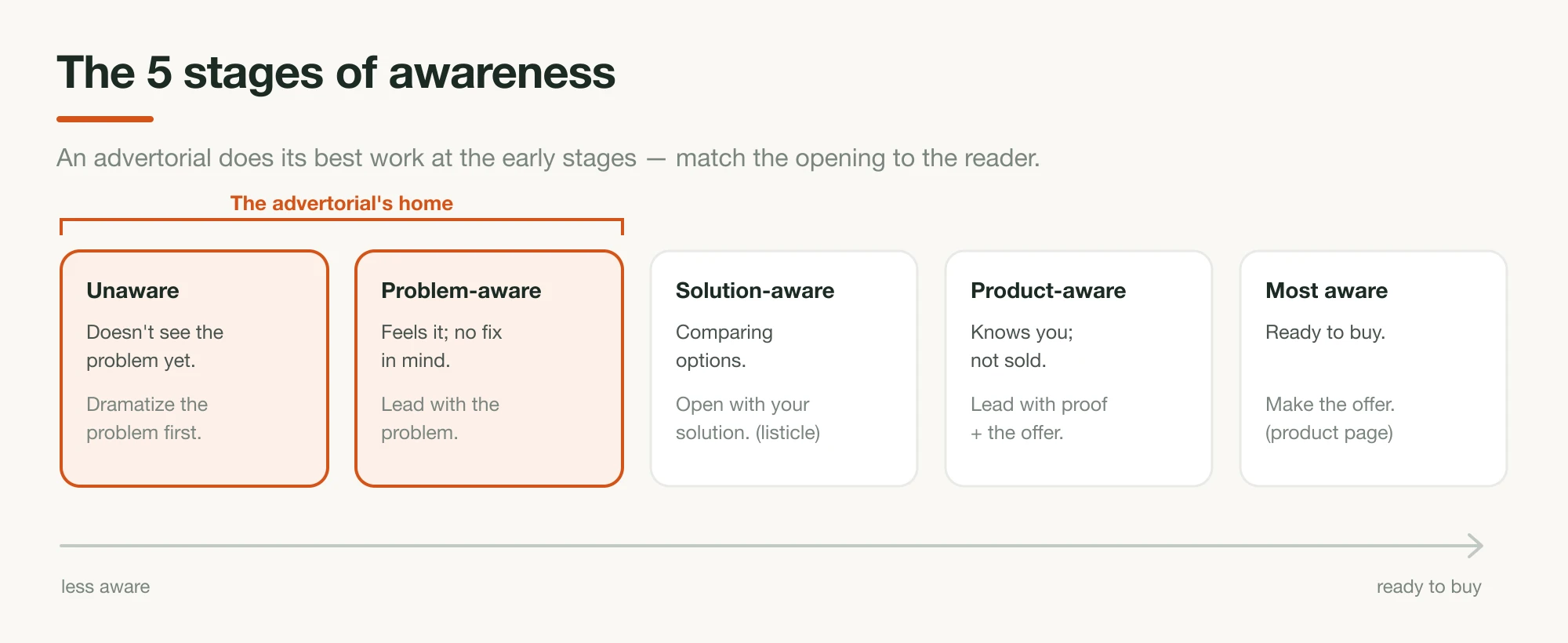
The most common AI-advertorial failure is copy pitched at the wrong reader: a product pitch written for someone who doesn't yet know they have the problem. Eugene Schwartz's five stages of awareness is the fix, and it works as a prompt constraint because it tells the model where the copy must start. A problem-aware reader gets a problem-led open with the product arriving late; a solution-aware reader gets a "why this approach beats the alternatives" open. Public prompt collections almost never include this, and it's the difference between an advertorial and an essay.
The reader is PROBLEM-AWARE: she feels the problem daily and can describe
it in her own words, but she does not know solutions like [product
category] exist. Therefore:

- Open on the problem as SHE experiences it — not the category, not the
  product.
- Spend the first half deepening the problem and explaining WHY it
  happens (the mechanism).
- Introduce the product only after the mechanism makes a solution feel
  inevitable.
- Never assume she has heard of [brand] or [category].

If any paragraph would only make sense to someone already shopping for
[category], rewrite it for her actual stage.
Swap the block for solution-aware traffic ("open on why this approach beats [the alternatives she's comparing]") and the same brief produces a structurally different, correctly targeted page.
6. Feed real customer reviews and make Claude quote them first
Voice-of-customer is the cheapest copy upgrade that exists: your buyers have already written the emotional copy, in language the next buyer recognizes as their own. Paste reviews in bulk, and use two documented Claude techniques on top. First, put long material at the top of the prompt and the task at the bottom: Anthropic reports that placing the query at the end can improve response quality by up to 30% on long, multi-document inputs. Second, ask Claude to pull quotes before writing, which Anthropic recommends for grounding long-document tasks.
<reviews>
[paste 20–50 real customer reviews, verbatim]
</reviews>

Task, in two steps:

1. From the reviews above, pull the 10 most emotionally specific quotes —
   the ones where a customer describes the problem or the result in
   vivid, personal language. List them.

2. Write the advertorial from my brief, using those quotes two ways:
   (a) up to 3 quoted directly as testimonials (verbatim, attributed the
   way the review platform shows them), and (b) the rest as raw material —
   borrow their vocabulary and specifics for the body copy, so the page
   sounds like the customers, not like marketing.
Step 1 isn't busywork; making the model extract the evidence first measurably changes what it writes from.
7. Ban the tells
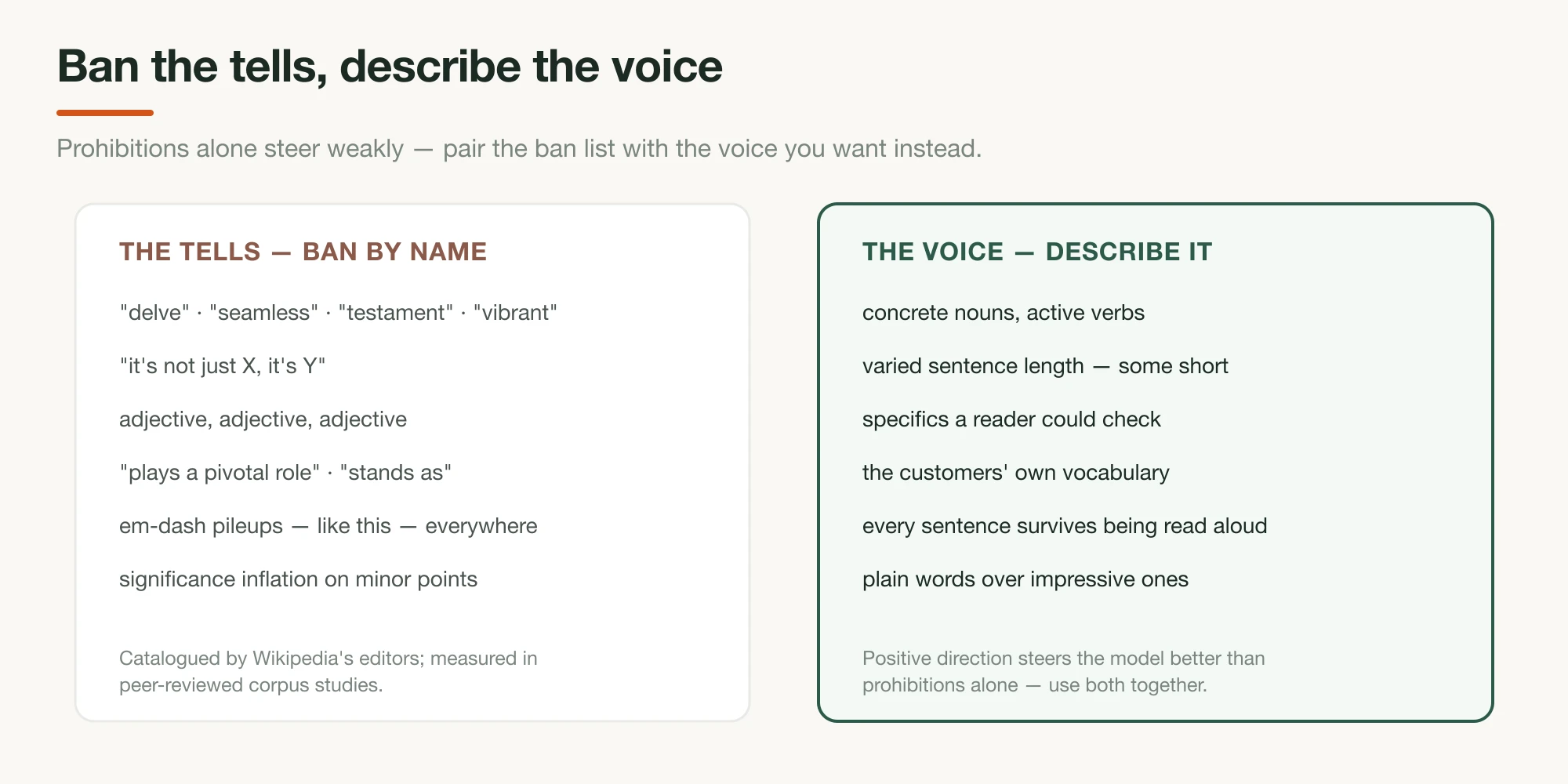
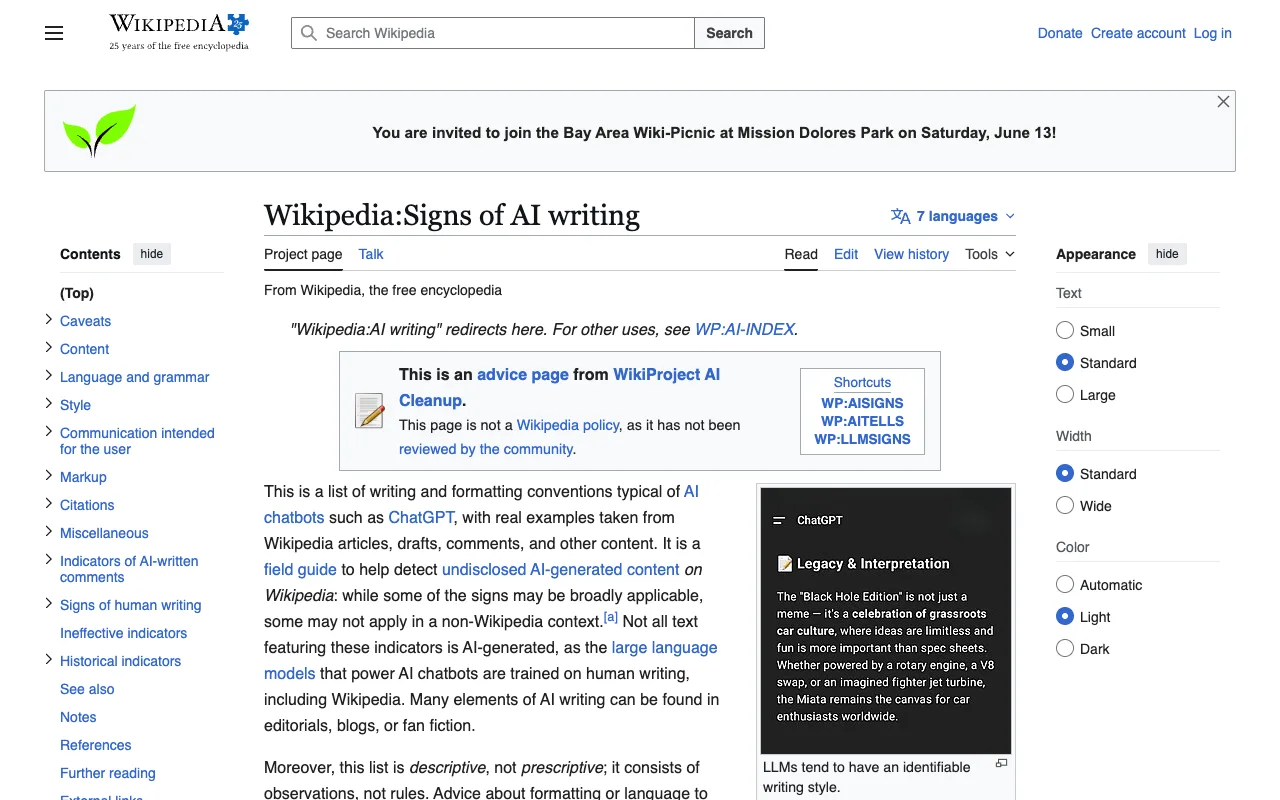
AI prose has recognizable tics, and they're documented well enough to ban by name. Wikipedia's editor-maintained Signs of AI writing page catalogs them: overused vocabulary ("delve," "intricate," "testament," "vibrant"), negative parallelisms ("it's not just X, it's Y"), rule-of-three adjective stacks, significance inflation ("plays a pivotal role"), and em-dash pileups. The pattern is real, not folklore. A COLING 2025 study measured the overrepresentation of words like "delve" in LLM text, and a 2025 Science Advances analysis of 15 million paper abstracts found at least 13.5% of 2024 abstracts showed signs of LLM assistance, detected through exactly this excess vocabulary. One craft note from Anthropic's docs: positive direction ("write like X") steers better than prohibitions alone — so describe the voice you want and ban the tells.
Voice: write like a sharp feature writer for a consumer magazine —
concrete nouns, active verbs, varied sentence length, plain words over
impressive ones. Every sentence should survive being read aloud.

Hard bans (do not use any of these, in any form):
- "delve", "dive into", "intricate", "testament", "vibrant", "seamless"
- the construction "it's not just X, it's Y" or "this isn't about X —
  it's about Y"
- three adjectives in a row
- more than one em-dash per paragraph
- "plays a vital role", "stands as", "in a world where"
- any sentence that could end with an exclamation point

After drafting, scan your own output for these patterns and rewrite any
paragraph that contains one.
8. Demand specifics a reader could check
Generic claims are the other half of the AI-copy smell. Direct-response craft has always run on specificity (concrete numbers, named details a reader could falsify), and that lesson is old enough to predate AI by a century; it's the spine of direct-response copywriting. Practitioners building public LLM copy systems encode it directly: the Boring Marketer's open-source direct-response skill file instructs the model to prefer "$47,329" over "over $1,000": exact beats round, checkable beats vague. Run this as a rewrite pass on any draft:
Go through the draft and flag every vague claim — anything a skeptical
reader couldn't verify or picture: "high quality", "amazing results",
"thousands of happy customers", "works fast".

For each one, either:
(a) replace it with a specific from <brand_context> or <reviews> (a
    number, a timeframe, a named ingredient and what it does, an exact
    review count), or
(b) if no specific exists to back it, DELETE the claim entirely.

Do not invent specifics. A weaker true sentence beats a stronger
unverifiable one.
That last rule is the legal one as well as the persuasive one: a model told to be specific without being told "don't invent" will happily fabricate a statistic, and a fabricated claim on a paid page is an FTC problem, not just a quality problem.
9. Run a second pass: make Claude critique its own draft
Never ship the first output. Anthropic's docs describe self-correction as the most common prompt-chaining pattern (generate a draft, review it against criteria, refine) and suggest appending an explicit self-check ("before you finish, verify your answer against [criteria]"). The craft insight is that the critique works best as a separate message with a named checklist, so the model evaluates instead of defending. SEO agency Screaming Frog's copy team works the same way, using AI to interrogate drafts ("is there any content in the below passage you would consider irrelevant…") rather than only to generate them.
You are now the most skeptical reader of this draft: a cold visitor who
clicked an ad and trusts nothing. Review the advertorial against this
checklist and score each item pass/fail with a one-line reason:

1. Could I tell what the reader's problem is from the first two
   sentences alone?
2. Does the product stay out of the first half?
3. Is there a mechanism — a WHY this works — or just claims?
4. Is every number and claim traceable to the brief? List any that
   are not.
5. Does every section answer an objection I'd actually raise?
6. Is there exactly one call to action, repeated?
7. Read the headings alone: do they tell the story by themselves?

Then rewrite ONLY the failing sections.
10. Load your brand once with a Project
Re-pasting brand context into every chat is the friction that kills the whole workflow, and claude.ai's Projects feature removes it. Per Anthropic's documentation, a Project holds a persistent knowledge base (upload your brand facts, review exports, winning ads, past advertorials) plus standing project instructions that apply to every conversation in it — and as of June 2026, Projects are available on every plan, with free accounts able to create up to five. Set it up once and prompts #1–#9 shrink to short task messages, because the context and the constraints already live in the Project.
[Project instructions — set once:]

You write direct-response advertorial and listicle copy for [brand].
Default reader: [your core customer, described specifically]. Default
traffic: cold paid social. Always: one CTA per page, problem-led
structure, specifics over superlatives, claims only from the knowledge
base. Never: [your banned-phrase list from prompt #7], invented
statistics, naming the product in the first third of an advertorial.

[Knowledge base — upload:]
- brand + product facts sheet
- 50+ raw customer reviews
- your 3 best-performing pages or ads
- your offer details and guarantee terms
The patterns behind the prompts
Read across the ten and three patterns do most of the work. Context beats cleverness: the brief, the reviews, the brand facts (#1, #4, #6, #10) move quality more than any wording trick. Constraints beat adjectives: named bans, named stages, named registers (#3, #5, #7) steer better than "make it engaging." Editing beats generating: the specificity pass and the self-critique (#8, #9) are where a usable draft becomes a publishable one.
Those patterns are model-agnostic, which is why this list will outlive any particular model release. They're also, not coincidentally, the same disciplines a good human copywriter applies; the prompts just make them explicit enough for a machine to follow.
Where to start
If you only adopt three of these, take #1 (the real brief), #6 (voice-of-customer grounding), and #9 (the self-critique pass); they're the trio that moves quality most, and each one compounds the others. Then put the workflow inside a Project (#10) so the setup cost is paid once.
For the full pipeline these prompts slot into (structuring the copy as a page, generating the images, publishing, and the compliance pass), see the end-to-end guides: how to create an AI-generated advertorial and how to create an AI-generated listicle. And if you'd rather the whole discipline ran as software, that's what Landra is.
Frequently asked questions
Can Claude write a good advertorial?
Yes — if you brief it like a freelancer, not a search box. Claude produces strong long-form direct-response copy when you give it real brand facts, customer reviews, a named audience and awareness stage, and explicit style constraints. A bare "write an advertorial for my product" prompt produces the generic copy AI is infamous for.
Do these prompts work with ChatGPT too?
Mostly, yes. The techniques — context-first briefing, voice-of-customer grounding, banned-phrase lists, self-critique passes — are model-agnostic. A few details are Claude-specific: XML-tag structure is a documented Anthropic recommendation, and Projects are a claude.ai feature. The equivalents elsewhere are similar but not identical.
What is the best Claude model for advertorial copywriting?
Use the most capable model you have access to for creative drafting. As of June 2026, Anthropic's flagship is Claude Fable 5, with Opus 4.8 and Sonnet 4.6 below it. Long-form persuasive writing benefits from stronger models; quick rewrites and critique passes run fine on cheaper ones.
How do I stop AI copy from sounding like AI?
Three moves: feed it real customer language to write from, give it 3–5 examples of copy whose register you want matched, and explicitly ban the recognizable tells — words like 'delve,' negative parallelisms like 'it's not just X, it's Y,' rule-of-three adjective stacks, and em-dash pileups — while describing the voice you do want.
How much does Claude cost for writing marketing copy?
As of June 2026, claude.ai has a free tier, a Pro plan at $17/month billed annually ($20 monthly), and higher-usage Max plans from $100/month. Free accounts can create up to five Projects, which is enough to set up the brand-context workflow described here for one or two brands.
Does an AI-written advertorial still need an ad disclosure?
Yes. Who (or what) wrote the page changes nothing about disclosure: a paid advertorial must be clearly labeled as advertising regardless of authorship. The FTC standard applies to the page, not the writer. See our guide to advertorial disclosure and FTC compliance for placement and wording.