
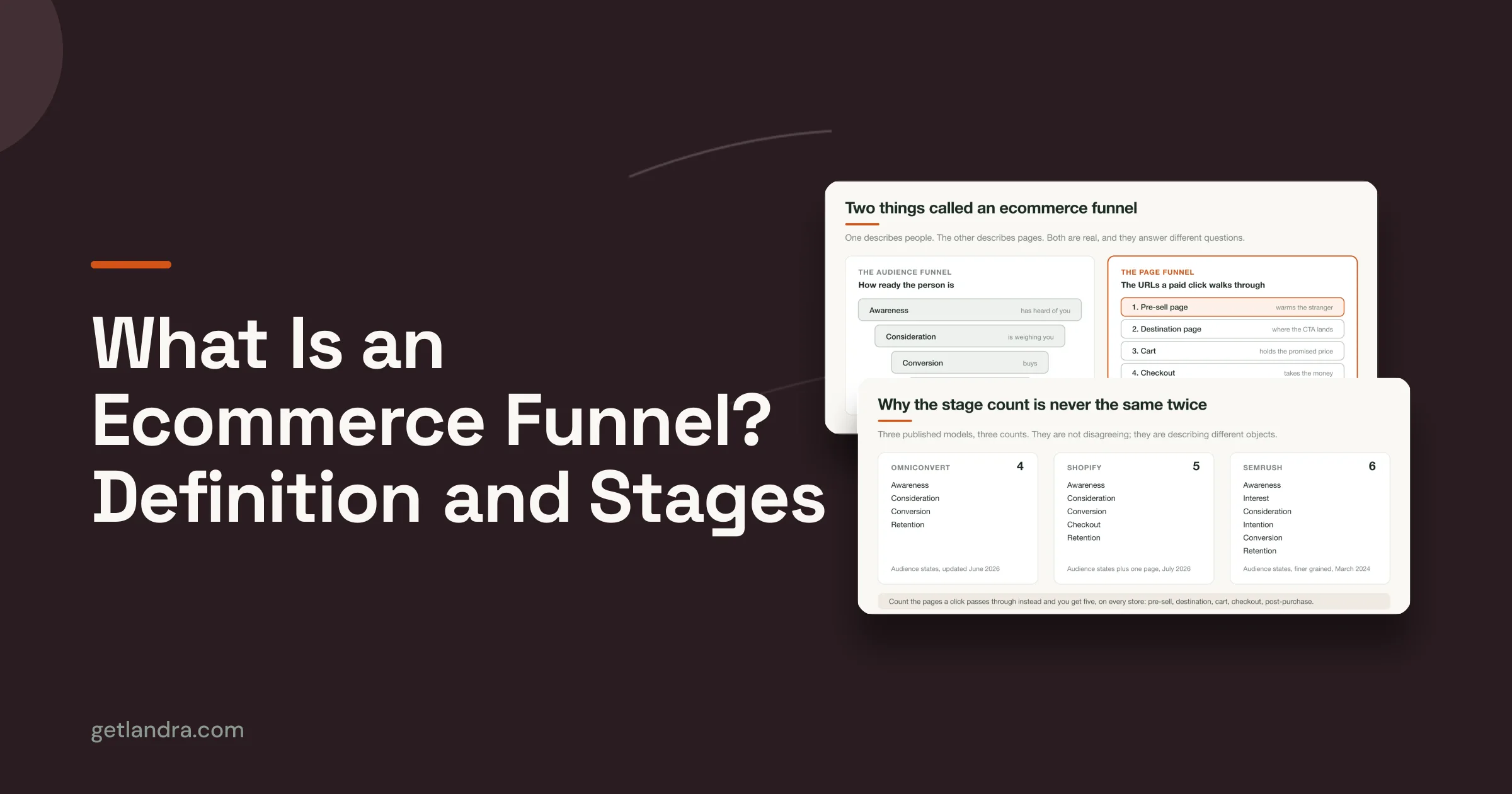
Two people can say "ecommerce funnel" in the same meeting and mean completely different things, and both of them are right. One means the stages a buyer passes through in their head, from never having heard of you to buying again. The other means a specific chain of URLs: the page the ad points at, the page its button points at, the cart, the checkout, the offer after payment.
That ambiguity is baked into the term, and it is the reason the definitions you find rarely agree on how many stages a funnel has. This page defines the word, separates the two things it names, reconciles the stage counts with their sources, and points at where the thing actually leaks.
What is an ecommerce funnel?
An ecommerce funnel is the path from a stranger meeting your brand to a paid order, split into stages so you can see where people drop out. The name comes from the shape: many people enter at the top, fewer survive each step, and a small number come out the bottom as customers.
The word covers two different objects, and they are worth keeping apart:
- The audience funnel. Stages of how ready the person is: awareness, consideration, conversion, retention. It describes people, not pages. This is what almost every published definition of the term means.
- The page funnel. The sequence of URLs a click actually walks: pre-sell page, destination page, cart, checkout, post-purchase offer. It describes things you can build and change this week.
Most people typing the term into a search box mean the first one. Most people who need to fix a funnel need the second one. A reader state is not editable. A page is.
Ecommerce funnel vs sales, marketing and conversion funnel
Ecommerce funnel is the umbrella term, and sales funnel gets used interchangeably with it. Marketing funnel names the acquisition half. Conversion funnel is the same path read as site events. Page funnel is the chain of URLs a click walks. Five names, four different objects, and sorting them once removes most of the confusion the term causes.
| Term | What it actually describes | Where it gets used |
|---|---|---|
| Ecommerce funnel | The umbrella term. Usually people, from first discovery through repeat purchase | Strategy decks, agency proposals, most published guides |
| Sales funnel | The same path end to end, drawn as stages of buyer readiness | Used interchangeably with "ecommerce funnel" in practice |
| Marketing funnel | The acquisition half. How strangers find you and warm up before any offer | Media planning, content and paid social teams |
| Conversion funnel | The same path measured as site events: session, product view, add to cart, begin checkout, buy | GA4, Shopify analytics, anything with a drop-off report |
| Page funnel | The literal chain of URLs a paid click walks through | Media buyers, CRO, anyone editing a page on a Tuesday |
The practical difference is who owns each one. The audience half is increasingly the ad platform's: Meta's own documentation says that "for new campaigns, Advantage+ audience is automatically applied if it's available, unless you create an Advantage+ sales campaign" (Meta, Advantage+ audience, read 3 September 2026). It moves the work. You still choose the creative, the offer and the budget, and after the click every page belongs to you.
How many stages does an ecommerce funnel have?
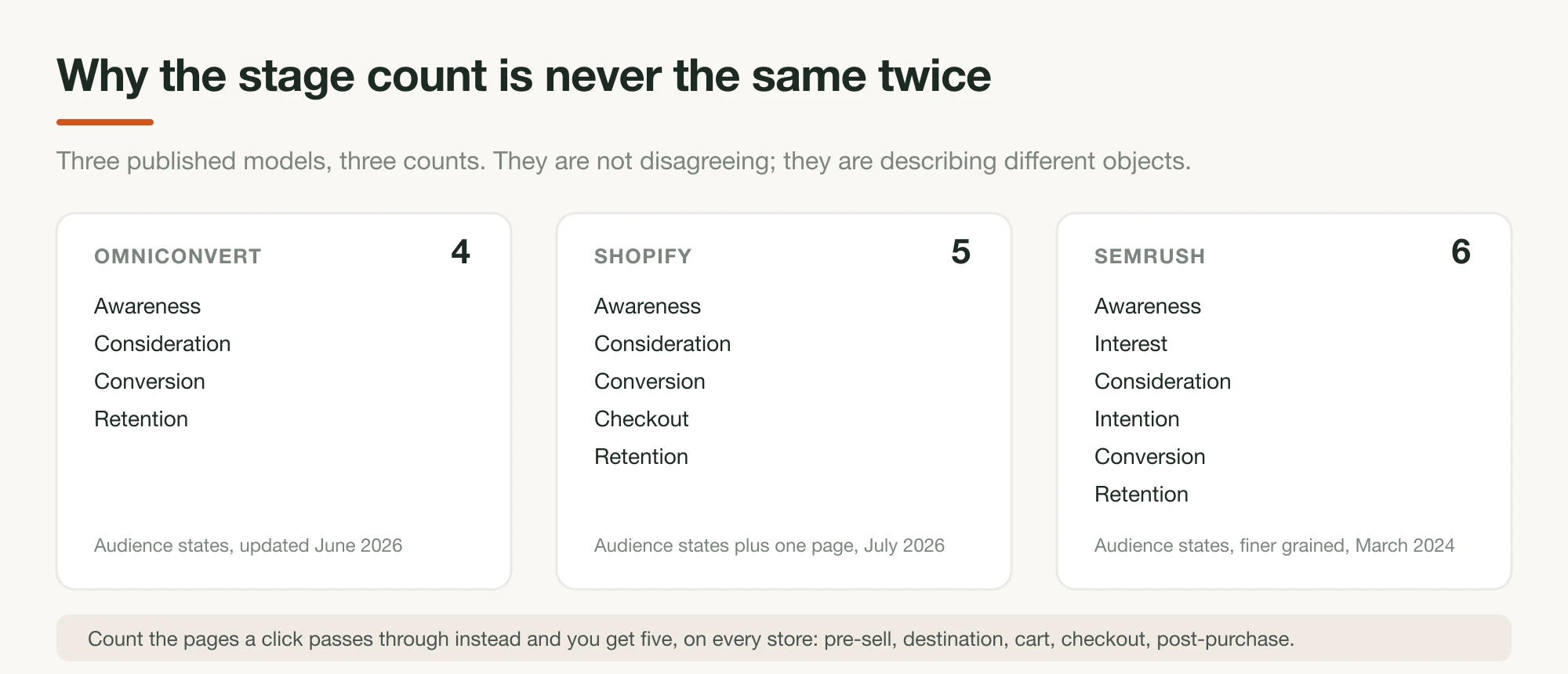
Four to six, depending on which source you open. Four of the guides ranking for this term define the funnel in near-identical language and then disagree on how many stages it has, which is the most confusing thing about the topic for anyone who reads more than one of them. All four read on 16 September 2026.
| Source | Stages | How it defines the funnel |
|---|---|---|
| Shopify (Elise Dopson, 2 July 2026) | 5: awareness, consideration, conversion, checkout, retention | "the full customer journey from discovery to repeat purchase" |
| Omniconvert (upd. 5 June 2026) | 4: awareness, consideration, conversion, retention | "the path a customer takes from first discovering your brand to buying and beyond" |
| Semrush (21 March 2024) | 6: awareness, interest, consideration, intention, conversion, retention | "a framework that describes how people turn from prospects to customers" |
| Yotpo (upd. 7 April 2025) | 4: awareness, consideration, conversion, post-purchase | Uses "marketing funnel" and "conversion funnel" interchangeably |
None of them is wrong. They are counting different objects. Audience states compress or expand depending on how finely you want to slice intent, which is how Semrush gets six stages out of the same journey Omniconvert draws in four. Site events are dictated by what your analytics actually records. Pages are dictated by what exists on your store. Shopify's five includes checkout as its own stage because checkout is a page; Omniconvert's four does not because checkout is not a state of mind.
So the useful question is never "how many stages should my funnel have." It is "what am I counting." Pick one object, name your stages after it, and keep every report in that vocabulary. A team that mixes reader states and page events in the same dashboard will argue about numbers that were never comparable.
The five pages you actually build
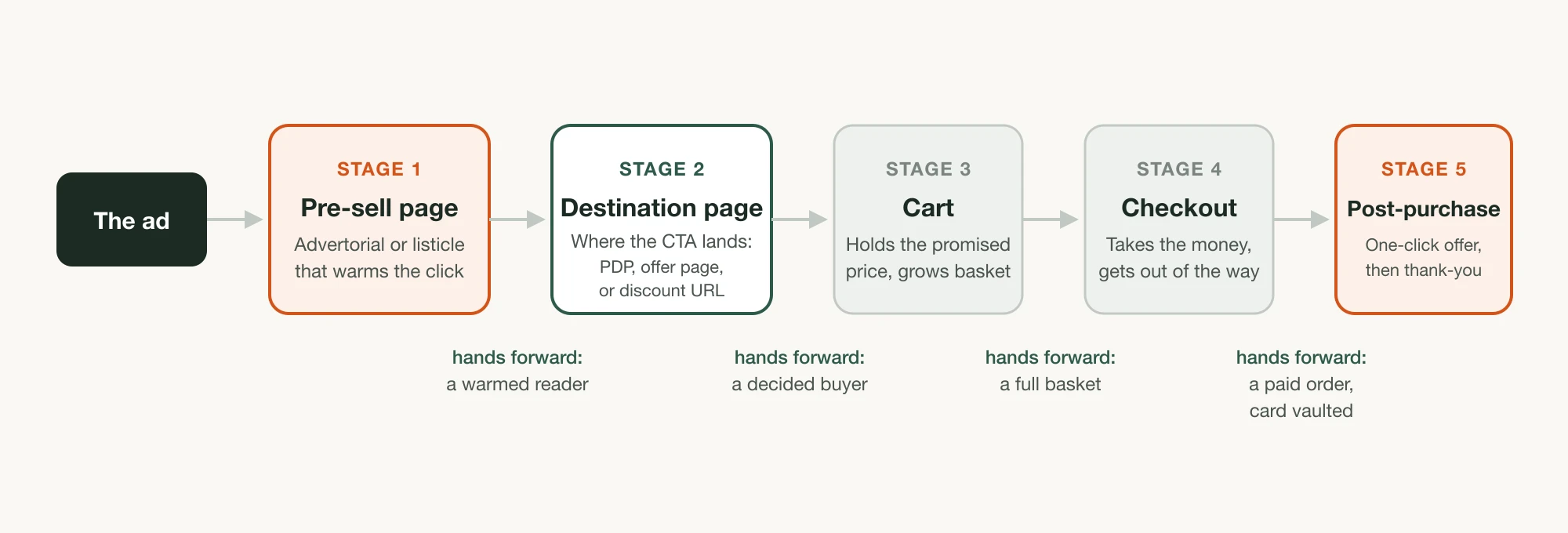
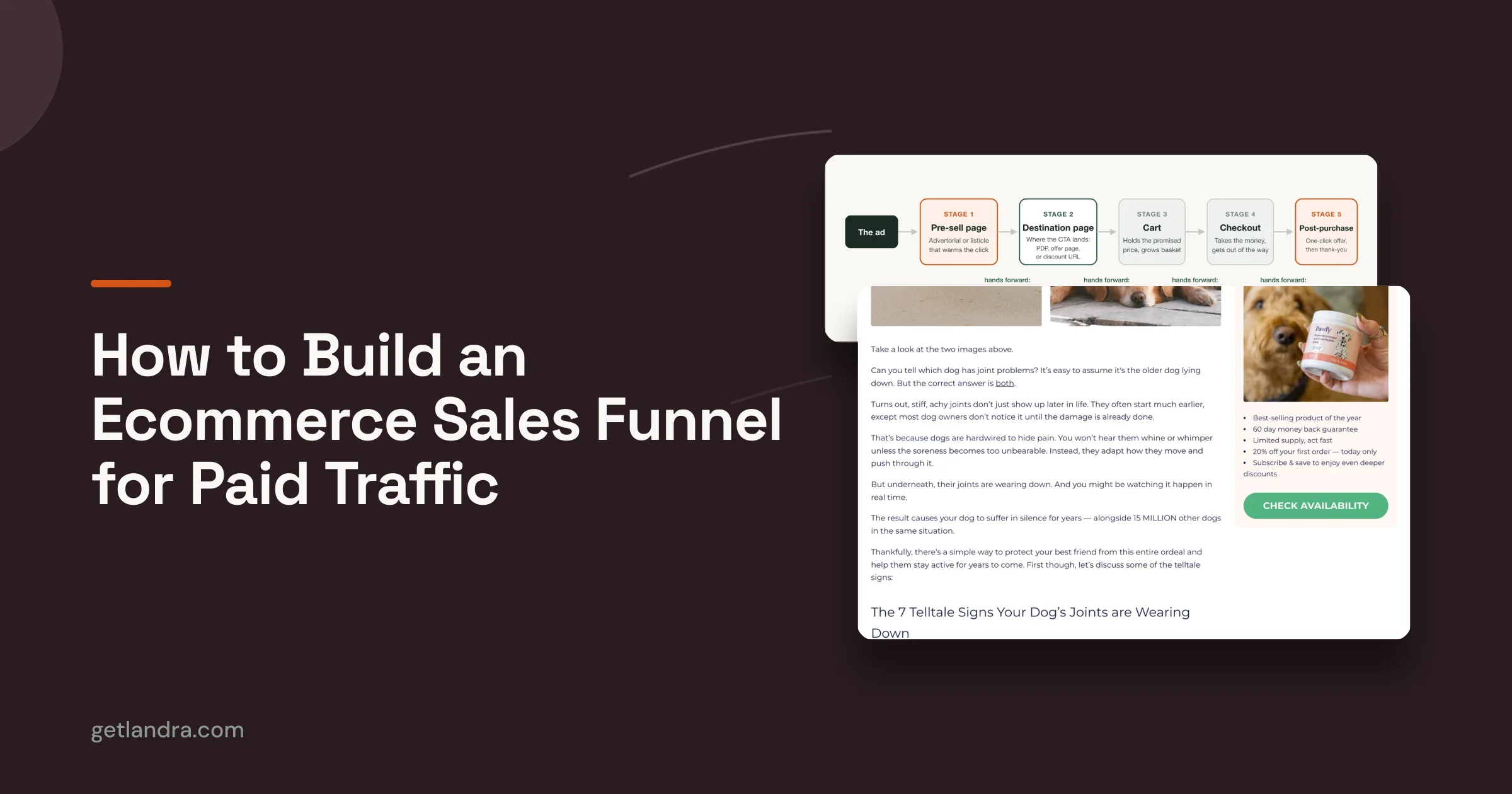
A paid-traffic page funnel has five stages: the pre-sell page that warms the cold click, the destination page its CTA points at, the cart, the checkout, and the post-purchase offer after payment. Four of the five already exist in some form on any Shopify store (the one-click offer itself needs an app). Only the pre-sell page has to be written, and only the destination has to be chosen.
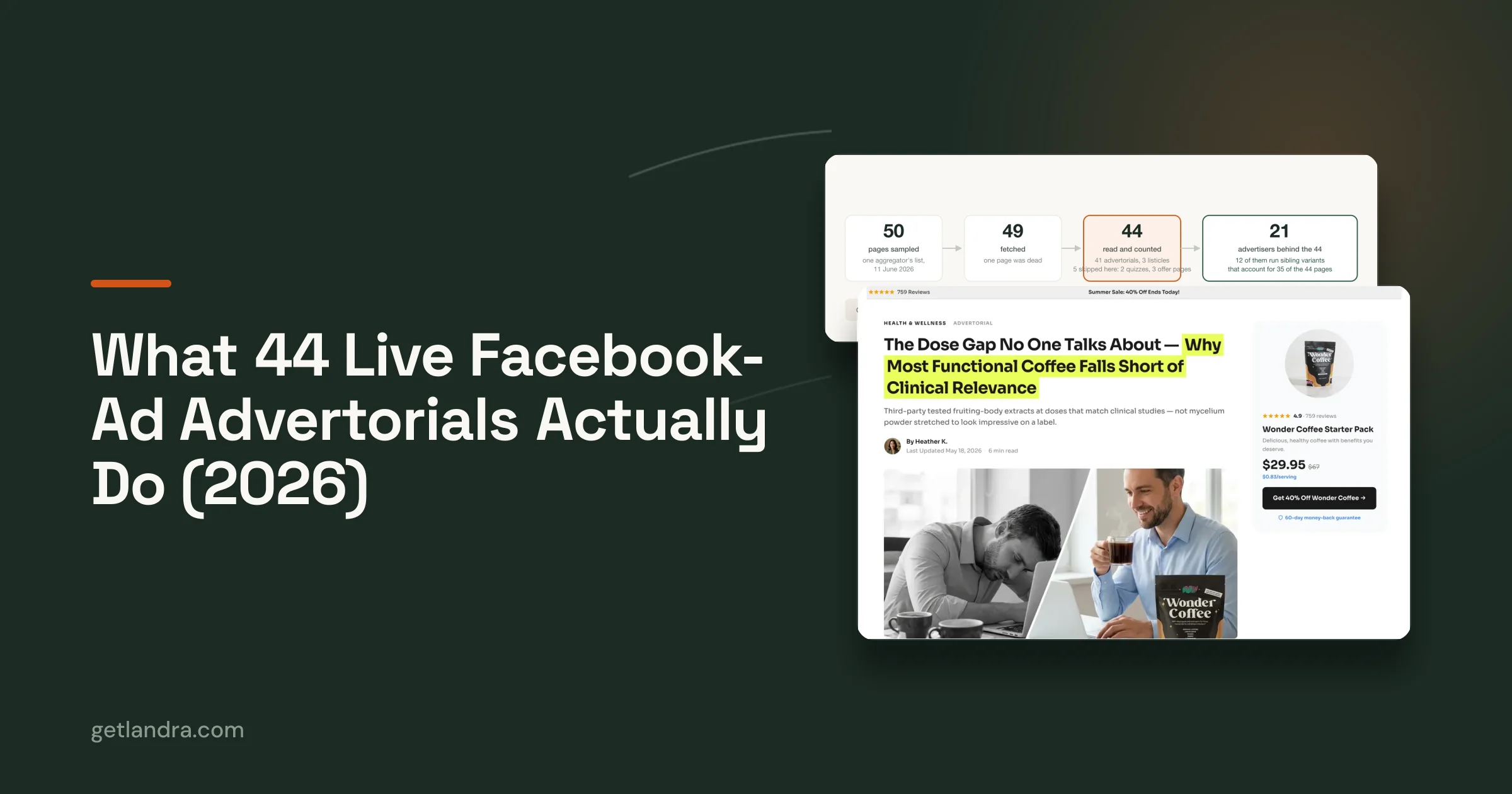
That asymmetry is the whole reason the page funnel is worth drawing separately. Three of the five are configuration on a store you already have, the destination page exists but still has to be chosen, and only the pre-sell page has to be written. In our own corpus of 44 live Facebook-ad advertorials, 22 of the 27 pages whose destination we recorded sent the click back to the brand's own store rather than into a funnel platform's checkout, which is why stage two is a decision and not a default. We wrote the full build, stage by stage, in how to build an ecommerce sales funnel for paid traffic, including what each stage owes the next one and the single number that tells you it is working. This page will not repeat it.
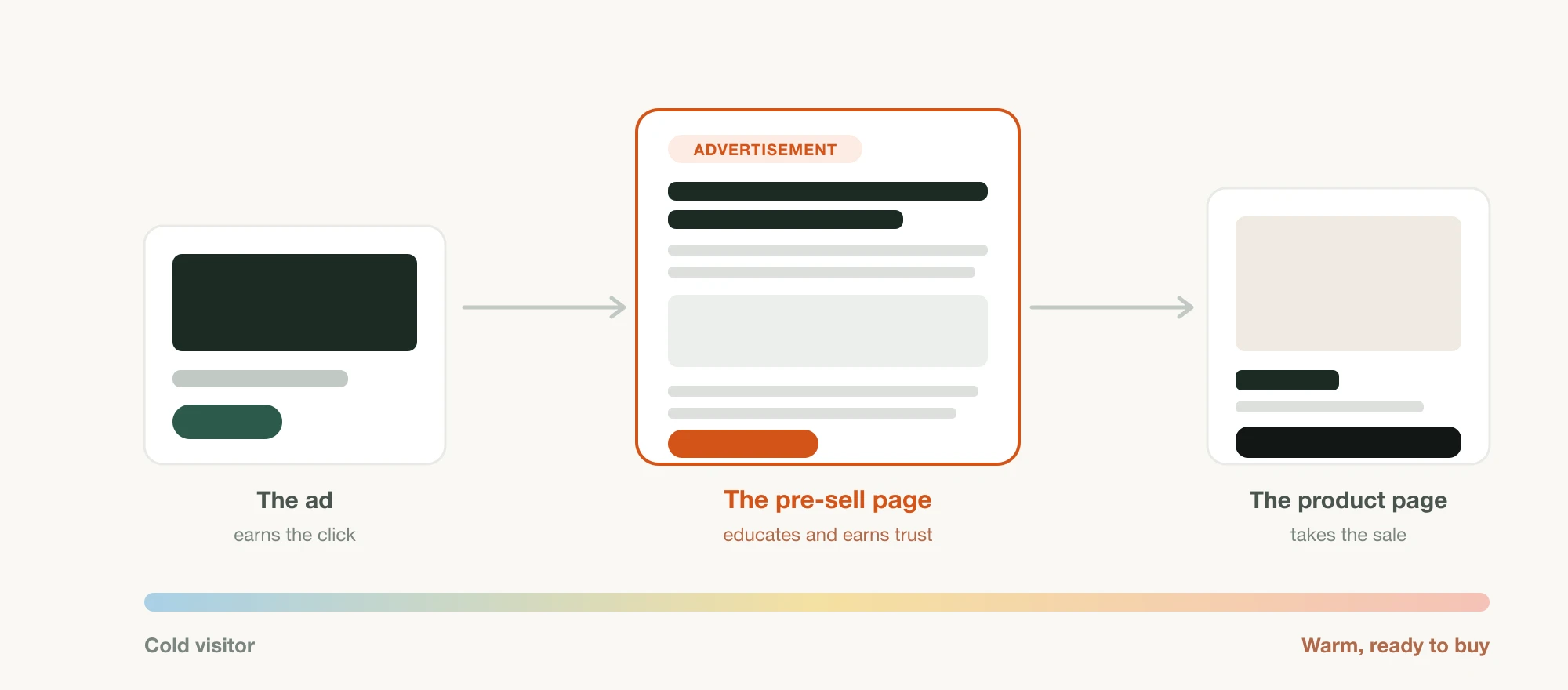
Stage one is the one nobody hands you. A pre-sell page is the page between the ad and the offer whose only job is to change the reader's state, and it takes one of two dominant formats: the advertorial, a flowing editorial article for a reader who needs the full story first, or the listicle, scannable numbered reasons for a reader already weighing options. Writing one by hand is most of a working day per angle, and you want several angles.
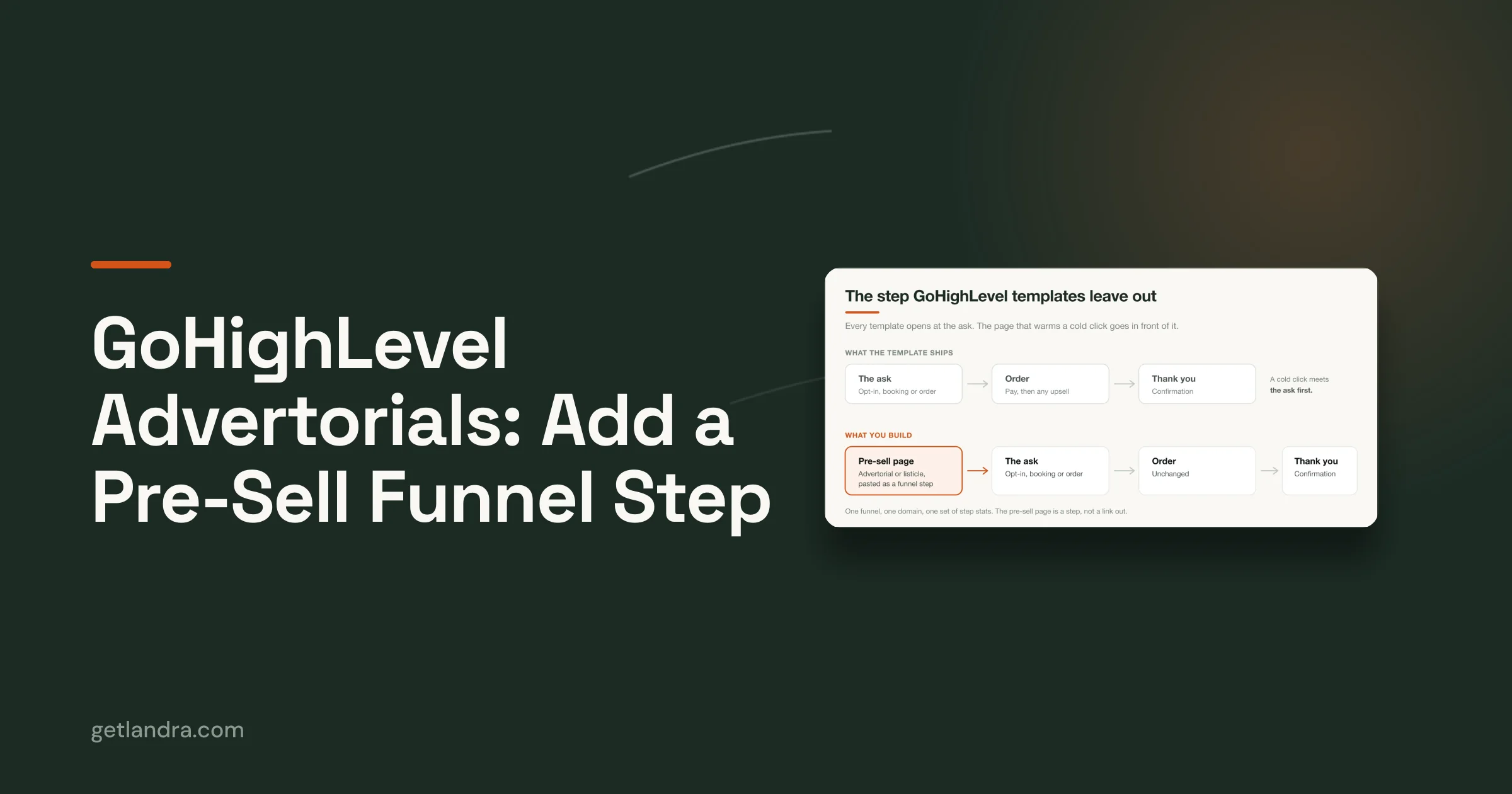
That is the page Landra builds for you. Hand it your brand URL and name the buyer you are chasing. It reads the brand and the catalogue behind that URL, decides the angle, and writes the whole conversion-optimized advertorial or listicle around it: headline, section order, long-form copy and images, laid out mobile-first in DTC conversion components you can click and edit, then published straight to Shopify or a Landra URL or an HTML export. It builds stage one and sets the link that decides stage two. It does not do your cart, your checkout, or the post-purchase slot.
Where the funnel leaks
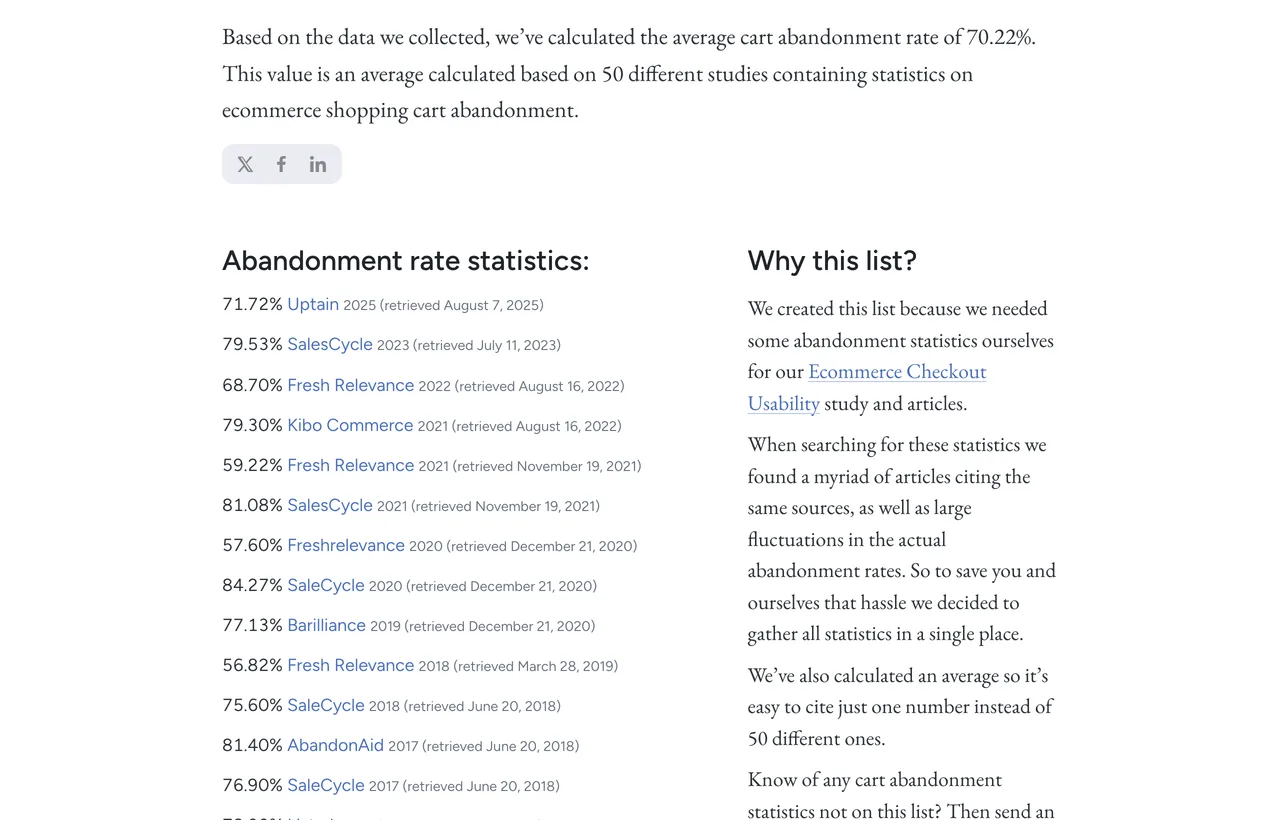
Checkout is the most measured leak in ecommerce. Baymard Institute puts the documented average cart abandonment rate at 70.22%, across 50 studies spanning 2006 to 2025 (read 16 September 2026). Roughly seven in ten people who put something in a basket never finish paying for it.
Read it as the size of the leak. It is not a target to hit. It is an average across published studies of different sites, in different categories, in different years. Your own checkout completion rate against your own baseline is the only version of that number worth optimizing, and the same applies to every other stage.
The leaks before checkout are larger and much quieter, because someone who bounces off an ad click leaves almost no event behind to count. Cold traffic is most of what a paid funnel carries: Contentsquare's 2026 Digital Experience Benchmark, built on 99 billion sessions across more than 6,500 sites from Q4 2024 to Q4 2025, puts new-visitor conversion at 1.7% against 2.9% for returning visitors (read 3 September 2026). A first-time stranger converts at a bit over half the rate of someone who already knows you, and stage one of the page funnel exists to close that gap.
If you want realistic targets before you set one, we keep DTC landing page conversion benchmarks with every figure sourced, dated, and labelled with what it actually measured.
Where the term comes from

The funnel idea is more than a century old and predates ecommerce by most of that century. It descends from AIDA (attention, interest, desire, action), a model of how an advertisement moves a reader, commonly credited to E. St. Elmo Lewis in 1898, though a 2023 paper in the Proceedings of the Conference on Historical Analysis and Research in Marketing argues the attribution rests on weak evidence (Iwamoto, PCHARM Vol. 21, 2023).
Every modern stage list is a descendant. Awareness is attention. Consideration collects interest and desire. Conversion is action. Retention is the part ecommerce added, because a subscription brand makes its margin on repeat orders, not the first one.
Knowing the lineage explains the disagreement in the table above. Those stage lists are edits of one inherited model, adapted by different writers for different jobs, which is exactly why no two of them line up and why arguing about the right count is a waste of an afternoon.
Related terms
Eight terms circle the same idea, and each one carries a distinction worth keeping. Three of them name the same path from a different end. Two are shorthand borrowed from older models. The rest name a specific piece of the page funnel: the page that warms a stranger, the offers after payment, and the number the whole model exists to expose.
| Term | What it means |
|---|---|
| Sales funnel | The same path end to end, usually drawn as stages of buyer readiness. In ecommerce, used interchangeably with "ecommerce funnel." |
| Marketing funnel | The acquisition half, how strangers find you and warm up. Shopify draws the line at conversion focus; Yotpo uses the words as synonyms. |
| Conversion funnel | The same path measured as site events: session, product view, add to cart, begin checkout, purchase. The analytics view. |
| TOFU / MOFU / BOFU | Top, middle and bottom of funnel. A three-bucket shorthand for awareness, consideration and conversion. |
| AIDA | Attention, interest, desire, action. The century-old model every modern stage list descends from. |
| Pre-sell page | The page between a cold ad and the product page whose only job is to warm a stranger. Stage one of the page funnel. See what a pre-sell page is. |
| Post-purchase funnel | Everything after payment: the one-click offer and the thank-you page. Shopify allows only one post-purchase app per merchant (read 2 September 2026). |
| Funnel drop-off | The share of people who leave between two stages. The number the whole model exists to expose. |
If the funnel you care about is the one made of pages, start at stage one and work forward: what a pre-sell page is, then pre-sell page versus product page if you are still deciding whether you need one, then the full paid-traffic funnel build.
Frequently asked questions
Is a sales funnel the same as an ecommerce funnel?
In everyday use, yes. Most ecommerce writing uses the two interchangeably. Where published sources differ is the line between a sales funnel and a marketing funnel: Shopify separates them because a sales funnel focuses on conversion, while Yotpo uses "marketing funnel" and "conversion funnel" as synonyms. Since nobody agrees, define the words once inside your own team and move on.
How many stages does an ecommerce funnel have?
Four to six, depending on whose model you read. Omniconvert draws four (awareness, consideration, conversion, retention), Shopify five (adding checkout), and Semrush six (splitting interest and intention out of consideration). The page funnel this site teaches is five pages: pre-sell page, destination page, cart, checkout, post-purchase offer. The count matters less than using one consistently.
What is the difference between a marketing funnel and a conversion funnel?
A marketing funnel describes arrival and warming, how a stranger finds you and becomes interested. A conversion funnel describes the on-site event sequence: session, product view, add to cart, begin checkout, purchase. The first is a story about people, the second is a report you can pull from analytics. They describe the same shoppers from different ends.
What is a good ecommerce funnel conversion rate?
It moves with traffic source and visitor type more than a single blended figure can show, which is why one quoted number is close to useless. We keep the sourced, dated figures in [DTC landing page conversion benchmarks](/blog/dtc-landing-page-conversion-benchmarks-2026), including what each one actually measured. Read your funnel against its own history first, segmented to paid traffic only.
Where do most people drop out of an ecommerce funnel?
Checkout is the most measured leak. Baymard Institute puts the documented average cart abandonment rate at 70.22% across 50 studies spanning 2006 to 2025. That is an average across published studies, so it sizes the problem rather than setting your target. Earlier stages leak too, they are just harder to see, because a stranger who bounces leaves almost no event behind.
Do I need a funnel builder to run an ecommerce funnel?
Not to start. Shopify already hands you a cart, a checkout and a thank-you page. The two stages you have to build or choose are the pre-sell page and the page its CTA points at. Tooling for the cart and the post-purchase offer is a later purchase, and there is a [roundup of those tools](/blog/shopify-funnel-builders) for when you get there.